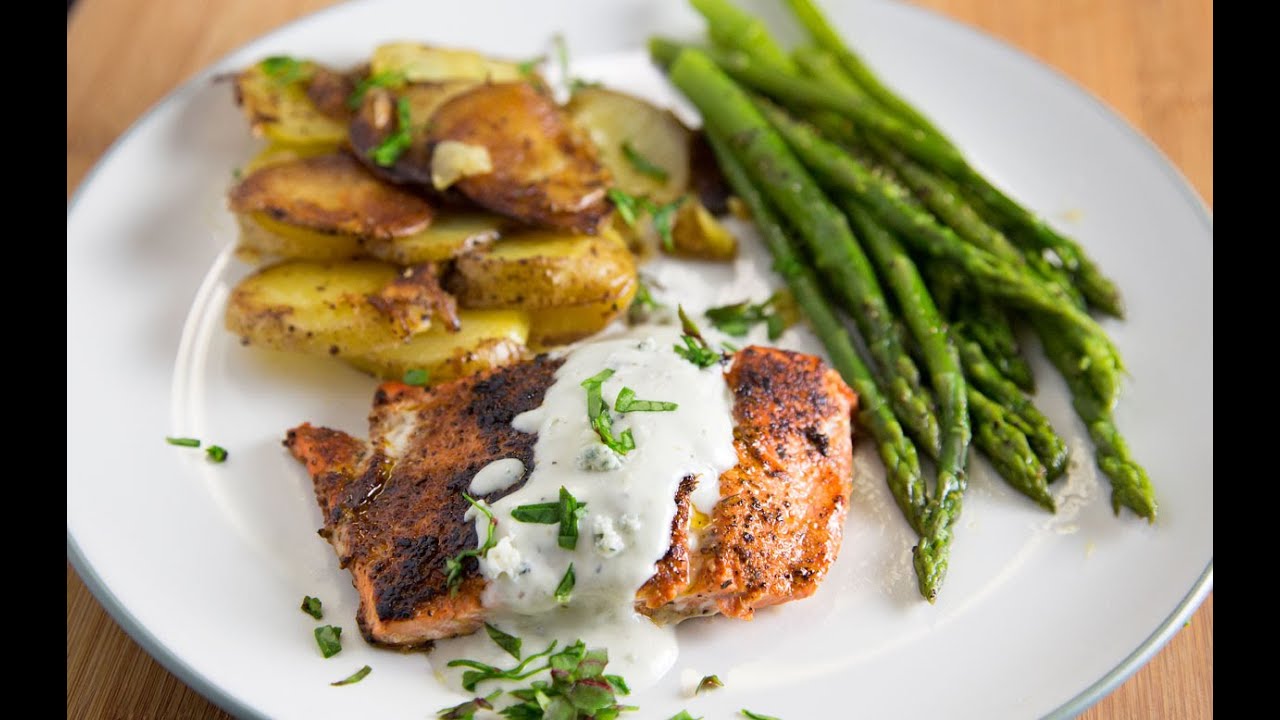
In this cooking tutorial, Chef Dennis Littley demonstrates how to prepare blackened salmon and a simple gorgonzola cream sauce. He begins by showing a precise knife technique for removing salmon skin, emphasizing the use of a sharp boning or French knife and an angled cut to pull the skin off cleanly. He then seasons the fillet with Paul Prudhomme’s Cajun Magic (and mentions Montreal seasoning as an alternative), explaining why he prefers ready‑made blends over custom mixes. The salmon is blackened in a very hot pan with a thin layer of oil, seared briefly on one side, then transferred to a baking pan with a splash of water (and optional olive oil) and finished in a 350 °F oven for 12–15 minutes to retain moisture. He discusses the purpose of the water, likening it to cooking fish in its natural environment. After the fish is cooked, he prepares a quick gorgonzola cream sauce by heating cream, adding crumbled gorgonzola, and adjusting thickness with a touch of white wine, water, or more cream; he also offers alternatives such as Greek yogurt, dill, tarragon, or ranch dressing. The dish is finished with a garnish of green onions or chopped greens. Throughout, he shares practical tips—how much seasoning to use, avoiding over‑cooking, handling smoke, and serving ideas like salmon bites, salads, or hors d'oeuvres—while responding to viewer comments about skin retention and fish choices.
Chapters
I'm just going to show you real quick how to skin something off. You could cook it with the skin on, and a lot of times the skin will almost come off of it when you go under it with a spatula to get it out of the pan, but I don't like to take a chance. I don't want to see the skin. Some people eat it. That's fine. I wouldn't serve my guests that, and I don't really eat it. Not that it's bad for you. It's just aesthetically, as a chef, that's how I was trained.
Yeah, I mean, when I cook my salmon and I sear it and then I finish it in the oven, it just naturally, as I, you know, take forkfuls of the salmon, the skin naturally separates.
Yeah, it comes off. And a lot of times when you go under it, you'll— it'll come right off for you too. It's not something I would do as I'm serving it. It's either if it's not off before, they're gonna get it however it is. But this is pretty easy to do. So let me switch cameras real quick.. And what you do when you have a salmon like this— now I already started it, but the skin will be here, so I like to come under here a little bit and just work the knife in, work the knife in, and just lift a little bit of the skin off.
You need a super sharp knife, I think.
Generally, you know, it'll be the sharpest knife in your kitchen. A boning knife is usually good, but I use a French knife for everything. So then as you go under it with your knife, you're going to grab a hold of the skin.
Okay.
Okay, you're going to take your knife, you're going to grab a hold of the skin, and you're going to put your knife down to the cutting board as low as you can on the skin angle, and then you're just going to cut. You're going to hold on to that skin, and as you hold on to the skin, you're just pulling.
Oh, you make it look so easy. Look at how clean that is.
Okay.
Wow, that is unbelievable. You got that A prize for that.
That just takes a little bit of practice, but the whole trick again is when you're pulling the skin, see how this knife— I'm not cutting straight down, I'm on an angle and I'm pulling the skin towards the knife.
I see, you were pulling the skin. I didn't get that at first.
Okay, so as I'm doing it, I'm pulling the skin.
Yeah.
I'm not really like I'm cutting into it. So that's how you do it. Alright, so that is the salmon, and I did dry it off a little bit before. You see how nice and colorful it is.
Nice.
You still have a little bit, but that's not bad. All right, so from this point, I'm going to season it. And when I blacken things, I'll either sprinkle it on or I'll put it on a plate like this and just push it in. All right, let me turn the pan on because I want the pan to get hot while I'm doing this. And that's pretty much it.
So is that seasoning that you just buy at the at the store.
This is actually Paul Prudhomme's Cajun Magic.
I was going to mention Paul Prudhomme. I have some of his seasonings.
Cajun Magic for fish. You know, he makes them for chicken, he makes them for fish. And you know, I always say, why reinvent the wheel? I mean, there's people that just their whole life is seasonings. And I mean, I, as a chef, I am about seasonings. But there's people that want to combine and mix their own spices, and that's wonderful. I don't really do that because I don't cook things like that that often. So I want it to be simple. I want it to be easy. I want to enjoy it. So I have spices I can trust. I always recommend Montreal. I love that for meats.
Oh yeah.
So this is great for fish and we enjoy it. It's not got a lot of heat to it, so it's not going to kick your butt when you eat it. It's got enough that it's going to add some flavor. And again, the more you put on, the heavier you make it. The more spicy it's going to be. You can always put whatever you want, use your own, any brand.
Yeah, and it doesn't look like you put a whole lot on there. I usually put so much on there to completely cover it. That's on the light side, no?
You can. You can use as much as you want. I'm not a big spicy heat person, and neither is Lisa. We just like the flavor of it. It changes it a little bit. It gives it a good taste.. It adds some color to the dish too. A lot of times I'll use spices like this. I think I talked about it a little bit with the shrimp and the jam— etouffée was getting some color into the shrimp. While we're doing this, let's throw a few comments up. Kristen Dryzel says, "I always let the skin help keep the moisture in." Kristen, when I roast the fish, I'm always going to put a little water in the bottom of the pan with it. For me, that helps keep the moisture in. Whatever works for you is fine. If you want to take the skin, leave the skin on, that's fine, too.
We have one from— oh, yes, from Candy, who's here from Tokyo. Can you use a whitefish for this recipe, Chef?
You sure can. You can use any fish that you like. Just be gentle with it if you're going to pan fry it. Anything that you can turn— let me get a spatula while I'm saying that— just so you don't break the fish up. You can use a fillet. You can use anything you like with it. Let's go to the pan. I'm only going to put in just a little bit of oil. It is going to smoke because the pan is really hot. I was afraid I'm going to set the fire alarm off, so I'm looking around. I did that once at a school.
Oh, I just did it last week. I made pizza and it, you know, went over the pizza stone.
I was blackening some fish, I think it was salmon, for a blackened salmon salad, and I'm talking, my back's to them, and I hear people coughing, and I turn around, the room was full of smoke.— and people from the school were running in. It was a high school. They thought there was a fire. I was so embarrassed.
Now, you know, that's a good point. Do you— could you— would you prepare that blackened and put it in a salad? Blackened salmon in a salad?
Oh, absolutely. And you can also, if you don't want to go around cutting it later or want to take it quicker, You can cut it into pieces. I have taken a salmon like this and cut it into little chunks, blackened the one side and cooked them exactly like this, finished them in the oven and used them as hors d'oeuvres, as little blackened salmon bites.
Now, how are you making it in terms of the inside? Medium rare, rare?
It's how you like fish. I like my salmon to be be all the way done. I pretty much like my fish all the way done, but it's that gentle line of being cooked completely without drying out. That's something you'll have. The first time I made this, I did cook it a little too long and it was a little dry. The last time I made it, I cut the time down by about 7 minutes. I would say once you do this to it and you want to just leave it alone like that for a couple minutes. Get under it. Let's turn it.
Oh, nice.
There's a nice color. So that's what I want. Now I'm just going to let the back sear, the bottom sear real briefly. And that's just to get it a little bit done. And that's all I'm going to do. Then I'm going to take it and I'm going to put it in a— on a pan that's got water in it. And I'm going to put this in the pan and I'm going to put a little bit of water in it. And then I'm going to put it in the oven at 350 degrees. For about 12 to 15 minutes.
Okay, now tell me again why the water? So it doesn't dry out?
Yeah, the water is going to help it keep moist. If you want to, you can even take a little bit of olive oil and just drizzle a little bit of olive oil on it when you put it in that baking pan. Not that you really need it, it's an oily fish, but that will help keep it a little moist too. Whenever I put fish in the oven, I put a little bit of water in the pan. I use the philosophy, as they came from the ocean, let's let them cook in a little water too. That helps to keep moist. You can see—
Wow, that looks great. That looks great. What a good tip. That's again a life-changing tip for me.
We're just going to put this right here for now.. And now we're going to make a really simple sauce for it. I'm going to take a saucepan here, wipe it out. We're going to heat this up. Very simple. Going to use some cream. If you're adverse to using cream, if you don't want to use heavy cream but you like Greek yogurt, you could make a very simple cold sauce for this. You can go a bunch of different ways. What I like to do is I want to complement this with some kind of a sauce that will balance the flavors, that will kind of give me that, "Mmm, really," when you put it in your mouth, the different textures and flavors combine, and it's a party in your mouth kind of a thing. That sounds good. If you don't want to use cream, let's say you like nonfat Greek yogurt. Greek yogurt. Take some nonfat Greek yogurt, and you can either put some cheese crumbles in it, or you can put some fresh dill in it, or some fresh tarragon, or some other flavor that you really enjoy. Or if you just want to use a little ranch dressing, say you went this far but you're just not feeling making a sauce or anything, anything like that is a wonderful flavor variation to this and will give you those combinations that you're looking for.. But we're going to make a little bit of a gorgonzola sauce now. Again, very simple. I get the pan a little hot. I'm going to add my cream in. I'm going to get that light boil.
That looks like about a half cup.
For 2, I would say about a half a cup is good. This may be a little bit much, but it's hard to do a light amount of cream in here. I'm just going to give it up there. I'm going to turn it off a little bit. I'm going to add my gorgonzola to it.
Oh, come on, add more.
We're going to garnish it with it. One thing about this is you have to be careful with the amount of gorgonzola. Gorgonzola, or if you want to use blue cheese, is a wonderful thing. Too much of a wonderful thing is just too much flavor. It starts to be too pronounced. So you want this sauce to be good and you want it to be a little bit delicate. You saw how fast that pan was hot. I just reduced the cream just a little bit, just enough to make it thick. I have the gorgonzola in here. It looks really nice. What I'm going to do now to serve it is when I go to serve it, say I take these out of the oven, This is on the side. You can make this up ahead of time. That's fine. If it gets too thick, just add a few drops of white wine or water or a little bit more cream into it. Then I'm going to serve it with just a nice amount, just so you have enough to dip it in. I'm going to garnish it with— you can use green onions. You can use chopped greens. I used a red kale the other day. It was very pretty.
I just can't believe it. That is a weeknight meal that looks like a Saturday night company dinner. That's 3 ingredients.
Right. Unbelievable. Now granted, it has to go in the oven for about 15 minutes. That we didn't do.