How to Make Cranberry Sauce and Turkey Gravy
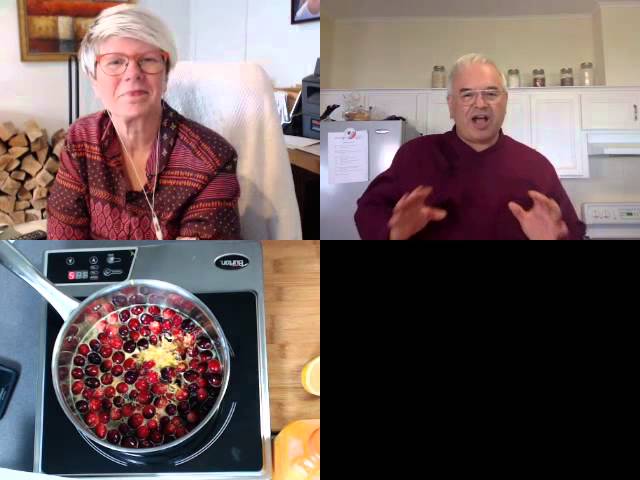
In this informal livestream, host Dennis (Speaker A) and kitchen designer Susan walk viewers through a step‑by‑step preparation of homemade cranberry sauce and turkey gravy while interweaving anecdotes from the recent World Food Championships in Kissimmee. Dennis shares his experiences meeting sponsors, tasting dishes from professional home cooks, and the logistics of large‑scale turkey production. He demonstrates a simple cranberry sauce recipe using water, tangerine juice, sugar, cranberries, lemon zest, and optional flavor additions, explaining timing and consistency. The conversation then shifts to turkey gravy, covering stock extraction, roux ratios, simmering, seasoning, and troubleshooting thickness. Susan provides a parallel discussion on kitchen design, reviewing a preliminary layout with angled shelves, drawer configurations, range placement, and visual focal points, offering practical advice on storage efficiency and aesthetic balance. The episode concludes with plans for upcoming prep weeks, including turkey brining (wet vs. dry), roasting techniques (upside‑down cooking), carving, and a future Q&A session, while also mentioning personal travel plans and upcoming content.
Chapters
so we can get going before I forget, because I will forget. And we have a few people in here. Tina is here. Hi Tina, good to see you. And who else is in the house? Let's see.
Michael, Michael T. Thomas, hello.
So if you can tell a little bird, if you haven't already, and it looks like you have, so I appreciate that. And we're going to get started. So it's really simple to make your own cranberry sauce. Let me see if I can fix this. Camera on me a little bit more too. That down— I can never remember which way is which on this when I do it. So, oh, it's not working. So that's all right, all right, we can live with it. Not a big deal. All right, so, um, Been a crazy, crazy week here. We had the World Food Championships in Kissimmee.
Yes, I saw that. So, so what was that all about?
Well, I was here, I was there. I actually went over Tuesday after our show to check it out to see what was going on, and they were setting up. And it has been in Vegas, and this is the first year they moved it to Kissimmee. Oh, Ron Snaeberger's here. Ron did help me out on Sunday, and we had a great time doing some live shows. And everything looked good. And then, Ron, when I went back to view them, I was not on any of the shows.
Oh no.
So I don't know, I don't know, me, Blab, combination of both. So, you know, I think I need to start using an iPad when I go mobile. That's all. I'm gonna have to bite the bullet since it's built— they have an iOS app. Maybe I need that app. But anyway, I was out there Thursday Friday. Saturday I went to a private event nearby that some of the sponsors, the area sponsors, were holding with some of my foodie friends, and USA Today was out there filming. So it was kind of cool, and I got to hobnob with some of the, the big personalities.
Wow. So, so people come from all over, and is it professional?
Is it, you know, it, it really isn't. They have a professional division sometimes, but this is more or less I mean, you can if you're a pro and you want to take a shot at it. And if a home cook makes you look bad, well, guess what? Home cook just made you look bad. And, you know, they're— I want to call them professional home cooks for the most part.
Yes, right. That's the whole thing.
Yeah, they're, they're cookbook authors. They're home cooks who have cookbooks. Some of my friends from the area won. Josie, I can't remember her last name, Lassig. I can't, I know that's not right, but anyway, Josie came in second. Josie had a horrific water ski accident not that long ago where she was pretty much immobilized. I think she was even partially paralyzed, and let me tell you what, she's back in action, and she took second with this beautiful seafood dish. We had the Swedish Cowboy was here, and he is a cooking show star in Sweden, and he did some of his stuff there. It was pretty cool. He didn't, but he didn't place?
So you had the Swedish chef.
Yeah, this guy. Yeah, but he was 6 foot 5 wearing the flag of Sweden around his head and he had a cowboy, like a straw hat, more than a cowboy hat. More.
Yeah, they make them. They make them big over there. They make them big over there. They really do.
But the Beefy Boys were there from England and they did a burger. They did a Mexican burger. Go figure. Some of the food. I mean, they were cutting stuff up and handing it to me because I was standing with the CEO of the World Food Championship. So I guess they thought I was one of his friends, which I did get to interview him. So I was tasting things and strangers were walking up asking for a bite of what I had, and they were offering me a bite of what they had. So it was kind of cool. You know, only in a foodie atmosphere would you do that. Anywhere else, a stranger walks up and asks for a bite, you're gonna go—
I know, no, I know, I hear you. But you know what, it's the same in my industry too. We have bloggers that are not professional designers, but Oh my goodness, do they have, you know, they have what it takes. They have an eye for it. You know, they have, they can communicate, you know, through pictures and words all about, you know, beautiful design issues. And I'm sure it's the same with bloggers too. They may not have a professional background, but I don't know, sometimes you just have it, you know.
Well, they had a blogging division. That was on Tuesday, and I didn't hear anything about that. I missed out on that completely. So I didn't even get to go— or not Tuesday, Tuesday and Wednesday. They had some kind of blogger function. And again, you know, I don't always get included on these. It's crazy.
Oh, that is surprising.
I didn't want to compete myself, but I would have liked to have been there to offer support. So that— yeah, I'm done competing. I— that dog don't hunt here no more.
I know. No, same with me. But you know what? I have a little surprise for you because because when it's the right time, you let me know. I revised, I changed some things around with your kitchen, and I want to show it here, and we'll talk about it and see where we're going.
I was going to say, to the Kenmore people, Kenmore donated like a quarter million dollars worth of equipment. Really? It's at the Kenmore Arena, and yeah, it was pretty cool. Now, you know, I said, can I back a truck up and take some stuff home? And they said, no, unfortunately, it's all going to like shelters and places. Yeah, which is— Bull, have you ever heard of Bull Grills?
Oh, that sounds familiar. No, I haven't.
Oh my God, one of the styles of the Rich and Famous Grills almost, you know. They were, they were there and they supplied a lot of things and really some really cool sponsors' equipment. A sustainable seafood guy was there from the Panhandle. They have a tag on all their seafood that you can look at with your phone and it'll tell you who the captain was that caught it. Oh my gosh, where it was caught, when it was caught.
That's crazy. That is really crazy. Well, we're gonna— yeah, once we—
let's get back into that. So let's get started for all the nice people.
Are we recording?
We're recording.
Okay, cool.
We're gonna make cranberry sauce, and cranberry sauce is— you know, I was afraid of making my own cranberry sauce for so long. I'm not an Americana cook, or I'm more of it now, but I have never been— that was never my forte. You know, I was always a sauté.
That's funny. And I've done it forever.
Yeah, it's what most people start out as. So I've been making it for years now, but at first it seemed like, why would I do it? Let me just buy that can that makes that god-awful noise when you shake it out. Oh, yeah. So anyway, we're going to start. Let me turn my pot on and I am going to start very simply. With a half a cup of water. And normally I make it with all water. But, you know, I love this.
Yes.
So I'm going to make it with a— I always put a little orange in anyway. I'm going to make it with a half a cup of tangerine juice as well. So tangerine juice is sweet, but it's not overly sweet. So I did cut down my sugar a bit and I'm going to add in about 3/4 of a cup of sugar because I don't know if you've ever eaten a cranberry raw. But oh my God, cranberries are pretty, pretty tart.
Well, you know, I'll tell you something. I have this organic, you know, food thing that I get every week delivered. And there were, there was frozen cranberries on the list to get. And I've only ever, you know, gotten the Ocean Spray. I have never gotten, you know, frozen. So I don't know.
I hope they'll be fine. Frozen or fresh, they will be fine. Cranberry is such a hearty fruit. I guess it is a fruit berry. So I'm going to put in— I have 2 cups and I do have the Ocean Spray. I bought a big bag of them at one of the big box stores. So I got them in there. And then after that, the only other thing I add in is I'm going to put in some grape. And because I did use tangerine juice, I'm going to add in a little bit of lemon. Zest. Now, to me, any citrus zest at this time, at this point, is good. And, you know, I was thinking I may make some more of this. I have a lot of cranberries, and I was thinking I might make— go get some fresh Florida grapefruit.
Look how coordinated we are! Forget the food, look at the colors. Look at these three.
I mean, so here's your zest in here.
Nice.
And you should— I love the smell. I don't know if I told you the story. Before I got married, I had a waitress that loved the smell of lemon. So whenever I use lemon, I would dab a little Oh, geez.
Wow.
And then we're going to put in a little bit of juice. So I'm going to use half a lemon. So like I said, I did cut back my sugar. You don't have to use tangerine juice or orange juice. You could just use all a full cup of water, 2 cups of berries, cup of water.
But you know, this scone is a big, like a complex layered kind of You know, flavoring. I mean, between the tangerine and the lemon zest and the lemon juice, you know, interesting. You're layering it.
And you know, this is where if you wanted to do something else, you know, you could add something into— like, some people might want to put a cinnamon stick in.
I was thinking that.
Yeah, you might want to put your own little touch in a flavoring. It's going to cook, so sometimes people add vanilla in. You want to let it get really hot before before you put it in so it doesn't cook all the flavor out. No vanilla. But, you know, again, it's your, it's your combination. It's what you're making. Now, the one thing I like to do with my leftover lemon pieces, if any of you have garbage disposals out there and you've never done this, you know, I'm sure you have, but throw your lemon, cut them up into small pieces and throw them in there. If you have an excess of them, put them in an ice cube tray with some water, freeze them. Lemon, lime, any of these rinds, cut them up small enough into ice cubes because the ice also helps. I was told help sharpen your blade, your garbage disposal.
Oh, interesting. Okay.
Makes the house smell really nice. Oh, wow. So let me grab a spoon.
You know what I thought you were going to say? I thought you were going to say put them in ice cube trays and then put them in a glass of water.
Well, you can do that too, you know, if you have a lot of them, you know, but you know, if you're handling, as long as it's your water, that's okay.
Right, right.
Yeah. If I'm handling them and squeezing them, I'm not going to give them to a guest. But, you know, definitely, you know, when guests are coming over, if I don't have a lemon cut up, I'll cut one up and just chunk it down there or a lime. Limes are wonderful or oranges.
Yep.
So I'm just going to stir this up and that's really all you need to put into it. And they're in a saucepan and we're going to let them— we're going to let it come to a boil, boil for about 5 minutes, and then I'm going to reduce it to a simmer and it's going to take about 15 minutes. So it's just about coming to a boil. And at that point, you'll start to see the berries break apart. So while we're waiting for that, why don't we talk a little about the kitchen?
Yes. Okay, good. So, you know, I got the vibe from you, Liz. Do you hear an echo?
No, I do not.
Okay, all right, now it's fine. I got the vibe from you last time that you were more about storage, and you know, me being a designer, for those of you who are new, I'm a kitchen designer for many years, certified kitchen designer, and we're doing Chef's Kitchen and we're finally, you know, moving forward. And you know, I like a kitchen that has visual interest to it. I mean, let's face it, anyone can get a bunch of cabinets and as my husband says, string them up on the wall. And I can't do that. You know, I mean, I want to put some time and thought and interest to it. So, you know, what we're going to have here is kind of a blending of, you know, mostly what you want in terms of storage, but with a little visual interest. So, I think I'm going to move my camera and put it over to the screen. So here, yeah, actually it's opposite. Yeah, it's funny, it's a mirror image. Okay, I'm gonna— yep, okay, there we go. So this is very preliminary, you know, ignore the colors. There'll be something over the refrigerator. But if you take a look at the corner, Chef, you see that, you know, we have a little bit of a focal point. We have some narrow open shelves. I had that wide open before, so I closed it in. You know, what I'm thinking of actually is that center angled section could even be another finish. It could be another wood or painted finish to add some interest to it. And the cabinet on the right of that angle, or actually it's a mirror image to you, so the cabinet on the left of the corner section, that's the same width as the other cabinets on the other side. So you have, we have excellent symmetry, excellent symmetry. Now I don't know what we'll do over the range. Right now, my, you know, quick vision was to have this cabinet there, and then you can have a pull-out— it's an inch tall— a pull-out sort of hood, and then the guts of the hood are, you know, up above. So we could do something like that, or we can make a hood as a focal point.
Yeah.
Uh, let me move this over.
If we could get on a really good hood given to us, that would be good too.
Yeah, so we can make a hood as a focal point, and that will really add a lot of visual interest to the kitchen. Now, I have drawers on each side of the— and we're going to begin to share this. I'm going to, you know, we're going to really begin to share this around and get some feedback on it. And please, for you, I'm so sorry that this is moving a little bit because it's a mirror image. I keep wanting it to move the other way. So, we have Drawers, drawers are good because it's one motion to open the drawer and there's your items rather than two, rather than two motions, which is opening a door and pulling out, say, a rollout shelf or opening a door and digging, bending down and digging inside. You're not, you can't do that. So the one, one motion is great. And then below, after the angled wall on the short wall below, then we'll have a set of doors so you can put tall items underneath because some tall items will not fit in a set of drawers.
Right.
So, the end bottom cabinet will be doors with probably with rollouts. And so now, how, what are you thinking? You know, now we could put the range on in the corner. What do you think about that?
You know, I don't mind that. It's just a matter of diverting the hood. I think the hood is in place, and that was my only concern with moving it, was what's already cut in there for the vent to go in.
Oh no, but yeah, but that's not going to the outside. That, that, that vent you have now, it's— I mean, all your cabinets are going to be replaced, so that's, that's not a construction thing right, right now, so that doesn't matter.
Right. Okay.
That doesn't matter. So, you know, I can do that. In fact, this is funny. Maybe you take it from here and maybe I'll— I can quickly do a— put the range in the corner and let's see if I can do that.
All right.
Well, there we go.
Sounds good. All right. So this is— this is going to be simmering. So what I'm going to do is I'm going to take this and I'm going to move it over to this— over to the stove, and then I'm going to start doing the turkey. Grips. Let me turn this off so it doesn't beep. Come over here because it's got to simmer a little while longer yet. So I'm going to turn that down and let's talk a little bit about— let's talk turkey. All right. And next week on Tuesday, we're going to talk— we're going to brine a turkey. And I'm still deciding whether to wet brine it or dry brine it because a lot of people now are dry brining. So, and it's really a lot easier.
Yeah, but, but isn't there a difference in terms of— you mean you can get that tenderness with a dry brine?
Well, you know, if you don't have a fairly tender turkey to begin with, it's not the brine so much that's tenderizing it as the brine is ensuring there's enough liquid in it and adding some more flavor. It's really like a flavor boost at the same time, making sure that you've got that extra liquid in it so when it cooks, it doesn't dry out as much. All right. Now we have adjusted how we cook turkeys. We're going to roast the turkey upside down for at least half of the time. The breast is down and all the fat drips into the breast. And then we're going to turn it over and we're going to let it finish so it gets nice and brown.
And that's 50/50 in terms of timing.
Yeah. Yeah. You know, you don't want to let it go too long so it doesn't start falling apart on you. But you want to let it get a good amount of the time upside down and then flip it. And this is where having some of these gloves that are heat resistant come into play. And you can get them almost anywhere now. Ask, you know, so you can pick it up and turn it rather than trying to have an accident doing it badly. So get yourself two kind of heat resistant gloves so you can just pick the turkey up and turn it. And again, a good reason not to stuff it, because if you stuff it, it's going to be even harder to turn. But, you know, brining. So Tuesday we're going to brine, and then Wednesday we're going to set the turkey up and roast it in the early part of the show. And then we're going to come back when the turkey is done at around 5 o'clock and bring it out. And I'm going to— after it's cooled.
Yeah.
I'll show you how to take it apart and give you another idea. Like, if you're having a good group of people over, chances are you might want to cook 2 turkeys. Okay, so that way you're insured you have leftovers if you want to send your guests home with turkey and to present it. Besides, you won't always have that beautiful bronze gorgeous turkey sitting there for everyone to see, but you don't want to be screwing with it while your guests are getting it.
No, you're right. It's funny you say that because I ordered— I have 12 people, which is not really a crowd, but I ordered a turkey breast which will, you know, like a boneless, big boneless turkey breast and a regular, you know, turkey. And what I'm going to do is I'm going to sous vide the turkey breast and then put the other one in the oven. And I don't know what I'll do with the skin of the turkey breast or maybe I don't know what, but yeah, you know, just to have plenty of leftovers for sandwiches.
Right. So, you know, this is a way to do it. And I mean, you could always do this. It doesn't have to be a humongous turkey. You want at least a 12, 14-pound turkey if you're buying anything, because anything under that, you're buying all bones. You're not really getting the meat. So you're giving away the secrets. I know that's, that's my job now is to make everybody a good cook at home. So, but for gravy, so we're going to roast that turkey. And if you make You know, even if you're roasting chickens or something and you save that stock, if you're not using it when you, when you use it, save it, put it in the freezer and you can always use it for gravy later. But we're going to need the stock from that first roasted turkey to help make your gravy.
That's true. That's right.
If you have some ahead of time, you can always make your gravy so you're not fighting with it the day of and save that for another time for Christmas or later on in the year when you make it. So right now I'm going to turn this way down. I'm going to start with a roux. And as always, I have butter because we're going to make the gravy and I'm going to take all those wonderful drippings. Spoon. All those wonderful drippings we have from the roasted turkey. And they're basically going to go in here. Now, I'm only making a little bit because this is just a visual. I just want you to have an idea. We've gone over this before. On what you need to do to make your gravy. And this is something you can even make the roux up ahead of time. It can sit. It's— I like to do it hot. So, you know, that is easier to do, but you want to do that.
That's where I have the most trouble. How much liquid? How much flour? Then I add too much. I had too much flour. I have too much liquid.
Then you're always Well, if you want to make it classically, you want— it's a pound of butter, a pound of flour, and a gallon of liquid.
Oh, really?
That is the basic recipe for if you're making something with a roux. So if you want to do— like, I'll generally do a stick of butter. And let's see, a pound, 2 cups, 18— it's probably about a half a cup of flour, somewhere in that range, and then a quart of liquid. And that's, you know, that's a lot of gravy. Let's be honest. That's a lot of gravy unless you're having a big—
Yeah, I know. Yeah, that sounds like a lot.
You always start making a lot. So, I mean, that's plenty of gravy. So right now I have got my stock. I'm going to let this cook a little bit and it's on low. This is— I don't mind a little bit of color in turkey gravy, so it doesn't have to stay completely blonde. It can go a little bit. Towards a brunette or a brownish kind of color, and it can get a little bit more of that nutty cooked flavor in it. That's fine. So you can let your roux go a little longer and you always want to let it cook because you don't want that taste of raw flour in anything that you're making, whether I'm making a soup, a gravy, a stock. But this is the easiest way. And you want it a little bit more on the liquid side. Than the dry side because it's going to incorporate easier for you. So I've got— this is hot. It's very hot out of my tap. My tap water goes at about 125. So this is pretty hot, not cold. And now I'm just going to add this in. And this would be— I'm going to take— think about taking the stock right out of your pan that you just roasted your turkey because you want to let that turkey rest before you cut it. So while it's resting, you can make your gravy. So, you know, being very careful not to burn yourself. And you can either strain the stock coming out of your pan before you do it, which is a good idea to get all the little— but, you know, if you—
oh yeah, I do that. I use cheesecloth. Yeah.
Or even I just— it doesn't have to be perfect. You can use, you know, like your pasta strainer, set that over another pot and just pour it into it. And get out all of the big pieces because, you know, having a little bit of grit or some— not grit, but having a little bit of piece of meat or a little bit of piece of something else isn't necessarily a bad thing with a turkey gravy. So here's the consistency, and it is going to keep thickening. So you want to make sure that you get into the corners and get everything out and scrape it a little bit so you get all your roux. Now it's a little bit thicker than I need.
Yeah, it does look a little thick. I mean, I like a gravy that's— I'm very particular about the consistency. Shouldn't be too thin, shouldn't be too thick. And that's as scientific as I get.
That's about it. You know, that's what I say too. It should cling. It shouldn't just run off, but it shouldn't be plaster at the same time. So this is your basic. And if you have a nice— if you roasted your turkey and you have a nice stock, At school, we used to roast turkey breasts all the time for lunch. We would never buy a preformed turkey. We'd buy a turkey, a nice good raw turkey breast. And honestly, what they're doing when you buy them at the grocery store, when you buy them that way, is they're taking 3 breasts. They're taking 2 and they're putting a third up into the between the 2, and then they're pulling the skin over it to form. So— Oh, wow. They're forming it so it comes out in a piece.
Yeah, yeah, yeah.
So you want to use that. I mean, that's if they're doing it good. So when you roast it, you're getting all this wonderful juice from the turkey. So whether you're doing a breast, thighs, pieces, or you're doing the whole turkey, all that stock coming out is going to come out and it's going to make a wonderful, wonderful gravy for you. And when I would do that at school, I didn't need to add anything else into it except all that wonderful juice. Never had to fortify it with any base or anything. It was Perfect.
Wow.
So this is how easy it is. And now once it's done, you want to let it cook for a little bit longer, and that's where you can always add a little bit more in. But once you've gone way too far, you know, it gets harder to bring it back. If you did, and if it is too thin, you can take a little bit more butter, more flour, cook it up in a frying pan, let it cook, and then add it in. And keep it a little on the liquid side, more of a slurry, and that'll help thicken it up a little bit more. Now we season it. And what do you season your turkey gravy with? If you want a little pepper in it, a little bit of poultry seasoning mix into it, that's pretty much all you need. If you want to get fancy, you can put a little bit of wine into it. A little bit of a—
Oh, that's a good idea. A little bit of a—
I used to do a red wine honey. Gravy. Wow, that was nice. And it was a little bit darker to begin with because it had a nice roasted color. Yeah, sometimes it's good if you want that darker color, take your pan that's come out of the oven and there's usually some burnt bits on it, but if there's not, put it on the stovetop and let it burn a little bit and get that dark color. Add a little more water to it, rinse it out and get that nice dark, dark color.
Oh yeah, well I have that, um, mine isn't— oh, I mean, that's very light. And I have that Magic Gravy bottle thing. So I put a little bit in there, little by little.
But if you don't even— if you don't want to stay natural, I mean, I used to use— I used to hide a bottle of Kitchen Bouquet in my office because we weren't supposed to have it, but never for turkey, but for beef. Sometimes the beef gravy just wasn't dark enough on its own.
Yeah, I know. Yeah. No, I like it golden. It has to be particular color.
Yeah, for, for your turkey, like, this is a chicken stock, it's not even turkey stock, so it's going to be lighter to begin with. But if you wanted to get that dark color again, you know, put the pan back on the stove and let it cook a little and caramelize, and then you'll have a better color. But that's the real secret to making turkey gravy, is the roux, is the slurry that you're, you have in your pan. And you can either add that, we can go the other way, you can put your stock in a pot and then pour the slurry in and whip it. Mm-hmm. Or you can pour the stock into it. So whatever way you feel comfortable with. I had a guy teach me sometime with a soup. What he would do was he would take a strainer. Of course, we had like the china caps and we're making a big, big pot of soup. So he would put the roux into the china cap and drop it into the hot soup and then slowly start incorporating it that way. That way there was never any lumps.
Yeah, I usually do the opposite. I usually take a little bit of the, the roux out. I know, especially if I need to add more flour, then I'll take some of it out, add the flour, and then put it back in. Yep.
So anything that works for you, it's just making it this way is a lot easier and you'll generally won't have lumps or there'll be very, very few. So cranberry sauce is still cooking. That's going to simmer for a little bit longer and then it's going to set up and get cold overnight and it's going to gel up really, really nicely. We're going to do pies. So I'm going to use that cranberry sauce with my apples to make a cranberry apple pie.
Oh, that sounds great. Do you want to take a quick look at your kitchen?
Let's do it.
Okay. So, you know, I couldn't, I couldn't do too much because I just kept wanting to listen, but I'm kind of thinking maybe just Maybe you should think we should put the range in the corner.
Uh-huh.
Maybe it should— it could really look like a focal point. I like putting that in the corner. You have tons of prep space then between the refrigerator and the range. I mean, this is not the best view, but, um, it gives you an idea. So I'm gonna shoot you over a couple of, um, designs this way.
Fire stove in there too, just wouldn't be the range top too. Right. It would be the ovens and the, and the top, right?
Okay, that's right. That's right. Yeah, the whole range top. Yeah. So unless you're thinking of double ovens, are you thinking of double oven?
Double ovens, that would be nice, but it would only be because it would be nice. I would never really use them that much on the few times. If I got a range and had a double oven built into it without being huge, you know, that would be okay because, you know, I never really use the bottom drawer except for storage. And it, you know, it's just—
well, then you know what, maybe you want a bigger size. Maybe you want a 36-inch range rather than a 30.
Yeah, if we're putting in the corner, that might be the thing to do.
Yeah, that might be the thing to do.
Good, good. All right, well, that's it for today's show. We can talk some more about that, and we'll have to do it in a Hangout though. I have to go old school. And yeah, we can't take this off the record, but that's— we're getting ready. It's coming down to the wire. Thanksgiving is in 2 weeks. So next week will be our last really prep week. And like I said, it will be brining and roasting and carving. So we'll give you an idea what to do. And then the following week we're going to do a Q&A.
So great, great, great, great.
You bring us your questions. What are you having problems with? And we're going to do that on Tuesday. And if need be, you know, I can do another one on Wednesday too. But we're gonna do that on Tuesday, so you bring us your cooking questions and what you're— what you think you might have problems with. And please, you know, come in prepared to come in the seat if you want to and ask us live.
Oh, that's great.
You're a great— thanks, you know— cook too, so you can answer ones I can't answer. And, you know, you make things different.
Oh, I've done it big time from scratch for I don't know how many years.
And like I said, you know, I had to cook, I did have to cook 150 turkeys one time in a restaurant kitchen. And I lived across the street from the restaurant. I mean, I lived across the parking lot from the restaurant and I would set my alarm clock starting like on, I think I started cooking them Sunday night after dinner, after we were done. And I would load the ovens up, go to sleep, come back, take them out, load them up again.
Wow. You were probably so sick. I'm sick of turkey on Friday.
Well, Thursday, no, Thursday, then all I— I never saw the line. All I did was sit and carve. All I did was debone and carve. Wow. Well, they served and we ended up having about 50 turkeys too many. So everyone went home with a cooked turkey that day.
That's what I mean. The next day, Friday, you must have just said, forget turkey, I'm having a pizza.
And there was a point I refused to cook anymore. He kept going out buying them. Thinking we weren't going to have enough turkeys, the owner, because we were selling the complete dinners too.
Yeah. Okay.
Oh my God, it was—
wow.
And then I think out of 150 turkeys that I did cook, I had 2 of them that weren't cooked enough. And of course there were turkeys that were going out. So of course I caught— oh man. And, uh, but yeah, so cooking turkey I can do.
I see that. I see that. Yeah, I see you have turkey cooking, turkey issues, a history.
I have issue. I do have issues with them. But, uh, and then this weekend I am going to, uh, Citrus County. I leave Thursday. Oh, nice. And I'm going up to Citrus and they're going to wine and dine me. I'm staying at the Plantation Golf Resort and they're taking me out to dinner all over Citrus County and lunches, and so I'll be eating very well. Unfortunately, Lisa isn't able to go with me, so it's just going to be me.
Oh well, fly me down, I'll be there.
We're gonna— they're gonna take me swimming with the manatees, but if it's just me with the manatees, I don't want them getting confused. Wow, wow, I'm one of the manatees too.
I didn't say it.
I know, I know. So anyway, but yeah, so that'll be fun, and then we'll be back next week, back, back to business as usual.
Yep, sounds good.
All right, well, thanks a lot, Susan. It was good seeing you, and let's jump in a Hangout when you have time and we'll talk some more.
Sounds good. Bye everyone.









