Let's Make Pesto
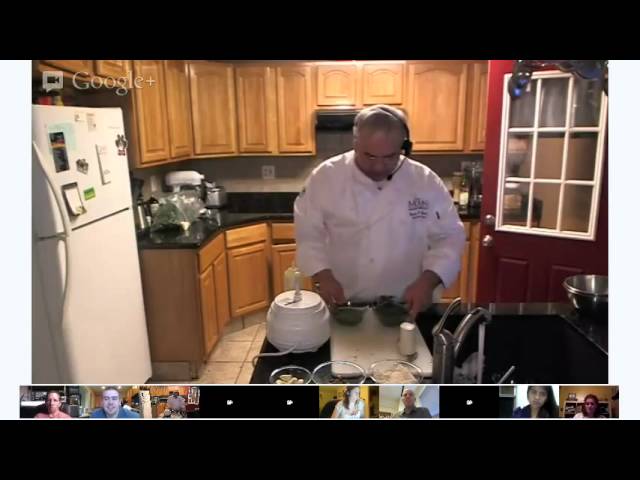
Chef Dennis Littley makes three pestos: traditional Genovese with basil and Italian parsley, arugula with pistachios and optional Gorgonzola, and sun-dried tomato with pine nuts. He covers ratios, technique, and how to freeze pesto in ice-cube trays.
Chapters
Hey there, how you doing? Hi, can you hear me? Hello. Hello. Getting ready to start in just a couple minutes. Perfect. Make sure I got this thing on air. We're good. Make a few kinds of pesto tonight when we get started. For those of you that have made pestos before, be second nature, but for a lot of us it's going to be new. A lot of people, so. Have you ever made a pesto? Any of you? Uh, yes. Good. We're going to make a few different kinds tonight. We're going to make a traditional Genovese, and then we're going to make a sun-dried tomato pesto, and also an arugula pesto. Yeah, we're just going to wait. Alright, it's 7 o'clock, and I'm Chef Dennis Littley, and this is for ChefHangout.com. Tonight we're going to make pestos. Good. Okay, tonight we're going to make pestos. The first thing we're going to start with is a traditional Genovese pesto. And Genovese is made with basil, and also with Italian parsley. Now, one of the things that people do most commonly when they make pestos and they make a basil pesto is they leave out the parsley. And a lot of times you find it's a little too strong for you, and that's partly because you're leaving the parsley out. The Italian parsley doesn't add a lot of flavor, but it does add some, and it cuts the amount of basil that you're using. So what I do is I use about 2/3 of a regular basil and about 1/3 of Italian parsley. And it's just the big flat leaf parsley. You want to try and get most of the stems off, but you know, if there's a few in there, it's not going to kill it. So we're going to put all the greens in at one time. And I also like to put the garlic in at this time too, to give it a really good chance of breaking up. We're going to put in 1 nice clove of garlic. You can use 2 if you really like garlic, but you don't want to go too heavy on the garlic because what will happen is you'll add too much heat and that raw garlic flavor will overpower. So we got a food processor and we're going to pulse. That's pretty much broken down. Little bit more. Okay, so we have a nice ground up parsley and basil, and now we're going to add some of our other ingredients. I have toasted pine nuts, and we're going to put in a couple tablespoons of pine nuts, and then I've also got some grated Romano cheese. And we're going to do about the same thing with cheese, a couple tablespoons. So we're going to give this a little pulse, get this mixed in. And at this point, all we're going to do is add some olive oil to it. I use extra virgin olive oil. So I'm going to turn it on and I'm going to stream in the olive oil. And you really can make this about as loose as you want, about as wet as you want. Okay, what's it going to use? That's pretty good. All right, and that was as, as, uh, all it takes to make pesto pretty much. It's pretty quick. Get a bowl. Now, this is, uh, blade out. We have this beautiful green pesto. Now again, you can make this a little looser if you like, if you don't want quite as much oil in it. I like this a little loose unless I'm going to use it on meats. But this is going to be mostly for pastas. And if I add this directly to my pasta, I want to have it a little bit wetter. Now one of my favorite ways to use Pesto Genovese is to just cook my pasta, get it out of the boiling water, strain it, and then add in some pesto and mix it up really nice. Serve it with a little grated cheese, put a little drizzle of really good olive oil on it if you have some on hand, and you're just ready for a nice fresh dinner. All right, so we're gonna move on from here. Rinse out my bowl here. I'm going to stay with green right now before we go to the sun-dried, and we're going to make an arugula. Now, pestos are pretty simple to make in the fact that you're just using greens for it, and you can use any kind of green that you have. It doesn't have to be a green, but you can make a dandelion pesto, you could make a kale pesto. You can make pretty much anything that you can put in this machine and blend up. You can make into a pesto. Alright, and the idea is how do you make it different? What do you add to it to make it a little different? Well, when I make arugula— these are baby arugula leaves, you can use full size if you like— I still put in the garlic, but instead of the pine nuts, what I did was I toasted some pistachios. And I'm going to use some pistachios in here. And then we're going to grind this all up together. You notice I didn't pulse it at all first. I just want to mix this in since there's not as many ingredients in. And I'm not going to use cheese. I'm going to get this all at one time. Alright, now we've got a much nice dry pesto here. We've got a much nice dry pesto here. Alright, we got some feedback here. Play back. Back. Make sure. Okay, so we have the arugula. Yes, sir. Joe here. I just had one quick tip. If you would click on your own box, it would broadcast your picture. For some reason, you needed to do that. There you go. Great. Sounds good. Okay. All right, we have the arugula, we have the pistachios, we have the garlic in here. Now I'm not going to use grated Romano cheese. You could use it if you want to. I like to do a little something different with this, and I don't put the cheese directly into my arugula pesto. Okay, what I do is I put it on top when I serve it, and I like to use Gorgonzola. Gorgonzola really gives this a really nice flavor. It goes really well together. So all I'm going to do at this point is drizzle in my olive oil. On. Okay, I'm going to have to scrape this down a little bit. Everything— I'm making quite as much with this, in this processor, so we have to help it a little bit. Okay, that's about it. Uh, a really nice looking pesto here, and this will give you a little different flavor. Where did I put my bowls? Oh, okay. This will give you a little different flavor for something, and it'll show you how easy it is to use something else. Like I said, you can use dandelion greens, you can use kale, you can make a spinach pesto. The sky is the limit with flavors, and don't be afraid to experiment. I mean, if you feel like a different nut goes well with it, or if you have a nut allergy in the family and you don't want to use any nuts at all, that's fine too. I've roasted chickpeas and I've used roasted chickpeas in place of nuts just to give it a little more of that consistency, but you can make it without. Okay, we are moving right along here, and we have our arugula pesto, we have our Pesto Genovese, Okay, two entirely different flavors, but you can use them in the same ways for a lot of things. What I like to do with my arugula is I like to put it on meats and then roll them, make rollatines with them, or bake them with the pesto on. It adds a lot of flavor. It's also great for fish. Put some on top of a salmon steak. And roast it. Okay, moving right along. We are on to our third pesto, and this is going to be a little bit different. We're going to use sun-dried tomatoes. This is actually probably my favorite pesto of all because I love sun-dried tomatoes. These are reconstituted. They're not exceptionally wet, but they are reconstituted, so they have nice body to them. Okay, and these are going to take a little bit more to chop up, so we're going to let these go by themselves with just a piece of garlic. It's getting nicely ground. Now we are going to use some pine nuts in this. I like the way pine nuts taste with sun-dried tomatoes, couple tablespoons. And we're also going to use some cheese, couple tablespoons of cheese. As this continues to mix, we're going to drizzle in some olive oil. I don't know if you've noticed how handy this little squeeze bottle is. But I'm never working without one. Sautéing, any type of cooking, just makes it easy to use the right amount of oil without pouring it in. A little wetter. Alright. This is gonna be a little more solid than the other ones we made. That's okay. You can still use it for a lot of different things. And you could take it down and make it a little loose by adding more oil to it. I just don't want to put that much oil into this at this time. This is your sun-dried pesto. Okay, get rid of this. All right, here's your safety tip. If you're working with a cutting board, if you put a little damp cloth underneath of it, when you put your cutting board down, the cutting board doesn't slide. All right, that's your safety tip for the day. Alright, so we have 3 pestos. Each a little different. We have our classic Pesto Genovese, and that was made with 2/3 basil, 1/3 Italian parsley, a couple tablespoons of grated Romano cheese, couple tablespoons of toasted pine nuts, clove of garlic, and enough olive oil to make it nice and loose. Then we have our arugula. Our arugula pesto had baby arugula leaves, toasted pistachio nuts, clove of garlic. I didn't put any cheese directly into this because when I do use it, I like to add a little Gorgonzola to it or blue cheese to it, something with a little flavor. You could just crumble that and put that on top of the pasta if you're using pasta. It's great for stuffing chicken breasts. You rub a little on the inside of the breast, put the arugula, put the Gorgonzola in with it and then roll them up and you can either sauté them or bake them. And then we have sun-dried tomato pesto. And the sun-dried tomato pesto is pretty much the same as the Genovese with toasted pine nuts, with the grated Romano cheese, a clove of garlic, and olive oil. And they give you 3 different ways to enjoy pasta dishes at home, whether you're making it just with the pasta, or whether you're using it with chicken and sautéing that up with the dish, or shrimp. Sautéing some shrimp and putting a little pesto into the sauce as you're making it and serving it over top of the pasta. Okay, but any way you make it, it's really a nice flavorful, easy way to change up the menu. And you saw how quick we made it, so it's not a big deal. Now, here's your question. We have a lot of pesto. Maybe it's more than you can use. Good way to save this is you can freeze it in ice cube trays. And then once it's frozen, pop it out of the tray, put it in a Ziploc bag, and throw it in the freezer. So when you want to have some fresh pesto sauce, a little taste of summer in the middle of winter, you can unlock, take out your Ziploc bag, and take a piece out and warm it up, and you'll have some fresh pesto. Okay? All right, I can take a few questions now, I think. Anyone has a question? Anyone has anything they'd like to say? Looks like Joe left. We're good? Alright, well, thank you all for coming to our Chef Hangout Let's Make Pesto Party, and I hope to see you all again real soon. We'll be having these classes on a regular basis, and we have some of our other instructors also giving them, so check out the chefhangout.com. For all the different free classes we're going to be running over the next few weeks, or as an ongoing thing. Alright, thanks for stopping by. I'm Chef Dennis Littley, and it's great to see you. Bye-bye.









