No Bake Creamy Peach Pie - Around the Kitchen Table
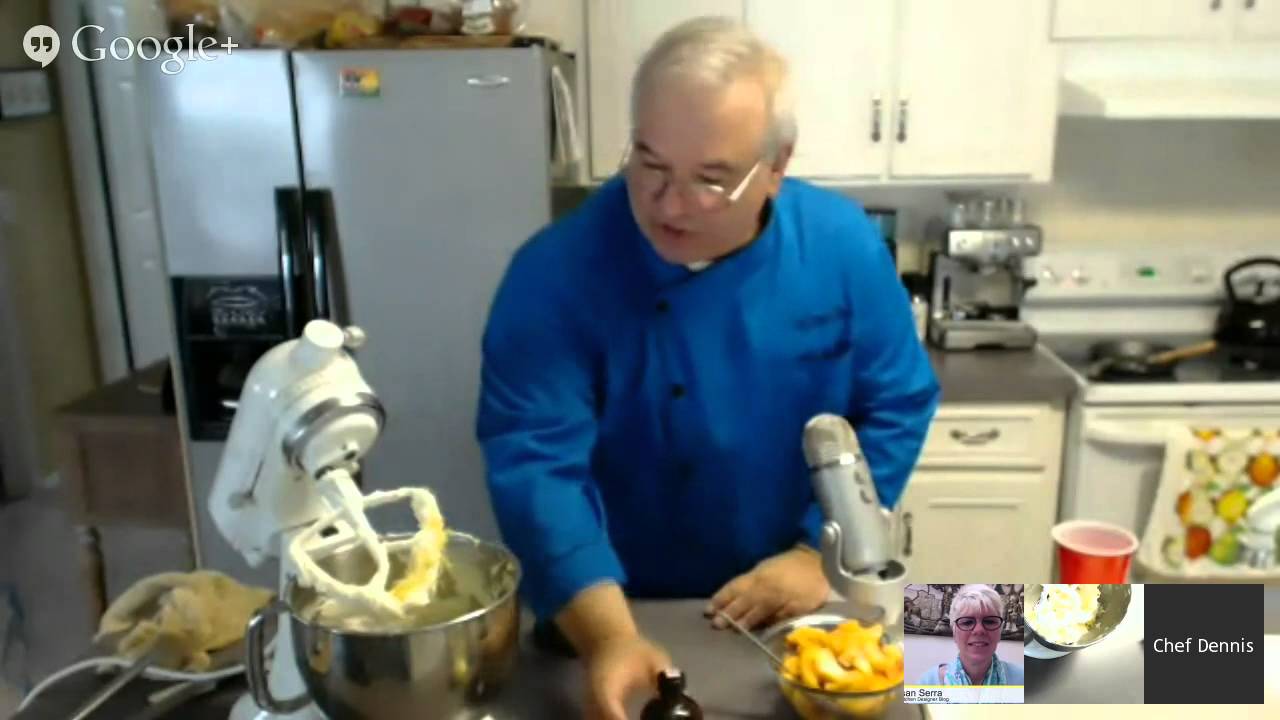
In this live cooking demo, Chef Dennis Littley, joined by co‑host Susan Sarah, demonstrates how to make a no‑bake creamy peach pie and shares a wealth of related kitchen wisdom. They begin with a casual chat about weather and seasonal baking, then explain why a no‑bake pie is useful for quick, freezer‑friendly desserts. The core recipe uses cream cheese (or mascarpone), whipped cream, sugar, lemon zest, vanilla, and a thin marmalade glaze, all assembled in a graham‑cracker or nut‑flour crust. Throughout the preparation they discuss ingredient substitutions (Greek‑yogurt cream cheese, light cream cheese, pure vs. imitation vanilla), proper whipping technique (slow start, gradual speed increase, checking for wet bottoms), and how to avoid over‑whipping. They provide extensive fruit handling advice, including flash‑freezing berries, pureeing strawberries, and using store‑bought frozen fruit versus home‑frozen fruit. Various topping and glaze options are explored—orange marmalade, strawberry, blueberry, raspberry jams, chocolate, nuts, and fresh fruit. The conversation expands into broader kitchen organization: designing a “baking center,” optimal countertop height, material choices (marble, stone, Silestone), utensil storage strategies (multiple sets, yard‑sale finds, categorized drawers, Ziploc dry‑mix bags), and the benefits of pre‑measured ingredient bags. They also field live viewer comments on freezing fruit, vanilla intensity, and utensil hoarding. The demo concludes with final assembly, chilling the pie, and suggestions for alternative presentations such as parfait glasses or using a star tip for piping. The tone remains conversational, enthusiastic, and instructional, aiming to empower home cooks to create a quick, elegant dessert while improving their kitchen workflow.
Chapters
Hi everyone, I'm Chef Dennis Littley and welcome to Around the Kitchen Table with my co-host Susan Sarah. So how you doing, Susan?
I'm doing great. It's a beautiful day here, low humidity. I mean, you should be envious. It's, I mean, what are we, 75 degrees, very low humidity, not a cloud in the sky. It's beautiful.
Well, you know, I am a little envious because the humidity has finally arrived in Florida. Ah. I am feeling it. And well, you know, it's the end of— middle of July, so I can't complain too much.
No, no, you don't have that much longer to go. And I mean, just, you know, you figure it's winter, it's the opposite. It's the opposite. And you know what's really funny? Because speaking of opposites, I mean, you're talking today about a no-bake pie. And hey, I mean, I'm talking about, you know, baking centers in the kitchen, but you know, The baking season, I mean, it's only 4 months away. We need to get prepared for it, right?
Yeah, it's not even really that far. The end of September is really when apples start coming in in good force, and people are baking apple pies. You bake in the summertime. It's just every now and then, one of these kind of pies that's quicker to make and something that you can actually freeze ahead of time without the topping. I mean, you could keep these in the freezer if you made them, and just whatever kind of fresh fruit you have on hand, finish it up before you serve it. You can even cut them. I would even say cut them frozen because by the time they thaw, they're ready to eat. It's one of these great fast pops.
If you even let it thaw.
Yeah, if you even let it thaw. If you're topping it, and you can leave off the glaze. You could top this with a myriad of fresh fruits, strawberries, blueberries, nectarines, cherries, anything you like. Delicious.
Yeah, you know, I went to the farmer's market yesterday and bought myself some blueberries, and it struck me when I got home— and we have, you know, now we have local fresh blueberries— it struck me when I got home, we had the most amazing strawberries through the month of June, you know, which of course is once a year, and they're just It was incredible, so sweet, so wonderful. All of a sudden, I thought to myself yesterday— now they're gone. Can't find them. I thought, could I have frozen them? I bought so many, and I never thought to freeze them.
Blueberries?
Strawberries.
Strawberries are really hard to freeze because of all the moisture in them.
Oh, good.
I'm glad you told me that. I mean, you can do it, but you really kind of have to flash freeze them. Because the way they freeze— and again, it's not even so much the freezing of them, it's the defrosting that really kills them because they are so— they're made up of so much water. And when those ice crystals form in the berries, it just starts to break the whole structure down of it since strawberry is mostly water. So they're not— what you can do is you can puree them, though, and you could freeze the puree.
Oh, and you know what? There is a I may have mentioned it. There's a Scandinavian dessert made of berries where you cook the berries down. You add some water to it. You cook it down. You add some— I think you add some cornstarch. And it's almost like a very, very— it's like a pudding, but not a pudding. And it's so wonderful with fresh berries. I probably could have frozen it for that and enjoyed that over the winter.
Absolutely. They'll freeze. It's just you want to use them for smoothies or for something cooked at that point, because structurally, they're going to look really ugly. That's the only thing. Blueberries will freeze a little bit better because they're small. Again, a lot of these berries we buy in the store and fruits we buy in the store are flash frozen. They are frozen immediately, and the damage to the structure isn't quite as severe. As it is to fruit that we would freeze at home.
That's interesting you say that because my kids get frozen strawberries. I think they get them from Costco or something, and they look great, and they look great. Yeah, so I went out to dinner this weekend as usual. I don't know, I'm always going out for dinner because we have so many restaurants locally, and I had this dessert that's a raspberry tart, some kind of raspberry tart on a walnut crust. Very thin, very, you know, like this thin. It was so delicious. Have you done that kind of— I mean, I love tarts. I love tarts. Oh, yeah.
Yeah, originally I did this pie on a baked shell, and then I got people yelling at me because you said it's a no-bake pie, Chef, and I'm like, well, yeah, it is, but the shell, you know, so I went to a graham cracker crust for this just so not one part of it is baked. The only thing you have to do is heat up the marmalade or the preserves on the stove a little just to get them a little more liquidy. Other than that, the whole thing's non-bake. I've used pistachios. I've used hazelnuts. I've used walnuts. You can buy nut flours, too, if you want to make something out of that.
I didn't even know if I knew that.
What I did see in the store that I thought was pretty cool— because I don't buy premade shells that often, even graham cracker. When I do a cheesecake, I'll tend to use— I like digestive biscuits, and that's an English Graham cracker. It's got a little different kind of flavor, but it's basically like an adult graham cracker. It's not quite as sweet, but it's pretty close to it. If you look in your store, I bet you'll find them. They come in rounds, in tubes, and they're called digestive biscuits. Everything—
Oh, that's funny.
Cookies are biscuits over there, so that's why they call them that.
I just want to ask you, can we do a New York cheesecake one time?
Oh, sure.
Absolutely. Okay.
The only thing with that is the baking time, and then of course the resting time, because to do a good cheesecake justice, it needs to sit overnight to settle. I mean, even 6 hours is a little close, because if you start to eat it before it really starts to get dense, and that's what gives it that creaminess and that really deliciousness, it won't eat the same. It won't taste the same. The flavors just don't quite build. Ah! You never knew it. You got to let them sit 12 hours at least. Overnight is always the best thing. Then they get that real dense, rich creaminess to them. Yeah, but we can do it. What I'm making today is really simple. Like I said, you buy some pie shells. I was almost tempted to buy— I saw shortcrust. Premade pie shells. Like I said, I don't buy them very often. They have chocolate ones, they have Oreo ones. I mean, so you could really— you could get a couple different pie shells, you could make this base. I mean, you could do it times 2 or times 4 and make a bunch of these pies, cover them up really well, and freeze them, and then top them. I mean, there's nothing to say you couldn't top this with chocolate of some kind, or if not fruit, if you didn't want to use fruit. So you could go top it with cookie crumbs if you use an Oreo base. So you know, you can really have some fun with these, have a really easy, quick dessert, pull them out of the freezer, ready to eat, and without any muss and fuss. And if you're making one, it's not going to take you that much more time to make 4 if you're making it all together. Make 4?
We're going from 1 to 4.
Okay, well, you know, if you're going to make them and you have freezer room, make them and freeze them. That's my philosophy.
Okay, Christian.
What we're gonna do is we're gonna start— I'm gonna take this off so I can put them in a little easier— but we're gonna start with our cream cheeses. And let me take off my lower third so everyone can see a little better. I don't know what I was thinking there, and that dropped me down. Okay, we're still working the bugs out of these Hangouts, and the pictures are getting a little different. I think I talked to you a little about how it We've lost some of the screen. All right, so I have cream cheese, and it's just a simple 8 ounces of cream cheese. That's actually the mascarpone, and here's the cream cheese, 8 ounces of cream cheese. And you could use light cream cheese if you like. And I actually saw something in the store, and I haven't seen it lately, but I saw a Greek yogurt cream cheese. Wow, it was a blend. That sounded really interesting because that tang of Greek yogurt is really, really nice. Greek yogurt would be too thin to use in this, but if it's in a cream cheese consistency, it would probably work pretty good with that. I wouldn't even use the mascarpone. I would just use 16 ounces of that and try it. That might be a real tasty kind of pie, especially with fruit.
Yeah, good for a change. Good to change it up.
So we're gonna whip this up a little bit, and I'm gonna add in my 3/4 cup of 10X sugar and let it go. And while I'm mixing, I'm gonna mute myself so I don't make too much noise.
Okay. All right, so doesn't Chef look great in his blues today? I'm just loving that blue jacket. I wonder if he can hear me. I can, okay. So, you know, yes, we— this is a no-bake pie, but I couldn't resist sharing with you some tips on baking centers in our kitchen. I mean, we don't have to have a whole baking center. You can have a— you can actually have a little spot. You can have a cart, that type of thing. But just to talk about baking, a few tips. You may— some people who really love to bake, their dream is to have a separate baking workstation. And as I said, that can be very small. It could be an island, a kitchen island. It can be built in. You know, to any place that could be a designated baking center. And sometimes baking centers are good when they're lowered by a few inches, and that's because you're— when you're standing up, you, you may be kneading, you may be using a rolling pin, and you're, you're from your shoulders up, you're kind of extending out and down. So a lower height is actually very helpful and it's very comfortable, especially, especially if you're kneading and rolling for a long time because, you know, sometimes our baking sessions take quite a while. For the surface, some type of stone, of course marble is the classic material, and we like marble very much, and it's beautiful. Of course, you have to watch the staining. There's a lot of controversy around using marble. Some people swear by it, and me, I have my clients probably signed 5 pages of disclaimers. So I'm a little ambivalent about marble, but it's wonderful for baking. Also, when you store your ingredients, you know, if you have a designated baking center or if you don't, you want to think ahead and make the baking enjoyable. And so you want to have your ingredients, your sugars, your whites, your whites such as sugars and flours and coarse cornstarch and other things, you want to have them in one area of the kitchen so that that's your go-to area for baking. However, things like spices, cinnamon, nutmeg, things like that, I would keep in the spice section. I wouldn't necessarily put them away because you can use them for multiple items. And spices are great when they are alphabetized. They're really, really great. Yes, it's easy to do, and it's not so obsessive-compulsive, but it's really great to do. I see, and I have more tips later on, and I see we're mixed.
Yep, we're ready. Talking about spices, I, as a chef, that was one of my anal compulsions, one of my many, I probably should say. My wife's probably over here shaking her head going, "Oh, God, yeah." Alphabetical. The only problem is Everybody in the kitchen uses spices, and they just put them back wherever they want to. After a while, I could be like that Soup Nazi kind of chef and yell at all my help for not putting them back alphabetically, which would probably make me seem even stranger than I am. I usually let it go, but it is—
No, they have to pay a $50 fine every time they put it in the wrong spot.
I used to make them do that for cursing in the kitchen. They had to pay a fine.
Wow, good one.
Anyway, I have the cream cheese and I have the mascarpone mixed up. I just wanted to break it down and get it nice and creamy and smooth so I got any lumps out of it. Now what I have here is I have a lemon zest. I wanted to talk about that briefly. When it calls for a lemon zest, there are zesting tools you can use. Of course, you can use a peeler, but the important thing is as soon as you start to hit that white, the pith, you want to stop. You just— whenever you're looking for skin, you just want to get that thin outer layer of skin because that's where all the oils are. That's where all the flavor is. Once you get down into the pith, you get nothing but bitterness. You want to always be aware that you're just getting skin. This is the tool, actually, I use.
Oh, look at that!
It's only— these are about $10, $12 in the store. This is a Microplane, but they make other ones, and it's really good. You know, it doesn't have a whole lot of other uses, but it's great for zesting lemon, any citrus.
I've only always used those little mini zesters with like the holes at the top, and you kind of go like that, but I haven't seen— or maybe I have seen that large one, but—
Well, the thing with those zesters is the skin's a little thicker and wider, Something like that you really need to chop if you're going to put it into something like this. I have the zest, and it's really pretty fine.
Oh, yes.
This could have actually been chopped a little too. I'm not really going to use all of this because that was a pretty good-sized lemon. Sometimes too much zest will make it kind of gritty when you're eating it. If I was baking this in a cheesecake that was baked, I would use it all because it's going to cook., but because this is raw, I don't want to use that much.
Good point.
So now I have some pure Mexican vanilla. I'm going to use a teaspoon of that, put that in, and then we're just going to mix this up again real quick. So I will mute again.
Okay, okay, and maybe I can get a word in before he finishes mixing. Also, likewise, mixing bowls baking sheets, pie plates, muffin tins, cooking molds, keep them all together so then you know exactly where to go, whether it's in another part of the kitchen, whether it's outside the kitchen, but keep all your baking things right where, right where you know where they are. So it's quick access. And let me mention utensils. Yes, spatulas, measuring cups, measuring spoons. And you know what? I have, oh, maybe 2 or 3 sets of measuring spoons and measuring cups. And I find that it's, you know, sometimes if you're doing a lot of cooking, you really, you don't want to wash them out. If you're making a main course and you're making multiple courses, so just invest another $5. Or $10 and get multiple sets. What do you think about that, Chef?
Absolutely. I have 2 sets of mixing cups, 2 sets of spoons, and you know, if you're gonna keep using a lot of them, like you said, they're not that expensive. And if you think they are, go to yard sales. You know, you'll find— believe me, everybody's always selling their kitchen stuff because they never use it. So pick one up for a quarter or for a dollar. Alright, so I have everything mixed in here now. I have the vanilla I have the lemon zest, and it's a little bit loose right now, but it's going to firm up really good when you chill it. So now I have some whipped cream, and it was 1/2 cup of cream whipped with no additional sugar in this. This is just the cream.
Oh, but Chef, isn't that tricky? I always found it tricky. When is the moment you stop whipping? I mean, my mother was a master of whipping cream. You know, it's a little tricky.
The whole secret to whipping cream is to do it slow because everybody wants to put the cream in the bowl and start whipping and turn it right up to high and it'll be whipped in about a minute. All right, well, that's exactly the wrong way to do it because it'll start to break down a lot faster. It's not going to hold up as long. People always ask me, oh, you didn't put any gelatin in your whipped cream when I added the things. No, I don't need to. It's going to hold up.
Right, my mother never did.
Yeah, it's going to hold up for— but you want to start out whipping slow, and it's probably going to take you close to 10 minutes to whip the cream.
Yes.
And then pick up the speed a little bit towards the middle and just let it keep whipping. And then when it starts to really start to form, you want to make sure you get into the bowl with a spatula really well a couple times, turn it up a little bit more, and watch it start to thicken. And the whole thing about it is, like, I've taken whipped cream out and the bottom has been a little too wet. Goes right back in the bowl. In fact, I did that right before we came on. I had taken it out, it was a little too wet, put it back in, and I whipped it up a little bit more. So now I'm folding this cream into this. Go ahead.
No, I was going to say, so you do that toward the end of the process? You kind of check it?
Yeah, I'll check it and see if it's wet at the bottom, turn it over. But, you know, it'll start— because it'll look done on the top, and it'll be firm and almost— because, you know, what happens if you take it too far is it turns to butter, so you don't want to go that far.
No, no, no.
There's no coming back from that. So this is pretty well mixed. I just folded it in. I didn't use the mixer to whip it in because I didn't want to break it down. I want to try and keep some air in it from that whipped cream, and that's why we added it in to make this a little bit lighter.
Reminds me of the nuances of making gravy. I mean, that's another thing, making like real gravy. You know, forget it. My mother was a master, master.
I know, right on the stovetop, add the flour in and you'd never see any lumps.
I want to do a lot of that in the winter.
Absolutely. Comfort.
Yeah, that's for sure. Tell me when you want to take a couple of comments and I have some images. Okay.
Together.
Sure. So Carmen Mandich says, I really find these baking tips very helpful since baking usually involves so many ingredients and I find myself crossing the kitchen so many times that I consider baking as a long process. Thank you, Susan. You're welcome, Carmen. Keep everything together. You know, everything in the kitchen, there should almost be categories. You know, you may have an opinion on this too, Chef.
Categories, what, for keeping things?
Yeah, you know, spots for keeping your baking things or your You know, of course, your baking sheets and your certain bowls for certain purposes.
Yeah, everything needs to be where it's going to be easily accessible for what you're doing. And if you know you don't bake that often, but you have a certain set of tools, you might even consider getting yourself a plastic storage bin, put everything in that, keep it clean, dry it, put it away, and then bring it out when you're going to bake. You know, maybe it's a little bit extra work. But everything is there. So when you're ready to bake, you don't have to go hunting for things. I mean, if you bake once in a blue moon, but if you're a steady baker, then you want to keep everything at your disposal so you can pull it. Now, one thing I do do when I start to bake— I haven't really started to bake much since I've been down here, and that's gonna be happening again. Like, if I make muffins and I make them with any regularity, what I do— or biscotti or anything that I make, I might make more than once a month. I'll take little Ziploc bags, and while I'm measuring out the dry ingredients, I'll measure out 2 more, and I'll keep all the dry ingredients in a Ziploc bag, and I write what it is— biscotti mix, muffin mix, cookie mix— if I'm making something special. You know, if it's not something I'm not going to make a lot of, I may only make 1 more bag. But even if you make 1 more bag of it, you date it. Next time, next Saturday morning, when you get up and you want to make some muffins, instead of measuring everything out, dragging everything out, you grab that Ziploc bag out, you got all your dry ingredients. Now you have to do is add the wet to them, and you're done and in the oven. So that's my tip.
That's worth a million bucks. And here we have another one from Cheryl and Cheryl Deuce, and I apologize if I'm not saying your last name right. Chef Dennis, do you have to adjust the vanilla if you are using pure versus imitation? I only use pure, but I've heard that you need to cut it in half for most printed recipes if you're using pure.
Well, it again depends on the intensity of the vanilla you buy, or it depends on how much you like vanilla. If you really want vanilla to be prominent, I wouldn't necessarily cut it. Depends on what, again, what I'm making., but you know, I may not necessarily cut the vanilla if I like that vanilla flavor. And you know, I— for years I bought vanilla like at a big box store too because it was less expensive, and it was pure vanilla, but you know, it's not that really rich vanilla that really— like if you want to get Tahitian, or like I have the Mexican, and I forget where else They have—
and I think it's Madagascar.
Madagascar, yeah. Tea. Even places like that. I think I've even seen some Vietnamese, or it's either that or cinnamon. I can never remember. But you start to see some very good products coming from places that you never thought of before.
Yep, that's true. And oh, Cheryl says Again, you can never have enough utensils. That's for sure, right?
I have two drawers of utensils and more packed away that I don't even have out. There's just never enough room for gadgets, and I brought more home. I was at a conference this weekend and OXO was there, so of course I brought more utensils home with me. Well, you know what's utensils no matter where, whatever conferences I go to, they always want to give you those.
Well, you know, another thing is, a good thing is for utensils, I keep mine— I don't have enough drawer space for all my utensils. I'm also a utensil hoarder. So I have pottery on the countertop that houses utensils. And, you know, I have them in categories. I have, you know, the forks, the not the dining forks, but, you know, certain forks. And then I have the certain cooking utensils and I have baking utensils and whisk, which are whisks and spatulas and that type of thing. So that's another great way to, you know, get obsessive about your utensils that are in pottery on the countertop.
Absolutely. Yeah, you can, you can have them and they look nice too. And it looks like you have a kitchen that you actually use. Which is always nice. So what I've done now is I've just lined up my peaches. See if I can get this right. Yep, towards the center. I actually put a piece of tape down to mark it so I could find it.
Wow, that looks good.
I'm going to heat the marmalade up just a little bit more real quick just to get it a little, little thinner, and then we will finish it. Are there any other comments?
That looks great. Ah, let's see. Mia says, great tip on the yard sale idea for utensils. Why not?
Pie dishes. I mean, when we sold— when we moved down here, you should have seen the things I sold. And some, you know, in boxes that had never been used because, you know, again, I bring things home from just about everywhere I go. You know, I sold a KitchenAid mixer. I had brand new blenders. I had knives. People would be going, "Oh my God," when they saw them because they were still brand new, but they were huge.
And they're 50 cents and they're negotiating.
Yeah. Well, yeah, knives I was sticking out for a buck because they were brand new.
But you know, Carmen's asking— Carmen Mandich is asking, "What fruits can you freeze?" So let's go down a little list.
Well, you can freeze— you know, I am not a canner or preserver. So for me to tell you, you know, I'm not— I'm just kind of speculating, but you know, it all depends on how fast you can freeze it and how you freeze it. I mean, you can freeze fresh peaches if you put them in a Tupperware container, but they're gonna come out, you know, they're not gonna be individual like IQF peaches like you buy in the store. They're gonna be in a lump, so you're gonna make something with them, puree them, that's fine. But for freezing your own fruit, I would Google it, to be honest with you, because it's not something that I have— I did try canning once. I thought I was going to be the new Little House on the Prairie, and it didn't go well. So anyway, what I did here was I have peach preserves. I added a little bit of water to them just to thin them out a little bit.. And then I'm going to brush these preserves on the top.
Nice. And you know what? It gives a nice glisten to it, doesn't it?
That's exactly why we're doing it. I mean, you could make yourself a little cornstarch-thickened glaze, but it wouldn't have the flavor. And this is adding— now, orange marmalade is also really good to use, and it's good to use with just about any fruit because the orange. It's not real sweet, and the orange goes very nicely with just about all fruits.
And now what about— you know, I mean, we can get crazy. We can do raspberry jam, you could do blueberry jam.
You could do strawberry. If you were going to cover this with strawberries, I would use strawberry jam. If you were going to cover with blueberries, you could use blueberry. But I mean, if you don't want to keep all these jellies in the house, you know, orange is sometimes a good one to use for a lot of things. And it's great for cheesecakes too, because When you top a cheesecake with fresh fruit, a lot of times you get those cracks in it when it just— the oven just isn't cooperating.
Yes, yes.
You cover it with something like this, you put a glaze on it, and it's beautiful, and no one ever sees— no one sees the damage beneath.
Good tip. Good tip. This looks great. It looks fresh and Just luscious, and the texture, and it's just oozing deliciousness.
Now it's got to get cold. It's going to have to go in the refrigerator for a good hour, or the freezer even, or even a little bit longer. Like I said, I like to chill things like this for a few hours just to give it time to really set up. This is a full-size one. If you had a smaller because now they make bigger pie shells than they used to. So, you know, it's a— it could be a little bit higher if it was smaller. The cheese could be up a little firmer. But I loaded this down with fruit too, so it's pretty good. But I'm gonna put this on a plate when I put it in the refrigerator just so there's no accidents.
Mm-hmm. That looks beautiful.
Yay!
Just beautiful. And Elena Bellametti says Always use fresh fruit. It's better and seasonal.
Absolutely.
And it sure is. And you know, Chef, I have a few images of baking centers, of kitchens that I've designed.
Great, let's see them.
What do you think about that? Okay. Sure. Let me move this up and I didn't get to— oh yeah, okay. We're going to see my monitor a little bit, but whatever. Actually, this is the last one I wanted to do, but it's first up. Oh, Google Talk plugin would like to control this computer using— no, I'm going to say deny. So screen share— oh yeah, here we go. So that picture, you see a picture of a table there? Yes. Okay, now that is a table that's in my daughter's kitchen, and that table is actually— the top is made out of silestone. You've heard of Silestone, it's an engineered quartz, but you know, your kitchen table, if you have the right kind of kitchen table, and something like this is great for a baking center, a big, big wide baking center, roll out everything, set everything up on the kitchen table. You don't have to have a fabulously designed kitchen, and so that's partially why we did this surface. So it would be multifunctional and beautiful for whatever we use. Let's see, let me go— now I seem to have to go back here. Okay, yeah. So, okay, now this is a sheeshy big kitchen. You see that yellow kitchen there, right? Yeah. Okay, so this is actually a desk area in the forefront, but you can move those things to the side and certainly make it a very small baking area. Why not? If you're making something special, I don't know, it's a multifunctional area. This is also—
Susan, do you, before I ask, do you ever make the baking section a little higher than normal?
I actually make it lower.
Lower? Okay.
I make it lower because when you're using the force with your hands and your shoulders, it's more comfortable if you're kneading, if you're kneading and rolling, it's actually more comfortable. You have better force. Yeah, so this is another baking center that's lower, and it's a piece of stone, and you know, it serves multi-functions when it's not. Now here's an island, here's a kitchen I designed with, you know, a classic marble island.
Gorgeous.
Again, multi-functional. Marble is good for everything. You know, all the pizza places use marble, and of course marble can stain and etch with citrus, things like lemon on it, and you have to watch the red wine. So you have to be careful of that, but many people love it. Here's a separate baking area, and it's outfitted with a— here you have a white KitchenAid mixer, and it's just off to the side. And again, it could be strictly used for baking, or it could be multifunctional., but it's certainly ready with the mixer right there. This other kitchen on the right, again, we have a separate baking area with marble, and this is similar height to the countertop. The client didn't want it lower, and this is a very, you know, highly decorative kitchen here, but, you know, there's a lot of ways to build in a baking center. Now, this one is unusual. If you see the both the cooktop and the countertop to the forefront is lower than the other section. I'm not sure if you can see that clearly, but I also like— believe it or not, I like to have the cooktop lower also. So this is multifunctions, and it's a great little baking area as well, right, you know, right in that spot. So, and here, this is a You know, wonderful, gorgeous kitchen. And of course, nothing beats a big kitchen island. I mean, we all love our kitchen islands. And when you have one like this, you have a little sink there, but you have a big expanse. You know, it's great if you can do it. It's— if you— if not, you use the kitchen table. Here's another little out-of-the-way spot, you know, with some stone. You have a window there, sink nearby. Hey, and listen, if you want a bottle of wine while you're baking, it's— that's right there too. So, and another one, couple of, you know, different options here for baking area. And the last two, here's a kitchen I designed that kind of goes around. This is in the kitchen, and you have the seating area beyond it. Here's the seating area, and there's the baking area. So, you know, that's, that's my story, and that's what I'm sticking to. So a couple of little Yep, couple little options here for the baking center.
Now I almost forgot to do this to my pie, and I couldn't find my, my star tip. So we're going au naturel and just squeezing out the whipped cream. But okay, I thought, you know, just to show you, and I have— I just got a disposable pastry bag. It doesn't quite look as pretty as it would with a star tip.
Oh, sure it does. Now what about sprinkling, say, some cinnamon on it, on the cream?
If you like cinnamon, absolutely. I personally, I like cinnamon, but I like it only on certain things. So I'm a little more judicious with mine, and I probably wouldn't put it on this. But you know, depending upon what the filling was too. If you were making a cookies and cream, like if you wanted to fold broken cookies into it and sprinkle it with a little chocolate or cinnamon, you could do that as well.
Oh, sprinkle with chocolate, yay!
Mm-hmm. But this is just going to be fresh. This would be another time you could use a little bit of that lemon zest if you had any more left over and just put a little— sprinkle a little more lemon zest on the top of it. Just to make it look pretty. Not clumps of it, not like that.
And you know what? Some blueberries too. Blueberries, raspberries. I mean, raspberries and peaches, forget it.
Blueberries would be wonderful on top of this.
How about raspberries, blueberries, chocolate, and whatever else?
You must be hungry. You're getting carried away.
Oh my gosh, I am. Looks beautiful.
That's your easy peach pie for dessert. You don't need the whipped cream on it, or you could just put the whipped cream in a bowl and let them spoon dollops of it on. That's pretty fun, too. Depending upon how you wanted to do it, with or without, it's still a great pie. You could also use this filling in glasses. Forget the crust. Take your filling, put it in dessert glasses, top it with peaches, or stir the peaches into it. And make a parfait-style dessert out of it. There's so many things you could do with it. Top the cream, layer it with different fruits. You could really have some fun with this. It's going to be a pretty light, very summery, nice, easy-to-make dessert that people will think you spent hours making.
Love it. Easy. No-bake equals easy.
You got it.
Good job.
All right, well, I think we're just about running out of time here. Thanks everyone for coming. We had a great time around the kitchen table with you joining us. Susan, Sarah, and I are here just about every week. I think we only missed one so far. Yeah, we'll be back next week with you, and I'll see what the markets have that I can turn into something summery and delicious for us.
Cool.
So I'll see you then. Take care.
Bye-bye, everybody.









