Roasted Rack of Pork - Around the Kitchen Table
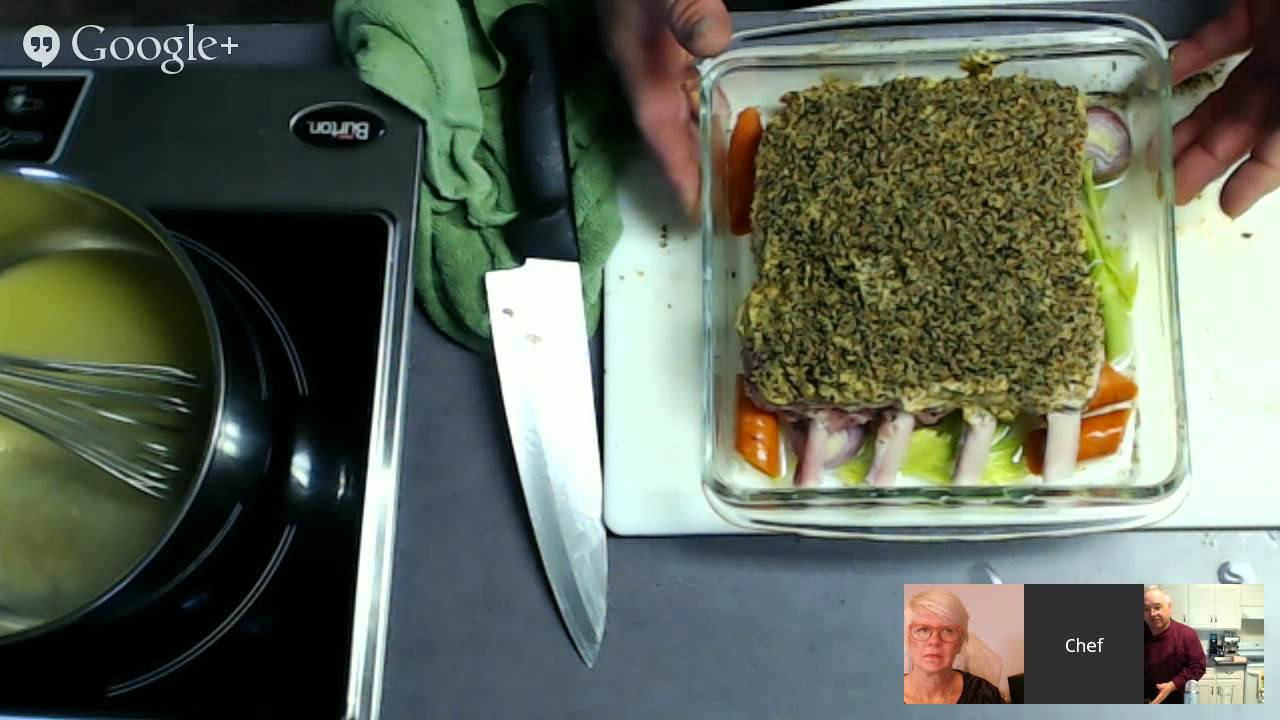
In this episode of Around the Kitchen Table, Chef Dennis Littley and co‑host Susan share a relaxed, holiday‑themed conversation before diving into a full‑course meal plan. They begin with light‑hearted small talk about Christmas decorations, a local golf‑cart parade, and the challenges of holiday kitchen renovations. The core of the show focuses on sourcing a large, 8‑bone rack of pork (primarily from Costco, with price and size notes) and demonstrating a step‑by‑step roasting method: bringing the meat to room temperature, coating it with brown mustard, applying Montreal steak seasoning, arranging vegetables as a rack, adding water, searing at 425 °F for 15 min, then lowering to 325 °F for 1–2 hours, and resting for 10‑15 min before carving. They discuss the fat rendering process and why the crust won’t become crispy. Next, they prepare a horseradish‑cheddar potato au gratin, detailing a gluten‑free roux (2 oz butter, 2 Tbsp flour), milk and water mixture, cheese amount (1 cup horseradish cheddar), seasoning options, and baking instructions. A quick side of “super greens” (pre‑washed kale, chard, spinach) is sautéed with garlic. Susan presents a slideshow of Scandinavian table‑design ideas, highlighting color palettes, natural materials, and styling tips. The episode wraps with audience shout‑outs, holiday scheduling notes, and a reminder of upcoming breaks and the Super Bowl.
Chapters
Hi everyone, I'm Chef Dennis Littley and welcome to Around the Kitchen Table. And it's not a beautiful day in Florida, but it's still a nice day. It's a little cloudy here, but it's still around 75-77 degrees. So for December, I'll take it. No, I do miss the little chill. Susan, how you doing?
I'm good, I'm pretty good, Chef. And it's cold and gloomy and it's wonderful Christmas weather up here. And I'm driving around with— I don't know if I mentioned I don't think I did. I'm driving around my car with a Christmas tree. You know how you get it from the Christmas tree farm and it's all netting? So it's all like that, and then there's Christmas lights all over it and a star at the top.
And that's in your tree or in your car?
On top of the car.
On top of the car.
Isn't that great? My husband thought of it. He said, oh, what if we put lights on? I said, oh my God. We were laughing. Hysterically. You know, sure, you expect to see it on top, but not with lights and the stars. So we're just, you know, we, you know, it's the kind of thing that you crack yourself up about, you know, cracking ourselves up about it.
You plug it in at night?
We absolutely plug it in at night, and an extension cord, and then it plugs in, and there's a plug in the, in the car, and we plug it in and then ride around.
And so you can plug it in while you're driving?
Yeah.
Wow.
That was lit as we're driving. I mean, you know, the kids, of course, the kids came over and said, you are whacked out. You know, you've lost it. But we got a laugh out of them.
I bet the people passing by think the tree is not the only thing that's lit when they see it. Yeah, I know.
I know. And that would be the truth. That would be the truth.
Yeah. That's all right. Last night we had our golf cart Christmas parade in the community I live in.
I bet that was a sight to see.
It certainly was. I have to say last year's was a bigger production, but I mean, they were driving through with their golf carts all decorated in lights and Christmas trees on them, and Santa went by and all that. But it was not quite as good as last year's debacle, but it's still interesting. You know, it's Florida, so that's what we get.
Right, right, right. So here we are with a week, the days before the big event.
Can you believe it?
I can't believe, I really can't believe it. It's like been a freight train through the calendar.
It's just amazing. I mean, Christmas is in a few days. Yeah, it's insane. You know, I think for me, not working is what really makes it seem here all of a sudden. You know, when we worked, especially in the school system, you get to a point and then you were off and usually had like 3 or 4 days before, so it was more more of a big deal. Now it's just like, like I tell you, we went to the pool, we went to the water park, we went— so it's not quite as much of a big deal.
No, it's true. It's true. And I did all my shopping online early in the month. But I'll tell you something, you haven't lived unless you were a designer of some sort and you had to get everyone ready and everything in and installed by Christmas. And let me tell you, working with kitchens, being a kitchen designer, that's like a death wish. You know, I mean, if people start their renovations in, say, October, and okay, they have to be done. And then, you know, the granite companies say their delays and this— oh my gosh, what a nightmare. I have been at more people's homes at Christmas Eve doing stuff. I don't know what.
Everybody wants their house done for the holidays. I mean, it's just the way it is. It's always— that's the time you have to think of that slogan, "Just because it's an emergency for you doesn't make it one for me." If you put off doing it for this long— gotta love it. Today, we're going to talk about one of my favorite dishes, one of Lisa's favorite dishes. We don't eat a lot of pork in the house, and I think I've said that before, but there's certain cuts that we look forward to. One is a rack a rack of pork. And I found this— I don't know, I think I found it kind of by accident, and it joggled my memory because back in my restaurant days at one place I was at, we used to get racks and we would cook them. But actually, I would cut them down into 2-bone portions and cook them in 2-bone sections, and that was a serving for someone. They weren't quite as big as these, so the serving wasn't quite as large as it would be., but it was a center cut, like, rack. So that's basically what these are, and I'm gonna grab one, grab it here.
Well, you know, Chef, you really jogged my childhood memory for me, not even beyond childhood, because my mother always used to do— it was a big event for her to do a crown— she called it a crown roast of pork that she did every Christmas or every New Year's, I can't remember which. I just remember her making us know that it was a big expensive piece of meat, and it was a big event.
Well, you know, I've looked at these out, and they are really expensive pieces of meat. And I think what I found was— I mean, I was getting them at Wegmans for a while, and they weren't this big, and they were twice the money for like a 4-bone size. But this I actually get at Costco. Sometimes you can find them at Sam's, and I even saw Publix was advertising, although I didn't look. But this is— let me click it on. This is what I have. See this better.
You know, my son who's very picky about meat, he gets almost everything at Costco.
You know, I don't buy a lot of meat there. Here you go. But I do buy certain cuts. And you know, anytime it's whole, that's when I buy something there. Like I would buy a whole fillet and cut it down. I would buy a whole prime rib if I was gonna roast it outside. So anything like this I would buy. Sometimes the individual cuts— you know, we don't eat— I don't eat beef, so it's easy for me. Chicken, if it's— or they do have free-range chicken, Coleman's chicken, I think it is, at Costco too. Costco's actually got a lot of organic products. I'm amazed at how much Costco's and BJ's is bringing more things.
Yeah, I mean, that's what my son has told me too, because they're into a lot of organic stuff. It's really surprising. Trader Joe's is another good place, although I'm not crazy about their meat there.
I have never bought meat from them. Fish lately, I found some— talking about sourcing things, I sourced— I'm always looking for frozen fish that's quality, but I always look for where it's sourced. I like to find things sourced in our waters. The Caribbean, the Pacific, things around here rather than Indonesia, Vietnam, India.
Yeah, but then there's the whole farm-raised issue versus wild-caught. Right, right.
Some farm-raised is okay, and we've talked about it. There's some European EU nations are farm-raising some different fish and different things. I think they're all right. It just depends on the waters. Wegmans was farm-raising a lot of their own up in upstate New York, and they were doing different cuts of fish right in the States that we wouldn't have got, different fish.
Wow.
Now also, you get all your clams pretty much farm-raised. Like, when I buy clams down here, they're more than likely going to be Florida farm-raised clams. So that's okay. I trust these waters. It's just not knowing exactly where the source is. So when I buy fish, I like to try and find— like I got some South American red snapper, which is basically the Gulf, so that's okay. Something like that. You look for sourcing. This sourced. It's not pastured pork. It's not grass-fed pork. Like I said, I don't eat that much, so when I do get an opportunity, I do buy that, but this is not. This was also $25.
For 4? For 4.
No, for this 8, 9-bone, 1, 2, 3, 4, 5, 6, 7, 8-bone rack of pork.
That is very reasonable.
They go for $25 to $35 depending upon the weight. Some are bigger, and honestly, this is big enough. I mean, this is a pretty meaty—
yeah, yeah, it looks substantial.
So what I'm gonna do, like I was telling you last week, I had 2 couples come over and ourselves, so 6 of us had it. So we had 2 chops left at the end of the night. This is actually just tonight for Lisa and myself, and especially since we just had it last week, what I'm gonna do is I'm gonna cut it in half and I'm gonna freeze half. And, and because this was not frozen already, so when you cut it, all you want to do is, even when you're cutting chops, is follow down Follow down the bone and cut.
See, I would have cut— for some odd reason, I would have cut in the middle. I don't know why. I would have thought half, half and half, but no, but that makes perfect sense.
Well, you need to cut where the bone is.
Of course.
Yeah, it's kind of the middle, but one side is always going to be just a little bit bigger than the other side, but they're pretty close. This is bigger because it's got this extra end on it. It's like a boneless chop right here. So if you wanted to cut this boneless chop off and save it for a time when you're alone and just feeding yourself, if no one else is home, that's another economical way to do it. So this is pretty much it. Now I'm going to freeze one and make the other. So let's take the small one for now. Another thing I do with meat like this is I try to let it come up to room temperature before I cook it. That means when I put it in the oven, it's going to cook a little more evenly. It's just like preheating your oven. You want your oven preheated. Well, if I let this— it's not warm by any stretch of the imagination, but it's not ice cold. It's been out for about an hour. So it's given it a time to kind of come up to temperature. When you cook, you want the fat side here on the top because as it cooks, the fat's going to melt and it's going to go through the meat. So it's going to help flavor the meat and keep it moist. So I'm also going to season the top so as the fat melts, it'll help bring some of the seasonings through the meat. Very simple. Alright, so all I do here is take some mustard.. And I like to put a nice heavy coat of any kind of brown mustard on here and just rub it in here a little bit. And for me, it's just a way to keep the spices on too. And I go real simple. You know, I'm a chef, I can make you all kinds of things, but if I can take a step out of something and make it a little simpler and make my life easier, I like that.
I just love mustard and meat. There's a chicken that I do. I put mustard underneath the skin of a chicken, and it's just so sa— it just changes. It's so savory.
It gives you such a good flavor. So I buy the seasoning called Montreal Sea Steak Seasoning. Oh yeah, I love it. I mean, I use it on potatoes, on roasted mushrooms, on some other vegetables, but especially with pork. I don't like it as much on beef, but on pork, when I'm doing a roast pork loin for sandwiches or this kind of a pork, and it's pretty much salt and pepper. It's good, but it's got some other garlic in it, some onion in it. So I make a little bit of a cap with this seasoning, and I layer it on probably more than you need to, but I'm not going to eat this. It's not like people are saying, "Oh, it's so salty," yada yada yada. Well, I'm not going to eat this seasoning. It's going to stay on the side.
So let me ask you a question. Is this thicker sort of topping— does that help keep things moist?
Well, it's a crust, and anytime you're putting a crust on, it's going to protect the meat a little bit. I don't know so much if it's help keeping it moist as much as you're just adding crust to it and seasoning. It gives it a nice appearance when it comes out of the oven. I think the moist part is coming from the fat and as the fat seeps through it. And depending upon the cut of meat, I've had some of these that were not as tender as other ones. The one I had last week was so tender, it was really one of the better cuts. And then it depends how you serve it. You can serve it with just pan juices, or you can serve it with a gravy. And last week I made a Marsala gravy, mushroom Marsala gravy. I just made up a small amount with the roux, and then when they came out of the oven, I poured the pan juices into it, and that was a really flavorful gravy. But you can just serve it just with the juices coming out of it as it's cooked too.
Okay, so let me just ask you, does that also mean that with that, with that crust on, will the fat get crispy?
No.
Will it not? It won't?
It will not. This is gonna— it'll render down. The fat's gonna render down. You're not gonna see almost anywhere near as much fat as there. A lot of it's gonna get rendered and cooked into the pork, and that's just one of the beauties of pork and how pork works, more than beef almost. But this is just gonna kind of settle down on the top of it. You almost won't see it. And then, you know, like I said, when I go to eat it, I'll scrape most of it off. I'll leave some of it on, but I'll scrape most of it off. And really, you're eating down this side of the pork too, where the meat is. You're not eating the very top of it as much. But it's not going to get crispy. It's going to get kind of pretty. And I did put a picture on our— on the page of a finished one. A finished one.
Yes, I saw that.
And it's not that the fat's getting crispy at all. The fat would if you didn't coat it with anything, but again, so much of it is rendering down through the pork. And, you know, there's not a lot, a lot of fat left over in the pan either. So that's something to be thankful for. So I'm just now— I'm going to put this— I didn't get them out. So let me get some real quick. Because whenever I roast, I really quite simply knife. And I use— this is a time to use whatever leftover or old celery, carrots, skins. Now, I'm not going to eat these. I know some people will prepare it. You could. You could prepare vegetables to put them on. This is a shallot I have in there. I didn't have any onions on hand.
You know what? It's almost as if the vegetables serve as a rack.
Yes, keeps it up. That's exactly what it does. So I've got the vegetables here. And see, you notice I threw the skin in. That's fine. And then I'm going to put this on top of it so it sits on it when it roasts. So it's not going to be touching completely. All right, so now what I'm going to do too is I'm going to pour some water in there. I'm going to put this in at 425°F, which is high heat, for about 15 minutes just to let that fat cook down and sear a little. I'm going to put about a cup of water in the bottom here so that when it cooks, it's got some liquid for everything to cook down into.
Oh, that looks great.
Okay, so this is going to go in the oven. It's going to get 15 minutes at 425°F, then I'm going to turn it down to 325°F, and I'm going to let it slow cook. And depending upon the weight and the size of it, it's going to take anywhere up from— now this is a small piece, so this might take an hour and a quarter, but it's going to take anywhere from about an hour and a half to 2 hours. I suggest you use a meat thermometer and stick it in both ends and have it read anywhere from 155°F to 160°F, because when you pull it out, meat like this is going to continue to raise 10 degrees. Once it sits out of the oven.
Okay, no need to turn it over. You don't want to turn it over. Oh, that's so easy.
Nope, that's it. Wow. Lift it out. Like I said, you've got your pan juice. You could just pour that over the pork as you cook it. You may even want to add a little more water to this. Pull out your vegetables, add a little more water, and get all the nice little bits that might have stuck to the dish. It will make a wonderful serving just like that. Now the other thing to remember is When you take this out of the oven, you want to let it sit for about 15 minutes, 10 minutes at least, but 15 minutes is good, even 20 minutes. It's not going to be cold, it's still going to be warm, and let it— let all the juices go back to where they belong. Let it rest before you cut it, because if you cut it right out of the oven, all the juices are just going to run all over the cutting board, all over the plate, and the meat's going to be dry., and it's going to be tough. You want all the juices to go back. Just like we talked about with the turkey, you want to let it rest so the juices go back into the meat, and it's still tender.
Sometimes meat is not something you need to eat super hot. It seems to be more natural to eat it a little bit cooled off. You eat it close to room temperature many times.
Yeah, just as long as it's around 100 degrees even, that's fine. You want it to be warm. You want it to be flavorful. It's actually going to probably have more flavor as it cools down a little bit too. The heat's going to change the flavor a little bit. Then again, I will say if you want it a little hot, what you're going to do at that point is you're going to— make the gravy nice and hot. So if you were— if you have these pan juices and you wanted to get them boiling, just like we used to do prime rib in restaurants, you know, when prime rib was all the rage, we would cook it. He would sit up on the top shelf over top of the stove, get an order, come down, we cut a rib off, dunk it into the hot au jus just to get a little heat into it, and serve it on a sizzle or serve it with au jus or something like that. You never really continued to cook it or got it real hot again. It was just a nice cut of meat.
Okay, chef secrets.
All right, so you have a— before I move on to the potatoes, you have a slideshow for us.
I do, I do. I thought, let me get a little— you know, we're all getting into our little cocoons around the holidays here, and I am too. And as some of you may know, I'm a lover of Scandinavian design, and it comes out in my table in my home. And you know what? It's such a nice, casual, easy sort of look. And I thought, well, let me just put together some, you know, some pictures for you, and maybe there's a little inspiration on a few little differences you can do for your table that's something you haven't done before. So I will start screen sharing right now, and this is an idea book that I put together on Houzz, H-O-U-Z-Z. So, you must know about Houzz. It's a resource for millions of images. And here we begin with something which I've said before, simple as a, you know, a bare tree, believe it or not, with a few decorations, lots of white earthiness. That's what we see a whole lot of in Scandinavian design. Is earthiness. Kind of like truthiness, except it's earthiness. And here we go, typical of Scandinavian design again, lots of whites, pale colors, you know, logs in a faux fireplace there, white light floors. And then you have a mix. You have a mix of some new and some old things here. This is sort of like a country look, but it's very light. The ceiling is very light wood instead of dark. And then we have pops of color with the painting, old-style paintings. But typically you will see plaid, some plaid fabrics, and again, a foundation of maybe a very soft gray. Turquoise you see quite a bit and coral, gorgeous together. Here is a fun, couple of fun things to put on the table, a vintage pitcher, a basket, a short— I mean, doesn't everyone put logs on their table? So here's a fun look. You know, just do, do what you find out in the backyard and, you know, add some flowers. And it's just, it's lovely. It can be so lovely. Again, the plaid, the winter kind of tablescape, and, you know, it's just so cozy. That's a lot of this is cozy when you use natural organics and in your design and some overscale. Remember, from time to time I talk about overscale things. It's unique, it's different. Here you go. I mean, this is to me, it's very sculptural. And what do you do? You go in the backyard, you get a branch, a fallen branch, put it in a glass vase, you know, and it's something, you know, and if you make it very tall and broad, it's cool. And this, I just like this picture. Again, it has some soft grays, very soft, you know, kind of blue grays and white and natural light color woods. And it's a warm, warm look. Here's a kitchen that now the countertops are mostly not cluttered. And sure, you have some small objects here, but you can work in your kitchen so much better So much easier if you keep your countertops uncluttered. And the wallpaper here, very, very large prints. So you see that too in Scandinavian design. Again, here we go, just a pleasant, adorable little branch. And I don't think going all white on every single surface, that can be extreme to some of us, but you see a lot of it. Skins, whether they're faux or real skins, You bring them out in the winter, you put them on chairs, you put them on benches. And again, this is just casual, very casual, but there's an elegance to it. And that's the thing about Scandinavian design. And even look at those curtains, that curtain rod is a branch, but yet you have that wonderful chandelier, the classic Scandinavian clock, and a punch of color. Scandinavians, every country loves a punch of color, and it just adds style. It really adds style. And talk about color, here we go again. And you know what, paint is so easy to change. I mean, if you have one wall and you want to do something new and different, paint it a really cool color. And here, of course, then Scandinavian design is also defined by neutrals and the soft grays and even some dark, you know, some dark colors. Very common, the teak or mahogany, that's red, and light blue is a complementary color, so these go very, very well. Again, the lights and the whites. And now I'll tell you something. In your kitchen, if you have an eat-in kitchen, if you have nice lighting and if you get good chairs, the whole entire look will be elevated. It will be much more upscale. So invest in those chairs. And even into your kitchen eating area. And here's just a simple, lovely, easygoing— I mean, this, I don't know, to me this just says 1960, 1965, but, you know, done well, and I would take this room today. I think it's lovely, very, very, very mid-century, very mid-century. And now here's a lot of frou-frou. I call it frou-frou. So this is the other extreme side of Scandinavian design. There's a lot of sides to it. And then we go to simple and bare and modern. And again, here's kind of a mix, colorful, a lot of art. This is a mix too. You have the design of the cabinets and then you have the simple modern chairs. Again, a beautiful chair, then you don't even feel like you're in a kitchen or near a kitchen. So that's really a secret. And there we go. Colors, style, again mid-century earthiness. This is very '70s looking. And, you know, just simple, very simple. This is actually an area that I designed. And you have a skin there, you have a mural, an old painting, but you have modern features as well. So here it is in its best form. And another one, and I think we're done. And that's it. So that's a little bit about Scandinavian dining areas.
They were beautiful and so different, so much difference in the different kind of looks you had from a modernistic to an older, like a '60s look, to just a country style.
So aren't they great? Yeah, easy to do.
Absolutely. Well, we're going to finish up here now with one of my— a dish that I don't make very often. Generally, when we have potatoes, they're roasted or they're mashed. I thought for a change of pace, and Cabot's was nice enough to send me my monthly allotment of cheese. They're too good to me. Every month—
Cheese is good.
I get their cheddar in the mail in different shapes or whatever. This month, I had a lot of the new bars that they're making along with some aged reserve cheddar. One of them was a horseradish cheddar.. So I was trying to think of what I could do with that to make it a little different. Of course, horseradish mashed potatoes with some cheddar in it. Thought, I says, you know, we haven't had potatoes au gratin in ages. You know, it's just been a long, long time. And this is also a great casserole dish. If you're doing a dish like the pork, it would go perfectly with it because both of them could be set out kind of like on a buffet. Like when I did the pork last week, I cut the— after it rested, I cut the bones down and I arranged them on a tray so they looked really pretty. I actually passed them around myself because the tray was pretty heavy. If you've got a buffet line, they could go out simply on that, and the potatoes could go out too, and people can serve themselves and just really have a nice, easy meal that isn't causing you a lot of angst because there's so much to do. This is something you can do ahead of time. Let's go back to this. Really simple, easy to make. What I have here is I've got potatoes. The potatoes I have are just sliced and they're arranged and I try to separate them just a little bit. You don't want to make them so that they're just end to end and there's no room in between them. Then I'm just going to salt them a little bit and I'm going to put some pepper on them. Then when I do my cheese sauce, I'm just going to put that right over top of them. So I'm going to season them up just a little bit before you get started. All right, and then I have in the other pan, I've got some butter melted, and I'm going to make a really quick little roux here. And a roux is simply butter or fat with flour. Now in this case, I've used butter. You could use coconut oil if you like. You could use a different kind of canola oil. You could make a roux with something other than butter. Although with a little bit that I use, and since we're doing cheese, I don't think it's a big deal to use the dairy. Now this is a gluten-free flour that I'm using, and it will work pretty much the same. So I want to put enough in this— since this isn't going to be a heavy sauce, this isn't going to be, because the cheese is going to help thicken it, I'm probably going to keep my amount of flour down just a little bit. Otherwise I'm going to end up with a really too thick—
so about how much butter are you using there?
I used about 2 ounces of butter, so half of a stick.
Oh, okay, that's what I thought.
Yeah, about half of a stick. And then I'm going to use a couple tablespoons of flour. I don't want it to be really like a soup thick or a regular sauce thick because like I said, I'm going to be adding cheese to it and that's going to thicken it up. And as it cooks, it's going to thicken up a little more too. So right now I've got this cooking. Turn this down just a little bit because this induction cooks so fast. It's foaming. I'm just letting the flour cook just a little. I don't want it to be completely raw, so I'm going to give it a few seconds to cook. And now your liquid should be room temperature or warm. You don't want it to be cold. And I've got some milk in this case since I am making a full dairy cheese sauce. If you wanted to use stock, you could use stock as well, and that would work. So I'm just going to put this in until it starts to thicken a little bit and get warm. Very simple, very easy to make. You just want to let it tighten up just a little bit, and as it gets hot, it will thicken up even more from the roux.
And did you put in equal parts flour and butter? Did you put in, what, about 2 tablespoons of flour?
Yeah, I probably— like I said, I didn't put in as much flour as I would normally if it was a soup. You can see it thickening up now. I guess you can't see it as well, but it is starting to look a little bit like mashed potatoes. So now I'm going to put in the rest of the milk. Because you want to put half of it in and give it a chance to see if you've done too much or not enough, because you can always cut back at that point. But I would say I used about a good 2 tablespoons of flour, 2 tablespoons of butter, so almost equal amounts. And milk, I used about— actually, I had a cup of milk in there and a half a cup of water because it was whole milk. And this is just might be just a little thick, so I'm going to put another half a cup of water in there because the cheese is also going to tighten it up. So that's got 2 cups of liquid, and that should be more than enough sauce. I'm going to let this get hot, and I'm not going to over-season this. You could, like I said, use a stock in it. I'm gonna put a cup of cheese in, and this is cheddar. This is the horseradish cheddar.
And how much did you put in? How much cheese?
A cup of cheese.
Okay, okay.
Okay, taste it. Okay, a little bit of salt in here, a little bit of pepper. And then anything else you want to season this with. If you want to add in, you know, garlic powder or onion powder, give it a little more zing. Or if you want it to be spicy and want to put a little bit of hot sauce in it, you can do that too. You could put some blue cheese in and make a little different, you know, if you have other kind of cheeses you like to use like a Swiss or Gruyère.
What do you think of something like, you know, herbs like rosemary or thyme?
Rosemary, I think. Thyme to me would almost make it seem like a chowder. But I think— and you know, you can also roast these potatoes first, let the cheese sauce cook a little bit more, cover them not quite so much, just like give it more of a sauce kind of a thing. And then pop them back under the oven to brown a little bit. So you can get away with less sauce that way. Okay, so that's done there. And then it would be like a roasted potato. So if you want to do a rosemary roast potato, that would be a lovely new way to serve our gratin.
Now let me ask you, can you do this the day before?
Yes, you can very well do the pork. You can set the Pork up, you can set the potatoes up, and then I'm just going to kind of try and get a little bit of that cheese sauce in between them a little bit. And I like cheese sauce, so I probably shouldn't put that much on, but my wife will yell at me. She's always saying, you put too much sauce on them. That's pretty much going to be it. I'm just going to shake them a little bit to try and get it to settle. As it's almost done, you can sprinkle a little shredded more cheese on top of it to let it look pretty. You can put a little breadcrumb in it. These were not precooked, so they're going to bake in the sauce. They're going to absorb some of that.
Oh, I like that idea.
Okay, now you could— now like I said, you could cook them. I kind of like— I might try the idea of roasting them. That just came to me when I was talking to you when you asked about the rosemary, but that sounds like that might be nice. Yeah, and that's pretty much it. And that's going to go in the oven for about— I mean, you can't see much color here, it just looks kind of white and bland, but it is yellow. You want to keep a little bit of maybe chopped parsley or another fresh herb to decorate it with when you're serving it or when you take it out of the oven, or a little breadcrumb or a little other cheese, something to give it a little splash of color.
I think it just— you know what? It sounds savory.
Oh yeah.
It looks like it will, you know, everything will absorb into each other and it'll just be savory and smooth and soft and Who doesn't like comfort food?
Definitely comfort food. That's what it is. You could take them in different directions and change textures and change flavors a little bit. It's all a matter of what you like. Again, I always tell you, nothing is etched in stone. Make it the way you want to eat it and enjoy it. It's whatever you like, whatever you want, and spoil yourself every now and then. Now, we are going to serve— I have some super greens, some mixed super greens, the kale, spinach, chards, organic, and I'm going to sauté them up with a little garlic and oil, and that'll be our meal then. The pork, the super greens, and the potatoes.
I never heard of super greens.
Yeah, I've started seeing them. There's a couple organic varieties. Let me grab the bag.
They come packaged all together?
Yeah.
Oh.
I actually got this— this is Taylor Farms, and I think I got this at Costco. It's prewashed chard, kale, and spinach.
Wow.
These are called power greens. I can't remember the name. There's a woman's name that's a brand, and she does a lot of greens. You see these plastic containers. She has Super Greens because I've gotten them before. It's just like the antioxidants, anything dark and green. Is really good for you. Anything colorful is really good for you.
Can you steam those? Oh, yeah. Can you steam them in, say, chicken broth and then maybe sauté them with garlic?
Sure. They really don't need— I mean, when I say sauté them, all I'm doing is getting them— I'm turning them over in the pan. I'm not letting them cook for very long at all. It's just a matter of getting something hot on them to make them wilt. A little bit.
That's all they need.
That's it. It's minutes. It's just like cooking fresh spinach. A lot of this stuff doesn't even quite take that long sometimes. It's just turn it over in the hot liquid. Like I said, it doesn't have to be oil, or it could be coconut oil, or it could be any oil that you like. You don't need a whole lot.
I love it. It looks so healthy and so easy. I need I need more vegetables in my life. I love it. I'm going to look for that.
Yeah, and again, you know, like I said, as much as I don't like to buy food at big box stores all the time, the price is so good that you can afford to eat these kind of things a little more often. You know, it's— and really, you know, if you're cooking for a family of 4, you would need this full bag because they're going to cook down to nothing.
Oh, you're right. That's true. That's the truth. Well, Chef, it looks fantastic. It looks— ah!
And I just want to say we have a few comments here. Michael Thomas has been leaving a lot of real nice comments. I just want to say hi to Michael. Something's not working right. Now my comments aren't coming up, so we're just going to say hi to Michael. And Greta Nielsen is here, and Aslim stopping by, Allie Phillips, Carolyn Caperna. So thank you all for coming.
And yeah, happy holidays everyone.
Yeah, and we are going to be taking a break. We won't be back next week, and then we'll— we're going to take a little bit of a time off in January, but we'll be back to you either at the end of January or the very first of February. Very possible we've been talking about a different day and a different time too, so And Super Bowl's coming. Yes.
We'll be here for Super Bowl.
Yeah, we'll be here for that. Alright, so have a great week. Enjoy your holidays and Happy New Year.
Yeah, Merry Christmas and Happy Holidays everyone, and to you too, Chef.
You as well.
Big hug. Great food. Thank you so much for all the great food.
My pleasure.
Very inspiring.
And we'll see you around your kitchen table soon. Take care.









