Skillet Dinners -Seared Pork Tenderloin w/ Apples & Potatoes
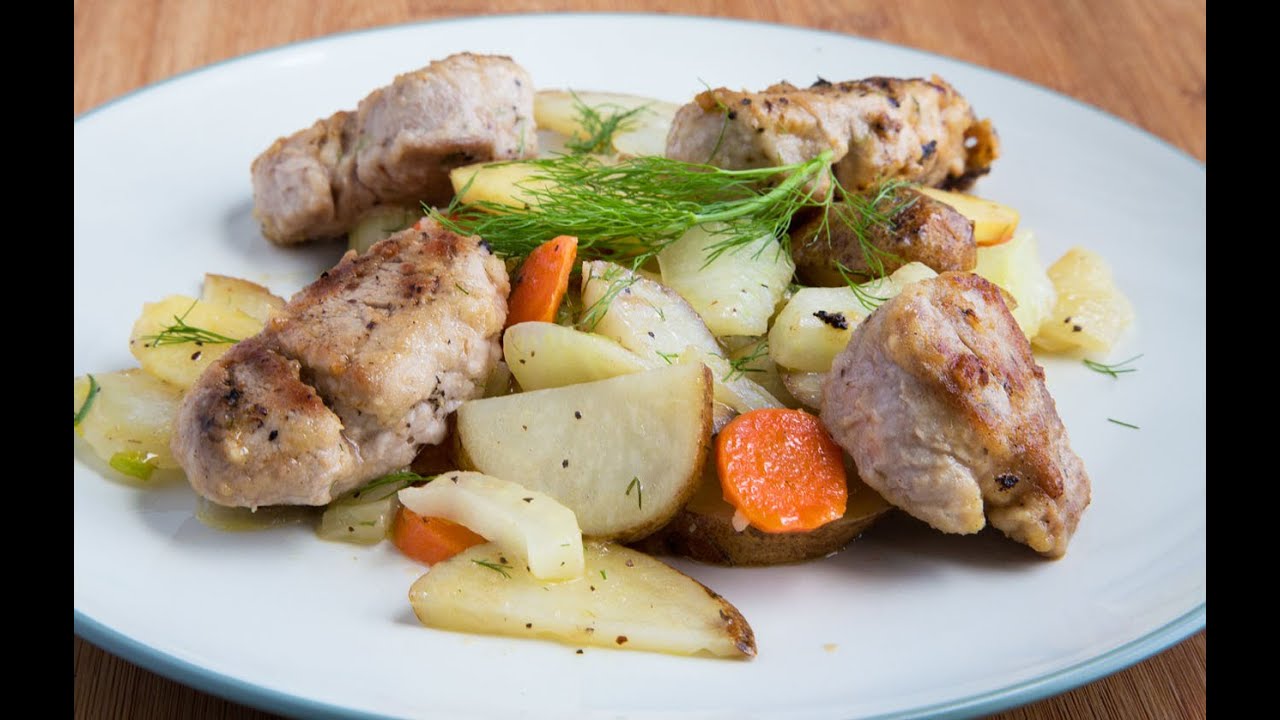
In this episode of Around the Kitchen Table, Chef Dennis Littley and co‑host (Speaker B) demonstrate a one‑pan skillet dinner featuring pork tenderloin, apples, potatoes, fennel, onions, and carrots. They walk through the entire process: selecting a regular frying pan, seasoning and flour‑dipping the pork, searing it, sautéing vegetables, adding apples, deglazing with chicken stock, and finishing the dish in a 350 °F oven for about ten minutes. Throughout the cooking segment they share practical tips—how to test pork doneness by touch, the benefits of a quick sear, when to use convection, and how to adapt the recipe with chicken, different vegetables, or roasted peppers. After plating, they discuss the importance of color and garnish. The conversation then shifts to a personal kitchen‑renovation update: Dennis talks about his island, fridge preferences (French‑door over side‑by‑side), desire for larger freezer space, double ovens, induction, convection and steam‑convection, and his decision to forgo a microwave. He also shares anecdotes about weight loss, upcoming moves, road construction, and a summer trip to Ocean City. The episode blends instructional cooking, kitchen‑design advice, and casual banter, offering viewers both a concrete recipe and insights into a professional chef’s home kitchen workflow.
Chapters
Hey, I'm Chef Dennis Littley and welcome to Around the Kitchen Table. It's another beautiful day in Florida. I know you people must get sick and tired of hearing me say that, but what can you do? I live in Sunshine State. So how you doing, Susie?
I'm great, I'm great, Chef. It's sunshine here, so that's a good thing. It's probably 37 degrees, but it's only April. I mean, maybe by the time it's June we'll be up to 50, hopefully. So it's been a long winter, but it's sunshine out and it's good. And here we are. So I'm starting to look forward to— actually, Sunday was beautiful weather. I was outside photographing and it was, you know, you may remember when you're inside in winter for so long and then you go out again, it's So nice. But then our winters must almost be like your summers when it's too hot to go out. I don't know if that's the way it is down there.
Well, you know, last year they said it was a not as hot of a summer, but we had so much rain. But I did not find it that much different than New Jersey. You know, New Jersey can get kind of hot and steamy, and very— yes— and I didn't notice the humidity. The only thing I noticed that was different was when I went outside in the sun I would start to bake. It wasn't that I would start to sweat. I wouldn't notice how hot I was until I touched my skin and went, "Oh, crap. I've got to get in shape." I know.
I know. It's good.
That's why they invented air conditioning, from the car to the store.
That's right. That's right. We have some interesting things to talk about. You're going to make a great dish today. I'm excited to talk about it. I'm so excited, I'm already starting now instead of later in the show. But we both are doing our kitchens at the same time. So we're going to start a series of, you know, of the kitchen experience from both our perspectives and the ups and downs. And let me tell you, it's a journey. It's like childbirth. It's a journey. Hopefully it'll end up, you know, with an adorable, beautiful,, you know, finished look. So, so we're gonna, you know, take us through those steps.
Sounds good to me. You know, I'm loving the thought of redoing the kitchen. This is pretty much the last step for us here, that and a new bedroom set, and we're done. And Lisa's already been hinting about moving somewhere else in the state, you know, same area but to another location. So I'm going, well, all my appliances are coming, but you know, I don't think we're really going to move is the kicker. I told her, go ahead and find someplace that we can afford to move into, which is not going to be really—
Okay, I was just like, alarm bells was just— I know, I know.
But she's talking about it. But you know, part of the problem is, is we have this road coming in that they have been working on for a year, a year building a new road. And I never knew so much went into a new road. And I think once that road's finished and it's easier to get back and forth, because right now that's what's bothering her a lot is the road. Once that's done, and they're building a train station right by us so we can zip in and out of, to go to Winter Park that we love visiting, and also it's gonna, from what I heard, it's gonna go to the airport. So it'll be like, duh!
Oh, that'll be convenient.
I mean, a mile from the house will be the train station. A mile and a half. So that's great. Yeah, so I don't think we are moving, but it's always good to let Mama think that we are.
That's right. That's right. You are looking good. You're dropping some weight, and you're looking terrific.
30 pounds.
Wow.
I may have to get this jacket company to send me some new jackets if I get too much thinner. It's not as difficult. Some days it's harder than others. Some nights I'm really hungry. It's good because I need that discipline because that was when I would eat while I'm watching TV before I go to bed, which is the wrong time to eat. So it's good that I'm trying to build this discipline where I know I can say no, I'm not going to eat. I'm just going to sit here, watch TV, then go to bed.
That's right. That's right. Sometimes you, sometimes you have to take it hour by hour, minute by minute. You really do. So that, that's great. So tell us about what we're having today.
Well, you know, I was thinking, actually I was browsing through some magazines and I saw that they were doing skillet dishes.. I thought, you know, that's a great idea. So, you know, they had something on the page and I took the idea. I'm not making what they had on it, but it's kind of basically the same. We're going to make everything in one pan. They were using cast iron skillets, which, you know, is really nice too, but I thought for this I would just use a regular frying pan since maybe a lot of people don't have cast iron. It's going to come out the same anyway. So I'm going to use pork tenderloin. We've been making things with chicken, so I wanted to vary it up a little bit, but This could very well be done with whole pieces of chicken, with chicken legs, thighs, bone-in, and it would come out really nice. The thing about a skillet dinner is if you think— like, you want to get it to a point where it's done, but if you think it needs more time, you can pop this into the oven to finish up. Let's say we're starting the skillet dinner, now you want to go get a shower and get dressed. You get it to a point where it's almost ready, you throw it in an oven and let it finish in the oven while you're getting ready for dinner.
Okay, now I took chicken thighs out tonight. Can I do the same thing with chicken thighs?
Absolutely. A lot of it comes to, again, whatever vegetables you like. Chicken with Brussels sprouts and potatoes, sweet potatoes if you like sweet potatoes. You just have to watch because they don't always cook quite the same. They might take a little longer. Sweet potatoes, onion, just any mirepoix vegetables, any type of color. That you feel could go in. You could even go as far as— like today we're going to go in a different direction. We're doing one of my favorite combinations, which is apples and potatoes with onion, and then I've got a little bit else to throw into it too. But you can always go in the direction where, you know, you're just making almost a stew too, and it's still going to be a skillet dinner. And maybe we'll do those another day with your regular mirepoix of stew vegetables, a can of tomatoes, boom, First, we're going to do the meat, put the meat back on it, throw it in the oven, and then go about your business until that's— give it about half an hour to cook, and you'll be done. Wow.
Okay. One pan meal is where it's at during the week.
You could use a deeper one like I have, the Sawtooth I use on a lot of shows. If I was cooking for 4, I would use that. It's an easy option, an easy way to do it. So it's pretty simple on how we're going to get started. So let me start— I'm also shooting a video today, so let me start that. Okay, that's running. And so we're going to start by, of course, heating our pan up. Switch over to that. And once the pan starts to get hot, we're going to add some olive oil to it, and we're going to start searing the meat. So to sear the meat, First, we're going to add the olive oil in. And then I've got my pork already cut and ready, and I cut it into about 1-inch thick pieces.
Okay, so that's a pork tenderloin. That's a pork tenderloin. Long, narrow.
Yes.
Okay.
Now, if I wanted to make a piccata and I wanted to sauté fast, all I would have to do is take this and pound it out a little bit to flatten it. My pan's almost ready, but you see there's something here. Make sure that—
And you know, you mentioned apples, apples and onions, and that's, it's such a, it combines to be almost a savory. Well, you have the savory taste of the onions. I put apples and onions in my stuffing, and they just— there's a little sweet— you have the sweet and savory kind of, but a little, you know, the great flavor of the apples with the— it's a great pairing, I think.
Oh, it is. So now we're going to do is put in the pork tenderloins. I just learned a very valuable lesson. Shooting video on my camera eats through the battery like nobody's business.
Oh yes, okay.
So I'll have to come back and do that later, but for now we'll just finish with this.
Yeah.
Important part anyway. So I'm just going to sear it, and this is an important step in doing this because You're kind of sealing the meat a little bit. You're protecting it. You're seasoning it. In the flour that I dipped it in, I had sea salt and black pepper.
Okay.
So, and we're going to sear it. Now, pork doesn't take a real long time to cook, and you can eat pork just a little bit on the rare side too, if you're so inclined.
Well, that's always the big question. In fact, we had that question From Davinia, how do you know when the pork is done?
Well, the pork is— you're going to be able to tell again, just like any steak, when you push on it. It's giving a lot right now, which means it's still not quite cooked. As it starts to firm up a little to the touch, you'll know it's more done. I mean, the rule of thumb with a steak was you push here and that's medium rare. Okay, when you push on your part of your hand— okay, that's medium rare. So it would be a little stiffer than that. Now the one thing about this is, is while we are cooking it, I'm not as concerned about finishing it, finishing it here, because it's going to go back in the pan when my vegetables are ready. All right, and so if I was going to pop it in the oven Once I get a little bit of color on both sides, and you can almost see from the interior that it's getting cooked through. You want to think of this in terms of tuna, too.
Okay, so the point is just to get a sear. Yeah, you want to get probably a quick sear.
Yeah, and if you wanted to finish this in the oven, you know, this would be the time to take it off because the heat, it's going to cook pretty quickly. So we've got a quick sear on it now. I'm going to just take it out, put it aside, and then I'm going to begin sautéing. I actually have some fennel here.
Oh, okay.
A little bit. I'm going to add a little bit more oil.
You know, I never cook with fennel. I don't know what to do with it.
Well, it's great in any roasted vegetable mixture. If you're going to roast a vegetable, throw some fennel in. Oh, it's just lovely.
Okay.
Okay, now I'm going to add in the potatoes, and now I'm going to add in some carrots. I'm going to hold the apples just for a little while, and the carrots are basically here for color. I just, I needed to put something bright in here.
Okay, quick question. The fennel has this big bulb at the end.
Yes.
And then it goes out to whatever it goes out to. So what part What part do you use and what part don't you use?
What I do is I take this big bulb, I cut the very end off, and then in this little core, you want to cut the core out. Can you see that?
Okay, yep.
All right, cut the core out, and then as I slice it down, I'm just going to slice it like an onion then. And you can go up to here if you like, and I like to use the leaves for either seasoning or for garnish at that point.
Great lesson in fennel. I won't be afraid of it anymore.
Fennel is a wonderful vegetable. Now these are getting sautéed. I have some onion I have to put in too. Almost forgot my onion. And the onion is what really gives this a nice flavor as it caramelizes. Now I'm going to let this go just a little bit longer longer because I want my potatoes to cook. I can move it around. Now I'm going to season it up with a little bit of black pepper, a little bit of salt, and then I'm going to lay some apples in here. And you can cut these in chunks, you can cut them in, you know, slices, whatever you like.
Wow, that looks like one savory dish. I bet that has a beautiful fragrance.
Oh yeah. See, now if you were making it for two— this is pretty much for one since I'm still not eating, so this is a nice portion of vegetables. She probably will not eat all this, but sometimes she surprises me when it's really good and then does. And then to finish it off, you know, once I've got everything in this, I'm going to take a little bit of the chopped fennel and just use it as a garnish. Now at this point, I would put everything back, pop it in the oven, and then just let it turn. Now the only other thing, if it's going to go in, you might want to add a little bit of chicken stock. Oh, you're going to go in the oven with it. Let's put a little bit of chicken stock in. And you could do that whether it's going in the oven or not, but you don't want it to fry. So at this point, it would go into a 350-degree oven for about 10 minutes.
Okay, and you do that just so, so the vegetables on the bottom don't burn?
Yes. Okay, add a little flavor, and then everything should pretty much cook up the way you want it to. At this point, and you can plate it up. Now to plate it up, let's do that real quick for you. It's really simple.
So easy. I have to try that.
Cooking has to be. So then to plate it, what I'm going to do— I'm just going to pull the pork out real quick while I'm showing you— is I'm going to take beautiful apples and fennel. Mmm, smells so good.
And all fresh, everything is fresh.
Right, and you know, you don't have to put it in the oven, you can finish cooking everything the way, you know, just as you're going, and then you could plate it.
Is that what the restaurants do? Do they finish a lot of foods in the oven?
Yes.
Why? I mean, I've done that several times. I just feel like it just all kind of cooks together from every top and sides and bottom. I don't know.
It's about timing, right? And in a restaurant, timing is critical. So you might want to make sure that it's going to come out at the right time. And if you're making 20, 30, 40 dinners at a time, you've got to time it properly. So finishing to a point where you know it's going to take 10 minutes in the oven, 15 minutes in the oven. Now, you know, at some points they may not even put it directly in the oven. It may sit until you're ready, and then it'll go in the oven. It depends on— everything's timing. You know, I should make this when I know— let's say the waitress is coming in and picking up, or putting in the appetizer order. As soon as I know the appetizer is almost ready, I would start the dinner. Then you saw how quick it went. Honestly, if I was doing a lot of these, say this was the special, I would cook up a whole batch of this vegetable and I might do it all in the oven.
Okay.
I roast all the vegetables and have them pre-roasted and then have the pork seared. Some people will come in and they'll order the pork medium rare or rare.
Yeah. Wow.
You know, you give them the option at that point. So that's pretty much it. This would be, you know, if it was cooked just a little bit more, That looks great. Finished plate.
Love it. Love it. As usual, the textures, the colors. I can only imagine the fragrance.
Ah, smells great. And you know, the important part with adding some color into the meal, if I didn't put the carrots in, you know, it would be kind of monotone. So think of what vegetables you use, and sometimes whether, you know, and carrots actually do go very well with this because of the apples and the onions. But you know, you want to always add, you know, a lot of times you see I add roasted peppers or peppers.
I was just going to ask about roasted peppers.
Peppers would be great too in this, you know, would be nice, a nice taste. But you want to add something that's just going to have a contrast of color because again the pork is kind of gray too. So you don't want the plate to be completely monotone. That's why I was kind of pulling the carrot out here or there. I might pull another carrot to set it somewhere where you're going to be able to see it a little bit more. Plating is sometimes as important as serving. If this was for a family of 4, like I said, I would probably roast all the vegetables ahead of time, sauté the pork, and then just transfer the pork on top of the vegetables, finish it in the oven, and we'd be done. Still one pan, really. Just line your cookie sheet with foil. You don't have to worry about it. Then just serve it all up family style on a big plate with the pork around it or the chicken. This would go very well with chicken.
I'm doing that tonight. I'm absolutely doing that tonight. Great. Yeah, good. Looks wonderful, Chef. Another good meal. So let's see, we have with us, we have some friends with us. We have Ron Snaeberger with us. We have MJJ, Namal Diaz with us. And yeah, we have some good viewers with us.
We do.
Yep. So let's Let's switch and talk about the kitchen a little bit. Now this is going to be fun. I want to interview you a little bit. I want to ask you what, you know, you hear about the dream kitchen. So there's a dream kitchen and then there's reality. And, and, you know, from what I understand, you're happy with the basic layout of your kitchen.
I am. You know, I have never had an island before. And I absolutely love it. My only thought on that was that possibly it could be just a little bit bigger, you know, you know, not to intrude on any other rooms, but I'm thinking, you know, 6 inches on either side wouldn't kill it, except maybe on this side, but 6 inches going around wouldn't hurt it. You know, just to make it a little bit bigger, because like I said, I love it for entertaining. I love it for the shows. You know, we'll even eat here now for breakfast and lunch. We save the dining room for dinner. So it's really— and it's a focal point of the house because it's laid out right in the center.
Yes, I— yes, that I know. So if we talk briefly about appliances, what would be on your wish list? Not necessarily in terms of brand, but, you know, Gas, electric, oven, one oven, two ovens, refrigerator, what do you think you're thinking of?
Well, in terms of refrigerator, you know, I would like it to be one of those new ones that have the French doors where it's all refrigerator on top and the freezer's on the bottom. The side-by-side was probably one of the worst inventions ever made in terms of refrigeration.
Yes, you're right.
Because there is no room to put anything in the freezer. At all. So, you know, one of those is looking good, and I would like it to be— I think I have 33 inches here, and the other ones are more like 36. I'd like to get it a little bit bigger, you know, even if it meant sacrificing a little counter space back here, because I don't use that very much since I have the island. It's really all about this. And then— go ahead.
No, no, I was going to say, you know, statistically, you open the refrigerator part 17 times to every single time you open up the freezer. So it makes sense, it makes sense functionally to have that bottom freezer and the upper, you know, the upper refrigerator door, much easier to work with.
Easier to work with, and it seems like you can store a lot more because of how your storage is set up.
Yeah, I mean, you do usually get a little bit smaller freezer than the side-by-side, But, you know, it depends on how you buy, too. And if you buy a lot of fresh foods, then having the larger refrigerator section is certainly better.
Oh yeah, the refrigerator. But, you know, on the freezer side, like, you know, when I shop, I'm a chef, I go to restaurants, eat a lot of 10-pound boxes of lobster, 5-pound bags of shrimp. So, you know, I need that extra freezer space to keep things that most people probably wouldn't have. And to be able— you know, I put everything in Ziploc bags, but to have everything a little more orderly, along with a bottle of limoncello in the freezer too.
Oh yeah, oh yeah. And you know, for cooking, I'll tell you, I just made the decision this morning what to do, but I was struggling between a single range and a cooktop and double ovens because I could fit either or. I could fit the double ovens, you know, if I wanted to. I just decided on the separate cooktop and double ovens. But how about you? Well, you know, you think you'll keep it as it is?
As is. I like some of the newer ovens that have two oven receptacles. But, you know, I don't know if I Honestly, I'm a 350-degree guy. I rarely cook at different temperatures. Sometimes I hold, and it would be nice to have a holding, but I do try to plan things so that they come out at the same temperature. I like the idea of having the bigger oven sometimes, and— but I think that's more to do with the width and the depth than the actual size up and down. So, you know, that, that's still a gray area. You know, all things being equal, you gas would be the choice, but I can't have gas here, so electric. And with electric, the choice, induction would be wonderful. I would love induction.
Yeah. Now, what about convection?
Oh, definitely.
You've got to have convection.
Absolutely. And I see they're doing more with convection now. Isn't there like a steam convection?
Yes. Yeah. I know one brand injects the steam into the freestanding range, and then you have these separate steam convection ovens. Even steam convection microwave ovens. So yeah, it could drive you, you know, it could drive you crazy. Are you interested in injecting steam into— you know, supposed to be good for baked goods.
Yeah, I know. And again, I'm not the big baker anymore. So, and honestly, a lot of times for baking, well, I had the convection oven, I had the convection at school. Were great, but sometimes a convection will rush baking if it's something that doesn't require a lot of time, and with cookies, you're better off on just a regular setting because they don't have time, they heat up so fast. So I found that in some baked goods, you're better off just using a regular oven. It's not taking, you know, it's not something you're baking for an hour and a half.
Well, I will tell you, um, I will tell you from my knowledge of appliances that the recommendation is that for convection oven that you turn the temperature down at least 25 degrees, right? So which— yeah, I guess you knew that. So that then things can take a little longer time.
Yeah, but you know, for the most part, I love it if I'm roasting something, you know, things take less time. It's just nice to have that option, you know, whether you use it or not all the time. It's nice, you know, even at work I wouldn't always use the convection setting, but when I needed to, it was there. So, you know, as a chef, you know, I think I look at things a little more than just black and white, and there's variances on everything that I cook. And sometimes I want pushed and cooked fast, and other things I want to have a little more control, mostly so I can watch them better. It's not that the oven's not doing its job, but my skills are divided or my attention is divided, so I may not have the attention to stand there and take advantage of the really quick time that it's cooking something at.
Okay, that makes sense, that makes sense. And do you use a microwave?
No, I do not. I have not had a microwave in over 20 years, and the last one I owned was only for melting butter for popcorn and reheating my coffee. And I wouldn't mind one for reheating coffee, but that is all I would use it for.
That's interesting. Yeah, you know, more and more people are I think moving away from microwaves. Actually, there's these new ovens called speed ovens, which they may not be as fast as microwaves, but they do more. They do more.
I understand the need for them, and I understand that some people have to have one. Personally, people are generally shocked when we tell them we don't, especially when Lisa tells them. They're like, "I can't believe you don't." She goes, "Well, I don't cook, so I don't need it anyway." Then they're really upset with her. In a kitchen, a professional kitchen, we might use something to quick-thaw something. If somebody cooks something in the microwave, I just— it's just not something— it changes. If you're going to eat it right away, most times you're okay. If it sits for any kind of time, it dries, it toughens.
Oh, yes. Yeah.
It's just not a good thing, and it changes the cellular makeup. It even looks different. Cells of what it's cooking. So, yep.
Yeah, so you have a good— well, let me ask you this. Does it— does Lisa get involved at all with the cooking? Do you ever get a bottleneck where you are with, you know, with you and Lisa within that area of the appliances?
She generally waits till I'm clear of the area to move in for anything because she knows I'm gonna go, move! Right, right.
Go ahead.
I've gotten better at not saying move because I used to upset her. So now I'll just say, excuse me, dear.
Yeah, I know my husband and I sometimes, it's funny, it's like walking in New York City. There's like a culture to walking on the sidewalk in New York City. Like who's going to move first, who's going to refuse to move. It's hysterical. In my other kitchen, it was set up to be a bottleneck, and depending on our moods, we would take on either of those things, and it's really funny. So traffic moving around the kitchen is something to discuss and figure out right away.
Yeah, now this is, you know, I am a chef and I am a man, and it's like, stay out of my kitchen. You know, people come, "Can we help?" "No, you can sit down and eat, okay?" That'll be the help. Or, you know, now with the chairs set across from the island, now people can sit here and watch and talk to me, and that I don't mind at all. You know, if I'm turning and raised as the chef in a kitchen, when I turn, there better be a clear path for me, and you better tell the dishwashers right away to move to the side so I can walk by them, you know, and that's kind of the mentality that carries over, unfortunately.
Wow. Well, you know, I had a client once who who was an amateur chef, let's call it that way, loved— I mean, cooked fabulous meals all the time and loved to entertain. And the way he wanted me to design the kitchen was to have the cooktop on an island, you know, with I think 4 or 5 stools so he could, you know, really interact with his guests and he could just be a real part of the cooking process. Because that's what he loved. And I— so, you know, what you're saying brings, brings that back. And you'll— plus you're in an open floor plan. So on each side of your island, plus behind your island, you know, there's plenty of places for people to go.
Oh yeah. And you know, I would love that if I was going to be doing more demonstration cooking and I was doing a lot of that type of entertaining.. But I would hate to give up the space on the island. And that's— I mean, if it was a longer island, if I had more room, then definitely the cooktop would go on it. And I might even think of putting the sink back where the oven was, because that wouldn't bother me at all. But, but all things being equal, the way things are set up and how this kitchen is set up, you know, yeah, I would opt for leaving it where it is. And generally, when people are coming over, I'm Like, if I tell them 2 o'clock, I mean 2 o'clock, because at 1:45 I'm still scurrying around like a duck above water with my feet flapping like crazy, getting everything done, because at 2 o'clock I'm going to be pretty much done and set, and I might only have a few little touches to make, so then I can be pleasant and talk. I've actually seen people to another room when they showed up early, I'm going, "It's 1:45, what are you doing here?" Geez, no, I know you can never go early.
No, come early.
You just listen to those to greet them at another door.
Right, right, right.
Hi, and wave to me, and then move them into another room real quick.
Oh my gosh, oh, that's funny.
You know, people that aren't in the food service industry don't understand that to a chef, 15 minutes is an eternity. You know, you can get— especially at the end of the process of cooking, you can get so much done in that time.
Yeah, pressure. There's a lot of pressure. You're feeling the pressure. Yeah. And so, so where do you do most of your— do you do both your prep? Obviously you do the cooking there, but do you do the prep on the island or the prep on the other counter?
I do the prep on the island because I have a garbage disposal here, so stuff can go down there. I have my trash can by the sink for everything else. I can rinse off whatever I'm rinsing, like I scrubbed my potatoes this morning with a metal sponge before I cut them. I peel the apple right into there. So it's really set up to work well for cooking the way it is here. Now when I bake, I bake back there. So that's my baking area counter, if you want to call it that, because my mixer's back there. And rather than move the mixer every time I'm going to use it, it's just— and my drawers have my measuring cups, my spoons, my utensils that I'll use for that.
So yeah, that's all next week's discussion.
Yeah, but I mean, that's kind of what I delegate the areas to because I'm fortunate to have the room. You know, it's not like I have to keep switching it over.
Yeah, so it makes sense that you need the island a little bit wider.
Yeah, you know, not a lot, but I mean, any extra room would be a bonus at this point. And then, you know, my sink is probably too wide for the space. It's a double sink. And I did put in a new faucet because I had to.
Is it a double sink with equal bowls?
Yes.
Oh, that's the worst thing in the world.
And it's not deep enough. I'm used to a deeper one.
Oh my gosh, yeah. When it's split evenly, each side is too small.
You can't do anything in it. Nothing fits.
No, I know. I was going to ask you about the sink.
Yep.
So good information.
Oh yeah. So, you know, little by little, things will start coming together. And, you know, I know it's going to be gorgeous when it's done, but it's just waiting to get to that point.
I know. Well, we're on a roll now. And every week we're going to be doing kitchen updates and lots to talk about.
Very good. Sounds like fun and good. You know, we'll hopefully we'll get things moving along and Yeah, I'm excited about it. Now I am going away to— we're going back to Ocean City for the summer. I don't know if I told you that.
No, really?
Unfortunately, it's not my decision, but Mama wants to go back for the summer, so yeah, we'll be driving back to OC for 5 weeks, and I told her I would stay for as long as I could.
Okay.
This, to me, this is still home.
So yeah, well, change is good. It's good to have a little change. It really is. So I think it'll work out. So good show today. Great meal. And, you know, we're on, on the road to kitchen heaven. I was gonna say kitchen hell, but no, it's kitchen heaven.
No, let's hope not kitchen hell.
I know.
We'll leave that to Gordon Ramsay.
Yeah, that's right.
All right, well, thank you all for joining us today, and I hope you enjoyed our skillet dinner, our one-pan dinner, and you'll be back for more Around Our Kitchen Table next week. Bye-bye.









