The Bloggers Guide to Using Google+ Effectively - Semantic Search with David Amerland
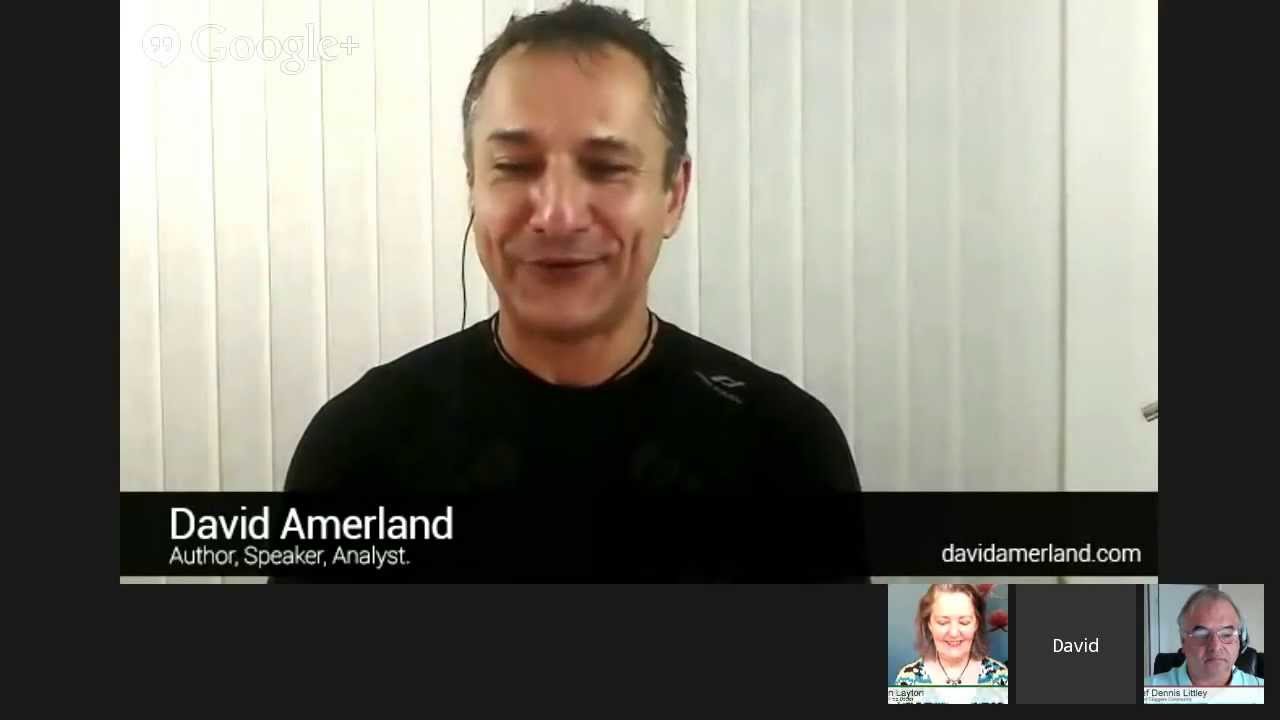
David Amerland explains how bloggers build authority through semantic search and Google+. He outlines a four-step trust model: contact, perception, evaluation, connection. Success requires clear purpose, originality, and social amplification across platforms.
Chapters
Hey everyone, I'm Chef Dennis Littley and we're here today with my co-host Jean Layton and our very special guest, Mr. David Amerland of Semantic Search, to talk about how we can improve our semantic search. And of course the show is The Blogger's Guide to Using Google+ Effectively. And of course, you know, we also don't expect everyone to be bloggers out there. We just kind of narrowed our approach on this when we started this whole lovely endeavor that we began about, what is it, 10 shows now?
10 shows, yeah.
So we're having a great time with this and we're going to continue it. But you know, again, it falls into an area where a lot of people can really benefit from what we share on this show. So very happy to be here today. I'm going to turn it over briefly to my co-host Jean Layton, and then we're going to move on to David.
So how are you doing today?
Hi everybody. I'm good. How are you doing? I hear you've got wonderful weather and we're rainy here.
Blue skies and sunshine, it's Florida, baby.
At least I'm not shoveling it, right? I've got rain, not snow.
Our poor friends in the Northeast.
That's good. I'm just dropping into the comments the URL of the post about today. This is the first time it's not a step-by-step instruction because there are so many nuances to semantic search and it's incorporated in every part of what we do here on Google+ that there isn't a step-by-step guide. There's a little bit of information, there's a connection to both David's community and Martin Shervington's community talking about Plus and semantic search, but it's not a how-to. It's in the comments if you need it today. But otherwise, we get to talk to David Amerland, one of my favorite people from The moment I set foot into Google+, I think I followed David within a day because he gives incredible, carefully guided information that everyone should know so that we all are doing things without harming our message. So I'd like to just kick it over and let David talk.
That sounds good to me, Jean. Let's hand it over to David and let him do his stuff. And guys, if you have questions As usual, put them in the comment bar. We will do our best to get to them. And let's take it away from there. David, it's all yours.
Jean, thank you for that introduction. And Chef Dennis, thank you both for having me here. I think the particular subject we have today about blogging and semantic search and how it should be done is particularly crucial at this stage of the conversation. We've had now semantic search for some time being active. Since last year, and we're beginning to see some of the results, and also the questions begin to come in as awareness rises. And really what I'm hoping we'll focus on today are the practicals, or the actionable advice that a blogger needs. And semantic search, it has to be said, is really complicated. It really is rocket science, although search never used to be. But the effects aren't, and certainly in order for us to get somewhere, we don't have to complicate our lives as long as we are aware of the particular issues we need to be tackling. So let's begin with a few basics. And one of the questions is, if you're blogging, what are you actually doing? And yes, it is writing, but this is not what you're doing. You're using writing as a medium, but really your effect, what you're actually trying to do, is something entirely different. You're trying to get your knowledge out there, certainly, and you should be. You're trying to generate value. You certainly are doing that. And you're trying to project a certain amount of your personality and establish a certain percentage of your identity. And I say percentage here because there are a lot of different subsets of information and actions which go into forming our online identity. So content creation and blogging is just one of it. So I'm hoping we're going to get a lot of questions as I go along, but I'll start off by explaining a little bit of the steps, the initial steps that any blogger should actually keep in mind in a semantic web. And really, there are— we begin with the easy ones, which is value. And it used to be that if you blogged, it was an easy out. You needed to have a presence, and you needed to get your thoughts out there. And you could basically use a blog because you didn't have to write articles. And there was a difference between articles which had a beginning, a middle, and an end, and a very thoroughly structured approach. To blogging, which sometimes was stream of consciousness. It was very personal. It was very personable. And over the years, we have seen a diffusion between the two in terms of the style and certainly in terms of how now they're approached in terms of the value that they deliver. And by that, I mean that if you blog and if you're not aware of the structure of a well-thought-through argument or piece of information or instruction in anything, even if it's a recipe, then you're missing out on the first basic step, which is communication. And really, you're blogging because you need to communicate. You need to communicate because you're trying to establish your presence and find your audience. And all these things tend to go together. And they're not part of the semantic web. They're part of semantic search because they help define the value you generate, the audience, which will give you the interaction you need, and certainly begin to define your style and voice on the web. So let's go back to actionables. The first thing, suppose you're a brand new blogger and you want to start blogging tomorrow, and the first thing you'll have to answer to yourself is why. You have to establish why you're doing it in very clearly thought-through stages. It can't be just because I like it. It can't be because I think I have value. That is not good enough anymore. You really need to define it to yourself. You need to say, well, I'm going to do this, and I'm going to do it differently from anybody else. And it doesn't matter if you're putting on the web how to do French fries. You can get probably a billion recipes on how to do French fries. You need to do it differently. If you can't do it differently, you're wasting your time. You're only giving some information which is exactly the same as somebody else's out there. You're wasting effort and energy, and you're missing out on the opportunity to let me as a reader know why I should read your post. And on that note, I have to say that we live in a world which is governed by two things. It's governed by the attention economy, and which— rather, it's governed by one thing primarily, the attention economy. And attention is what is really limited. This is what we're actually striving for, we, all of us, in terms to get anywhere on the web are trying to get the attention of our audience. Our audience in turn is receiving a lot of impact points vying for their attention, and they have to prioritize. And shouting louder or loudest here no longer works. Nobody can shout out loud enough to drown out everybody all the time. It just can't happen. So really, the only way that you will find the audience you actually want in terms of the people you want to read your blog posts, they need to propagate your information, they need to follow you and become your evangelists eventually, is to actually be able to answer that. Why am I doing it? In very clearly defined terms. So we start off with that, really. In your head, it has to be answered completely. And that should be your touchstone. It should be the touching point in terms of, let's say, your blogging career on the web. If you have any questions at this point, I'll take them. Otherwise, I'll go into the next slide.
I am not seeing anything that's specific, David, so feel free to continue.
Okay, so once you define why, then you have to answer how, and here is where the style begins to come in, because everybody's different in the way we write and certainly in the way we speak. You know, you could be potentially very technical. You could be very light and fluffy but still say things which have value. You could be a mixture of the two. You could be very serious. You could be irreverent. Now, once you realize how you do things, then you also need to think how your audience expects you to do things. And I'll give you an example now. When I was writing my book on Google Semantic Search, my natural writing style is fairly academic because I had done a lot of research in my head. I had joined all the dots. I follow mathematics very closely. So I was actually— I could sort of render that very quickly. And an academic book is not what would have served my audience best. So really I had to go back into the drawing board and look at everything I had written and approach it from the point of view of the audience in terms of what they expected and rewrite it in that sense. Was it hard? Absolutely. But at the end of the day, what I needed to do is what every blogger needs to do, which is communicate. If I had just stuck to the easy for me, I would have missed a large chunk of my audience. And certainly I wouldn't have served those who expected help best. And really, that leads us to the next thing. Because if you are answering how, and you're beginning to synthesize it, then you really need to realize that your defining characteristic as a blogger is your ability to deliver value, stroke, help to those who actually need something when they read your content. It could be a piece of information. It could be that they're looking for a recipe, if you're doing recipes. It could be they're looking for some kind of in, in something specific, and you're going to give them that. Or it could be an idea even where they're struggling with something and tell them, hey, you know what you're looking for, this is how I think it should be done, and hopefully this will help you. If you do not communicate this clearly, you're missing out. Your audience will not actually resonate. The reader will go away. They'll think they wasted their time. And I think all of us have seen in comments sometimes, this is, you know, 5 minutes of my time I won't get back because the content was of poor quality. Now we're talking right now about things which are conceptual. We're talking about psychology of the why and the practicalities and the actionable of the how. And it's funny because normally anything which had to do with search, this was the last thing we would ever talk about. The search of the past was always an execution thing which was based around key metrics like keywords, for instance. And we would start the day saying, OK, what I need today is, for instance, to write 300 words based around pink puppies, because pink puppies is a keyword you're actually doing. We don't do that anymore. Keywords certainly will come into your text. They certainly still play a role in search in terms of surfacing content. But what you should be thinking about are concepts. So if you have in your head the how— sorry, the why and the how— Then you begin to ask, okay, how do I put the content together? And really here you need to begin by answering questions. You need to place yourself in the shoes of your audience, you know, your potential audience if you're starting out now, and you need to think, okay, what are the questions which are pertinent, most pressing in their minds? And you begin to style from there. And basically if you have a certain idea of what your audience is and who they are, you will begin to think, okay, these are the questions which they are looking to answer. You begin to synthesize in a way that nobody else can actually answer them but you, and that's when the connection between them and you begins to become established.
So what I'm hearing, David, is unique answers to pertinent questions is how your semantic search establishes you as the expert. Am I phrasing that correctly?
You're phrasing that absolutely brilliantly, well, exactly. Now, in a semantic search universe, essentially everybody needs to be able to establish their authority. You need to be able to establish your identity, and you need to be able to establish trust. And trust, since we're coming to the trust question, is why, for instance, should I listen to you? You know, if I say, okay, Eugene, and you have a blog, and you give me this recipe, and you say, if you do French fries, this is the recipe to use. And I'm thinking, well, why shouldn't I go to Wikipedia? Why shouldn't I go to, I don't know, my Good Housekeeping recipe from my mum's days or something? Why should I trust you? The only time that I will actually give you my attention and trust you and listen to you is if I feel I know you and I understand what you're doing, how you're doing it, and who you are. And the only way this will happen is if through my encounter with you I have gone through a certain stage, and the stages are that the moment we actually come across somebody, that's the moment of contact, and that's the first point that we actually come across. And the moment— and the next thing, of course, is perception, is how am I perceiving you to be? You know, the first contact, you know, you begin to go through, okay, is this person, the way they say it, is it credible? Does it show their expertise? Do I get a sense that they are confident in what they're saying? Classic example, suppose I'm answering a question and I'm beginning to go, um, um, um, which is, you know, it may be very natural, but at the back of your mind you think, okay, he's struggling with that answer, maybe he doesn't know it, maybe he's not an expert, and this is the kind of thing that actually establishes our own first assessment of the perception of the validity of what somebody says. Now once we have that, then we go through evaluation. Which is the third stage of any kind of content. Once we have the perception, we think, okay, this is worth our time, and then we actually begin to fine-tune it and look at it very closely and see if what that other person gave us really works. And the moment we have evaluation, then the next thing we have is the connection. So these four steps, which are there for any kind of content, begin to generate trust. Because if I get to the stage where you have passed, and that's a hard word sometimes, my evaluation of you or what you do, then I think, okay, Jeanne is great, and now I'm connected with her. So if you were to give me the recipe, for instance, for French fries, I'll take it from you straight away because the threshold barrier now between us is lowered, and I tend to trust you more than, let's say, a recipe from a more traditional trusted source like a recipe book.
Okay, that makes sense because we had a question from one person who asked, um, Tony Rose, 99% of my food— sorry, I'm going to bring it up— of my food blog recipes are developed by me and therefore original, and I try to present the best visuals that I can. Is that enough?
Hahaha, okay, that is a brilliant question. Okay, let's look at it in terms of what we just said. Now, in the past, being original was really key because that's what you needed in order to surface in search because it looked at original content. However, we, in semantic search, as a component, which is a trust component— we're talking about veracity, which essentially a search engine and a person needs to establish your credentials for saying something. If you're so original that no one has your content ever, only you have that kind of content, and you have zero engagement, you have zero interaction, you have zero visibility on the web, instead of saying, wow, great, this is what I need, a question mark is born at the back of most people's minds. They think, okay, how can he be so original? Either he's way out there, you know, he's absolutely so brilliant that nobody has caught up with him yet, or we go to the other extreme, he's absolutely of no, zero value whatsoever. He works in a in a virtual black box, in a vacuum. So really, in order for your original content to establish credentials and credibility and then impact and reflect upon you positively, you need to have the social element. You need to have engagement. You need to have reshares. You need to surface elsewhere, which means this is what you should be doing. If you have great original content, re-share it in a way— first of all, it has to resonate. It has to resonate with people. Then you have to re-share it in a way that they actually come across it. Then if it resonates well enough and it's of good enough value to them, they will amplify that content. It will start appearing elsewhere in sources which you can't control in ways you can't control, but they increase and amplify your own visibility. That then surfaces in search individually. Independently of you. It becomes part of, let's say, my research process if I'm actually looking to see who you are. Certainly I will come across your content in other ways apart from, let's say, your website, and they will bring me to your website. And all this goes— all that wide web of interconnected activity goes back into establishing your credentials for giving that information, which then allows me to form a value judgment on whether to trust you or not. And whether to take it on board and follow it. And if I take it on board and follow it, then I have connected with you, I've gone through those 4 stages which I've mentioned before, which then makes me another potential amplification point. If you won me over, well, I'm not going to keep it to myself, I'm going to tell my brother, I'm going to tell my friends, I'm going to tell my family, I'm going to reshare it perhaps on my social network. So then all your hard work, all the things which you have put in and slaved over and thought so hard about to connect with just one individual, me, potentially come back to you times 100, times 1,000, times 10,000, depending on my own social network and connections. So this one-to-one, which in the pre-semantic web world didn't make a lot of sense— we're working really hard to get one reader— now actually makes sense, because that one reader becomes the amplification point. So does that answer your question?
I think it answers that person's question. It certainly answered the ones that came up in my head. What I'm wondering is, it's not just our personal readers on our blog at this point. It's all the connections we're making to people on Pinterest and Twitter and Facebook and Google+ and Google Communities. They're all adding up to be network of expertise.
Yes, absolutely.
As we start to really manifest the connections we've created. So Chef Dennis with his amazing community of Google food bloggers has a larger expertise web because he has that community all knowing who he is.
Yes, yes, and here's the thing, in the past, let's take it in pre-Semantic Web days, Chef Dennis, however good he is, wouldn't really be anywhere because he'd be competing against Martha Stewart, who traditionally, for instance, was everywhere in terms of magazines and newspaper advertising and TV shows and all that. Now he gets into the place where he can actually interconnect and amplify his presence, validated through interactivity and personal connections, and suddenly he ends up being bigger than her. Because Martha Stewart, by being establishment, which means to a certain degree arm's length, non-personal, non-personable, big brand approach, begins to also create question marks as to the validity of what her brand actually does and the real value it delivers. So this is the counterintuitive approach, which is again semantic search related. Because the web becomes transparent, and we stop working in our little boxes, then the one person we connect— and really we're only working really hard to really connect with one person every time— that one person then amplifies our message and brings us back several thousand, tens of thousands, potentially millions. And we work in a web which is really transparent niche, or the niche-ification of the web, which before semantic search days used to sort of cut the web up into little boxes, and you know, you could only hope to get a small number of people who would follow you, now becomes truly global. So although we work at a very local level, we work at our knowledge level, we work at our expertise level, and then we infuse those with our personality and we make it us, so people buy into us. We said, or rather Google said, that the semantic web is a transition from a a web of websites to a web of people. And this is exactly what we're seeing here. In the offline world, psychologically, we are hardwired to go for personalities and people rather than brands and logos and signs on the wall. And we do that in the offline world, in the online world as well. In the past we couldn't, but now for the first time we actually can. And the advice that we see frequently when it comes to marketing where it says now if you're a person, you are a brand. And traditionally— again, this is another counterintuitive thing— traditionally we would say, well, what, do I need to advertise now? Do I need to get a logo instead of my face? What do I need to do to become a brand? Well, really what that means is that you need to do what brands used to do, and they did it well within their very narrow confines of the past, which is you need to create content and the level of interaction and the kind of engagement which allows people to understand who you are, to understand your identity, and also understand your shared values. And I must say here that at this time, brands have been superseded in that respect because the arena has broadened and have found themselves wrong-footed because what they did worked in the narrow confines of television advertising and perhaps massive mailers and newspapers and magazines and billboards. You take them to social web, you expect interaction and engagement and personality and responses, and you make value judgments based upon them, and brands are wrong-footed. So really now we've come into the area where we're advising brands to behave like people, i.e., project your personality, forget about canned messages, forget about being blunt and faceless and at arm's length. But we're also asking people to behave like brands. Where you have to think strategically really about the impact of what you say, how you say it, how you do it. It's a very public stage and everything you do becomes part of the value judgments your audience makes, so you really need to be aware of that.
There's a question on that then, David. All right, I am myself a brand because I'm a person and I understand that concept and working myself as a brand. Now we have tons of questions all the time and you can find differing answers to these, no matter, you know, you can look everywhere and people are always debating this. Am I better as Chef Dennis Littley, or am I better as my blog title, A Culinary Journey with Chef Dennis?
Well, whichever one you choose, in a semantic web, eventually you will have to become the face of. Corporations right now are struggling with the concept of their CEOs have to at some point fairly soon become the face of the company. A classic example is Virgin or the Virgin Group of companies. We think of Richard Branson for instance, and the moment you say Richard Branson, what do you think? Virgin, that's it, and you don't need to explain what Virgin are, and really nobody really knows because they are so big and so diffused, they go from space travel to providing internet service and telephony, they do so many different things. And yet We know who they are because he is the public face of that company. We know they tend to be a little bit funky, a little bit fun, they tend to be a little bit crazy, and you know, they're constantly pushing the envelope. And how do we know this? They haven't worked to tell us that. He does that through his antics and personality and has become really that face of the company, which shows the power of personal branding. Companies are having to work very hard to do just that just now, and actually later in the week I'm having, on Thursday I'm having a Hangout On Air with David Gingell, who's the NetApp head of IMR. And NetApp are a massive Fortune 500 company. And we examined just this. Should CEOs blog? And my take is, in short, yes. And his take, in short, is maybe not. And this is exactly what we're going to examine. I must stress, there's no— the short answer is yes, you should. You should be the front, the face of your brand, whether you actually go for your blog and eventually get your personality through, and you have to work out how, or you actually post your name and you say, okay, this is what I do. The actual thing there in terms of execution is really a question of strategy, where you're heading in terms of your plan and your business development.. But whether you're going to use your blog to just project your content and allow people to work through that, well, that will not work. We see something like that with writers who think, okay, I've written the book, I'm going to let the work speak for itself. Well, in order for that to happen, people need to realize that somebody has written it, which means publicity, and that person has actually had a thinking process which involved a problem and the solution, and the book is the result, if it's nonfiction. If it's fiction, it's an adventure. But again, they need a thinking process. They need to buy into that, which means that the person, the writer, now has to come ahead of the book, and people have to buy into the writer in order to go and explore the book, because buying a book, even today, is a level of uncertainty, a level of trust. I'm going to give you some money, you're going to give me a product, I don't know what's in it. You tell me it's good. Well, you're the creator. You're bound to tell me it's good. If I don't trust you to think that, okay, if you want my $10, you're not going to rip me off, you're going to give me something which will be at least worth $5, then it's a risk I'm willing to take. But for me to trust you, I need to know who you are, and if I don't know who you are, well, all you're doing is asking me for money. And you know how many times a day people ask us for money in many different ways? You know, we definitely do not listen to them, we're totally tone deaf. When anybody asks for money.
So then connecting on the personal level and then maybe trying to get more going further ahead with your business plan might be better off then, getting that trust factor first.
Well, absolutely, because I mean it goes like this, and here's the thinking behind it. If you establish yourself as a person who fronts your business, whatever your business model may be, it can change on a dime. Without actually affecting the potential sales impact or the potential market share, because your personality doesn't change, just your business plan. If you put your business plan first, the moment you change that, you're changing your entire approach to marketing, you're almost leaving your past audience behind and you have to find a fresh one, because the way you market defines the way you actually reach your audience and the kind of audience you reach. If you do it through you, people buy into you. You know, today you're doing recipes and tomorrow you bring out a book on fitness, for instance, and you say, "Hey, you can eat all day and get fit," and I'll believe it because I know you and I know it will actually have value. But you know, this kind of approach, this kind of sudden change in direction is something which people can do really well and not suffer for it because we can see the logic behind that, and companies can't. And again, we're talking in a wider context here. Companies are being wrong-footed on the web. Large corporations are finding it very difficult to advertise to us, and they can't understand why. Well, this is why. Because the moment they try something different, we don't know why they're doing it. We're thinking, OK, what's going on? They bring out— I don't know, let's say the favorite of companies. They bring out a new packaged food recipe, and they put on the COVID new improved recipe. The moment I see that, I'm thinking, all those years I was buying the old one, was I buying rubbish? I mean, why did they just improve it now? What's the deal? And this, it's a very valid point of view because it's a communication point. They don't tell me what they did. They're telling me what they want me to believe. I'm not buying that. None of us are. So really, the only way that I would actually understand what they did and think, oh, this is 'Pretty cool, I'm actually gonna buy this again because they've improved and they did all this research and they've improved the ingredients and lowered the cost and it's better than ever,' is if somebody tells me, and that person has to be somebody I trust.
So David, a fair number of us food bloggers work with brands to be able to create unique content. Is our voice as a blogger a better strategy for these brands because our voice is a personal voice than their—
Yes, absolutely. And in a perfect world, every company should have touchpoints in the blogging world where it would be bloggers who, not necessarily in their pay, because the moment we go into this kind of hard transaction, I'm going to pay you to say something, trust goes out the window because you can get paid to say anything. It's a relationship where bloggers may well be doing this as a paid service, but it's a trusted voice. They wouldn't say anything they don't believe in, which goes back to the credentials and trust that a blogger can establish with their audience. And the power of the blogger is exactly based on that very fragile equation. The moment the audience believes that you've been bought, you've lost everything. It doesn't matter how big you may be or how many followers you may have or how many people come to your blog every day. They need to understand and believe, and it's a constantly reinforcing kind of action, that every time you say something, it is very clearly thought through, it is filtered through shared values which you share with your audience, and you're acting as their trust filter essentially, which is why they believe you. Brands which are clever and real and want to have a voice need to work through those bloggers and need to find who those bloggers are, establish a relationship which allows the blogger to really trust the brand, not just their money, and then trust in turn the blogger to actually do the job for them. Don't tell them, you know, this is what you've got to say. And I've seen this. I advise large corporations on their social media strategy. The number of times I have seen the memos— yes, they still have memos— coming out of the C-suite saying, this is what we want our bloggers to say. It's like, OK, why do you need bloggers? You have PR agencies. Have them write up a press release and send it out there. This is not how blogging works. With a blogger, you have to give them information, explain what you do, explain your strategy, explain everything you've done, and do a really good granular job at explaining. And the moment you do that, then you have to trust the blogger to do their bit. And in order for you to trust them, you need to develop a relationship with them. And it has to be a real relationship where you also understand the pressure points and the value judgments of the person you're working with. So this is a very different world. Companies are not used to working like this. They're just beginning to get to that point. Again, it's a mind shift. It's a mind shift from both sides. So we're in a phase of transition right across the globe in that respect, and we're seeing a lot of disruption as a result of it.
I know with a lot of the parameters that I get sometimes working with brands, and I don't work with very many brands because of this, is that they kind of start to suck all the fun out of what you're doing, and they give you so many restrictions that the honesty and truth of what you were saying is no longer important because you're just delivering a message, like you said. So, you know, and you get money for it, and then you kind of feel dirty about it.
Yes, exactly. It's a mouthpiece. And, you know, the moment you become a mouthpiece, the moment you can't apply your own sense of values and its own sense of interpretation in what they've given you, you feel used. You may do it because you need the money, but your conviction is no longer there. The moment your conviction is no longer there, your writing becomes flat. You're no longer really working very hard to reach your audience because your point is not to reach your audience but to fill or to fulfill a contractual commitment. And really your end result is to write a post or to write a blog post or whatever. The moment you've done it, you think, I've done my bit. It's failed. You may have checked a little checkbox saying, oh, blogger's doing that, but we have lost the emotional connection with the audience. The only way we can develop that emotional connection— and here now we are, we're talking about semantic search, and we're talking about emotions and psychology. This is how subtle it actually has become, because the human element is prevalent throughout all of these things. So really, in order to have the emotional connection, the blogger has to believe in you. If I was XYZ megacorporation bringing out food, for instance, in this case, I would find the food bloggers who are passionate about what I'm working on, and then I would explain to them how, hey, I'm also passionate about really good quality prepackaged food, if that's what I'm doing. And this is what I'm trying to do in order to feed the world at a price which is reasonable and still make money, because there's nothing wrong with that. But we need to be transparent, we need to be honest, we need to be truthful. And then I can say to the bloggers, I need your help. I have so much to actually help you support your writing. Can you help me understand what I need to do? So this becomes a dialogue now, a real dialogue. A brand needs to learn from the bloggers. They need to learn about the audience because the brand can no longer really talk to its audience in the same voice. Bloggers in turn need to understand and learn about the brands. And this is the constant dialogue. It's a very fluid situation we're in right now. We never had it before. We used to have very ossified really blocks. We used to have Brown XYZ, this is what it is, 200-year company doing prepackaged food and we changed our logo for the first time in 150 years because we're evolving. You know, it doesn't happen like this anymore. It's very granular, very human. People need a human connection, they need to understand the why, they need to understand the shared values, they need to understand the voice, they need to establish trust and trust is unquantifiable. You know it when you come across it, you also know it when it's not there.
Excellent. We do have a couple questions, so let's try and get to a few of those. Phil Ashton is asking, in some markets, sectors, 70% of website visitors are using smartphones, so shorter posts broken up with bullet points may be shared more or gain much traction. Do semantic search concepts affect the length of the post or does it depend on the subject?
Okay. Yes and no. Let me quantify this. Yes, with semantic search, if you're writing original content and you can go to great depth, or even if you're not writing original content, let's say you're writing the same content everybody else is doing, but you go to greater depth than everybody else, then your post becomes of greater value than somebody else's because it's more complete. And that will be reflected both in the terms of engagement interaction you're going to get. It'll be affected in its assessment and evaluation search, and it's ranking eventually. Does that mean every post needs to be 2,000 words with 3 or 4 links to authoritative sources? No. Really, each post needs to be as long as it has to be. If you're delivering something which is perfect to say in 150 words, then saying that in 300 words is only watering down the value. So really trust in your audience. To receive the value of what you're actually saying. Don't go following convention, i.e., on the phone it's difficult to read, so I'm going to make every post 150 words and a picture. It shouldn't. It has to be what it is. Trust your audience to trust you. So if I feel that you're feeding me just what I want to see, after a while everything becomes bland and the same, and I know what to expect, and I begin to look for the excitement of another blogger. If every time you give me something which captures my attention, it doesn't matter if on my phone it's 150 words or 1,500 words. If you have my attention, you actually have it, which means you have my trust. So this is what you actually need to work for, which is again a mind shift for bloggers. We used to chase metrics and conventions in terms of keywords and keyword density and the number of words in a post and whether we have pictures and headers and how we're going to do it. Forget all that. I mean, have it in the back of your mind because technically, you know, the technicalities need to keep in mind. But really, your prime directive, your overriding motive power here has to be delivering value to your audience, which means you need to respect them at a human level, a very fundamental level. They will respect you back.
I see.
Excellent. Okay, we did have a question earlier too from Griswold Grimm, and he goes, are we moving away from the content producer and audience towards cooperative tribes of information hunter-gatherers. Is Google— is approaching Google+ from that perspective naturally in line with the behaviors of effective use?
That's an excellent one. I mean, that's a good point to make. And really it comes down to this: okay, great, we're talking about content, we're talking about how we use content to make that first contact point, which allows us to create a perception, which then will go through an evaluation, which then will lead to a connection. And then instantly, if I'm hearing this, I'm thinking, well, you know, I'm new in business, I'm new to blogging, I need to find my audience, and you know, I really suck at writing. How do I do it? And the answer really is that, well, what is of value is content which has value to the audience. If it's original and it's your thoughts and ideas, great, provided they have a resonance with the people who actually receive them. But you know, if you're aggregating content If you become, I don't know, if we talk about food blogging, perhaps you could become the point which takes 10 traditional recipes and evaluates them in terms of, you know, would they really work, or here are 10 traditional recipes you wouldn't find anywhere else in one place. You know, this is basically repurposing information. It's a little bit of curation, and curation in its own, has its own value, which is why we go to museums, right? We go to museums why? Not because the past is stored there, but the past is stored there in a very ordered way. And the ordered way and the structured way of the past allows us to understand how things progressed, a sense in history. We begin to actually see the bigger picture, which again brings us back to the Semantic Web, because essentially if you're working in that kind of situation where you're curating content, or even if you're creating original content, you can't just create it willy-nilly because, you know, today you woke up and you have an idea and you're going to do this, and tomorrow you're going to do something else. There has to be a structure in place in terms of what you're delivering and how you're delivering it, and then also how you're presenting on the web. And structure in today's information world is critical because it allows the evaluation to happen a lot faster, it allows the assessment to happen faster. And let's quantify it at a very personal level. Suppose I go on Jean's blog and I see there a picture of her cat because she went out on Sunday and she photographed a cat, and you know her sister's wedding which was the Friday before that, and here's food bloggers and recipe and something else. There's no structure to this, just stream of consciousness. It doesn't work, I'm going to have to work really hard to understand who Jane is, what she does, how she does it, whether she's trusted, whether she's out there somewhere, she's some cat lady living at the end of the world, or she's a very well-respected which blogger I should listen to. So really the structure of how you present things now becomes critical. And if we take that into an offline situation, suppose you open up a shop, and suppose you open up a drapery shop, and you have a lot of knowledge and expertise to give customers. It's not an easy purchase, somebody coming in needs to know about fabric, particular fabrics for particular settings, and whether there's a lot of sunlight or not, and dust levels and moisture levels and all sorts of things. Highly technical thing. And suppose somebody opens up another draper shop right next to you, and they have beautiful display, everything outside, the front window, the shop window is beautifully laid out, and at a glance I can see that they have different kind of fabrics and there's some kind of order in what they do. That begins to color my expectation of what I will encounter inside. And you don't have that. You just have a door and a window, and there's nothing else. Well, I don't know what's inside your shop. I don't know how good you are. I'm going to make that first assessment from the outside because my time is precious. Again, it's the attention economy. I don't have a lot of work, a lot of time to work hard to understand what you're doing. If you can't show it to me, the chances are that you can't show it, period. Therefore, I'll go to someone who I feel can show it better. And that kind of structure works whatever you're doing, whether it's content whether it's content which is curated or content which is repurposed, you know, it needs to generate value at a glance, and the value has to be obvious. If it isn't obvious, if the audience has to work hard to get it, you're losing out.
So David, if you have multiple aspects of your expertise, like, you know, I'm known for gluten-free, but I'm a doctor, so I talk medicine as well. To curate, would you use two different blogs like I do now, or would you somehow try to get them all in one place to be able to create a whole picture of who I am? I'm asking totally on my own.
No, well, I think in terms of— we're talking about things that transition towards a personal brand, and the personal brand is always more multi-level and multifaceted and complex. Than the traditional brand which says, "Hey, we just sell Kellogg's Corn Flakes and that's all we do." So really it is a lot more valid and it creates greater credibility when you work through your profile as a person and you show that you do more than one thing and then you link the expertise from one to the other. And this also makes a lot of sense in terms of economy of effort. If you're working in two blogs and I have to work equally hard in each blog to establish But if you have your brand as Jean who is a doctor, who does diets, who will do something else, there's a halo effect which buys you a honeymoon period. The trust levels are there for people to take a small leap of faith in order to go into your next venture, which again is the power of the personal brand, it's the power of the trust connection, and this is really the smartest way to work because You're working hard really at one thing and one thing only, which is to establish the connection and trust with your audience and to deliver value to your audience irrespective of what you're actually doing. Great.
Thank you.
All right, here's a question from, uh, Faranaz. Uh, question is not about food, but in general, it happens that I search for an answer to my question but what comes up is not clear enough for me. I conclude that some people might know the subject well but do not communicate it systematically and in simple steps. This is just an observation.
Yes, okay, Farinaz, that's a brilliant observation. And here's the state we're in right now, and it's a state of search. Semantic search, the ultimate aim of semantic search is to go through the web, understand what it is, index that information in in a way that completely understands it. So when you put in a query, a search query in Search, it brings you up the best possible answer for your particular question in terms of your circumstances and context and past history. So really, it's the best possible answer for you. So it really understands the intent of your search query as well. We're not there yet. It's a massive job to actually do. We're asking Search to become a little bit of a mind reader, a little bit predictive. And also understand the multiple nuanced approach of all the kind of information that is on the web and is exponentially growing there on a daily basis. So this brings it back to us now. Okay, great. If we want information to be surfaced, what do we do? If you're a blogger or information or content creator or information curator, you need to create a kind of structure which has a logic as to why you're doing it and how you expect that to resonate with your audience. So if you're, for instance, curating, suppose, pictures of vases with flowers, if there is no logic to this, all you're doing is accumulating pictures of vases with flowers. You know, one may be square and one may be round and one may be pink and one may be white. That has zero value because it doesn't really make the job of finding anything easier. But if you're beginning, for instance, in this particular case, to curate pictures of different vases in terms of square or round and the effect they have in the display, whether you have particular flowers which look good with a square vase and particular flowers which look good in a round vase, then that begins to actually generate value because of the classification you're actually putting in place. Which leads us back to the semantic search steps for content creation. You need to have a structure, which then makes it easier for search to understand. It makes it easier for you to communicate because you're thinking clearly, and certainly makes it easier for people looking for the kind of information you have to offer to find you. Very good.
Wow. Well, I want to make sure everybody sees David's book because this is what we've been talking about and from what we've been talking. And I think somebody put it into the event page with a URL. It's in my post as well.
Oh, that's very kind of you. Thank you.
And everybody needs to own this.
Yes.
David has an amazing community of people who talk about semantic search. The community is in my post, the link there. And Martin, we didn't talk at all about Martin Shervington and you and your—
Yes.
Your flow-through, can you talk about that a little bit?
Absolutely.
Everybody needs to hear that.
And this is typical of the kind of transition period we are in in the world and how beautiful, for lack of another word, the G+ environment is. Martin Shervington has a fantastic community which is called Plus Your Business. And he has a website which is called plusyourbusiness.com. And essentially He covers there— it was a tremendous amount of work. He covers there a lot of the things which we need as business people to take advantage of Google+. And there's a lot of practicalities. Most of the content there is practical and actionable. But there's also some conceptual elements which can be taken advantage. And the community is very large, very thriving. And it's got about 10, 12 moderators. And I'm one of those people there. And we have created there— And Martin came to me with this suggestion. He said, you know, why don't we create 12 steps to semantic search which are free to access. It's a modular course. Every week you'll be getting a step in your email if you sign up for the course. It doesn't cost you anything. And it explains in brief steps which you need to take in a semantic search web in order to create content and a web presence which is highly visible. And it's free. And to access this, you need to go to plusyourbusiness.com and find the semantic search link there and just sign up for the course. Put in your email, and that's all that's required.
And I have to admit, I just joined the course last night, and already I've learned more things than having read the book twice. So get the course. I'm really glad.
I'm so glad it works.
I still think you need, like, a book study session. David, with the extra hour you have in the course of the day.
Yes, yes, that's the 25th hour, isn't it?
You are one of the busiest men on Google+ that I see routinely.
It gets a bit hectic, but I must admit I really love the platform here, but I love it because of this kind of interaction. We never before had this kind of human connection. In the past, I used to work at arm's length. I used to write my books, my publisher would take them, they'd market them. If any reader contacted me, it would be through the publisher. They would send a letter to the publisher, and 2 to 3 months later the letter would probably reach me. And by then, having read the letter, I would have to go through the publisher now and reply. I never did, because it's 3 months old, all I'm going to say is thank you for contacting me, so I never bothered. So it was this kind of distant thing. And I talked to executives, I talked to companies, I advised them. And again, it's all happened in a silo. And suddenly we get here where it's very real. I see the audience that reads my book. I get to hear about people's problems on a daily basis. I take part in Hangouts where we actually look at case studies and problems which are happening in real time. And I bridge this with the knowledge I bring in from my corporate clients who are also struggling with this change happening in their marketplace and in their audience. And in their commercial sectors, and they are struggling to change. They are very smart people, corporations are not dumb, they hire clever people to do very smart things. They behave in a very dumb way because they are restricted by what's in place in terms of how the system works, what they can do and what they can't do, and the way they have been structured in the past. And to their credit, we are beginning to see incremental constant change in that direction. So they're in a process of evolution as well, and those who aren't naturally will die out 5, 10 years from now, half of them will be gone, and the ones who will be in place will be totally different. They'll be companies we can actually trust because they'll be speaking in a different voice and reacting differently. And what I find fascinating is that the change we feel here, where we get to know people and trust them, really trust them, and we haven't met them. These are people we have not met before, we haven't shaken their hand or heard their voice, and we actually get to understand them. That same change is now happening within the world of corporations and businesses, which it never used to. You used to have a job and a career, and that was your primary thing, and you sort of backstabbed everybody to climb up the ladder, and you never really trusted anybody working around you, which is ridiculous, but that's how you had to operate. And now you're learning that if you don't work together as a team towards a very specific goal, you're going to fail, and the audience you're trying to reach will know that you're not working together, and they'll know that you're not real because you're working under those kind of restrictions, like the bloggers who are being told what to say. It comes out as false. They don't believe in it. They resist it internally. So all this is addictive because it's like We're seeing history change right in front of our eyes. And for the first time, we're part of it in a way that we're actually aware of the process. And it's amazing.
It is amazing. I'm having a blast with these Hangouts, because there's no way I would ever have been able to reach out to somebody like you. I mean, we're how many time zones apart at this point? You're— what time is it where you are?
Well, I'm in Greece right now, and it's It's getting towards 9 in the evening. Wow.
This has really become a Disney ride in truth. It's a small world after all.
Oh, totally. You're not kidding. And it's so empowering. I mean, this is the whole thing. And you know, the way we operate right now, if you were to set up tomorrow your own massive global conglomerate, you'd think, great, where's my audience? Well, we're your audience., and we operate in this way. So suddenly you think, okay, how do I reach them? Do I go and advertise on the Super Bowl? Well, maybe, but you know if your Super Bowl advertising isn't quirky to bring your character out, it's not going to work, it only happens once a year. What do you do the 364 days of the year that are left? And well, I don't know, do I go and advertise in newspapers? These are traditional tools at your disposal, and now they don't work. We need to find new tools, new voices. And it's funny because all this has actually come about because of relatively small changes in programming, in code essentially, on the web that allows us to find information. And the information we find allows us to shape our own ideas and our own thinking processes. So essentially it's changing us and it's changing our perception of the world, which then affects everything else. And search is helping make us, I mean, if we think about it, mindless programming, or relatively mindless, it's getting cleverer, it's helping us become more honest, more open, more transparent, because yes, it's nice, but also now we see the practical value of this. And here's where the psychology of the person comes in. We've always known it's nice, but when nobody else is doing it, to do it yourself, however nice it may be, only makes you stupid because you're going to be shortchanged. But when you actually see that, hey, being honest and being open and being transparent helps you also make a living, it helps you create an audience, it helps you change the world you want to live in for once, it can actually happen, then you want to do more of the same. And if anything else, you want to do it faster and faster. You're no longer content to sort of think, oh, in 20 years' time this will change. You want to say, I want to change tomorrow. So this quickening we sense is because of that, and it's, it's this empowerment of the basic human connection, the person at a very basic level. And it's technology that actually made it possible. So I think it's amazing when we actually think about it.
Amazing.
Well, on that note, we have another question here from Phil, uh, asked, and it is, uh, do you think HOAs or video will be the preferred way to build trust and authenticity? In which case, how does this fit in with semantics? Search?
That's an excellent question. I think Hangouts On Air and Hangouts themselves are a critical component towards a shortcut in creating and establishing trust, certainly. And I mean, case in point, what we're doing here. There's 3 people in different geographic locations talking about something which is communal to our thinking. It's certainly a commonality which joins us., and those people consuming this content directly now wouldn't have the time or the patience to go through perhaps 12 dry articles I would put out, or even 12 not so dry articles which would cover the same thing. So really this is a shortcut in a world which is seeing fewer and fewer of these now to actually establishing that connection. It is no longer just enough though. Certainly it helps break the ice, it helps lower the barriers because you get a sense of who the people are, how they respond, how they talk, what they look like. You get a sense of their physicality, which we still need to some extent, but then you need to go to the next thing. So if I, for instance, suppose I do say that, hey, I'm a world-renowned author, and then you go on the web and you can't find any of my books, you think, well, wait a minute, what's going on here? So really, it's a kind of thing you need to have everything else to back up what you say. Which means that you need to do more work. Just using this is not enough, but you also shouldn't sometimes think that, okay, does that mean I need to do a lot of writing? No, you can do a lot of— you can do podcasts, you can do pictures, you can do memes even if you're clever with it. But what you must always do is communicate and back up what you're saying, help people establish exactly that sense of trust which we are establishing here, help them reinforce it by giving them the information and the content that they need to do so. Wonderful.
And we have one last question here from Melanie Hall, and she wants to know, is it a wise thing to spend money to advertise your blog via something like AdWords?
Whoa. Loaded question. OK. Bear in mind that every corporate client I have also advertises. So really, you need to ask— Why would I? Well, the short answer to this is that if you have the budget, in the first instance, getting something seen, it's the quickest way to do it. Because if you do it organically, you do it through search, it takes a little bit of time— quite a bit of time, really— and a lot of effort and work. And the immediate visibility of advertised blogs or advertised content or advertised products is there, certainly. But you shouldn't only rely on that. And again, case in point, every corporate client I have these days has moved consciously away from a policy where they use their budget to just advertise in search to a policy where now they're pretty much tearing themselves apart internally to do the same soul searching that I've just asked individual bloggers to do in order to be able to produce the content which then becomes the point of verification. And these things, if you're advertising at the same time, these things become— they sort of close the loop really. Because if you see the organic content surfacing somewhere, then you're less resistant to the ads. And if you're seeing the ads somewhere, then you also become less resistant to actually accessing the organic content. And this is fighting for the attention economy again. Attention is key to everything. So it's being seen just once and hoping to capture people's attention is not enough. Case in point again, these Hangouts on Air. I totally love them. I love the interaction. I love the fact that I have a live audience with questions. I have no idea what will come up, and it challenges me. But at the same time, I didn't think to myself, OK, I'm going to do one in January and then perhaps one in June and hope that's enough. It's not. I've done hundreds of them since my book came out and since I've— I used to have Hangouts before that. So I could familiarize myself with the medium. So really, it's that thing that you need to have a multiplicity of presence on the web in many different contents and contexts.
Very good. All right. We are winding up the hour here, and I don't see any other questions. It's been— I think we could probably go on for a couple more hours here and still still just barely scratched the surface, but hopefully we've given you an idea, or David's given you an idea. I've been sitting here listening and nodding, hoping that more of it sinks in. How to use semantic search, what exactly it is, and what kind of a tool it is. From what I got of it is the personal branding is probably the most important and the content you write. I think that's what we tell bloggers all the time. It's your voice, it's your content, and you are really your brand even though your blog may be XYZ Title Something. You are your brand, and that's really what you have to promote. Would that be correct, David, you think?
Absolutely. And I mean, the case in point is if we find by accident content which we like on the web, and it could be content of a company or it could be content of a personal brand that has simply branded themselves, the next thing we do is we go to the About page. We want to find out who they are, because if we can't find anything about who they are subconsciously the value of the content we have just consumed drops, and it's a psychological thing because if you don't know who is behind it, you have no way of ascertaining their motives, their commonalities with you, the psychological touch points which become the fundamental building blocks of trust. And again, it's an undefinable human thing, so really, yes. Personal branding, or the personal brand comes first, everything else comes second. How you execute it doesn't matter. Ultimately, you're really only selling yourself, within inverted commas, as the person who does something, and that's the way to go forward. So these are the decisions you should be making as a blogger. So don't feel you need to go and change your blog if you have it as xyz.com instead of your name. You don't have to do that, but you do have to work to get your personality coming through You do have to work to get your own quirkiness as a person marking what you do.
Excellent.
All right, so Jean, any last remarks here you'd like to share? Any questions?
No, I'm— gosh, there's so much from this, I'm going to have to go back and listen to it again. It's going to be that kind of a Hangout for me.
Absolutely.
We should mention next week we're going to be talking about image sizing and Distribution of images throughout Google+ and how do we make sure we find the right size for our images, which gets back to a how-to post. But we thought the semantic search was crucial for people to be able to understand why we keep saying talk about yourself first. Have yourself be the person and then talk about branding.
Right. And we both get these questions all the time, Jeanne, and some days I just want to bang my head against the wall because it's addressing— and I understand that people are coming on new and they're, you know, and we've been sold such a bill of goods on Facebook about being just a brand that, you know, it's a hard transition. So we keep repeating these same answers and hoping they're still true. So thank you, David.
You're most welcome. I think, you know, it's pretty valid. As people, we constantly need reinforcement, we constantly need to also question always the validity of what we do. Certainly everything we see now, everything we feel in many ways validates the point of view that personal is the way to go forward. I have seen nothing which will say otherwise, and we all know that. And just reinforcing it and also questioning it sometimes to see if it still works the way we expect it to, it's a good thing. And I think that again is a very human thing, very new. We need to have that question, critical thinking really, that goes into everything we do now in the online sphere.
Yeah, I always preface my statement with at least that's the way it is today. I said Google may update it at any time, we don't know, but I don't think they will, but you never know. Just hang in there and do the best you can. So, well, thanks again, and we've been here today with David Amerland and Jean Layton and myself for the Blogger's Guide to Using Google+ effectively, and I hope you learned something, and I hope you stop back again next week to see us. Take care.
Thank you.
Bye everybody. Bye-bye.









