The First Annual (Virtual) Bloggers Festival - Welcome Address and Virtual Cocktail Party
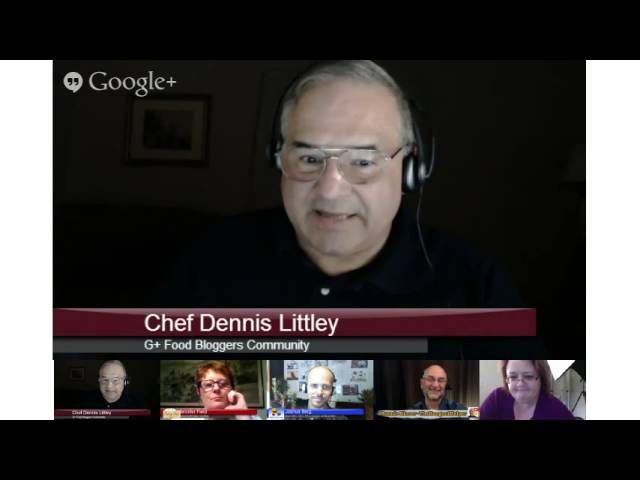
Chef Dennis Littley opens the inaugural virtual Bloggers Conference with a casual welcome and cocktail party, joined by co‑host Ronnie Bincer and participants Janice Manfield, Joshua Berg, Jenny, Stephanie Manley and others. The host thanks Google for enabling the event and extols Google+ as a growing, community‑focused platform. Participants share their experiences with Google+, Hangouts, and Hangouts On Air, highlighting visual connection, live broadcasting, and the ability to reach global audiences. The agenda for the multi‑day conference is outlined, covering sessions on reader engagement, podcasting, gluten‑free recipe development, YouTube strategy, creating Google‑worthy images, SMO/SEO integration, Pinterest marketing, and blog design/tech. Speakers discuss the synergy between social media and search, the rise of visual content, and practical tips for using Hangouts. The conversation also touches on cross‑platform integration (e.g., bringing Hangouts to Facebook), monetization ideas, and the logistics of virtual attendance, including recording sessions on YouTube and using Google+ event rooms. The tone remains informal, enthusiastic, and community‑oriented, encouraging participation and emphasizing the collaborative spirit of the blogging community.
Chapters
Hi, I'm Chef Dennis Littley, and welcome to our first annual virtual bloggers conference. And tonight we're having a little bit of a welcoming party and a little bit of a virtual cocktail party too. And with me tonight we have Ronnie Benser.
Cheers!
Hi, here is great to be here.
And Joshua Berg is here as well.
Hi, great to be here.
So I had hoped to have a nice big keynote speaker for you, but you're going to have to get stuck with me tonight. I'm going to talk a little bit about what we're doing and why we're here. First of all, I'd like to thank Google for being here because without them none of this would have happened. We're really opening up a whole new world. For those of you that have come over and have made the transition and are using Google+ the way it's supposed to be used, bravo! You know, you're ahead of the game. People are still coming on now, people are still using it wrong, and it's going to be a while before it really takes over and becomes the number one social media in the entire world, but it's going to happen. And everyone that's here with us now and that's starting now is going to be on top of the heap when we all get there. It's, you know, it's the place to be, and no matter what people tell you, it's not going away, it's not going to change, it's not going to become Facebook. We're Google+ and we're plussers and that's the way things are going. We believe in community, we believe in engagement and we believe in having a good time here and that's what we're doing tonight. So I'd like to welcome everyone to this conference. I hope you're enjoying a cocktail. I'm going to pour myself a little limoncello in a bit but I wanted to get through this with a clear mind or at least as clear as possible before we did move on. I'm going to ask my friends here to just to speak a little bit about their experience and about what they think about Google+ and where it's going. Ronnie, I'm going to put you on the spot and let you go first.
OK, great. Google+ and me have had almost a 2-year relationship. And when Hangouts came out, I really, really loved them because I was able to connect with people visually in a way that was pretty much impossible without Hangouts. And then the ability to do the Hangout on Air thing, which is what we're doing now. When that came out, things just took off like crazy because it's basically your own TV show in a box, right? Right there on your computer. You've got the ability with just a webcam, maybe a headset like I've got on, you're a TV station. And it's just amazing, the ability to do that. And so I really gravitated to the idea of Hangouts. As being one of the most important tools in the toolset and really have fallen in love with it. And a lot of people that I've talked to, a lot of training I've done with people, have felt likewise. This is just an amazing gift, in essence, that Google has given us because we— it's free. I mean, it's just rather amazing. So I, I think it's one of the best ways to connect with people with a similar mindset. And so what I usually do is I encourage people to start when they're in Google+ to look for the What, what it is that they're interested in, start with that and then eventually you'll find the who behind it. And just like any good social environment, you're going to want to make friends with those that are in your area and especially those that are influencers already and that'll help elevate you and it'll elevate them and then everybody gains benefit from it. It's a great place to be.
Very good.
Joshua, I don't know if you'd like to say a little bit about your experience on Google+.
Joining Google+ is the best thing I ever did in social media. It was just never the same before with other social media platforms. And I've used a lot of them. I've used every kind of forum and bulletin. Actually, we had bulletin boards, uh, online bulletins before the internet started. So just at the earliest days of the internet, uh, we had these dial-in bulletins, and then, uh, it kind of all came together and the internet. So I've been using the internet for that long, some 20 years. And I never saw anything I like or liked or really gravitated to like Google+. And Ronnie got me going into the Hangouts. I think I did my first Hangout with Ronnie and Mark Traphagen. And that was great. It got me sold on it. I was never sure that I would be very comfortable talking about technical stuff in front of a camera, and I hadn't really done that before. And it's gone very well, so I really enjoy it. I think it's a great place for people who, you know, specialize in something or have a lot of friends in a particular industry or business group that can meet and socialize in Hangouts in a live way. And then just within Google+, you've got the communities, and then you can bring in your business page to have the— your business angle., and then your personal for the personal angle. There's just so many different aspects that I really appreciate about Google+. And of course there's the search and authorship and SMO and SEO aspects, and I will be talking about that later on in a different session tomorrow night. So look forward to that.
We do have a great lineup of people set. If you haven't looked at the schedule or if you're just looking at it for the first time, our sessions start tomorrow morning at 10 AM Eastern Standard Time, and everything's listed in times. I wrote New York time next to everything not to confuse anyone, or hopefully not to confuse anyone, because I know one thing about Google is we are global. Now this has taken us to a whole other level. I mean, we're, uh, other social media I had followers around the world a little bit. I mean, now all of a sudden I looked at my analytics today and 50% of my readership is outside the US now. And that's just mind-boggling to think that you're reaching that many people all over the world. And Google+ has a lot to do with that now. So, you know, I have to thank them. And before I forget too, I did want to thank Joe Saad from Chef Hangout because he was the one that really got me started using Hangouts. I had been on Google+ and I've been around on it and I didn't know a whole lot about it and he really motivated me and got me using Hangouts way back when there weren't a whole lot of us on there, when it was kind of a ghost town. No, it's not anymore, but back when they were calling it that, you know, it might have been considered a little bit more of a ghost town.
So, uh, you know what, Chef Dennis, it was never a ghost town for me. You know why? That same thing I talked about. I looked, I found out who was talking about the same things I was interested in. And from day one I connected, and man, it just kind of took off like crazy. In— not necessarily in numbers, but in the interaction. My ability to find someone that was interested, or people that were interested in the things I was interested in, that knew more than I did, was just amazing. It was like, it's right here. And then you start interacting, and it's never been a ghost town, ever. For me.
I have to agree with you on that. I mean, I just— people were calling it that. I think it was a little quieter back then, but you're right. And that's when we met a lot of the really people that have gotten huge, or at least the ones that I know have gotten huge over time, when we could, we could talk to them, we could engage with them, because there weren't a lot as many— much engagement. But you could find those people if you look for them. And I'd be sitting here laughing hysterically at posts things. I mean, I'd be on Google+ for hours and hours just looking at posts people would put up. I don't have that kind of time anymore to spend on it. I wish I did because those were some of the happy times for me, reading these crazy things that popped up. Looks like Janice Manfield is going to join us in this party.
Very, very briefly. Very good. I can do that. I'm just in the middle of deliveries right now, so I thought I would pop in and say hi everybody and looking forward to the lineup you've got scheduled for tomorrow.
I think we've got a pretty good group of people tomorrow.
I think so too.
From tomorrow through Sunday, so it's going to be a really nice event. I'm glad you could stop in for a few minutes amongst your deliveries there. So, are you on your phone or?
Me?
I'm on my phone, yes.
That's cool. Okay, because we— I don't have a picture of you, but I mean, I do have the voice good, so.
Okay, yeah.
Yeah, the video is not coming through with the phone right now for some reason.
Okay, that's okay. Yeah, just the fact that you can do that— I have not tried it on my phone yet, and that's, that's next on my list of things to do sometime.
So let me see if— no, I can't see a settings on here.
That's fine. Do you remember, Dennis Littley, I went to South by Southwest with a cell phone and did live broadcasting. So we did live Hangout On Air with a cell phone. So it's definitely one of those things that's growing in its reach, replacing almost a TV truck.
Now, did you find any issues? I know we're always talking about not being on Wi-Fi. Did you have any issues with going over just over your cell phone?
That was earlier when The different data plans weren't having issues. I think right now they're a little concerned about too much activity going on with video, and so some of them are having struggles. But I had no issues as far as getting a signal and broadcasting, except for the fact that I was at South by Southwest and there was like 20,000 people sucking on the bandwidth. So that got a little bit challenging at times. So really what I found is the further I got away from the main action the more— the better signal I had. So I was actually drawing people away from the main meeting areas to like the food truck area. That's actually where I got some of the best reception, was where the food truck guys were.
Probably some of the best food too.
Yeah, it was good. I enjoyed it.
I still remember I made it out to San Francisco, first time I was ever in San Francisco, and the conference they had to Food Buzz, may they rest in peace. Was there, and they had food trucks feeding us, and the food was just phenomenal. It was just phenomenal. That was my first experience with food trucks, so it was quite an eye-opener for me. Philadelphia doesn't really get into them as much, and I'll be moving to Orlando area sometime in the next year, so hopefully I can find some food trucks there to enjoy.
Hey, maybe if they're not there, you can help start it up.
There you go. You know, in my next career—
I don't know about that. You can, you can, you can hire the guys to drive the trucks and you just take care of some of the logistics and get it rolling.
Oh yeah, Dennis.
And then enjoy the fruits of your labor.
Oh, that would be good. I'm sure there's some very talented chefs down there we could call on to do that. This old dog is about done with working that hard though. My body just won't take it anymore. This video stuff is nice. I like it. I don't have to get out of the chair, you know.
Production cooking for 200 people or more is Yeah, takes its toll.
Well, my girls, I had 600 there, so, you know, it was just a little hectic, you know. And there were days when I could do 200 by myself, and anymore I just— that's when I know things have changed, when I can't do that many by myself anymore, or I don't want to do that many by myself anymore. It's time to move on or retire.
So I've noticed, Chef Dennis, this blogging conference isn't really just about food. There's a lot involved with food, but can you give an overview maybe? I mean, I've got the schedule in front of me so I can read off some of the things and maybe you can fill in the gaps.
Well, I'm just going to sign out, but I just wanted to pop in and say hi and I'll see y'all tomorrow.
I'm so glad you did, Janice. Thank you very much.
Okay, ciao.
Bye-bye. Oh, it looks like Stephanie Manley is going to be joining us. That's great. Yeah, Ronnie, you know, when I set this up I thought about it and I was gonna make it a food bloggers conference and I said, you know, this is information and I guess what hit me was, you know, here I am new to food blogging.
This blogging conference isn't really— There we go.
Hey Stephanie, how you doing? Oh, there's Janice, we can see you now.
Oh, hope it's okay. Hi, and I'm signing off.
Good morning. Okay.
There you go.
It's a good thing she wasn't doing anything she shouldn't have been. Stephanie, thanks for joining us tonight. It's so nice to see you. You're muted. You have to unmute yourself.
I think she's trying to make sure she can find the video so it's not echoing and things like that. Okay. Yeah, there's a thumbs up. So you were saying that you thought it was mainly information that we're talking about and the virtual conference is a pretty cool concept.
Well, you know what it was, was— and again, naïveté or whatever, I never realized that all these other guys are bloggers, too, for the most part. I'm thinking food bloggers are the only bloggers in the world. I knew about mommy bloggers, too. I'm thinking, "Oh, you mean other people actually blog?" I was like, "Whoa." I said, "These guys are bloggers, so it's not just a food blogging conference. This is a blogging conference." We have a couple food-related things in it because Mama Food Bloggers community. But for the most part, I think 7 or 8 of the sessions are aimed at everyone in general. We kick off— Martin Shervington kicks off on how to engage your readers and how to gain more readership through using Google+. That's definitely something that any blogger can use. Then we follow that up with the second session is— what is that, Ron?
It's Developing New Markets Through Podcasting.
Podcasting. That was something I know absolutely absolutely nothing about. I know there's some food bloggers out there that podcast, and I just see more and more about it. And I thought, you know, this is the wave of the future. You know, I don't know if I'm gonna podcast, but I know, you know, a lot of my friends out there that have blogs, they're young and energetic and want to do something else, you know, and want to add something and spend some more of their time doing something on blogging, might be interested in podcasting, or maybe that's their niche. That they will really excel at, just given that opportunity. So I said, you know, this is something to add into this conference to really make it—
Dennis, when that happens, I want you to ask on my behalf, the Hangout Helper, I want you to ask the podcasters, are they considering doing Hangouts? Because you could pull the audio out of it and just make that the podcast, but you've also got the visual component too.
I have actually mentioned that to people because I thought that they could do that with some of the ones that I've done, simply because I'd be too lazy to redo more podcasts on the same subjects. So they could pull the audio. Hey, I'm a podcaster already then.
You are?
But I did mention that to them, and I had a few people say, you know, that that was an interesting idea.
So I've talked to a couple radio stations, you know, that interview me and things like that, and they're all very, very interested trying to figure out what's the future for the radio. With this free video broadcasting tool. And so the podcast, in my mind— of course, you know, I'm, I'm biased, you might say— but in my mind, the future isn't just in sound, but there's audio and visual because it's just built into the Hangouts.
Absolutely. I think we're just scratching the surface with what Google is going to give us, and I think these Hangouts are going to just keep evolving the way everything on Google+ is evolving. And it's just a matter of waiting around and seeing what new kind of toys they give us. Like with the— you can phone call now from the Hangout. I saw that, Ronnie.
Yep.
What's that all about?
The sidebar— the part that's gonna last is the sidebar. That's the Hangout sidebar on the far right side. Instead of normally you can use it to type messages to each other and turn it into a video call You also have the ability through different settings there to choose a phone call, and when you do the phone call, it actually just brings you into a Hangout like we're in right now, but instead of somebody's face, you see a picture of a little round thing with part of their phone number in there. So I can, I can— what we're in right now, we could add, except for the fact we're in a Hangout On Air, okay, but normally with a regular Hangout, you can add in phones. So we could have visuals as well as people that aren't able to get a camera, but they want to be on a telephone, they can be our participant. But the Hangout sidebar, the new thing is the ability, just like Google Voice let us do in the past, they took it away when they added the Hangout sidebar, now they've added it back. So Google Voice is back in essence using the Hangout tool.
So we'd use our Google phone number or any phone number?
Yeah, any phone number, either one.
Cool.
If you make the phone call, it automatically is going to go to your Google Voice number if you have one. So in other words, it's going to look like it's coming from your Google Voice number.
Great.
Yeah, and the people that share in your social profile information, if you share a phone number where you're accessible, that's going to be available to anybody that has access to you, that you've given permission to see it, and they can click a button and call you. So I can actually call 40,000 people or so.
Hopefully not all at once.
No, not at all. Not all at once.
Before we move on, I just want Stephanie to say hello. Hi, Stephanie. Oh, we're still muted.
I don't read her lips that well.
Okay, that's alright. We'll move on then. No problem.
So session 3, I mean, we talked about finding and— what is it— finding and engaging with your readership. That's session 1. Then developing new markets through podcasting, that's session 2. Session 3 is how to develop gluten-free recipes.
You know, and that came about— that was the last add-on. I was hoping to get one of our big blogger friends to do a demo and give a talk on food blogging, and I picked the wrong week to have this. You know, everyone's got prior commitments, everyone had plans. As much as everyone wanted to do this, you know, they just weren't able to. So I'm thinking, what can I put in here that's really interesting? And I recently had a friend on Google+ who's not a food— blogger, but he's a blogger— asked me about gluten-free stuff. I really— I'm ignorant about it. I don't know anything about it. I don't know where to go, what to do, but I do know that we have some extremely talented gluten-free bloggers on Google+. I thought one of the best things we could do then was to add a "How to Develop Gluten-Free Recipes." I don't want to say it's a fad. I don't want to say it's a trend because it's anything but that. I think it's a new lifestyle statement. I think as people go to doctors more and more, they're going to be told that the reason they're having all these aches and pains or the reasons they're having all these ailments is because of gluten. I'm probably one of the biggest offenders of that, too. I have body aches that I could probably get rid of if I could get off of the white flour. I'm thinking one of the things that would help then more people to be aware— because like I said, I don't think it's a trend. I think it's something that's here to stay. I think it's going to be part of the future, and as part of the future, as a food blogger, I need to know more about that and how I can adapt recipes. And people that are out there, you know, that are eating should be thinking the same way. You know, this is something good I can learn. I can use different kinds of flours. I can use corn flour. I can use garbanzo bean flour. I can use— you know, and I remember the first time Janice Manfield was rattling off these flours, and I'm counting, I'm going Oh my God, oh my God, she's up to like 20.
I had—
I'm thinking white flour, unprocessed flour, rye flour, that's the whole wheat flour, and I'm done. All of a sudden, she's going through all these flours, and it's just amazing. People that learn how to use them and can pass that information on us and show us how to make products that resemble food that tastes good.
Resemble food. Resemble food that tastes good.
Got it. That's the whole kicker. You can make something with it, but is it going to— be edible and tasty. One of the things that impressed me the most was last year I made a trip to the Culinary Institute of America, and their baking course, they have, they have a challenge at the end before they graduate. One was they made something regular, then they made something either dairy-free or sugar-free or whatever, and then they had to make something that was gluten-free. All three products had to look the same and taste the same. So I'm thinking, this is great. They're teaching them to do that now. You know, this is really what more of us need to learn about. So that's where that came about. So, and talking about baking now, Jenny, if you go unmuted, I'll let you say hello.
Am I?
There you go.
I'm audible?
You're audible.
Okay. Hi everybody, thanks for letting me come in, Dennis. This is great.
Oh, my pleasure. Thank you. It's good to see you here. We were talking about Google+ and what it's done for us and what it means to us. If you'd like to say a few things about how you think it's changed how you blog or how you even live.
Well, I will say I still have feet in both courts. I have a really vibrant community on Facebook, although I feel like— I said to somebody yesterday that being on Facebook is kind of like being on an island without cell service. So you're just kind of like there in this little pod and you can't really get out. But the folks who were there and are with me are great. I know that they're not going to come over as much as I have begged them. They're not going to come. I owe them. It's my responsibility to be there for them. Google+ gives me the opportunity to have a much broader reach. I know that my message is going to get out there and it's not going to be hampered. I'm not going to be shackled or dinged by Facebook or by Google+. By sharing links and things. The cooler the stuff is that you're sharing on Facebook, the fewer people see it. It's kind of backwards and weird that way. But Google+, I know that it's going to get out there. I feel like the interaction with my actual audience is more— Authentic or something on Google+ maybe. I like both places. I use both of them very differently. But Google+ for sure has been great for me as far as search rankings and that sort of thing goes. And also just meeting folks that I don't think I would have hooked up with otherwise because they weren't on Facebook.
Absolutely. That's one of the biggest things. We've met people that we would have never met in our entire lives had it not been for this media. And I think, you know, I know it's done a lot for me. I think it's done a lot for you too. We both benefit from this. Oh, absolutely. So thank you so much for saying that. And I would never tell anyone to stop using Facebook. You know, that's what people always say. No, if you've got a vibrant community, and you do have a vibrant community there, there is absolutely no reason to walk away from it. But start building here too.
Absolutely.
Some of us that are lovers of Hangouts are trying to figure out and building tools to bring the Hangout into Facebook.
That would be lovely because I like, at this point I'm just sharing a link over there to the YouTube and possibly to the event page and the people who are brave enough to sign up for Google+ will come to the event page but most of them will just watch it on YouTube from Facebook. I think I could get more people to come over if there was a handy tool.
Yeah, there's some Facebook apps that are being used for that and I'm working with someone who's happily trying— we're trying to develop it so not only can it be visible there, but actually the comments from there can be brought in like this one, you know, like with the comment tracker where we can turn something on and say, hey, everybody out there, let's see more of your cocktails in these comments. So that kind of thing is easy to— or relatively easy to do inside Google+, but we want to be able to also do that outside from Facebook, and so we're working on it.
That is fantastic. Cool.
Talking about YouTube, that's actually our next session that's on after gluten-free recipes, and that is YouTube. YouTube is now— it's huge. It always has been, but for me, it's like a brain thing here. All of a sudden, I realize how important it is. We've got 3 of the most talented YouTube people that have great followings doing a session for that. Actually, one of them is with us, and if she's unmuted, we're going to make her talk a little bit. She's still not unmuted, so she's going to have to wave. So you're going to have to believe that she can speak because she will be speaking tomorrow in our Hangout.
Stephanie is an excellent communicator.
She is.
Just not right this very second.
You go, girl. Hey, and just because some people out there like numbers, in the past we used to point out that YouTube was uploading 72 hours of video every minute. They've updated that. It's now 100 hours of video every minute. Of every day. So there's a massive amount of activity going on there, and whenever we do a Hangout, Hangout on Air, we are contributing to that. So it's interesting to know and learn how to use YouTube properly so that your videos get found amongst that massive volume. And I'm sure that's what some of the things that are going to be covered in that session— that's session 4.
Yes, session 4. And we have 3, like I said, 3 of the best. Hila Johnson is going to be joining us. She's got a tremendous following on Google+ and does some great videos.
I think I met Hyla at South by Southwest.
She's an Austin blogger. Stephanie, you're from that area too, aren't you?
Houston, right? Houston? Houston.
Houston.
Houston.
I'm from San Antone, okay? I have to say, I'll say San Antonio up here because people have no idea or they think you're trying to be a cowboy. Cowboy. But if you're— if you meet another Texan, you actually have to say San Antone.
I tell you what.
I tell you what. I finished half a limoncello and I've got a buzz.
So settle down there, Dennis.
After session 4, and then there's Joanne— is it Ozog?
Joanne Ozog and Stephanie Manley, and they'll be speaking about it. And Joanne— Stephanie has like been doing these forever with her copycat recipes, and she has incredible following. Joanne is a scientist, for, for lack of another term, and she methodically figures things out. And she just went from 0 to 60 in a month on her YouTube videos by things that she put into place in practice. So now we've got the best of all, all represented here to give us an outlook on YouTube videos and how they're going to help you because they're going to bring a whole different readership to you, just like podcasts would.
And just to tie it in because it ties in so well, YouTube is owned by Google, in case people didn't know that, and it also integrates incredibly well here with Google+.
Yep.
So there's a lot of very tight integration. In fact, I've got a community on Google+ that I call GooTube+ because of that tight integration between Google and YouTube and Google+.
Absolutely. Alright, so moving to the next one, what do we have up there, Ronnie?
We got session 5, which is How to Make Google Worthy Images.
You know, and it's not just Google worthy, but it's like food porn images, and I think it's one of the— Google is such a photo-driven community, such a photo-driven entity.. And getting pictures, especially the way they, they display them now, how some of these bigger ones get shown, they cover the whole stream. It's amazing.
Right.
We've got our local, our community moderator Adam Barnes, who's been doing a lot of Hangouts for us, joining us. And then we have Taylor Mathis, who has a blog, and he does some really great stuff with images. And then Naomi Robinson from Baker's Royale, and oh my God, Naomi's photos are just incredible. So we've got some really good photographers with different perspectives on how they shoot, and they're gonna talk to us about different things that they do. You know, when I pick people, I try to pick people that had a different outlook on things. You know, I don't want people that are all gonna talk about the same thing and agree. They'll have points they do agree on, but they all have a different way of doing things. And you know, that's, that's what makes it work for everyone, because we all like different things and we all— something will connect to us. So I have 3 really talented photographers coming on for that one.
Yeah, one of the most vibrant communities in Google+ period is the photography community. They're just massive and the amount of imagery that's around here if you just were to look for it is amazing.
And they're so helpful too.
They're helpful and the quality of the image that comes across is not just this little tiny thing but you can actually zoom in and zoom in and zoom in. It's pretty amazing.
I know that one thing that really, uh, that I learned— I forget how— was if you open up that image and you scroll down far enough past the comments, you can actually see all the technical information about the image, how it was shot, but you can see how many times it's been viewed. And I have some pictures that were viewed like hundreds of thousands of times, and I'm going, oh my God, you know, it's just, it's mind-boggling to think, you know, here we were before and on Facebook you're not going to get that unless even if you pay them enough. You're not going to get that many people to see your photos.
So let me ask you guys, I'm going to put up a comment here and ask you what does that mean? Twine is key to food porn, right? That must be an inside joke of some kind.
Kim is just being a troublemaker.
That's him. I invited her in here but she bowed out saying, oh no, she couldn't. I think it was a Canadian thing but Janice on, so we can't say that.
Wow, wow.
Is that an inside joke? We're going to leave that.
I have an issue with the twine. I have an issue with seeing a bunch of cookies tied up with a bunch of stripy twine. I'm a little tired of it. I'm just going to put that out there.
It's been overused. It's like anything else. We have seen enough twine, and it's time to move on.
Yes, the title of it should be Beyond Twine: Food Photography.
Alright, well, the next session, since we're moving on, Session 6, we have one of the stars here, Joshua Berg. He's gonna be talking about the SMO of SEO. What do those letters mean, Joshua? Tell us.
Okay, SMO is social media optimization. SEO is search engine optimization. So in the past they sort of had different meanings. We had, uh, SEO was optimizing your website or blog to get it as high as, uh, you could in the, in a search engine. A search engine, in other words, Google, Yahoo, Bing, or And now it's mostly Google because they have the largest percentage by far of anyone using their search engine. So that was the SEO. And then SMO first started being discussed some years ago as a way to get techniques to get more attention and coverage within the social media And now the two are coming together because social media is starting to also have a strong effect on search results, which is greatly improving the results that are had in search. Uh, in the past there was a lot of gaming in the search, and with a lot of a technical keyword stuffing, backlinking, link farms, all kinds of stuff like that people did. So Google wanted a way to filter out a lot of that noise, and the best way to do that is not with algorithms but with people. And you need a good social media platform to do that. So prior to Google+, Google+, they really did not have that as an option. They had a backend feed to Twitter for a couple years, and that stopped about 2 years ago, uh, where they had, uh, the straight access like that. And then the Facebook feed, they don't have that good a feed from there either. So with Google+, they can really see what people think about all the different content that's being shared through mentions, tags, +1s, all that kind of thing. So it really is starting to have a much stronger effect. Some people feel that it doesn't have that much of an effect. There's different ways that it does. I wrote a series called PageRank in Google+ where I actually analyzed all the different aspects and how that effect comes about. Because when I first started in Google+, I didn't really understand, and I was using it for a couple of months, not quite understanding how the effect, you know, is it more followers, is it about more plus ones, etc. And then finally I started to get a clear picture. And as I put that together, I wrote that series. And so that's some of what I'm going to talk about. It's the social media meets search coming together. And that's what— that's the future of search. The future of search technologies.
I just had a chat today with David Amerland about semantic search and the idea of the social and the SEO coming together and the more natural language searches and things. So that's going to be pretty good stuff coming up.
Very smart fellow, David Amerland. He's really got that down, the whole semantic side and the future of search.
Do you think that Google built this thing, this lovely Google+ so they could get better search results then? You think that was their ultimate goal?
I think that's certainly a big part of it. But Google+ has been trying in the social media arena for quite a number of years. And they've had a number of different platforms that they've used and tried out or purchased.
You mean Google tried to do that?
Sorry, yeah, Google has with various platforms that never really took that well. And, you know, they built some things into stuff like YouTube, etc., as well, but there was nothing that really compared. And then what we started seeing was not just with social media, but across the internet, we started seeing how a lot of people could put together something and create a vast amount of intelligence and knowledge if you had a way to sort and sift that and bring it together. For example, Wikipedia was a very good example of that. And a year or so ago, Britannica Encyclopedia went out of print. So that is talking about— that says a lot about the future of information and the way that direction is all going, because you have these wiki-type platforms, and a wiki is any type of platform where a lot of people put information together. And the, those wiki-type platforms really took off as well as social media. So seeing all those different aspects, and those things were built by people, by users,— a tremendous amount of knowledge and information put together, that could never be put together by a company that's hired hundreds or even thousands of people. But by volunteers of the millions and all working together within a platform, if you can get people all interested in something, to put something together, and give them all a part of that platform, then it's amazing how much can be accomplished, how much, uh, it can, uh, all come together. So with search and Google+, I think that's where we're gonna see that happening that we never have before.
So, Chef Dennis, because I'm not as vested I'm not as deep in the rabbit hole as Joshua is. I'm going to make a bombastic statement. I did come from a background of SEO. What I believe has happened is Google was trying to get what they call social signals from wherever they could and those places weren't giving it to them enough and they said, "Okay, we'll make our own." And so here we are. So I really do believe that Google+ is a place to gather social signals. That they can verify, they can add levels of trust and authority towards particular people based on their content and how other people with similar content are interacting with them to help elevate different levels of authority. And that's a social signal that helps you know the veracity or the truthfulness or the authority of certain things. And I'm just throwing out words because I'm not doing the session. It's up to Joshua to deal with the details.
I'm sure he will very well.
I felt very much that Google+ and Search through authorship is the marriage of author— authorship. The authorship system is the marriage between Google+ and Search, bringing that all together for a much improved Search. Hang on, let me show you something. Here, that's one picture I remember seeing that. Yeah, that's a Google+ means authorship.
Anyway, that's a little, little nerd humor there.
Okay, thank you, thank you, Josh.
Okay then. I thought it was a cocktail party, that's what I was thinking.
Hey, that's fine. Cheers, Shandon, whatever you want to say. I'm a cheap date anymore, one shot of limoncello and I'm buzzed.
I'm going to have to run, you guys. Thank you for letting me stop in for a minute, Dennis. This is really exciting. Great job on rounding up all the wonderful speakers and it's going to be a great weekend.
Thank you, Jenny. Thanks so much for coming by.
Thanks, we'll see you guys later.
Bye-bye.
Good night, everybody.
Bye.
Stephanie, you got a microphone now.
Finally.
Alright, why don't you say hi and tell us what Google has done for you or what Google means to you, Google+.
Okay, so hi everybody, now that I'm on a computer that works properly. I really have loved the interaction. I've met most of y'all in person and I wouldn't have done that without G+. And for me, blogging is about the relationships that you create. Because we're really going to learn more from each other than anyone else. So it gives me a chance to connect with my audience. But more importantly, it gives me a chance to connect with the other content creators. And we can learn how to do things better and provide better quality content for our users. So that's what really excites me about G+.
Absolutely.
Very well said. Thank you very much.
So that brought us through Saturday. We're done with Saturday.
Yep.
Virtually, right?
And then really good with the, the SMO of SEO, and then close out Saturday night and come back Sunday morning. And we're opening up— I think I know that one. That's Lisa Eckes, or Sally Eckes.
Sally Eckes, right?
Sally Eckes of the Lisa Eckes Group.
Right.
And she's going to talk about how to write a book proposal. Which, uh, so many bloggers are really ready to do that. Stephanie, I know you've already done a few books, so you're, you're past that stage of the game. Yeah, so many new bloggers out there that are just really getting started and want to write a book, and I think one of the big pitfalls they have is they don't know how to send that information to someone or what person to even send it to. And the Lisa Eckes Group is an agency They represent authors and book publishers. I actually met her through another friend, Allison Kramer, who had done an event for us. She is a gluten-free vegan, which is a really niche blogger, but she does exceptionally well. She's had 3 books out. They're going to talk to us, and they're looking for some people that might want to even pitch to them. She'll tell you what your pitch is or what she thinks of it.. If there's anyone that wants to do that, let me know and we can put you in there.
So I got a question for you, Chef Dennis. You've got all these different sessions and they're starting and ending at certain times. What if somebody can't come live? Are you gonna keep this video available of the session or are they gonna have to go somewhere else to try to find it or how's that gonna work?
Well, Ronnie, it's gonna be like all the other events we do. It'll be YouTube videos that they can go and access at any time at their convenience. Convenience. If you can't make a live session, you know, and I know this is a weekend in the summer, in July, in the middle of the summer, and a lot of people have had plans. So if you can't make it live, you can watch it later. And you can go right to the event page. You can just click on those links in the post that we've done, and it'll take you to the event page, and you can watch it right at the event page and leave a comment in the comment bar. Or you can go to the— my YouTube channel where everything resides. I had thought about doing one for the community but basically I am the brand and I'm doing this so they're all residing on mine, on my channel for now. It's just easier for me than to have to keep track of two.
So to reiterate that, there's going to be a separate event which is a Google+ room, think of it that way. There's going to be a separate room or separate event for each session and you can go back to those at any time and enjoy the content in case you didn't see it live. And you can also leave comments before, during, or after the session. Is that right?
Absolutely. You can ask your questions and leave them, leave them later. And I'm sure our session people that are, that are in each session will come back and check the comments from time to time, at least for a while, you know, for a week or so, and answer your questions. Or you can always just send them a question directly to You know, and just make sure you put the plus sign in their name. A lot of people do that. And while we're on that, let me just get on that. If you're gonna send me a message, do put my name in because a lot of times with notifications we don't see them. So if you put the plus sign and the name in, we have a much greater chance of finding that message. But if you just put a comment on the end of a post, and it might just be by chance that I come across it days later. So, you know, that's a a good way to do it. So if you have questions for us, you know, you can put your questions in the comment bar now, and when we get to that session, we can address them. Or you can ask them live if you're in the, uh, watching the session, and we'll keep an eye on the comments there. And you can leave them after the fact, and hopefully, you know, everyone will come back and check on the questions and answer you. Or just email— or not email, just message the people directly and ask them your question. So moving on, Sunday we had to move our blogging session because of a commitment the person had made at work had changed. So the next session is at 2:30 and that would be—
Who is that? It's me.
That's the Hangout Helper. There we go. Ronnie Binzer, the Hangout Helper. Ronnie, you want to tell us a little bit about—
Sure, I'll make it short because I've already been hogging a lot of the time here. So the bottom line here is on session 8, 2:30 New York time Sunday, we're going to be talking about Hangouts and what they can do for you. If you are going to want to produce them yourself, I'll talk a little bit about that. If you're going to want to be in them and take advantage of them in a private way or in a public way, I'm going to talk about the differences and the concepts as well as give you some tips as to what are the most important things to pay attention to, because a lot of people when they first start using Hangouts, they kind of aren't sure what they're doing, and your first impression actually does make a difference. So it's a good idea if you can to get what I call situ— situationally aware as to what it's like inside of this thing called a Hangout and know what some of the buttons do and things like that. In fact, as a reference I frequently look at competitors to Hangouts just because I want to keep up on stuff. I looked at one yesterday, I'm not going to say the name, but I got in there and I was like, I don't even know what to do, what should I be doing and what is this over here? I had no idea. That's common when you're brand new to a platform. So we're going to talk a little bit about how you can feel more comfortable inside of a Hangout.
Very good. And as always, Ronnie Bincer, the Hangout Helper, is around, he's got his community that you can join if you have questions and there's a lot of knowledgeable people in that community that will help you as well. Isn't that right, Ronnie?
That's right.
Okay.
Then we go to session number 9 on Sunday which starts at 4:30 New York time, 4:30 PM and that one's Pinterest.
That's right. I included Pinterest, I thought about doing an Instagram one too and we just couldn't get the logistics of that worked out. But Pinterest to me is my second highest source of hits of where my traffic is coming from. And I think Pinterest has really blossomed into this really great tool that we can use. And again, it's how to use it properly. Okay, so we have some people on that panel that have been using Pinterest. Marla Meredith, I forget how many followers she's got, but I think it's in the hundred thousands. It's amazing. And Cheryl Suzanne has also got a great following over there. And then Valerie Kaufman is going to talk a little bit about the science of Pinterest and how to get that pin right that's going to gain you more notice and more hits on your blog. So we have 3 people talking about Pinterest because it's really important. We found out it's here to stay. They've made some adjustments They brought someone over, I forget where he came from, but he's like changed the look of Pinterest too. And I think it's a really good tool that we need to use a little more successfully.
Cool.
And then the last session, session 10 on Sunday which starts at 6:30 PM is Blog Design Plugins and Tech Talk with Keeta Roberts.
Keeta Roberts, okay. If you haven't met Keeta, you are in for a treat. She is a gem, and she's really, really knowledgeable. She builds her— she can build her platform from the ground up. She can use Genesis, she can use any of the other programs that are out there, and she's gonna answer your questions and talk a little bit about blog design. And if you want to get a designer, you know, she'll help you with some questions of what you should ask or what you should know going into it, so you don't go into it blind. She's a really great source of knowledge on blogging, and she has a blog, it's called Pass the Sushi, and I love her term for it because she calls it fat kid friendly food. So that's kind of a good favorite of mine as well. So she's gonna wind up the conference for us, and that is at 6:30 PM, and That'll bring about our 10th session of actual conferences, and I think that's a pretty, pretty neat thing for a virtual conference. You know, we're bringing it to you. I remember someone posted about it and I loved it. It was no hotels, no airfare, you know, just everything. We're bringing you all the information to you in your own— into your own house when you want to watch it, when you can watch it, and there's no extra expense. Expense to it. So for those of you that can't travel or that just can't afford to travel, this was why I did this. And I'm just so very fortunate to have so many very talented friends throughout Google that were willing to help with this. So we're bringing a conference to you, the first virtual conference.
And this one, we didn't talk about this, so I'm going to throw it out there, but some people are doing, working on this concept of the virtual conference conference and it's free while it's live, but then later you actually have to pay for it. This particular one we're doing, or you're doing, is free and stays free. Isn't that right?
Absolutely. It's just one of the benefits of being on Google+. It's done a lot for me, so I feel it's a good thing to give back to the community too. And, you know, it's a good way to be. I have a lot of friends, bloggers that have come over because they trusted me to come over. And one of my slogans was always, "Together we're stronger." So this is one of the reasons we're doing this. And not just for food bloggers, like I said, there's the mommy bloggers, there's any kind of blogger out there. This SEO will work for you. A lot of the different things will work for you. If you ever thought about podcasting, it's a good time to learn. And if you wanted to pick up a camera and you want to take better pictures, a picture's worth a thousand words, and on Google+ I think it's worth about 10,000. So, you know, you can pick up a lot of great information through these people that are sharing their time with us.
Yeah, but there is something to be said for that model. So we're— I'm going to chat with you about it later for maybe the next year or something, because many people are needing to figure out how to monetize what they're doing online. And that model where it's live while, you know, it's free while it's live, but then later it's packaged in a different way and you get to watch all of it and there's bonuses added and things like that. That's actually a pretty good model, I think. It might be something that we can look at for the next time. Now, a quick question that some people might have out there: how long are these sessions? You know, we've got the starting time. What's the average length, if there is such a thing?
The sessions will probably run anywhere between 45 minutes to an hour. Okay, I don't see them going very much longer than an hour because I set them 2 hours apart. Part. So I need a little time in between, you know, to shut down my computer, restart it each time to make sure everything's running properly, have a bathroom break, do something, eat a little something in between, and then get everybody back in and online. So it's probably not going to be longer than an hour. With the session, what we're going to do is we're going to have the presenter talk about whatever their— the subject is, and then if there's questions, you can ask them while they're going on and we'll try and come back to them.. If we can stop during, we will do that and ask the questions while we're going, but we'll also have a question and answer period afterwards.
And so we could— we could always go to Chef Dennis Littley's profile page, and you can see a list of all the different events and links to get into each and every one of them. And some of us have been resharing that as well. So if you can help us by helping reshare that, there will be more people knowing where to go, in essence. And you'll know which room to end up in for the particular session that you want to get to.
Yep.
And all the links are there for all the sessions, so you can just click on a link to take you to the event page too and join in there. And you know, I still do have some seats available in a lot of the sessions, so if you'd like to come in and ask your questions live, you know, don't be afraid of the camera. You know, you saw tonight, it's not really a bad thing. Just have your earbuds on or your headset on so you don't cause any echo or feedback.
That's an interesting point. Let me ask you a question. I'm going to pretend I'm the person that doesn't know. So I can go to the event and watch, just watch from the outside. I can add comments and I can add questions from the outside, but you're saying that I might be able to actually get inside the video, like in that film strip down on the bottom?
Absolutely. Like I said, I wanted to bring 2 or 3 bloggers into each session. And I don't have them all filled. So if somebody would like to attend a certain session and be inside and be in the film strip, and then when we go to questions, be able to ask your question live and get it answered, you know, let me know and I'll be happy to put you in there.
So how do they let you know? Do they do that right in the event and say, hey, I'd like to be in the film strip, and that's good enough? Or how does that work?
You can, you can either monitor, you know, in each of the events you can put it in that event that you'd like to be in that, and before I go on, I'll check it. Or you can just send me a message, do a quick private message to me, you know, plus Chef Dennis Littley, you know, I would like to be in the SMO of SEO, or I would like to be in the Hangout, or I would like to be in the blog design. Do you have any room left? You know, if you have a couple that you'd like to ask about, you know, if one's full, I can put you in another one. So, you know, if you'd like to be inside and just get some direct exposure and ask some questions you know, please let me know and we'll get you in one of those sessions.
Okay, so since I'm the Hangout Helper, I'm going to help here. Before you come and do that, you want to make sure first off you feel comfortable in front of a camera and you've done it before.
Mm-hmm.
So you know what the sounds are going to be like, you're not going to be having echoes and things going on. If you can have a headset, that usually helps eliminate echoes. And the camera, you can do a Hangout on your own. So if you've never done one, just start one up, invite yourself to the Hangout, nobody else, and just get a feel for what it's like on the inside. Because when you get on with the big boys, it's a good idea just to have a little bit of an idea of what's going on.
Yep.
And I don't know about the big boys, but we've just been doing it longer that nothing really— we've had so many things go wrong that nothing really fazes us anymore. It's like, one thing you have to understand about Google Hangouts, they are are wonderful, we love them, and I would never ever trade them for anything. But what can happen will happen, and if it hasn't happened yet, it will happen at some point in the future. So just be ready for anything. So, great. Well, I think that's, that's about it for our little get-together here, our cocktail party, and our little welcoming address. And thank you again so much for stopping by and for listening to me, and I hope you guys aren't too tired of listening to me talk, because I'm gonna be talking for quite some time now. But I look forward to seeing you all tomorrow, and if you'd like to be in any of those Hangouts, please do reach out to me, let me know one way or the other, and I will do my best to get you into one of them. Alright, so guys, Ronnie, thank you so much for being here.
It's a pleasure, thanks for having me.
Joshua, thank you, and I look forward to seeing you guys tomorrow.
Thanks for having me. It's really great. Looking forward to it.
My pleasure. And so thanks again everyone for stopping by. Please feel free to stay in the comments section and have a little cheers.
I've had—
I'm gonna have one more limoncello and then it's off to bed for me so I can get up bright and early tomorrow morning. But I'm Chef Dennis Littley from the G+ Food Bloggers Community, and join us tomorrow as we make history with the first annual Virtual Bloggers Conference. Okay, I'm sure you're gonna see a lot of them coming up later, but we were the first. So thanks again for coming.
Thank









