Exploring Aliveness # 6 | The Dao of Working (w/ @dennisxiao )
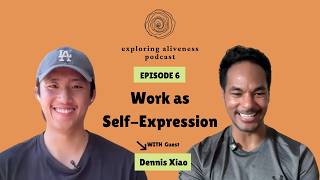
In this episode of the Exploring Aliveness podcast, host (Speaker A) and guest Dennis Xiao discuss the nature of work, identity, and aliveness in the age of AI. Dennis traces his personal journey from a high‑paying investment‑banking job, which he found soul‑crushing, to a series of experimental roles—creative production, coaching, AI‑focused side projects (e.g., Homey Calendar), and a current search for a B2B SaaS or operations position. He distinguishes between a "job" (a source of income) and "work" (self‑expression, aliveness). The conversation explores how repeated career experiments have revealed that the specific title or industry matters less than the feeling of being fully oneself at work. Themes of commitment versus attachment, the role of desire and "wants" that generate new possibilities, and the idea that work can be a crucible for inner transformation are examined. Both speakers use musical metaphors (tuning instruments, sound baths, handpan) to illustrate the process of aligning with one’s inner rhythm. They reference Friedrich Weckner’s vocation definition (where deep gladness meets world need), Wu Wei, and the 64‑Door archetype (the Daredevil) as lenses for understanding vocation. The interview also touches on AI as a tool that expands personal dimensionality, allowing one to be a writer, coder, coach, or musician simultaneously. The episode ends with reflections that job‑search interviews themselves become a form of inner work, teaching trust, attunement, and the importance of a "warm, playful, safe" job container that feels like a reciprocal flirtation. The overall message is that authentic self‑expression, rather than external validation or a fixed career identity, is the core of aliveness in work.
Chapters
Welcome everyone to the 6th episode of the Exploring Aliveness podcast. Pablo, my friend, my good podcast buddy, is on retreat today and probably for next week as well. So I have a guest with me, my good friend Dennis Xiao, and today we'll be talking about working. Like, what is work? What is our relationship to work, especially with the age of AI and like everything that's been so tremendous and like changing. I feel like I don't actually know what work is. And it's very alive for me, and hopefully for Dennis as well, to explore just what, like, what is work to us in life? Like, is it service and so on? So I'm going to pass it to Dennis to introduce himself, and then we'll get straight into it.
Wow, introducing myself. Yeah. Hmm. What feels alive is like sharing how I'm feeling and like how it relates to work, which is actually quite excited, which is not how I've felt before. And I think like work, like when you say like, what is work? It's like it's changed so much for me now where I think I used to see work as work is what gets me paid. And now work, like, that still is part of work, but I also feel like work is like so much bigger. Like, work is actually a way for me to express myself and not just a way for me to earn money. And so like, work doesn't have to be something that earns me money, which is like a total shift from how it was before. And that's just bringing me a lot of aliveness and energy.
Hmm. Could you define work in that context? So it went from like, work is something that brings me money, to work is something like you do to express yourself. Could you define it more clearly?
I think another way of saying it is like a job versus work. Like, job is the thing that earns me money. And so right now I don't have a job. I'm exploring getting a job, and I hopefully will have a job soon and have consistent income. But I'm also not not working. I'm working a lot. Like, especially in the past week or two, I've been working a lot, and it's been really enjoyable and exciting. And I'm feeling this, oh shit, this is how what we think of as work— to me, like, how it should be, like, in the most, like, enjoyable sense. It's just like we are just like having fun and expressing ourselves. And I feel like my journey the last few years and since I graduated school has been about like coming to this.
Yeah, I want to hear more about that. What did work start off as, like your relationship to work when you first graduated college? And what has he transitioned to? Like, how did he get to the point you are now?
I mean, for context, I started out in like out of school working in investment banking, and to me that was like solely a job. You know, I had followed all the stories and scripts I had around it, like get a high-paying job, get a job that has a ton of optionality and I got there and the first day I was questioning, oh, is this it? Like, this is the thing that I was grinding for for years, the thing that I, like, I've, like, poured so much myself into and felt so much distress over. And it's just this thing of, like, me sitting in a cubicle. People aren't really engaged with me. And that was just, I mean, a whole other conversation, but just sent me into such a deep crisis, honestly, because here's this thing called work that I've been moving towards my entire life, especially in college and internships and all of that. And all of a sudden, there was this thing that actually made me miserable. And that was just a really big struggle for me.
What I'm hearing when you share that is like, the beginning, like, I heard the question, is this it? And I really like that. It's like, is this it? Yes, this is it. There's no future. This is it. Like, this is the place we are. And this is the things we do. And the ways that the things we do make us feel is it. Like, I feel like there's something about that that lands really deeply. And like, there's a way in which I feel like, when I hear you share that, it's like, for me as well, started out high-paying job in tech. And the question of like, is this it? It's like, would I do this for the rest of my life? Like, is this it? It was like a question of like, is how I'm showing up right now how I want my life to be? And there was like an answer of like, of course not. Like that kind of job. And then it's like, what, how can I get to a place where how I'm showing up right now is how I actually want my life to be, like, for this is it to be it, if that makes sense. And there's like a combination of like combining the long-term and the short-term, like the present and the future in that. How does that— what? Yeah.
Yeah. I mean, like, it's always, as you said, it's like it always, this is it. You know, we don't, we don't have a second chance at this. And yeah, what you're saying, it's like, is how I'm showing up right now, like, in alignment with what I want, like, how I want to be in the world? And to me, it's like less of what I'm doing, like, work affects that. Like, my job in banking affected that. I think that was really the tension there was like, I'm sure there's a world where I could have shown up in my banking job and been like, hypothetically super aligned and authentic and like, this is just how I want to be in the world. But for me at the time, as a 22-year-old, it was just not possible. And I just really, I really felt that tension and gap between what this environment was bringing out of me and how I actually wanted to be.
There's like two pieces to it. So like there's a job, there's the work. And then it's like how we're showing up is what I'm hearing. And it sounds like the important part is like how we're showing up versus the work or the job. Could you tell me more?
But yeah, that's been, I mean, as you know, that's been like the whole journey for me is discovering that it's not exactly about what we do, like what we do matters. And it's way more about how we show up to this. You know, like I've done the thing of, trying to go all in on doing creative work to doing coaching facilitation work. And as I've gone through these different phases of thinking like, this is my thing, like it's actually, it's like, oh, what I'm doing is the most important thing. Over time it's evolved into that actually doesn't matter as much as I thought it did. Like right now I'm, I'm considering going back to working like a job and like startups and doing operations. And that has been such a process of like unfolding different beliefs and identities. And I'm at a place now where I'm like, yeah, like I can just work at a B2B SaaS company and that's totally cool. Whereas before, when I started my job search, I was like, I need to work in consciousness. I need to do something that is like super transformational. And now I'm like, actually, I don't, care. I think it would just be fun to just play with AI all day, which is what I've been doing, which is what I've been doing for the past 2 weeks in a really, like, like, more than I have in like the last year, just like building stuff with AI. And that's just brought me so much energy. It's like the thing that like I have to like pull myself away from it. And that's— I'm like, oh, this is how I want it to feel.
Hmm. There are like so many cool pieces there. It feels like an evolution of like, the job is it at the beginning, right? It's like, oh, the job is it. And then you're at the job and it's like, wait, is this it? And then it's like, no, it needs to be the right job. That's it. Like, it needs to be the right thing. That's it. And then you like start, you go all in on YouTube or creative work and you're like, is this it? And it's like, no, let me go all in on coaching. Is this it? No. Let me go all in writing. Is this it? And you're like, as you've continuously— what I'm hearing is as you've continually tested, like the different varieties of what working could be, like the framework of what work is has dissolved of like, it doesn't matter what it is. It matters if you want to like show up and do it. It matters if like, what I'm hearing is if you're excited to do it, like that's what matters. It doesn't matter. Like you can go back to a corporate job and as long as sounds like it's in alignment, it's relating, it doesn't have to do with like your identity anymore. While in the past, like there was like an identification of like, this is it because it defines me in some way. And then as you've explored like different things that could define you and seeing like in a way like, how regardless of what defines you, like your personal experience is what matters. You're like, it doesn't matter what defines me as long as I'm having fun. So, there's like a slight disenchantment with the identities that working provides leading to like enjoyment and excitement just being there regardless of what you do. So, you can be like the ops guy at a B2B SaaS company and be like, I am enjoying myself so much and I'm so excited. Who gives a fuck if everyone sees me as a B2B SaaS? Pops guy. Yeah, that's so fucking cool.
Yeah, I have a lot I want to say here, where hearing you say all that just now, it brings up the question, like, what is the constant? This isn't it. This is it. Oh, it's not it. And the constant is, oh, I am it. And then that realization of, oh, I am it, just being expressed through all these different things. So it actually matters less of what I'm doing. And it also reminds me of like how much I, I think a good pointer for me is like what I didn't want to be, because that's also a form of identity. Like, I don't want to be this. Like when I was working in banking out of school and like you do the whole thing at parties where it's like, what do you do? And I'm like, I would feel so much resistance towards finally saying that I worked in suffering and angst I experienced because I kept thinking I needed to do this one thing to be like, some, to be a someone. And like this job search process alone has been like that even more. Like I thought I was done. I thought I had let go of one identity by being like, I don't have to be a full-time coach anymore. Let me go back to a day job. But then all these many things within that, that also had to fall away. As I was saying earlier, I also wanted, I still wanted work to reflect me in some way. And so I wanted to work in these like consciousness orgs, or I wanted to work at human-centric AI companies, not just a regular AI company, but a human-centric AI company. And over and over again, reality didn't happen. I didn't get these jobs. They led nowhere. And now I'm at this place where I was applying to be like an office manager and a B2B SaaS company. And I was like, holy shit, like, this job sounds like something I would really enjoy. But then past, I've been like, dude, office manager? Like, I used to work in investment banking. What the fuck am I doing being an office manager? But now I'm like, sick, I get to be an office manager and like do all these things.
Like the identity disillusion of not getting accepted by your dream job.
Yeah, dude, that's been the That's been like the biggest—
what comes up is like, how much, like, tougher, how much would that identity still be there is like what comes up.
For sure. I'm like, I'm someone who works— I don't work at OpenAI. I work at this human-centric AI company that wants to empower people to unlock their innate potential. And yeah, so you're saying it's like, I feel so much lighter and freer, like not having to be that.
A real gift to it is what it sounds like, of like, it's like long journey of not having work being a gift, like truly humbling, like cutting down the ego of like what— like, I, it feels like from what you're describing, like maybe not fully, but what you do really doesn't define you. And that's like a freedom that most people don't have, including myself.
And I can imagine it's gonna like become sticky in subtle ways, you know, as I go back to work and all of that. And one thing, I don't know if you've heard of this quote before, and I'm curious how it lands, like what it brings up in you, where it's by this guy called Friedrich Weckner, and he talks about vocation, or he describes it as like where God calls you, is where your deepest gladness and the world's deepest need meet. It's just like that intersection. And when I hear that, you know, gladness is just like joy and like contentment. And need can be anything. Like right now, as I'm considering just going and working like opposite of startup, like, Whoa, my deep gladness right now is actually just doing AI automation and building shit. And there's a need for that. There's a strong need for that. And there's also for me, this really big aspect that's been cultivated these last few years of I get a lot of gladness and enjoyment from connecting with people. That's one thing that was always a constant at my job in banking, my job at WeWork was that I sought out the opportunities without being asked to just connect with people. To hold space, actually hear how they're feeling and to get to know them on a meaningful level. And I'm excited to bring that as well amongst the AI stuff to my job.
That feels really good to hear. I think the first thing that comes up is sadness of how hard I've been trying to find an identity around working. The thing is, like, I don't even— the 'I don't want to work' is an identity I have. I don't want to work. I don't want to work. I'm on sabbatical. Like, that's like this current identity that I'm holding. And I'm seeing how much that hurts me. Like, it's not true that I don't want to work. It's also not true that I want to work. Like, it's just like, I want to be myself. And I want to express myself how I want to be. And there's a way in which anything that I'm defined by versus anything I'm not defined by gets in the way. And working is— we started about like, what is work? But it's like, it's not about what is work. It's like, what's it like being myself and letting myself express myself in the ways that I want to be expressed. Like there's like something in that that comes up when you share that. Like I was on a call yesterday with a friend and he was like, what's your purpose right now? And I'm like, I don't know why, but it feels like my purpose right now is to learn how to dance and go dancing. So I'm gonna go dancing after this call ends. And then he's like, how? Yeah, I was like, what the fuck? Like if my purpose doesn't have to do with money, I feel so stressed and worried and anxious. And I was there too, like when I was thinking about money all the time, like there was this anxiety to it. And it's like, if my purpose isn't to earn money, then like I'm fucked. Like there's like this like holding, but something like clicked for me where it's like, if money is the most important thing to me right now, like if I'm actually like the limiting constraint for the enjoyment of my self-expression or the limiting constraint for my self-expression is the amount of money I have right now, it would probably be my wanting. It would probably be the thing that I focus on. But that doesn't feel like the limits of my self-expression right now. Like money feels like I have enough to express myself to the full extent that I want to. But I'm limited by my, like, I want to go dancing, I want to have more like, like embodiment and fluidity in the ways that I relate to people in a, like, relational touch-based way. And that's limited not by money, it's limited by just like experience, like going out dancing or like getting massages, giving people massages, like doing some Alexander Technique, whatever it is that brings me into my body, that feels like the limit, current thing that I'm hitting up against. So that's what it feels like I'm called to, even if I don't understand why. And there's a way in which it's like self-actualization, like, like money isn't the thing that will self-actualize me. There's like different archetypes that I want to live out. And maybe like my ability to caregive is underdeveloped. So like I feel like a pretty strong calling to go be a teacher for a bit. And that's not gonna pay shit. But like in the act of teaching, I learned how to be like a father archetype or a mother archetype and like caregiving and that I developed the skills and I become more self-actualized. And there's a way in which like my self-actualization also gets limited by identities. Like if I have to be something, but the thing that is the most underdeveloped is my warrior archetype who wants me to like fucking eat, train, and like, you know, sleep, workout, do this, do like, you know, have the regimen to schedule routine. If that's the thing that's underdeveloped, then that's the calling. And like, but my identity is like dancer and fluid and this, then like, I'll be stuck, like I'll feel stagnant in some way. So I feel like there's that work thing of like, not using work as a way to identify, but in the act of developing that fluidity, there's also the piece of now I get to grow in the ways that my body or my soul actually wants to grow. That's what comes up.
Yeah. And what you're saying of, How do I be myself? Like, how do I be expressed? Like, whatever I am, how does it be expressed through these things? And, and I've done this so many times of it's actually more constraining to say I am this one thing because all of a sudden I close myself off from all these different ways of experiencing myself. Like, what is it like to experience myself as a dancer? What is it like to experience myself as like an investment banking analyst? What is it like to experience myself as a coach? What is it like to experience myself as like this. And to say that, like, I am this and I am not, like, all these things is actually, like, limiting to your own development and, yeah, self-actualization. I think that was, like, a really big thing that I've had to come to terms with. It's like, oh wow, like, I'm actually— I'm limiting myself by, like, just trying to be a coach or just trying to be a creative. Like, there's all these latent aspects of myself that weren't coming alive because I was so fixated on like, I need to be a coach. And you talked about purpose earlier. Like, that's like, I would have been like that. I say like that asshole. It's like, what's your purpose? Like, I definitely would have been. And now I see that question differently. But if I had been so fixated on that, I wouldn't have discovered the joy of like, I've told you about this, but like waking up at 7 a.m., listening to Fred again and just like vibe coding for 4 hours. Like, if I was just focused on being a coach and facilitator, I wouldn't have experienced that, or I would have experienced— I didn't know I could experience myself this way.
That sounds so fun. Yeah. Yeah. Like, how that lands for me is like, we are multidimensional. And there's like a fun in seeing myself and ourselves in many different domains. And like, I feel like there's something about career and, you know, at least in the past, I think this is changing. But at least in the past, there's something about career where like, you have to one-dimensionally develop yourself so that you're financially valuable, because it takes so long to get really good at things. But I feel like that's changing, or it's like, dude, it's AI, it's like you can, actually like your full dimensionality, you can bring that out and have, have a portfolio career where you're doing many different things that touch on so many different parts of you. And that sounds like the more fulfilling life in comparison to that one-dimensional life.
There's a lot we could talk about AI from like a philosophical view. And one thing I'll say is I was having this conversation with a friend the other week where AI is actually— you all of a sudden have this full access to a specialist in everything you could possibly imagine. And really what I believe we're being asked to do is to become generalists or to embody like more of like more facets of ourselves. It's like, yeah, I can suddenly experience myself as like a writer. I can suddenly experience myself as someone who like Vibe Code's an app, I can suddenly experience myself as getting coached by AI. I could see that.
That sounds so exciting. Yeah.
Makes me really giddy. I think that though, as you were saying, work used to be this thing where it was very linear. You follow this one path and that was the thing that I really faced a lot of resistance towards is when I started out, And I was like, this path that is like just this one groove for like the rest of my life just does not bring me alive. And where is the energy? Like, where is the aliveness pointing me towards? And I feel now it's just an aspect of like following that and like not letting it be constrained by attaching to an identity or like something as work.
Yeah, I feel like there's like two pieces to it though. Like, there's something about commitment that feels like devotional. Or like if I'm committing to an art for a long time, like there's a way in which all my dimensionality can just come through that art. Like writers, for example, like they're like, there's this thing about, I think you're a writer. There's like this thing about committing for a long time on writing. Where like more and more of yourself can show up in the writing because you have more vocabulary, more granularity in how that shows up. But there's like both pieces of like, same with dancing. Like, I feel like there's a way in which like, you can express yourself in many ways, but you can also express all of yourself in one way. Like, I don't think it's a duality. Like, that doesn't feel true. How does that land?
For sure. And what comes up for me is how do you commit with it? Like, what's the difference between commitment and attachment? Oh, you know, I've definitely fallen in the void of attachment to the point where it brings me suffering to keep holding on, you know. And maybe, like, maybe it does start out as commitment and then it becomes blurred. I'm not really sure. So that's an open question I'm posing to you, and I can answer myself. And I also think, as you're saying, we can absolutely experience ourselves through one thing. I think about what you've been telling me with your coaching practice of there's one way of experiencing yourself in this, which is like coaching someone one-on-one. Okay, maybe I'm just doing like how, what questions. And then there's, oh, I'm experiencing myself by bringing in like somatics or sound or something. And there's also all these other aspects of like group facilitation or building a business around coaching or doing group coaching. And so I see that as also like totally a way to experience yourself. And it's just like this container for all these different ways for you to show up, but only if you allow it to be.
What comes up is like that saying that Joe has of like, fully feel your wants and your wants will have children. Of like, like, oh, I really want to learn how to play the handpan. And then as I'm learning how to play the handpan, The next want just comes up natural. It's like, I really want to give people sound baths and like have that experience of really guiding them through a meditation into like a pleasurable, bodied, embodied sense of like enjoyment while listening to very soothing music that I get to play them and attune to their body to play for them. And what's the next want? Like, it's like every want kind of has children and you can just get to follow it and like expand and allow. And there's like an evolution in that, that just like naturally happens, I feel like. Like if I allow myself to want without an expectation for what it thinks, like what it should be like, without the hubris of identity, without the hubris of like it needing to be something that solves my life, it just gets to be the thing. And then it unfolds on its own naturally. Like it just gets to be handpan and then it just gets to be sound baths and it just gets to be group facilitated sound baths and it just gets to, Whatever the fucking next thing.
Sound bath plus dream work or something.
What?
Sound bath plus dream work or something.
Yeah, sound bath with dream work. Oh my God, it just gets to evolve. And I feel like the potential of the evolution is greater than the expectations that we set. Like, the dreams are always smaller than the reality.
Yeah, yeah, 100%. I think dreams can point us to what is, and we have to like open ourselves up to being able to dream, which that is its own separate thing, I feel like. How much are we allowing ourselves to dream, just to welcome them in? And what comes up for me as you're saying that too, it's interesting because at one point I was so like, I'm going to be a full-time coach and facilitator. And I actually don't have that wanting to experience so many different things through it, even though it's still something I really enjoy and I'm going to continue on with. I've actually felt that more with like when I'm building with Homey Calendar, it's like brought so much energy where not only am I excited to just build the thing, I'm also feeling all the excitement of what if I gave a shit about making this a thing? Like what if I actually like wrote articles about friendship? And like what if I actually got people to use it? What if I marketed Homey Calendar? Not because I like, and it's not because I want it to make money, even though it could. I'm not— it's not because I want the validation of saying I have like a ton of people using it. It's because I genuinely believe what I'm making is like so awesome and something I want in the world that all this stuff that I want to do for it is downstream of my wanting.
That comes back for me to like the commitment versus attachment. Like commitment feels like a pull, like a calling. Attachment feels like, the devotional commitment at least. I've had this with people where like, I interact with them once and I'm like, oh, this person is going to be in my life forever. Or there's like a calling to them of like, oh, this person is important. And it's a fucking struggle. It's a fucking struggle when you have that calling. Like it's never, like a calling is only a calling because it's going to make me grow. And it's going to be difficult. It's going to be hard. But it's like the commitment to the calling, like knowing it's important and not like sidestepping the importance of like the growth that's there in the suffering. Because growth only happens when you break down, you're like, you need to destroy what's there to grow a new identity, like to change and grow in those ways. And there's something about like when there is a calling, like a devotional calling to a person or to an idea, or to an art, or to a thing, where it's really fucking difficult. But in the act of staying in that difficulty, in that intensity, not difficulty, let's say intensity, there's a way in which like, there's even deeper love, there's even deeper devotion, even deeper like enjoyment and flourishing of the wants that come up through that process.
When I hear you say that, comes up for me is, and I probably have done this, where seeing calling is this solid singular thing. A musician's calling is to be a musician, like to be a musician. At one point, I probably would have said my calling is to be like a coach or facilitator, or to help people transform and heal. And I only saw that through the narrow lens of being a coach or facilitator. And now it's almost like, what is it just that I'm called to, period? And it's like, am I devoted to my own experiencing of myself, like my own self-expression? To me, like, that feels like the thing that I'm committed to right now is how do I want to be expressed or experience myself.
It feels the same for me, of like, like there's an external thing, but like the more I'm seeing the disillusion of the external thing, like the job's not gonna no matter what job I get, I'm the one in the job. So if I don't know how to be, the job doesn't really matter. Same with dancing or music. It's like, even if I get really good at the hand, like any instrument, like I am the one playing the instrument. If I don't know how myself, if I don't know enough about myself or how I want to like know how to listen to myself in a way where I know how to express myself. Through that music, like, it doesn't matter how good I get at it. It might just be like rote repetition or like skills, but the fulfillment I feel like always, again, poetry and writing, even in dance, even in massage, even in all the bodywork stuff I'm doing right now, like, it comes from the self-expression. It comes from the attunement to myself and the other in the world and what wants to be what wants to be shown right now. And I feel like that's like the skill, not even skill, but like that's the journey. That's the life journey. Yeah.
Unfortunately, it does kind of feel like a skill that we have to learn as adults, like re-remembering what it is to attune to ourself. And when I hear you talk about instruments, I mean, I feel like we ourselves are the instrument And we're learning how to play ourselves or be played through these different ways. And that's like a whole journey and process. Like, I wish it was like the case for more of us, but it is kind of a skill that we have to re-remember.
That feels so sweet. We are the instrument with which life plays itself. It doesn't matter what life is doing. If we know how to play ourselves well.
That's the thing. It's like, how do you— and I think a big thing we talk about is aliveness, is energy, like being able to attune to that and just allowing that to flow where it wants to without trying to like tell it where to go. It's like telling, telling it, in the case of like work, oh, I need to, and attaching to this outcome of being like a— for me, I'm a full-time coach, a full-time creative, a person who works in consciousness or human-centric AI. Maybe that does happen. But can I allow that just to happen on its own without trying to make it what happens?
Sounds like just getting out of your own way. Yeah, it's like, oh yeah, this is what wants to happen. Do I get attached in some way? Do I make an identity out of it? Do I get in my own way in some way? Or do I let the flow, flow, and do the Wu Wei, the Wu Wei way. Yeah.
And I have a question for you. And maybe there isn't an answer where it's like, when do you know that something doesn't wanna happen?
When do I know when something doesn't wanna happen? Like the first thing that came to my mind is when it doesn't happen. Like that was like the first thing. It was like, if it didn't happen, it didn't wanna happen. Like if it wanted to happen, it would happen. There's like a simplicity in that of like, the universe is continuously giving me gifts. And if I'm looking for something that's not there, then I'm like looking away from the gifts that it's already giving me. Like there's a way in which like, me not like figuring out my job stuff has been such a gift. And same with, I'm assuming same for you. And same with like, there's so many different places where like, me not getting what I want got me more what I wanted than me actually getting the thing I wanted. So there's like a way in which like, I am creating the reality that I am in. And all the problems that my reality has is there because they're lessons that the universe is trying to teach me. So like, if I face a problem, I was like, great, like, perfect, is what comes up for me when I think about that. And if things don't happen, and I want it to happen, like there's a trust that it will eventually happen. Like a deep, for me, there's a deep trust of like, I know I will make the money I need to live the life I want. Like there's a deep knowing. There's, I know that I will have fulfilling relationships. There's a deep knowing. It might not happen now. It might not happen in like 5 years. But I know it will happen. And if I die before it happens, like I'll probably be building all the skills necessary, where the entire time my life is still fulfilling, till the point where I, yeah, when I do die, there's still like a satisfaction, like contentment of like what has unfolded.
What I hear in that is when I'm living in alignment with myself, the thing like, that's where the trust comes from. That's how I'm hearing it. Yeah. Like when my, when my instrument is like tuned properly.
Thank you for reflecting that. Yeah. When my instrument is tuned properly, it, yeah, I get to play whatever, whatever life wants to play through me and it's fun and enjoyable.
What comes up for me is that I've been learning, I say I've been learning, it's been like a couple weeks. I've been learning guitar recently as something that I've been wanting. I haven't played guitar before. I haven't played an instrument in a long time. I'm learning guitar just for the enjoyment of it. And I think about like tuning, like tuning the different strings on the guitar. And when they're perfectly tuned, I don't even know how to play guitar, but just like strumming it, it sounds beautiful. As opposed to if like one string was like super out of tune, you could hear it. But even when it's in tune and you're just playing guitar, it just can't not be like beautiful and sound good.
Something opposite came up when you said that. Okay, because like when I play the handpan, the wrong notes sound so good when I learn how to fall in love with them. And like, I make mistakes all the time. And when I fall in love with the mistakes, like I get to see them so much more clearly versus like if I feel shame or angry at myself when I make a mistake, like it's harder to see the mistake as it is. And then it's like, oh, I'm playing and I'm making a mistake. And it's like, oh, the mistake sounds good. It sounds like not, you know, it's not tuned, but it's like, oh, I love the mistakes as much as the tune sounds. But now because I can see the mistake more fully because I love it, because I'm like looking forward to even the mistakes, I get to like retune back to like the non— like the flow much easier. And I feel like there's an aspect of that in life of like, like I'm doing something and I make a mistake, but if I love that mistake, then I'm like, oh, I just made a mistake. It's not like an identity thing. It's not like a big deal. Like there's a— yeah.
And I think when I hear that, it definitely resonates with me. And when I look at my own experience of— there's an aspect of like appreciating how the mistake brought you to where you are.
Yeah.
As like a redirect, like as if like life is retuning you without you even needed to ask it to. You know, it's like it's always happening where— and something you were saying earlier, there's like one of like those phrases where it's, I may not get what I want, but I always get what I need. We are always getting and being presented with what we need. We don't even have to ask for it.
Wow.
It's interesting. Sometimes it sucks. Like, I've definitely felt how much that sucks, like over and over again with the job process. I'm like, oh, I want this job. I don't get it. Like, oh, thank fuck I didn't get that job. Oh, I want this. Oh, I want this job. I don't get it. I'm like, oh, thank fuck I didn't get that one. Like over and over again.
I really like that image of like, this is life. And there's the walkway. But the walkway is like, you know, there's like, it's like a, like, I think that's in Buddhism, it's called like the middle way. And it's like, when you get off the middle way, life will tell you. And then you get to feel the pain of it. And then the mistake you made that made you go the wrong way and then back. Now you're not only back on the path, but now you know what led you to be off the path, like you've learned that lesson. So now, like, that's not the mistake that will put you off balance. Like, life is this, like, multidimensional balancing act. And then when you're off balance, life tells you, and then you get to learn exactly what you did that made you off balance for your, like, for the way. So even that is part of the way, because you get to learn that lesson of like, oh, this is how I'm not following myself, or this is how I'm leaving myself, or this is how I'm not trusting myself.
That feels really good. It's all just the way.
It is all just the way. Yeah, I love how this started off as working and now it's just like trusting yourself and yeah, being attuned.
And I think that's, that's been the real journey for me, and I can, I can imagine for you too. It's like that's been the process, like learning how to attuned to oneself to be able to recognize the next thing. And it feels all just so like paradoxical, or like, I feel like when I was even less attuned, I was still going towards the thing. And then in that, again, as in that process of feeling like off balance or off centered, getting the information to know like, oh, what is actually more aligned for me, more in tune. And that gives me a lot of That gives me a lot of like reassurance and trust with how my career is gonna unfold. It's like, okay, cool. Like I know what calls to me right now and I know that that's gonna change and I have trust in myself that I'm going to be able to listen to the call.
The question that comes up is like, then what's there to do?
I mean, there's a part of me that says like probably many things, but when I really relax into it, it's like, if you had told me that at the start of my job search, I would have been like, dude, fuck you. Like, so actually I know that, and also like, fuck you. Like, I— what do you mean don't do anything? Like, what do you mean don't send like networking, you know? And there's different ways you can like talk about like doing, but yeah, yeah, there's like a piece of like not doing anything doesn't mean not doing anything. Yeah.
Like, yeah, it's like a hard thing to see clearly until you're in it, of like, not doing anything means like not forcing yourself to do what's not being asked of you.
Yeah. And I guess like what comes back around for me is like that question I asked you, which is, how do you know something doesn't want to happen? And to me, there was just a real, I mean, that was a real gift and opportunity this past year with job searching is being able to recognize for myself, like, what doesn't want to happen. When I was so fixated on having conversations with people in like consciousness orgs or venture or something, and I would talk to these people, and I just like wouldn't feel good. Like, I didn't feel energized or a lot. I didn't feel like excited to want to work with these people. And I had to get hit on the head with that like multiple times to be like, oh, actually, like maybe I don't want to work in consciousness. Like, it's like, and I had the same experience when I was leaving banking and interviewing for roles. It's called like corporate development. And it's basically just investment banking, but in-house for a company. And I was having these conversations with all these corporate development people and I was like, Why does this suck? Like, why am I not enjoying any of my conversations? And then it dawned on me one day, I was like, wait, they're all former bankers. That's why I don't. Okay, let me just stop applying for those jobs. And it happened the same thing again, like, oh, I don't actually want to work in consciousness. Maybe in like the right, there's like one particular fit for me, but like, I'm not finding it right now. So it's not going to happen.
So what do you want? Job-wise right now?
Oh, I mean, I could list tangible things, which I will, and I could also just list like how I want to feel, which we were talking about this earlier. We're like, the biggest, the biggest thing for me is I just want to be myself. I want to be myself and I want to be fully expressed. And I think as I've been reflecting on my job search, I realized like that was like the biggest pain point for me and why I left both times is that I had this belief that I can't be myself at work. Like there's just like, I didn't have the data and I also just, I also just like didn't trust myself to be myself at work. And so that's what I want now. It doesn't matter what I'm doing, although I have like certain things that seem really fun and interesting to me. But really what I want is just to be myself at work or at a job.
What I'm hearing, this sounds tangible as well. Like you want a job where there is an opportunity for like a full self-expression. It might be, you know, desk job at a B2B SaaS, as long as you are given the leeway to fully express yourself in that. or it might be, I don't know, CEO, COO, like some, some consciousness company, as long as it's like, what I'm hearing is like, if you have the leeway to fully express yourself, the job doesn't matter as much.
Yeah. And to me, that's the question of job being the container. Because it's a two-way thing, just like in a relationship. Like, is this container like big enough, safe enough for me to actually be able to be fully myself and to expand with it, or it's not.
What have you seen in all your interviewing? What have you seen in terms of job container that you have trusted more versus trusted less that brings up that, oh, I feel like I get to express myself more here versus here? Like, what is that sense of safety in your body?
To me, and I feel like the qualities are different for people, but it's warmth and like ease and sense of play. Like, that's how it shows up for me, and for someone else it might be different qualities. So when I'm interacting with a person or I'm interacting with like an interview process, do I experience that sense of like warmth and like play and ease. And I have like, through the different ones I've been in, I'm like, oh yeah, I clearly felt that here and I didn't feel it here. And just learning to trust that. And something I think about is like, from like the very first conversation, like with a recruiter, like, are they just like asking me questions off a script? Or are they like actually engaging with me and like yes anding me and riffing with me to the point where I'm like, oh, I'm not even being interviewed, I'm just having a conversation with this person. I've had a few of those and those feel really good.
This sounds like— the first thing that came to my mind is like flirting. Yeah. It's like, is the job flirting with me? Yeah, it's like, it's probably going to be flirt— like fun in the entire time. Yeah, it legitimately sounds like a relationship is what I'm hearing.
Yeah, it's like, am I being flirted back with? Or like, are they like asking me to convince them? I've That's, that's one thing. I've had conversations where I've clearly felt this person wants me to convince them and I'm not going to do that. There's like no fucking way I can. Like they've already written me off. Like there's nothing I can do about it. Like, I don't want to work with—
Yeah. What else comes up? I feel pretty complete.
This is— Yeah. Work is just— there's so much there in work. And I think we joked about this before. We're like, If you want to do a lot of inner work, just go apply for jobs. Go through interviewing for jobs. That's been like my— that has been by far my biggest like vehicle for transformation and discovery is just applying for jobs.
That's so funny. It's like, what did— what led you to have like amazing inner work experience? And you know, it's like, oh, I just applied for jobs and now I have Wu Wei. I don't identify with myself and my identities as much. I just kept getting rejected by jobs, man.
And not to get like super woo, but I think there is that thing about like, I don't know, like gene keys or 64 Doors, all that stuff. And if you looked into that—
I know, keep going.
But there's like, I think it's with 64 Doors, there's like these different archetypes. And at least the one that I got really clocked me, where it's called the Daredevil. And there's something around work and contribution being like the crucible for transformation, essentially. And for some people, it's like romantic relationship. For other people, it's maybe art or something. But for me, it's the most poignant one has been work.
I feel so good in my body. Like what came up as that landed is like, everyone has their own vehicle and life just calls them to it.
You can't get off.
Thank you so much, Dennis, for being the guest for this episode. Exploring work, man, that was super sweet. If you have anything else or where people can find you, go for it.
I'll just ask you to link it. It's probably easier than me trying to remember. Yeah, my last bit is like, I just hope that there are more conversations like this and I think especially happening between like younger people, even though like age doesn't really matter, but I think it's still important for people to see and to be able to relate to. And so I think it's really cool that you and I who are in our 20s are having this conversation and having our own experiences and talking about it.
Yeah, yeah, yeah, yeah. Thank you everyone for watching. It was super fun.
Thanks, dude.
I appreciate, appreciate you for letting me be on here.