From $52K in Scholarships to an AI Marketing Platform for Nonprofits | Haley Evans, Epic Impact
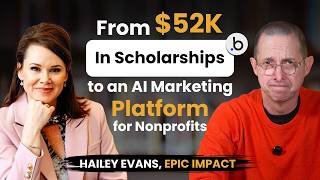
In this episode of the ratio.dev podcast, host Dennis H. Lewis interviews Haley Evans, founder of Epic Impact, about her journey from using storytelling to win $52,000 in scholarships to building an AI‑powered marketing platform for nonprofits. Haley explains the chronic challenges nonprofit marketers face—being under‑funded, wearing multiple hats, and using siloed AI tools without brand consistency. She introduces the EPIC framework (Engage, Sway, Inspire, Close), which she codified in a bestselling 2025 book, and shows how the framework underpins Epic Impact’s no‑code platform built on Bubble. The platform offers roughly 40 branded content tools (email sequences, donor letters, website copy, lead generators, website audits, etc.) that embed each organization’s branding, writing preferences, and the EPIC structure, turning AI output from “slop” into consistent, mission‑aligned messaging. Haley highlights use cases such as empowering interns to act as a “marketing team in a box,” automating repetitive tasks, and freeing staff for donor engagement. The conversation moves to the product roadmap—expanding audit and lead‑gen features, forming strategic partnerships with foundations and nonprofit alliances to scale the tool downstream, and hiring a partnership lead. Haley also reflects on the entrepreneurial grind, the loneliness of building a solo venture, and how working with ratio.dev’s no‑code approach and collaborative partnership accelerated development, delivering a cost‑effective, timely solution. The episode closes with optimism about scaling Epic Impact and the broader accessibility of building AI‑driven nonprofit tools.
Chapters
Well, hello everybody and welcome to another episode of the ratio.dev podcast. Today we're going to talk all things AI. And I think in this really special way, because we've got a really great guest, fabulous customer of ours, who's been working really hard to integrate AI tools into enterprise and nonprofit backends where it's really been an uphill battle for a lot of business owners and especially a lot of nonprofit organizations to understand how to incorporate all of this into their day-to-day work. And for me, it's really special because Hailey Evans, who is from Epic Impact, is also a magnificent storyteller. As you know, storytelling has been something I've been talking about for a long time. Welcome Hailey. And I'm really happy to have you on the podcast.
Well, thanks, Dennis. Very glad to be here.
So Haley, tell me a little bit about yourself. Tell me about what you're doing, and then we will jump in and dig deep into, into your project.
Yeah. So for the last several years, I've been helping nonprofits how to build capacity and how to scale. And the 3 things that I kept noticing, number 1, they're all overwhelmed and underfunded. They're wearing 5 different hats. A lot of times the person in that marketing role does not have any marketing experience or background. They're just kind of wearing that hat. They've gotten pushed in that role. Secondly, they are now starting to incorporate AI. However, it's siloed. So Susie's using ChatGPT and Jimmy's using Claude, and there is no alignment. So they might be creating a lot of content or, you know, trying to, but it's not branded. It's not sounding aligned with all of their team. And then third, they don't have a repeatable system or process when it comes to creating another campaign or another event or whatnot. And so those are the things that I kept seeing over and over and, uh, At first I started building custom GPTs and those were selling like hotcakes. And then I was realizing I need to take this to a broader scale in a platform. I didn't really know how to do that. And so I just started researching and found you. I was listening, I found your podcast. Yeah, I found the podcast, started listening. I was like, hmm, this sounds interesting. Uh, reached out and, um, just really excited about where we're headed and where, um, how far we've come.
Yeah, I am too. So I'm, uh, showing here your, your website. Site for Epic Impact and it looks really sharp. So good job there. This one we didn't build, I'll say, but another one we will. And nonprofits, AI, and storytelling. And you started off, you wrote a really great book about telling stories. So let's start there because I think, you know, I've talked a lot about this, that the words on the page are so important. You know, people really, and, and, you know, we're seeing your website here. It's really slick, but the best thing is, is that the words really make sense. They really speak to the, to the person you're trying to reach. And that's, that's where so many organizations fall flat.
Yeah. Well, that was the other thing that was hard for me. I got into storytelling when I became a single mom. Goodness, that was back in 2011 and I needed to get my education. I'd been a stay-at-home mom for 14 years, hadn't finished my college and didn't have any work experience. And so I started writing scholarship letters and essays and stories because I didn't also— I didn't want to go into debt. And so I ended up earning $52,000 in scholarships and grants, and that paid for all 3 of my degrees, including an MBA. And that's when I realized the power of storytelling. We all have incredible stories, and even with the clients or the customers we serve, where they're sitting on a gold mine of stories, but they don't know how to communicate their impact. And so I wrote a book. It came out— Epic Impact came out, uh, back in the summer 2025 and was on the bestseller list for a little while on Amazon in 3 different nonprofit categories because I wrote it specifically for nonprofits to say, here is a very simple communication framework that works, and you can apply it to any kind of platform, whether it's your social media or your donor email or, or whatnot. So EPIC stands for Engage, Sway, Inspire, and close. When you follow that framework, it makes everything so much clearer and it helps people to lean in to your message.
So true. And I'm gonna ask you a tricky question here because I know that we both know the answer to this, but it's a question that a lot of, especially business owners, they get it wrong. And you say, oh yeah, it's about storytelling. And then you ask them, well, who's the hero of your story? And who's the hero of the story, Hailey?
The hero always needs to be on your client or on the prospect or on the customer. And so we are simply the guide. We don't want to take away from, you know, the focus off of them and their issues and their problem and trying to solve their problem in a way that is meaningful to them. So absolutely StoryBrand, uh, I was StoryBrand certified guide. And so believe in a lot of those techniques as well. And then just put together the EPIC framework to make it even a little more simple. And you know, when it comes to math, 2 2 always equals 4. But when it comes to words, it's very easy to get confused and disoriented. And so when there is a simple framework that you can modify depending on who your audience is, it just makes it so much easier to do your work in an effective way.
I totally agree. And so when you came to me, I got, I bought your book off of Amazon and I started reading and, and I realized that what you're trying to do and what you, we've, we've done now with this first version of the tool that we've launched is to bring that, that those insights from your book and incorporate them in a way so that you're not just sending off messages to ChatGPT or to Claude or to one of these things with no context. We're actually providing it the framework in the, in the, in the calls, in the tools. And you know, like you, I was showing a little bit of the, of the dashboard there while you were talking. There's tools for writing emails. There's tools for writing donor letters. There's tools for writing website copy. But they all incorporate that wisdom that you brought to create a consistent voice, to create a consistent brand experience that, and that makes it so much more powerful than just, you know, paying the subscription to one of these tools and joining the army of people out there creating AI slop, right? I mean, that's—
Yeah, that is the term right now. Slop. It is that much. And when I was doing AI bootcamps and training people how to use AI, they were still frustrated with their output. I kind of became a prompt engineer and I was obsessed with getting the right output, but you first have to focus on the input. And so what I realized is that number one, they needed their branding, they needed their writing preferences, and then they needed the EPIC framework to create very consistent output. And so those three things have been embedded in the platform, and that has just made a world of difference. And one example that one of my clients said, he cannot hire anyone for 5 years because of the grant that they accepted. Well, what is he to do? I mean, he, he needs marketing help. However, he can't pay anybody. So instead, this platform, Epic Impact, will be available to an intern who needs to earn hours and volunteer. And they don't have to be trained. It doesn't take months to onboard them. They don't have to learn all the branding and the consistency and the messaging. They're literally given the platform. If they know how to use AI, which all Gen Zs do, they will know immediately how to create the content. It's literally that simple. It is pretty much a marketing team in a box. And you don't have to think and be frustrated with the output because it's all right there for you.
Yeah. And one of the things that I think is really spectacular about the— and it's almost an operating system already for these organizations is that you can take it both ways. You can say, okay, guide me through it. And the platform is already prepared. It knows what questions to ask you to draw out the details, to draw out the, and take that and turn it into barbecue, right? I mean, you know, that's, or you can, you know, go in and say, no, I just want you to write me an email about this topic and it'll do it. It'll spit it out. But it, you know, the real power comes from having all of those consistent questions that are designed for each specific tools to, so that, that way you are giving it the, the input that it needs to do a good job.
That is the biggest differentiator of any other AI program and what we've built is that when I was doing, you know, teaching AI, a lot of people would try to use AI for strategy and they would just say, ask me 10 questions. Well, that is a great start. However, you, the prompt needs to be, ask me 10 questions one at a time, because that will give that output so much better detailed and depth. And so when you come to the dashboard, like you said, you can either type what you have, you can paste it in, you can click refine and boom, there it is. Or if you need help creating that content, you just click guide me through it. And like you said, it asks you specific questions related to that tool. For example, an email. An email could be a one-off email. It could be a 5-part soap opera sequence, which is my favorite, or it could be a side fill email. And so again, it's going to ask you specific questions with whichever kind of email you're trying to create. And so it really is just, it is powerful and a really helpful tool.
I totally agree. So how many tools do you have already in the platform? You know, how many are in there waiting for the— for people who are, you know, already today they can sign up and start using?
Absolutely. Oh my goodness. There's probably at least 40 in there right now. And the biggest, I think, ROI is the content creation. You can go in and, for example, once you complete the questionnaire and it embeds all of your branding and your writing preferences, and that takes like, I don't know, 5 or 10 minutes, you're ready to go. So all you have to do is simply go to email and just say, write a 5-part sequence about our campaign or our event coming up. Here's the details. And then boom, it's done. It's all branded. It has the EPIC framework. And it's just, it's so easy. You don't have to spend hours and hours and be frustrated with AI anymore. I was recently at a conference, a nonprofit conference, and, and I said to, I asked each one of them, I said, what would you do with 10 hours back in your week? And the, the answers were astounding. Number 1, they said probably leave work on time. Number 2 was take a lunch break. Number 3 was more donor engagement, pick up the phone and have more meetings with actually the mission that drives it forward instead of doing all of these little things that can be automated and made so much simpler. And so that is my goal is to really help build capacity and also offer a sustainable financial opportunity because as we know, nonprofits are very underfunded and they need, they need answers. And so I cannot think of a better ROI for them to spend money on sharpening their message because that is going to move the needle further than anything.
I totally agree. That is so true. And you know, it also is, is really cool to be working on a project that, you know, is, is amplifying so much good in the world, right? I mean, I don't know if we've talked about nonprofit, but we have other clients that are nonprofits and, and they don't always pay as much. They're not always as profitable for us. That's, that's okay because it really does, you know, it feels good to be making a difference.
Yeah. I, I couldn't agree more. I've chosen the nonprofit route to focus on. I don't say no to for-profit businesses. I mean, I am a for-profit, I'm an entrepreneur, solopreneur, so I know how hard it is. They are wearing all the hats as well. But when it comes to the nonprofit side, I just believe so much in their mission. I understand how tough the competition has been and the funding's been cut and they are doing the most meaningful work out there. If we did not have the nonprofit sector, our social, the life, I mean, it would just fall apart because there is such a need out there. And I can't think of anything better to spend my time focusing on helping them uplift them and give them the tools that's really gonna help them be more successful.
So what's next, Haley? What's on your roadmap now? What's the future have in store for Epic Impact?
Yeah, so we were at a conference last, uh, last week and we did about 50 makeovers. And it was really interesting because we got a lot of data, got a lot of feedback. So they had 3 options. Number 1, they could, we could do a website audit and give them a donor conversion score. We could give them a new elevator pitch and make it for a donor or volunteer, whoever the audience is. Or number 3, we created lead generators for them, which is kind of a new concept for nonprofits. The majority of them chose the website because most nonprofits have a website from, you know, 1980. Obviously that's not true. You know what I mean? It's a dime. And so they have either realized that they desperately need to update it, or they are just going through the update, or they have literally just ended the update. And so that was fascinating. We met several other organizations who partner with nonprofits. There was one out of Pennsylvania we met. They serve 500 nonprofits. And so my goal is to create a custom system for those larger organizations who can pay that, and then they can share it with all of their nonprofits downstream. And so it's really a win-win. The foundations are getting to help their nonprofits more, and then the nonprofits are getting a subsidized, um, you know, cost-effective way to have this tool and have access to it. So My goal is really to partner with those organizations, whether it's foundations or alliances or associations that have the, uh, the, uh, the database right now. They're already serving nonprofits, realize, and they recognize the capacity building opportunity. And those are the ones that are seeing, like, they're, they're catching the vision. They're like, oh my gosh, this is really big. And, um, so that's where I'm hoping to head. I just brought on a strategic partnership, uh, role, and he's doing fantastic. He's got space in the nonprofit nonprofit world experience and consultant. And he's like, he told me this, he said, Haley, I don't think you realize, but this is ready to explode. And I'm like, finally, all of my effort, my hard work could be paying off because it's kind of been lonely sometimes. You know, I work a lot of hours and—
And I think that that's really great that you come out and you mentioned that because for all of us who are entrepreneurs and we're building businesses bigger or smaller, or, you know, they've been around longer or not, it is lonely. At times. It's a tough thing. I mean, you know, and it's funny that in our culture we do, that's one of the great things about America is that it values entrepreneurship probably more than anywhere else in the world. And we're not going to go down the road of all the other parts of the equation that maybe we could work on a little harder. It's still hard. It's not just snap your fingers and suddenly, you know, the $100 bills are falling from the ceiling. You know, it's, there is a, Uh, and, and the journey of building something like, like you've built this tool, the system for nonprofits and for-profits, um, you know, it's, it's, I think we're in one of these moments that it's never been easier to do, but it's still tough.
It takes an incredible amount of determination, perseverance, grit, and it, I mean, you get beat down every day. You go out there and you're either getting rejected, you know, you're making cold calls, you've got emails going out, and it's hard and it's exhausting. And so I've been doing it all my own for months and months. And so we basically have 6 meetings a day and then sit on the couch for the, you know, last 5 hours at night until midnight or 1 o'clock following up. Answering emails, doing all the things that I, you know, couldn't get to. And meanwhile, my inbox is still getting longer and longer and more overwhelming. And so, yeah, it's, it's tough at times. And I'm finally seeing a little bit of light at the end of the tunnel. I'm so grateful also that I found you. So.
All right. So I guess, I guess it would be— it's important that we have a little segment here. Tell me a little bit about how it's been working with us and here at ratio.dev and You can, you can be as brutally honest as you want.
Oh, it's been fantastic. The first developer that I was connected to and referred to, he did all regular coding and I felt very disconnected from the process and I really didn't have a great experience with him in general. And so I started doing a little more research. I'm like, I've got, there's gotta be a better way. And so I was so grateful to find out that Bubble is a no-code app. Not that I know how to do any of the backend things like you do, but at least it allows me to have the independence. And autonomy to go in there and make a new product, make a new tool, you know, create some things without being so dependent on the team and you and the professionals. And so what I've really valued working with you and Tony is just the partnership. And it's a team event, you know, it's not like I'm giving you all the information and you're going to, you know, just do this and that, but I love the collaboration. The ideas that you bring to the table, the experience, and I really value that a lot. And it's been great. I think you're fantastic about making sure that there's value added in everything that you do. And that stands out to me. And so we've been working together, what, since maybe October, November? And, um, we've gone through several phases of the build and I couldn't really be more happy with the progress. You know, it's been timely. It's been cost-effective and it's been an enjoyable experience. So I really appreciate that.
You don't know how much I appreciate those kind words. So thank you very much. So I guess I think that I like to think about when we do these podcast episodes that, you know, the people out there that are listening to your story, they may have their own ideas. They may have their own mission, their own passion, and they're sitting on their, you know, on their couch at 11 o'clock at night, or, you know, thinking, could I do this? Is this You know, is this doable? Is it, you know, could I, could I create something that, that allows me to have my own kind of future with, you know, building something that really provides for my family and, and also solves real problems. And I think that that is, for me, that's one of the coolest things about what we do is we get to meet people like you. We get, we get to sit down and say, you know, and, and sometimes we sit down with people who say, look, I don't believe that that's going to work. And we're honest with our, with people. We don't just take on jobs for, you know, to take them on. And if we don't think something's going to work, then we'll tell people that. But I don't think it's ever been easier with all of the tools that we have at our disposal to build applications, to build communities, to build, solve problems where, you know, when I started out, you know, many, many, many years ago, working with, for IBM, doing something even remotely like what we've done together, would have been 3, 4 years worth of, you know, work with teams of developers and hundreds of thousands of dollars invested. And it wouldn't have been doable because, you know, unfortunately back then, only big companies could do these projects. And now, and now it really is accessible. Now, you know, if you have a good idea, if you're willing to put in that determination, that grit, because as you know, building the product is only part of the equation. It's doing those 6 meetings a day. It's doing those 5 hours of follow-up emails and it's doing them one day after the next, after the next. And that's just part of the reality. I mean, there's no getting around that.
Yeah. Yeah. You, you do have to wear all the hats at the same time for a while until I, you know, or until anyone can get to that point where they can bring some help on. I've had a VA of the Philippines and she's been helpful, but it'd be so great to have somebody that could do the sales and then do some more of the business development. But, you know, when you're doing it all on your own, it is hard. And I totally agree. I think it's wonderful. It's wonderful that we have access to tools these days that do make it easy. And I was on a podcast a few months ago and I was sharing with him what I was doing. He's like, you really need to get this out to the world. And, you know, I'm like, well, how do I do that? He's like, you need to build an app. And I'm like, that's for smart people. I can't do that. So that's— I really immediately felt like I was completely disqualified from doing something on this level. And when I started learning a little bit more about all of the things out there and then speaking with you, I tell my clients also that if they want a custom piece and they're like, well, what about this? What about that? You know, I want to integrate this or that. I'm like, look, if you can dream it, we can probably build it. And the light bulbs go off. They're like, really? It's that easy? I'm like, yeah, these days, let's figure it out. Let's be innovative and figure out the workflow that is going to help your organization thrive the best and build it. And so that is just a complete mindset shift. That's never been able to be a thing until now, I think.
So, yeah. All right. Well, Haley, thank you very much. I think it's been an awesome episode. I really appreciate you being on the, on the podcast with us. And, and I'm looking forward to a long future of seeing Epic Impact just grow and do all sorts of spectacular things.
Absolutely. We've got a lot of momentum and a lot of scaling coming up, I think, in the near future. So very glad to have you part of it.
Thanks a lot.
More from Dennis








Is Google Killing Websites? The Future of Search, SEO & Web Design After Google I/O

Something we're still looking forward to in Bubble: richer design experiences! #bubble #nocode #ai

Big mistake companies are making right now: firing employees instead of empowering them. #ai