Old School vs No-Code: Startup Lessons From Two Eras (And Why You Need Both) – Nocode Wizardry
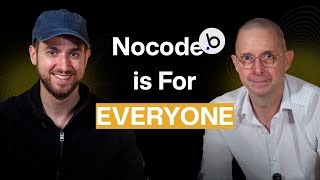
Dennis H. Lewis and Tony compare old-school software practices with modern no-code approaches. They argue you need both: plan for a week, then iterate fast. A client named Sarah moved her brick-and-mortar business online by pairing product work with community building.
Chapters
Hi, I'm Dennis from Ratio.dev. i'm the old guy in this conversation. In fact, I've been building applications probably longer than most of the people listening to us have been alive.
Probably true. And hi, I'm Tony, and today I build a lot of my businesses from my phone, which I actually don't have it from my tablet as well.
So I think that the whole purpose of this episode of the no Code Wizardry Episode podcast is to highlight not only the differences, but the advantages of having a generational gap and having two different points of view on a lot of issues. Points of view that sometimes we crash and discuss vehemently, and other times we're able to really pull out the strong points of each of us.
I think that people that are listening and watching today's episode are going to get something really valuable out of you. And this is actually something that I'm trying to really learn from you. It's a really valuable skill that I've seen you master, you know, across your entire life, which is to never stop learning and to never stop.
You know, I guess what. What's the right choice of word here? Being able to adapt.
Yeah, To.
To things that are.
To evolution, man. I mean, if you don't adapt, you die.
I mean, I don't want to be rude here, but you're on the older side.
Just to give people an idea. My first development job of building a software application was with a Kaypro 2 computer. It was this huge suitcase, like, device. It had two floppy disks. Okay. That means it had no hard drive. It has 64K RAM. And I got hired to build an accounting program with this system, and I did. That was the first.
How was the building experience?
Well, there was no database, so we stored data in files that we had to. That I had to sort myself. And I would keep the program in one floppy disk and the data in the other so that you could kind of keep things, organize it. This was with cpm. It was before dos.
It all sounds Chinese to me.
It does. But the truth is, is the lesson there is that it was. I was still doing the same thing. I was solving a problem for a business and getting paid for it.
And are you enjoying today's way of building better?
Of course. I mean, tools change, but I think that the underlying understanding of what you're doing and how you have to adapt and solve real problems, that doesn't lose its value. It doesn't lose its place. So, sure, now we use bubble, now we use AI, now we use Web3, now we use all sorts of really sophisticated things we can have in our, you know, an iPhone can do, you know, a gazillion things more than that huge, you know, Kaypro computer could do at the time. But the value that we bring is the value of not only being able to develop a software, but it's to develop a business and it's to understand the business needs of our customers and get them where they want to be. And I think that that is kind of irrelevant to the tools, but you obviously have to keep up to date.
Well, in contrast, my first business I actually launched in a weekend and I think I started on write a single line of code. It was probably like 2015 or so. And yeah, I had 300 people signed up by Monday or Tuesday, so.
Well, sure, that is a great example of the speed that we can achieve Now. I'll also tell you that that business flopped like most of them, like most of businesses do. So it was a great learning experience and I think that you have to keep the balance. So it's not just about finishing in a weekend, because when you finish in a weekend, you probably don't have something sustainable, but it's also about being able to go at that speed when. When you have to. So it's getting shit done.
But you can't deny that there is value in being able to launch something in a weekend. I mean.
Oh, of course. And I think the value now is, is that you can launch something with an audience. That is something that is completely, completely impossible. In the old days, you and I.
Talk a lot about how cool it is to be able to build things fast and build things that can scale quickly. But there's no denying that there's a lot of power to, in today's day and age and being able to market efficiently.
So definitely the, the. That's I think, is the core message that we need to be getting out to the people that are wanting to work with us is that you're not just going to build a software, you're not just going to do marketing, you're not just going to work on the business part of your project, you're not just going to build a community, you're going to do all of that. And there aren't a whole lot of people out there that can help you do all of that. And I think that's what we bring to the table. And I think it's essential because in today's day and age, building a product, if you're not building the community at the same time, you're going to fail. You can't just build a product, you can't just market. You can't just build a community and you can't just build a business. You have to do all of that. You have to do it together. And.
It used to be that you would do those in stages. In the old days, you would. There was no choice. You did them in stages. You put in a lot of effort equal to product, and then you put in a lot of resources to try to get it to market. And then you did sales, and then you started worrying about your cash flow and you started worrying about all of the other business aspects. Today you have to do it all at the same time and you have to do it in parallel and you have to get that community growing probably before you even start writing the first line of code or you start creating the first, you know, application in bubble, you should be building the community.
And.
Yeah, with community also comes funding eventually at some point, right? I mean, it is easier today, for example, if you want to raise some money to get access to that capital.
Well, yeah, I mean, I don't think that anybody who has capital is going to, in today's market, risk it if you're not able to at least prove that not only can you solve the problem, but that you can attract people.
With the problem and that wants your solution that exact. Right. So you've championed traditional planning for a long time. You've actually done that on this, on this podcast now a couple times. It used to be the case that you needed a thorough plan, you needed cash flow projections, you needed to come up with all of this planning ahead of actually building. Today, I would probably argue that it's better for you to just get started building.
Yes and no. You still need to do some planning. Okay. On the product side, don't jump in and start building a bubble application without thinking about your database because you will fall on your face, it will fail, it will not scale, it will have a gazillion problems. Start thinking about how you're going to create the user experience. What functions are you going to have in the back end and what functions are going to be on the client side. These are really important planning steps that you do have to take into account, but they can be done a lot faster. You don't need six months to do them. Maybe you need a day or two to do them and do them well.
So the time is being compressed, but the actual process is still fundamentally the same. Think about your customer. Really get to understand the problem. They're facing the part that hurts. And then design a solution that you can effectively bring to market as you cultivate a community of people that are suffering.
How long can you afford to spend planning?
At least a week.
But not six months.
Not six months.
If you're planning for six months, you're probably just taking yourself for a ride, thinking that you're building something and you're not.
How do you feel when you hear the, you know, this concept of move fast and break things?
You know, I'm. I think it's kind of a cool idea. In fact, if. If I didn't know that you were having a bad hair day, I'd say now's the time that you give me the cap, because I'm prob. The one who's more willing to break things than you're. You're more organized than I am. You're more.
I don't like it when things break or where the. You know, when the unexpected happens.
Right.
You're a little more chaotic.
I am. Maybe that's the age as well. I've just seen so many things happen. I know they're going to happen. I know things are going to break. There's no way around that. Life is breaking things.
You're my dad. Give me a tip for not being so scared of the uncertainty.
Sit down and tell yourself, okay, if the worst thing that you're imagining happens, what does that really mean in concrete terms? So if the worst thing that happens is that bubble kicks you off the platform and you can't and you lose your application.
I've never heard that happen.
That's never happened before. But I'm just giving you something just. Just so you can not sleep well.
If that happens, what does that mean? That means that you will be forced to find another platform to build your solution on. Okay. And are there other platforms that can be used? Yes, there are. So is that really that big a deal? Well, it's a big deal, but it's not that big a deal. And that's the way you look at and you say, okay, I don't need to be so afraid of the uncertainty. What I need to do is actually face it down and say, okay, if this happens, what does it really mean? Can I just say, so what?
Right, well.
And like we said, that's. That's never actually happened, right?
No, no, but I mean, there are lots of things that happen in business. There are lots of people who have been kicked off their payment processors. That's a big deal. There are a lot of people who've had their YouTube channels banned for stuff that maybe they did wrong or they didn't even know they were doing wrong.
It would cost us a lot of money. For example, if someone starts building on bubble and they build something for a couple years and they start actually making money with their bubble application and then they get kicked off.
Well, I mean, let's be honest. I've never heard anybody be kicked off a bubble. And if you're doing that, you've probably broken some really serious rules.
So let's, let's take it in a more realistic path here. Let's say that someone builds a bubble application and they're marketing through a YouTube channel and then they get kicked out of YouTube and they lose their entire community.
Right. Well, that is a real business risk that you have to take into account.
So how do I deal with that uncertainty? Do I just not.
No, you build, you build an email list with your.
You have a point.
Yeah. You learn enough to run ads on meta if you have to, or on X, God forbid, or somewhere else to get leads. You diversify your those risks because they're not under your control. And you also try not to do anything that's going to get you back. Right.
Let's talk a little bit about Sarah.
Right. Good old Sarah.
Good old Sarah.
That was a fun project. That was a project that was.
So we changed Sarah's life. I feel pretty comfortable saying that.
I. Yes, we did.
And we did it because, well, we were, you know, it was about 2020, give or take. The world was going through something interesting.
Yeah, it was, it was a complex.
Time and a lot of brick and mortar businesses and people that relied on, you know, being able to exercise their services in a physical location where we're going through a really hard time.
They were, you know, and we were able to open their eyes to creating a whole new business model online that turned it around for them and really increased their projection. And it was all based on building out a website and building out a solution that they didn't have.
I do like being fully transparent. Right. One of the main reasons why we did a really good job with Sarah's project as well, for example, is the fact that Sarah had a really, you know, I wouldn't say she had a really big audience cultivated, but she did have a small audience of raving fans.
That's true.
That were, you know, they were waiting for, they were waiting for Sarah to upload the next YouTube video.
And, and that was a. One of her core.
Strengths was that ability. But they didn't have the. Know how to actually leverage it and make it.
Make it real and turn it into an online business.
And turn it onto an online business. And that happened. And, you know, I'm proud that we were able to help Sarah transform her very.
Physical brick and mortar presence into something that gave her more freedom and more ability to grow.
Now, the reason why I even brought Sarah up is because it wasn't easy. She was a. She was a little bit of a difficult client.
Yes, she was.
Because. Well, let's just say that Sarah was on the older side. She was very used to doing things in a very meticulous way. She didn't love marketing that much.
Right, she didn't.
And.
And she was on the other side of the world as well. That was a. That, that, that is.
You know, there were cultural differences as well in the way we.
Even in things as simple as how do we write emails and how do we communicate to clients. She was scared of selling.
Right.
Why are people scared or afraid? This is actually something you're. I'm half Spanish. I'm probably like 60 Spanish and 40American. You're, you know, you're fully. God bless America. Let me ask you, why is it so easy for Americans to put themselves out there and ask people to pay up? And why is it so hard for people in other cultures and other parts of the world to do the same thing?
It's a great question. I think that if there's anything that we could say about America, it's that we're good salespeople. And you only have to look at what's going on in the country to see that that's not always selling the highest quality products.
Right.
And I'm going to leave that part of the conversation there. But, you know, whether it be we selling something really great or something really shitty, we're good at selling it. And I think that from a business point of view, you have to get over the fact that if you have something of value that helps people, that helps them solve one of their problems, that relieves their suffering, you have an obligation to get it into their heads, to make them aware of it. And that is by putting yourself out there and selling it. And you're doing good by doing that. Now, if you have a shitty product and you're just selling it to make money, then frankly, I don't want to work with you. I don't want to know about you. I don't agree with that. I think that, you know, you shouldn't be. You're not making the world any better by doing that. So, you know, there's a, there's a left hand and a right.
Yes, I was going to say. So there's two sides of the spectrum here. You can either be really American or you can be very anti American in the way that you hate marketing and you hate shoving down your product through, through people's throats. Is there a, is there like a middle ground there?
Well, I think that we have to realize that. Look, when I learned marketing and sales, it was in a direct marketing world. It was in a market, TV commercial world. There was no Internet when that was starting. So here we are with the, with the generational gap again. And it was basically big corporations projecting their messages onto the populace and that's what drove people to buy stuff. When the Internet came around, that all changed. And even in America that has changed a lot. People are very jaded, they're very suspicious, they're very.
On alert for somebody who's trying to take advantage of them or sell them something that isn't real. So I think that the answer to that is to do marketing that isn't pushy, that isn't offensive, that isn't, you know, sleazy. But still do marketing. You still need to get your message out there. Just do it in a cool way. Just be authentic and be genuine about what you have to say. Is there believe. If you believe in what you're trying to sell, what you're trying to tell people that come across.
So let's actually give you a real old example here. So let's take Ben Settle for example. Guy is very much market the heck out of your email list. Send more than one email a day. Give them. I mean, if you're brilliant at something, you should be able to send your email list at least daily email with something valuable in it, right? You're an expert at something.
And it's not just value, it's not just the. Because otherwise you would only, you know, only want to listen to Harvard professors. And Ben Settle isn't a Harvard professor, but he's just damn good at writing emails and we could have a lot of discussions on other topics that I probably wouldn't agree at all with. Ben Settle, but the fact that he's really good at writing emails and he has a built a really strong relationship with his audience is true. And.
What he promises, he delivers. And he delivers it in his own unique voice. You can like it or you can hate it, but he's not ashamed of it. And I think that that resonates and that's kind of what I want to be. Ben Settle in all the ways that Ben Settle is. No, I'm not. I'm Dennis. I'm different than he is. But I know that I've learned things from him. So hey, you know, to each his own.
Can you market disagreeing with Ben Settle? Can you say, hey, I love selling my products but I don't want to email my list every day?
Well, I would say that if you're hung up on emailing your list every day, don't do it. But I don't think there's absolutely anything wrong about emailing your list every day. Do you get, if you're, if you're.
Doing it well, do you get emails from someone other than Ben Settle every day?
Sure.
Do you read all of them? No.
But did I read all of Ben Settle's email? No. That's okay. That's perfectly fine. You don't have to expect that every person read everything every email you send out. But the truth is if they're getting seven to ten emails from you a week, then they're likely to read one. And that's probably more than you can hope for. If you're only sending one, then maybe they'll only read one a month and you're going to get forgotten. Because the truth is people are going to buy from you when it's good for them. They're not going to buy from it when you want them to. They're not there, you know, because you're pushing them. They're not going to buy. But you do want them to remember you because when the time comes that they actually need your solution, if they've forgotten you, they're going to go with somebody else.
What would it take for you to unsubscribe from Ben Settle's email list?
Actually, I don't know if I, if I'm still on it, to be honest.
So from a marketing standpoint or did you just get tired of listening to him?
Actually, no, I think it was the other way around. I used to be a paid subscriber and I canceled and I think he took me off his email list, which is what he promises. So that's, that's fine, you know, interesting.
So I think that as a recap, especially after just this was a good episode for to just listen to you speak.
Most. But I think that one of the things that I'm taking away from this episode is that you have to be agile.
You do. And you have to be.
Sufficiently self aware to know that you don't know everything and that you make mistakes and that, you know, hey, you could, there's always somebody who knows more than you and you can always learn something new. And that keeps you on your toes. It's, it's fun. It's. There's nothing, you know, nothing more interesting than actually discovering something new.
How does, I don't you have to help me out here? I keep wanting to say, I keep wanting to say, how does an old man.
Okay, there you go, boy. How do I pay you back for that comment?
How does someone on the older side.
Stay so excited about innovation? For example, I. Every week, you and I, you know, we hang out together for a couple hours, we have strategic meetings and everything. And I am beyond impressed how each week you, you show up to our meetings and you tell me, oh my God, Tony, look at what I did with AI. How does someone, at your age, for example, and you're not that old. Okay, I'm gonna give you a break. You're in the older 50s. But how does someone stay so excited about innovation? How can someone keep up?
Well, I mean, you, anybody can keep up as well as you can. That's not really the case. I mean, you know, I'm, I, I enjoy that. It's fun, it's interesting, it's, it keeps your mind going. It's, I think it's, there's absolutely no reason so far now, maybe in 20 years the old ticker just won't work enough to. And I'll be an old, crotchety old man. But for the moment it's, you know, it keeps you, keeps you going, it keeps things interesting.
If you didn't keep up. Are you aware of the fact that, you know, we as a business would have probably been left behind in terms of not just us, but anyone that isn't using AI or that isn't keeping.
Up with AI but it's not just AI, it's AI. It's web three, it's blockchain. It's no code, it's, it's a lot of things. This is a fast paced world, it really is, and there's no choice about it. You can complain if you want, but the world isn't going to listen to you. So you might as well, you know, keep up. Keep up.
Well, I think this was cool conversation and we can wrap it up for this week.
Be sure and get the no code resource center if you haven't already. We've got lots of good stuff. There's a link somewhere.
Check the show notes for the link. It's going to take you to our website where you can just drop in your email address and we're going to give you access to our resource center. We actually I'm the one who's updating that manually each week with top of the notch videos that we're creating and that we think that you might find useful. It's they're all up, they're not just about Bubble actually they're about you know there are podcast episodes that we've listened to that have inspired us. There are you know tutorials that either Dennis or I have recorded around bubble.
There's plugins that you might want to use.
It's 100% free. We're not going to charge you anything. You just go to the show notes. There's a link there you can just click on it. It's going to take you to our website rachel.dev Drop in your email and I'll be in your inbox.
We'll see you in the next episode.
Take care.
More from Dennis








Is Google Killing Websites? The Future of Search, SEO & Web Design After Google I/O

Something we're still looking forward to in Bubble: richer design experiences! #bubble #nocode #ai

Big mistake companies are making right now: firing employees instead of empowering them. #ai