
Combining Operations + Automation To Build Accounting Firms That Run Themselves
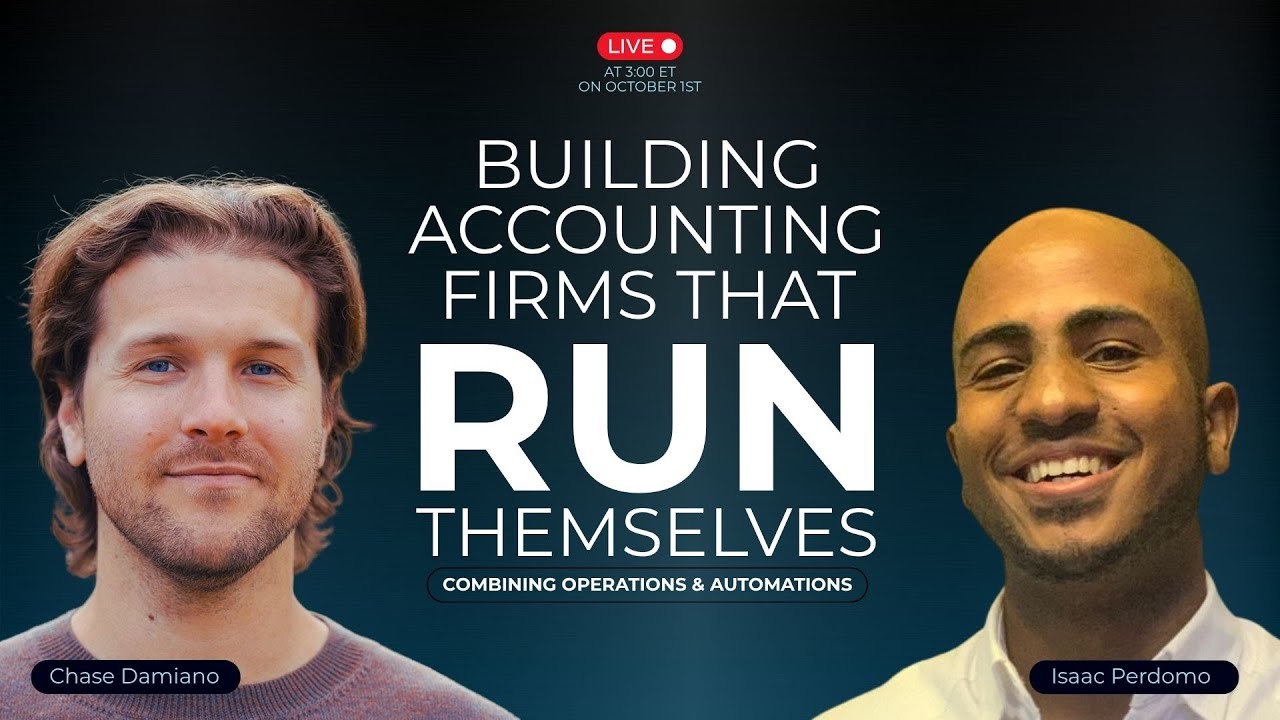
Chase Damiano of Humans at Scale explains how accounting firm owners can build self-running businesses by layering operations (roles, OKRs, metrics) with automation. Firms show they're ready when the CEO becomes a bottleneck, meetings multiply, and accountability disappears. The path involves mapping roles, building a KPI dashboard, instituting weekly meetings, and creating a living playbook.
Chapters
All right, all right, beautiful people. Welcome everyone, welcome to today's, uh, live. We're going to be talking about combining operations on automation to build accounting firm that run themselves. I see a couple people joining in, looks like we have 9 people live. If you are joining us, please feel free to comment. Where'd you join in from? Give us a thumbs up if you can hear us and see us, and we will get started. Um, as we mentioned, the topic of today, combining operations automation. We have today our guest Chase Damiano. He's the founder and CEO of Humans at Scale, an operations agency that partners with accounting firms to streamline their process and help them scale. Before that, he worked in Accenture implementing technology for Fortune 100 companies, and he later built the largest US distributor of Necro Cold Brew Coffee as the COO. He emphasizes aligning people, process, and technology to transform businesses into self-sustaining systems. What a beauty. So thanks for joining in, Chase, and happy to have you.
Cool. Thanks, Isaac. And way to nail my last name. You pronounce it—
Damiano?
Yeah, you nailed it.
Perfect. All right. All right. So I see Matt joining in from Canada. Feel free to keep the comments going. Here's where I like to start, and this is a question I get often. I suspect you do too, which is like, why accounting firms? You know, there are so many other industries that we could be supporting with our businesses. What kind of led the path to accounting for you in the first place?
Yeah, for me, so what's been interesting is the caliber and incredibly heart-centered nature of everyone that I've met in the accounting industry. So first of all, just working with great people that have high integrity and intention to grow and also lead their people has been a joy to work with. Uh, but also more so just like so much change is happening in the profession right now. It is, you know, private equity has come in. We have the shrinking number of CPAs that are coming out of university and taking the exam. A lot of offshoring and AI has been coming in and I keep hearing a theme of mental health and burnout is rampant. And I think that these are great ingredients for transformation. And I just see more and more firm owners wanting to be more intentional with their business and installing some practices that are gonna help them grow.
Yeah. Can I try to tackle those issues? Internally, like, with operations. Yeah, all right, makes sense. Well, I'd like to start with terms because I think operations is one of those words that's so broad, right? You ask 10 different people and they're gonna give you 10 different versions of what operations mean for them. So in your own words and from your perspective, you know, For a growing firm owner listening to this, how should they think about operations and what are like the elements that make it up?
So I think of operations on 3 different levels. One is it's the functions that run the firm. So think of your marketing function, your sales function, your onboarding, your client delivery, your retention efforts, account management, internal operations and finance, et cetera. It's like all of these functions stitched together that actually are the engine that runs the business.
Right.
But it's also more than that too. It's having an operating system for a team to perform together and get work done. So I think of this as clear roles and responsibilities, clear goals or OKRs, clear metrics, a meeting system, an operating playbook on how we work together. And then the third is that underpins all of it is this culture that drives change. So it's a culture of accountability, it's a culture of performance, and also even psychological safety and creating the conditions for the other 2 to happen. If we have great performance, great accountability, and great safety, then the way how we get the work done can be made a lot easier, which then drives performance into each of the functions, which then drives results to the clients. So those are the way that I think of operations.
Yeah. Could you elaborate on what you mean by safety? I think that's probably one of the terms of everything you've brought up that I think is not talked about often enough.
Yeah.
So I'm curious to better understand how you think about that and kind of what that means for you. And practically speaking, how could firms create that kind of safe space, I'm assuming, for the team?
Sure. Psychological safety. I think this came out of a paper outta Harvard written by Amy Edmondson, and it got very popular during the pandemic. All about, okay, creating psychological safety for teams. And what psychological safety is, is it's a precursor to learning. It's a precursor to performance, but it's a feeling that if I, as an individual on the team, take an interpersonal risk, something that is like, I admit a mistake or I make a mistake or admit that I don't know something, that I'm not gonna be punished for it. That punishment usually comes from someone in a leadership position. And therefore it's only the leadership that can create psychological safety. Ways to do that can be expressing our humanity and vulnerability as leaders. When we admit things that we don't know or we messed up in front of the team, it brings a more human light to, to a work dynamic in which there tends to be a power differential between employers and employees. But that's what safety is all about. Can we together, as a single operating unit, learn, Make mistakes, admit errors, grow together, shoot for the moon, stretch ourselves and fail and have it be okay.
Yeah, I like that. Like not really punishing people for doing a wrong job 'cause then they're not gonna learn. You're gonna allow them to grow in the company.
That's right. You lack safety in your culture if you are surrounded by people who say, hey, it's all good, just tell me what to do, tell me what you want.
Yeah, yeah, yeah, makes sense. Okay, so we have functions. We have the operating systems and we have the culture. From your perspective, like, where does automation play a role in that, like, picture within operations?
Yeah, so I see operations as this big picture context for how everything works, and it's as strategic as it is tactical. So thinking of things like, again, operating performance metrics, culture, process and procedure. And then automation is the pursuit of reducing the level of effort required to do all of that, hopefully to near zero or zero. So I, you can run an incredible operation totally autonomously, totally with automations, but the strategy to stitch that together is part, is part of operations and automation is a tool, a methodology to help get to really well-run operations.
Yeah, of the 3 things you kind of talked about in operations, like functions, operating system, and culture, is this— is it fair to assume that automation plays a bigger role in functions in particular?
100%, and probably in that order. So if you have a— if you have a client onboarding process, maybe you've gone through it a handful of times, automation can be an incredible way to make that well-defined process much more efficient. In terms of roles and responsibilities, metrics and meetings, I see automation somewhat playing a role, especially around metrics. So for instance, hey, we're gonna connect to all your tech stack here and start reporting on the data that is necessary for you to make great business decisions. And then culturally, maybe, probably not. I have seen some interesting tools.
Yeah.
That help with accountability and sort of automating a management function and help people, you know, work on the right things, but also make sure they're doing their own individual reporting, but probably not as much that might not be able to be fully automated away.
Yeah, that's like so people-centric, right? That we kind of want the humans involved in that particular instance. We want their efforts, not really kind of reducing that.
How do you see it, Isaac?
I see it the same way fundamentally. Like ultimately the functions run, the firm, and that's where automation can come in to help. When we have people involved, and we want them involved and engaged, which is in those performance conversations and that accountability, we definitely want, I guess, well, we almost want to encourage engagement from the people. So we almost like intentionally try to like minimize the tooling or automation involved because we want them We want the humans involved in that particular area.
Love that. Cool.
Yeah. Okay, now we have operations, we have automation, we have the different functions, operating systems, and culture that drive that. As a firm owner listening to this, like, where should they be thinking about getting started? Of course, you know, AI is a big thing. People feel the FOMO. They have all these tools that You know, that they feel are gonna solve the problem, because of course software has big budgets to market and make you believe that that's the case. But fundamentally and foundationally, what's like the biggest lever that firm owners can do to kind of get started in that, moving their operations in a good direction?
Yeah, so I see this quite a lot where I'll meet with firm owners And they'll, they'll share to me and say, it's like, hey, you know, I've been using this tech stack and I'm thinking about switching to something else. Chase, what do you think?
Yeah.
And in drilling down why, and some, some of the firm owners I'll speak with might be on their second or third, possibly fourth practice management platform, sort of looking at a tool maybe to solve something else. But it's, it's very rare when I see that, hey, they've selected a set of software that is actually and truly not gonna work for them. So what actually is it? It's likely you do not need a new practice management tool. It's likely you don't need a new proposal tool. It's more likely that your culture, your habits, the rituals, the behaviors is what is missing. And I, I also see this with automation too, where a firm owner might, might choose, might choose a tech stack and then spend a lot of money trying to stitch everything together and automate things. In the name of trying to get more efficient, but there actually lacks a deep operational understanding of what are we actually doing here. And when, when you get that bigger picture first and understand how is the business supposed to work, how do we want this to work, and mapping this out, that's when I think automation can come in and really do a great number. And I'm sure you've seen something like that too, Isaac. Have you worked with firms?
Yeah. Yeah, I mean, for sure. And I think we learned this the hard way over the years because of course we want our clients to be successful, our firms to be successful, and we sometimes started to realize that the clearer they were upfront, the better the outcome.
100%.
And the more we started to say, hey, how can we replicate that? How can we actually help them clarify that in the first place so that we're not guessing, you know, and we're not Kind of like trying to, to your point, we're trying to fix something that's broken with a tool where the tool is not the issue.
Right.
We have to kind of fix the underlying process, get that clear, and then we can have a conversation around automating it from there.
And I love that about you and Opsur as well, because I know you do some significant process work. Like you focus on creating that level of clarity. And alignment before you're doing any automation.
Yeah, definitely. And that's something, again, we kind of learned the hard way that it's just gonna lead to a better outcome, both for the client and for us. So we kind of like feel the need to do it. Okay, now one of the things I like for people to start thinking about is like, what are the signals in their day-to-day life that will indicate to them that they're ready? to start investing in operations and improving their operations internally? What are some of those common, I guess, telltale signs from your experience at Chase?
Yeah, so this is what I usually see. The CEO gets bottlenecked, whether they are aware of it or not. The symptoms can be things like too many meetings, an infinite to-do list, missing processes, a low sense of accountability across across the company, ineffective meetings. Maybe you've picked a tech stack, you know that people aren't using it the way that you think.
Yeah.
And you're, you're, as a result, you're spending anywhere from 60 to 80%, sometimes 90% on internal operations. You're spending a lot of your time reactively and fighting fires as opposed to what do you want to do, which is usually Firm owners want to spend more time on growth and vision and business development and figuring out what direction that the company's gonna go. They wanna spend more time on that. And in addition, also spending more time creatively and proactively as well, like more blocks of deep work on their calendar as opposed to like going back and forth between tons of different meetings.
Like back and forth meeting.
That's right. So the CEO is bottlenecked. I think from a service delivery standpoint, you might have in your engagement letters, you might have an SLA. You're, you know, you're either delivering the books by a certain period of time, closing the books and delivering your reports, and you're just not meeting them. You, you may, you may have tried the 3-tier pricing and you wanna push people to that higher pricing tier, but you're not certain the team can actually perform. There's a lack of coordination. There's possible quality issues. You might be spending a lot of time reviewing people's work. You might be personally managing like a lot of clients, more than you want to. And I don't suggest that that number should be zero, but more than you want to. And then from the team's perspective, they tend to be confused or they feel like there's a lack of direction, or they're asking you for permission to take action as opposed to a bias towards action. And as a result of being in that chaos, sometimes They'll have like their own spreadsheet or organization method to like clarify, okay, I actually can't count on the practice management tool, but I got my own private sheet over here that helps me stay organized on what I have to do. And those are a lot of common signals where it's like, hey, it's actually time to invest and scale up the operation so that you can add on, double your business, triple your business, and have that actually work instead of fall apart.
Yeah. Actually, there's a term I really like that a person from the industry uses. She's called Alison Ball. Maybe she's watching this. She called it hidden factories, which essentially kind of what you're alluding to. It's like people have found their own ways of producing, but only they know about it.
Yeah.
You know, they have their own hidden factories in the backend, and it's such a hard way to scale because sometimes you don't even have this ability. Into that as the firm owner.
Right. I love that. Hidden factories. Yeah, that's exactly it.
Yeah. All right. Um, what about, I guess, the automation side? Um, are there any particular signals, signs that at some point you'll say, yeah, you're ready to invest in automation?
So this is what I think. I'd love your opinion on this is Firms and teams that are really clear on what to do, how to do it. They have a clear process and clear approach for the pieces that are ripe for automation. They have also a commitment to their tech stack. They're not, they're not wondering, okay, do I have the right technology? They've actually identified what they have is good enough, and they have no intention of switching. They'd rather double down and extract the value out of what they have. So that, that tells me that they could be ripe for automation. The staff is also on board with following a more standardized workflow or process. And so again, those like hidden, those hidden factories, we've actually removed all the hidden factories and now this is our way of working together. And then they're, they're able to also consciously select the processes that are ready for automation, things like sales, onboarding, pieces of delivery. Because they see very clearly where the manual effort is. They see where the bottleneck is and where things start to slow down. So through that awareness, they're able to say, okay, we know that we have a bottleneck in here, here, and here, and I see those are the ones that are very ready for automation. But I'm curious what you see too, Isaac.
Yeah, definitely. I think that you nailed it. The more clarity they have around what their current processes are and what are the pain points in those processes, which you brought up, is like Where exactly are the problems here? Where is work getting slowed down? Where are issues or errors happening often? The more they're clear on that, the more we can attack that particular area, you know, directly. And I love you mentioned, you know, also having their team on board because I feel like there's also— and I know this is like where everything comes together because you were talking about safety earlier. I feel like If the leadership is not clear on why we are investing and diving into automation, there might be an internal fear.
Yeah.
Which you sometimes notice of, oh, you're gonna invest in this automation AI, my job's gonna go away. There needs to be clarity. I think alignment internally with the leadership team and the rest of the team, of course, we kind of flows down on why we're doing this in the first place.
Yes. Especially if you can tie it to processes or things that do not bring joy or energy to people.
Yeah.
Whereas it's like, you know, please take this job.
It's the other way around. Yeah. Something you're excited, excited to, to give away.
To get rid of this. And I think you, you're right. You need that leadership level clarity of, hey, why are we doing this and what are we actually doing? And I think this enables this shift that is happening within the profession, which is moving much toward advisory and being this thought partner to the clients instead of focusing so much on the, on the transactional work, starting to be of higher service and higher value, which I love seeing. And I think automation can be an incredible tool that helps you get there.
Yeah. And it's funny because we've actually gotten a lot of I think the story goes like, hey, you were able to automate your compliance work so you can focus on advisory. But we started to see a lot of opportunities to actually automate areas in both. Of course, I think the advisory has the meeting with the client component that, at least for now, you know, we kind of do human to human. But I think both have opportunities in our experience.
That's cool.
Yeah. All right, um, cool. What I want to talk about next, it's like, what does growth look like? I think a lot of the firms you serve and we serve are on a growth path, right? They want to continue to scale. Some don't, which is totally fine. But as growth happens, there's almost always sticking points that are somewhat predictable that people hit. in that journey. You were talking about this kind of off the live earlier, so could you help us understand, like, from your perspective, how does that— the operations of a firm owner's life evolve as they go from, hey, it's just me working with the clients, to kind of hiring a small team, potentially growing beyond that?
Sure. I think of it in revenue tranches. So, you know, under $1 million USD, $1 to $5 million USD, $5 to $10 million, and that's— we'll stop there. So from— for those like under $1 million, it's essentially you're proving that you have a business, not just a series of projects. It's really you as the founder is the center of the business, plus your team of helpers. It's individuals that are trying to like take work off your plate, but really for almost all the client relationships, you have a very high degree of accountability. Most of your growth during this stage is referrals or word of mouth. Maybe you've done a little bit of digital marketing efforts, but really, you know, you're forming deep relationships with each of your clients because you are in the room. And the key hurdle I see is founder time. It's like, it's learning the skills around delegation, it's getting your practice management system in place. It's clarifying some basic processes so you can get increasing leverage from the team that you have brought in.
Yeah.
Then that tends to work until you break about the $1 million mark. So at the, at, when you're at the $1 to $5, you are, you essentially have a small team of seniors and junior staff. You likely have account managers that are running client engagements. end to end without a lot of your involvement. Maybe you're jumping in to do account management type calls every quarter. Hey, how's it going with our relationship? But all the work is being done by the team. It's great. You're starting to also build your non-partner management layer. If you have a, if you have other partners in the firms, they're taking on these additional roles such as head of operations or head of the accounting or tax function, uh, or you might hire these individuals. So it could be a head of ops, uh, ops manager, director of ops internally. You might have a director of accounting or VP of accounting who is overseeing the accounting function as the technical expert that's managing and leading the team on how to do the work. And you're spending your time trying to optimize your practice management, your tech stack system and processes. So things are just less manual effort and start humming together. At that point, you're no longer solo, so your margins have probably been impacted. You now have team, you now have payroll, you might have a bench that you start having to take care of. So it's really important to get clear on things like utilization and client-level profitability so that margins always remain high so that you can continue to build cash, but also not, you know, have several months of people on the bench and all your margins go away. And the key here is that thing, capacity management, making sure you're adequately matching supply of accounting talent to the demand of clients.
Yeah.
And then we have— yeah, go ahead.
Sorry to interrupt there. Like, let's take a pause there 'cause I think that's such an important part that, you know, a lot of other, you know, people in the space talk about capacity planning, right? And how to do it right. I mean, how do you think about, like, what does that look like? What does the process of capacity management look like for a firm at this stage? And how should they be thinking about it and approaching it in the right way?
Yeah, so I like to tie capacity to sales pipeline and then renewal pipeline. So we can make some assumptions that under most circumstances for, let's say, you know, CAS type services, let's say bookkeeping with some tax.
Yeah.
That clients have a high probability of renewing with you unless things are going terribly wrong. They have a high incentive to stay with you. So we can assign a probability that a client is going to be there next month, usually relatively high, but the real driver is your sales pipeline. So you have, you have your pipeline. Each deal that you have in your pipeline has a certain probability of closing. Each deal also has a level of complexity requiring a set of skills all the way from junior to senior time. And you're able to anticipate with that probability of closing and what you think the number of hours might be, you can start forecasting over time. Okay. How, you know, what is the demand for Time and effort and skillset over time. So you can start forecasting it out. You know, this is October right now. We might have a November, December, January, February forecast. And then it's just a mathematical equation. You can start assigning part-time roles or full-time roles into each of those. And then you just start seeing as the, or as the organization grows in revenue, which are the roles that we need to add and then when.
Yeah.
Take that and then work it backwards to the amount of time it's gonna take to find that individual and then turn them into a productive member of your team. Could be any, you know, depending, could be anywhere from 6 to 12 weeks. The onboarding piece we wanna keep tight, but in terms of the hiring and finding the right person, that can take more time. And then, you know, when to start starting these, when you start having to look for these individuals. To match your forecast. Now, of course, like, not everything works out perfectly, right?
Like, there's a lot of assumptions in that.
It's a lot of assumptions, a lot of probability, and a lot of prediction. At the same time, you can also look at client-level profitability and an understanding of staff distribution. And what I mean by this is, for a given client, what percentage of the total time being worked on that client is being served by someone in a junior position, someone in a senior position, maybe you have a controller as part of it, maybe you have a CFO part of it, and what's the percentage distribution. It also helps to find where are great delegation and training opportunities that then, that then put work into a more junior seat that helps you increase and improve the profitability. But it also maps back to the forecasting because then you can start Understanding, okay, well maybe I don't need a new controller. Maybe I can get away with a senior accountant. And that's another way to add into the forecasting and like what roles do you need over time?
Yeah, I like that. It's ultimately like, it's not just when I should hire, but specifically which role I'm gonna need. Right?
Right. And you can make some, and again, not everything goes perfectly. It is a probability. And you can play with your probabilities of which deal, which deals are gonna close as time goes on, as you facilitate your sales process. So you get more and more certain over time.
Yeah. And there's also the uncertainty of like potentially depending on the firm size, right? It's like maybe we don't close this deal, maybe this client churns, maybe a team leaves, right? Unexpectedly. So all of those variables start to play into that. capacity plan, which is something actually we've been thinking about a lot internally. So I wanted to make sure we double-click on that because that's something honestly I see a lot of firms struggling with.
Yep, me too.
And I think, I think it is because many either don't have those estimates in the first place of how much they estimate their work is going to take, like by role, which is relatively— I mean, in concept, this is a simple exercise. Clients, roles, how much time per role. That's it. But I think a lot of— right, right. And then I think also they don't have a way to visualize that easily, right? There's a lot of spreadsheet magic to try to like get a sense of that.
I totally agree, 100%. I love that.
Yeah, let's wrap up the 3rd stage. Sorry to interrupt, I did want to double-click there because I think a lot of People need help with that. But let's move on to the next, you know, $5 to $10 million branch. Like what are the sticking points there and what does that look like?
So at this stage, I start to see that the partners or the leadership team really starts specializing more. So someone might be a lot more focused on business development. Someone might be a lot more focused on client service, a lot more focused on operations and et cetera. So it's like a divide and conquer between the partners at the top. The team itself can also start specializing. This is where you might consider, hey, what, who do we need to bring in for practice leadership? Do we want to define our work by industry and focus more deeply on certain industries or a geography? Do we wanna remain in our geography or enter a new geography? It also can be by service line. What services are we willing to do and which services are we not going to do? And we might find specialists in those services. So, you know, a great example is like you might start building, you know, a team dedicated to payroll or a team dedicated to AP or AR processing, right? Where they can specialize that skill across all of the clients. You're gonna have deeper middle management. So more directors, your operating team might start turning, not just having a COO or head of ops in place, you might have—
Mm-hmm.
a handful of ops managers or ops coordinators that are running a machine. And the big thing to worry about here is recruitment. It's finding talent and putting the people in the right seats. And it's also developing the leadership of your middle management layer. I see consistently that accountability and initiative are sometimes challenges at this stage, where it's like, I just wish my, you know, the team would take more ownership. Over things. So it's developing their leadership to make sure that those values are being taught and more accountability is being taken. And then also similar to the stage before, it's avoiding margin erosion, not building too big of a bench without a strong pipeline of clients coming in, which is gonna kill margins for that period of time.
Yeah. Yeah. I have 2 questions for you that it's something that has come up with other firm owners. You know, we talk to many on a regular basis. I would say that this morning talking to another firm that had this question of like, should we start to specialize? But then the question becomes, how do we specialize? By, right, by industry, by service? It seems I see a lot of by service typically being the default, but I'm curious if you see the same and if you think there's a quote-unquote better way or a way that's kind of like typically Works best for firms?
I'm actually not sure the answer to that question because I, I do see, uh, differences between the two, and I, I don't know if there's an end-all be-all. It's like, hey, this one works better than other ones. Um, I do know that when you are, uh, doing a large amount of offshoring, um, this sort of decision can be really impactful, and I— especially in structuring things like pods. And like having groups of some sort report to each other in your offshore structure and maybe with a US-based account manager or maybe not. But I don't know at this point if there is a right answer to this question.
Yeah, yeah, actually. And I think the answer is probably there is no right answer. Like ultimately you have to decide based on the particular firm needs and maybe even the firm, you know, could decide either way, and that could work. Now, what about the traditional partner structure? This is another conversation I've heard in the industry of like, we have department leadership structures, so like we're gonna have someone that's dedicated, say, to marketing or sales, and someone in other areas, versus the more traditional model of like, hey, you're just gonna become partner, And almost highlight your own little business within the business, so to speak. Do you have a more stronger opinion on that one by any chance?
Not a strong opinion, but I will say one thing that I am seeing that has been working is giving percentage of revenue compensation to more individuals on the team as they manage a book of business. So you can imagine a world in which you have a relatively senior, high-level experienced individual managing a book of business of a certain revenue amount, and they're coordinating directly with their team that's also incentivized to perform.
Right.
Now there's a lot of aligned incentives while a firm owner can adequately predict the contribution margin coming from that group, that pod, and you can give the best performing Owners, the best, the best, the best performing heads of these groups, more clients. They can build more teams. Maybe they're going out to get their own business. Maybe you have some centralized business development resources that support them on that. Maybe they're totally responsible for business development. That incentive structure for the firms that I've seen, it tends to be working, or at least it's working right now during this period of time, which, which I'm interested by.
Yeah, I'm super interested in that too, actually. We have a client that actually has gone through all these phases. They're doing more than $10 million a year, and it's one owner, but he does production pay across the board. I think like even the lower people in the organization in the production team get a percentage of the production, you know, of the livables they produce or the revenue they're working on.
Yeah, that's great.
So I think that's something that more and more firms should pay attention to, especially if they are not given equity. I think that that's probably a big piece of moving through those phases, or at least one strategy that can work well.
Yeah, there's a lot of things that make sense about it. Align incentives, align performance, more clear seeing who your top performers are. And getting a strong sense of predictability over your bottom line.
Yeah, and I've seen people that is as far as, hey, it's fully variable. Like almost like you kind of, you get what you eat kind of thing.
Yeah.
So that's super interesting. Of course, I think for most firms they probably find like a sweet spot of like base plus incentive.
Yep.
That's an increasingly interesting area for me as well. So I appreciate you sharing.
Yeah.
And good that we're aligned on that. All right, let's start to talk like practical steps. I heard this live, I'm interested, I definitely see the opportunities that could open up if I focus on my operations. I resonated potentially with one of those hurdles in that kind of growth trajectory we talked about, like what do I do next? What are some practical steps In your perspective that people can start, you know, taking today with them, start implementing on their own?
Sure. I think of this in 5 different areas and it's up to the firm owners to choose, okay, where do I wanna start in these 5 areas? I would encourage anyone starting not to do everything all at once. A lot of these exercises build on each other, but I'll just give you the run-through. First, it's roles and responsibilities. It's a map of the entire organization with clear ownership and structure. This is not an exercise in creating job descriptions for everyone. It is facilitating the collective understanding of what the person to my left does and what the person to my right does. And sometimes we don't know that job descriptions get lost somewhere in our folder structure and no one reads each other's. It's not just about, it's not just about that piece. All of us in the company, especially smaller ones, need to know what do we all do here? How does the whole operation work all the way from the marketing and sales function all the way to delivery? It's not just about who works on what client. It is about how does this firm work as a collective whole? So it's getting that shared understanding and documenting it.
Yeah. I, I'll say this real quick. I felt called out cuz I've been spending a lot of time recently writing job descriptions.
Yeah.
I think it's, there's still value in writing them for the owner itself to kind of conceptualize, internalize the differences. But that's not even half the battle from what you're saying, which is like it's written now, it's actually making sure everyone internalizes that as well in the team.
Yep. That's it. There's a step 2 to that. And you're right, roles and responsibility, like those job descriptions are great tools for owners to figure things out. And it's a great tool to communicate a single person's responsibility to that person. But you're right, it's a collective understanding exercise.
And the way—
yeah.
Sorry, I just kinda wanna dive into that. The way I see it too, the job description is almost also like it plays into the recruitment sticking point and the recruitment thing we talked about, 'cause it is the ad for the person you're trying to attract. So it kind of has to be well written for that to attract that person, but keep on, keep on, keep on with the other ones.
The second one, and you'll like this one, is an operating dashboard. So it's the right KPIs that measure the firm performance. This can be done very simply to start. I'm a huge fan of doing things manually, especially if you're not fully committed to your tech stack. Open up Google Sheets, pull an export from practice management, pull an export from your, your QuickBooks that manages your firm's financials, not your clients. And then another one from your CRM if your practice management doesn't cover that. And then manipulate the data to get a better understanding of, okay, where am I, where am I making money? What's my client-level profitability? What's my utilization? And get an understanding of who is working on which clients because all the data should be there. And just the exercise of creating something like this can give so much awareness. It almost pops you out of the organization. You're working on the business now. So you can see the performance as a whole. Sometimes you might not like what you see, but as all things, that is the first step to improving everything is you have to look.
Yeah.
And I think there's a huge need to automate this as well. Especially for those committed to their tech stack. Like, this is fully automatable. A lot of the practice management tools also, they have their own reporting function or, you know, live boards, things like that. But sometimes the data doesn't talk to other data. And I think that that's the important piece here.
Yeah.
Third is a meeting system. This is probably the one of the lowest lift ones to do is a lot of folks will just come in, you know, we have this team meeting on the calendar, CEO might walk in, hey, what are we talking about today? And it's all, it's good vibes, it's good connection, we're hanging out as a team, but there is so much value of doing that, but also having a very strong meeting structure. What I'm seeing working right now, and again, I, the way I think about meetings is it is the method that we use as a team for synchronous communication. So what information needs to be synchronous and live and discussing? Number one is making decisions. It's not reporting status updates. It's like, okay, here's all the information. If you got your operating dashboard spun up, here's all the information, team. Like, let's review this information, talk about it, make a decision on what we need to do. A very simple structure for this is run a, run a weekly team meeting. I actually like to model it after EOS Level 10 meetings.
Yeah.
And daily standups. Weekly team meeting is about 90 minutes. Daily standups, 15 minutes. What's that? Hey, what's everyone working on today? That level of accountability is automatically gonna clean up your practice management tool.
Yeah.
All of a sudden the whole company is gonna start, okay, let me get all my tasks in. Let me get all my due dates updated and start running these reports. It's about measure— it's like observing with your eyes. And then over time you can start petering it down and not making it so meeting intensive. But I think most will find that a very strong meeting structure is gonna help run the firm performance.
Yeah. Yeah. And this is so timely, at least for me, cuz we're literally, we brought a project manager today, literally, and we are having the conversation around standups.
Cool.
And we literally be having that conversation this Friday with the team to start incorporating that. I've been a little bit hesitant about that just because of the small team we have, but it's starting to feel— I'm starting to feel the importance of, like, that daily synchronous to ensure accountability and get an understanding on where we can support our team members if they're stuck.
We do it every day internally at Human at Scale, and we start with a connection question, something to help drop us in. Make us laugh, all the benefits of working with a team. And then we move into any announcements. Then we take a measure of team health. Green, yellow, red. Where is everyone in terms of like, are you feeling good? Are you overwhelmed? Are you burdened? If anyone reports yellow or red, we help that individual. What can we take off your plate? How can we help you with it? Then we go into blockers. Who's blocked on something that needs just some to get unblocked? And then if we have time, we're reviewing the tasks for the week. And we built all of this in Notion, so we're not creating new pages. It's just a single page in Notion that has all the live data updated. And we spend maybe the first minute, uh, okay, everyone in silence, just update all your information. So now we can run the meeting.
Yeah. And then we teach them on that.
We teach our clients how to do this as well, and we run and facilitate these meetings for them. Every client's gonna look a little bit different based on how they structure their tasks and how they structure their deadlines. But the format of just this standing meeting can really add a lot of, really add a lot of juice.
Yeah, no, I really like that. Let me ask you this question. Is there a range where it makes sense to bring the whole team? And is there any point where you would say either on both ends, we're too small? To do it yet, or we are too big to bring everyone?
I think if it's you and one other person, then you, you could probably keep that pretty asynchronous. I've seen it work well with as few as 4 people. I think it can get up to 10 to 15 before a middle manager somewhere might wanna spin off their own version of it. Again, we're not, we're not going around the room and saying, this is what I'm doing, this is why I'm doing this, this is why I'm doing this. If we've done our job well in In terms of practice management and recording everything, it's actually already on the screen. We're literally looking at it. And so anyone can go through and give a quick scan, ask questions. Oh, I see you're actually working on this. You know, I have some information for you. I've been meaning to give it to you. Done. That connection's already made and now it's, now it's over. So it, it, it's kind of like this central operating system that prepares people to do what they need to do within that given day.
Yeah, I like that. So essentially we have clearly clarifying roles, responsibilities, not just writing them down, but making sure people understand that, the right metrics, you know, in that operating dashboard, and then the meetings we need to have on a regular basis. What else?
Yep, so another thing, the 4th thing here is the operating playbook. So this is your internal collective knowledge, internal wiki on how everything runs. So think of this as your system of SOPs, processes, ways of working. These can be the client-facing SOPs. What do we do for this particular client? And also your internal things such as, okay, how do I put my PTO on the calendar? As like a very, as a very basic example, it's the information That typically resides in one of the partners' heads, often the CEO's heads. And then that permission-based culture happens, happens again. So people will ask, it's like, oh, you know, can I do this? Or where is this? And usually it's living up in their head. If you have this operating playbook, well, it's no longer in their head. Go look at this instead. And you'll find like, as you build it, the— build it and then direct people to this as a resource, then the number of day-to-day questions, you're less inundated with all the messages all day. Hey, can you take a look at this? Where do I find this? Hey, can I talk to you about something for a second? Because those questions are just a symptom of a problem. And the problem is that you are the path of least resistance to having a team member's question get solved or challenge get fixed. So building this is a really important body of work.
Yeah.
We like to not overbuild this. We don't want these huge employee handbooks that are trying to carve out every possibility of everything. These are meant to be nimble, lightweight, relative, relevant, and live, constantly updating.
Yeah. And I think if I may chime in, I think there's also one of the use cases where AI becomes incredibly useful. You mentioned Notion earlier. having those AI features built into the product where you put your knowledge base so that people can ask questions and not have a hard time finding the answers that they want.
Definitely. Absolutely. And so the last— and the fifth and last piece here on what can improve operations is the culture. I talked about this before, this culture of performance and accountability. It's essentially The way that we lead as leaders, like what kind of firm do we want this to be? And it powers the entire model. So performance is just, it's being able to handle our workload or even raising our hand, be like, I cannot handle that. It's a, it's a way of showing up. And we as leaders tend to be great examples for this. It's instilling that in the rest of the culture. And then accountability is all about doing what we say. It's about, hey, I took on that thing and I did not deliver on it, and this is what I'm gonna do about it. Again, if we want safety in our organizations, it's not, it's not that, hey, I couldn't deliver, and then, you know, we slap someone on the wrist metaphorically. It's more of just like we're teaching people how to take ownership over something, and that ownership is okay. Ownership feels safe and good. And that's more of a way of being. If you feel like that is not you, then a recommendation would be like get leadership development or coaching. Or there is a myriad of leadership assessments to take to understand where your blind spots might be around it. But it is a journey and everyone has access to it. It's not, I swear it's not a personality type thing. It, everyone has access to bring greater performance and accountability into their business and have that ripple into their teams.
Yeah, I really like that. All right. Anything else?
No, I think those are the— those are 5. Do you have anything to add, Isaac?
I really like the one about metrics. So of course, I think that's probably where there's an opportunity to introduce technology to assist.
Definitely.
And as well as like the systems, right, where we are clarifying the processes. There's probably the 2 I can chime in the most, but honestly, Honestly, I'm kind of like learning about the other ones as I grow our own organization. And it's definitely interesting to me to hear how you think about meeting cadences and importance that that plays in the rest of the org. Yeah.
When we, you know, when I share everything that we've talked about today, we love dogfooding it ourselves, which for those that don't know, it means that you practice what you preach. So similarly, the way that we run Human at Scale, we do all of these things all the time. This is how we run our internal company and we are learning with ourselves of how to do things better. And that has a ripple effect to the clients that we work with. We're learning from our clients, we're learning from ourselves and doing these practices, these rituals that help drive, that drive performance. And it makes it very, very exciting to work in this domain.
Yeah, definitely. Well, let's start wrapping it up then, Chase. I think that there's definitely a lot for people to digest from our conversation today. What would be maybe one thing that you would hope people take away from our conversation today?
To take away, I think the spirit of our conversation is operations and automation. Together, and they go hand in hand. It's like one, one piece can be the, the strategy, the collective knowing of us, like how do we work together as a company, this singular operating unit concept. And then automation can be some of the highest amount of leverage that you can bring in to save your team's time and to make sure that they're also working on the right things, you know. As little manual repeated effort as possible. And I think the combination of those 2 is like really can create a powerful engine for growth. The whole spirit of operations and automations together is simplify. That's what I think, at least. The spirit is to simplify. The spirit is to build ourselves out of a job and to constantly be improving and reevaluating What, what are we doing in the firm and how can we do it better? The spirit of continuous improvement. It's under— it's understanding, it's understanding data. It's, it's understanding where can we improve. That's habits like having a project retrospective, or if a client leaves, hey, maybe as a team we should talk about why they left and what about our process can change.
Yeah.
It's understanding client feedback. What would be a better service that we can build? And together, like operations automation together is the pathway, like the way of understanding that knowledge and then being able to act on it. So I know it was a big takeaway, but that's what I want people to leave today.
Perfect. I know you added something there actually I think I'm a big believer on, which is closing feedback loops.
Yeah.
The idea of like we made a mistake, something went wrong, what can we learn from it? And then improve our systems so that that doesn't happen again and being preventative in that way, whether it's client feedback or internal issues. I think that's a big, big, big important part as well.
That's big. We ask all of our clients every month, okay, what's feedback on our work at Human at Scale? And we ask them structured questions to force folks to tell us what's not working. It was like, what are the things going well? Like, what's one thing you can improve? What are you hoping for next? And then give us an NPS score. You know, what's your, what's the, on a scale of 1 to 10, how likely are you to refer to a friend or a colleague? And we take the feedback really seriously and we build a better service and all our account managers become accountable to building better services for our clients. Then we go out and teach the exact same thing. It's like we help clients get, we help our clients get a better understanding of the way that they can improve for their clients. So again, it's this ripple effect that you have to have it.
Yeah, perfect. Well, tell the audience a little bit more about how they can find out more about you and if you have anything to offer.
Cool. So for those that are listening, we are offering a free operations assessment. This is at humanatscale.com/assessment. It's 10 questions long. You're answering questions on a scale of 1 to 5, and it's gonna give you a simple report on how well your operations are working according to your questions. And for those that fill this out, we also wrote about a 19-page playbook on how to solve some of these common operating issues. And we're happy to help. So if folks take the assessment and wanna jump on a call to talk about how you can build better operating practices in your accounting firm, I'm happy to do so.
Perfect. All right, so free assessment. I always like free to get a pulse on how well I'm doing. And of course, I'm sure that if people are not doing as well as they want and can, they would appreciate your help. All right.
Thank you.
Well, beautiful people, if you have any questions, feel free to put it in the chat. I see one. From League Hitters. So I throw that at you now, Chase, to see if you have any thoughts.
Oh yeah, I see it here. Uh, the question is what practice management system you see, uh, people having the most success with, success being easy or use or people actually using it. Uh, this is a great age-old question. Uh, the practice management system that I see working the most is the one that people are committed to. And again, it is not a— it's not about the technology. And I, and this, I know this is, um, sometimes challenging. Every, every, all the practice management tools I've seen, they have their own series of trade-offs between different features, many of having overlapping features, many of them specializing in certain features over others. And the, the failure mode that I consistently see is is not enough training, not enough implementation, not enough configuration and customization for how do we as a firm actually use this tool. And sometimes it's just making very, very focused definitions. So as an example, for those that use Carbon, what is work? How do we define work? It's one of, it's one of the task structures within Carbon. But how do we as a company define work? Canopy is another example. What is a task? The tools have suggestions. They have recommendations on how to do the structuring, but it's really the responsibility of the firm to ask themselves this question and then make that definition for the entire company. By doing that, I think that is one of the biggest leverage points, because if we can just agree Okay, here's all our sets of statuses. What does each status mean? First of all, who created all these statuses? And then what does each one of them mean? And what are the triggers that move from one status to another? That in itself enables a type of team communication. You don't have to talk about stuff anymore. You just move the status and then people have the context for what's going on and making that reliable. So Lee, I know that's probably not the answer that you wanted, but I really do believe that it's this habit and behavior and ritual around our practice management tools that are gonna drive what success is.
Yeah, I love that answer. You know, it's not sometimes that people— sometimes not the answer people want, but it's the real one. Um, all right, he says it was helpful. Thank you, Jennifer. Another software question, uh, what kind of software will we need to build a firm that runs Build a firm that runs itself.
Isaac, what do you think? You got a stab at this?
Yeah, I'll give it a go. Um, I mean, ultimately the way I think about it is software is a representation of, of a thing in real— in the real world. And the things that you typically want to track, it's your work, so having a work management system. It's your clients, so having a client management system, and then like your team and your financials. So of course she also asked about like the part that runs itself. Of course, you know, there will be a combination of the tools themselves that have features that allow you to automate certain things, additional integration tools that you can add on top of that, but also the people that you delegate to, to then be able to step out of the operations, which was a lot of the things that we discussed with Chase today. So I see those as like 4 core areas and not necessarily different software tools. They can be— one tool can cover multiple, but I wanna be able to track work, I wanna be able to track financials, I wanna be able to track clients, and I wanna be able to track people and projects and the relationship between all of those things as well.
Totally, 100%. Uh, I completely agree with this. And one, one place to look if you are interested in building a firm that runs itself— and by, and by the way, it's, it's, it's each of these functions, as Isaac said, and then there's a stitching that needs to happen between each, like some sort of integration, um, some sort of a database that also centralizes the the information such that you can get, extract the right reporting and information out of it. If you're looking for ways to build a firm that runs itself, I would consider looking, doing a time audit on your, on your, on yourself. So the exercise here is like for the, is for the next week, hour by hour, just keep a notepad at your desk and just write, what did you work on? This is a helpful way to understand where are you spending your time? And where that time is being spent could have up to 6 different destinies. One is you're hiring a person to do it. 2, you're delegating and training an internal person to do it. 3 is you can outsource it to another firm, another company to do it. 4 is to automate it, complete invest in technology to totally get rid of it. 5 is to consciously eliminate This is usually underused. I'm just not gonna do this anymore. I don't know why I'm doing it. And then number 6 is to keep it as a responsibility on your plate. If you do that exercise, it's gonna start giving you a picture of, okay, the next step in building my firm is hire these people, delegate these things, automate these things, and then I'll keep these things. And so time, time is to me a leverageable asset, and the way you invest your time can have long-term dividends. Over, over a long time horizon. So if you start doing time audits, I would recommend doing this maybe every 6 months as you're growing. It could be more than that too. Then you're gonna start understanding, it's like, okay, what do I actually need to build a firm that runs itself? Well, I need these people, I need these tools, I need these processes in place, I need to receive these reports so I can make good business decisions, et cetera.
Yeah, great answer, Chase. We have a couple of thank-yous. Lee says, Chase, do you have a newsletter? I'm on ISIS already. I'm assuming that if they jump on the assessment we talked about, they might just, you know, start getting your emails as well.
If you jump on the assessment, you will start getting emails, although my newsletter is not very well built out. I'm sorry.
Yeah, no, that's totally fair. I send a monthly I don't have any more time for that. Jennifer says thank you too. Appreciate you, Jennifer.
Thank you.
We are on the hour. Chase, a pleasure to have you sharing your wisdom with our audience. Massive respect for what you're doing. And again, if anyone's interested in knowing a little bit more about their operations, how well they're doing from the perspective of the assessment that Chase has built, that's humanescape.com. And with that, I'll let you all go. Have a nice one.
Thank you so much, Isaac. This is awesome. Thank you for bringing me on.
All right, take care.
See everyone.
More from Isaac




This Boring AI Automation Could Save Your Accounting Firm 40 hours (But most ignore it)

How to Build AI Systems With Claude (So Your Accounting Firm Runs Without You)





