
The Power of Automation in Modern Marketing - Creative Operations Podcast
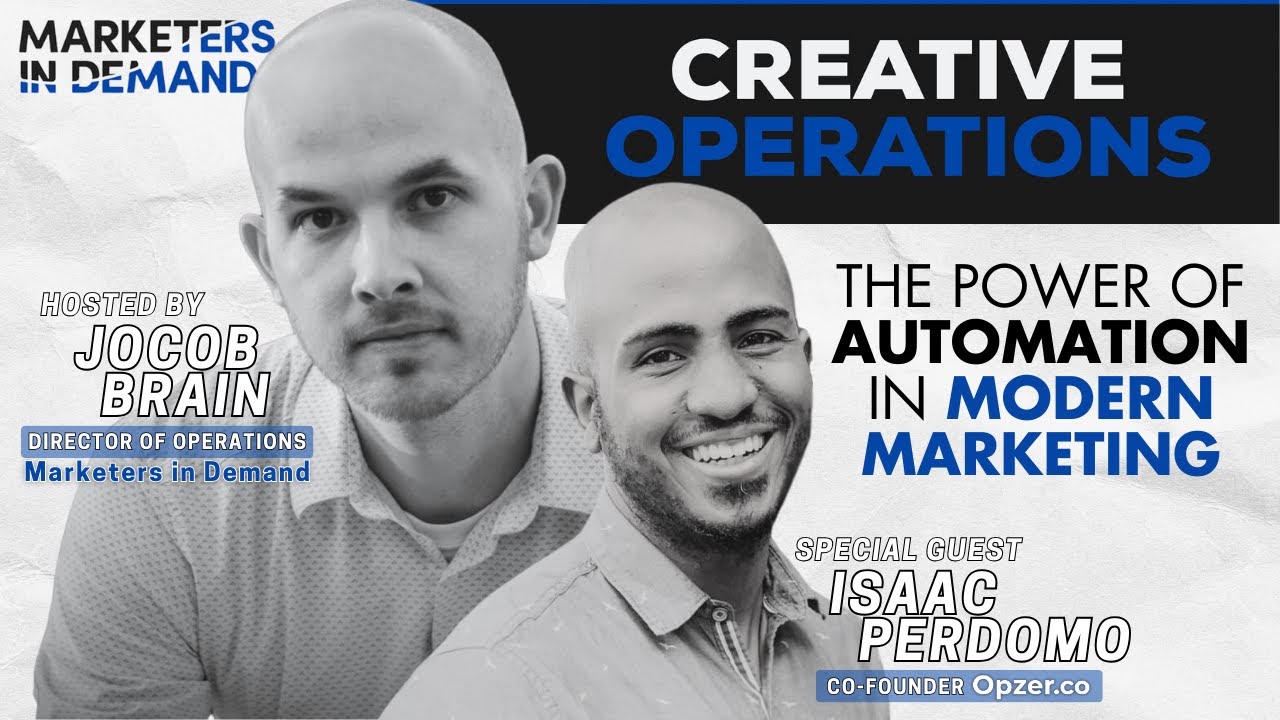
In this Creative Operations podcast episode, host Jacob Brain interviews Isaac Promoto, co‑founder of Opsur, about how marketing teams can harness automation to do more with fewer resources. Isaac shares his journey from a marketing agency VA to an automation specialist, emphasizing that automation is a tool—not a silver‑bullet—and must be embedded within a well‑designed system of people, processes, and technology. They discuss common misconceptions (e.g., over‑reliance on tools, thinking automation solves all problems), the importance of starting with analysis and clear requirements, and methods for estimating time‑savings and ROI. The conversation moves into practical guidance for selecting a tech stack—prioritizing ease of use, integration capabilities, and choosing established platforms over cheap, unproven ones. Isaac outlines a five‑level integration pyramid (native integrations, no‑code platforms like Zapier/Make, APIs, custom scripting, and robotic process automation) and explains when to use each. They stress the need for clean naming conventions, regular platform audits, and thorough documentation (process maps, platform inventories, FAQs, videos). The episode also touches on the rise of no‑code tools and AI (e.g., ChatGPT) to bridge gaps between systems. Finally, Isaac advises leaders to foster a culture that encourages experimentation, rewards automation wins, and openly supports team members in automating their own work. Listeners are directed to Isaac’s LinkedIn and YouTube for more content.
Chapters
So I think it's important for people to build their business in foundation of software platforms that have been established. Of course, you know, I love the AppSumo deals and, you know, this kind of like lifetime things and this kind of more affordable tools, but there's always a cost and you need to kind of like be aware of that.
This is Creative Operations, a podcast for B2B marketers who want to redesign how their own teams get creative work done. In each episode, Jacob Brain discusses the strategies, processes, and tools required to create amazing work that also has a business impact. Using a blend of personal stories and interviews with guests, Jacob uncovers how you can get the most out of your creative operations. Let's get started.
Hey there, my name is Jacob Bring, the Director of Operations in Marketers in Demand, your host for Creative Operations. Today I'm joined by Isaac Promoto, the co-founder of Opsur. They're a firm focused on enabling clients to get really more from their teams and increase efficiency through integration, process automation, and things like that. I talked to a lot of teams in marketing departments as well as marketing agencies, and they're all being asked to get more results with less budget and resources. So there has to do this when quality content or a Talent is in short supply, budgets are shrinking, the tech landscape is evolving at lightning speed. And so helping teams like this is what Isaac is so passionate about. He focuses on developing the infrastructure to enable existing talent to spend more time on high-impact activities, which then multiplies their efforts in a way that even adding another team member sometimes can't do. So in other words, he helps small teams have the impact of teams 2, 3, 4, 5 times their size. So. Without further ado, Isaac, welcome to Creative Operations.
Thanks for having me, Jacob.
Appreciate it. Of course, of course. Looking forward to the conversation here. So I actually want to start out really in the beginning just to get to know you a bit better. So you started your career actually as a founder of a marketing agency. Tell me a bit about that so we can get to maybe start to get to know you a bit.
Sure. Actually, there's a step before that that you don't know about. So I'm going to go a little further back. Because I started my first job after college was in a marketing agency. They did influencer marketing for, for software. And at the time I was simply a VA for the owner, but I was learning copywriting at the time. And essentially I was the guy behind the scenes getting him clients because I was creating these leads, these lists of leads and sending them emails, outreach, et cetera. And as I started Looking at those software companies, signing up for their tools, I was fascinated with all the tools and new tools going out there in the space. I realized that, you know, I started to see some emails come in from those software companies. Some were great, some were not so great. Some didn't have emails at all. So I was like, well, I'm reaching out to these people on behalf of this guy. Why not reach out to these people on behalf of myself and try to get these people as clients? So that's how I transitioned into What I did for probably 3 to 4 years after my, my graduating from college, which is doing copywriting and marketing consulting for software companies, mostly focused on their onboarding process and that first few touchpoints of, you know, the welcome email sequence, et cetera. I did have a couple of side hustles in the meantime, but today you're gonna like transition fully more to the technical side.
Mm-hmm.
Of automation. You know, as you mentioned, helping teams automate their workflows, leverage and fully utilize their software and AI and automation tools available in the marketplace. We've been able to work at this point with about 60 clients. And, you know, each client brings a new stack. So we've tested hundreds of applications at that time, and we estimate we saved teams around the world at around 20,000 hours. So that's kind of where we are at the moment.
That's awesome. That's awesome. Well, thanks for walking through that there. As I, as I mentioned in the intro, we're, we're in like a moment of time where the expectations for marketers is at an all-time high. The resources given to them seem to be continuously dwindling. And, you know, you have economic concerns leading to budget cuts, talent's really hard to find. There are a lot of ways that these teams can try to get ahead, but why, like, why turn to automation? Why did you even make that your focus as you started in the marketing world?
Yeah, I think ultimately automation's there to, you know, increase the efficiency of a particular system, which, you know, is a serious— if literally what you're just describing, the less resources that you have, the more you have to get out of it, right? And usually, you know, if you think about people and the cost you have to pay for people versus software, which is like code and it's essentially a lot less costly, you can kind of like leverage those software tools to help the people in the process and in the system do more. And, you know, you're kind of getting more out of what you put in.
Yeah. Someone could put a hiring freeze on, they can cut your budget, but they'll never stop you from being more efficient.
Exactly.
Good stuff. So sometimes though, when we're talking automation, people see it as this like nirvana that Well, this thing that will like solve all of their problems if you just pick the right system. What are, what are some of these like misconceptions that people have around automation when they're starting, uh, starting out?
Misconceptions. Um, I think software gets more credit than it deserves usually. It gets more blame than it deserves too, right? Many people are like, oh my God, my team is not producing as much. We need to change the tools that they're using, right? And they don't think about the system as a whole. So. If I were to define a system, kind of like in our own definition, you have a series, like a combination of the people, the processes, and the tools. So typically automation comes like only in the tools, but you need to make sure you have the right talent and the right processes in place, you know, to achieve what you want. And automation is just a small, unfortunately, I wish I could say, I wish I could say it the other way around, but automation is just a small part of the system as a whole.
Mm-hmm.
The other parts are just as important.
Yeah, 100%. Yeah. And then there's also this, this trend that every company can resonate with is you, you buy, you know, this gigantic new CRM maybe, or this new automation platform, martech, whatever it is, and it promises to solve everything. And then it just like sits there 20% used for 3 years straight until someone finally, you know, makes a budget cut and you have to move in a different direction anyway.
Absolutely.
You kind of mentioned this, or we talked on this a little bit, but it gets like, it gets a lot of lip service, if you will, automation. And it's something that everyone like knows they should use. And when they, yet when I look at the infrastructure of a lot of marketing teams, there's not a whole lot going on. Like maybe they're, they probably have some like, you know, some email sequence that's automation, but they barely like actually dive into that world. Why do you think that is? What stops people from actually like making traction as far as automating a lot of the things they work on?
I think it's just lack of awareness of what's out there and what's possible. Uh, that's usually a big part of it. It's also inertia to an extent. If you are a marketing team, you, you know, you kind of want to keep doing what you've always done to an extent.
Yeah.
So, uh, sometimes it's intimidating to assess these new tools and see how you can use them. I think also something that I've heard from a couple clients as well, that There are so many tools out there. It's kind of like hard to even, it's kind of overwhelming at times to try to assess what's actually worth it. So I think that's probably why they might not necessarily be leveraging automation to the fullest extent.
Yeah. It also can sometimes have this, like, it feels inaccessible, right? To like connect different platforms together. You have to be a developer or an incredibly technical person or something like that. And yes, there's, there's a case for that. But there's also some quick steps that you can make that a lot of people don't know, or tools that you can use, as you mentioned, that people don't know.
And as time goes on, we've seen a lot of transition into no-code. So more and more the technical side is becoming a lot more accessible to people. So that's something that hopefully over time we see, you know, you know, you can kind of like lower the, the, the threshold for people to get started.
Yeah. The barrier to entry drops and you see a these tools being used a lot, a lot more frequently.
Exactly.
Let's say that someone gets the, the automations bug and they launch into some automation project, whether it's onboarding, like you mentioned before, what are some like common hangups you see people run into?
I can think of 2 ideas. One of them, it's sometimes they try to automate too early.
Okay.
So they don't necessarily have thought about the full context of why they're doing it and thought about, you know, kind of like hone down their stack, hone down their processes to then really automate. And maybe for marketing teams listening, this could be like a good analogy. It's like that client that comes to you and they just want you to write their website, but they don't necessarily are clear on, you know, what they stand for or who their client is or, you know, why they're different. So you have to like take a step back. Hey man, let's actually answer these questions because that's going to allow us to write your website. And in the same way, I think with automation, many people just want to jump straight into it without really clarifying their tech stack and honing that down and clarifying the processes as well. So that's usually a big part of what we do. And don't get me wrong, initially people came to us and like, sure, we'll do your automations. But over time with like Wait a second. Let's, let's, let's take a step back. Let's actually, uh, define these kind of like prerequisite work first.
Yeah. So actually that's a perfect transition because one of the big things I wanted to talk to you about, Isaac, is you do this for a living, right? You help companies identify the opportunities for automation. You mentioned like getting that foundation locked in and you walk with them through that process. You facilitate it, you build the automation. And I think in, in, in many ways, like knowing the process to follow when you're doing something like this is one of the biggest indicators of that success, being able to chart that and follow the right stages through this. So for someone listening that's running, let's say a small marketing team, I'd love to hear, maybe walk me through your process for helping clients kind of build those. What's the first step? Where do you start with something like this?
Yeah. So as I just alluded to. We initially have some sort of analysis process where we really define what is the process that you want to automate, kind of what, why are we doing this in the first place? What do you want to accomplish? Right? Is it that you want to create more pieces of content from your particular team? Is it you want to, you know, what's the output increase or the time decrease that you want to see? We also like to get clear on what are the requirements. Based on the processes you have, what are the requirements of the tools you're going to need to do that? So getting clear on their tech stack and not only what they want, but what they need, kind of what's the must-haves and the nice-to-haves, the tools you want to put in place and the software tools you want to put in your stack. And really, you know, once we have clarity on the tools we're going to use and making sure that fits the business goals that you're trying to accomplish. And we are clear on what's the current process, as manual as it may be, kind of like clarifying what's currently getting done and what's the ideal process would look like. What, which of those steps could be automated, which of those steps could be potentially removed or simplified. This is kind of like the goal of that first step. It's kind of like the strategy work. Any questions there, by any chance?
Yeah, so, so you start out, this is perfect. So you started with a foundational, like, First 2 steps. So you said the analysis piece and then the requirements piece, starting with that analysis piece. Like, how do you, you mentioned like time savings is often the biggest one. How do you estimate that? Like, I assume the time savings, if that's your output, that's how you prioritize the different projects you're going to do. When you're working on that prioritization, how do you even like start to estimate, well, this will save me this much time, this will save me this much?
Sometimes hard to measure. It will depend on the size of the team, of course. If it's just you and a couple of people, you might, you know, just ask around and kind of like measure yourself, take a week, track your time and see how much time you're spending on certain activities. As the team gets bigger, of course, you can start now measuring it on units of people, right?
Mm-hmm.
How many people are in this particular process? What's the output of that particular team? So if you have And this is top of mind because we're putting some content systems in place. But if you have like a content team, you have, I don't know, 5 writers that are able to produce 50 articles a month. You know, you can actually measure in that instance what you're getting out of each individual team member. You can kind of start to measure, okay, if we were to reduce this, the time it takes by 20%, theoretically we would increase The output of the particular team and we will have like more pieces of content for the same resources as an example.
Yeah. And then you can actually start to really measure the ROI based on that, right? So if I save this person 30% of their time, they spend time more on high impact, more creative activities. This is what that can look like. Now on the, so that's the analysis piece. You mentioned the, like the requirements or the tech piece of it and this like Identifying the must-have and the nice-to-have elements of this. So once you've locked that in, you kind of get why you're doing that. You've done that analysis. You've run some of those numbers. You've specced out the requirements. In that requirement piece is often a, like a list of the stack that you currently have, correct?
Exactly. So you could list out, one of the things I like to do is ask very simple questions like, Of the tools that you have, what do you currently like? Or what you currently don't like? I also like to ask, like, is there anything you want to do that you currently can't with the tools that you have? So that starts to give us an idea of specific requirements, specific features that we might not have available, or maybe sometimes we have available, but we don't know we have available in a particular tool.
Mm-hmm.
And start giving us an idea of what are the things we might want. And also I think it's important to differentiate between what's something that's required, what's something that's nice to have. And I think most, even we struggle with this internally, you know this, because, you know, recently I was with my partner picking a CRM and we were like, oh, we need this, we need that. And honestly, it all came from a lack of alignment on the requirements. Because the moment you know exactly, we literally sat down and say, hey, what are the requirements? Could we agree on this? The moment we agree on that, we were like, oh. this is the tool we're going to use. Like, there were no debates after that. So I think hard work is thinking, but it's important to get clear on what those kind of like software feature requirements are.
Yeah. Yeah. There's this, there's this, like you mentioned this earlier, as far as like, you don't start with the tech, you start with what you need. So the technology should improve your business operations and facilitate that, or I guess Maybe a better way to say it is your business operations should drive your tech decisions. Your tech decisions should not drive your business operations. I think that's where you're going.
Exactly. Exactly. Tech is only there to support your business goals. If it's not doing that, you know, it's no point having it.
And now when you've, you're doing this analysis, this requirement identification, and you're talking through a lot of the different processes that the organization has. Oftentimes I've heard a lot of people say you want to start a process doing it manually before you would ever go to automate. Do you agree with that? What are your thoughts around that?
Yeah, I agree in general, but I think it comes from a— here's why I think it's valuable to do it manually first. It's to assess what are the different scenarios that could come in. If you have the expertise already based on previous roles, based on previous jobs, based on similar work you've done in the past. And you already have a good idea of what are the different scenarios that could happen in this particular process, then I think there's the option for you to kind of like automate right away if you kind of like know what you're doing already. But yeah, in general, I do agree that it's valuable to do something manual for a few, a handful of times at the very least. So you can, because you might identify that, hey, maybe there's a particular step that's not needed. So it's better to delete that, to automate. You might realize there's a particular, there are certain things that can be simplified. And by simplifying, you actually make it easier even for the automation in the system to be more efficient and do it more quickly.
Yeah, automation will allow you to do things more quickly at scale, but if you're doing the wrong things, you're just doing more of the wrong things.
Yeah, I just wrote a piece, I think last week, it was, it was around, I think it was automation makes you more efficient, not more effective. So it helps you do more, but you need to make sure you're doing more of what's actually helpful.
That's really good. That's, that's nice. So you have this, this, again, we talked about the analysis and the requirements. Let's say, let's actually maybe sit on this tech stack. So you're doing this requirements, you put it together, you can kind of measure those requirements up against the current tech stack that you have. You might at that point cut away certain technologies, but you'll probably also realize you might need to add something. At that point, and there's a million—an overwhelming number of platforms out there. It seems like the last year or two that's like multiplied. So what are some like the key considerations you want to make when selecting an implementation? Implementing, I guess, like two things—not only just like the tech itself, so like the CRM and the maybe marketing operation automation tool if that's a different one—but even like the glue that keeps things together, like the Zapier, the Make, the Tray.io. When you're building this tech stack, like what are you thinking about? What are the considerations you're thinking at that point?
I can think of 3 off the top of my head that I think are somewhat universal. One, it's ease of use. I think that it's important that it's, if ultimately what you want is for your team to save time, it needs to be easier for them to use. So that's a big one. Of course, we as automation professionals, we also evaluate the automation capabilities of the platform and the integration capabilities of the platform. So we want to look at not only is this tool useful for what you want, but will it seamlessly integrate to the rest of your stack? Essentially, you know, looking whether the tool has native integrations with the tools you have, looking if the tool has, you know, Zapier or Make support so that you can integrate them in a more custom way. Seeing if it has like an API or application program interface available. It gets a little more technical as you go, but if the, if it has some way of automating, sometimes also have like built-in automations. Literally, I think recently Slack launched like a workflow automation tool internally and Typeform has one, Calendly has one, and most CRMs have kind of like internal workflow automation tools that you can leverage. So it's one of the things, of course. We're biased, but we really want to make sure we have all the automation capabilities the client will need today and into the future. And the last piece, it's a little maybe controversial, but I want to make sure that my clients are picking tools that are established. And I'll tell you a quick story on this. I had this client, e-commerce brand actually, and they were using Automate.io. It's like a Zapier alternative, but it was cheaper. It was like a new kid on the block, right? But cheaper, right? It was like, oh, I want to use this because it's cheaper. I want to save money, right? I was like, well, it's going to take me more time to figure it out. And at that time we were charging on an hourly rate. So it was going to be more expensive literally for them for me to set it up. He was like, no, that's fine. You'll figure it out. Let's move forward with that. Okay. We spent 3 months building all of these workflows, all of these automations, automated the entire order process. For a big e-commerce brand and literally 3 days before we launch, there's a banner at the top of the platform that says, we're shutting down, we're getting acquired. So that platform got acquired by Notion and it wasn't acquihire. So literally they just wanted the team and they were shutting down the platform completely.
Oh no.
So literally we spent more time to figure it out, which was, you know, more costly for, for the client. And then we had to migrate everything to another platform. So I think it's important for people to build their business in a foundation of software platforms that has been established. Of course, you know, I love the AppSumo deals and, you know, this kind of like lifetime things and this kind of more affordable tools, but there's always a cost and you need to kind of like be aware of that. Even tools that are, you know, established and more affordable, if you think like ClickUp and HighLevel. I don't know if you're familiar with that one. Even those tools that are more affordable usually come at a cost, which is usually speed and support. So those tools have all the bells and whistles, but are usually not as fast as others, or their support is like average at best. So those are the 3 things that I think I would like always keep in mind for selecting a particular software tool.
That's good. That last one is something that I think I wouldn't have even really thought of, right? I find this platform, it does the same thing. It's a little bit cheaper. It's a brainless decision. Of course you'd go with it.
Right.
That's good though. Sometimes when you're finding maybe that, that, that glue, right? The, the Automation.io, the Zapier, the Make, the whatever, it will integrate with almost every piece of tech you have except one of them. There's always that like one weird platform that you use that maybe is not as popular. When that pops up, what options do people have in situations like that?
Yeah. Over time, I've tried to just this for myself and for the team to develop like a little bit of a framework around what are the different levels of automations as we, as we can like exhaust those options. So I'll walk you through, we have like a little document internally, which is literally like a pyramid. And at the base of the pyramid, it's native integrations and building automations. So literally, if you can do what you want and integrate your tools with the native integrations and with the built-in tools the tools have, you don't even need Zapier for that, those particular workflows. So that's usually where you start because that's the most efficient, that's the most reliable, that's the one that's less likely to break and the easiest to implement. From there, you have these, you know, third-party integration platforms like Zapier, like Make. And you want to assess if they have the triggers and actions that you kind of are relevant to your process. So you can literally, both platforms have directories where you can look Zapier, you know, insert platform, and you can look at the triggers and actions they have available in their integration. From there, if they don't, if either the platform's not there in those tools. Or the actions and triggers are not there, you might want to start looking into the developer documentation of the platform. So this is where APIs come in. API stands for Application Program Interface for those not as techie. And the way I like to explain what an API is, easiest way that I found to explain it, it's simply a login page for a robot. So just like there's a login page that you have as a user where you enter your password and you have access to the tool where you can For example, if it's a CRM, you access to your HubSpot account. Now you can create contacts, delete contacts, associate them, create deals, et cetera. In that same way, an API, it's a way for you to give a robot a password. And so they can, you can access and do all of those actions on your behalf. So that would be like level 3. APIs is a little bit more complex. Those usually you can still do. within the integration platforms like Zapier and Make, you could, like, you can host those actions within them, but you can have to like understand that world. Any questions you had? I saw you wanted to say something.
No, no, that's really good. So the, the, you're, when you're building these things, what you're thinking about is I'm going to always default to that native integration, right? Like, I know HubSpot has their whole app marketplace. You mentioned Slack just built one, but if they have that, that's the place to go. And then I've often, sometimes when I've selected platforms, actually, I've sometimes started there, right? Like if I know, if you were to diagram my martech stack, I'll start with my like core platform, which is in many cases a CRM. And then I'll figure out what connects with that. And that'll be my, like, my starting point for identifying the whatever other category of tool I'm looking to find just to make sure, because I know that automation and like a martech stack in many cases is going to be a really critical piece of the success of using that, that software. So I'll start at that level. That makes a lot of sense. And if that doesn't work, that's where you have your like backup almost as a Zapier or Make or something like that. And then those integrations can either append what already exists or just totally replace it if that doesn't happen. And then that's third level. If that, even that doesn't exist, you get into more of a like development approach connecting to the APIs, you know, building that whole, that infrastructure, if you will, which is maybe a little bit more advanced.
I have even, I, there are in the pyramid that we have, there are 3 levels above that, which are, you know, even more technical, but it's like scripting. So, you know, forget about this no-code alternatives, kind of like use code to do it. There's also ways to reverse engineer an internal API. So think about, you know, might be a little getting too technical here, but if the API is not publicly available.
Mm-hmm.
There's still an API. So you can sometimes kind of like do things as a user and try to understand it and kind of like reverse engineer it. And then at the top, there are like UI-based automations, you know, often called robotic process automation or RPA, which is where you don't, you're not actually doing anything programmatically, but you're like, you're like automating the human input, like you're automating the clicks, the keyboard inputs. And there's a relatively new and up and coming tool called Action.ai that is like backed up by Y Combinator and integrates with Zapier and some of these tools that I'm kind of like paying a lot of attention to and we've used a little bit. And that's usually like the last step. And think about how many, there's a lot of tools out there that have no APIs at all, like government platforms, banks, like a lot of these things that you can actually access as a human and download certain report or access certain data. That you wouldn't necessarily be able to do programmatically. Now those tools allow you to do that by kind of like mimicking what the human would do.
Yeah, that's really interesting. And then I'm assuming at each stage of that you have some like strengths and weaknesses, right? Like the native has, you know, more strengths and weaknesses, but as you get higher up that like development maybe takes more upkeep connecting to an API. If the API changes, you have to fix that. And the, I think it was called action.ai. I had not heard of that.
Axiom, X-A-X-I-O-M.
Okay. I had not heard of that. That's really interesting. And then the RPA, the, is, is really interesting, but as you're, to your point, if they change like a, a UI, they change the UI, that's it.
You have to rebuild the bot.
Yeah.
If they do that. So of course, as you go up, there's, as you suggest, it's harder to implement. It's harder to maintain. And you'll probably have to spend more time updating it as well as things change.
That's good. So once we've locked in that, that martech stack, we've decided how to integrate, we've decided which level on this pyramid we're going to use to do these different things. Are you usually like, are you mapping that out on, I don't know, like a Miro board or draw.io or another tool like that? Okay. And is that like, is there a framework that you follow for that? Is it like different every time? What does that look like?
So from, at least from the, we have, you use like these flowchart tools, we actually use Swimcycle and we just like to map out what's getting done. And it's really more from the perspective of training the client and having that documentation available so that if someone else wants to know what's going on, they can be able to see that flowchart and understand what's happening in the background. Because sometimes, you know, we might have a particular client that has already been doing certain automations. But there's like no documentation at all. So we don't really have the context to understand what's, what's, what's there. So that's one of the things we always keep in mind. I do want to touch on something that might be useful before the automation that maybe we skipped.
Oh, please. Yeah.
And it's this, and it's, it's the setup of the software itself. Okay. So this is not like automation in its truest sense, but There's a lot of cleanup, a lot of naming convention. So as it relates to your software setup, there's usually, it's usually helpful to clean things up and to have some sort of naming convention. Because what we've seen a lot is that, and this is one of the mistakes we see a lot, especially with marketing teams and teams in general, you're always adding to the system. You're never removing anything. So we might have a CRM with a million tags. With zero naming convention, and it's kind of like hard to assess both for the people, but also for the platform and the automation exactly, you know, how to make sense of that. So one of the things we often do if required is a little bit of a cleanup and establishing some naming conventions if needed for tags, sometimes for folders, for pipeline stages, deals, custom fields, et cetera, so that essentially we have a standardized way of kind of defining the different elements of the platforms. Because that's usually the way I like to look at it is we're dumbing it down for the computer and the software to know, easily find it later on. And in doing that, we're also making it easy for the, for the people to find what they need later on.
Yeah. Yeah. That's, it's a really common thing to like, especially in the agency world where I come from, is we'll start working with a client and we'll open up their CRM and there's, you know, too many cooks in the kitchen situation where there's 100 different custom fields. You know, there, when you try to run a report, it's impossible because no one's doing things the same. So there is this like, sometimes documentation is treated as a, like a nice to have. And in some cases, you know, You can't do it the right way. But at the same time, if, if people are following different processes or the, the tech or whatever is not configured well or not simple, like it just gets so complicated that the, the benefits that you could derive from the platform itself actually can't happen. Like you lose reporting, mistakes happen in automation because it's connected to the wrong field that has almost the exact same name and stuff like that. Is that kind of what you're referring to?
Yeah, essentially, like you don't have A simple example could be like folders. If you have naming conventions for folders in Google Drive or something like that, if you want the system to find it later, you need to have some sort of naming convention. It might be like last names underscore company name or something like that. Like if you don't, if all the names in the folders are different, how is the system going to find it to then upload files or do this other things automatically? And the same thing applies for CRMs and other tools, but I think the, at least the folder example might be one that's kind of easier to understand where if every folder is named differently, how would the system know which one to pick? You know?
Yeah. Yeah. That's good. When it comes to that documentation element, there's a million approaches to take. Like I've seen, yeah, one of the biggest mistakes I think is, you know, the people that get this, just like someone can get an automation bug, they get a documentation bug. And their boss comes down and says, we have to document everything. And then suddenly there's hundreds of just text-based pages that are, you know, 3 weeks later, completely out of date. I've seen people use maybe video to walk through things. I've heard like the 80/20 rule applied to this. How do you approach documentation when it comes to something like this?
Yeah. So at least as of now, we have 2 main documents. One is for the process and one is for the platform. So we literally have in the platform documentation all the tasks we created, all the custom fields, all the lists, all of the different tools we are using, all of the workflows we created with links to those. So it's kind of like easily referenced. And the approach we take is that we document what we did. And then at the bottom, we might have FAQs. So as the client asks us different questions, like, how do I do this when X, Y, and Z, then we create videos and attach it to those documents over time. So that they can kind of like, if they have a similar question again, or someone else in the team have similar question again, they can reference back to that. That's on the platform side. On the process side, we kind of reference back to the flowchart I talked about earlier, where we have kind of like mapped out visually what are the steps in the process. We also sometimes like to do essentially kind of like merging both the manual and the automated process. But clearly labeling each step so that it's clear, oh, this is a manual process, it's in red. This is an automated process, it's in yellow, it's in, in green or whatever it might be. So that it's clear, like, okay, this is the entire process and these are the things that have to happen manually. And these are the things that happen automatically as a result.
That's good. Now, when we were talking about like making sure that the platforms remain simple and clean. Documentation is a huge piece of this, but do you ever recommend, or do you have like processes that you talk to people about around like just auditing it to just to make sure that as over time you add things that you are taking the time to cut things away?
Yeah. So one of the things we often do is like an optimization, which is literally, for example, say we're doing an optimization of a particular marketing CRM. We're gonna literally list on each iconic spreadsheet, like all of the tags, all of the lists, all of the custom fields, all of this, all of that. And we try to literally just assess what's required. So sometimes we might have like 3 different tags that are all the same thing. Like it's just a tag for new clients, but you know, 3 people have been using the platform. All 3 kind of like name it differently for some reason.
Yeah.
So kind of like merging those, most CRMs allow you to kind of merge relatively easily, merging those that require deleting those that are required. And honestly, my partner is a little bit better than me at this. And he usually has kind of like quarterly recurring tasks on our project management platform to kind of like optimize certain things. So I think that could be a practice for a best practice for our team as well to kind of like Frequently ask yourself, hey, you know, of the things that I have, are there things that are not needed that I can remove? Are there things that, are there things that I can merge? And essentially not trying to just, you know, add and add and add all the time. See if there's anything you can kind of clean up.
Yeah. And that is probably even more so important now, as you mentioned in the beginning, like all of these new platforms are popping up every day. I read about a new, or I see on LinkedIn or something, some new platform, and I often want to try these. And so when we try these. There's this like natural tech debt that will happen over time as I'm using something, someone else on the team is using something, and it's just like the pile of technology we use grows, which makes the integration of those platforms, the cleanliness of reports, that just gets impossible at some point.
Yeah. And do you see, I was talking about, you know, tags and custom fields because this is particular to the platform, but I think the same concept of always adding and never removing applies on a macro level too, because I've seen clients that, you know, working with this client, they have like Ontraport as a marketing CRM. They have Padre as a sales CRM and they have HighLevel, which is like a sales and marketing CRM. So it was like, and they always have a story, you know, like, oh, we started working with this marketing agency and they recommended that, or we work with this sales manager and that's the tool that they know how to use. But it's like at a macro level too, if you're using, if you have multiple software tools that do the same thing. You can probably get rid of one.
And then that's why, as you mentioned earlier, that's why you start with that analysis and like the requirement stage so you can identify what you can strip and what needs to be.
Exactly.
I've also seen a lot of people start to integrate the SI/AI generally across software, but even like a separate platform. So like just use ChatGPT since we almost made it a whole conversation about martech without talking about ChatGPT. That's a, that's a feat in itself. But I've seen people like use even systems like Zapier and connecting those to outside platforms like ChatGPT to kind of mold whether it be content or something else to then kind of adjust and, and increase the ability for these platforms to connect in a way that they maybe couldn't have before. And so the easy example is like content distribution and creation is you have kind of one thing happen here and then you can kind of send that into ChatGPT or something, break it up into a couple different models. Pull it into a different platform to be scheduled to push out. So that is like, to your point, a really interesting place to allow like systems that maybe talked a different language can be connected together through a lot of these AI platforms that understand even in the future where you were going earlier, like there's 2 different fields that are pretty much the same thing in 2 different platforms. Well, tools like that actually might make it easier for those to be understood as the same thing.
Right. I agree. And, you know, you, you, you talked about content and we literally are in the process of, I'm taking a course actually on content automation. So imagine a table, kind of like a base, a database of sorts where you can have, you can ideate your content, you can create it, you can post it, you can see the analytics all within that same tool. And I think that's going to be more and more interesting over time as we have more integration capabilities that we only have to use this thing because that really makes it so much, much easier to collaborate. It makes the feedback loop a lot more smoother because now the team that's helping you edit this video or write this piece of content can potentially see right there the views and the comments and the engagements it's getting or it's had and kind of assess their work to kind of like do more of what's working, do less of what's not. So yeah, pretty exciting times for sure.
It is. It's a really exciting time, especially in this tech world. So what are the, maybe the top couple of things you'd want listeners to leave with today?
Sure. I know some people listening to this might be, you know, in-house, some of them might be leaders or are business owners. I do want to encourage people to like embrace the technology because really We can't stop it at this point. And I think it's important for in-house and kind of like employees and team members to understand that automation is not here to replace you if you learn how to replace yourselves first. So lean into it. And also for leaders and business owners to encourage your team to use it. Because ultimately, you know, if a team member comes to you and he automated something and you just say, cool, now Here's what worked for you instead of kind of like encouraging them, you know, give them a bonus or a day off, whatever it might be. And even just communicate that, you know, you're open to embracing technology and automation so that your team knows and they can provide ideas and new ways of doing things. Because ultimately the people doing the work are usually the ones that will have more insight as to what can be automated.
That's a good point. Yeah. As a, as a manager or a leader in an organization, you don't have your hands quite as deep into everything people are doing. And so often the ideas and the opportunities for that analysis will be with your team, and then you can take that and help them kind of make that happen.
Yeah, and it's important for them to know that you are open to these technologies and encourage them to do so. Again, like, just send them an email and let them know that, that this is something you're open to and encourage them as much as you can, because ultimately It's really all for, for the better of, of the entire business.
Yeah. And then the other piece, and you mentioned this as well, would be like celebrating when it does happen, right? If you create a culture of this continuous, like tightening up of spending the times on the things that you want your team to spend time of getting those administrative tasks away, getting that, that copy and paste into multiple systems thing, the more you can cut that out, the better. And so if you can encourage and celebrate when that does happen, that'll just naturally kind of happen.
More often. More often. Exactly. That is exactly it.
Good stuff. Perfect. Thank you for jumping on that. I'm glad that was a good— I'm glad you said that. Perfect. I think this is a great spot to wrap things up here as we're coming up on our time. I know, I know you're a busy guy, but where could people go to learn more about you and what you're working on and what you're doing at Opsur?
Sure. You can look for Isaac Perdomo or Isaac Zapier on LinkedIn and YouTube. That's kind of like the platforms we're using to distribute our content the most. And that's pretty much it. Good, good.
I know I follow you and I enjoy your stuff. So that's perfect. Isaac, thank you again. I really appreciate you spending some time with me today. It's great having you on Creative Operations.
Awesome. Have a nice one, man. Take care.
You too.
Thanks for listening to this episode of Creative Operations, the podcast for B2B marketers who want to create amazing work that also has a business impact. If you enjoyed this episode, make sure to follow Creative Operations wherever you listen to your favorite podcasts or access all episodes at marketersindemand.com/creativeoperations. See you next time.
More from Isaac




This Boring AI Automation Could Save Your Accounting Firm 40 hours (But most ignore it)

How to Build AI Systems With Claude (So Your Accounting Firm Runs Without You)





