Dharmesh Singh 1 on 1 Podcast Interview
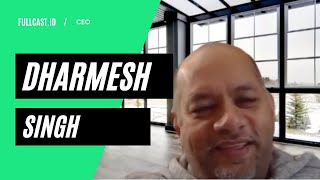
Dharmesh Singh built Fullcast after 17 years at Microsoft and four at Salesforce, frustrated by Excel-driven planning at enterprises. Nine people now support 15-16 enterprise customers. His biggest mistake: rushing hires without checking cultural fit.
Chapters
Well, hello everyone. Thanks for joining us again this week. I have a special guest, his name is Dharmesh with Fullcast IO. I'm super grateful for his time. I know he's a super busy guy. So thanks very much for making time for us and the audience to learn more about you. And how are you doing today?
I'm doing very well, thank you, Tony.
Awesome. Thanks again. I'm super grateful. So I wanted to start off with the top 10 with Tony and my famous question when I open up with is, what's your one word? Open. How would you describe in one word how you're feeling right now?
Like you said, gratitude. I'm grateful for what I do. I'm grateful for the people that I get to work with every day and I'm grateful for everything that I've been given. So, you know, I pursuing what I like to do and I, you know, I feel blessed.
Wonderful. I love that. So let's start off with how did you get in this business? How did you get started? And tell us more about a high level of what you do just for us to have a better understanding of Fullcast IO.
Yes. My background has largely been a large enterprise. Spent about 17 years at Microsoft, another four years after that at Salesforce. My last seven years at Microsoft, I was running business planning for Office 365 and then went into engineering of some, some aspects of Office 65 lined up at Salesforce. And in 2013, right in the middle of all right, the beginning of their annual planning cycle. My co founder right now, he had worked with me at Microsoft. He's the guy who actually took me to Salesforce. And so both of us looked at the opportunity of how planning is done at large enterprises, how tedious the process is. And it's largely an Excel driven process. And our view was large, scalable business processes cannot be Excel. It's just too much work, too complicated, too error prone. And so we thought about, we looked at options and none were available. And so we decided to solve the problem and essentially build Fullcast as a platform to what we still streamline, go to market planning for teams and help them get the plan deployed. So cut down the time it takes to build the plan and then really make it instantaneous to get the plan into action.
Wonderful. And would you be able to tell our listeners about one of your, you know, your biggest wins that you've had recently and what did you learn from it?
Yeah, I think the biggest win, I would say, apart from the customers who've trusted us, you know, we are a really small team actually, all things considered actually. And we have some really large enterprises that take dependencies on us. And so we have a team of nine people supporting on 15 or 16 large enterprises and we're growing and signing up new customers. So the biggest win for me has been to have a team of people that work independently. We are a team that's like I said, I told you earlier when you're chatting spread within Seattle and San Francisco. And you're able to do that because we don't require a lot of supervision of people. And I think that win is the ability to hire the right kind of people who can think independently, who can work independently, but for a collective purpose. Right. I worked in large companies and I know manage teams and I know how much of a time suck management of people can be and getting them to do what you think and pushing towards a common vision, not really easy. So for me that is I think the biggest win. Wonderful.
How about, you know, I know we don't like to talk about failure, but it's there. We all have to learn from it and move on and it's what makes us sometimes generally speaking. So I'd love to hear about, you know, one of your biggest failures and what you learned from that. That'd be wonderful too.
Absolutely. I mean everything that we do like, like the wins come because you've learned something on the failure side and that correlate to that is I've failed in sort of anticipating some people in early in the beginning when you were building the company. Right. And we, it was how we were hiring people and how we interviewing people and bringing them onto the team. And we realized quickly was that half an hour interview just getting to know each other and making a decision out of three of your four people have spoken is a disaster, especially in a startup because you know, the startup has a lot of things known but a lot of things are unknown as well. And so you might be hiring a person and you can talk very nicely and you know, it's all things works but when the rubber hits the road is not able to live up to the values that you as a team are putting together. And I think we quickly found out how distracting that can be. And not only that can be, if it's not nipped in the bud on time, it can be quite toxic for the company.
Right, understood.
I think for us, we quickly realized was that the failure was if you're going to hire people who do not align with the core values of your company and the values are not just put on paper, you live them. Then it's a disaster. Got it.
Would you be able to go into telling our listeners more along the lines of what is your biggest business expense as of today?
People. People. Getting the right set of people. I think like, like any company, right. Payroll is predictable and payroll happens every month and on a clockwork. And so people become the biggest expense item. You know, I mean today's dev cost, hosting costs are relatively cheap compared to, you know, what it used to be. So I think people become the number one asset and the number one cost
human capital. Right. At least it's a common one and it is with a lot of leaders I speak to as well. So let's go into your favorite online business tool. What is that for you today?
I like Miro, actually it's. I noodle a lot. I think about frameworks in terms of like how do we spend time just orchestrating ourselves and now the fact that we are all kind of locked up, working independently and no more whiteboards, then it's all the more reason for something like I'm here to just brainstorm. What are you going to talk? How are you going to talk and push it out there? In fact, I was just talking to my team every Friday we have this stunning calls and my partner was saying, I miss our whiteboards. I'm like, yes, I know we all miss our whiteboards.
Absolutely. I know the only whiteboard we have, you know, to your point, the only whiteboard we have is on Zoom. We could, you know, pull out your iPad and get your pen and then screen share that. You know, a little bit of a. Yeah, I know someone that's whiteboard is very important to him and one of my closest friends, he's a great leader and every time we have a meeting, when it used to be in the past, face to face, I would always have a whiteboard ready for him. So I know how important that is to all of us.
Great.
What about your client acquisition? What's your best source for acquiring new high value clients as of today in this market?
Yeah. So it's our outbound sales strategy that's working and an investment in content. And so we tend to do webinars or fireside chats. And so that's been a good way for us to sort of find prospects who align with our point of view at this stage. We don't assume, we don't even think that everybody is going to be our customer. So it's like the classic crossing the chasm moment. So we are looking for early adopters who are visionaries, who are thinking ahead of the game. And so for us in outbound, it is a filtering exercise of really figuring out is this person a fast follower, an early adopter. And so for us, that has worked well. And references from our existing customers, right? Every single customer of ours that has come in today to date has largely been inbound, even though we do running an outbound campaign. But these are people who hear about us, they hear from their peers and they'll say, hey, we want to talk to you. Right? So that's how it's been working. It's a balancing that what we call the seeding, putting the seeds in the ground through content and thought leadership out there, which attracts people who think like us, and then they reach out to us and say, hey, can we talk?
Well said. I love it. Now let's go into the next thing. If you were me, what is the one question that I should be asking you that I haven't yet, if any, so I would love to hear, you know, what do you think is a question that I should be asking that I'm not asking?
I think you asked all the right question. The only piece that I would just say is how do you keep a bunch of people together in a startup, right? Startups by definition are very fragile. Hard work, a lot of grit, a lot of resilience, and then it's a hard job that's sort of, sort of keeping the flock together, sort of committed to the mission. So I think that would be one thing I would just dive deeper into. Like how do you keep your team together? How do you focus, get people to focus on? But I think you picked up all the right questions actually that those are the most important ones.
Awesome, thank you. And let our listeners know, as we're coming to a close here, let our listeners know how they could get a hold of you. However, your preferred method of communication is whether it's your email or Twitter handle or your customer service or your website, just let people know what your website is and how they can get a hold of you or to your team if they're interested in hearing more or if they have questions for you. Please feel free to do that now.
Yeah, So I think LinkedIn is great. LinkedIn Dharmesh Singh or my email address, you know, Dharmeshullcast IO. It's pretty straightforward on that one. Those are the two best places, best ways to go. I mean, I'm on Twitter, but I'm generally more reading than tweeting. But I think the LinkedIn works really, really well. Good for me.
Wonderful.
Thank you.
And as we're at the close now, I'd love to hear your one word close on how you're feeling right now compared to the beginning.
Same. I'm delighted and grateful for getting to meet you. Actually, we run the business of sort of dealing with people, and every new person that I meet, I'm grateful for you giving us this opportunity.
Same here. I'm equally as grateful. Well, there you have it, everyone. There's Dharmesh with Fullcast IO we had the privilege of speaking with them today. It's been awesome. And thanks for sharing more about who you are, your story, your background, and what's important to you. So till next time, thanks everybody, and goodbye.
Thank you.