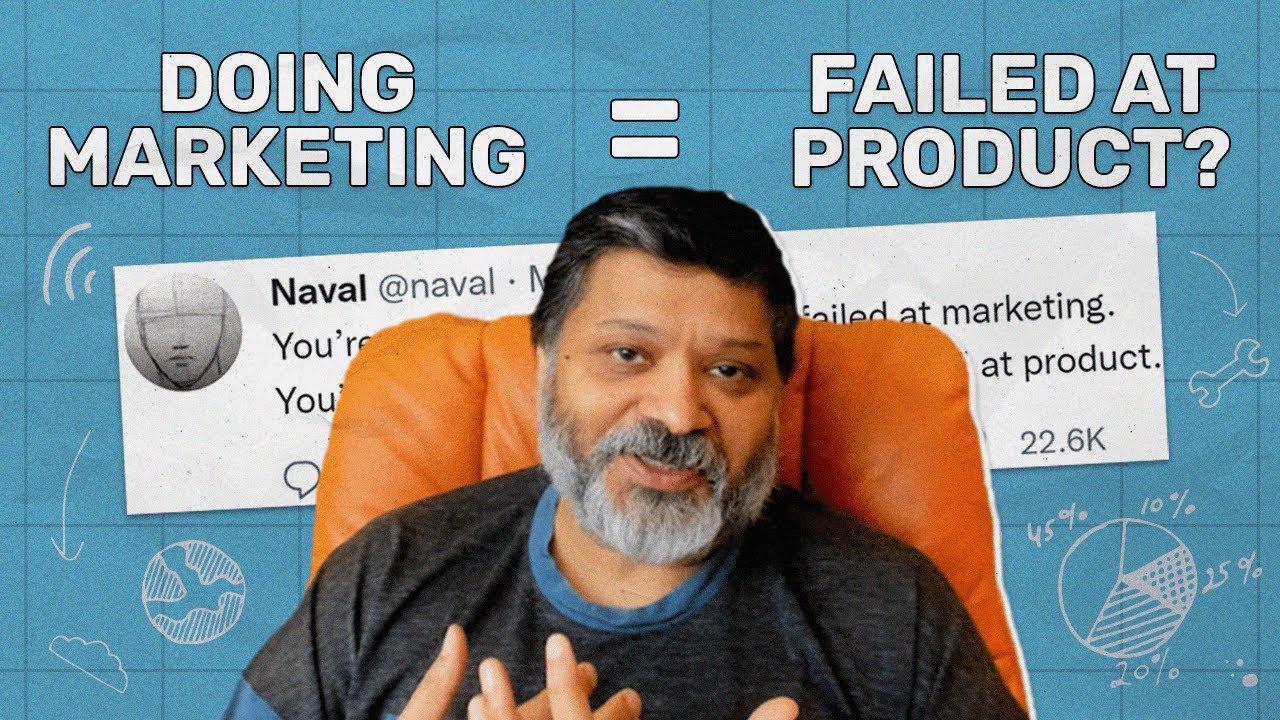
In this solo talk, Dharmesh Shah challenges the notion—popularized by a tweet from Naval—that doing marketing signals a failed product. He argues that marketing is far broader than advertising, encompassing community building, storytelling, naming, pricing, and product‑led growth. Using Tesla as a concrete example, Shah shows how a company can excel without traditional ads yet still employ a large marketing organization (over 400 staff) for branding, merchandise, events, and referral programs. He asserts that every successful product engages in some form of marketing, and proposes an interdependent chain—culture → strategy → product → marketing → sales—where each function makes the next easier. While affirming that product quality is paramount, Shah concludes that marketing is still necessary and does not imply product failure.
Chapters
One of the questions I've been getting recently is, if I build a great product, do I really need to do marketing? Or even stated differently, is the fact that I'm doing marketing an indication that I have failed to build a great product? And the reason I'm getting this question recently is based on a tweet by Naval. You're doing sales because you failed at marketing. You're doing marketing because you failed at product. Now, it's a well-crafted tweet. It reads really well, but I disagree with the fundamental premise that the only time you need to do marketing is if you failed at product. And there's a couple of reasons for this. One is I think we're confusing advertising and promotion with marketing. Marketing is much broader than that. So if you have built a community for your product, that's marketing. If you have created videos and are telling the story about your product, that's marketing. If you came up with a name for your product, that's marketing. You came up with a price for your product, that's marketing. That's all kind of in the collective bucket of marketing. But let's take a step back and we'll look at a concrete example. I think one of the best products indisputably of our generation is Tesla. Tesla does not do advertising and promotion, that part of marketing. They don't take out Super Bowl ads or put billboards up on the highway. But they have invested in their visual brand, in their logo. They have merchandise for Tesla loyalists. They have Elon get up on stages and launch new products and make announcements. They have a referral program so happy customers of Tesla can refer their friends and family to also get Teslas. All of those things are marketing. That's kind of point one. Point two is Tesla, the company. Has over 400 people that identify as working in marketing in the company. So there's no doubt, I think it's indisputable that Tesla, quote unquote, does marketing. And they also have what I think many would say is an absolutely fantastic, successful product. And so I'll go further and say that every successful product that we know has done marketing of some sort, right? Maybe not advertising and promotion, but maybe it's community building, maybe it's product-led growth. If you're even analyzing your product usage and building in features that you hope will get more adoption, that's marketing. It really is. So I would kind of turn this around. So I know what Naval is driving at. What he's driving at is that product is the most important thing. And he's right about that. More important than marketing, more important than sales. That's the thing you want to kind of get right. But so I would kind of change the tweet and I suggested this to him in a What I call a pull request to his brain, is that I would suggest we say, if marketing is done well, sales becomes easier. If product is done well, marketing becomes easier. If strategy is done well, product becomes easier. And finally, if culture is done well, strategy becomes easier. So all these things are not like, oh, if you do this, That means you failed at that. These things kind of build on each other. And yes, if you can build a great product that does not require advertising or promotion, awesome. But you are likely going to need marketing. And just because you're doing marketing does not mean you failed at product. So love you, Naval. But anyway, I just had to get that out there.