Stop Being Selfish: Your #1 Job as an Entrepreneur
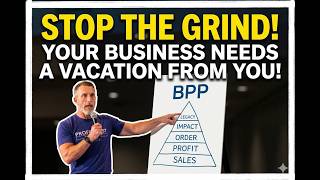
Mike Michalowicz argues entrepreneurs should build businesses that create jobs, not just extract profit. He presents a Business Priority Pyramid (sales, profit, order, purpose) and the DAD marketing framework to cut through noise. His core challenge: take a four-week vacation with no email to force delegation and prove you're not the business's biggest bottleneck.
Chapters
So you guys ready for our next speaker? So say yes. Now we need a little energy to make sure that he feels welcome on the TSP stage. Convinced that he has cracked the code to success, he became an angel investor. He proceeded to lose everything— his money, his confidence, and nearly his mind. That breakdown became his breakthrough. Sound like some of y'all's testimony. Determined to rise stronger, Mike Michalowicz is committed to more than rebuilding his bank account. He set out to transform how business owners approach both their work and their lives. His mission is to create simple systems that generate lasting wealth, meaningful impact, personal freedom, while elevating health, happiness, and purpose. Today, he is known worldwide for helping individuals take control of their time, money, and energy. He host of the upcoming TV show, "The 4 Minute Money Maker," a main stage speaker for top 10 events, and a trusted voice on many podcasts. Mike runs 2 thriving companies of his own, and partners in 2 dozen more, using them as live labs to test everything he teaches. While he is the creator of Profit First, the cash flow system that helps over a million business owners go from survival to constant profitability, his other bestselling books include All In, Get Different, Fix This Next, Clockwork, Surge, The Pumpkin Plan, The Toilet Paper Entrepreneur, My Money Bunnies, and many more books for kids. Can you guys help me welcome to the stage our friend, Mr. Mike McCallowicz.
Woo! Thank you. Thank you so much. You're the best. Woo! Thank you. Thank you. Thank you. Thank you. Thank you. Thank you. So they say when you do a conference, you have to start off with like a really good tip that will change your life forever. So here it is. Don't dress like I do. I said, I'm traveling with my wife. My daughter lived in Marietta, right down the road from here. She's now in Chattanooga. She came to visit. And this morning I said, you know, I will be presenting at the conference, so some people may recognize me. So I'm walking down in my outfit. Right by the bar, and some people go, "Excuse me, there he is. There he is." And I look at my daughter and my wife and I'm like, "Here I am." And I go to them and I say, "Would you like me to autograph a book?" And they said, "No, a margarita, please." Bartender. They thought I was the bartender. So if anyone wants a drink, I'm here to serve you. I'm here to serve you. How big was your kindergarten class? How many kids were in your kindergarten class? Just shout out. 20? 30? That's a big one. That's a big one. 30? 25? Yeah, my class was 25 too. The average number is 25. Some classes are a little bit bigger, some are smaller. There was a study conducted about entrepreneurship, what we do. Oh, it's about 55%, but 50% of people ever dream of starting a business one day. I'm gonna move Lamar's stuff over here. So if you take a class, we'll say, just for easy numbers for my mind, say you had a small class of 20 people times 50%. This means that 10 kids from your kindergarten class ever dreamt of doing what you're doing. Only 10 kids. 17% ever actually attempt to start a business and are able to run it for more than 3 months? 17%. 17%. Oh, this is getting hard math already. 3.4, right? 3.4. That means 3, maybe 4 kids from your kindergarten class ever attempted to start a business. Do you know only 20% of people that start a business do it sustainably after 5 years? That means 20. That is 7%, 0.7%. That means one— there's one kid from your kindergarten class who actually started a business, successfully pulled it off, and is sitting in this room today. So, yeah, congratulations. Every, every kindergarten class had a weirdo. You know that one? If you're wondering who the weirdo was, it was you. You're a weirdo. You said, "I'm gonna start a business and make all this money. I'm gonna serve my community. I'm gonna provide for my family. Are you insane?" Haha, yes we are. Yeah, you pulled it off. Well, I talk about the other kids. There's 19 other kids in the class of 30. There's 29 other kids that didn't. Start a business. What they're looking for is good jobs with good companies to live a good life. The number one job of an entrepreneur is not to do the job, it's to be a creator of jobs. Your job— nugget, nugget, is that the word? No, I'm gonna nugget myself. Nugget! So, so your job, my job, our job as entrepreneurs is to create jobs. If you are doing the job, you are taking the job from your friends. Yeah, self— selfish. I'm gonna nugget you. Nugget. Right, we're being selfish and we think It's so honorable to sacrifice myself, to work like an animal, to— I don't go on vacation, I don't see my family, I don't have any friends. All I do is work. It's selfish. It's selfish. Our job— did it just get intimate in here? So how is your tripping? Yeah, exactly. Can I pour, did someone say can I pour a drink? Yeah. What I wanna do in our session together, we got 60 minutes to do this, is to give you the best of what I know. I have written many books, I've run some businesses, and my God, have I struggled. And in this journey, I found some things that I think you may have never heard before. So my goal is just to nugget, nugget, nugget, like crazy here. I do want to start off with a problem I see in entrepreneurship. At the end of the day, our business is a chain of events. There's a sequence of things we do. We take a request from a customer, and then we go through a sequence of events to, in some cases, make a physical product or to create something that serves them. I think analogy of a chain is perfect. So imagine there's a chain between me and you, and our job is to make the chain stronger. So we're pulling the chain You know, the default is to say, well, the closest thing to me are the links in my hand. Let me fix what's in my hand. It's called the primacy or the recency effect. But it's very entrepreneurial to look at what's right in front of us and say, this is the thing we need to fix. But that actually won't make the chain any stronger. The chain will break at its weakest link. The other kind of process of the entrepreneur, and this is, this is the most common, is like, let's just fix every single link. Let's go link by link by link by link. And just fix this whole thing and it'll get stronger. But it won't until we happen to come across the weakest link. The fastest way to improve your business is to identify first what is the weakest link in the chain of events. Fix that one thing and the entire chain gets stronger. Then find the next weakest link, strengthen that, and the next, and the next, and your business will move forward extremely rapidly. We're going to show you— does this display on the screen up there when I— oh, it does. Look at that. Okay. What I'm going to show you is the chain of events or elements of a business. Quick history lesson or biology lesson. This is based upon Maslow's hierarchy of needs, something that we probably studied back in grade school. But a quick refresher on this. This is how humans operate. Maslow was studying human behavior and said at the base level, all humans have physiological needs. Every person in this room needs to breathe air, drink water, eat food to survive. It's the base level need. And if that's not being addressed, nothing else matters. But once that's addressed, we go to the next level of needs, which is safety. We need to be protected from harm. Right now, as I'm sharing with you, I'm breathing, believe it or not.
Nugget.
I'm breathing, and that's a physiological need. If my safety was threatened, if someone came running up and put like a plastic bag over my head, all the rest of this doesn't matter. I immediately revert to the need to breathe. Now I'm from New Jersey, so there's— rock and roll, rock and roll— so there's like a 50% chance someone would put a bag over my head while speaking. Like, you, right? That's Jersey. Yeah. And you would like it. You would like it. There— we always revert back to the base. It has to be what Maslow taught us, is this needs to be adequately addressed before we can go to the next level. Safety being shelter from harm and so forth. The next level is belonging. We need to be part of a community. Next level is esteem, meaning we need to— I don't know what the hell that is. That says esteem, believe it or not. And the highest level, self-actualization. Basically, we go through these different levels. Self-actualization is living life's purpose, but you can't live life's purpose if you're starving for food. That's the essence of it. Our business has a hierarchy of needs. And this is where we're gonna explore kind of that chain effect for our business. Oh, Lamar, interesting, good. Okay, here we go, here's something fresh here. So let's go through the business, I call it the business priority pyramid 'cause it's a sequence of priorities and I'm gonna give you the techniques to address every single element. Okay, so there's 5 levels just like Maslow's hierarchy of needs. Foundationally, and this will not be a shocker, every business needs sales. It's the creation of cash. It brings money into our organization. And if we have no sales, we have no money. But even at this level, that businesses get stuck because most businesses believe I simply need to sell more to be successful. And that is a total lie. You need to sell more profitably for sure, but you don't need to sell more. In fact, sales results in stress on an organization. Imagine I sell something to you, a service, and I say, okay, I'm gonna take care of you, but I say I need to make more money. I'm also gonna sell to you and you and you, and now I'm dividing my attention. It drains me. So we need to sell, but we need to sell healthily, profitably. It's essentially the breathing of an organization. And just like breathing, if you breathe more and more, there's a certain point where you'll hyperventilate, get dizzy, it Maybe even pass out. And too, unfortunately, I've seen too many organizations push for growth, growth, growth. They start hyperventilating and they spin out of control. So how are we gonna sell more? Two ways. First, I'm gonna introduce you to a technique called DAD, and it's an acronym. I've heard every dad joke on the planet ever since I said this. So I'm gonna tell you the worst dad joke ever, or the best one, you tell me. So here's the dad joke: when does a good joke become a dad joke? When it becomes apparent. Yeah, yeah, yeah. Knock it! Okay, this is how we're gonna improve the sales of your business. We're gonna deploy dad. First question is, whatever whatever you are selling, is it marketed in a way that is different? Does it differentiate from the market? Here's the number one way not to market: look at what your competition's doing, see how they're marketing, and then do more of that. Because consumers cannot see better marketing if it's the same as everything else. There's a part of our brain called the reticular formation. It's the very base of every human's brain. It is a neural net, and what its job is, is to ignore almost all the stimulus coming into it, because if we considered all the things going on at all times, it'd overwhelm us. This is— believe it or not, this is the brain. This is the worst brain ever, but that's the brain. This is the spine going into it, and there's this thing called the reticular formation right here. The inputs going into our brain are sight, sound, hearing, taste, you know, touch, all that stuff. Our brain sits there and these different stimulus comes in. It says, we're going to ignore these things unless it's one of three things. If it's a threat, I'm going to pay attention to it. If it's an opportunity, I'll pay attention to it. Or if it's something I can't determine what it is, I'll pay attention to it. But if it's something I'm already familiar with, I will ignore it. Who here has ever received the marketing back in the day? It was email marketing that started off the words, hey friend, have you ever got that? Hey friend email. Okay. Remember that first time I got a hey friend email? I was like, oh my gosh, who's this friend of mine? They are such a good friend. They're calling me friend. I think I love them. I then start reading the email and it's like, hey friend, did you know you can do spam, spam, spam, spam, spam? And it's all this marketing. And by the end I'm like, this is not my friend, this is my frenemy. I hate this person. You received that email, right? And I bet you— is it true the very first time you received it you're like, who is this friend? The second one, how did you respond to that? Delete. Yeah, I like that. You're like, whoops. Like how you did, you're like, delete. That's how I did, delete, right? Delete, delete, delete. The more I got of those, the faster I was deleting them. And I know you did the same. And I know why. Because of how our brain operates. When we see something that's not relevant and not for us, when we see it again, it doesn't even get into the brain. It just says delete. Delete, delete. If you're marketing the same way as your competition and they're getting deleted, you're getting deleted too. Fucking nugget. So are we allowed to swear? Are we allowed to swear? Okay, all right, just one, just one. So I'm in this town, Boot. Where are you in New Jersey? Okay, where? Jersey City. I love Jersey City. So I'm outside Jersey City, a little bit west of that, in a town called Boonton. It's about this big. In my little town, there's 3 gyms or fitness studios back to back to back down Main Street. When you look in the windows, it's the same advertisement, the before and after, you know, schlubby unfit customer turns into this ripped customer, right? And every window has them packed with this, and you've seen these too. So I sat outside and I just watched people's behavior, and people just walk down the street, they maybe see the picture for a second and walk by it. Why? Because the brain is blocking it out. We are, it's called habituation, we are habituated to it, we already know it can be deleted. So I went to the gyms and said, the only way into the brain is through threats, Opportunities or being different. Now listen, marketing through threats actually works. People will pay attention, but it will not work in the long run because people won't trust you. You could sit outside of a gym with a machine gun shooting in the air, people will notice. No one's coming in. You've probably received threat marketing. You ever get something in the mail, an envelope that says, you know, $100,000 fine if opened by someone else? You know, it's a threat. And maybe you even fell for it like I have. I open up like, what is this? And it's a, it's a, it's a total marketing scam from some government agency. And you rip it up. And now I'm habituated. When I see those, they go right into the garbage every single time. The second way, of course, is opportunities. You can sit outside the gym and say, hey, come on into our gym, try it out. Here's $100. Here's $100. People will notice. But people are very suspect of opportunities. I was at a Starbucks, not just now, but a few months ago. I saw a $5 bill on the ground. And I don't know, have you ever done this where you've seen money just sitting there? I don't know if you behave like I do. I'm sitting there drinking my coffee, or apparently someone else's coffee. I'm sitting here and I see the $5 bill and all of a sudden in my head, When our mind sees opportunity, does one of those moves, like, oh my God. Now here's the funny thing about opportunities. We get very suspicious. I then look around. Does anyone else see the cash? Right? And all of a sudden my fork fell on the floor and I had to grab it like this. And I did like one of these moves, you know, and I leaned down, yeah, you know, in my pocket. And when I went outside, I'm looking at this money, I'm like, "Oh, I'm a winner." I'm very suspicious about it. And when you see an opportunity, the way we capture or grab it is very cautiously. So opportunity marketing usually backfires on us. You've received those things in the mail where it's like, "Hey, here's your free return address stickers. Please give us a donation." Do you make the donation? Probably not, but you're like, oh, thank you very much for the return addresses. So threats get noticed, but people get fearful of it. Opportunities get noticed, but people are suspicious of it. But different gets into the brain every single time. Do something that no one else does. What happens is the brain opens up— we're gonna do a new color here— the brain opens up and says, I'm seeing something different. It It hits this back part of our brain called the amygdala, which is the hyper-response part of the brain, and it forwards the information to the prefrontal cortex of our brain that says, "We gotta evaluate this because we don't know what it is." You ever get lumpy mail? Like some of you, you ever get like a box and you didn't order something through Amazon, it just appeared on your doorstep? And you're like, "What is this?" It's something different, it's something unexpected, and we feel compelled to open up and investigate it. Going back to these gyms, I said, well, we're not gonna do what everyone else is doing 'cause that won't be noticed. We have to do something different. Now here's the technique to doing different. Look outside your industry and see what's successful elsewhere. I took, this is a long time ago, but I took my kids to the local amusement park and they had like a funhouse. Went to the funhouse and they have those mirrors that make you look like really like one. You look like E.T. or something. Another one makes you look all weird. You ever see those? Well, I noticed as I was walking through, everyone takes out their phone or taking pictures. Oh my God, I look so funny. Ha ha ha. With their phones. So like, oh, people, we like to look at ourselves in mirrors at funhouses. So I'm like, let's take that idea and translate it into business. This technique, by the way, is called doing R&D. Which stands for rip off and duplicate. Nugget. All right, nugget. Get outside your industry and take the best ideas and bring them in. I went to these gyms and said, I got an idea. I'm going to do it totally gratis, but whoever's willing to do it, we're going to do something radically different. We're going to become a funhouse. All these 3 gyms in my town rejected me because people are terrified to do different, which, by the way, is your biggest opportunity. Your competition is afraid to do— your competition isn't even here. They're afraid to do different. Have the courage to do it. It took me a long time. I finally found one company in Utah, a CrossFit gym, that said, okay, we'll do your idea. We took two mirrors. One mirror made you look like kind of squat and round and flattened you down. Another one gave you this perfect like V-shape. Above the first one, we put the words "before" on that mirror. Yeah, you're with me. You're good. The other one had the word after. After. Before and after. So now what happens, people are walking down the street, all of a sudden they're like, what's that? Oh my God. Phones popping out, pictures taken. Oh my God, I look so funny. Look at me now, I'm amazing. Funny, amazing, funny, amazing. Amazing, amazing. People got engaged. Different gets attention, but it alone is not enough. We need two more elements. Where's my dad? Here it is. You must differentiate how you market. You must attract— oops, wrong color, but we're with this. Attract means it needs to be attractive. I could have come on stage and say, hey Lamar, do you mind if I dress like Bozo the Clown with the big floppy shoes? You would pay it. You would notice that. But would you like be like, oh, that's, that's clearly an entrepreneurial expert? No. What's Yucca the Clown doing here? Can you see the word attract? You can't really see it. So it has to speak to your audience and what they desire. Seeing ourselves transformed in mirrors is something that we desire. It's fine. It's education. So when you market to sell better, Be different than the market, but do it in a way that speaks to your audience's desires. And the last element is then you must give them direction, what to do with what they're experiencing. And the thing is, small steps always wins, safe steps. So in this gym sign, these mirrors, we had one that said, here's the before, here's the after. And there was a little sign next to it, it said, we just transformed you in mirrors, we want to transform you in real life. Please walk inside. They got 5 times the foot traffic. I'll give you one more example. Maybe you can steal this one. Any photographers in this room by chance? Any photographers? Oh dude, my brother. Dude, I'm telling you, you do this, Jersey City will never be the same. I spoke at PPA, the Professional Photographers Association, 1,000 photographers there. No one did this. And it's so easy. We're all consumers of photography work. Maybe you've had portraits done of your family or whatever, and the number one way to market in the photography industry is the postcards. You may— oh, it's graduation season, mail postcards. Ooh, fall's upon us, you know, and you send out pictures of your favorite portraits. And the way you're looking at me, you actually do this like you're getting pissed at me. Yeah, he's just like, okay, now, but here's what you're gonna do. We have to first do different. So he said, what does no one do? And one of the ideas that came out of our brainstorm was, well, no one sends no pictures. We said, that's exactly what we're going to do. Instead of sending a postcard with our favorite portraits, we're going to send out an empty frame and really nice frame, an empty frame. Imagine getting that in the email, in your mail. And instead of there being a picture in there, we simply put a phrase. It said, most pictures go into the cloud, but the ones you cherish go into frames. We create the ones you cherish. You know how many freaking calls they got? Do it. They just nuggeted you. Yeah, you were nuggeted hard. Like in the face. There's nuggets everywhere. Do it. Okay. That was a little too visual. All right. Sales. We just nailed our sales. You now know how to sell better. Don't do what everyone else is doing. Do something that's radically different. I can tell you story after story of how this works. Next level in your chain is profit. While sales creates cash, profit creates stability for an organization. Maybe you can relate to this. If your business isn't profitable, you're living check by check. What's going through your mind? I need to sell more. I'm panicked. I need to survive. Do you know who wants you to be profitable? Like more profitable than even you yourself or your business? Your clients. Your clients want you to be wildly profitable. Now, listen. You'll never have a client come to you and say, "Hey, could you charge me a little more? Could you rip me off a little bit?" Here's what your clients will say: I want your full undivided attention. I want the best of you. I want you caring for me like I'm your number one customer. Imagine, imagine you get rushed to the hospital. I'm wishing this upon no one, of course, but imagine you get rushed to the hospital today and it's a heart attack of some sort. You get rushed in and two doctors come out. Doctor One comes out and he looks at you and goes, I hate to say this, I'm not profitable at all. In fact, I'm desperate to generate some money. I'm behind on my mortgage. Here's the deal, normally people charge like $50,000 for this surgery, maybe there's insurance, but I'll do it for $5,000 and there's a half-off of yak now. That's Doctor One. Now imagine you have a heart attack, you get pulled in, Doctor Two comes out and she comes out a little bit cocky too, you know, sticking her chest out. She comes out and she goes, hi, I'd love to be your doctor. I'm actually extremely profitable. I'm not bragging about this. I happen to own the largest house in the community, and it's my haven. I go back there and focus on caring for my customers, and I'm proud of what I've earned. Most people charge $50,000 for a surgery. This is all I do. I charge $100,000 for a surgery with a 99% success rate. "Are you ready to proceed with me? No discount." Which doctor do you choose? 2. 2. And listen, you may not have that money but we'll find a way because your life is on the line. Now, here's the deal. You may not be saving the lives of your customers. I get it. But you're transforming their lives. They're— "Did I get a come on?" Yes! Yes! I'm tearing up over this. I've been waiting for for that. You are transforming the lives of your customers. You are not transforming the lives of all your customers, and that's the mistake. There's some people who see what we do as a commodity. If you're a website designer, some people say, I need a website, and there's some people say, I need a website. Those are the people who are having a heart attack and need someone to transformed their lives. We have to pursue the best customers. So how do you pursue profitable customers is the question. I'll give you a real simple way to do it. Look at your existing clients, and we're gonna make a chart together. In this first column, I want you to put the word or letters REV— stands for revenue. Next column is name, it's the customer's name. Third column is city CC. Here's how it works. Sort out your existing clients by revenue, most revenue to least revenue. And just— I do this for my own businesses. I did business in the past, I did computer systems. My biggest customer did $25,000 a year with me. My next customer did about $17,000. Another one did about $10,000. I had a few that did $10,000. I had some that are making maybe a few hundred. Some here, I think I was paying them money to work with me. Like, that's how bad it got. Now, why is this important? You're getting ready to get nuggetized. That sounds so perverted and gross. I'm gonna nuggetize you. Do not, do not trust people's words. Words, trust people's wallets. Yeah, I call— I pre-called my wallet. Listen, we lie to each other constantly. I was here this morning, apparently serving drinks to people, but I was here this morning and I was observing. There's folks talking and so forth. And here's what I heard. Haven't seen you in a while. How are you? How's the kids? How's the family? And And the response was, "Good, everything's good, everything's good." Bullshit, bullshit. But, but, could you imagine you come to me, "Hey Mike, haven't seen you since last year, how you doing?" "Not good, not good, life is really bad. Wife hates me, my daughter doesn't wanna be here." Like, if I tell you the reality, which is, that's not the reality, just so we're clear. If I tell you the reality, I'm not putting my burden on you. I know social consequence just like you do. And you don't put the burden on someone else because it makes it really uncomfortable. Now the conversation's over. So the rule of thumb is always at the surface level. Everything's fine. Everything's good. Good, good, good, good, good. When you ask your best or any customer, how's our service? Here's what they'll say. Yeah, it's pretty good. It's good. No, seriously, how is it? It's good. It's good. Because they know if they say, well, there's a problem, You know, the photographs are a little blurry. Now they're going to trigger conflict and awkwardness. So it's far better to say everything's fine and then never do business with us again and go on Yelp and slam our ass. So people do not speak the truth through words because of social consequence. We speak the truth through wallets, our spend. Sort your clients by revenue. The clients that spend the most with you are screaming they love you. These people are screaming they don't value you at all. Step 2, write their names. So for me, this was a bank, you know, write their actual names or whatever. This was a hedge fund, which I didn't even know who they were, and so forth. The last one, the CC, stands for crush or cringe. Here's how it works. Pretend the caller ID pops in and it's your first customer on the list there. How do you feel when the caller ID pops up? It says Bank. I'm like, oh, this is amazing. I love these people. Hello, how are you? It's a glorious day. Or are you like, oh my gosh, I was hoping they were dead. I mean, not really, not really, but kind of really. The reality is, if you get a cringe when a customer calls, we will subconsciously or maybe even consciously treat them less effectively. They say treat all customers the same. We can't do it. That, that customer that you can't stand, when you have to call them back because they have yet another problem, do you do it first thing in the morning, we're all excited, or do you wait till the end of the day hoping you get voicemail? Yeah. So what you do is you put a smiley face or a frowning face, and sometimes even your big revenue customers are cringes next to each one. Okay, so it looks something like that. Then next step is, let's do green. Circle the highest generating revenue. They love you the most. That matches up with a smiley face. You like them the most. Circle them. You just found a customer that's life you're saving. They're the ones who are having a heart attack and value you tremendously, are willing to pay top dollar. But now, of course, okay, that's great. Now I know who my best customer is. What do I do? Well, first of all, you prioritize them. You serve them better than anyone else. You cater to them. But there are 3 magic Jedi mind questions, or as we like to say, nuggets, that you're about to learn that if you ask these 3 questions, it will bring permanent profitability to your business. It will get you more of your best customers, guaranteed. Here's the questions. I did this for my own business. I went to a hedge fund, there's like a brokerage house. I went to them and said, hey, the owner's name was Larry. I said, Larry, I love working with you. You're truly a best customer of mine. I want to ask you, write this down, what am I doing right? I said, Larry, what am I doing right? Now this question is gonna blow your mind because it's not gonna tell you what you think. So I go, Larry, I said, what am I doing right? He said, Mike— now this is back in 1996, just to give you a sense, that was my first business. I didn't have this gray stuff yet. And he goes, Mike, your company responds quickly. This is— the internet had just come out. You didn't do remote stuff, like you actually drove over to someone's office and fixed their computers. He says, my last computer guy took like a day to get on site. He goes, we're trading stock, we have backup systems. Systems, but we want to get our system back online. He goes, you get on site within 4 hours. What you do right is you respond quickly. Now here's the Jedi mind trick. He wasn't telling me what he— what I'm doing right. He was telling me how he judges me. That's the key. Listen, you are doing hundreds of things, thousands of things, but the customers see very few. Our number one job to be more profitable is to determine What do they really care about? And when you ask them what you're doing right, they will tell you what you care about. But I'll tell you the ultimate nugget of this nugget is whatever you're doing right is actually the thing you need to fix. Wow. Not even a come on on that one. You're just, you're just shocked. Shocked. Yeah. Gotcha. You're pacing. You're pacing. I'm not pacing. I'm a little too aggressive. I'm sorry. Whatever you're doing right is the thing you actually need to do better. When Larry said, you get on site on time, I said, holy cow, I got to get on site faster. So listen, it was 4 of us, it was myself and my 3 employees. And what we do is always have one of us within a 15-mile radius working on one of our clients within Larry's office. And every time Larry said there's an issue, I don't care what it was, I I would tell a lower client, I have— that camera's fast, look at that. Let's applaud, that's amazing. That is amazing. So Whatever you're doing right, you gotta do better. So we would dispatch ourselves to be within 15 minutes of Larry. When Larry said, I have a problem, we're getting on site immediately, within a half hour, every single time. Larry calls me within one month. He goes, I don't know what you're doing, but what you're doing is amazing. He goes, you're the best company we've ever worked with, not just in computers, in anything. You don't have to fix everything, you don't have to improve everything. Dominate in one space. And your client can tell you what it is. Now, I need water. I'm blowing my own mind here. All right, here we go. Question number 2. Question number 2. What— now don't write this down yet because there's gonna be a little Jedi mind trick. What am I doing wrong? But here's why you don't ask that. We already talked about— we lie to each other constantly. How are you doing? I'm fine. How are you? Fine. One of us is lying already. If you ask your customer what you're doing wrong, they won't tell you. But here is the trick: ask your best customer, what is wrong with my industry? Yeah, because now it's the person outside the room. Listen, at the end of this presentation, I'm like, I can come to you and say, did you like it? Was it good? Was I funny? Money? Did you learn?' You'll be like, 'Oh yeah, real good Mike.' The second I leave, you're like, 'That guy sucked. Like the bartender joke didn't land— all it didn't work.' You will speak the truth about me when I'm not here, and I hope to earn and win you over but maybe I won't. But we can't have an honest discussion about if I'm here. But if you ask what's wrong about the industry, ho-ho-ho! They go. I went to Larry, said, what's wrong with the computer industry? And he goes, oh, the billing practice. The last guy, the last— the billing practices were so confusing. This is back when the Palm Pilot existed. Does anyone remember the Palm Pilot? If you raise your hand, you're over 50, right? Right now, for the youngins in this room, Here's what the PalmPilot was. It was the first ever smartphone that wasn't smart and wasn't a phone. And we loved it. He said, these PalmPilots, this guy would install them. They were $250. If it didn't work, he would charge me $500 to fix it. Just give me a new smartphone or a new PalmPilot. And I said, oh, we got to change our billing practices. Back in '96, we moved our billing practices practices from what they call break-fix, charge per hour, to a flat rate. That was unheard of until later on. If you fix what's wrong with the industry, you redefine the industry. All right. If you redefine the industry, my gosh, you become the dominant force in the industry. And isn't that what your kindergarten class is waiting for? Someone from your class to do it. Why not you? Third question to ask: where do you congregate? And maybe that's not the exact word you use, but, but I went to, I went to this hedge fund guy, Larry, said, hey, where do hedge funds hang out? Now I was active in the Chamber of Commerce, all those things. I said, hey, do you go to the Chamber of Commerce? He's like, no, no, that's, that's great, it's small business. But hedge funds go to two conferences. They go, there's one in Long Beach, California, and one in Greenwich, Connecticut. So, okay, I started going to 2 conferences. The more frequently you appear in front of people, the more they start to trust you. I just started— I didn't buy, I didn't get a booth, I just walked around the conferences. And after my third appearance, someone came up to me, said, I saw you here a lot, which hedge fund do you own? I'm like, I don't own a hedge fund. He goes, well, what do you do? I said, I'm a computer guy for hedge funds. He goes, oh, you're a hedge fund technologist. I'm like, apparently so. I didn't even know. I didn't even know. But the lesson is this: simply appear in front of your community of best customers. Birds of a feather flock together. They hang out together. Simply appear there over time. Just by— you don't have to be slick. You don't have good marketing. You just need to appear over and over again, and that's how trust is built. Whew. All right, let's go on. Are we doing okay so far? All right. All right.
Okay.
Okay. Let's go to the next level. Next level is order. This is where we build the efficiency of your organization. We started off by saying the number one job of an entrepreneur is not To do the job is to be a creator of jobs. So how do you do this? You don't have to do this right now, but I'm going to give you the biggest challenge of your life, and this gives people like proverbial heart attacks. What I challenge you to do tonight, pull out your calendar, scroll through it about 1 year from now. I'll give you up to 18 months, a year and a half from now. And block out 4 weeks. 4 weeks to go on vacation. Yeah, yeah. 4 consecutive weeks on vacation. 4 consecutive weeks on vacation with no email access. Yeah. What? Here's the deal. You don't need the vacation nearly as much as your business needs a vacation from from you. I'm gonna nugget myself. Nugget! Nugget! Do you know, and you've heard this, but do you really get the biggest, the biggest block to the growth of your business is you. Why? Because you're not doing your number one job, which is to create jobs. Question, and be honest here. Who here has a personal assistant? Just raise your hand. A few people, alright, good. Okay, put it down. Who here does not have a personal assistant? Put your hand up. Keep your hands up. If your hand is up right now, you are the personal assistant. Okay, let's be really clear about this. What are you doing? You're doing everything. What? This stops tonight. You're getting a personal assistant. Thank you. Thank you.
Hello.
Yeah. Now, now here's what I can feel. I can't afford a personal assistant. I can't bring someone on board. No, don't worry about it. We're not gonna hire a full-time personal assistant. What we're gonna do is, it's called fractionalization. Here's the ways to get the right personal assistant. Write down the tasks you do. Boop, boop, boop, boop, boop. 50, just the top 50 things you do. Top 25 if you want. Then, for the first step, is to circle a couple that you are willing to assign out to someone else. Just one or two. And let's hire an assistant that only works for you, if it's 1 hour a week, that's fine. Because the goal here is not to alleviate work. It's for you to learn how to delegate once and for all. Nugget. Oh, the bigger nuggets coming like that was a little nugget. This is the big one. Here's the big nugget chunk of gold. When you go through this list, I want you to put a star next to the thing you love the most. I love doing this. I love speaking. I love writing. I love doing photography. And then hire someone to do that. Because here's the thing: the more we assign and delegate out work of stuff we don't like, we do more and more of what we do like. We build this cocoon of work for ourselves. The number one job of an entrepreneur is not to do the job, is to be a creator of jobs. And if you're doing what you love, you'll keep on doing it. This is the most courageous step entrepreneurs can take, is to stop doing what you love to do, because you're gonna find what you really love to do, and it's to support your business, to hire people, to care for our community, our country, our globe. That's your job. Woo! I got another one for you. Ready? Okay. Let me think about what it is. I got a couple of— okay. You want to know how to hire people, like really good people? I'll tell you what not to do, is to interview. You know the most common way to hire people is to run some form of ad, like on Indeed or whatever it is, and then you go through these interviews, and like, oh, I like this person. I don't know. Oh, the more advanced levels, you have them take take a test like, oh, Myers-Briggs, or what's your DiSC score? I'm a high D. I don't even know what that means. I'm just high. I'm just high. A lot. You know, there's a better way. There is an industry— and by the way, when we hire through interviewing, there's about a 10% success rate in hiring A-players, top talent. And maybe you've experienced this when you hire people, The very minority of people work out to be extraordinary. Is that true? That's true for all industries except for one. There's one industry, and it's roughly a trillion-dollar industry, maybe actually more now, that has about a 90% success rate in getting A-players. And that industry is the sports industry. I saw Magic Johnson. Lamar's like, "Mike McCallister's coming up," and then Magic Johnson came on. I'm like, "Is Magic Johnson doing my introduction?" Yeah, that's, that's my ego. I was super high there. Here's the deal. The sports industry does things a little bit different, and we can do the same thing. I played— anyone ever hear of the sport lacrosse? Anyone? Okay, good. I played lacrosse. I played lacrosse in high school. I was a marginal athlete, and there was an opportunity to go to a lacrosse Any lacrosse players in here by any chance? No. Okay. All right. Say this with me. Token white guy. I'm the token white guy. Alright, so, so, lacrosse, believe it or not, is a sport. I've got two sons who play lacrosse and rugby. So when did you adopt your white children? Oh, alright, awesome, awesome. Awesome, awesome, awesome. So I played lacrosse and I went to camp, lacrosse camp, and I went there and at this camp there's, there's 500 kids and the, the coaches and stuff were telling us how to do stuff and their skills. And I noticed after a day they tap some of the kids on the shoulder and say, hey, you're really doing a good job, we want to bring you to another field to enhance those skills. And after that, some of those athletes got tapped on the shoulder and got moved to another field for the elite players. By the end of this camp, it was a college, 3 of the kids were recruited to play at that college and 497 weren't. Here's the interesting thing about camps. Everyone got better. I actually went on to play collegiate lacrosse, believe it or not. Thanks, Mom. Mom. Yeah. And everyone got better, and 3 were picked to play at the elite level. The number one way to recruit talent for your business is not to interview, is to teach, to be a coach. Say you have a bookkeeping business and you want to hire bookkeepers. Put on a class saying we're teaching new bookkeeping skills, how to do reconciliations and so forth in 2026. The interesting thing about the best talent is it always reveals itself in the same 3 stages. Stage 1 is interest. I'm curious about this. I want to learn about bookkeeping. Most of us in this room perhaps are not interested. We wouldn't qualify. But the people who want to learn usually want to earn. Second is they show desire. They ask questions. They're super engaged. That's what the coaches were doing. They're looking which athletes were really into this. And the last level is thirst. I can't quit this. Has anyone here ever gone to a Home Depot birdhouse building workshop? No. Yeah, you have. You have. Okay. A couple of people. Do you know that's a recruiting platform? Home Depot is recruiting us. Here's, here's how it works. You go to Home Depot, you bring your kid, you're like, oh, build a birdhouse. Oh, this is fun. There's two instructors, one instructor And there's one monitor. She sits there with her orange apron, and what she does is observe for interest, desire, and thirst. Who's the parent that comes back multiple times? Who's that whack job? Who's helping out other folks there? Who has the most questions? At the end of building a birdhouse, they go to the people that are the most engaged and say, Hey, if it's ever of interest, we're looking for you to work at Home Depot. Do you want to join us? And they get applicants this way. Now, you went— did you get an applicant application? Yeah, you suck compared to you. You're running— it was you. Did you get an application? You suck too. Home Depot. And you didn't even know how bad you suck. You had no idea. And that's how you recruit people. Educate them. If they know they're being recruited, if they're being hired, it's all about the interview. People who interview well should be hired only for the job of interviewing for life. We want to find people that are really talented, but you can't reveal that because they'll play the interview game. Now you know how to do it. Calling education. Now you may— did you say that's good? You complete me. You complete me. Finally, that's good. Thank you. And let's keep moving on here. So that is about building efficiency throughout your organization, is recruit people who want it the most. There's one more thing as you bring people on. Remember, our job is to get you out of working in the business. Your job is to be creative jobs. That's your job. And you're doing all this work, but all the knowledge is in your head. Like, you know it, what's going on. You don't have SOPs. Do you really? And if you have SOPs, they're ridiculous. It's a big book of just junk. I was visiting a business a few years ago and they literally had a book and it said SOP on it and it was like it was covered with dust and so forth. You blow it off. And I asked the guy working there, I said, what is that? He goes, that's our standard operating procedures. I'm like, he worked there for 10 years. Have you ever looked at it? He says, no. He goes, you learn on the job. Okay, let me give you a new way to create SOPs in your business, and it's through video. Like, listen, if you want to do anything, you can go on YouTube and there's a video how to do it. Like, you want to build a deck for your house, you go on YouTube and there's some— someone showing how to build a deck. I thought this was so absurd that it teaches you everything, but it does. I I said, how do you peel a banana? And there's a video on it, and I was doing it wrong. If you peel a banana from the stem— who peels a banana from the stem? That's how I do it. That's the wrong way to do it. You pinch it and it flips open. If you don't believe me, tonight, YouTube peel banana. And you're like, this guy was the best speaker ever. Like, you'll be showing people peeling bananas. Here's the deal. We consume video now and we learn that way. So every time you hire an employee to do something, as you do the work, you're going to teach them, record it. If you are doing some accounting, record it, do a screen capture and give it to them. If you're moving stuff around, set up your phone and film you doing it so they can see you doing it. But here comes the nugget. Nugget! Oh, that was a premature nugget. I got like a bigger nugget. All right. Okay. I'll take it. I'll take your premature nugget. But you should get that checked. But you should get it checked out. Here's the bigger nugget. Here's the bigger nugget. Once you give people, your team, the videos that you want them to learn from. Give them a week or two and then tell them to record a video of them teaching the process. Because this is the nugget. The greatest student in every room is the teacher. Thank you. Thank you. Perfectly timed nuggets. Make them teach it. You master it by teaching it. And by the way, if they ever move on to other things, You've captured their training. It is the ultimate way to build efficiency throughout your organization. That was a nugget. I'm feeling the nuggets. Okay. My wife's like, wait, how was your presentation? Like, it was like 1,000 nuggets. And she's like, I thought we're going to dinner. You ate chicken McNuggets? Okay. All right, impact is next level. Impact is where a business creates transformation as opposed to having transactions. So transform. Most businesses are in the business of transformation. I mean transactions. I mean, most businesses are in transactions. That's where we become commoditized. I build websites. Transformation is where you shift the person's definition of themselves or their experiences so phenomenal with you that they have to tell other people. I'll give you an example. Anyone here ride motorcycles? Any motorcyclists? Okay, there you go. The white people, the white people. Yeah, that's awesome. TWG. Do you, do you ride Harleys? Yeah, of course. Shockingly, the white people ride Harleys. Let me tell you something about Harley-Davidson. If you do ride motorcycles and you drive a Harley, you are part of more than just owning a motorcycle. There's thousands of motorcycles out there— Indian, Kawasaki, BMW— there's millions of motorcycles, but Harley means something. You got a hog, after all. But listen, listen, people— do you have Harley tattoos by chance? Okay, no, not that far. Some people get Harley tattoos. Some people put the company's logo on their skin permanently. The company's logo. I was gonna, uh, I was gonna ride my 5.0 so my hair could blow. Yeah, yeah, okay, here's the deal, here's the deal. We have to, have to transform the client's experience from a transaction to being part of something bigger. And if you get, if you can get your company logo on them, my god, have you arrived. Who here flew in? Anyone fly in here? Wait, quite a few folks. Anyone fly United? Yeah, boo, boo, boo! Worst airline of all time. I thought, I thought there is only one airline worse than United. It's called Spirit. What's up with Spirit? I know, true story. Spirit is struggling so much that 5 years ago they ran a contest for a new tagline. For marketing, and I submitted it. I lost, but I'm curious if you like this. I said Spirit Airlines, the spirit for life torn out of your soul, and they rejected it. But United does something. United does something that we all can do. And here's what United does. They build community by giving you loyalty points. Next time you fly United or any of these airlines, watch when they say, "We'd like to invite on the Platinum Club members." Look at the arrogance of those people, like, "Ah! Ah! I forgot I was Platinum!" You know, the ass is sticking out, all that stuff. I know that's— I can say that joke because I am a Platinum member. Right? And then they get on and then they say, we'd like to invite on any of our gold members. And they're a little more humble. They're like, oh yeah, I'm gold, silver, semi-precious metal of any type, you know, just plastic. You know, people filter in. Now here's the crazy thing about that loyalty. I am loyal to United even though they kind of suck, but I'm loyal to them to the point where I will go on trips with them even though it's more convenient to go on another airline because I'll keep my Platinum status. Now here's the benefit of Platinum status: I'm allowed to board the plane earlier, which means I sit on that tin can longer. That's my benefit. Look at me, my ass is really hurting. Like, that's my benefit, and I've been loyal for 10 years. What's What's the benefit of your organization? Not the product you deliver, what's the extra thing? What's the surprise you have? Everyone go to In-N-Out Burger? In-N-Out Burger? Anyone? Right. Do you know the— you don't care for them. Okay, you're a premature nuggeter and you don't— I get it. Here's the deal. In-N-Out Burger, do you know the off-menu thing You don't know it? Oh, you're not in the club yet. What is it? Animal fries. Next time you go to In-N-Out Burger, next time you go there, say, excuse me, I'd like the animal fries. And they will go, oh, welcome to the club. Yeah, nugget. Now here's the deal. The interesting thing about secrets in your organization, in your organization, Give it to your best customers because the best customers can't help but share that. When I'm like, oh, you don't know about animal fries? Let me tell you all about In-N-Out Burger. I just started promoting In-N-Out Burger. What is your secret that causes transformation? The last level I want to talk about is legacy. Legacy is this. Legacy is the realization you've never been a business owner in the first place. You're not an entrepreneur. You're something greater. You are a steward. A steward. You have a responsibility to grow this business. We talked about those kids in your kindergarten class, the 25, 30 kids. There's 19 or 24 kids that are never going to be entrepreneurs. They want good jobs with good companies to live good lives. That's our job. Your legacy is not necessarily to sell your business and make tons of money, and I hope you do if that's what you want, but the greatest legacy is to transform the lives of others because you've given them an opportunity with a great company. That's your mission. I did a little bit of research. There's a saying, and I know you've heard it, they say that small business is the backbone of the economy. Have you heard? You've heard that, right? Okay, so I'm into the data, and this is actually kind of a crazy way to end my presentation, but the data does not say that small business actually is not the backbone of the economy. Small business is the economy. It's the entire economy. When I did the data research, every business that exists today started off as a small business. Yes, some of them grew massive, some of them got funding and grew faster, but every single one started in a room just like this where Someone said, "I have an idea. I'm going all in on it." Small business isn't the backbone of the economy. We're the entire economy. We fail, it's over. It's over. We succeed, it's better. Your job is to no longer do the job, but to be a creator of jobs. And now you got the pathway. Thanks for having me. Appreciate you guys.










