This content was created by Doria Cordova. This content was uploaded by Doria Cordova. This is a YouTube video titled "The Secret Law of Wealth (Mastering Leverage)" (created 2026-08-25T02:00:05Z). It contains a conversational-style dialogue between two speakers (labeled SPEAKER A and SPEAKER B) who analyze and summarize the Money and You program and Doria Cordova's book. The discussion covers core concepts: redefining wealth as access, three types of leverage (people, processes/systems, technology), the physics-inspired idea of precession (ripple effects), and a mindset shift from scarcity to sufficiency. The hosts use examples (Doria's anecdote involving Pete Wanger and Tony Robbins) and frame practical business applications for entrepreneurs seeking scalable, self-sustaining systems.
Chapters
Ever feel like you're, you know, doing all the right things in your business, but growth still feels like this constant grind?
Yeah, like pushing a boulder uphill sometimes.
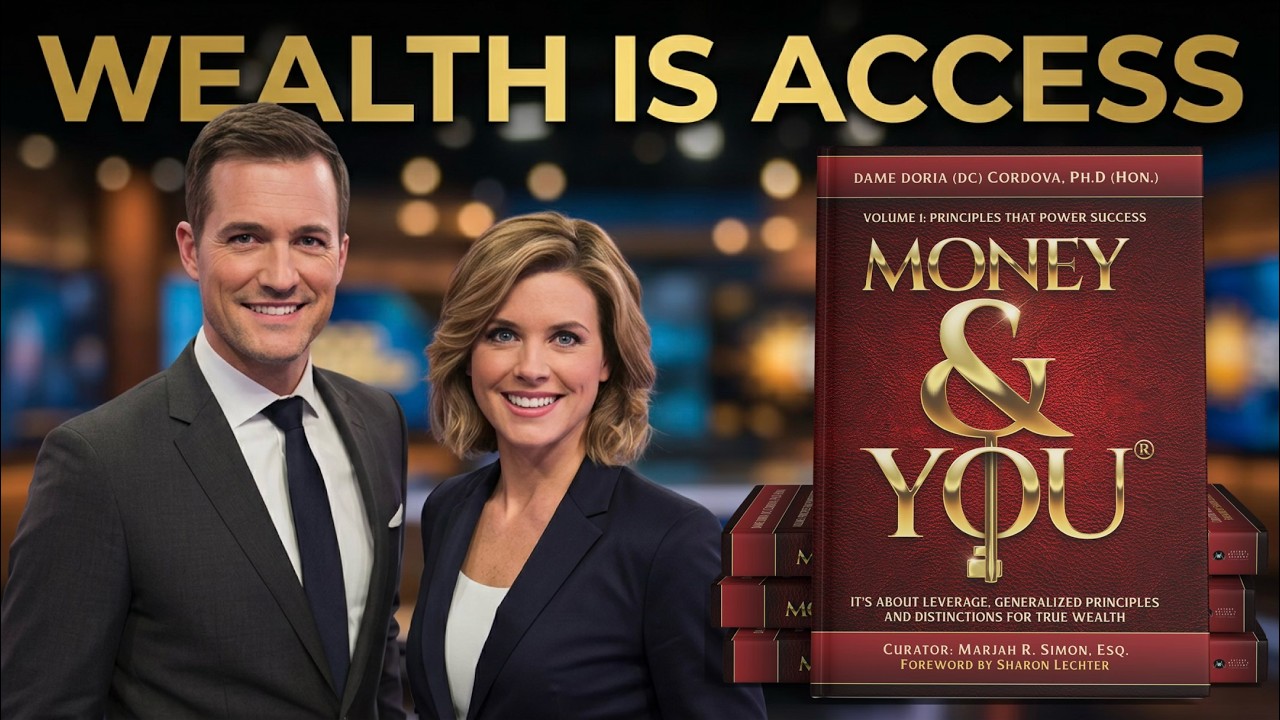
Exactly. What if true impact, real freedom, wasn't just about working harder, but about understanding, I don't know, a few key, maybe hidden universal principles? Today we're doing a deep dive into Money and You. It's this really influential program captured in Dain Doria Cordova's book, It's about leverage, generalized principles, and distinctions for true wealth.
Volume 1. Yeah. A foundational text for a lot of people.
Right. So our mission here is to pull out the really powerful ideas about redefining wealth and mastering leverage, that key word to get, you know, real success and impact.
And what's really revolutionary right off the bat is this idea that wealth isn't just about the cash you have.
Okay?
It's about the access you command. It's a huge shift. It means your network, your knowledge, relationships. These aren't just like Soft skills.
Right. Not just needs-to-haves.
Exactly. They're your actual leverageable assets, your true wealth.
That is a powerful distinction. So if true wealth is really about access to knowledge, resources, support, people, how does that immediately change, you know, where you should focus your energy?
Well, think about it. Most of us see money as just exchange, right? A tool.
Uh-huh.
But money and you says, look deeper. Its real power is in the access it unlocks or facilitates.
Okay, interesting.
Yeah, the book gives this great example actually from Doria's own life. She was 29, no credit history.
Right.
And a wealthy partner, Pete Wanger, he co-founded Granny Goose potato chips. He co-signed a car loan for her.
Wow.
Now that wasn't just him being nice, though it was, it was a direct demonstration of his access, his influence.
Ah, I see.
And that access created opportunity for her way beyond just giving her cash. It immediately makes you think differently about, you know, building relationships, gaining knowledge, not just stacking dollars.
Okay, so if wealth is truly about access, then the logical next question is, how do you amplify that access? And this seems to be where the book brings in leverage. It calls it a generalized principle of physics, like gravity. That sounds big. It is big. And generalized principle basically means it's a universal law. It works whether you believe in it or not. Just like gravity.
Huh.
So, understanding these principles isn't about luck or just hoping for results. It's about designing for them, getting predictable outcomes. Buckminster Fuller, a big influence on the program, he put it simply: doing more with less.
Doing more with less through strategic design.
Precisely. Amplifying your effort.
Okay, so how does this big universal principle actually show up in, say, running a business? What are the practical ways to apply it?
Yeah, good question. The book breaks it down into 3 main types of leverage. First, there's people leverage.
Like delegating.
Exactly. Think hiring an assistant for scheduling or building a team. It frees you, the leader, up for the high-level strategy, the vision stuff, where your input has the biggest impact.
Okay, that makes sense. Second, processes or systems leverage. This is about creating, uh, cookie-cutter ways of doing things, standard operating procedures. Right.
So, the business doesn't just rely on one person's talent.
Precisely. It allows the business to run efficiently, consistently, even if the owner steps away. That's not just freedom for you; it builds a scalable, maybe even sellable asset.
Hmm, scalable and sellable. Interesting. And the third?
Third is technology leverage. Using tools like AI, automation— it's not really optional anymore, is it?
Definitely not.
It's a must for amplifying what you do. Letting tech handle the repetitive stuff, Freeing up human creativity.
I know, I definitely fell into the trap of thinking I had to do everything myself early on.
Yeah.
It felt like, yeah, just treading water constantly.
So many entrepreneurs do.
This idea of leveraging people, process, and tech to focus on high-level stuff, it really flips the script. So what's the ultimate test then? How do you know if you've really mastered leverage?
The book's pretty clear on this. It's when your business can run smoothly for weeks, maybe even months, without you having to be there.
Wow. Okay, that's the goal.
That's real freedom. That's a sign you've built a self-sustaining system. But it also brings up another point. Beyond just the immediate results for your business, what's the wider impact?
The ripple effect.
Kind of. This is where another concept comes in, precession.
Precession. Okay, it sounds like physics again.
It is. It's defined as the effect of bodies in motion on other bodies in motion. Basically, yeah, the ripple effect, but in a physics sense.
So how does that relate?
When you really get it, when you grok procession, as the book says, understand it down to your bones, you become way more conscious of how your actions ripple outwards.
Okay.
And the book argues that money and wealth, they are inherently processional. They have side effects intended or not.
Can you give an example?
Sure. Tony Robbins is a famous Money and You graduate. He didn't just use the principles to build his own huge coaching empire, right?
Right. Massive success.
But he also leveraged that success processionally to create his foundation, which has fed millions of people. That's a huge ripple effect. It's about impact far beyond just yourself.
That's— yeah, that's profound. Seeing your success not just as an endpoint, but as a starting point for other effects?
Exactly. And underpinning all of this— the access, the leverage, the procession— is a really crucial mindset shift.
Okay, what's that?
Moving away from a scarcity mindset You know, the feeling that there's never enough to go around.
Which is pretty common, I think.
Very common. And shifting towards a sufficiency mindset, the core belief that there is enough for everyone.
That sounds nice, but is it practical?
The argument is that it's actually a strategic advantage. When you truly operate from sufficiency, you're way more likely to look for win-win, even win-win-win solutions.
Even with competitors?
Even with competitors, because you genuinely believe there's enough pie for everyone. Think about how that changes negotiations, partnerships. It turns potential conflict into collaboration. It actually attracts more abundance.
Hmm. Less zero-sum thinking.
Totally. More collaborative creation.
So, let's wrap this up. We've taken a deep dive today and seen how true wealth, according to Money and You, is really about access.
Amplified by understanding and using these universal principles, like leverage doing more with less through people, process, and tech.
And precession, being aware of that ripple effect your actions create.
And it's all grounded in shifting from that scarcity thinking to a mindset of sufficiency, believing there's enough for everyone.
Right. It suggests your journey to really transforming your impact starts by recognizing these principles are already operating.
And then consciously applying them, creating your own positive ripple effect.
So, here's something to think about. How will you apply these insights in your own life, your own business? Maybe start by asking yourself every day, how can I produce more results with even fewer resources? It's a powerful question.