Riderflex Podcast - Guest Interview #458 - Dr. Alan Kadish
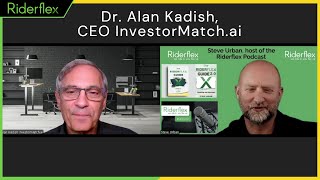
Dr. Alan Kadish, a physician and entrepreneur, built InvestorMatch.ai, an AI platform that matches founders with investors using deep data analysis and due-diligence grading. He discusses the startup's free model for founders, SaaS pricing for investors, and his broader views on AI's impact on jobs and the need for re-education.
Chapters
Hi folks, Steve Urban here, host of the Rider-Flex Podcast and founder and CEO of our day job recruiting firm, Rider-Flex. We hope you enjoy this episode. And as a reminder, please subscribe to the podcast for updates and news. If you haven't already, check out the series of books we've published on hiring, interviewing, and overall career advice titled The Rider-Flex Guide. And finally, today's episode is brought to you by Class 6 Partners. Are you ready to sell your business or raise capital? Class 6 Partners guides you through the entire process, from business optimization to securing the perfect deal. With over $3 billion in transactions, they turn your business dreams into reality. Visit class6partners.com to start your journey today. How about this? What kind of young person were you? Were you a rebel? Were you a straight-A student? What kind of kid were you?
Oh, goodness gracious. I was a horrible, horrible kid. Actually, the quick funny story, my parents were less than amicable and my brother and I wrote a book called Parents as Pets, 250 Things That You Can Do to Torture Your Parents. So with that said, I think that summarizes a good deal. No, I was a horrible rebel. I've been an entrepreneur since I was a youngster. Whether it was shoveling snow, mowing lawns, selling seeds, newspapers, building cars, building businesses, building buildings, both residential and commercial. That's basically my movement entrepreneurial. And then my background is I'm a physician. I went to medical school. I've been still, and I'm still practicing. The other side of the coin is that my desire to learn has been Probably what really defines me. I love learning. So from synthetic biology projects currently to the SaaS play that we'll be talking about called InvestorMatch.ai, I'm involved in a lot of different places and pieces. Think life sciences and technology. Those are probably the two largest areas that I focus my attention.
Did you know you wanted to be, get your doctorate when you were young?
No. Oh, heck no. No, no. Funny story. Funny you should ask this. I wanted to be a garbage man. My parents, I, for whatever reason, my mother kept telling me how when the garbage truck would come, I was just fascinated. And then my first real girlfriend, her dad was running a recycling. This is back in the, oh, I guess '70s, was running a recycling. Boy, would I make a mistake. That one would have been a winner. Woof, monetarily and otherwise. All right. But I didn't follow through on that. So no, the path took me in different directions.
When you went to school, did you go right into med school after? Was there—
No, no, I've done, um, it was biology and chemistry degree, did some business training at another college, and then proceeded to go to medical school. No, I've always loved biology, and it was, uh, based on the premise that I had this amazing absolutely amazing professor. He taught a biology class and it just knocked my socks off. It was great. That's what really stemmed the interest. The other piece for the medical was I always had some sort of GI something. And my parents spent oodles of money. And I saw God knows how many physicians. I left the country when I was 13. And all the symptoms went away. Oh, by the way. So it came to a head because two different surgeons wanted to operate on two different areas. And my parents threw their hands up and said, this is ridiculous. What the heck's going on? I left the country. Yeah. It's one of those weird stories.
Wow.
And all the symptoms went away and I put two and two together. Okay. It was allergy to food, high stress load. And I didn't have adequate microbiome. I'm a youngster, a teenager, and I figured it out, went, oh, look at you guys, how much money with these dingwits, and you couldn't put two and two together, and no one asked the right question. So medical school is called— I get to play detective. That's why I do it. I love doing that part. So I'm a concierge physician. I see patients who have already seen a bunch of folks. Not happy. Things aren't working. Can somebody please take the time to figure it out? That's what I do on that end.
In layman's terms, when you say things aren't working, psychologically, physically, mentally?
A combination of any of the above. So the typical clients that I see, they've got a huge stack of medical records. I go through them, what tests were done, what wasn't done. Did something get followed up? Did something get dropped? Ooh, wait a second. This sounds like, feels like, looks like, let's follow that up.
Well, that, that's probably like 80% of the people who see doctors.
I'm not disagreeing. Um, yeah, I'm never gonna be without, uh, clientele.
Uh, right. Okay. So do you have, uh, all right, so you have your own practice now still and you're seeing, you see, do, do you have like a team? Do you have like an office or you just, just use—
No, no, I do telemedicine and yes, I do see patients. Um, we have an office setting. But realistically, it's part-time. And I like working. I mean, and again, I didn't think we were going to go off in this area of things, but I like seeing patients who we both correspondingly enjoy each other. It's a teamwork effort, not doc, tell me what to do. I'm not that guy. I'm more the let's lay out options and let's talk about it. Let's have an intelligent conversation. Given enough detail, you can make good decisions.
Okay. Maybe you can help me. Maybe we can do a little side, maybe we can do a little side. Can you solve my pains? I'm 57. I wake up in some sort of pain every day.
Can you fix that? Well, gosh darn. I mean, Steve, come on. We gotta approach. So the way that medicine got totally waylaid, it's based on there's no time for anything. So you told me about your pain. So how would I approach that? Well, the first step is, When did it start? What was the progression? Is there knowledgeable pieces that are obvious? I.e., you had a motor vehicle accident, you this, you that, whatever. And then what have you tried? Where are you going? Why hasn't that worked? What might make it better? What might— you know, this is standard detective work.
Aren't you just going to give me a pill? Yeah, but aren't you just going to write me a prescription for a pill? That's all I got.
No, that's a bad idea. So the other piece of this conversation is my belief system is offer clients alternatives as well as conventional. So whether it's a vitamin, a mineral, a glandular, an amino acid, or some combination of both, or a prescriptive or surgical intervention, I'm not attached. My attachment is what works for you. But I think most people misunderstand the first step into the process. It's not write me a script. That's absolutely the wrong approach. First, what's the problem? What's the causal agents? Then we can have a conversation that makes sense. But if you don't have that piece, you're just spitting against the wall hoping it sticks.
Well, I'm not, I'm not a doctor, but I've listened to enough podcasts and had enough guests on the show to, to understand that, um, so much of it is the diet and the exercise and, and, you know, what you're putting in your body.
Lifestyle. Lifestyle and The other piece that's completely lost is the ecological aspects. Think about, you just said you wake up and you, you're in pain. Are you on a bed? I'm, I'm giving a lecture actually on the 17th for, um, Autism Today. There's a huge get-together and my particular part is Health Starts in the Bedroom is the name of my little talk.
Okay.
Make a long story short, were you sleeping on a petrochemical bed?
I have no idea. I don't even know what that means, by the way. I have no idea.
Good. Good question. So are you in one of the commercial foam combination beds where you're breathing all sorts of horrible materials for 7 to 8 hours, 9 hours a day? Is your pillow made with the same petrochemicals? Maybe you're doing something crazy like memory foam. Well, I don't know about you, but formaldehyde, toluene, and other products of that sort. Not something I want next to my body, not next to my nose and my mouth.
Okay. My pillow is memory foam. So is my bed.
Oh, you need to listen to my lecture, buddy. Also, it's funny we should have this conversation. I thought we were going to stick with investor match.
We will. We'll get there. We'll get there.
Okay. Okay. So the other piece to that puzzle is that if you took a look at the overwhelming— there's a great book here Death by Rubber Ducky. If you ever want a book that'll knock your socks off, go get this book.
All right.
But speaking of books, myself and another physician have just finished— we're at the very last chapters being edited— of a fertility— it's The Smart Couple's Guide to Fertility. And in there, when you see the plethora of potentials that impact your body— what did you eat? Did you move your body? To here we are talking about your bed. All of those components are additive. And what most people don't get is it makes a difference. So as an example, I'm going to do a little ditty on— I have a patient who we just saw last week or so. She has a— you name it, she has it. It's one of those. In the medical field, we call them train wrecks. She's a train wreck. Nice, delightful woman, but from a medical perspective, you name it, it doesn't work. Turns out her bedroom is over her garage. Well, what do most people put in their garage?
All those fumes from the automobile, I guess. I don't know.
So we then did an air test. So we did a urine test, what's coming out of her body, and she's like, wait, wait, what the heck is going on here? Then we did an air test in her bedroom. Total correspondence. It was amazing. Literally, you might as well just be sleeping in a gasoline-inhibited, inhabited circumstance.
Wow. Wow.
And there's no question it's impactful. And her poor body was off the chart when we did her actual urine testing. It was ridiculous.
Last question on this topic. I know we could talk about that one all week. You come back on the show, we could talk just about this, but, um, in general, is it safe to say that you, A, can help people feel better and, B, probably save them money on their health bill and, and, and their doctor bills and their medication bills? I'm just assuming.
Unequivocal. Unequivocal. So if you take a perspective of everything's additive, even if you take just a few pieces like your memory foam pillow out of the picture, and aren't breathing horrible chemistries for many hours a day, you're inevitably going to reduce the load. Can your body work better? Sure. I like using the analogy, it's a half-ton pickup. If you put 3/4 of a ton of crap in the back, what do you think's gonna happen? You're gonna be dragging the wheels and you aren't gonna feel very good and the vehicle's not gonna last a long, long time. It just works that way. No, most of us are doing things that really are contributory to health decline.
And it's Alan, Alan, Alan, 40% of the, the 40% of the US is obese. I'm sure you know that.
That's one of the many pieces. So how did we get there? As an example, think about endocrine disruptors. So let's talk about such things as phthalates, which are found in cosmetic products, are found in all sorts of things. That are a whole class of chemicals that screw with your hormones. Well, whether it's your thyroid, whether it's your adrenal hormones, all of these are going to be impacted on some level. So is it really surprising that folks are declining in their health? No, not even remotely. There's a new piece you probably saw. Was it last week? Younger people are getting cancers. By a high margin.
Wow.
It's really substantial, especially in females, is really higher. Why? Because they have more fat generally, think about breasts and otherwise. So it's not they're obese necessarily, it's just the nature of the way people are constructed. And fat is one of the storage areas for all sorts of toxins. So if you add up some of these pieces, is it surprising that more folks are experiencing health decline at an earlier age? No. Think about you did something you thought was a good idea. You ate some salmon. Well, there's a problem here. What's the problem? Microplastics.
Am I not supposed to be eating tuna and salmon?
Tuna? Well, only if you like mercury poisoning. I don't know. You like your neurological system to function or—
No wonder I can't think straight. I've eaten tuna for too long. Oh, I bet. I bet. Are you, are you married? Family? Kid? What's your— what's your— okay.
Yeah, I have a delightful other half who gets it. And I was—
you know where I was going, right? You know where I'm going, right? Does she, does she, does she do the diet? Does she like— if you— if she opens up a can of tuna, do you just— you just—
she doesn't. She doesn't. No, she knows enough to know better. I mean, let me have a little perspective on this. You know, does that mean she'll never have a can of tuna? I think I've seen her in 20 years. It'll be our 20th anniversary coming up. Um, probably 20 years.
Okay.
So no, we actually do. So two things. We practice what we preach. I'm figuring 1,000%. Oh, good God. Nobody is. I don't want anybody to go off there.
Yeah, but you look like, yeah, but you look like you're in pretty good shape. I'm guessing you don't eat a lot of crap.
I don't, I don't actually, I do a more vegetarian vegan diet almost exclusively. It works for me. I'm not suggesting it for everyone, but I'm gonna tell you right up front, I get up in the morning, I hit it and I'm going all day long. I keep up with anyone and everyone. No questions asked.
No steak. No steak. Oh my God. I can't, Alan. I can't.
Now my brother makes up for the difference. He goes and does tomahawks and other crap. But he's in pain. I don't know. It's all relative.
All right.
How did you—
all right. So you— all right. So you go from there. All right. Then you get into biosciences, biotechnologies. Walk us through a little bit of your career before we get into the AI stuff. Go ahead.
So I just love learning. And I've also found I've been very blessed, if you will, with people come to me with, hey, what do you think about this? Or do you have any thoughts and ideas? Dad was an electrical mechanical engineer and I grew up playing with gearboxes and things to that sort because that's what we could afford. He brought them home for work. I got to play with them. Great toys, great toys. Beat the daylights out of current stuff. Make a long story short, I see things from a different perspective, generally from the 40,000-foot view. And then where could you apply things and what have you? So anything that comes my way, if it's even remotely interesting, and most things are, I want to learn about it. So from the biologics to med tech, pharma products, um, technology would be anything from SaaS plays and fintech straight through to, oh gosh, I was just doing due diligence as an example on a coffee product. Someone had actually, in this case, done ultrasonically welded tea bag-like products. So you don't have— most people don't get this. And yes, I speak material sciences, so I dive into this stuff. There's actually an adhesive that sealed your tea bag. Well, that's not good. Hot water, adhesive. This is a bad combination, right?
Oh man, I got to tell my wife about this.
I mean, most people don't think like this. I know it's crazy, crazy story. So this fellow was smart enough to figure out how to ultrasonically weld. So there is no materials and it's biodegradable and on and on. That's just one of the crazy coffee talks that, that was last week. Wow. The week before that was a group that we did due diligence on that does a spatial analysis, speaking of AI, for interactions of molecular products, primarily in pharma. In fact, exclusively in pharma. And what they're doing is they're using modeling to determine receptor site attachments and modulation. Totally awesome, amazing stuff that really gives, as an example, the top manufacturers in our medical industry the ability to now think through how a new molecule would actually interact other types of product potentials, et cetera. Very cool stuff. So are you, are you a doctor, a scientist, an investor, or an entrepreneur?
Which one?
All, all of the above. No, I do all this stuff.
Yeah. You're all, but you're, but you've obviously been a serial entrepreneur. Like you've had that while you're doing the doctorate stuff and the medicine stuff and the biosciences. The entrepreneur stuff's been there from the, almost from the beginning.
I saw my parents not do great in terms of, we had cousins who were actually physicians and others, and I looked at the differential financially and otherwise and social status and went, I don't think you guys get it. You gotta put your butt on the line and just go for it and take some risks.
Okay.
And sure, I've done some stupid, I've done plenty of stupid. But I've also— it just happens. But I've also done good stuff that really paid dividends. Yeah.
What's your biggest successful exit so far? What's your, what's your, what's your home run so far?
I think I'm going to still say the medical only because— well, medical and real estate. We own a real estate company and that did really, really well. But the medicine because I've helped over 10,000+ people go from dead in the water to, hey, at least we have an idea what the problem is. And many of them were able to really see the light of day again.
I gotcha.
To me, that's a big win. That's a huge win.
Alan, we're, we're living in a fascinating world right now, aren't we? I mean, with the, with the biotech and AI and maybe even those fusing together kind of as we I mean, wow. Back in, you know, 1980, would you have ever thought we'd be here? I mean, it's crazy, right?
Absolutely. It is amazing. The changes and the acceleration and just the velocity. Mind-numbing. Mind-numbing. I mean, think about today. We're going from generative AI to conceptualization, visualization, auditory contextualization. It changes the whole parameter.
I remember still the day whenever this was, which was not long ago, the very first day I used ChatGPT-4, when ChatGPT-4 launched. So for me, but my buddy called me, he's like, hey, man, he's like, the 4 version's out, you know, you need to try it. I remember getting on the plane around with her for about an hour. I went upstairs, I told my wife, I was like, Wow, I think the world might have just changed a little bit.
Oh, absolutely. Absolutely. No question about it. I mean, I think two things to consider. If you, from a demographic and adoptive point of reality, look at the uptake of any of the AI processes such as ChatGPT literally in months, not years, but months to go from zero to millions. Never in the history of our planet was this even a conceptual potential until now. I mean, now when somebody says to me, well, it's going to go ballistic, does that mean three digits in the millions? Is that billion? What does that mean in terms of people utilizing your product. It's crazy.
And aren't we already like, I know, I'm not sure you know who Ray Kurzweil is. Are we, are we already, are we already?
Yeah.
It's already, it's already AGI, isn't it? I mean, aren't we already there? I mean, the Turing test, aren't we already past the Turing test? I mean, really?
Well, I, I will tell you that there's just enough. I, I personally use more Glock than I use, um, ChatGPT, but that's just me. And that's a G-R-O-Q, not K. Make a long story short, I still get hallucination. I still get some— what the heck? Wait, I thought I gave you the correct information. What did you do with it?
Yeah, but it's not perfect, but it's not like human beings are.
No, no, it's true. It's true. But I think within the next 3 years to 5 years, just as you indicated, I used it and it became the norm. That's going to be the same with about a dozen other pieces within the puzzle. Let's think about this. iPhone 16 just released. AI is integrated. OMG. Now it's a conversation that conceptually makes much more sense than, hey Siri, where's the nearest? Yeah. It's far greater in depth. And I don't know if you saw yesterday the new glasses that someone came out with.
Yeah.
It's like a— That's getting creepy. Now we're getting really creeping out here. I don't need to know your undies size. That's your business, not mine. Come on.
I mean, you saw that OpenAI just raised the largest VC round ever, ever.
I mean, but I don't see how the money's— I mean, realistically, if you look at the demo, at the financials, it's not making sense. It costs fortunes, literally, per day to run these centers. I don't see the input-output is very distorted. I, I wonder how this is all going to pan.
I don't know.
It's not making sense. From an investor, it's got to be completely disruptive. It has to be amazing, amazing, not just good, disruptively amazing to seriously capture the market and pay for itself. I don't see it yet.
Well, I guess, but one would— I think now I'm starting to really question, will all of it end up creating a completely different economy anyway? And I know now we're really going down a rabbit hole, but let's just go there for a second. I mean, will it, is it creating a completely different world than we can really conceptualize anyway? And what I mean by that is, If AI can do everything, if autonomous robots get better and better, if they take jobs, if, if the, you know, and I, and I don't know if you've, if you read the book by Mustafa Suleiman or if you, uh, maybe if you saw the interview with, uh, Brett Adcock from Figure AI, but my, my, my point is we may end up in a different economic situation anyway because the cost of goods and services will be driven down so aggressively by fewer humans involved in the production of goods and services that maybe it's a completely different system anyway. I, I don't, I don't know. I, I, very hard to, uh, very hard to predict.
Um, but there's parts of that that I would agree with. I think that we'll never having lived overseas and other places, there are groups that will never embrace current technology in a million years. They're just in another, on another planet for all practical purposes. That's just who they are. With that said, will first world countries rise? Absolutely positively. Will there be a very big differential in terms of haves and have-nots? I think we're going to see much more defining realities, both fiscally and demographically, because people are going to need far less. As an example, to start a business, you can do so much integration now at just so much less cost.
Yep.
Before you had to hire, you just plain and simply had to hire personnel to make it happen. Now, come on, the automation level, it's just exploding.
Alan, I did on a Sunday afternoon, I helped a friend create an operating agreement, a cap table, a marketing plan, a business plan, a pitch deck. And we did it in like 45 minutes.
I'm a little hesitant to take a look at your pitch deck, but that's awesome. That is awesome.
I mean, just, yeah, everything is just done quicker with the advancement of AI. I want to come— let's come back to whether or not robots will take over the world. I want to ask you that towards the end. But before we go, before we go too far down the rabbit hole there, let's talk about InvestorMatch.ai. InvestorMatch, tell us what you're doing. Give us the pitch. Go for it.
Here's the deal. I got tired of everybody bitching and moaning. When I say everyone, founders and funders all bitching how much time, effort, and angst they experience between making the connection with somebody who makes sense as either as from a funder's perspective in their thesis or from a founder's perspective, how many folks they reached out to, to try to get some funding. I hear it daily, daily. I'm on multiple forums. I'm involved with lots of investor groups. I'm doing mentoring with accelerators, et cetera. And I just kept hearing the same, this is the pits. I'm killing myself to find $5. And the funders are sitting there going, another person who didn't get the basic idea of I don't invest in X, I invest in Y. I put two and two together and said to myself, what's the problem? It's alignment. It's really straightforward. It's all about alignment. You're not at the right place, right people, right time. Why should it work? It won't work. And watching founders just throw themselves at the mercy of everyone and anyone and doing the Google it or ChatGPT it or what have you is absolutely the wrong approach. That doesn't work. So I said, all right, so what's the solution? Good data, having a first-pass due diligence level of information, and then matching that to what is a funder offering? EIRs, space, maybe there's an opportunity for mentoring, maybe there's introductions. What, what, what do you bring to the table? What do the other folks do? Then at a high level, what's your industry specific? If you said to me as an example, fintech, Doesn't mean spot. Are you a service? Are you a software? Are you a hardware solution? I don't know. Give me the rest of the deal. Are you maybe crypto? Specificity, granularity, high fidelity matching. That's the essence. Then you're talking to the right people at the right place. And do they have the money that you need? Are they doing, as an example, possibly a seed? Maybe they're only series. Yeah. So Investor Match is from pre-seed all the way straight through to Series B. It is from ideation to IPO ready, seriously.
Okay.
It is industry agnostic, but taxonomy deep. It's inclusive of private, public, and commercial funding. So regardless of the source, it is global in scope. So no, it doesn't matter where your borders are. And the essence is How do we find the right people for you to speak to immediately?
A dating— hey, it's a dating app for founders and investors.
A lot of people keep telling me, guys, you're probably just— it's the match for you guys. Yeah, right. It, it's far more than that because we look at everything from an angel all the way straight through to a family office.
Yeah, cool.
PE to CVCs and VCs. It really truly is comprehensive. And the essence is that the way we currently have our finances, it's free for founders. So you had asked me at the beginning of our conversation, okay, how can we offer some value? Now, oncoming in the next version, which is almost here, as a founder, we'll offer you a Lean or Business Canvas automatically, a SWOT automatically. Why? Because we have the data set. A pitch deck, sort of, kind of. I'm not a UI/UX guy. It ain't gonna look pretty, but guess what? You'll at least get the basics. What's your problem? What's your solution? What's your team? Blah, blah, blah.
Let me just pause it for a minute. Anybody with a startup can sign up for InvestorMatch.ai if they're trying to raise cash and it costs nothing.
Nothing. Zero. Zip. There's nowhere you can put your credit card.
No qualifications. You don't have to, you know, you're not vetting them. You're not qualifying.
No, it's from ideation all the way straight through to you're gonna be talking to me about your S1 or S3 because you're IPO ready.
Wow. All right, it's all right.
There's more, there's more.
Go for it.
Uh, one of the other pieces we have is a competitive analysis. How many times have you, Steve, taken a look at somebody's pitch deck, you go to their competitive slide, you go, darn, I know 4 people that you didn't mention. Oops. Happens all the time. It's just ongoing. We have, as I was saying earlier, an 8 million plus database of companies that we're adding 100,000 to a week. All the data you could need to really make the connection of who is your actual real direct competitor.
Okay.
Funders, funders pay us. That's where the money's coming from. So hang tight. I'll tell you where the rest of the dollars and cents are.
All right.
You can do a white label. How many of my funder friends are yelling and screaming, my inbox is full of crap? 90%. And I don't have time. I don't have the energy. I need it to be sorted. And no, I don't want to hire 4 more staff members to play with this. I need it to be solved.
Okay.
Tell me what your parameters are. Here's your high link. Here's your alignment level. If it's 80, 90%, oh gosh, give them a call yesterday. You don't want to miss that deal flow. If it's less, send them a nice letter. Hey, doesn't work for us, but good luck.
Does the investor only— does the investor get pinged automatically by your AI, or if the startup founder wants to ping?
It can be done 3 ways. So you have some options. One, if you're looking for deal flow and LPs, we'll match and then send an anonymized to both parties. Both parties say yes, go for it. On the other side of the coin, white label us. Here's your intake. Everybody and anybody can apply. And now you know, because you've now filtered, here are the people I'm going to talk to. Everybody else gets a nice letter saying thanks, but no thanks. All good.
I see. I see.
The other opportunity is let's say you're one of the large angel groups and you're doing due diligence, which happens all the time. The whole front end is built intentionally so that for your report, all that manual acquisition, whether it's the due diligence aspects from your operating agreements straight through to your taxes, from all of them, everything is ordered in a— reciprocal deals with digital, digital groups that do obviously a data room. How and where is everything there? Maybe partial. We got a red, green, and yellow. Easy Stevie, and you can export all the data to your report automatically. Wow.
Wow. Okay.
So, all right.
Wow. I didn't know you were going to have a data room with all the stuff too. Okay. Very good.
There's more. There is one more. Let me, let me free you one. All right. We've kept having every time we find, or almost every time that we find a founder enters our data set, we ask them, what do you need? Team member to, oh, my cap table's a mess. To, hey, do you have maybe some HR software, whatever it may be? We've amalgamated a really amazing group of individuals who can help you with— you name it, we've got it. How we deal with them is a percent of the successful contract or service.
Uh, I did, I did, I did tell you that RiderFlex was a recruiting firm for our day job, didn't I?
You did. You did.
I'm just throwing that out there.
That's why I thought I should definitely jump in and say, before we go to the two far down the line, there's more to the story. So that's one of the ways that we can really add value and everyone benefits. There's no upfront cost and it's matched. So let's say as an example, your HR, you specialize in whatever it is. I, I really honestly don't know, but a specialty subgroup.
Yeah.
Okay. Tell us, we'll send you the right people. So again, you're talking to the right people at the right place at the right time.
Can I ask you, if I were a startup founder, I guess one of my first questions— well, you told me it's free, so I'm like, okay, it's a no-brainer to put our stuff on there. But my second question is, okay, well, how much access do you have to how many different firms, angels? Like, what, what's— how big's your— how big's your database of investors?
Thank you for asking. Perfect. Uh, 6 figures now. We're at 6 figures for investment potential. So if we can't find it, Uh, probably doesn't exist. Maybe that's too outrageous, but yes, it is literally awesome in terms of it's being expanded on a daily basis.
Okay, now, but, but, but don't, but don't the investors have to sign up?
Yes and no. What we have done, we haven't— here's how we work. So we have found everybody in the industry that we can think of, and it's an ongoing scrape that literally keeps filling our database.
Okay.
If they have— if we have a connection, we send a note out to them letting them know we've got an opportunity for you. I see many have signed up, but those who haven't will actually drop them a, hey, would you like an introduction to exactly who you should be speaking to? Let's talk about this. Let's spend a few minutes and start the process and show you the value that we can bring to you.
I love that. Now, how do they— do they pay per deal? Do they pay per month? They pay a setup fee.
It's a SaaS play and it is a monthly type of engagement.
Yeah, but don't you want to— okay, that's good for you, I guess, but good for them. But damn, if they get like 2 deals off of it, don't you want to capture it?
You know, it's difficult. Some people have suggested, well, why don't you take some equity? Like, why don't you— you know what? Yeah, yeah, I don't want to go there. I think the game plan here, more than anything else, is How can I bring the maximum value? Okay. That's a no-brainer. That's easy. Good example. You're a small VC firm. You can't afford to hire a whole front-end worth of folks. It just doesn't work that way. You're still at your beginning stages. You're not Y Combinator or something of that sort.
Yeah.
Guess what? Let's reduce your overhead, but yet keep the quality at maximum because anyone who fills in our form, you're going to see— and truly, this is one of the nice parts, because people ask me, well, there's a lot of questions. Well, yeah, you're asking me to write a check. You're asking someone else to write a check. You think they just love you because you look happy camper? I mean, come on, it doesn't work that way. This is all about standard common sense. They need to know the story. So it's a real good way for many of the firms to literally sort through. If you can't answer these questions and it's half-baked, you're probably not a— you're not a funder level. If you can fly through it and you've got the data set, heck yes, we've got our first pass due diligence.
Do you, do you have all the big boys signed up for this, like Sequoia and all these other guys?
No, they, they think they, they have their better way because they ask their own questions. Uh, that's been my experience so far, is that the big boys I think they have it down and they've got their own methodology.
So, so your target, what's your, what's your target?
Generally it's going to be angel groups and VCs are by far. Now the other group for due diligence is family offices. They need high velocity due diligence because they're getting hit right, left, up and down. So from that perspective, that piece of our software is very useful.
Okay, very good. All right, where are you in the life cycle? Are you— how long have you been alive? Are you in a cash raise? Are you expanding? Are you rolling out version 2? Talk to me.
We're great. Thank you, appreciate the good questions, Steve. Um, this is literally our rollout. We've gone out of beta. We're in rollout mode. We've been doing this for 2 years to get to where we are. We're a little over 2 years now, but we literally soft launched in January. So we're still pretty darn new.
Okay.
We're making progress. We have various groups talking to us in various ways, as I mentioned, from due diligence to white labeling, from, hey, I'm a vendor and I need more clientele, et cetera. It's still on the outworld. We are scaling. Don't know that we're looking for money. We're doing okay. Maybe we'll consider it at some point. Certainly we've been offered a number of opportunities. We're actually speaking to two different firms who want to do an M&A play. We'll see. All right. It's very complimentary and it would add a whole other level of potential for both startups and funders.
Any deals, any marriages yet? I mean, you know, you know what I mean, you know what I'm. You know what I'm saying? I mean, has anybody, has anybody actually signed a deal yet and cash is transferred hands?
Oh, yeah, yeah, yeah, yeah. We've taken some. Yeah, yeah, yeah, yeah, yeah, yeah.
Okay, so you've had, you've had founders get funded, you've had investors fund give us money?
Yes, yes, we've had both sides.
Gotcha. Okay, very good. All right.
Right now, waiting. There's a multi million dollar, a double-digit multimillion-dollar deal that we've literally sent this poor fellow. It's in the oil and gas industry, probably a half dozen connections. And I just saw yesterday an email saying, hey, it looks like the Permian Basin deal is going through. Woo-hoo!
Okay. But my reaction to that is, okay, you're going to help somebody, you're going to help a founder get $2 million.
But it's more than that. It's double digit. Sorry.
You're going to help a founder get this big raise, but meanwhile you're just capturing a monthly subscription off of that from the, from the—
I don't know. It's not a windfall. I'm not disagreeing with you. At some point after we get momentum and all of a sudden, okay.
All right.
X number of deals, we'll rethink it. At this point, no, it's fine. It really truly is fine.
This is not how you're making your— you're obviously not paying your— you and your whoever's involved, nobody's getting paid yet. I'm guessing.
That is correct. That is correct.
Did you put— who funded it? Did you put in your own? Who? Okay. Any other, any other cash in besides yourself?
No. Okay.
So you're 100% cap table?
No, I have two founders with me. They put sweat equity.
All right, good. Well, hey, that— well, that was nice of you to let them do that.
They're both— I'm really— working with them.
So by the way, this is a great, this is a great, you know, a lot of the listeners of the podcast are aspiring entrepreneurs and things. I think this will be a good, if you don't mind sharing here, your advice on this. We've had so many on, we've had like 400 guests on the show, so many entrepreneurs and founders and a lot of, a lot of aspiring entrepreneurs. And, you know, they, a lot of them have never written an operating agreement before or whatever. And they often run into this situation where, you know, okay, one guy's got, one guy's got $100 grand and then his two friends don't have any cash, but they want to help and it's okay. How the hell do I, well, how do I do that? How do I structure that with sweat equity? You know, how does all that work? Of course, now they have ChatGPT and stuff. I guess they can, you know, ask that questions, but let's get, let's get, let's get Alan's advice. What advice would you give any listeners right now trying to work up a deal with friends where maybe one person has cash and the other two folks are sweat equity? And I realize that's a pretty big question you could probably spend 30 minutes on, but maybe just Could you maybe just give a little bit of advice on how you would structure that, if you don't mind?
No, I'm good. First thing, someone has to own at least 51%, period. End of conversation. Dead serious. Why?
Totally agree.
Totally stupid stuff happens and somebody has to ultimately make a decision. And if everybody is sitting there with 33% going, well, maybe, or 50/50, You're never going to go anywhere. So don't do that.
Totally agree.
Ideation is not worth much. Execution is the story. So I spend many hours a day doing this. The other folks are part-time, just so we're clear. And yes, cash makes a difference depending on how you spend it and on what. Everybody has their own infrastructure, computers, internet access. So come on, that's not it. It's really about how much skin you have in the game. That's my belief system. If you're willing to go the distance, I mean, one of my co-founders, for example, is an expert at AWS. For him, it's, for me, oh my God. Yuck. Headache.
Okay. Okay.
On the other hand, the programmer, I don't program well. I don't. But on the other side of the coin, you ask me to put the whole kit and caboodle together from a wireframe. Sure, sure.
But more, but more specifically, I was wondering the structure of it. Is it— how would you recommend, okay, you know, over time you're going to earn this much?
There's absolutely a vesting schedule. There should be a vesting schedule and cliffs. That is just plain and simple the way it should work. Once you've got go-to-market strategy, and you've got market fit most importantly, and the money's starting to come in, that's when you guys should really, really, really seriously have had this, here's what we're doing, how much input are you gonna put into this? Is this just a side job for you? You gotta kind of work through that. Now there are a couple of books out there. I'm trying to think of the main one that everybody refers to, the pie book, splitting up the pie. Okay, that's one way. And you can get really deep into, well, is this fractional? I think part of it is gut. Sorry, I know that's not very scientific.
All right, all right, very good. I know we could talk about that, that topic for a long time. You know, um, I totally agree with the 51% thing. I tell people that all the time.
You know, I love it when people come on the show, well, you know, it's my best friend, and we, you know, we It's like, okay, you know, it may or may not be your best friend by the time liftoff takes place or by the time you even get to an MVP. And again, who's putting their equity into the process? And by equity, I mean seriously execution, not just talk out there pounding the pavement, making connections, making the happening of whatever it is, service or product. You got to look at the whole picture.
Yeah, totally agree. Okay, very good. So you got this thing off and running. It's up, it's live, it's generating, you have subscriptions. I don't guess you can share how many, I mean, how many? Okay. There's got to be— I mean, I don't want you to name the competitors, but I mean, there's got to be other people doing this, right?
Oh, sure, sure. They've got— what we found was, and certainly in the last 2 years, there's been a number of folks trying to break into this area. What we found was they're not really doing the due diligence level of granularity. I mean, there's some very big definitive differentiators.
All right.
Machine learning, it's, it's literally a very specific, if you're not a funder and you haven't been doing this for a lot of years, just saying, okay, this person has X number of dollars, blah, blah, blah. That's not it. It is far more granular and you have to look at the whole picture. The other piece is the way we're doing our financials. Sure, I can tell you people who will take your money and find you money. Oh, there's no lack of those. That's pervasive in our industry. It's just the nature of the beast. Everybody knows somebody who has a couple of bucks, but what are they gonna charge you to make an introduction? I don't think that's where the real money is personally, but that's just my opinion. Okay. We have lots of pieces that fit differently than our competitors and some overlap. Absolutely some overlap.
Okay. Investormatch.ai. Um, before we go, I want to finish. We have a couple of minutes left. So back to AI and the end of the world.
Oh no, no, it's absolutely the opposite. It's—
so that's, so that's, so that's my question. Not to cut you off. I didn't mean to cut you off, but you know, you got some people over here saying Terminator and then you got some people over here saying the world of abundance. And all, you know, where are you in this?
It's first off, it's both. Could you manufacture a horrible virus and manufacture it? Sure you could now, even if you're not that knowledgeable. True. Not good news, but hopefully you won't. On the other side of the coin, if we can eliminate dumb jobs, which we can, stupid things, repetitive, Um, things that really don't make much sense. That will be where this fits. Now, on the other hand, how are you going to eliminate your electrician, your plumber, uh, your contractor? Somebody's got to figure it out and drive nails. And no, you can argue with me, well, but you can, uh, 3D print a house. If you like concrete that much, sure. Um, can you do CAD/CAM approaches to panelize? Sure. But somebody's still got to assemble it on site. So there's never going to be a lack of that. That's not going to be automated fully. That'll always have some input. On the other side of the coin, if I can generate content that's very much clear, concise, and relevant, and it really truly hits home, awesome, which you can do now. On the other side of the coin, you could argue with me and say, well, but everybody's doing that. So now the plethora of crap out there is just magnified. 5 times whatever number. Okay, I'm not going to argue. That's probably true to some extent. And then you could come back and say, well, what about fake news? And what was it? Well, you know what? There's always been garbage. There are people who will tell you something that has absolutely no reality and it's just, that's who they are. What are you going to do? What are you going to do? Can they do it better? Sure. That doesn't make it bad necessarily that the technology is there.
So if I had to— if you had to decide on an answer for this, I won't hold you to it. There's so many predictions on what percentage of jobs might be affected by AI and robotics. I mean, it's all over the board, but a lot of, a lot of really smart people are, are predicting that it could be 20-30% of the workforce affected eventually. Where are you at?
What do you think? I think that's an— I think that's very accurate. I think that's incredibly accurate. Um, I don't think that's missing the boat in any means, manner, or form.
Okay, so I'm gonna follow up— follow that up with this then. So I agree with that number. In fact, I— it could even be higher. We're at 4% unemployment right now in, in the country. What happens when it's 30%, Alan?
Okay, so you remember circling back to the earlier part of our conversation about the haves and have-nots?
Yeah.
Okay, I think there's a definitive problem here. I don't know if I want to go too far off into the ozone of, you know, do we pay people who have no skill sets a certain wage just because Yeah, I don't think that's how an economy can function. But that's, again, I'm not an economist. So I'll own, this is just my own theories. Nothing more than that. I think people need to either regroup and figure out what is the potential for reeducation. Okay, a good portion of them will never be able to rise to that occasion. But we have that currently. That's just the nature of the beast.
Okay.
Other people will utilize this at a much higher rate and reduce costs on all sorts of goods and services. I think that's probably where it's, I think that's, yeah, that's, that's the balancing act here. And you're right. I think as this becomes more pervasive, there may be higher unemployment and there'll be a dislike for certain groups are probably going to be a problem. And I don't know how to fix that. I don't think we have an answer.
I heard somebody say the other day, and I know that, I know there's a lot of smart people trying to come up with maybe possible scenarios as, as this is looming out there. Um, I heard something the other day, it was, they were calling it an AI robotics tax, basically a, a tax on AI and robotics companies that will supplement a UBI for all the people that can't work. And I'm like, I, I don't, I don't know.
I, I just, I'm not of the opinion that that works. There's been countries that have tried that and it failed. Yeah, I think that clearly that's not the solution. I mean, think about it, at least for me, I would feel pretty damn useless if literally I sat on my tail all day watching Netflix, getting a check in the mail. I'd rather just die. Why are we— that's not, that's not living.
I think that's a whole nother— I totally agree. That's a whole— I got to have you back on the show. That's a whole nother podcast is then what do people do? What's the purpose, right? The whole purpose conversation comes into play. We can go deep. I got to—
well, you're in HR. Think about this. What do we talk about in HR? If you don't have a purpose, you're not given the potential to expand and really excel. Yeah, you're probably going to hate your job and you're going to quit anyway. You people need goals, they need a reason.
I agree.
You take that out of the equation. I, you know, we talked about mental health, look what happened with COVID You want to amplify that more than we are already? No, we got a whole generation. And I hear, I'm this, I'm that, and what have you. And it's like, oh, hold the phone, boys and girls. What is happening here?
You know, we, we can, we can wrap it up with this. We were saying how it's a fascinating time, just an extraordinary time to be living. At the same time, also a little bit kind of scary. Like, you know, a little bit of both.
Yep. Welcome to interesting times. Hopefully we don't blow ourselves out of the water in the right park. Yeah, it was crazy stuff.. And on the other hand, think about the potentials that we could explore in medicine alone.
Yes.
The probability of seriously diagnostically and therapeutically making massive moves that, you know, that our whole population has never seen before is happening as we speak. Yeah. Freaking fascinating.
Fascinating. Absolutely. Alan, thank you so much for being on the Rider-Flex podcast. I really appreciate it, sir.
You're welcome. You're welcome. Well, thanks for having me. I'll look forward to our tackling other issues.