A Psychiatrist Says Your Depression Might Be a Metabolism Problem | Ep. 357
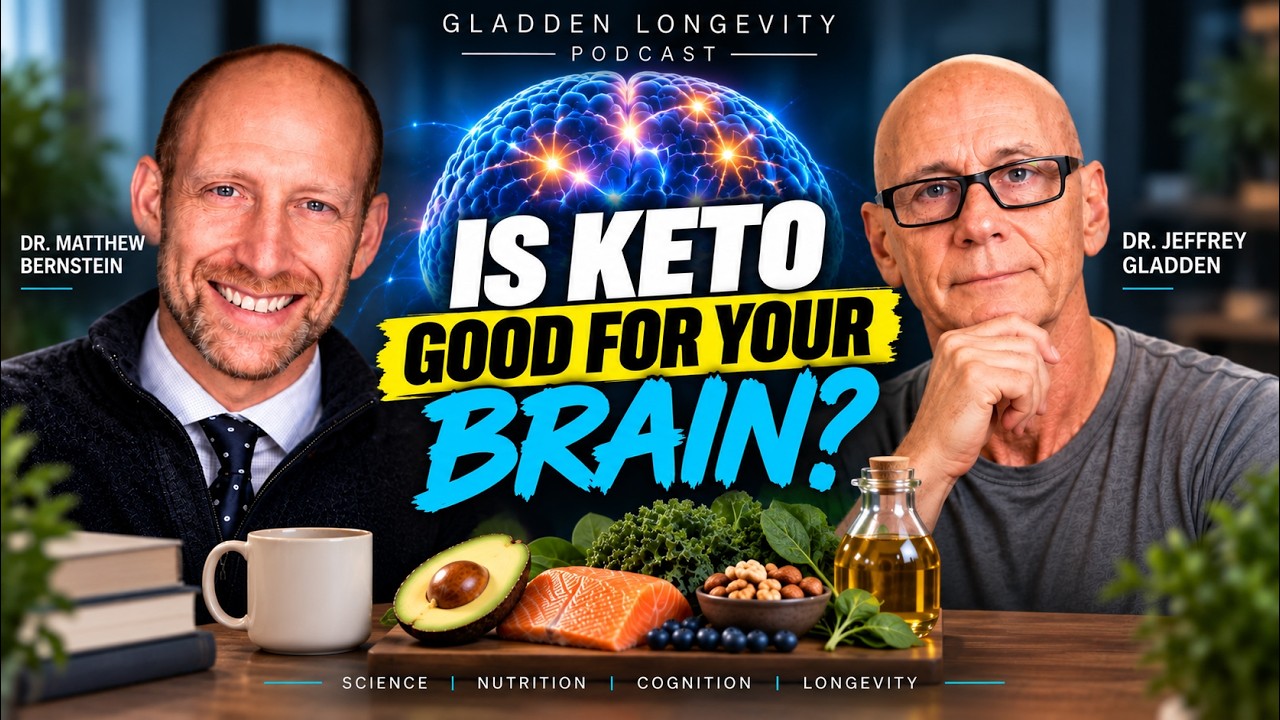
Psychiatrist Dr. Matt Bernstein treats depression, bipolar disorder, and anxiety as metabolic problems, not just neurotransmitter imbalances. He uses ketogenic diet, exercise, and targeted supplements to reduce psychiatric medication by 50-90% in many patients. Severe mental illness cuts life expectancy by roughly 15 years, but metabolic restoration can reverse it.
Chapters
We had a big issue with our kids about 9 years ago where they were diagnosed with autoimmune encephalitis, but it presented very psychiatric. And then the psychiatric treatments didn't help them, in fact made them worse. And that really opened my eyes that, you know, we have to think about the whole body here.
Hey everyone, Dr. Gladden here. I just finished a conversation with Matt Bernstein, who's an MD psychiatrist, and really interesting conversation because he was classically trained, you know, medications, et cetera. And then started to realize the limitation of that, particularly when people are putting on 3, 4, 5, 6 different medicines, not doing well, side effects, et cetera. And he's kind of transitioned into a different approach. And I think you're really going to enjoy hearing about this approach. And we go down the rabbit hole on a number of different things related to mental health and then how absolutely critical it is to longevity itself. It's worth 15 years actually not to be depressed, not to have psychosis, things like that. But in addition, you're going to hear us talk about some really interesting strategies on how to optimize brain function from his perspective, and it interlaces with what we do here at Gladden Longevity. So, I think you're really going to enjoy this show.
He went from saving hearts as a cardiologist to rewriting the entire aging playbook. Dr. Jeffrey Gladden believes 100 is the new 30, and he's got the science to back it up. This is the Gladden Longevity Podcast.
Matt, welcome to the Gladden Longevity Podcast. It's good to have you here.
Thanks for having me.
Yeah. So what's on your heart and mind today? What, what are you most passionate about that you want to discuss with us?
Well, I think my perspective that I'm bringing here is of a psychiatrist. I've been practicing for, you know, about 26 years in the field of mental health, working with people with all kinds of different conditions, but a lot of people with more serious mental health conditions.
Like what? Rattle some of that off for the audience here. What kind of things are you thinking about?
Sure. Yeah, I mean, I've Spent a lot of my career working with people with bipolar disorder, with and without psychosis, schizoaffective disorder, schizophrenia, severe major depression, severe OCD, PTSD. I also work with people with, you know, anxiety disorders, ADHD, issues with relationships. I sort of run the gamut. I'm a real generalist.
Okay.
You know, but, but I do work with people, you know, on the more serious end of the spectrum a lot. And, um, We often hit a wall with those folks with the medication approach, meaning we can get people out of an acute episode with some of the psychiatric medications, but then what happens next is usually not a great scenario.
Right.
Meaning people have metabolic side effects, they have neurological side effects. Sometimes we don't recognize those as neurological side effects in my field, meaning people are having Cognitive problems, sedation, lack of motivation, anhedonia.
Right. So there's a big word. There's a big word for the audience. Anhedonia basically means you don't, you don't feel pleasure. If you're a hedonist, of course, you're right. You're going after pleasure. And anhedonia means that you, you can't feel pleasure. So life becomes very flat, right? Kind of dull.
Yeah. And sometimes those are from the initial condition, but sometimes they're made worse or even caused by the medication interventions to try to stabilize people.
Right.
And so my big message is that we now have a different way of looking at these mental health problems that's based in metabolism, that's not all about neurotransmitters. Not that neurotransmitters aren't important, but they've kind of dominated the way we think about these things completely for at least 4 or 5 decades. And we are still hitting these walls. And so psychiatry really has needed a fresh look at root cause and mechanism. And I think we have in the last 8 or 10 years come to a place where we have a lot of evidence for us that we have a new way of looking at this that will provide a lot of people with benefits that they haven't been getting so far.
It's really refreshing to hear you say that because, you know, my background was interventional cardiology. My best friend in medical school went into psychiatry, actually, and I was married to a woman that went into psychiatry and then child psychiatry. So I understand the field. You know, it's a funny story. I, uh, when I did my psychiatry, you know, rotation in medical school, I went out and bought a corduroy coat with patches on the sleeves and started smoking a pipe. Uh, I thought, well, I may as well go all in. Yeah, I really enjoyed, I really enjoyed psychiatry. I mean, I, I'm, you know, the people on the, on the podcast understand that I'm very much into the psycho-spiritual space and the importance of that in terms of meaning of life, purpose, and, uh, Yeah. Solving big issues like, you know, do you feel loved? Do you, do you feel safe? You know, these kinds of things, right? And healing the traumas that we all end up living in reaction to that stimulate, you know, anxiety, stress, PTSD, and things like that, right? So we've gone down the rabbit hole with the audience here around those things, looking at things outside of traditional psychiatry, realizing the limitations of the medicine— medical approach. And, you know, it— there's— There There's a time and a place for everything, right? But it's refreshing to hear you say that you're kind of moving outside of that. So let's, let's talk that through. What, what direction are you going when you talk about looking more at the root cause of things?
Yeah, it's really thinking about metabolism and energy production as the main thing that's failing in all of these psychiatric conditions.
So we're talking about mitochondrial function. Is that what you're talking about? Just not enough ATP in the brain? That can certainly be a piece of it.
It's a big piece of it. Yeah. Yeah. There's been shown to be mitochondrial dysfunction in postmortem brains of all these serious mental illnesses. So, and I think that one of the reviews I looked at in schizophrenia and bipolar, more than 100 problematic mitochondrial proteins, you know, found. And in major depression, about 50 or so. So mitochondria is a big part of the story. It's not the only part of the story. I mean, I think, you We're sort of working a little bit backwards from the mechanisms that we know about these approaches from the work in epilepsy over the course of many decades and which one of those really seem important for psychiatry. And it turns out most of them are important in psychiatry.
That's interesting. You're kind of, as a psychiatrist, you're kind of getting pulled back more into the medical side of the sphere than the pure psychiatric side and even actually into the functional medicine side of the world, right?
Absolutely. Absolutely. Yeah. That's been my evolution in my career. I was traditionally trained in psychiatry and we had a big issue with our kids about 9 years ago where they were diagnosed with autoimmune encephalitis, but it presented very psychiatric. And then the psychiatric treatments didn't help them. In fact, made them worse. And that really opened my eyes that, you know, we have to think about the whole body here. We have to think about all of these systems, the immune system, the endocrine system, metabolism. You know, we can't just isolate the brain from the rest of all of that and expect to help most people.
Yeah.
Right.
Yeah, it's, it's really interesting how siloed, you know, medicine is in general, but psychiatry in particular has become fairly siloed away from, you know, does this person have subclinical hypothyroidism? You know, do they have enough estrogen in their brain? Do they have enough testosterone? You know, all these things that, that we know and understand are really critical.
Yeah, I think you're understating that. It's, it's very, very siloed. It's not very siloed. Somewhat siloed. Yeah. I mean, I think you go to a psychiatrist, And, they're diagnosing you based on the DSM, which is a checklist of symptoms made for inter-rater reliability, not really designed at all for validity or finding out really what the true biological or root cause of these conditions are.
That's right.
And then, we added that together with a lot of assumptions reverse-engineered from some of the medications that are effective that neurotransmitters are the root cause and there's really Very, very little evidence for that. They're part of the story, but they're not close to the root of the cause. They're downstream. And so we've ended up having a field that can accurately, reliably make a diagnosis based on what someone else would make, but we're just putting words to biology. And then we're prescribing medications based on those symptom clusters that are unfortunately not effective for many, many people. And then we label them treatment resistant when we can't help them.
Yeah, it should be that their clinician is resistant to actually understanding what's going on. Right.
That's right.
That's right.
It's clinician-resistant.
Yeah.
And you mentioned a few potential medical causes. These are not the kind of things that psychiatrists routinely look into. If an outpatient psychiatrist is doing any medical workup at all, which often is not done, someone comes in with the first episode of major depression, They may get no lab work.
Exactly.
But, even if they do, it's going to be pretty cursory. And, the reality is I'm not trying to say that it's easy to find a root cause on a medical root cause is very challenging. It requires a lot of testing, a lot of expertise. And, we're not going to get that much help from our medical colleagues. We can send the person back to the primary care doctor and say, well, I think we really need a very thorough organic workup of medical causes, and that's not going to happen either. So I'm not saying I have an easy solution here, but we've got problems.
It's a great point because if you send them back into the, into the same system from whence they came, they don't really have the tools to get to the root cause either, let alone the root cause of the root cause, right? So people that are in that system are kind of stuck in a way. It's like they're swimming in an ocean that doesn't really have the solutions for them. And it can be very frustrating for them and their families. I mean, There's tremendous frustration with that. So if you're listening to this and you have somebody in your family who's caught in that ocean, you know, you'll want to listen to what we're going to talk about here. So what are some of the things, you know, when we think about it, we start with the genetics, right? We like to look at what's the genetic predispositions, right, for ADD, ADHD, for response to different medications if that's ever required. You know, what about depression? What about cognitive decline? What about cardiovascular disease? We like to look at all that so we get a sense of, you know, what's the landscape. And then we'll do a lot of functional testing. look at the brain through about 5 or 6 different lenses to get a feeling for how it's working or not working. Understanding glucose metabolism, insulin levels, cardiovascular performance, you know, on and on. Thyroid's a big one, quite honestly. We find a lot of subclinical hypothyroidism by doing resting metabolic rates on people that have normal, quote unquote, normal thyroid blood tests, right? Which is a big one. And then hormone optimization is a big one also, particularly for aging people. So I'm curious, what kind of things have you discovered? And mitochondrial function, you know, as we talked about earlier, we have Many ways to dissect the mitochondria here too. So what are you doing and how are you doing it? Are you ordering these tests yourself or what's your approach?
Yeah, I'm not, I'm not getting quite as thorough of a deep look as you're describing there, but I do get a very thorough lab panel looking at metabolism and nutritional markers as well as, you know, thyroid, all the, you know, all the potential thyroid tests that I can test for. So I'm using a standard lab, but getting, you know, a really big panel and workup to see if we can find anything there. And then, you know, I have, you know, a protocol of intervention. Because I think, you know, people, they do want to see if there's any root causes. We still often don't find them when we do that kind of testing. But we do have a protocol that is very effective at this point for many, many people with these various mental health conditions. And so that's exciting because it's also a very safe intervention.
Yeah, no, that is exciting. I would encourage you to look deeper. You know, there is other testing out there that quite honestly we find to be incredibly useful, like even knowing someone's genetics around the DIO2 SNP, you know, how well people convert T4 to T3 in the brain. When people have a reduction in the ability to do that systemically, even they can have a normal resting metabolic rate, normal thyroid lab work, and yet still be energy deficient in the brain because of that. So, right, pretty, pretty fascinating.
Yeah, that does sound interesting. What's the intervention that you give if in that—
T3.
You just give T3. Yeah. Which interestingly enough, there's a long literature in psychiatry of giving T3 as an adjunctive treatment for depression without any testing, of course. And, and, you know, only works in a subset of people.
Right.
But that's, that's really interesting. Yeah.
Yeah. Yeah. This is the way you can have more precision about who you might think about it for.
Right.
So yeah. Yeah, I'd encourage you to push— continue. I love the path you're going down. I would just encourage you to push deeper into it. But even with, even with what you're doing, explain to us kind of some of the things that you find and some of the things you correct, what you've learned and And what you're seeing is actually helping.
Yeah, yeah. So, I mean, you know, what I'm seeing is the most helpful intervention for people with, with psychiatric conditions is the ketogenic diet.
Okay.
A well-formulated version of the ketogenic diet.
So what does that look like? Describe a well-formulated ketogenic diet for us. What do you— Sure.
So first, you know, what does ketogenic mean? It means that you're eating in such a way that you're basically forcing your body to use fat as its main source of fuel instead of carbohydrates. So we're burning fatty acids in the muscles. And throughout most of the body, and we're converting some of those fatty acids into ketones because long-chain fatty acids don't make it into the brain; they don't cross the blood-brain barrier.
Right.
And so the liver will chop up some of them into these smaller packets ketones that do get into the brain. And in that kind of metabolism, ketogenic metabolism, ketones become an important fuel source in the brain. And you know that can in and of itself provide some benefit. You know when there's brain insulin resistance in certain regions, and there are some regions of the brain that are very highly. susceptible to insulin resistance even when there's not insulin resistance measurable in the rest of the body. And those regions happen to be very important for the mental health conditions.
That's really interesting. Yeah, one of the things we do is we do 2-hour glucose tolerance tests with insulin curves on everybody, and we're stunned that many people show insulin resistance with a normal hemoglobin A1c and a normal fasting blood sugar. Because when you stress the system, you know, put the pancreas on a treadmill, so to speak, you'll see that they're running high insulin levels. They have a very exaggerated insulin release In response to the, to the 75 grams of glucose, and they may even actually control the blood sugar, so you wouldn't pick it up on a continuous glucose monitor, but they're dumping tons of insulin into the system, which of course has a lot of aging properties. And then in some cases, they don't control it very well. So it's interesting that, you know, we've learned that too much glucose in the brain causes a lot of neuroinflammation also, it seems like, and the ketones tend to, tend to calm down neuroinflammation. They do. They do.
Yeah, one of, one of the, you know, mechanisms by which ketogenic diets help in epilepsy, we know for sure, and most likely also one of the mechanisms why they help in, in mental health too. So, so those areas of the brain that are sensitive to insulin resistance happen to be very important for psychiatric conditions.
What are those areas?
So it's the, it's the hypothalamus, the hippocampus, and the amygdala.
Okay.
So, you know, very crucial regions for the things that people come to see me for.
Right. So then that's also going to be related to hormonal control, right, through the hippocampus. The hypothalamus is going to be— or the hypothalamus, rather— the hippocampus is going to be associated with memory, and then the amygdala is going to be associated with stress responses and things like that.
Yeah, it's a sort of fear center in our brain. That's right. And so if those are running out of energy, which they will if those areas become insulin resistant, they're going to just, you know, be dysfunctional. And then the ketones come in and they don't require an insulin signal to diffuse into those regions, into those areas. And so we rescue that energy problem almost immediately with ketones in that scenario. So that's one of the purported scenarios that we're thinking about in terms of why this works so well for people.
So let's say, let's say you, you use a ketogenic diet, you're avoiding Carbs, you're avoiding things that have a high glycemic index and high glycemic load, right? One is the glycemic index is basically how rapidly does your blood sugar rise in response to it, and glycemic load is how much sugar is in the thing altogether. So you're kind of minimizing those foods. And if you're listening to this, you can look that up— foods that have a high glycemic index and foods that have a high glycemic load. Those would be the ones to avoid. But once you do that, then what, what do you actually notice from a, let's call it a symptom improvement? What, what are you seeing? Let's, let's just walk through some of the common disorders like anxiety, depression, PTSD, things like that. What do you actually see? Sure.
So yeah, if someone's doing that intervention, that diet, you know, first thing we see is they get into ketosis. We're measuring ketone levels. And, you know, in the program where I am, you know, we can often get people into ketosis in a few days. With outpatients, I don't generally have it go so quickly because it's a big change in your physiology. It's better to do it slowly if you can, if you're at home. So That's the initial phase, is get into ketosis. Then there's an adaptation period. Sometimes as soon as someone gets into ketosis, they do notice benefits, and that's really, you know, harking on that mechanism we just talked about, that, you know, energy rescue mechanism could be fairly quick. Some of the other mechanisms that we think about can take longer, and so for some people, it could be a number of weeks after adapting to ketosis before they start feeling benefits. You know, these other mechanisms which we can get into, but pretty universally we do see people improve their energy, their vitality, lowering of anxiety, improvement in mood, memory improvement, cognitive improvements. I would say more cognitive flexibility is very common too.
Yep.
And cognitive flexibility is a hallmark of mental health in my view. If you can more flexibly think about a situation, you have got an ability to, to manage it.
Yeah. So what you're saying is that somebody that's depressed or anxious, they kind of get caught in a thought loop, right? Where it's hard for them to get out of that. It's hard for them to have a different perspective on the situation.
That's right.
And so by cognitive flexibility, you're saying that people can then sort of stand outside that loop and look at it from another vantage point, right?
Exactly. Exactly. It makes a huge difference in terms of people being able to use the advice they're getting from friends or family or from a therapist. To actually improve what's going on in their life. People can get all kinds of incredible advice and not be able to do anything with it.
Not be able to hear it really, right?
Right.
That's right. Because they're stuck in a loop.
Yeah.
Yeah, that's interesting. And so in those situations, are you taking them off their meds or you're never starting meds or how is that working with your, you know, your clients?
Yeah, excellent question. The medication piece is a very important part of I think doing this well, doing it with success. People generally come to me, they're often on multiple medications already, multiple psychotropic medications. It's very common. We talked about the scenario where people get into a situation, they start a medication, they're getting a little bit of a response. Typically then the next step is, well, let's add another medication. They're not taking away the first one, they're just adding another one.
Right.
And then people end up on some of these conditions, You know, like bipolar disorder, for example, it's very common for people to be on 3 to 6 medications just for their bipolar disorder.
I mean, when you stand outside the system and look at that, it seems like there's got to be a better way, right?
Right.
Yeah.
And so sometimes we don't see the full benefits until we start lowering medication.
Okay.
That's also a very tricky scenario as well, because all of these psychotropic medications have potential withdrawal syndrome.
Right.
And that's also not been well enough recognized by the field too. Yeah.
I mean, the SSRIs are kind of a classic case in point, right? You stop them too quickly and you lose serotonin signaling and then, you know, you can exacerbate depression or anxiety or whatever else. Right. So, yeah, it's tricky. It's very tricky. So if you're listening to this, the point is I wouldn't just start a ketogenic diet and quit all your medicines next week.
That's probably not the right—
that's probably not the right— that's probably not the right answer. However, I think you can have the aspiration to wean down your medications over time under some supervision to make sure that you're doing it properly. But what are you seeing from the standpoint of medication reduction in the people that you're treating through this paradigm? Are you able to get them off their meds, or you're still— there's still a couple things that are left, or how do you— how is— how's that playing out?
Yeah, no, I mean, not everyone gets completely off, especially as I said, people come in with these more serious conditions like bipolar psychosis and schizophrenia, but we can often reduce the medication burden by an enormous percentage, you know, sometimes 50%, 75%, even seen it, you know, 90%. And there's some people who have been able to get completely off their medication. So, and there's some people who just stay on their same medication because they feel good on it and they feel safe on it and they want to stay on it and they're doing well with the combination of the metabolic approach with their medication. So it's not one size fits all, but it is very important to recognize that. For some people, they're not responding. And part of that may be that they're on medications that are really impairing their metabolism as well. And, you know, many of the psychotropics fit that category.
Yeah. So tell us about the impact of the psychotropics on metabolism. Are they poisoning the mitochondria in some way, or are they increasing insulin resistance? Or tell us a little bit about that.
I wish I could tell you the exact mechanisms. I don't think that's been studied enough, but really, no. What we do know in big studies is that many of the, what we now call atypical antipsychotics or second-generation antipsychotics are very, very harmful for metabolic health, you know, with weight gain, insulin resistance, dyslipidemia, full metabolic syndrome being very common. And it's also true of, you know, some of the ones that are considered safer still have a metabolic signal, but they're better than the, you know, some of the other ones. But even SSRIs and what they call mood-stabilizing medications also have a negative metabolic signal, just not quite as severe as some of these atypical antipsychotics.
Yeah, you hear a lot about people gaining weight when they get on antidepressants or antipsychotics or that kind of thing, right? It's very, very common for people to, quote unquote, gain weight. And in our society, with all the GLP-1 craze, people are trying to go the other direction.
Right.
And have been for a long time. Yeah, so that's interesting. So let's talk about another adjunct to this, which is exercise.
Yeah.
I think that's really been understressed in psychiatric health, quite honestly.
100% agree.
So tell us a little bit about your insights around exercise.
So just, I mean, just a little detour on talking about some data. There's tremendous data on exercise and mental health. You know, their meta-analyses have more than 1,000 studies in them sometimes. So I mean, this has been studied a lot. We can be pretty certain about what we're saying here. And so for exercise for depression, for example, has a greater effect size, you know, and we measure that often in these studies by a Cohen's d, you know, statistic. It's usually in the 0.6 to 0.8 range for exercise for depression.
So what does that— what does that mean, 0.6 to 0.8, for the audience? What is that?
That's considered a moderate effect size.
Okay.
Small effect size is, you know, 0.2 to 0.5. And actually, that's where modern antidepressants come in for depression. In the 0.35 range. So exercise is significantly more effective than antidepressants. The challenge is it has to be intense exercise. And it's very, very hard to get someone who's very depressed to do intense exercise.
Yeah, that's, that's the trick right there, right? When someone's depressed, they're not motivated. Trying to get them to exercise is difficult.
And I should just back up a quick second. When I gave the statistics, that's for moderate depression. That's not for what we consider severe depression.
Sure. I would think prophylactically, however, exercise for people that have a tendency towards depression, prophylactic intense exercise would be a great way to avoid it, right?
Absolutely. And especially when someone recovers from a depression, one of the things that I would highly recommend is now's the time to get into your regular exercise routine. Exactly. That's going to prevent the next time you might get depressed. Because we now know you're prone to it. And there is very good data to show that once someone's had one major depressive episode in their lifetime, that's right, about 50% chance of having a second one. And once you've had 2, there's like more than a 75% chance of having a third. Once you have 3, you know, it's most very likely it's going to keep happening unless you take some significant action. And exercise is absolutely one of the best things that you could do.
Yeah, we'll talk about exercise a little bit more because that's very interesting. I will tell you, I will share that I've got some genetics that predispose me to depression. And I've struggled with depression at various points in my life. In fact, it was at one point I, when I started to really feel good again, I didn't realize that I'd actually been depressed for the last 8 years, right? Kind of thing, right? And so, in unraveling the knot for myself, I discovered that a supplement, well, I don't methylate well, I don't make neurotransmitters well, I don't make enough serotonin and dopamine, the receptors may not work quite optimally genetically, right? So, I'm Okay, so now I understand why. And then I got on the right combination of B vitamins, right, to support methylation. And I needed folinic acid, not just methylfolate and things like that. So there's some subtleties there that you pick up in the genetics. But then also SAMe, which is a methyl donor, actually has been kind of a godsend for me, quite honestly. And I know it shouldn't be used in bipolar. So if you're listening to this and you have bipolar, don't run out and start taking SAMe. But, but for me, if I start to feel depressed, I can take, you know, 400 or 600 milligrams of that and literally in 10 minutes I feel better because it's actually augmenting both serotonin and dopamine production. And for me, it's like I said, I carry it around my backpack because, you know, if I start to feel something, I'll take it. I don't take it every day, but I'll take it and it just turns the corner for me super quickly.
Yeah.
And I exercise all the time. So anyway, I'll just throw that out as a caveat. That being said, to return back to exercise, there is some really interesting data on the brain and intense exercise. And I was reading something recently about the need to actually get to a point in the intensity where you're developing lactate production in the muscle, right? And do you want to talk a little bit about that?
Yeah, that literature is really interesting. You know, lactate does go to the brain and it seems to be a very important signaling molecule. In the brain, as well as just, you know, gets used as fuel as well. So that does seem to be one of the major mechanisms by which exercise helps brain health is through that lactate mechanism, obviously through other mechanisms too, which we could talk about.
Yeah. So if you're, if you're listening to this and you're thinking, well, I'm going to start an exercise program, I'll start walking through the neighborhood, that's better than sitting on the couch. And there are some definite health and longevity benefits to that. It's, it's 10,000 times better than sitting on the couch. But to actually get lactate production, you've got to be exercising at a level where your muscles are starting to feel that burn, right? Which is related to the acidity that's developing. And one of the things that we found is that the best and easiest way to do that is with blood flow restriction. So if you put on something like B Strong bands or Katsu bands, which is basically kind of like— it's not a tourniquet, but you put it on and kind of inflate it to where it's like a blood pressure cuff on your legs and your upper arms and around your thighs and then you exercise, you can develop that lactate production at a lower level of activity than you would if you were trying to run up and down stairs for 10 minutes to try to get that burn, right?
Right.
And so, that's a really nice hack is to use blood flow restriction. There's another machine called a Vasper that uses blood flow restriction. It's on a NuStep, so you're seated and you're going back and forth and it's cool and all that. And, I did it this morning actually. I have one here and one, one at home and one in the office and one in California where I have a place also because I like it so much. But this idea of blood flow restriction for lactate production, if you're listening to this and it's like, I'm exercising, but I don't feel that much better, even when I go for a run, think about adding in some, some blood flow restriction exercise.
Yeah. And sometimes, you know, you have to keep ratcheting up the intensity. I think we all get Yeah. In addition to, you know, this is my workout, and it's a good workout for me. And I'm just going to keep doing that workout. And it was a good workout for you 3 months ago. But if you keep doing it regularly for 3 months, that's, that's a great success. But to keep having success, you need to actually ratchet up your intensity.
That's right. So your body adapts to exercise, it gets stronger, right? And so that's what you want. But to your point, you've got to, you've got to switch it up, change it up. So yeah, I think, I think this is really, really important insight. I think it's also true for Cognitive function, almost anything related to the brain, that if you get to that point where you're developing lactate production, that is going to be helpful for your brain.
And of course, we're also improving mitochondrial health, you know, right? Activate PGC-1 alpha through exercise, also through ketogenic diets as well. So that's an area where synergistic.
So tell us about PGC-1 alpha. What does that actually do?
So this is a signaling system It's telling ourselves to make more mitochondria and to recycle the old damaged mitochondria into parts and build them back into new high-functioning ones.
That's right.
And mitochondria are a huge part of this story. We've mentioned them before already, but in terms of energy production, but they do way more than just energy production. And, I think we're now appreciating how important mitochondria are for mental health even outside of the energy story, which is huge already.
Yeah, they're a massive part of the whole aging process. You know, mitochondrial dysfunction is one of the 12 hallmarks of aging. And so being able to boost them and rejuvenate them. Another substance is urolithin A, can be very, very important for something called mitophagy, which is the ability to actually clear out old mitochondria and replenish them with youthful mitochondria. And it works along with PGC-1 alpha. And then, you know, you've heard about things like methylene blue that actually will increase ATP production across the electron transport chain. It can fill in at any point. And then, you know, CoQ10 and NAD and all the things you've heard about that support, as well as B vitamins and getting toxins out like lead and mercury and things like that. All those things support mitochondrial function. So, yeah. Yeah.
So, yeah, we, you know, we now know that mitochondria are— I mean, they respond to all those things. The other, you know, thing to bring it back to is that, you know, mitochondria respond to our stress state as well. There's now lots of very good evidence Yeah.
Tell us about that. Yeah.
So, yeah, there's a few labs, in particular Martin Picard at Columbia is publishing a lot about this, actually looking at what the mitochondria are doing under microscope. They have studies where they actually look at people's stress states and see how the mitochondria respond in these various stress states. And, they do respond and they respond to mind-body practices as well to To reduce stress. And so, you know, we think the mitochondria are, you know, they're a very important function in terms of producing energy, but we have to think about all these other functions that they do as well. And so they huddle around at the end of neurotransmitters to get neurotransmitters to release. They're involved in the initiation and resolution of inflammation. They can actually initiate apoptosis or cell death when, when needed. They're involved in transcription of genes in the nucleus of the cell.
Yup.
So, I mean, they're almost like, you know, little CEOs of the cell in addition to being energy factories.
That's right. Yeah, they can help repair DNA, making purines and things like that. They do— they're amazing. They're also sentinels for the cell. If an infection comes along or something like that, they're the first to recognize that and signal the cell about it. So there are many, many functions to these mitochondria. You know, one of the things that we really stress here is, you know, our target for longevity is when we're age 100 is to have a 30-year-old body but develop a 300-year-old mind. Right, right. With all the perspective, right? Tranquility, sense of transcendence, become unencumbered by healing all the traumas we live in reaction to, understanding how loved we are, how safe we are. All of that's based on a psycho-spiritual area. And then here we can actually measure the status of someone's nervous system. We can actually see how stressed they are using something called BrainTap NeuroCheck. Put a couple clips on their wrist for about 5 minutes, and it looks, it looks deep into the, to the nervous system. Also, the algorithm will imply how much stress the adrenal glands are under because stress is not only neurological, it's hormonal as well. And it's really interesting because we can teach people how to meditate, we can put them into theta states or alpha states, which are states of slow brainwaves that correlate with, with meditation. And we can actually see significant improvement in their stress scores. If they'll do that, you know, twice a day for a couple of months, let's say we don't see them in 2 weeks, but We see them back in a couple months and retest them, we'll see really significant improvement. So to your point about mindfulness being at the center here, as well, of not only mitochondrial function, but mental health in a way, that's a really nice intersection.
Yeah, absolutely. Yeah. And I've seen that many times, actually, where we are optimizing in our protocol, you know, their diet, they're making ketones, their insulin is very low, they're exercising, we get them out walking in the sun, and multiple times a day, getting enough natural sunlight, and they're sleeping well. But if they're still stressed, they're not feeling well yet.
That's right. That's right. No, it's a really big deal. And stress, I think, you know, getting in the right brainwave state is a big help. But I think there also— this is where psychological, spiritual insight to be able to resolve those traumas and to feel ultimately feel safe, to feel lovable, to feel acceptable, you know, all the things that, that people go through life dancing around, so to speak, right? Getting rid of shame and guilt and other things that encumber us, right? This is big. This is why talk therapy is helpful. Yeah.
You sure you didn't want to go into psychiatry? I mean, you're—
Well, I love psychiatry. That's why I bought that. That's why I bought the jacket, you know. So, but, you know, it brings us to the point of a lot of these things are imprinted into the nervous system through experiences. And talk therapy can only take us so far because it's not an experience, it's an insight. And so I don't know if you want to go down the path here, but there's a lot of work being done with psychedelic-assisted therapies, either ketamine, psilocybin, ibogaine, things like that, that are showing some dramatic, dramatic impacts on people. Like people that— we have a guy in our clinic who was an alcoholic, did ibogaine like almost 2 years ago now, hasn't had a drink since, right?
Mm-hmm.
Things like that, which would never happen with, you know, anything else, quite honestly. And many people with psilocybin experiences or bufo experiences that get new insights into the nature of reality and why they're here and things like that are very meaningful. And all of a sudden it's like, oh, okay, I get it now. So I don't know if you want to speak to that, but that can be a very powerful tool.
It can be. Yeah, I'm happy to talk about it a little bit. I mean, I think first we do need to put some caveats on a discussion about psychedelics because I've also been talking about people with serious mental health conditions.
Yes, that's right.
So it's just important to say that, you know, if someone has one of these more serious conditions, it may be very dangerous to take one of these psychedelic medications.
That's right.
So that's important. So psychedelics, I think we're talking about a different kind of population, someone who, you know, has pretty good mental health, potentially, they have some strengths, they're not anywhere near a psychotic state. They haven't had a psychotic state before. But they're really maybe struggling through, as you said, their, their psychosocial, spiritual identity, you know, they've had traumas, they're having trouble really figuring out what their meaning and purposes and connections are in life, struggling with their relationships. So in that kind of setting, you know, then these can be very helpful. And so, and there's a little bit of a division to ketamine being not a classic psychedelic, right? Probably quite a bit safer too, in terms of from a psychiatric perspective, at least.
Yep.
Because it's not really inducing that, you know, full, long psychedelic experience like some of these other compounds. And so, you know, we do have some literature now on ketamine being very helpful for depression, that the medication itself can be helpful for depression. It also induces some neuroplasticity, which can be really helpful when someone's in a healing process, a therapy process, and trying to change their life. These more classic psychedelics, which are not legal to use so far in the United States therapeutically, although that may change very soon, are riskier for people just to put that out there. I know some people who have done ibogaine in therapeutic settings in other countries who have had really negative outcomes too. So, I just want to put that out there.
That's right.
It's a very, very, very powerful substance. And, it will take people to places that they had no idea existed.
That's right.
As you said, sometimes people can come out of that stronger than they've ever been before and healed in a way. And, other people, they may not have such a pleasant experience and it may actually lead to some harm.
I think it's a great point. I think it's a great point. It's kind of like you've got to be healthy enough to do the exercise. Right? If you're not, if otherwise you can hurt yourself, right? If you're still, if you're still trying to run on a broken leg, that's not a good idea.
Right.
And so that's kind of the analogy. But I think if people do get to a point where they are healthy enough, then, you know, with evaluation, with talking to somebody that's skilled in these kinds of things, we've seen it actually be transformative for a number of people, you know, when they're, when they're the right person. Right.
Absolutely. Yeah.
Yeah.
I think it can be the absolute right thing. for certain people at a certain time in their life or at various points in their life. And, it harkens back to— there is really— I mean, I'm sure you know this very well, there's really strong literature for longevity for things like social connectedness and having meaning and purpose. These are really durable concepts.
That's right.
And so, someone, again, could be doing everything right with all their protocols, they figured out their genetics, they've got it all going, They even may have a good job and great relationships on the surface, but something feels empty or missing. They don't really feel connected to their life. They don't really feel as much meaning as purpose as they should or feel like they could. Would like to. Would like to. That's an interesting thing to be going after and a really powerful thing to go after in those situations. And it does require, I think, you know, expert guidance. You know, it does.
Yeah, totally.
You really need to trust the people who are, who are guiding you through that kind of process.
That's right. Yeah, that's right. It's not for everybody, but for the right indication, I think it can be quite profound. You know, to your point, there's some really nice research now coming out of Baylor. And I was talking with a woman that does the research down there, and they're showing nice longevity benefits. Telomeres are being lengthened, and, you know, brain gray matter is increasing in size, and, you know, neuroplasticity is increasing. And, you know, Many, many things, skin and fur on these animals is improving. You know, they look younger, they act younger. So it's really interesting that these plants, you know, have some utility. And again, in the right setting, in the right context for the right person. But it's kind of exciting to see that kind of open up.
Yeah. And fungi, of course, when you talk about psilocybin. Yeah, sure.
Well, yeah, mushrooms, of course. Well, Matt, it's been a pleasure chatting with you about all this. Is there anything else that you want to let the audience know about, or?
Well, I mean, just thinking about longevity a little bit, you know, in, in my area, I'm talking about these folks with more serious illness and just want to put it out there that, you know, people with those serious illnesses have on average a lifespan that's 15 years shorter than the average population.
That's right.
I mean, if we think about, you know, trying to optimize longevity, you know, We can do a lot of things. And, you know, as you said, you may get to really incredible places, but we've got really low-hanging fruit here. We've got people who are not even making it to, you know, the average, you know, by an order of 15 years and having, you know, terrible healthspan consequences along the way. And so I just wanted to get that, that point out there. I think it's a really important one for people to hear.
Yeah, in our world, you know, we really have 5 circles that need to be addressed to optimize target of 100, at age 100, have a 30-year-old body and a 300-year-old mind. And the first circle, the one that encircles all the other ones, is life energy, which is a psycho-spiritual space because we know that how critical that is. And then inside of that is longevity itself, which are related to the hallmarks of aging, health, of course, performance, right? Which is being fast, agile, strong, quick, balanced, learning how to go in a flow state. And then the environments we reside in, architecting those. To support the mission. But the circle that encompasses all of that is the psycho-spiritual space. And maybe that hearkens back to why I enjoyed my psychiatry rotation, right? But, and some spiritual things that I did when I went to seminary for a brief period of time. But the point is, this is, this is critical. That's 15 years. I mean, you know, think of any intervention that's going to add 15 years. I mean, there aren't that many that we know of that's going to add 15 years. And there it is, right? In front of us, right? So, yeah. Well, again, really a pleasure. I appreciate you taking the time to chat with us. I think, I think the audience learned quite a bit here, so that was very fun. Yeah.
Well, thanks. Yeah, I appreciate it coming and thanks for inviting me.
How do we live young for a lifetime? How do we make 100 the new 30? The answers are out there and we're bringing them to you every episode. Make sure you're subscribed. Check out more episodes right here and follow us on social media so you never miss a breakthrough. Thanks for listening.









