The 3-Layer Protocol That Actually Makes Peptides Work | Ep. 342
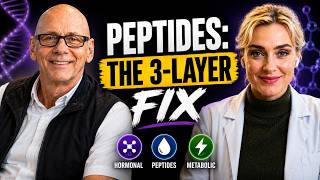
Dr. Alexandra Gayer, an ER doctor turned longevity specialist, uses a three-layer protocol: build metabolic health first, optimize hormones second, then add peptides to fill gaps. She pairs specific peptides like MOTS-C and BPC-157 with lifestyle changes to preserve muscle, boost energy, and support recovery.
Chapters
Mostly we're seeing the end product of chronic disease, and I was seeing the same people over and over again, putting Band-Aids on different conditions and seeing them come back the next month worse and worse and worse.
Welcome everybody to this edition of the Gladden Longevity Podcast. And today I'm talking with Alexandra Gayer. She's an MD working in the Northern Virginia area outside of Washington, D.C., and she has an interesting story about transitioning from the emergency room into a practice that now is quite heavily focused on the use of peptides. And I, if you have an interest in optimizing weight, optimizing energy performance, things like that, and the way that she weaves her peptides together, I think you're gonna find this an interesting podcast.
He went from saving hearts as a cardiologist to rewriting the entire aging playbook. Dr. Jeffrey Gladden believes 100 is the new 30, and he's got the science to back it up. This is the Gladden Longevity Podcast.
Welcome, Alexandra, to the, uh, Gladden Longevity Podcast. It's great to have you here.
Thank you so much. Thanks Thanks for having me.
Yeah. So, you're coming to us from Virginia outside of DC. How are things up there right now? Is starting to get some springtime, I'll bet.
Yes. Finally, we had a really rough winter here. Everything was frozen for, for quite a while. So, we're, we're enjoying the touch of sunshine.
Beautiful. So, let's talk a little bit about your favorite topic. I don't know if it's your favorite topic, but it's one of your, one, maybe one of your favorite topics, which is peptides. I think it's almost everybody's favorite topic at the moment, right? Everybody, everybody on every corners talking about them. So how did you get into the whole peptide world? How did, how did that go, come about?
So I trained as an emergency medicine doctor. I'm coming from conventional medicine. I, I'm an MD. I went through my training at University of Maryland. I did a residency at GW. I spent 10 years in, in the ER. And as we know, most of the things that come through the ER, there's, there's the traumas and, and a little sprinkling of all those things, but mostly we're seeing the end product of chronic disease. And I was seeing the same people over and over again, putting Band-Aids on different conditions and seeing them come back the next month worse and worse and worse. And eventually I experienced my own version of burnout through COVID and all these things.
And tell me about your own version of burnout. Now, was this where you actually got sick from COVID or you were burned out? Trying to manage all the COVID cases or what was going on, or maybe both. I don't know.
Yeah. So I think COVID was just a demoralizing time period in emergency medicine, but I think early on my constitution had trouble with the pace of, of the work that I was doing, you know, and, and the constant switching between nights and days. I actually got Lyme disease while I was in residency. And although I recovered, my stamina, my exercise tolerance, some of those things were just not where I was before that. I, I had a child in medical school. I had a second child in residency, and between those two, I had Lyme. So I actually really loved emergency medicine. There was a lot of things that, you know, I felt like I developed a skill set that was really cool. I got to do cool things, but I think deep down, I felt like we're not addressing the things that matter. We're not creating health. Nobody here is— maybe they're getting better temporarily, but we missed the boat on actually creating healthy people. And for myself, I felt like it was wearing on me in a way that really all the good parts of me were getting left on the table at work. And I had very little left at the end of the day. And I felt strongly that I wanted to do something, something different, something that would actually give me a little bit more meaning and allow me to be healthier as well.
That's a really good point. You know, I don't think that necessarily the people listening to this fully appreciate where traditional doctors find themselves because we all go into it. You know, I was interventional cardiology for 25 years. We all go into it with, you know, really wanting to help people, really wanting to add to health. And then we, we get caught up in a system where we're, you know, flying from thing to thing, basically putting out fires and trying to get people out the door or get them better or put a stent in and, you know, whatever, and stop the heart attack, whatever you're doing. And so it, it does become very wearing and it actually becomes demoralizing. I think a lot of physicians get depressed from a perspective of meaning that they're not actually accomplishing the things that they that they set out to do when they went into medicine, right? And the public has become skeptical of traditional medicine, and rightly so, but it's filled with, I think, in many respects, very good, well-motivated people that are actually sort of trapped in a system that is actually even demoralizing to them. So I don't know.
Absolutely. Yeah, I think it was so widely demoralizing. And, you know, the COVID time period was just challenging, you know, the way everybody handled it. You know, especially in the ER, we were dropped in the middle of this thing and nobody had any idea of what was going on. The hospital that I was at did not have enough PPE, protective equipment for the doctors.
Oh, wow.
And we, as a group, we kind of decided that the younger physicians would take on most of the COVID cases so we could protect the older physicians working with us. And there was a lot of deaths. We didn't know. I mean, there was so much we didn't know, you know, and— And then the ERs actually emptied out to some extent. The whole stay home message got out really well, and they started cutting people's hours. And so it was just stressful from so many perspectives where we were sort of potentially risking our lives and working under these conditions that were so metrics-focused. And what you said about it being demoralizing, I think you're just face-to-face with so much suffering, and you know that maybe more is possible or more would've been possible if we kind of reached these people 10, 20 years ago, but now you're just at this end zone of some of these horrible illnesses.
Yeah, I think that's exactly right. So anyway, so you're in the middle of that. You're suffering with all that. You had Lyme. You had a couple of children. You're working in a demoralizing job. This sounds like it's leading to a, you know, kind of an unhappy ending, but I think it went a different direction. So how did you get out of this?
Yeah, honestly, I feel like I was at the right place in the right time in so many ways, but you know, years before I actually left, I started taking courses, studying, trying to understand partially for myself, you know, how can I heal? You know, how, what, like I've, I've done everything a conventional medicine can do, but how can I improve my wellbeing? And I want to function at this pretty high level and how can I support my body in order to do that? And I became interested in metabolic health and hormone health and eventually peptides. And then I, I actually—
sorry to interrupt, but just walk us through that triad of things you just talked about, because there's a sequence there that I think makes sense for a lot of people. So you started with metabolic, then you were looking at hormones and you're adding in peptides. So talk to us a little bit about how that played out for you.
And I think that that's, that's how I approach patients now. And that's how I've come to understand some, some of the healing that can take place. For myself and for a lot of my patients. But I think that our metabolic health, you know, is at the root, is at the base, and it is the foundation of almost everything else. When I say metabolic health, I'm mostly talking about what happens to food after we put it in our mouth. Is it used as fuel? Can we turn it into ATP, or are we going to store it as this inflammatory fat organ that's going to send out inflammatory cytokines and cause all kinds of issues down the road? And we've normalized in America being metabolically unhealthy. And one can be lean and still be metabolically unhealthy because, you know, I often think about this in an evolutionary perspective. I've come to think about it this way, that we've been on Earth as humans for something like 200,000 years, and it's only the last 150 that we've been exposed to this chemical landscape, to these non-food products that we're putting into our bodies. We have genes that adapted over, over this extremely long period of time that are trying to help us survive by seeking out oils and sugars and all these things. And now that they're so abundant, metabolic health is, is rare.
Yep. I agree. One of the tragedies there is that it's really very difficult to actually get ahold of what I would call high-quality, nutrient-dense, clean food. It's, it's actually a challenge unless you've got a garden. You know, in a remote area where you're— there isn't somebody spraying pesticides next to you, it's very difficult to actually get a hold of really good quality food. I think absolutely the thing that you can focus on is trying to avoid the bad stuff. And even if being organic, you know, the nutrient density in organic food is not what it used to be 50 years ago, right? So there's lots of things kind of conspiring to make it difficult for us to be metabolically healthy is the point. So, but nonetheless, what I like about what you're saying is that it is foundational. And I think when we're talking about peptides, a lot of people want to jump to the peptides. And yet peptides work best, like everything works best, when it's going into a system that's optimized in other ways, right? So metabolically, we also think in the psychospiritual space, you know, there's so much stress, anxiety, right? And we know that that really not only aggravates disease and inflammation but accelerates aging. But when that— when you reverse that, and that's something people can, you know, learn to do, then all of a sudden everything else gets better too. Right.
So absolutely. I wanna digress for one second and you touched on the psycho-spiritual space and I can tell you the real story of how I came to start my practice.
Let's stop playing around. Why don't we get to the real story?
Okay. So I went on a trip with my sister and my family to Tulum and my sister and I went to take a yoga class. I left my kids with my mom and we get, we get to this place where there was supposed to be a yoga class and it's not happening, but instead there's this session called Manifest the Life of Your Dreams. So I said, I don't want to do this. I don't know what this is. This seems like I just wanted to do yoga. And my sister said, what's the worst that can happen?
Yeah, you might get a great life.
So I went to this thing and everybody had some kind of, you know, issue in their life that they were working with. And, and I think the big thing that was my focus was I felt like I can't continue in emergency medicine. Like, I'm just pushing against such a weight that it feels so misaligned with my life. Like my spirit's just no longer there. And, but I don't see a way out. There just isn't a way out, you know, in my head. And we did whatever it was that we did in that little ceremony. And I came home and I met a physician who was selling his cash pay practice and met him very randomly. And he said, would you like to buy my practice? And I said, I don't think that's possible. You know, I don't have that kind of savings. I'm not in a place to do this. And he had a few other offers, but we really kind of became friends. And he said, you know, I really want to sell the practice to someone who'll continue to take care of my internal medicine patients that I've had this lifelong relationship with. And he basically helped make it possible for me to buy his practice. And sort of build from that. So just a little diversion there.
That's cool. That's cool. So what was the little ceremony down in Tulum that wasn't yoga?
Yeah, you know, the interesting part is that I don't fully remember exactly what we did. We did— it was a meditation. It was— she had some writing prompts. She guided us through. It was like in this little clay cave. You know, I think there was a ceremony. Went, I did it, I forgot about it. And, you know, let's keep moving along.
That's cool.
Yeah.
When you move from— let's talk about moving into the hormonal piece of this, but the psychospiritual is always cool in my mind.
Yeah, me too.
Hormone piece, was, was that based on having the kids? And then I don't know where you are in your life and things like that, but—
so I bought the practice and the practice was internal medicine plus a weight loss program that was already pretty popular in the area. So with this sort of foundation of metabolic health, I became really interested in, in making this weight loss program as evidence-based and, and really healing for metabolic health as I could. And as I got into it and I started working with patients more, that's when I started learning about hormones and that I got a better understanding of how hormones are influencing metabolic health. And even for some women, we were getting the results metabolically, but they still, they just weren't feeling well. And it seemed like there was such a gap. That's kind of where the next few years of effort went into, of really trying to understand this kind of both for men and women, what happens with our hormones. And, you know, of course, always thinking about myself as well. And I am in that perimenopause phase, but, you know, most of the time when we think about hormones, people think about, of course, women and the menopause transition, men and testosterone. But I started looking at cortisol, our thyroid health, really kind of optimizing thyroid, looking at growth hormone decline through IGF-1. Numbers and kind of building. So in my mind, this foundation became metabolic health. Then let's look at the non-sex hormones. How is the cortisol acting throughout the day? Are we optimized when it comes to thyroid, adrenal health? And then we can look at the sex hormones, which for men is mostly testosterone and women estrogen, progesterone, and testosterone and Yeah, my patients are my greatest teachers. And over the years, we've just had amazing results when you— when women have the right biochemical support, you know, because we're often in the prime of our lives when we get hit by the bus that is perimenopause. And that biomedical— biochemical support can do wonders for, you know, mood, cognition, body composition, energy, sleep.
Yeah. Beautiful. No, the book I wrote is 100 is the New 30. And so, you know, when we're 100, we want a 30-year-old body, but you really can't get there without hormone replacement therapy. I mean, it's definitely required in my estimation. So then from metabolic to hormones and now to peptides. So tell us about how the peptides started to play a role for you.
Yeah, I think it was very similar in that sense of, you know, we've, we've optimized on these levels. And there's still a gap. You know, men and women are still complaining of low energy, especially working it. I'm right outside Washington, DC, so there's a lot of people experiencing burnout, a lot of patients who have gone through trauma and who maybe their numbers are looking good, but they're still not where they want to be there, or they're— the demands on their life are such that they need a level of support that they're not currently getting from the biochemical perspective. And I think, you know, and again, I kind of look at it from the evolutionary perspective where for those, for most of human history until about 150 years ago, we lived till age 40. So we have genes that adapted to keep us alive to reproduce and then die. And we touched on conventional medicine, which has its flaws, but it's bought us an extra 40 years of life. But I think in our conventional training, we were also trained to say, these are signs of aging. This is just aging. Nothing you can do about it. We got you these last 40 years, but I'm going to prescribe reassurance. And so yes, with, with hormones and peptides, I wanted to give something a little bit more than reassurance. Like, how can we create a quality of life in those last 40 years?
So what have you learned about the use of peptides? Because there's a lot of chat about that and there are different stacks out there. There are different people using different things. You know, we find that peptides, you know, work best when you put them into an environment that you've cleaned up in other ways, let's say metabolically, hormonally. And for some of our people, we're doing plasmapheresis, you know, on intervals to kind of clean out inflammatory cytokines and things like that as well, right? So there's some nice data about epigenetic age being reversed with that kind of intervention along with PGG on a regular basis. So anyway, but the point is, let's say you're preparing the individual, and then you're putting in the peptides. Which ones do you like? What have you been— what have you seen results with?
I can definitely tell you some of my favorites. I think of it in a couple of ways. Definitely peptides work best in a resourced body, and that comes with the right metabolic health, the right hormonal support. I've also encountered patients who are not able to get the level of exercise I would like them to have, are not able to resist food cravings. Are not able to sleep enough. And sometimes, you know, through peptides, we're able to support them in making lifestyle changes. You know, I try to prepare people the best they can with the resource— with— in the real world, you know, not everybody's gonna be able to do all the things I ask of them. And sometimes I think peptides are helpful in basically resourcing the body enough to create some of the habits that we're talking about. So I would love everybody to be sleeping at least 8 hours a night, doing strength training 3 or 4 times a week, you know, avoiding all ultra-processed foods, doing a stress reduction exercise, you know, but not every— and sometimes we get there. The peptides actually allow us to get there. So, and just from a basic perspective, I think people already know that peptides are these biochemical messengers that we naturally produce in our bodies and they get downregulated as we age, just like hormones do. I like I mean, I guess some of my favorites, the first that comes to mind are some of the mitochondrial peptides. And I think I particularly, I think because fatigue is such a frequent complaint that I run into, especially for women in hormonal transitions, I use MOTC frequently, which is a mitochondrial peptide. Sometimes we do a short course of MOTC and upgrade how the mitochondria is producing energy, improve insulin sensitivity. And then follow that up with NAD. And that can really support people to actually build some of those really helpful habits.
Yeah.
Cause I found that especially useful in women who are going through hormonal transitions.
It's a nice synergy between MOTC and then NAD. We've been using SS31 also.
Yeah, we do too.
Yeah. And then NAD. Yeah. Are you using IV NAD? We haven't really gone down that route. We kind of get people to produce their own.
But, uh, yeah, we offer it, but we don't do that much of it.
Right. It was all the rage there for a while, but I, I don't know. It's, uh, when I learned that about 98 or 99% of it doesn't even get into the cell, then it was like, okay, what's the point?
Exactly.
Yeah. That's cool. Have you been working on some of the things related to brain function also, those peptides or?
Yeah. I have the most experience with Semax, Selank, and Penelion. I've used some Cerebrolysin, but I have to say that I just don't have as much clinical experience with it, and I'm still trying to understand some of the dosing nuances there. But I really like Phenylion. It, I think it is one of the lesser known peptides, but it is one of the master bioregulators that can just reduce neuroinflammation, oxidative stress, and reset the circadian rhythm. And I've had some great success with sleep for patients with Phenylion.
Nice. Yeah, that's great. And then what about healing and injuries and things like that? Are there things that you're using there as well?
Yeah. So, you know, the, the, the workhorse is BPC-157. I think that's, you know, that was the most popular peptide that was probably used underground with athletes for, for many, many years, naturally produced by the stomach. And it can sort of marshal the right cells to areas of injuries and reduce inflammation as well. So we've had great results with BPC-157, TB500, and in terms of injuries, specifically musculoskeletal injuries. I use KPV and thymosin alpha-1 for patients who are struggling with autoimmunity. And again, when people come in with fatigue, I think the number one symptom of inflammation is fatigue. And it's, if it seems like their fatigue is coming from a highly inflammatory state, we'll sometimes try to put out the fire by balancing the immune system with KPV or thymosin alpha-1.
Nice. Yeah, great. We've been using KB orally also with some oral BPC for gut healing as well.
Yeah.
Which is satisfying. What other indications are you using your peptides for?
We're of course still doing a lot of body composition work. And we talked a little bit about metabolic health and of course people are kind of focused on losing fat, but I think it's equally, if not more important that we're building muscle. And muscle really is the, the currency of health and I think exercise probably outperforms any supplement that's ever been made. And if I can get people exercising, if I can get people active, I can get people to build healthy lean muscle, I think that's a great investment in longevity and long-term health. So we use some of the growth hormone-promoting peptides, mostly semoraline, CJC-ipamoraline, and tesamoraline. Sometimes ipamoraline alone also. We, you know, we have good data on tesamoraline because that's been FDA approved as Agrifta and for visceral adiposity in HIV patients. So I like that because we have a good deal of data on there. I think at higher doses and in some sensitive people, we see some fluid retention with it, sometimes joint pains. I think semoralin is the mildest.
Yeah, I was going to say with tesamoralin, it's, you're getting some of the side effects you would get from growth hormone, right? Some joint swelling and joint pain, things like that.
And I think women are— or I've found that women are a little more sensitive to it, where men tend to tolerate it better. And women are— so sometimes we go to the Somorlin, I think, is subtle, where, you know, you don't necessarily see the body recomposition as dramatically, but it supports healthy muscle formation in active athletic women. I also find those a useful tool when we're transitioning off GLP-1s along with sometimes MOTS-C because that maintains that insulin sensitivity. And then if we can support body composition with a growth hormone-promoting peptide, right? We're very careful of how we get people off GLP-1s, which I think can be very tricky with the weight regain that's possible.
Yeah, it's tricky. My understanding, the reason it's tricky is because the GLP-1s more so than the GLP-2s or retutride, lower the metabolic rate. So you have a low metabolic rate and then you have a rebound when you stop of ghrelin, which is the brain signaling molecule for appetite. So it's almost impossible not to regain weight if you've got a slow metabolism and increased appetite, right?
Right. Some of that metabolic slowing too is just the muscle that we're losing. We're losing that metabolic engine. So I think we're extra careful to maintain or increase muscle mass by most of our patients patients who we're doing body recompositioning with, I have a nutritionist and health coaches that meet with them every week and we're doing those in-body scans. And I think if I'm making you lose half your muscle, I'm doing you a disservice and we're not actually investing in your long-term metabolic health. So we try to avoid that at all costs.
Yeah. There was an interesting study on a new product, a new supplement actually out of New Zealand called Ameristate, which is marketed as Calocurb, which you may have be familiar with, but it's, it's basically activating bitter receptors and it causes an endogenous or self-stimulated release of GLP-1, our natural GLP-1s, which go down with age. And it also releases CCK and PYY, which also go to the brain naturally and suppress appetite. But the thing of it is they don't, you don't get the drop in metabolic rate. And when they do the, uh, the weight loss, people are losing weight, but they're losing preferentially fat over muscle. With it. So that's, that's become our go-to. And so, I mean, trying to get people off GLP-1s if they want to, that's, that's become part of our strategy is to transition them over to that. Right. So, yeah.
Yeah. We've done that too. We've used the Calocurb and the Akkermansia probiotics just to make sure that we, we have that gut health support, but it's a tricky journey. And of course, I think right now a lot of people are, you know, there's so many people on GLP-1s. Doing it either online or somebody who's not doing it thoughtfully at all. And they don't know that once they stop being able to afford this, or do they decide they don't want to do it anymore, that they're going to be in a pretty difficult position.
It's coming back with a vengeance. I think one of the biggest mistakes I see people make is that they actually focus on their weight. And, you know, everybody wants to quote unquote lose weight, but it's really, we try to coach our clients that it really doesn't have anything to do with weight. It has to do with body composition. It's really, we don't care if You put on 15 pounds of muscle, right? That's weight, but it's weight, right? You're metabolically healthy. Whereas if you lose 15 pounds of muscle, you lost weight, but you're worse off than you were. So it's really not about weight. It's really about body comp. It's interesting how fixated people are on weight, however, as if that's a metric, you know, it's really hard to get that through. So sometimes even getting, if you're listening to this and you're wondering, well, geez, I'm focusing on weight. If you can even get a scale in your home that gives you you know, an approximation of body composition, that's going to be a big step forward for you in terms of how you're, you know, thinking about this. And you can actually, from that, you can see, oh, okay, I'm losing quote unquote weight, but what kind of weight am I losing? Am I losing good weight or am I losing the weight I actually want to lose? I think that's really, really important because I think with the GLP-1s, it's so almost predictable. When we measure in bodies on people that have come to us, we see, you know, and we've done it before, let's say, You know, we see them losing predominantly muscle and it's, it's really quite sad. It's predominantly muscle. And even for people that exercise and even people that are, you know, doing Perfect Aminos or trying to eat some high quality proteins or whatever. So I think therein lies the challenge.
Yeah, absolutely. That is, that's 100% the challenge too. And yes, we try very hard to talk about body composition. We want you to lose fat. Maintain or gain muscle. But especially for women, I think, oh, that overall weight number, they're like, I know I'm good, but I, you know, there was a day when I was 130 and I want to be that again.
I want to be 130 if it kills me. So it's really an interesting fixation, right? It is. It's really interesting because if they were at 135, but they were much healthier than they ever were, they still, it's like, well, I need to lose 5 pounds. Well, actually, really, you don't. You know, you really don't. Like, you're much healthier at 135 than you were at 130 because you put on all this muscle now, right? So, yeah, it's a, it's an interesting game that our minds play with us. I don't know how it got so ingrained as like such an important metric.
I know. Maybe there's something about a number, you know, how we don't know how to feel about ourselves. And here's this number. It's so clear. It is, you know, we had one in the past and we felt good with it. You know, it's almost like grades where people can over-identify. Tell me how I'm doing. And it's— we can over-identify with a number and it's hard, hard to get past that.
I tell you what we need to do. We need to create a different number. I mean, we sort of have it with body comp, but it's a little abstract. We need to create a ratio of muscle to fat. Right. And that, that ratio is what you're going for. And then you don't care about— you're just going for that ratio.
Right. Right.
Yeah. And on the InBody, you know, it shows you basically muscle mass and total body weight and percent body fat. And, you know, it seems like we could come up with that. If that could be popularized, we could start a trend. What's your, what's your, what's your number, right? It's like, oh, what is— right? It'd be a new thing. Maybe we should do that.
Absolutely. I'm in. All right.
Start that. So what's, what's exciting for you in your, in your world right now? What are you leaning into?
You know, I think just leaning further into how to, how to create that health from the, from the inside out. And, you know, we have more and more tools that create meaningful outcomes. And in a world where people want to take 100,000 supplements that may or may not be doing anything, I think the tools that allow us to, to have a little bit more meaningful information about what helps. Certain people. And, you know, just talking about those results and focusing on weight. And sometimes that, that woman who might be hyperfocused on, "I used to be 130 pounds," we go through her labs and her fasting insulin went from 25 to 6, and maybe her high-sensitivity CRP is now less than 1, where it used to be 3.1. And just trying to walk people through how that changes the trajectory of the next 15, 20 years of your life. And, you know, I think those of us who have been on the other side of interventional cardiology, emergency medicine, I think people don't know how bad it gets when you keep going with a fasting insulin of 25 and a high-sensitivity CRP of 3.5, you know, where that's going to land you. And there's a time when you can't dig yourself out. So even though people can get caught up on little things, I think building a meaningful foundation— we're looking more at gut health, doing GI MAP testing, trying to get to the root cause of inflammation as well. And, you know, I think just, just working with people in a meaningful way. I also feel like the therapeutic relationship that I have with patients, being able to spend time with them, I think the relationship itself feels healing and very rewarding to me.
That's right.
And I'm just grateful to be able to practice in that way.
Mm-hmm. You're much happier doing this than you ever were in the emergency room, for sure. So, well, cool.
Yeah.
Yeah. It's been a pleasure chatting with you. Congratulations on the transition that you made. It's not easy, quite honestly, to step away from the known into the unknown, right? It's, uh, right. It's for me, it was like BASE jumping. I call it, you know, out of cardiology into what I'm doing now. You hope the chute opens before, you know, before you hit the ground essentially, but it's exciting work.
Yeah. And you don't know what's going to happen, but I think we're living in an exciting time that the science is out there and you can kind of dive in and help people. People get to where they want to be.
Yeah, totally. Well, great. Well, it's great chatting with you. I appreciate you taking the time to talk with us.
Yeah, you too. Thank you so much. How do we live young for a lifetime? How do we make 100 the new 30? The answers are out there and we're bringing them to you every episode. Make sure you're subscribed. Check out more episodes right here and follow us on social media so you never miss a breakthrough. Thanks for listening.









