Webinar January 2026
Dr. Jeffrey Gladden, a former interventional cardiologist, explains why longevity requires an exponential, multi-dimensional strategy rather than linear protocols. He recovered from severe fatigue and hormonal imbalance using genetic-guided functional medicine, and now uses a five-circle framework addressing 16+ hallmarks of aging through AI-curated testing, regenerative therapies, and continuous feedback loops.
Chapters
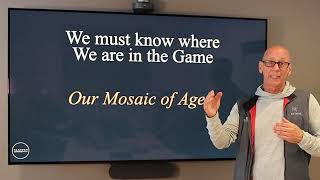
The way that we think and the way that we go about things is really unusual in the space of longevity. Welcome everyone. I'm Dr. Jeffrey Gladden, and I'd like to take the next few minutes to explain to you why I think Gladden Longevity is so unique. To begin with, when you think about longevity, there are many competing ideas of what that actually means. I wanna be healthy for a long time. I wanna be good when I'm 80 or 90 or 100. I wanna live to 150, 180, 360. I wanna be immortal. You know, for us really, it boils down to things that we can relate to. Very hard to relate to what it would be to be 150 years old. And yet we all know what it is to be young. And so what we want is when we're 100 years old is to have a 30-year-old body. But at the same time, I think longevity actually represents the greatest opportunity humanity has ever had because not only do we develop a 30-year-old body and maintain that, but we also have the opportunity to develop a 300-year-old mind. right? All the equanimity, all the insight, all the wisdom that comes along with that. And I think that's really an exciting future that gets me excited to wake up every day. So this is the book I wrote, "100 Is the New 30." It was published a couple of years ago and it's been a bestseller. It also outlines what I'm gonna go through in this talk in a lot more detail, but it's available if you'd like to pick it up on Amazon. So I was on Audible, I read the entire thing. It was also done pre-AI, so I wrote every word. This is a picture of me on the left here when I was 27 in medical school. This is my anatomy partner, Ed, and he and I were best friends. So the reason I show this slide is not because I look identical, but I wake up 27 every day. I was born in February of 1954. You can do the math on that, but I don't identify with a chronological age. I actually wake up 27. And the reason I do that is because if we, wake up and identify with a chronological age, we've actually already acquiesced to the aging process. If we say, "Yeah, but I'm good for my age," or "Maybe I shouldn't be doing that at this age," or "I'm not sure this is the right thing," then we've already acquiesced to what society has reinforced around us that actually as you chronologically go through life, there are things you should or shouldn't do. And I don't wanna live by those rules. So I basically wake up 27 every day and it's a really big future that I have because of that. So this is my, This is my legacy activity, if you will. I was an interventional cardiologist in Dallas, Texas, and surrounding areas for 25 years. This is a cath lab. That's not me, but it could be me. This is a heart attack occurring, an LAD total occlusion. This is a widowmaker. This is going in, opening it back up, putting a stent in, and we would reestablish flow. And I love this work. I thought it was great. And I actually built my own heart group. I had— this is our flagship office that was being built about the time I left. We had 10 offices. Not this size, but scattered around North Texas and Southeast Oklahoma. And I also had the opportunity to co-found a heart hospital with the people at Baylor and one other cardiologist. And this came about because we were actually asking different questions. How does somebody going through the existential crisis of heart attack or a bypass surgery or a valve surgery, how do they actually recover best? And so we created large rooms where patients' families could sleep in the room with them. The ICUs had 24/7 access. Was incredibly efficient in the way it was designed for doctors and nurses to work. And it was really a great project. I also sit on the board of a company called Scientia Vascular, which is a legacy activity as well. I've sat on this board for over 15 years. They make interventional products that are going into basically stop strokes. Very innovative company. I've been an avid mountain biker. I picked this up in my 50s. I just went mountain biking this past weekend in Colorado with my son. We rode two separate days. Some pretty gnarly trails, I will say. And I got into snowboarding in my mid-40s. Again, my son introduced me to it when he was about 15. Dad, you got to try this. It was a bit of a beating to get started, quite honestly, but we got very, very good. This is on a Snowcat trip, and we did a lot of heli trips— South America, Canada, the West, all over the place. This is me doing a little stand-up paddling in Maui, and I became a better stand-up paddler than I am right here at our home in Puerto Rico for a while. Grew up body surfing. I love the ocean. I love being in the water. So one of the things you should know is that I had some known challenges as I'm going through life. Number one, my kidneys were damaged when I was 5 years old. I had strep throat. The antibodies from the strep throat attacked my kidneys. I was home from school for 2 weeks, stopped urinating. Kind of a tough scene. My kidney function came back and it's never quite been the same. So the interesting thing is that using the regenerative therapies we have here, my kidney function is now the best it's been. Interesting, right? Chronologically, I'm getting better. That doesn't happen. And the other thing is that my father ended up dying with dementia, which was concerning. He was a very high-functioning guy. And to watch him, he always knew who I was, but to watch him decline was really, really difficult. So in my 50s, I started to face some new challenges. The first was I was developing severe fatigue. Like you could sleep 2 2 nights, 3 nights in a row and still be exhausted. I was losing strength and muscle. I was putting on fat around the abdomen. And when I would become stressed, it would lead to anxiety and the anxiety would lead to depression. And the depression was not like, oh, I'll go for a run and I'll feel better. I'll talk to a friend and I'll feel better. It was like, no, I just want outta here kind of depression, like really deep. And I was developing brain fog, right? So I'm obviously concerned about all this. I've got a lot of things going on. And I went in to see one of my local colleagues. They did their quote unquote tests. And this is what I was told. Hey, your results look normal for your age. Right? Phrase I don't like, normal for your age, just getting older. Why don't you take an antidepressant? So this was one of the most existential moments of my life. It's like, oh my gosh, it's gonna be all downhill from here. And I couldn't make peace with that. So I didn't make peace with that. That's when I threw myself into the functional integrative age management medicine space and actually Actually took me 2.5 years. If we had the labs in front of us, we could figure this out in about 10 minutes now. But it took 2.5 years to figure out everything that was going on. I had subclinical hypothyroidism. My thyroid activity at the cellular level, very low, even though the blood work looked normal. The other thing was that I was hormonally depleted, low on testosterone, low on DHEA. I started some testosterone, DHEA, lost 20 pounds of fat, put on 10 pounds of muscle, felt great again. Once the thyroid was sorted out, I jumped outta bed again. And not only did I have subclinical hypothyroidism, genetically I don't convert inactive thyroid to active thyroid in my brain efficiently. So getting on the right kind of thyroid made all the difference in the world. And then when it came to the anxiety and depression, that all has to do with the fact that genetically I don't make certain neurotransmitters very efficiently. And once I figured out how to actually make those properly, I could come under all kinds of stress and not get depressed. And if I felt myself getting depressed, I know exactly what supplement to take. And literally within 15 minutes I feel better. So it's really quite amazing. And then I learned to meditate. I've learned a lot of other things on the 300-year-old mind that also mitigated anxiety and stress. So this is how I fix myself. And I found out that during that process, that in life we really only get the answers to the questions that we're asking. right? So I realized that as a cardiologist, I was asking, are you short of breath? Are you having chest pain? Are you having, you know, difficulty breathing when you lay down? Things like that, right? Are you having palpitations? But I started asking different questions. And the first question I asked myself when I started to feel great again was, geez, I wonder how good I can be. How good can you be, right? I think it's a resonant question. How good can you be? How fit, how strong, how mentally sharp, how psycho-spiritually aligned? How good can we be? right? And then how do we make 100 the new 30? How do we actually do that? When I wrote the book, 100 is the New 30, it was an aspiration, right? But you never get the answers to the questions you're not asking. So how do we actually do that? How do we live well beyond 120? There's a physiologic limit to how many times our cells can divide before we fade out. And are we able to break that Hayflick limit? And then the next question is, how do we develop a 300-year-old mind? What does that even mean? I'm gonna walk you through that in a minute and show you how incredibly integrated it is and important it is for your own longevity and health. And then how do we live young for a lifetime? This phrase of living young for a lifetime with all the enthusiasm, all the curiosity, all the ability to try new stuff. What happens as we age is we, we get locked into a way of thinking. We lose flexibility, we lose our ability to try new ideas. And living young for a lifetime I think is also critical. Life's a lot more fun that way. So when we think about aging, we're really kind of handicapped because we relate to it from a linear fashion. We think chronologically, every year I'm another year older. So it's a linear process, but in actual fact it's not. It's an exponential process. We age a lot more between 70 and 80, 80 and 90 than we do between 20 and 30 and 30 and 40. The rate of aging is much faster, right? And data from Stanford, shows us that aging, not only is it asymmetric, meaning that there's a big spur in your 20s and 30s— youth is over at age 25, by the way— and then it can lull, it can go forward, it can go backwards. A woman gets pregnant, she ages, she has the baby, she gets younger. You get COVID, you get older. Get over COVID, you get younger. So it's bidirectional and it's asymmetric. And look what happens between 63 and 78 or 80. It's a massive increase. So this is the problem, however, and that is that while aging is exponential, our ability to have impact and the opportunities that that brings is also increasing exponentially. And the tragedy of life as I see it is that once those lines cross, you can still carry on for a bit, but then this starts to crater and now people are coming to see you in a nursing home because somebody still cares. And that's really a tragedy. So this is what we want to change. So in our world, by having a physical body that's 30 years old, it enables us to not only live young for a lifetime, but look at the return on investment. Impact and opportunity continue to exponentially rise. This is the life that I want to lead. This is the life that I want you to be able to lead. This is really strong, powerful stuff. So aging is an exponential problem. It requires an exponential strategy. The problem, however, is that most strategies that I see in most longevity clinics are linear strategies for an exponential problem. Therein lies the big difference between Gladden Longevity and other places you might run into. So if you're gonna actually develop an exponential strategy, well, what does that entail? Well, first off, you actually have to know the cards you're holding, and that comes down to understanding your genetics. If you don't know your genetics, you don't really know how to play the hand. How can you possibly win a game when you don't even know what cards you're holding? The second thing is you have to know where are you in the game, right? We have been kind of coached into thinking that we have a chronological age and now the idea of a biological age. But I'm here to tell you that if you go out and get a test done and they say, oh, your biological age is 5 years younger than your chronological age, you're doing good, you've actually just been misinformed. Because your body is a mosaic of many, many, many biological ages. You have a brain age, a heart age, a blood vessel age, an eye age, telomeric age, mitochondrial age, right? A senescent cell burden age. You have all these different ages. And the other important thing to know is you're only as young as your oldest age. So where are you gonna focus your attention? This is the, what we tease apart when you come in and do testing with us. You can think of aging kind of like a river. right? And the current inside the river is what makes it accelerate. Everybody that ate better, exercised, got a Whoop or an Oura Ring, right? All good things. All good things. Learned how to meditate, cleaned up their relationships, lowered their stress. Beautiful, wonderful. Can't get there without it. It's just not enough because you're not really addressing the current in the river that's driving aging. And although those people that have done that, still get carried over the falls, right? So in our world, you have to understand that these hallmarks of aging are what's actually driving the aging process. So we're up to about 16 now, but these are the biological processes that are driving the current in the river that if they're not addressed, really sabotage the entire thing you're trying to do. So they're interrelated like this. It's complex. They play off each other. So when something goes down with telomeres, it's impacting multiple other hallmarks of aging. When that goes down, it impacts multiple others and on and on and on. And this is why aging is exponential because this starts to spool up like a tornado that's actually taking you down. So being able to tease this apart, what are the weak links? Where do we focus? How do we unravel this? This is a big part of what we do. So I think the future of medicine includes the following. Number one, it's always gonna have symptom-driven elements to it, right? So that's how I was trained. You came to me not because you felt good, not because you wanted to be good. You came to me because you're having symptoms. Then there's always a root cause medicine, right? So this is functional medicine, integrative medicine. This is how I solve my own problems. But longevity medicine, and this is what's missed most of the time, is the root cause of the root cause. Those hallmarks of aging and the interplay of those hallmarks is actually the root cause of the root cause. And all of this really sits on top of the psycho-spiritual space, right? And I'll show you that in just a second. So we've developed what we believe is an exponential strategy for an exponential problem. And it basically boils down to 4 circles. There's a 5th that I'll show you in a second. Life energy, longevity, health, and performance. We're constantly sourcing new information into these circles, foundational information. We've been using AI to do this for about 4 or 5 years now, actually, the earliest phases of AI. Then from that, we identified levers that reside on these circles, things that need to be pulled or activated or actuated to optimize the circle. And with that, what we've discovered, particularly with longevity, is just 'cause there's a lever doesn't mean you pull it all the time. There's actually a timing and a sequence of frequency, intensity, and duration with which it gets pulled. When you get that right, The subtitle of the book is How Playing the Symphony of Longevity Will Enable Us to Live Young for a Lifetime. It's very musical. It's very symphonic. From there, we do a lot of testing to identify where somebody is relative to all those levers. That's why we do extensive testing upfront because we have to know where you are in the game. We have to know your genetics as well. And then from here, once we see those test results, we can then prescribe actions, things to do, not to do, take, not to take. Regenerative therapies that may be indicated, et cetera, et cetera. And then there are feedback loops with wearables and follow-up testing. So this becomes really an exponential strategy. It's a construct that we're constantly funneling new information into it, but the construct remains very useful. So the Life Energy Circle, I'll just talk about that for a minute. It's basically the foundational level. And it's built on a growth mindset. So what do I mean by a growth mindset? It's a term that you hear a lot, but what does it actually mean? For me, it's still down to this: Are you married to your answers or are you married to your questions? So I think that we've been kind of duped in many ways to think that it's our task to go through life and find our answers. When in actual fact, all progress comes from questions. Even if you believe something very intently, the progress that will come around that belief will come from the questions that you're asking. And so I think it's very, very important to identify what are your questions. I showed you the 5 questions that we wake up to every day here at the practice, but it's very important for you to have that. The other thing about growth mindset is it moves away from binary thinking. I think most of the problems in the world are related to binary thinking. Somebody's right, somebody's wrong, we're gonna fight about it, right? We've been doing it for 5,000 years, we're gonna keep doing it, right? That's binary thinking. It's very, very low level. Quantum thinking, on the other hand, looks at a field of all possibilities and decides what's the best best solution at this point in time for the people involved. And I think we need to be thinking more that way. And then optimizing mental health, lots of anxiety, depression, PTSD, addiction. These things really sabotage health, right? You know that you can't be youthful or healthy or have longevity if you're constantly sabotaging yourself. So what I've come to understand is that most mental health issues are a function of genetic wiring combined with traumas that we've experienced as we go through life. And then we end up living in reaction to those traumas. And they sit in the background and we're basically always referencing everything we see relative to those traumas. And it makes us kind of live life on tilt, if you will. So one of the goals is to identify those traumas, to heal those traumas, and then ultimately to transcend them to where you become grateful for everything that ever happened because you become more empathetic, more loving, more caring. And that's really, really important. Once you get to that point, now you're starting to develop a 300-year-old mind. Then feeling loved, unconditional love for self, right? So many people are hard on themselves. This has a big toll on our health. I never felt unconditional love till my son was born. It was like, oh my gosh, I've never felt love like this before. And when you feel that kind of love, it's like, geez, I don't think I ever got that as a kid. I don't think I ever gave it to myself either. Why don't I give it to myself? Once you do that, it's a big step in the right direction. Optimizing relational health. What's the definition of a good relationship? Right? Is it one that just lasts a long time? Or is it to know and be known and to love and be loved? I think it's to know and be known and love and be loved. And that takes a lot of courage, a lot of vulnerability, a lot of courageous conversations. And then what about feeling joy? Well, for me, my North Star is feeling joy from a loving place to create joy. That's really why I'm here. And so I use that as a North Star. Optimizing spiritual health. Every study ever done shows that people that have a strong faith, they live longer, they do better, they recover faster, they're happier. Really critical. We're wired for spiritual connection. And then feeling worthy. This is kind of the flip side of mental health. There's so much shame, guilt, remorse, regret that goes on that burden people down. Being able to become unencumbered, right? To go in and heal these things, transcend them, and become unencumbered by these things so you can bring all your gifts forward is very important. And then optimizing wisdom. How do we make great decisions? Not just for ourself, not just for everybody here in the room, not everybody in the city, but for the state, the country, the world, right? The planet. When you start making really wise decisions, you feel really good about what you're doing, right? It's very, very engaging. And then feeling safe. This is really a big one. I think most anxiety, stress, worry, fear, angst, Greed. All of these things really boil down to people not feeling safe. So how do we give ourselves safety, right? We can give ourselves unconditional love. That's an inside job. But how do we give ourselves safety? That's critical. That's also a psycho-spiritual question because nothing external to us can ever make us feel safe. History's shown us over and over again, I don't care how much money you have, where you live, who your family is, what you believe in, all of it can be taken away. Everything can be taken away. And then you're left with yourself and your connection to source or God. So this is very important. And then feeling this energetic resonance with the universe, right? This greater sense of purpose. Once you get these other things done, now you're actually here for a reason. It's like, oh yeah, I wanna live a long time because I really have a lot I wanna contribute to everyone, right? And so this becomes really a critical piece of it. In the Longevity Circle, we go through all the different hallmarks and we can test for all of these. And in the Health Circle, we go through all the different organ systems and subsystems. These are just a smattering. And then when it comes to performance, we wanna be fast, agile, strong, quick, balanced, great cardiovascular capacity, reserve flexibility, right? I want all that. But if I'm gonna be that at 100, I need to be that today. And I'll give you a big insight, and that is that being fit is not about your muscles, it's about your nervous system. If you're training your nervous system for balance, agility, quickness, That's how the muscles come along for the ride. This is how we wanna train people. So this is me on an EndoBoard wearing a BrainTap, which actually can put me into a different brainwave state where I can meditate. My eyes are closed. This is a way to train the nervous system. And then the fifth circle is basically understanding that the environments we reside in, we all reside in four predominantly, home, work, business travel, and vacation, architecting each of those to make it as easy as possible for us to comply with what it is we're trying to do, to reinforce what it is we're trying to do. So this becomes really key. And then when you put it all together, it looks like this: 30-year-old body, 300-year-old mind. You have to focus on longevity, health, the environments, and performance. And it's the Life Energy Circle is really the one that binds them all together. So this is our exponential strategy for an exponential problem. And when you get to that, you end up with a 300-year-old body, and a €3,000 mod, right? Why not? Why not go all the way on this? I think the future for us is so bright. We've never been at another point in history where we have so many technologies available to us to actually make this happen. And if you're interested to engage with us, we'll show you how to do that.









