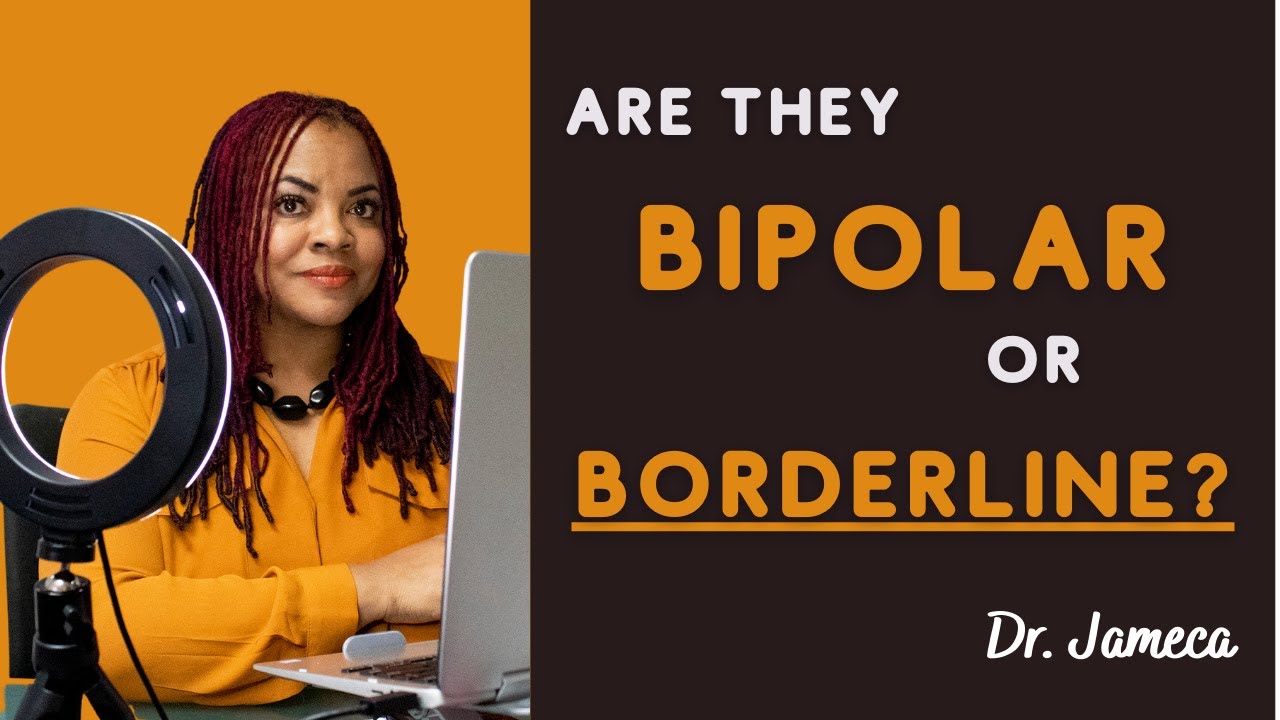
Dr. Jameca Cooper explains why bipolar disorder and borderline personality disorder are different. Bipolar involves mood shifts lasting weeks to months between depression and mania. Borderline is marked by rapid mood changes triggered by relationship conflicts and impulsivity.
Chapters
Hi, I'm Dr. Jameca Cooper Cooper. Make sure you subscribe to this channel. Today I'm talking about the difference between bipolar disorder and borderline personality disorder. When I hear people talking just in normal conversation, people use these terms interchangeably, and I think they're describing one thing, but they think they're describing something else. I'll give you an example. So many times if I hear someone saying, oh, I don't want to deal with this person because because they're moody. You don't know how their mood is going to be. They're bipolar. So they use the term bipolar to describe someone that is moody. Now, that is not altogether incorrect, but I want to talk about the difference between bipolar and borderline personality disorder. What I see from people often, um, who have the mood swings are people that display borderline personality disorder, and I'm going to talk about the difference. So first, let's talk about bipolar personality or bipolar disorder, which is a mood disorder that is diagnosable in the DSM-5, which is the book that psychologists use to diagnose mental disorders. So we have two different types of bipolar disorder, and contrary to popular belief, bipolar disorder is not as common as people think. It's actually not as many people who suffer from it in our population as people think. That it is. So what is that? Bipolar, two poles, meaning that you move from depression to mania. Depression being sadness and everything that comes with that, and then mania is opposite of that. It's right, it's this heightened sense of, um, everything and entitlement, reckless behavior, etc., etc., non-sleeping. So poles, so you move from those poles. Now the rate at which you move from depression to mania could vary. You have people that are rapid cyclers that could move quickly between those moods, and people that might only move between those different poles once or twice a year. Okay, so that is bipolar disorder. Now, one thing to remember, that both borderline and bipolar both have mood swings. So you do have mood swings with bipolar disorder. It is a mood disorder. Now, the other thing that you have to think about that is specific to bipolar disorder is that the duration the length of the mood swings tend to last longer. So as opposed to minutes, hours, days, if you have bipolar, they tend to last weeks, sometimes days, but mostly weeks, sometimes even months. So contrast and compare that with borderline personality disorder. Borderline personality disorder is a personality disorder, which is a totally different category in the, the book of diagnosable disorders. Bipolar mood disorder, borderline personality disorder. So that is one distinct difference. So you do have mood swings if you suffer from borderline personality disorder. You definitely have mood swings. One of the things that you have that may be unique if you have borderline personality disorder is that you tend to exhibit impulsive behavior. Sorry, you tend to exhibit impulsive behavior. Impulsivity in the form of making choices quickly without thinking, uh, saying things that you shouldn't normally say, maybe inappropriate things. So it tends to come with a lot of impulsive behaviors. And depending on the person, sometimes these impulsive behaviors could all be in a certain area. It could be sex. You could go out and have sex with random people, make impulsive decisions about that. For other people, it could be shopping. It could be a combination of those. But impulsive behavior is a part of borderline personality disorder. Unstable relationships are also a hallmark of borderline personality disorder. If you find someone that you think has borderline personality disorder or has been diagnosed with it, you usually see a long trail of unstable relationships, and usually it's everyone in their life— parents, siblings, relatives, coworkers, friends, romantic relationships. All the relationships are unstable because they're unstable. So they typically go from black to white. There typically is no gray area with a person with borderline personality disorder. They either love you or they hate you, and they tend to not go in between. Either you love them or you care nothing for them is typically how they perceive things. So one of the hallmarks though, and one of the big differences in a person with bipolar disorder and a person with borderline personality disorder is that usually when you have the mood swings for borderline personality disorder, those mood swings are triggered by some type of interpersonal conflict. So in other words, such-and-such didn't call them back, so now they're having a mood swing if they're borderline personality disorder. Whereas if you suffer from bipolar disorder and you have a mood swing, it's typically not triggered by an interpersonal conflict. It's really triggered by something chemical. Something neurotransmitter, or if you have a seasonal version of it, it could be seasonal qualities as well. So those are the main differences. Um, mood swings in both. One is going to have one, um, hallmark of more unstable relationships and impulsive behavior, whereas what triggers the mood swings in both categories are very, very different. So hopefully you can understand the difference. I want to make sure that everyone is clear on what the difference is so that when you are describing someone that you know that is moody, don't just throw out the term bipolar. Everyone is not bipolar. Sometimes people are just moody. Sometimes you can be moody and not have bipolar or be borderline. You can just be hormonal if you're a woman. Sometimes you could just have a sucky attitude. Sometimes you're just not in a good mood today. Sometimes you didn't get enough sleep. But I want to make sure you understand that when you use these terms, that they have power and that they are associating certain classes of behaviors with people that really these people might not deserve to have. So be careful in your wording and think about now what you know are the differences, and be careful in how you describe people. Be intentional and be knowledgeable when you use your words. So thank you for tuning in, and make sure you check out more videos. I'm Dr. Jameca Cooper.