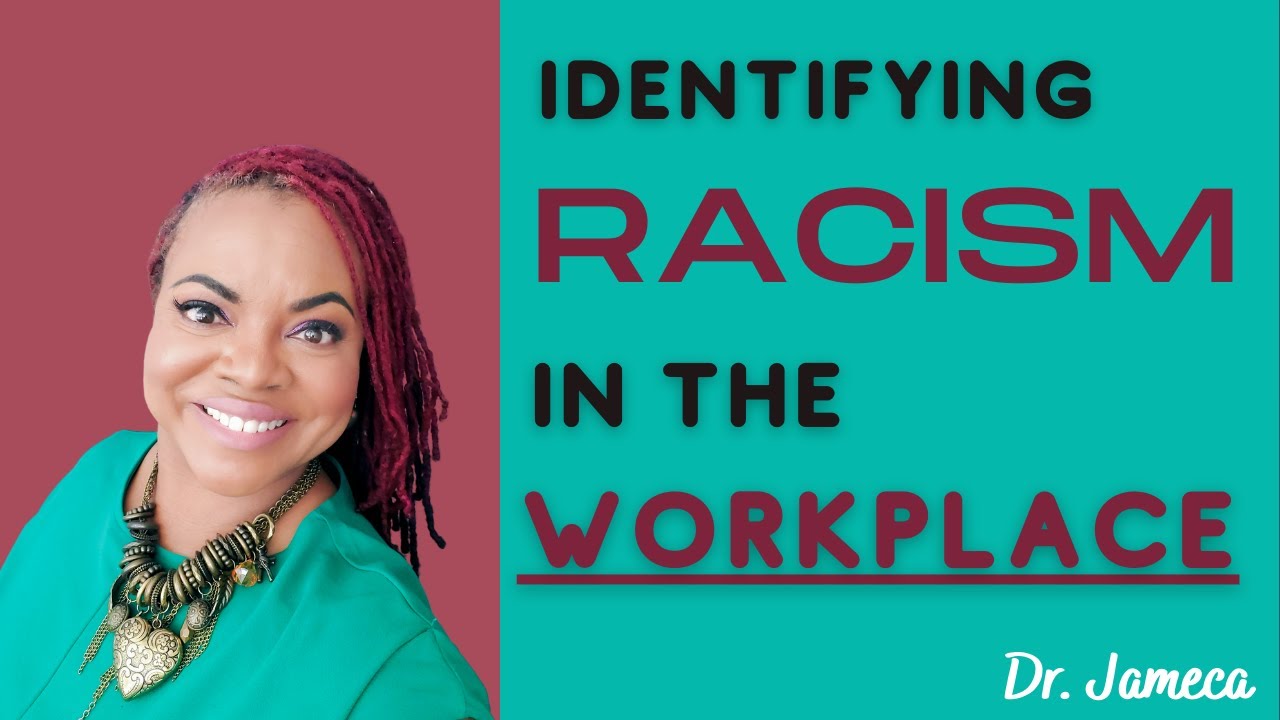
In this educational YouTube video, Dr. Jameka Cooper outlines four practical ways to recognize racism or discrimination in any workplace. She begins by defining microaggressions—subtle, often “innocent‑sounding” remarks that imply a person does not belong, such as commenting that someone “speaks well for an Asian person.” She explains that these slights, coined by psychologists, can erode self‑esteem despite their seemingly minor nature. Next, she describes unequal workload distribution, using examples like Black male employees being assigned heavier packages, suggesting a bias that they are physically stronger. The third indicator is the presence of stereotypes, both explicit (e.g., stating a Black woman is “angry”) and implicit (anticipating an angry reaction from a Black female colleague). She notes that stereotypes can persist unnoticed by others while harming morale. Finally, she discusses pay disparities, citing decades of research showing that equally qualified individuals of different races (and genders) often receive lower salaries, especially Black women compared to white men. Dr. Cooper emphasizes that these patterns damage mental health, sleep, and overall job satisfaction, and she encourages viewers to stay tuned for future videos on additional identification methods. The video concludes with a call to subscribe.
Chapters
Hi, I'm Dr. Jameca Cooper. Make sure you subscribe to this channel. Today I'm talking about racism in the workplace, so I want you to focus on ways that you can identify racism or discrimination in your workplace. Now, there are all different types of workplaces, so I don't want to really stereotype as to one field or another field, but I really seen this with my patients across all different fields. So the first way to identify racism in the workplace is microaggressions. So what are microaggressions? I talk to my students about them a lot. So these are slights, I'll call them, slights that can occur in a workplace when one person is interacting or speaking with another person. So a microaggression example could be something like, "Oh, you speak well for an Asian person." or "You speak clearly for a Black person." So that would be a microaggression. Now, over the years, my students have really debated, like, how is that micro? And we could go back and forth over that all day, but it's a term that was coined by a psychologist some years ago, which gives a term to some of the ways that people say things that they consider to be innocent, but they're really racist and they're really aggressive. Because it implies that you don't belong here or you're not from here, when in fact you could have been born and raised in the United States. So a microaggression, that's one way you can identify racism in the workplace. Second thing you can identify in the workplace are work— workloads and the differences in workloads. Let's say you work at FedEx or a UPS company, Amazon even, and if you're an African American male, and you tend to notice that you get loaded with more packages or heavier packages, that could be a clear example of some type of discrimination or racism going on, because the implication there is that as a Black man, you can carry more, you can lift more, you're stronger. Now, there could be some real-life differences as far as who can pick up more or carry more, but in a workplace, all those things should be equally or evenly distributed. So number 3, one of the things that you can notice in a workplace environment would be stereotypes. Some of these stereotypes could be implicit and some of them could be explicit. Of course, it's explicit if you hear things being said like, "Oh, we don't want to get into a meeting with you as a Black woman because you're angry." That's a stereotype that could be, again, explicit. It could be implicit if you're in a meeting and someone says something that may be a little tricky and slightly racist, and everyone looks at you as a Black female because they think you're going to have this outrageous reaction and get angry. Those are stereotypes that can really work on a person's self-esteem and on their level of morale in their job. So stereotypes are very important because sometimes they could go on for long periods of time and not be noticed. Unless we're talking about the person that they affect. Other people around may be totally oblivious to the stereotypes in your workplace. The fourth way and the fourth thing, fourth thing that you can identify in a workplace would be the lack of fair pay. Now, we have research data studies over the past 20, 30 years that talk about the differences in pay. So I want to say differences let's first say that these are among equally qualified and equally credentialed individuals. So they have the same education, same experience, same training. So even in these cases, studies have found that people of different races get paid less than other people in their jobs, regardless of, um, what they're doing. If they're doing the same exact thing, studies show that they're still going to get paid less than other people. Now we know that this also exists for gender. Like when you look at the pay rates of different genders, men versus women, there's a big difference. Now if you look at pay rates for white men versus Black women, huge difference. So how do you substantiate this? You don't really, except that someone somewhere decided that this person is going to make this much and this person is going to make this much. Or another way to look at that is someone somewhere decided that this person deserves or is entitled to make this much, and another person is, is not deserving of that. So these are things that may not be easy to find out or may not be easy to detect, because not a lot of times do people at work talk about their salaries or their pay rate. But if you can find it out, these are things that can help you identify if racism or discrimination is going on in your workplace. Like I said before, I work with a lot of individuals who deal with racism on their jobs, and it's not an easy thing to deal with. It really wreaks havoc on a person's self-esteem, on their mood, on their, their sleep, on their morale. Many times they don't want to go to work every day because they know that they're going to have to encounter these things that I talked about. So today I talked about 4 different ways to identify racism in your workplace. There are lots of other ways that you could identify what work in the workplace, and we will talk about some of those more in some other videos. Make sure you stay tuned. Subscribe to this channel, and I'm Dr. Jameca Cooper.