Dr. Jason Hawrelak: How to Optimize Your Gut Microbiome to Reverse Disease!
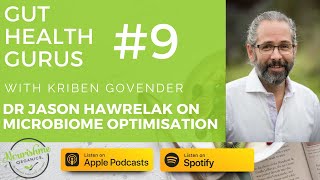
Transcript of a Gut Health Gurus podcast interview (hosts Krivin Govenda & James Shadrach) with Dr. Jason Hawrelak covering gut microbiome fundamentals, drivers of dysbiosis (diet, stress, sleep, medications, early-life factors), testing limits, key microbial groups (Firmicutes, Bacteroidetes, Proteobacteria, Methanobrevibacter, Akkermansia, Faecalibacterium), clinical interventions (dietary fiber, prebiotics, probiotics, PHGG, lactulose, partially hydrolysed guar gum), short-chain fatty acids (acetate, propionate, butyrate) and their benefits, SIBO and PPIs, and considerations about parasites, helminth therapy, fungi/virome. Emphasis on strain- and dose-specific evidence for probiotics and the value of clinician-guided testing and interventions. Practical clinical notes and example doses are provided.
Questions this video answers
About 1 metric tablespoon per day (roughly 5–7 grams).
About 1 teaspoon per day (≈5 ml); author states 5 ml contains ≈3 g lactulose (used as minimum therapeutic dose).
Lactobacillus reuteri DSM17938 (Biogaia); study referenced used ~10 drops per day in the described trial context.
Less than 7 hours of sleep was associated with diminished microbial diversity.
Chapters
Hey, guys, this is Krivin Govenda from the Gut Health Gurus podcast. I'm a food scientist and my colleague here, James Shadrach, is all things psychology with a psychology background. And today we have a very special guest, Dr. Jason Horolak. Jason, certainly in Australia is one of the most, I guess, credentialed speaker educator when it comes to the field of the gut microbiome, probiotics and gut health. Jason, welcome to the show.
Thank you for the invitation to take part. I always enjoy chatting about gut microbiome related topics, so I think we'll have a fun discussion today.
Awesome. Jason, I'm so appreciative for you joining the show. I know we're both crook at the moment, so audience members, please excuse the croaky voices. And maybe a potential break here and there to have a sip of water and a bit of honey tea.
Yes, I had two days of being very unwell, then two days with patients last weekend. My voice is at that breaking point, much more husky than normal.
And that's really interesting, Jason. I guess the two of us who are really focused on the health space, the wellness, there are times when we can get stressed out. Maybe it's a lack of streak, lack of sleep, a bit of work stress. And sometimes you can get hit by these illnesses and it's perfectly normal.
Yeah, I think it totally is. And I think sometimes it's an enforced break because I tried to sit here and work on Monday and my head was nodding down, my eyes couldn't stay open, like, okay, no, I actually need to take some hours off and go have a nap and I don't do that. And it's also what I found through my student life and post student life is you go through these periods of very stressful workload. And then when you get to the end of a project, that's often when you fall ill. Often had that at the end of term at university where you cram for exams, you get everything done and then you get over the finish line and then you just fall over and get ill. And that was part of that potential recovery phase. So for me, I've had that sort of year. So it's nice to perhaps see this as the end of the race recovery phase and forced time off.
Totally. I could not agree more, Jason. At times we get really busy, we overset ourselves, you know, and sometimes the body just says, hey, Jason, Ruben, stop, have a break and let me, let me do my job and keep you fit and healthy and going. So sometimes those forced breaks are A very good thing. So, Jason.
Yeah, for some of us, that's the only breaks we get. We have a very hard time mandating or creating break spaces.
Yes, agreed, totally. So, Jason, today, just to set the scene for our audience, so we'll have a conversation on I guess the microbiome. We'll delve into general gut health, probiotics, prebiotics, anything that's peaking your interest at the moment in terms of that gut health, probiotics, microbiome space. So just to set the scene for the audience, I've seen some figures recently where it's, fact check me from if I'm wrong, Jason, that approximately 10 million Australians suffer from some form of digestive discomfort. So that's, you know, that's almost half a population. Just to kick things off. Why do you think that's the case, Jason?
That's good question. And I think inevitably there's going to be, you know, a number of involved factors that are involved with that. I mean you'd get, you know, the western diet, typical Australian diet, or sad, SAD diet undoubtedly is a contributing factor to that. I think high stress loads and lack of sleep, as we just touched on, I think are contributing factors that too, and then medication use too. And I think you can take a step back and go, okay, what all those factors arguably negative impact the gut microbiota. You know, certain medications do, like antibiotics and proton pump inhibitors and nonsteroidal anti inflammatories, all of which are widely used by Australians at this time point. Most Australians aren't really eating all that well. Sometimes we live in bubbles and you know, oh my God. Close colleagues that I see on a daily basis, they eat really well. But then I go down to the local supermarket and I can see what the typical Australian is eating. And it's quite a different story. Their shopping troll is filled with cans of Coca Cola and white processed foods and it's just like, ah, that's what they. No wonder their gut isn't going well. No wonder they're not going well more broadly from a metabolic standpoint either. So I think it's a combination of those things and nevermind taking even a further step back, going back to the early, early childhood history of, you know, C section BIR and formula feeding, early antibiotic exposure, all of which impact gut microbiotic composition and in this early windows essentially permanently, which I think does preclude to certain digestive and other metabolic diseases from that time onwards, which is where the research is now teasing out.
So if someone. So you mentioned the word gut Microbiota or microbiome. So for someone that's never heard of this concept before, what is the microbiota? What is the microbiome?
Yeah, it's what's been interesting for me as a researcher who's been in this field for 18 years, is that understanding of those terms is now far more widespread than before. You know, you go back 17, 18 years ago, the term microphore was used, and very few people were paying much attention to gut bacteria, and very few people were familiar with the term and familiar with the term probiotics or prebiotics. People just called it acidophilus at that point, had no idea what prebiotics were. Thankfully, that message has really changed and gone out into the community. Now. Microbiota is the organisms that make up a certain environment. And obviously we're talking about the gut microbiota. We're talking to the gut, the microbes that make up our gastric intestinal tract. But primarily we're talking the microbes that reside in our colon. It's the colonic microbiota that we're assessing with stool sampling, where the numbers in the colon far, far outweigh numbers of microbes anywhere else. In the gut, transit time is far slower. So there's a lot of chance for those microbes and their products and byproducts to interact with the human cells and gut cells and immune cells in a way that that sort of alters function of those cells or that organ, in terms of the colon, for example. And microbiome tends to incorporate all of those microbes, but also their genetic capacity of what they can actually do as well.
And so in terms of the microbiome compositions, there's a couple of things I want to dig into. So you mentioned testing as one. So there's options now for people to have tests done. And so.
Which is brilliant. I absolutely love that. As I said, I've been in the field for so long that we had to make do as clinicians and as the general public with suboptimal tools for a long time. You couldn't really get a good feel for what was going on in your gut when we were relying on culturing fruit, for example. So it's been revolutionary as a clinician working with patients over the last five years, where we've actually had access to tools to properly assess the ecosystem and the diversity and the number of species that are present, et cetera.
Someone gets a stool report. So options are they can discuss it with their clinician, who's best in this field, or Some people are citizen scientists and maybe they want to test themselves and have a look. So how do they interpret these reports?
I think it's actually tricky because it's complex, it's not a simple area. I mean each individual person might have 160 different species present. A number of those species have only been recently discovered and scientists don't know what they do yet or what a normal amount of that population is. So how can non scientists have any interaction with the unknowable at this time point? So I think that really complicates it. And even the stuff that we do know is still complicated too because we might know a number of key genera and some markers that we associate with key microbiota health like diversity. But I still think it can be challenging area for even clinicians with a background of reading scientific studies to navigate. Which I can say from experience of observing people around me, let alone for the, for the general public it doesn't mean that they should do the tests and engage and start doing it because I think it creates that motivation to learn, motivation to take care and nurture that environment. And I think that's a wonderful thing because it has been a very much neglected ecosystem that people have inadvertently trashed for potentially the 20 odd years of earlier life or their entire life up to the point that they realize that it's important they do a test and then that actually can really change the way they interact with that. You know, I run workshops for the general public for that. That reason is to help people engage with what we do know about that ecosystem. And it's in five years time those workshops will run from our far longer because we'll know far more about the different species than what we do now and how to interact and change those things. So you know, we've got, you know, some of the research on the microbotic goes back to 1960s and 70s, but it's really the, the evolution of technology and the, that really took place in early 2000s where we moved to using DNA technology to assess what's there that the microbiota researchers just skyrocketed in terms of the amount that's been done and how much detail we can see the changes because before that it was pretty hard. When we're using culturing researchers were looking at vegetarian diets versus high meat diets and they couldn't see that it made any difference on the gut bacterial population. And this was perplexing because it's like it should, but it just didn't seem to. And other researchers are Postulating that, hey, I think we're using, it's just too crude. These instruments we're using are too crude to actually see the changes that are occurring. And that's exactly what it was. And you fast forward 10 years and using DNA techniques, it's like, oh, now we can see the impact of different dietary approaches, of different medications, chemotherapy, radiotherapy, a whole range of things that we couldn't necessarily easily see before, and also how long lasting they are. Like, we used to think antibiotics impacted the ecosystem health for two weeks or three weeks or four weeks. And it would look like it did before when we use culturing and now we start using DNA tools, it's like, hold on, it doesn't look the same as it did before. Certain species do, they bounce back. Certain species are advantaged by the antibiotic exposure if they have the right genes. But some species are lost and arguably ecosystem is, some people argue, permanently altered in many patients, even after, even when they're healthy in just a single course of antibiotics. And this has only been teased out when we switch to better technology with the capacity to notice these changes and to deceive species we didn't even know existed before because we couldn't grow them in test tubes.
Let's deep dive into some of the genera, the species, the phyla. So if we start at the very top, the two most common ones, Firmicutes and Bacteroides. So are you able to give us a quick bit of information on what these two phyla are all about?
Yeah, they certainly make up the bulk of the bacterial species within genera within someone's gut will be from within those two phyla. But just because they're in the fila together, it doesn't mean they have actually much in common. That's, that's perhaps one of the biggest things to point out because, you know, the phyla that humans are in also has, you know, like lizards and fish. We do have some things in common, but we're actually quite different at the same time. So I think it can be problematic in some ways trying to make too much generalizations or interpretations around phyla level data, except for, in my opinion, when it comes to Proteobacteria, because all Proteobacteria, which is another phyla that most people have in much smaller amounts, thankfully than Firmicutes and Bacteroidetes. All protobacteria share a structural component that they're composed of called lipopolysaccharide or endotoxin. All of them, it's just part of their Makeup. It's not like and we call endotoxin because it does have toxic like of effects. It's not like it secretes it to make us ill, it's just part of its structural makeup. And all of them within that category have got that. And we, there's a bunch of research has come out from 2006 onwards that have highlighted the pro inflammatory role of this endotoxin that's released on a daily basis by your gut bacteria because as they die they sort of endotoxin gets released into your gut and then some of it gets absorbed and some people will very, very, very much as to how much proteobacteria they have in their gut. And you could have one person that has 0.5% Proteobacteria, which is probably the lowest I've seen in practice. And I've seen other people that were 25% Proteobacteria in their gut. And that is huge. And just think of all that. You've got 25% of your gut bacteria, which is trillions of bacteria, are filled with this endotoxin that's a pro inflammatory compound which we now know that even when your gut is intact and healthy, we're absorbing and getting some in, but when you have more of it, more gets in and it has a capacity to actually damage the gut as well. So I think from a, from a phyla perspective it's really Proteobacteria to me is the biggest thing I look at there. And yes, bacteroideted teas I look at too because it also contains all the organisms within that phylum do contain endotoxin, but it's not nowhere near as pro inflammatory as prokobacteria endotoxin. So but that said, if you have someone who's 25% Proteobacteria and you know, 65% Bacteroides, it's like whoa, you know, that's a lot of gram negative bacteria, a lot of endotoxin floating around in their gut, which is going to not just stay in their gut, but go into their bloodstream and cause a whole range of inflammatory reactions. And I think it just depends on the person as to how that that can manifest. But we know these, this is a key driver for metabolic syndrome, type 2 diabetes, fatty liver, even anxiety, depression are being linked with this endotoxin bloating now and Alzheimer's disease, just to name a few.
And say someone comes up with a high level of protobacteria, what steps can they actually take to address this high level to Lower this level.
I mean, you would normally that would be the first thing to look at is the file level. Then I'd look, I'd dig a bit deeper into the genera. What genera of Proteobacteria have you got? And that can dictate to some degree the best interventions, because most Proteobacteria as a class of agents prefer growing at a more sort of neutral ph. And the clonic ph is immensely adjustable with dietary factors and with prebiotics. So through those taking control, and we can control dietary factors, we can ingest prebiotics. And as a consequence we can actually really shift and acidify the colon because essentially we provide food for other microbes that produce short chain fatty acids like propionate and acetate and butyrate, that lowers the ph and that makes it less conducive to the growth of the vast majority of protein, bacteria and those simple things. Just eating more plants, food, more fiber, taking the right prebiotics can make an immense difference to Proteobacteria populations. And I see this on a weekly basis in my patients because we test this, we do the interventions, we test afterwards, and those levels go down and generally they feel much better because it is very much a pro inflammatory compound and you don't want that much floating around in your system. You will feel altered from having that much floating around in your system.
So if we delve a little bit deeper into protobacteria. So is it Bilophila and Disulfiram, other ones that you're looking at?
Those are two. And those ones are perhaps more significant because, yes, they're Proteobacteria, so they contain that sort of pro inflammatory endotoxin. But secondly, they are hydrogen sulfide gas producers and so they essentially eat generally sulfur compounds and they convert that through to hydrogen sulfide gas, which is pro inflammatory and is gut damaging at higher levels. A tiny amount your gut can deal with quite fine. But again, you can have this huge variation between having, you know, almost no hydrogen sulfide gas producers to being, you know, 8, 10% of the ecosystem. And you can just think of how much extra hydrogen sulfide gas is being produced when they're on that higher end of the things. So those are certainly two of the genera that I look at. But there'll be other things like, you know, E. Coli, Enterobacter, Clivera, Shigella, Salmonella, you know, some of the ones that we see as gut disease agents are often in that Proteobacteria category. Klebsiella would be another one in the.
Category, too, in terms of the, I guess the methane produces. Are you also looking at the archaea, something like msmithi?
Yeah, yeah. So Methanobrobacter smithii would certainly be on my radar too, and we'd be looking at whether it shows up in the test and what, what percentage it shows up in the test. And to be honest, as a clinician, I actually find breath testing is a more accurate way of assessing for methane status because you do get some people, I mean, everybody, everyone in my patient where they've shown up with high Methanobiribiribacter have shown up as a high methane producer on gas testing too. But I've had patients that have showed up on a gas test but didn't show up with detectable levels of Methenobibacter on stools. So it was relatively small amount in that stool sample. So I think breath testing is a more reliable way of ascertaining someone's test. But when it's high, then that is usually correlated with slower gut transit time and. Or constipation.
And we'll talk about the pre and probiotics in depth down the track. But in terms of intervention with a prebiotic for specifically these, I guess, these negative species or pathobiance species that you're talking about, is there any recommended prebiotics that people might want to consider if they have higher levels of these bacteria?
Yeah, certainly. When it comes to Methena Riverbacter smithii, that the ingestion of partially hydrolyzed guar gum, which is a prebiotic fiber, usually results in a decrease in methane output and it results in a normalization of stool form. So those people who are on the constipated end of things, it tends to soften the stool, allow for easier passage.
In terms of dose level.
Most clinical trials using phgg, which I'll say for sure it's far easier to say, is about 1 metric tablespoon. So 5, 6, 7 grams per day would be a typical sort of dose. I do work with some very sensitive patients, so sometimes we've got to start with a quarter teaspoon a day for a while and build up. But most people can start with just that therapeutic dose, assuming they're not in that extreme sensitivity region.
And this is also applicable for protobacteria that we're talking about.
Yeah. Partially hydrolyzed Google gum doesn't seem to shift the overall ph dramatically. It does up the production of butyrate specifically. And I think the butyrate and methinobra are often negatively Correlated so that higher butrate is lower methyl and Riverbacter and vice versa. So I think that butyrate itself seems to inhibit the growth of Methanobiferbacter. Now when it comes to other like the hydrogen sulfide gas producers it can be. I think the change in ph has to be a bit more, more dramatic than just upping the B joy production because I don't think PHDG on its own seems to do much for those populations. But I have found that inulin phos, fructoligosaccharides or galactyl oligosaccharides, both from a research perspective can decrease numbers of those hydrogen sulfide gas producers. But also clinically I found it to do so with my patients. Too often you've got, we do dietary stuff too. So we don't say just take this and keep eating the same diet because we've got to take, ideally take away some of that food source. So with Bilopyla it's often bile, it's a bile acid eater. That's what name Bilophylla comes from bile loving microbe. And its population is generally very much dependent on how much fat you eat but also what sorts of fat too because certain types of fat, dairy fat in particular, when we ingest it we have to create a different sort of bile that's much higher in sulfur and bilifida loves that sulfur rich bile and their populations can bloom as a consequence. So often you'll see people with higher bilophila on a high fat, high fat dairy diets. Also you'll see it as a consequence of bile acid supplementation. So there'll be people out there who don't think they tolerate fats well when they eat it. So they say I'm going to take some bile ox bile as a supplement or bile acid as a supplement. And they, what they don't know is they're often feeding the bilifila. And you can have patients go, I have that seen with patients where it's called gone from 0.05% up to 5% of the ecosystem within just six or eight weeks on a bile acid supplement. So it just works as a preferential food source. So I would consider bile acid supplements a bit like an anti prebiotic and selectively feeds microbes that cause you harm. That's not to say there isn't a time and place for them, but I think when they're over prescribed and someone that doesn't need extra bile, they're harmful.
Absolutely. What I love about what you do, Jason, is that not only looking at the research studies, but you've also got practical experience when dealing with clients. So you're looking at, I guess, stool samples and resulting DNA microbiome testing, making the adjustments required, using prebiotic supplementation, and then potentially retesting the client and seeing if there is improvement impact on these prebiotic supplementation.
Yeah, yeah.
And how about we segue now to the positive ones? So ones like Lactobacilli, Ephrodobacter, actamancula. So what's the story there, Jason?
Yeah, well, I think most people are familiar with Lactobacilli and Difficobacteria. Those are the. The two classic ones that people tend to be familiar with. And there's probably a couple reasons for that. One is they were isolated, you know, from the human guts a long time ago, over 100 years ago. So we've known about them for a long time. Lactobacilli are also the predominant fermentative organism in most fermented foods. So that would be from yogurt, sauerkraut, Kim and chi. So a range of other indigenous ferments will generally have Lactobacillus as dominant end species. And then many of our yogurts contain bifidobacteria too, where people just call it bifidis, for example. So I think that's partly why we're so familiar with those ones. And despite the fact that, like looking at Lactobacilli, they actually play a very small role in the gastric, in terms of the colonic ecosystem, you know, they're immensely important for vaginal ecosystem health. They're like the dominant species in the vagina ecosystem, but when it comes to the gut, they're often there at like, you know, between 0.01. Up to 1% would be totally normal, you know, but people expect it to be there in large amounts because it's the bug they know about. It's one that's all the supplements contains. So therefore it should be really high in there. It's like, no, it's actually relatively small player. It doesn't mean it's not playing an important role, but it is a relatively small player. And then we've got Bifidobacteria, which is a bigger player in that, that you'll see it in healthier ecosystems between like 2 and 5% of that sort of ecosystem composition. And because it's there much higher amounts, hundreds of fold times bigger than active satellite, it has a capacity to interact with you in a far, far bigger way. And we know that one's very. The genus in general is important for gut integrity. You know, and I often see people, because I do, you know, intestinal permeability testing for a lot of patients too, that those who have leaky gut have often have low Akkermansia and low bifidobacteria, or none show up on their testing. And it's like, okay, they're lacking two of the species or they're in such small amounts that their body has evolved in relationship with to. As part of their functioning role was to help heal up damaged gut. And you can see it's gonna be much harder for that healing process to progress forward if the key cells whose role it is to do so aren't there or they're in, you know, 100th the amount of what they should be. So for me, I've often seen that relationship. And on the other side of that is when we actually nourish Akkermansia, we nourish different bacteria, we bring those populations back up to a healthier state, then we get an improved and gut integrity as well.
So how.
It's always a core focus.
And how do we increase levels of these beneficial types of bacteria in the gut?
Yeah, so essentially it's feeding them. That's the core aspect. So it's working out what foods these particular species eat. And it comes to bifidobacteria that's been, excuse me, it's been pretty well researched over the last 20, 30 years. But prebiotics, so we're looking at inulin, phos, inulin being a long chain fructooligosaccharide, which means it's very long. Whereas oligo fructose is probably the best term for a shorter chain fructoseaccharide. And what a lot of research does this day is it combines them together because you have some bifidae that like the long chain and some that like the short chain. So if you have a combination, it means you got the best chance of feeding your individual bifidobacteria. So I think that that combination of all of your fructose enriched inulin, to use this proper terminology, which is very wordy but I'll use it, is a fantastic prebiotic that works very well for bringing up different bacteria quite broadly and Akkermansia as well. The other sort of key prebiotics are lactulose. And lactulose is a indigestible disaccharide that was originally used in infant formula ages ago to try to make it More like breast milk. So it was the first sort of prebiotic inoculated infant formula which never followed up well until very recently once again. Now it tends to be used in conventional medicine as a laxative because in large doses you can't break it down or digest it. And if there's too much for your bacteria to eat in your gut, then it has an osmotic drying effect, draws fluid into there and softens your stool and gets eases the passage of said stool. But at the doses we tend to use, which would be minimum therapeutic dose is 1 teaspoon per day, 5 mils contains 3 big grams of latulose itself and that's the minimum therapeutic dose. At that dose you tend not to get a laxative effect, but what you do to get is a prebiotic effect. So it works, works very well for feeding up bifidobacteria quite broadly. Higher doses I find can bring up lactobacilli and they also work. Also works as a food source for Akkermansia in most patients, but not all. And for Phecalobacterium in the vast majority of patients. Faecalobacterium is another of those species that people would be less familiar with for good reason because we've only realized it existed about 10 years ago or something like that, yet it actually can make up 25% of what's there there in your gut. We just couldn't see it before. We didn't have the technology and tools to see that it existed. Where now we see it. It's a pivotal health promoting species. That's a key butyrate producing bacteria. Yeah, and blackilis works on that and serves inland floss I should say too can also bring up fecalobacterium. And the last prebiotic is that I'll touch on in this category is galactooligosaccharides which we can find in some food sources like legumes. They'll contain stachyose, orafenose, beet beetroot can also contain that compound too. And if you're eating, you know, a cup of legumes a day for example, or more, you'll meet that, that sort of mineral therapeutic dose of galactyligosaccharides. Otherwise it's pretty hard to get from your diet if you're not having legumes. But you can get supplemental sources. That works very well for feeding up bifidobacteria and faecalobacterium but generally doesn't impact Akkermansia or in my experience Lactobacilli.
Jason, you mentioned short chain fatty acids and some of these short chain fatty acid producers like the Kalibacterium pronitzii. So firstly, just for someone that's never heard of short chain fatty acids, blood butyrate, what do these compounds? What do they actually do? And maybe talk about some of the other species that are involved in production of short chain fatty acids.
Yeah, well, there's, there's three main ones that, that bacteria produce in your gut. And it's, they do this essentially when they're fermenting fibers, oligosaccharides, resistant starches, even sugars, they're producing short chain fatty acids and gas as a byproduct. And the three main ones that I did briefly mention before were acetate or acetic acid. Same thing you find in vinegar. You're just allowing bacteria and you create that in their own little bottle before you can buy it. The same thing's happening in your gut. Propionate and then butyrate. And butyrate is generally one of the smaller percentages in terms of output, particularly in people eating a typical western diet, because they're generally not eating much to feed those b raterate producing bacteria. So the top of that list is Fecalibacterium, but then we've got other ones like Blotia, Roseburia, Subdola, Granulum, Anerostypes, Anerotrunchus, Intestinibacter, or other species or genera, sorry, in the gut that are key butyrate producers too. And when we feed them, or we feed them resistant starches, we feed them partially hydrolyzed guar gum, we increase the output of butyrate, we're nourishing those species who produce that as a byproduct. And butyrate is an amazing substance. And I was heartened to see an article published in a mainstream neurology journal two years ago that said the best thing we can do for brain health essentially is eat more fiber. They would not have published this 10, 20 years ago, but it's amazing to see that there. And it's because of this production of butyrate. And butyrate has gut healing properties, which are really important. And maybe we'll, we'll segue there first because your colon, your large intestine, essentially we've evolved this relationship with, this relationship with these beetrate producing bacteria. So much so that 70% of our energy needs for our colon cells is reliant on this beta 8 that's produced. If we don't produce that butyrate we don't have the energy for those colon cells, we get this inflammation and they don't function quite right. You know, that's, that's huge when you think about it, is that we've totally reliant upon butyrate production by these bacteria to nourish cells to function properly. And if you don't have that, you don't have cells functioning properly and a whole organ in your body, I think that's, that's pretty massive to consider. So most, when you only produce a little bit of butyrate, all of that will get sucked up by those colonocytes. Colon cells, they'll use every single drop that's produced because they need it. But when you produce more than that, you produce more than the minimum amount required for their functionality. That's when it can reach your circulation. That's when you start getting the other body wide benefits of butyrate. Those things include improving blood sugar regulation, improving insulin sensitivity, improving mitochondrial function, decreasing brain inflammation, you know, having a whole body wide sort of anti inflammatory effect. It's an amazing, amazing substance. And so I think it's pivotal that we look after those little b trape producing factories in our gut and feed them and nourish them because they're there, happy to make butyrate for you if you feed them. And it's just an issue for most people is they're just not feeding them. And I see this time and time again when I'm doing microbiota analysis is that there's many patients that really are following dietary approaches that provide insufficient food source for those butyrate producing microbes, you know, and that means that they might be there at 5 or 10% of the overall population, whereas in other people they'll be at 50 or 60% of the population. And that think about that again, that's huge, huge difference. Huge variation in how much betray is produced and how much Ba3 is then absorber when you get all of its medicinal benefits.
So what's your thoughts? And clearly there's a food, there's a food intervention that you used to increase butyrate production. What about exogenous butyrate as a supplement?
I do use it in a supplement in certain patients, but I usually use it as a complement to fixing up the indigenous producers. That's always in my core aspect is you've got them there, feed them and they'll make it for you. It's a much cheaper process. How we evolved, it's like it makes more sense. But you do get patients. Do you See, some of these that have their gut is so damaged, so inflamed that they can't tolerate even the tiniest amount of intestinal gas being produced, which means that they can't really go much more in terms of fiber or resistant starches or even with generally well tolerated prebiotic fiber like partially hydrolyzed gargan. And thankfully this is a small percentage of people, but I do have some of them. And that's where endogenous or exogenous butyrate as a supplement, I think comes to play. And even potentially using. I've had patients with very severe visceral hypersensitivity in their rectum. So, you know, some patients severe enough that they had to do an enema every single night before they could go to sleep because just the sensation of fecal matter in their rectum was enough to cause pain and prevent them from falling asleep. So they have to like empty out the rectum every night, just like in sleep because of that, the nerves were so inflamed in that area that even the tiniest amount of pressure was enough to cause pain. And then you can use butyrate as an enema in that situation to try to decrease that inflation. And that's been used as a therapy tool in ulcer class colitis research too. Where again, that rectum area was very inflamed from the ulcerative colitis. And then topical butyrate can actually help decrease that inflammation prone healing.
Wow, that's amazing. I've never actually heard of that before. That is gold. Let's segue now on you mentioned about people suffering from digestive issues. Firstly, let's talk about. This is actually I should mention to the audience there was numerous questions put forward by our community that we're so excited to ask Jason. So I wrote a list of them down. We'll try and get through as many as we can. But someone asked about the relationship of gut dysbiosis and brain function or I guess mental health.
Yeah, I mean, I think I've got a whole lecture on the connection between, you know, depression and gut dysbiosis. There's a lot of literature there. So even some, you know, pivotal animal experiments that are shown very clearly where you can take, you know, poo from a depressed person, give it to a mouse and rat, and that rat will become depressed despite no change. Anything else? Just from inoculation. And you can take poo from a healthy, not depressed person, give it to a rat, they don't come depressed, they're quite happy still. It's not just getting poo, you know, human bacteria, that's a problem. It's that depressed person's bacteria. And it actually changed neurochemistry in the rat after getting that poo transplant. So we know there's this direct relationship there. So. And I do personally see that the building data set around endotoxins with anxiety and depression and Alzheimer's as being pivotal error to keep an eye on because it just fits ticks so many boxes. Because we're living in a day and age where our interventions like proton pump inhibitors, for example, and antibiotics often increase the relative proportion of proteobacteria in our gut. We're eating a dietary approach for many people that there's a decent amount of proteobacteria populations that are there and there's a lack of gut integrity, allowing more of this compound to get through. And endotoxins do cause brain inflammation. They do change how your brain neurochemistry works. We shunt more of the tryptophan down a different pathway. It's not made into serotonin. We can give healthy person like you or me give you a shot of endotoxin in our arm, we get depressed and lasts for about six hours afterwards. This is very, very clear. So we know this occurs. And what's probably been teased out since 2006 onwards is that we actually are getting little doses of endotoxin all day, every day, and some people getting more than a little. And if you're eating a dietary pattern that is one, conducive to the growth of proteobacteria and two, inhibits growth of gut healing species, you end up with this leaky gut, lots of proteobacteria, lots of endotoxin, lots getting through. And that is arguably one of the drivers for these sort of depression, anxiety epidemics that we're. That we're seeing.
James is. He's got a psychology background. So, James, is there any questions you want to ask around this mental health connection between gutter. Sure, Jason, thanks. I think that's fascinating. I always had an inkling that eating certain foods would kind of create like a dip in mood or just negatively impacts how it felt. But fascinating all the science that's backing it up. So I was just wondering, like, for our listeners, are there any types of diets in particular foods you'd recommend to avoid so they don't experience these negative effects?
Yeah, yeah, that's a good question. Big question that it's such a challenging area to navigate diet. Diet these days, you know, because there's so much information out there and so much conflicting information out there. So for me it's a matter of going back to what the research was saying. So you know, we know that saturated fats, whether that comes from, from dairy or from a, you know, steak or from coconut oil, we know that saturated fats increase the absorption of endotoxins. They will bind to them and create a bit of a raft that facilitates their transmission through the gut into your circulation. That's clear. So I'm very cautious around the use of saturated fat sources and essentially dietary approaches that have a low amounts of fiber. I think those are perhaps the key things for me is like the amount of saturated fat you're having and the amount of fiber you're not having that are potentially very problematic because there's a few aspects of that because some of the fibers can actually bind to some of the standard toxins and help prevent them getting absorbed. But importantly, when you're eating a fiber rich diet, you're nourishing the species that actually are conducive to good gut integrity as well. And that again is going to have a sort of indirect way of limiting absorption of those compounds. And there's some fascinating research where they can give people McDonald's meal and look at the amount of endotoxin that hits their bloodstream before and after. And it's like, wow, there's a massive increase of endotoxin after that McDonald's meal. But if they have some high fiber foods with that McDonald's meal, it nearly blocks all the endotoxin from being absorbed.
Ah.
Even though they're still eating the crap thing, if it is lots of fiber alongside of it that actually prevented it from occurring. So not that I'm suggesting we do that approach. If we do both, we avoid the crap food and eat lots of fiber and avoid the things that are obvious triggers like the saturated fat.
So Jason, the next question we had from our community is that how does light and sleep affect the microbiome?
Yeah. So light is. I'm not that familiar with the research around light and microbiota. So there's probably other people can answer the question myself and I'll leave it to them. But certainly I'm familiar with some information around sleep and sleep does seem to have a lack of sleep seems to be problematic from a diversity perspective. I think it was less than 7 hours sleep tended to diminish your microbiota diversity. And we know that diversity is one of the key markers of a healthier ecosystem. And there's a number of Animal studies, I think, showing too that chronic sleep deprivation, so less than that disrupts that ecosystem and I think leads to an increase of, you know, Proteobacteria once again, which is what you don't. Don't really want. What was fascinating least in one of the animal studies is they did a, you know, a crappy western diet and sleep deprivation versus a healthier diet and sleep deprivation. And the combination was atrocious, you know, because the lack of sleep wasn't as bad as a typical western diet was. But you combine the two together, the changes were huge, substantial shifts in that ecosystem. So I think we have to consider good sleep as part of our gut management. Good gut management strategy too, undoubtedly.
I couldn't agree more. It seems like that seems to be the number norm in, I guess, our western culture. Bad diet and bad sleep.
Yeah, it is. When people get stressed, they often sleep less and eat more crap food and you get this horrible negative cycle that goes on.
It is horrible. So another buzzword that we hear a lot about is sibo. Jason, what is sibo?
Well, it's small intestinal bacterial overgrowth growth placebo. And, you know, if you would have asked that, that question in the early 2000s or late 1990s, it would have been seen as a rare condition typically observed in people that with Crohn's disease or some people that had part of their small bowel removed because they had chunk of their small intestine removed. It meant that there was a bit of dysfunction. There's often a bit of pocket that would sort of form there, which a bacteria would sit in and stagnate because it just wouldn't flow as per usual. But in the early to mid-2000s, an American researcher put forth this idea that, hey, this is actually more common. It may be the key driver of irritable bowel syndrome, which is, you know, quite a common gut condition. And you might argue that, you know, 10 to 20% of Australians at any time point will suffer from IBS. So, you know, that was a pretty astonishing statement at that time point. And I think we find now that it's probably not quite like that. I think you suggested that 84% of people with IBS had SIBO. And I think more conservative estimates, when they do more broad studies around the world, it might be 30% of people with IBS actually suffer from overgrowth of bacteria in the small bowel. And these bacteria can come from one of two areas. One is from the oral cavity down. So sibo as a consequence of proton pump inhibitor use so there's people who are taking medications for gastric reflux, for reflux disease. Getting Sibo is quite common for them. I think there's a meta analysis done in 2013 suggesting that people taking proton pump inhibitors, that whole class had a seven fold increased risk of developing Sibo. And essentially you think about that. You've got, I think it's 100 million bacteria per million mil of saliva. You're swallowing a liter of saliva per day. So you're getting about 100 billion bacteria you're swallowing on a daily basis from your oral cavity. And normally your stomach acid is there to that kills the vast majority of those bacteria. But you take that away, you're having like, you know, that's often equivalent of like 10 probiotic capsules per day just from swallowing saliva of microbes that are, that are getting down there. So it's not surprising that that SIBO has become far more common because the rate at which proton pumpers are being used has expanded dramatically over the last 20 years.
I'll just pause there for a sec. So I did get. Pause you there for a sec. I did get a question from one of our community members regarding exactly the same thing you're talking about. With the large amount of bacteria in the mouth, is there a place for a mouth probiotic?
There totally is and there are research teams developing that now and there's a few in the marketplace, mostly in North America and probably Europe. Australia's a bit behind in certain areas and this would be one of them. And most of it's been looking at gum disease and dental caries so far, which are good areas to research. But they might expand a bit more on that. I mean, I think for someone that's trying, that needs to be on a proton pump inhibitor. And I, you know, and the research tells us that actually a decent proportion of people who are taking them actually don't need to be on them. So it's always worthwhile they have to check in with their provider of whether they need to still be on that medication. Maybe it was appropriate two years ago or two months ago, but it's not needed now. But those who do need to be on it. That the ingestion of a particular probiotic strain, The Lactopils reuteri DSM17938, very catchy name, also known as the Biogaia strain. There's a very cool study published, I think it was last year, showing that maybe even this year my sense of time has gone without. But very recently anyway, in the big scheme of things that, you know, when people took this instead of a placebo, it reduced the rate of SIBO occurrence dramatically. When they had to take proton pump inhibitors, it was a dramatic decrease from taking 10 drops per day of this particular probiotic. So whereas we have research with other probiotics showing that they didn't work. So it's not like all probiotics will be helpful, but that one in particular does seem to be effective to prevent the development of sibo. So for someone that has been a ppi, I think that's a bit of a must.
Alongside that, we do jump around a lot in this podcast.
But before we say, yeah, fair enough, it's one of those, you know, yeah, they all flow on different areas. That's fair.
Exactly. And before we jump into probiotics, which you perfectly segue into, I wanted to talk about something that I find interesting that's popping into my radar, which is helmintic therapy. So the use of worms to treat dysfunction. And what's your thoughts on that, Jason?
I think it's an interesting idea, and to be frank, I'm not totally familiar with the overall area. I'm familiar with some of the research that was done on helminths for celiac disease, for example, and the results, I think, were quite disappointing. So there might be some indications where the theoretical evidence or theoretical rationale manifests with good clinical trials as a useful treatment approach. I mean, I kind of like the thinking that we evolved with the. We've normally had parasites there, so maybe, you know, something is dysfunctional in our system. We don't have them anymore. I mean, I can relate to that underlying theoretical rationale for their use. But certainly when I read the research of using the American hookworm, necator americanus, in CVAC disease, it was. It was quite disappointing. It was like it caused a lot of pain and discomfort, and it slightly decreased inflammatory low. An after dose of gluten. It's like, well, that's not all that helpful. Thanks very much. If it totally prevented the damage caused by gluten, maybe it's worth it for those people who really miss their. Their croissant or their danishes or their slice of sourdough bread. But in this case, it was just slightly limited the damage that was caused. But certainly. But you still got, you know, weeks worth of horrible symptoms from ingesting the worms in the first place. So I don't think it was worth it. But there might be other areas where the research has evolved beyond that that I'm not familiar with.
And continuing on that train of thought. So let's talk about parasites. Are they a real problem? Something like blasto? A lot of people focus heavily on parasite elimination. What's your thoughts on that?
I think it really depends on the microb in question. And you know, something like giardia. Yeah, like if someone presents to my clinic with giardia, I do use these herbs and for a lot of etc. To eradicate the bug because it does cause massive malabsorption in the small bowel, potential nutritional deficiencies longer term, but certainly a lot of syndrome in the short term. And you know. So yes, I think giardia is one that you would get rid of, but I think you have a range of others and I think this is an area where clinicians are behind the times in some areas versus what the research is saying when it comes to what's normal. Like we normally have protozoa organisms in our gut. They're normal, you know, and it's only because we're using DNA that we can now see that they're there. And we're still trying to define what the normal amounts are normal species. And that's ongoing now. So. But I think there's a lot of those clinicians out there that go in really heavy handed to try to kill off these things that there are the research scientists out there saying these are actually normal species. And I would include things like Dientamoeba fragilis and Blastocystis hominis in those categories. There's been a number of recent research studies that come out of Europe showing that these things are normal and they probably play pivotal roles in the healthy ecosystem. Some people are arguing that there are the apex predator that they eat, Apoglastocystis eats bacteria. And if you take that apex predator out of an ecosystem, there's consequences which is overgrowth of certain bacterial species, you know. And I think this is fascinating and from a research perspective and looking at an ecology perspective, it's like taking the wolves out of Yellowstone national park or taking sharks out of ecosystems. There are consequences and people are arguing the same thing with gut too. So I just feel, I think for those people that went way out of their way taking, you know, quadruple antibiotic cocktails inter colonically and orally to try to kill off these things that often have limited evidence of causing harm in the first place and called irrevocable damage to their bacterial components of the ecosystem as a consequence of that approach. You know, to kill off something that may have actually been playing a role to Keeping them healthy, which I think very few clinicians are familiar with that. More research that's come over the last couple of years looking at the role of commensal protozoisms in the gut. Same with the microbiome too. It's like, I'm not that familiar with microbiome. It's relatively new area of research. But we're supposed to have fungi in our gut. Yes, this is normal. And if you just go killing it all off, there are consequences to that. Do we know them all yet? No, because, you know, just teasing out what these species are and the sort of web like effects of their interaction with other bacterial species there, you know, so there's some, you know, I think it was an animal study, but they gave them one of those antifungal agents and yes, it killed off damage and changed the microbiome quite dramatically. Some species went up, some species went down depending on what they were susceptible to. But also they'd actually change the bacterial composition indirectly because of all those sort of interactions between different species. And that was like a unexpected consequence that wasn't beneficial for these particular animal models. It would sort of cause the sort of dysbotic bacterial ecosystem to develop after taking this sort of oral antifungal. So it's in a similar category in my mind of going, okay, it's early days. We need to be aware or try to think more about the consequences of treatment to kill off all the fungi in the gut, kill off all the protozoa in our gut, because we don't know whether this is a good move or not. And the long term consequences of that.
At this point and the barn as well. What's your thoughts on the bar?
I know almost nothing. It's hard keeping up to date with bacterial ecosystem changes and the amount of research that's coming in and keeping a little bit of an eye on the microbiome and the protozoal composition. I'm not keeping up to date with.
The virome and the metabolite. That's the other hot area, I'd say as well.
Yeah.
So, Jason, let's talk about probiotics. Now. This is a quite a controversial topic at the moment with the study coming out from the Wiseman Institute around antibiotics and also robotics. What's your take on, I guess, the effectiveness of probiotics and especially after a course of antibiotics?
Yeah, and I think there's a few things to tease out here. And one, it's on my agenda to really properly critique that study because I haven't had a Chance to look at every little depth of it because I see patients and teach things, take my priorities critiquing and studying something I might do over the summer on a day off. But. But I think there's a few things that we tease at. One is the extrapolation of the research findings. So, you know, you can look more broadly at that research field and you'll find there's a number of animal studies, slim records and finding the probiotics were helpful. Did they get published in the same journal? Did they get worldwide media attention? No. So we're like taking one study out of context going, hey, look at this, this is what all probiotics must cause harm to the gut and it slows down normal redevelopment of the ecosystem post antibiotics. And what you can't do is say anything, bar the fact that this particular preparation used in their study is not appropriate for this task. That's all. You could not extrapolate that. You should not be able to extrapolate that beyond that because they only looked at one probiotic preparation. It turns out that the lactobacilli in there, in that specific preparation secreted content that inhibited growth of a number of other beneficial bacteria in the gut. Is that something all aptosole do? No. So you can say this particular product should not be used post antibiotic. I would totally agree with that. You know, we know from looking at the antibiotics and probiotic literature that there's some that seem to be effective and some that don't seem to do anything and it looks like there might be some that might be harmful to take at that time. And again it goes into using the ones with clinical trials of efficacy for that condition. And I'm firm a mover or pusher for evidence based prescribing of probiotics. So use the ones with evidence showing that they work. You don't experiment on things that may not work. And this I think if anything is a clear example of the potential negative consequence of using one. That's no research showing it works that may actually cause harm and slow down the regeneration process. Because we have other studies showing that actually probiotics can speed up regeneration process per antibiotics or importantly reduce side effects and reduce overgrowth of nasty potential pathogens like clostridge and fissile. So I think it was just the conclusions where I think far too strong for the type of evidence that was created and how it was, you know, blown up on the everywhere new sites. It was not even just people that you only talk about gut health. There's all These people that normally don't even know that gut health exists, talking about this study that oh, probiotics are bad, who are not familiar with the area at all. It was immensely frustrating.
Absolutely. I appreciate your take on that, on that study and hopefully we'll hear back and do the full critique of the study. But what I wanted to delve into is there seems to be some group, like four groups of probiotics. So there seems to be your bifido lacta type probiotics, then your soil based organisms in the yeast one, I think it's espoirda, you can never say it properly and E. Coli. So maybe if you could quickly talk about the difference between these different types of probiotics, in what situations would you use these probiotics? And finally, should probiotics be used symptomatically or can they be used prophylactically?
I think for certain conditions we know the use is definitely prophylactic. So I mentioned that Reuteri DSM17938 for the prevention of SIBO and someone who takes a PPI inhibitor, great clinical data on that. We know if you take it L rhabnosis gg, a specific probiotic, when you're being exposed to people who've got viral gastro, your reduce of developing viral gastro will go down. So I think there's very specific instances where the right probiotic will make a big difference from a preventive perspective as well as for treating certain disease conditions too. I'm just a proponent of using the right strain with the right action for the right condition. And I think that means that it's pretty hard to make. In fact it's impossible to make class specific recommendations of All Lactobacilli are good for this, all bifacter is good for this, all soil based probiotics. What does that mean? I've got soil in my yard that has a whole bunch of different species than the soil that's from Byron Bay or the soil that's from Cambodia. They have different species in it and it doesn't mean they have anything in common besides the fact they like growing in soil in different environments. So I think we can't make progeny around, around that either. So we can make therapeutic claims when we have trials showing that they work and have a specific action. And I think before that time, particularly with things like the soil based probiotics claims and health therapy claims and health claims came out well before there's any research when they did anything. And I think that's, that's quite Problematic. You know, I, I hear you about eating more dirt and then we don't eat as much dirt as we used to. I hear that. You know, I had kids and they're out in the garden, organic garden. I don't necessarily wash my veg and stuff, so I get with dirt too, that's fine. But that's quite different from concentrating up and making all these claims around it before. There's good science showing that they actually have those claims just because they come from dirt. So I think we've got to be careful of making broad generalizations around categories of probiotics. I think the reality is the research tells us that these things aren't even species. It's not genera specifically, it's not species specific, it's strain specific. For many applications, perhaps not all, but.
For many, for many it is strains. I 100% agree. So, strain specific, what's your thoughts on doses? It seems to be dose being an important factor as well.
Yeah, I mean, I think there's been, there's a bit of pushback from probiotic researchers on this because they're frustrated by the commercial interests who are saying the higher the better. The higher the better. It needs to be 500 billion. Look at the research. Research tells us that most of time a billion CFU is adequate. Look at what was used in that exact study for that indication. And if used a billion cfu, colony forming units of a billion organisms may have used 100 million and it worked. You know, and yes, sometimes the research used 450 billion for VSL number three. Yes, that works. Would I use that one in lower dose and expect the same effects? No, but If L rhyomnosis GG works at 1 billion, then all will use 1 billion. You know, you don't have to use more than what we need shown to actually work. There is some research showing that for some indications there is arguably a dose dependent effect. So let's look at Bifidaterium lactus HN019, which is a microbe that speeds up gut transit time. And there's one particular study where I think they gave 1 billion versus 15 billion. I'm sorry, I might be a little bit off by my numbers. And the 1 billion sped up gut transit time significantly, but 15 billion sped up even more. So in that case I'd be like, yes, for my patients who present with slow gut transit time and constipation, I'll generally use 15 billion because that will work better. But for most strains we don't have that sort of dose comparative Data and some strains, it's been shown that there's no difference at higher doses for certain applications. So I think we have to go beyond this higher dose is better thing. And just using the right dose, the right strain and the right dose trumps any theoretical considerations around the wrong strain at high amounts.
Absolutely. Jason. I think the takeaway for me is that for the public, they need to be working with someone that's probably in probiotics that understands what the strains are actually doing, what sort of dosage, what sort of research study are they basing these recommendations from, rather than willy nilly buying probiotics off the shelf and hoping is perhaps.
Yeah, because the claims on the labels don't always match what the research says. And it goes both ways. Even though they have great research on them, don't always show that research on the label that have no research on them will often make lots of claims on the label. So you can't go by what's on the label. And I totally agree that working with a probiotic liver practitioner is essential if you want to get the most out of that tool. And same with prebiotics too. There's some people out there who think that prebiotics are fiber. It's just like, no, not all fibers are prebiotics. Prebiotics are selectively fermented and feed specifically on certain bacterial species. And that's immensely helpful when you're looking at an ecosystem that has a certain type of dysphonic pattern. You want to increase fecalibactum and Akkermansia, then you can use the right tool to do that. But it's not to say, hey, eat more fiber. And I agree they need to eat more fiber broadly too, but it's knowing the specifics. So I think working with people, clinicians that are, that are probiotic literate and prebiotic literate and microbiotoliterate will actually make a big difference to your gut health outcomes and broadly health outcomes. These what's not being connected to a dysbiotic gut disease wise at this point in time, there's very few conditions that aren't linked to dysbiosis in the gut. So I think that you'll be well served to have someone working on that component of your overall health.
Absolutely. And Jason, I know your time is precious and we're definitely going overtime. If you wouldn't mind just a couple more questions and we'll wrap it up. So, just to finish off the whole prebiotic loop, we spoke in detail during the previous discussion, but is there any other prebiotics potentially, aside from food sources that people could potentially consider.
I mean the ones I highlighted were the glycoligosaccharides or fructoligosaccharides latulose partially hydrolyzed gorgon. I mean I think those would make the bulk that I use in my practice and have the best data set for definitely meeting the criteria. You do get other things like acacia fiber for example, that's got a couple of studies showing a bifidogenic quality, which means capacity to enhance bifidobacteria populations. And I think there's a room for that particular supplement because it tends to be well tolerated by those subjects who can't tolerate much gas production. Whereas inulin phosph, lactolase tend to be pretty gassy. Goughs less so, but acacia tummy fiber less so again, but it only feeds bifidobacteria. So I haven't seen it make any changes either from a research perspective or in patients from a faecalobacterium or Akkermansia perspective, you know, whereas something like inulin phosph will do all three of those ones, which is very cool. So that would be also in my list of therapeutic prebiotics to use and just. And then the rest. It's working with dietary components of things like polyphenol rich foods and foods that contain those prebiotic compounds. And then resistant starch containing foods would be the core tools I would use to shift someone's ecosystem. And you can shift it hugely dramatically within a short period of time by cutting out certain foods, increasing intake of certain foods, increasing prebiotics and you can make massive shifts quickly.
How about digestive enzymes, is that something you use in your practice?
I use them mostly in celiac disease patients actually, and not that much outside that occasionally. But celact disease patients because even when their small intestine is normal in quotation marks after, you know, the CELAC is mostly cleared up, it seems to be healed up, looks normal on an endoscopy. They still will have lower brush border enzyme function. So digestive enzymes on those little, you know, villi in the small bowel will always be hampered in celiac patients. So having extra digestive support I think is essential for that population. And that would be long term, like forever. But I don't use them hugely in.
Practice outside that hydrochloric acid, I think.
It is over prescribed and I think it's to do with a extremely unsubstantiated theory. When you look at the research data that reflux disease is caused by hypochondria. And it's. This is a project I have my group of students in the US do a research search on the data around low hydrochloric acid being common in GERD patients, reflux disease patients, and their task is to find any research study that actually finds that's the case. And every single year they come back saying we couldn't find anything. The medical literature says that people with GERD have normal levels of gastric acid or relatively higher than healthy control, not less. So I think there's a, in that functional medicine community, there's a lot of misunderstanding around the prevalence of hypochondria, which means it's often overused as a tool. And I have had occasions where it's actually caused not only just worsening pain, but actually ulcerations of people, esophagus as well, when they were taking it, when they did not need to be taking it, because I read on a blog that they should be taking it. So I'm cautious around its use because you can't rely on the fact it doesn't cause you burning pain, that it's not causing you damage. That's one thing that's clear from the reflux literature, that you can have severely ulcerated esophageal mucosa, but no pain, meaning that people have pain and have, have very little damage or none, no apparent damage to their esophageal mucosa. So we can't just rely on the lack of pain that is not causing you tissue damage. So that doesn't mean I never use them, but I almost never use hydrochloric acid.
A couple of final rapid fire questions for you, Jason. What's exciting you at the moment in terms of the research gut health? What's the first thing that comes to mind?
I just think the link between the microbiota and everything, it's a very broad, exciting area. But I do find goes back to us with some, you know, I'm a, a naturopathic clinician and we've talked about the importance of gut health and there's naturopaths talking about, you know, optimizing gut bacteria back in the early 1900s, you know, so it's an older concept for us. And speaking of naturopaths who were trained in the 80s, that was part of their training, talking about dysbiosis and gut bacteria and we didn't necessarily have the right, the best knowledge of what tools to use as we do now, but it's always been part of that thinking of that gut is the root of ill health and if that's functioning right and the ecosystem is all that healthy, there are consequences. And I think, I just love the fact that that's being shown so clearly in the research that's come out of the last 15, 20 years and continuing to come every single day.
Absolutely. It's such an exciting time for people in this space with an interest in gut health.
Yeah.
And if you could, for our listeners, if there's one thing that they could do to improve their gut health, you could just pick the one thing, what would it be?
Eat more colorful plant foods.
Right. I love that. Yeah, I love that. That's a great way to end this amazing discussion. Jason, I am so grateful for you giving up your time to spend this morning with us. Record the podcast and I will link to you in the show notes. If people want to connect with you, you want to quickly maybe let people know how to connect if they want to connect.
Yeah. So I've got a website called the Probiotic Advisor that is all about evidence based prescribing of probiotics. It's geared mostly for clinicians, but I do have a teaching course online course portal too that's connected to that. That we've got courses for the general public about microbiome health and for practitioners to upskill in the ever expanding, challenging area to navigate that is gut microbiota health.
Absolutely. Jason, thank you so much and you have yourself a great day.
Ah, you're welcome. It was great chatting actually. I got totally into it in though I'm feeling a bit sick. It was all good.
Awesome. Thanks Jason.
Thank you.
More from Dr.



Ep. 72 Interview Dr. Jason Hawrelak: The Last Microbiome Episode You Will Ever Need







