Gut health IS health with Dr. Jason Hawrelak
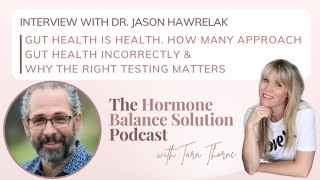
Interview between Tara Thorne and Dr. Jason Hawrelak explaining why gut health affects systemic disease and how to assess and treat it. Key takeaways: gut microbiome composition and metabolites influence metabolic, neurological and immune conditions; colon transit time is a pivotal, under-assessed metric (home test described using corn/visible seeds); ‘leaky gut’ occurs in many but not all related diseases and should be tested rather than assumed; major drivers of microbiome harm include antibiotics and dietary patterns (high saturated fat, low fermentable fiber); testing preference is for broad sequencing (16S or shotgun) plus metabolite markers rather than narrow PCR panels; primary interventions discussed are diet, targeted prebiotics, cautious short-term herbal antimicrobials (avoid long-term berberine/enteric essential oils), and clinician education (Probiotic Advisor courses).
Chapters
Hello and welcome to the past. I am so excited to have you today.
Oh, thanks Tara, it's love. Lovely being here and chatting with you on, on gut things.
Yes, all things got.
Yes, all things got.
Yeah, it's going to be good because you are, you are definitely an inspiration to me. I have been learning from you for a while now. It's been a few years. I've done a lot of more courses and now obviously I'm doing the advanced certification, which is just incredible, a wonderful certification which we can, we can chat about.
Thank you.
Yes, you have been instrumental in some changes that I have made. I've been sort of talking a little bit to my community and on the podcast a bit about changes in the approach that I've been taking as a practitioner to my clients gut health. So I'm excited to dive in. So with all that in mind, let's dive. Let's start with why gut health? Why is it so important? Why should people even care about gut health?
Yeah. And I think for people that have obvious gut discomfort or bloating, distension, gut pains, diarrhea, constipation, they care because they have symptoms that they can clearly see or gut related or heartburn for example. And there's a large proportion of people who in their western nations who actually tick those boxes would have one of those things or reflux. So it's like they're obviously getting symptoms from a gut that's not working the way that it should. But what we have learned, I would say in the last 20 to 30 years, is that what's happened in the gut doesn't just affect what happens in the gut, it actually impacts every other body system. And I think really there were some pretty. Well, I'm trying to think back when that research sort of really started changing people's minds. Maybe the first study in published in 1999, where they gave probiotics to pregnant women to prevent eczema in the child. And that was, that was pretty mind blowing at the time because at that point robotics would just forgot things, you know, for us now like of course we use probiotics for this, this and this. But at the time you only use probiotics for these gut related conditions. You would never think about using it for anything outside that. That was a game changer when published was like, whoa, look at that. We can change how the immune system functions in the next generation by having them exposed to this probiotic and, and, and arguably for life changes how their immune system actually is, is functioning. Um, and then there Are studies in the early 2000s, mid 2000s, where they are. Well, I think the P1 where they were able to induce or transmit obesity. You know, they could take a poo transplant for an obese mouse, I think it was. And give it to these thin mice, and they would get obese from. From that. With. Despite no change in calorie in. In p. They were exercising less or eating more. They weren't. They just gained weight in the same diet. They became grossly obese just from the poo transplant. That was another one of the studies that was a game changer. It's like, whoa. What we're doing to the gut microbiome alters how your metabolism works. And since then, we've done. There's been a lot more research that's been done that's linking, okay, with depression, anxiety, Alzheimer's disease, Parkinson's, multiple sclerosis, fatty liver endometriosis, ovarian syndra, osteoporosis, high blood pressure, you know, metabolic syndrome. All these things are related to gut microbiome. That's what's been pretty amazing to see in the last 20 years. It's all these. These things of. And we've definitely gone from that cor. Correlative research where, like, oh, we study people with disease and people without. And look at their microbiome, they go, oh, look, they're different. Um, which is always, like, interesting. But does that matter, you know? Or is. Is it different because the disease causes a change? And we since worked. We really worked out is, no, it's the microbiome that causes the disease. And again, we can take a, you know, a poo transplant from someone with high blood pressure, give it to mice and they get high blood pressure or to people and they get high blood pressure and vice versa. We can reduce people's blood pressure just from being a poo transplant. You're like, even. Even someone who. For me, who spent 20 years, nearly 25 years now delving into gut microbiome, I did not ever think high blood pressure would be a transmissible disease via poo transplants, you know? Yeah, it really is. And. And, you know, and I think because we talked about all the disease I listed there, it's like, that's a lot of the population right there. And even, you know, we've delved into the aging microbiome and how essentially the microbiome is a driver of the aging process or it slows the aging process too. And all of us are obviously aging. So it's related to us in that everyone's lives in that respect too. Yeah. So it is a really huge pivotal factor in our health and well being, you know, and I think the microbiome is a key component of that, but also is your gut integrity and also I would say transit time too, in that you want to make sure that things are moving well. You know, when we have a gut that's not moving well, even if you have some of the other, you know, place things in the right place in terms of microbiotic composition, in terms of lack of gut leakiness, if things transit time is slow, you're going to have a range of health problems associated just from that.
Let's talk about that. Because a lot of people are going to be sitting here thinking, well, I go to the bathroom every single day, so I have transit time, I'm good, I can tick that box off. And so a few things you said, it's microbial composition in the gut, it's whether or not your gut is leaky, which is also something to touch on. And the transit time. So in regards to the transit time, why don't you explain a little bit about why you can be going to the bathroom every day, but you actually can still have slow transit time. And what does that mean? And what transit time do we want to have?
Yeah, great question and great point to differentiate too because I think there's a lot of people there who think I empty my bowels once a day, therefore it must be fine. And even I had that bit too for the first part of my practicing career too. And you might go, okay, there's the pooh scale called the Bristol Stool chart or Bristol Stool Scale. You're welcome to Google it. If you don't, you listeners don't know it. It's got seven different types of poo on there. And people kind of make the assumption if it's in the middle somewhere and they're pooing once a day, they're fine transit time wise. It's just not true. That's the thing is when you get people to do, and luckily for us, this is, you can, you can do this in a hospital setting in a very like high tech way or you can do this at home in a very low tech way. And I choose the at home, low tech, no cost way to assess someone's viral transit time with every single patient I see and have for a number of years now, and that's eating some corn on the cob or some canned corn, black quinoa, you know, black sesame seeds kind of, and trying not to chew all that well, like, don't choke on them, but. But don't chew them particularly well because you want to be able to see them in your poo. That's the point. And you'd write down exactly when you ate them, and you write down when you first see them come out and when they finish coming out in your stools. And when I started implementing that with every single patient, I had those patients who, who every single day, never missed a day ever. And type 4 on the Bristol stool scale. So equal, like, you know, perfect poo. Ten days was when she first saw the corn pop out the other end. Now she had fatigue, brain fog, you know, bloating, distension, and symptoms I would tend to associate with. With slower transit time. But you would not have get that if you just looked at the stool four, which was the perfect four, and the, you know, frequency of bowel movements. Yeah. Whereas other people that might be emptying their bowels once a day, it's. They will see the corn after 16 hours, you know, so it can vary so dramatically. And this is why that. Doing that, that test, I think, is imperative to. To work that out. And that's why every single one of my patients does that test at baseline. So we have that. That knowledge to work with. Because when you do have stuff sitting in your colon for long periods of time, it's what naturopaths have always referred to as bowel toxemia. And I think it's a very apt term. Yes, exactly. That you're absorbing bacterial toxins through your colon or large intestinal wall, but also environmental toxins too, and hormones too, that your body's trying to get rid of. It's like one of the main ways your body detoxes is through bile, which goes into your poo, and it's supposed to be pooed out. But when it doesn't get pooed out, or if it's sitting there for long periods of time, a lot of those compounds get re released. We call it enhanced enterohepatic recycling in the trade. But essentially it's bacteria eats. Eat something and re release that compound, that hormone, that environmental toxin, and whoa, you get to get exposed to it a second time and a third time and a fourth time until we actually eventually poo it out.
Now that makes me think about, aren't there studies on how gut health can be associated with nonalcoholic fatty liver because of this very concept? Is it that, you know, you have to detoxify all these toxins if you're not pooping them out on a regular basis or if you don't, if you have slow transit time, those toxins go through to the liver. Right. And they burden the liver.
That's the first place where, where, where things are detoxed. Yeah. And, and we know that bacterial toxins, primarily what we're referring to is lipopolysaccharide or endotoxin, which is in the gram, the cell wall of all gram negative bacteria. You know, so we, so generally we're talking about micro, microbiology. We've got gram positive bacteria, gram negative bacteria. That's related to whether they took up a stain by a guy called gram. Long, long time ago, he developed a stain to put on to, to make bacteria visible. But some bacteria worked on some it didn't. So there's like gram negative, gram positive. That's where that comes from. But the gram negative bacteria have a, they just grow some special stuff in the cell wall. Like, like we grow hair, we grow nails, they grow endotoxin. It's not meant directly to make us ill. They're not secreting the toxin to harm us directly. But it does.
Yeah.
And our liver is pretty good at detoxing some of it. And we've got mechanisms on our intestinal cells to detoxify some of it too. It's just when you have an excess that produced, it exceeds what our intestinal cells can deal with. Goes into our portal bloodstream, goes to the liver. Liver will filter out most of that quite effectively for a while. But what it doesn't will cause inflammation and damage in the liver and then it floods your system. And this is where we're seeing this. Say a lot of the chronic diseases that we see commonly around us in western nations have a strong endotoxic toxemia driver. This bacterial toxins be getting through either like slow transit time in your colon. You absorb more from there too. Yep. Yeah. If you got a leaky small bowel, you absorb more of them. So this is where we have that, that triad of like a altered gut microbiome, leaky gut. So colon transit time, which is quite common in western nations. That's like horrific in terms of the actual load of bacterial toxins that you're going to be having to deal with. And as we touched on before, the liver is quite good at it for a while and then it becomes, loses, loses that capacity. And that's where we start getting the damage that occurs. And you get endotoxins float sliding everywhere. You know, we know it causes damages to the blood brain barrier. We know it changes your neurochemistry. You know, we know that people with Alzheimer's have between 3 and 26 times more endotoxins in their brains than healthy controls.
Wow. Oh, gosh. That is such an important piece of information. So anybody who is listening, who's constipated, let alone you don't even know what your transit time is, you've really got to get on top of that. Like, a lot of people think constipation's normal. Like, I have so many friends and women in my community that, oh, yeah, I'm just constipated. It's like, no, no, this is actually a very big deal.
This totally is good.
Essential drive chronic disease. So you can't cover that.
You're spot on. And it does. And there's research showing that now, too, that at one time, I think Parkinson's was seen. Sorry, Constipation was seen as a side effect of Parkinson's.
Yeah.
That's reversed. And now constipation is seen as a driver. Parkinson's. Yeah. And it definitely increases your risk of a range of even heart attacks and overall mortality. Your risk of just dying is increased if you're constipated. And that all makes sense when you understand all the extra sort of toxins you're absorbed with your bowel wall when things move slowly. Ye.
It does. It does make sense. So basically, what happens in the gut doesn't. It stays in the liver. Goes to the liver.
Yes.
And the bloodstream. And the bloodstream.
Yeah, that's right.
Okay, so a couple of points there. I want to talk about saturated fat, by the way. So I've written that down. We've got it. Because that's something that's important for us to discuss, I think. But before we go there, because you've touched on leaky gut, I think that it has become such a term that's been bandied about in the online health space. But not everybody has a leaky gut. And you can actually have a lot of gut symptoms and not have a leaky gut. So why don't we just touch on leaky gut? And you know why we. We shouldn't just assume we have a leaky gut. Not everybody has a leaky gut.
Yeah, because even if you look at the medical literature around diseases that are associated with leaky guts, and there's. There's a number from type 2 diabetes, type 1 diabetes, celiac disease is a classic one. But. But other others, too. If you take those, a group of 100 people with that disease, still, it might be 30, 40, 50, 60% of people have a leaky gut, but not 100%. Yeah. So if we end up spending all our patients money and time effort on trying to treat something they don't have, obviously that's a major waste. And that money could have been spent on something they do actually have. And that I think is one of the benefits of testing for it rather than making assumptions around it is we get one, whether it's definitely there or not. Two, we get a baseline and we can go, okay, this is how severe it is now and we could do follow up tests in six months time and see whether things have moved in the right direction. Now you may not bother to do that test if they're feeling great and life is wonderful. Like, no, that's fine. Well, that's probably all good by the sounds of it. But the thing about leaky gut, if it's very severe and it gets 50% better, it's still leaky and you're still getting bacterial toxins through there. So six months down the line because it does take surprisingly long time to heal leaky gut for many people. When you start doing pre and post testing protocols, you're like, oh, whoa. It's not after one month or two months. And after two weeks of supplementing, it's like after six months is usually when I would do a follow up test to see what progress we've made or whether it's, it's gone completely. Yeah, it takes considerably longer than one would actually necessarily assume because I think I had that thing when I first came out of training was like, oh, gut cells regenerate every few days. Therefore leaky gut must heal up in a few days. When you take out the, whatever the cause is, it just. That's not true. That's not what reality is. It's just like it's really, can be slow moving. Even when you remove the causative agent. Kids heal up more quickly in general when that's the case too with leaky gut. But you know, you're looking at a six month sort of protocol before doing a retest and if they don't have that condition, that's sort of six months wasted that could have been spent elsewhere.
Yeah, good point. You know, true healing really takes time and I think that a lot of people don't realize and it's kind of frustrating sometimes to us clinicians I think, because we know what's possible, we know they can feel better, but if they're trying to feel better in a couple of weeks or a Month or two, they're going to miss out. I often say you don't walk, and I don't know who said this, but I've stolen it. You don't walk 10 miles into the woods to walk out in five. You gotta stick with it and be patient because true healing is really possible. But you gotta, you gotta be patient.
Yeah. And typically the longer you've been unwell, the longer it takes to get better. I mean, I think that that rule tends to come. There are always exceptions to that, but I think in general that that is a true aphorism. Like if someone has just taken a, a medication like a nonstero anti inflammatory drug that caused their gut to be leaky for, for two weeks, otherwise it was fine, that's not going to take six months to heal. Yeah, but if you've had leaky gut for years, you know, then. Yes, it's going to take a long time.
Yeah, absolutely. So just a quick question then, in your experience not everybody who has an autoimmune disease then has leaky gut, is that correct? Correct.
At least at the time that we're potentially working with them. And that might be different at two years in the past or five years in the past. You know, when that initial initially diagnosed or that that disease process evolved, it may well have been leaky at that point. Yeah. Whereas when we're working with them right now, it may not be.
May not be.
I mean, I think I can understand the reason behind just making that assumption with autoimmune disease because there is a strong correlative link with the research. But when you go into the fine nitty gritty of those links, there's still a lot of people who don't seem to have it at that time. And it still means that your money, your patient's money is better spent on another thing. They need help with that rather than trying to treat the leaky gut that they don't have.
Yeah, absolutely.
Yeah.
So let's talk about. Okay, let's, why don't we talk about what are the drivers of poor gut health? So maybe antibiotics would be a good topic. Saturated fat would be a really good topic because of the keto and the carnival craze that's going on. But maybe we can just touch on. Yeah. What contributes to a poor, to poor gut health?
The big question, there's a lot of, a lot of animals because of, of living in Western nations. We're exposed to a lot of things that cause either gut integrity harm or microbiome harm. Yeah. And your, your Spot on. Antibiotics are definitely the, the biggest driver of microbiome harm. You know, they, they want to do dramatic shifts within days. You know, like absolutely massive shifts in composition and irretrievable changes too. I think that's the thing that's important for people to note that it's not like you can take horse antibiotics and it'll go and then four weeks later it'll be back to normal. It's like. No, it's actually, it'd be normal. Ish. Typically after four weeks. But we can look at the research. It's like a study published in Gut a couple years ago that showed nine species permanently lost from a single course of IV antibiotics. It wasn't orally, it was IV and nine species gone. Yeah. So if we think about how that might add up. So of course, you know, with antibiotics over our lifetime, the impact on our diversity of our ecosystem, our richness is obviously demarket from that. And I grew up in the 1970s and they were given antibiotics for everything. Oh, you've got a sniffle or a cough, boom, boom. So like most years I would have had three or four courses, I'm sure growing up, which was typical at that time point. And I look at my ecosystem richness now, it's like it suffered from that and it's not easily retrieved. You can't just pop some probiotic pill or take some kefir or some sauerkraut. It's not going to fix that. They can be useful tools to help in the quicker restoration to a better new set point, but they can't replace the function of the species that you've lost. I think that's the key thing. And nor do they permanently colonize. And that's one of the other myths that's widely promoted, is that if you wiped out your bifactory, we'll just pop it in a pill and you'll be fine. It's like no, they don't stay, they don't stick around. That is clear. Like they'll stay for a few days with a good strain, maybe in days, but then they're. Every single day their population diminishes and then they're gone from that point. So it does bring up that idea of custodianship too, of really, I think people have to be really aware of what you've got and how sort of fragile it is. In some ways it's robust in that it will rebound in some fashion. Whether it be chemotherapy, radiotherapy. Antibiotics are probably the three that cause are really acute dramatic changes. And yes, it will bounce back, but it will never look quite the same.
Yeah, right. As it did before, you know, jumping in there. But my daughter recently, as you know, we went to Canada and my daughter got a cat scratch on her eyebrow and went to the hospital. She had to get a couple of stitches. And I said to my husband, they are probably going to give you prophylactic antibiotics. And I said, just ask the doctor. Is it okay if we just wait a couple of days and see, you know, the doctor said, yes, it's fine. So we actually waited. It was like four days in, and then she came to me and she said, mommy, I don't feel good. And she did have a fever and I, I was like, oh, crap, you know, like. And I didn't want an infection to, you know. So we ended up giving her some of the antibiotics, but then she wouldn't take them after a few days because they were huge pills and we had to fly back to Australia. And it was kind of a blessing in disguise because then I spoke to another doctor when we got the stitches out, and the doctor said that fever was probably unrelated to the scratch. But I was like, damn. Because I knew the damage. Just a few days of antibiotics could do. But they.
Yeah, but it's even out. Yeah, yeah, they totally are. But you've got to balance out for when it is. They do save lives and they do save lives.
Well, that is absolutely correct.
Exactly.
That's right. You've got to take them to. They say lives. Absolutely. So they've been a wonderful invention. But, you know, if it wasn't for my knowledge around this, I would have just probably taken the prophylactic antibiotics, you know, told her to take them. So I think we need to also be careful and judicious. When we're. We're told just to take them, we have to push back and say, well, is it really necessary? And if it is, you take them. And if it's not.
Yeah, you wait. I think it's totally spot on. It's like, is this going to be helpful? Because there's a study published just a few years back where they looked at the. What patients got if they went to their GP with viral bronchitis. Right. 80% of them went home with antibiotics for viral lung infection. You know, and you're like, we, we, you know, it isn't going to work for that. And even the rationale that it prevents a secondary bacterial infection is actually not based on evidence either, you know, but. And you're causing harm. And that's one of those Ones if you push back. Like do I really need this for a viral infection?
But also the microbiome impacts the lung. Right. We've got a. Yeah. Lung axi.
We've got totally everything. Yeah. And we know that immunity dips after antibiotics too. That's through the microbiome harm.
Yeah, yeah. So antibiotics. We antibiotics them that you know, obviously food and stress and lifestyle impacts the microbiome. Let's talk about fat.
Yeah. Because this one is, is more controversial these days.
Yes.
Before.
And I'm giving up my butter, by the way. I'm not doing it. I will give up other saturated fat, but I can't give butter.
I switched olive oil like 20 years ago and have them.
Yeah. So yeah, I love olive oil but I, I don't know when I have my odd piece of gluten free toast. Ah. Olive oil is not the same.
No, it's, it's, I would argue better, but you have to. Yeah. I drenched it with mine with olive oil.
Okay, I'll give it a go.
That's why I love going traveling in like Italy or something because every single table has olive oil which is I love. Whereas I go to France, it says butter. I'm like, I don't want butter. You just need some olive oil, please. Yeah. So and I think, I mean it is interesting because we know that, that you know, sunflower oils and seed oils do have some harmful attributes. Particularly their high Mega 6 content is unhelpful in today's day and age where we're exposed to make six fats which are pro inflammatory way too much like we do need them. But even just small amount and we have way too much. Yeah. And they can be kind of harmed during the cooking process too. So I think that has led to many people to latch onto, you know, saturated fats as ways of, of around cooking because they don't have mega 6s in them. So they're neutral from omega 3, omega 6 ratio. And they, they tend to be a bit more stable in the cooking process. But I do want to point out that over the last I think five years, the research has shown that extra virgin olive oil, totally stable to cook with. Totally fine. And there's even researchers putting out that we should be cooking more because all the food you cook in, it gets healthier when you cook in olive oil. It soaks up the lovely anti cancer, anti inflammatory polyphenols. When you eat that vegetable, you're actually getting, getting it. Oh my God. Yeah.
That's all I used to cook with. I didn't know that. That's cool.
Yeah, it is cool, because I think there's that. That general conception that, no, don't cook with extra virgin. And you try to trace that. That back. And it comes, I think, partly to this thing around smoke point, and only looking at one thing, the smoke point, not looking at the antioxidant compounds and how that might counterbalance that, which it does, by the way, but also looking at some of the research that was done in the early 2000s on refined olive oil that. That showed it did not cook well. And then people took that to mean extra virgin oil is the same as refined. Refined is where they take these horrible solvents and pull everything good out of the olive oil and just leave the fat bit and. Yeah, no, that's not good to cook it and it should not be eaten. But yeah, it's just important to trace these things back to their origins, but moving probably away just from, you know, cooking oils, et cetera, too. I think it's important to understand that our microbes, what microbes we grow depends on what we eat, because I think this is sometimes lost, and I think also lost in that there are microbes in our gut that eat bile, the microbes in our gut that eat protein, microbes in our butt that eat fiber and sugars and oligosaccharides and polyphenols. And, you know, so if we go in a dietary protocol that is higher in fat and higher in protein, you feed microbes that eat protein and eat bile. That's. That's the cause and effect. It's very straightforward. Yeah. It's not. Not complex. It's like what you feed grows. If you don't feed them, they don't grow.
Yeah.
For the rest of. If you're not feeding fibers or oligosaccharides or polyphenols, those populations of the bacteria all go down. It's just we know that those. That when protein is putrefied or fermented in the gut, it's not a clean process. We get less intestinal gas. Yes. We get a lot less hydrogen being produced.
And that's why a lot of people do these type of diets.
Exactly. Because you do have less intestinal gas produced, less hydrogen being produced that. That hydrogen that is produced tends to be shunted through to become hydrogen sulfide gas. That is one of the downsides. But that won't necessarily manifest in the short term. Yeah. Because hydrogen sulfide gas causes colonic inflammation. It causes leaky gut. It causes what we call visceral hypersensitivity where the nerves in your gut become hypersensitive to stimuli. So they start reacting to small amounts of gas. And they do these research studies in people with IBS all the time. They have these special balloons that put up your bum. They pop up these balloons and people with IBS get pain, discomfort when their blueness is this big. Whereas normal people, it's this big before the same degree of pain because the nerves are hypersensitive. And we know that hydrogen sulfide gas makes your nerves hypersensitive. So people get in this cycle where they're like, they cut out these foods because the nerves are already inflamed and they're like, oh, I'm producing less gas, therefore there's less discomfort and pain associated with eating. But they get more hydrogen sulfide gas being produced which actually makes the nerves even more sensitive to them. Might go, okay, well I wanna bring some fiber back in. And then they feel even worse gut wise than they did before. So you get this really negative feedback loop and it can be really tricky to pull out of if you've been in it for long periods of time. But also it's I, I can see why people kind of lean that way because it's kind of it really, they eat this way, their pain goes, goes down and they just don't understand the longer term complications. And this you see clearly if you do microbiome analysis like oh, you're full of hydrogen sulfide gas producers and you're full of endotoxin releasing bacteria at really high amounts too. Because that's the other thing that comes to. Because they, the bacteria that produce the most pro inflammatory endotoxin like growing at a sort of more neutral ph in the colon. And we achieve that with a higher protein, high fat diets and more neutral colon ph. We prevent that by having fiber. Yeah, like fermentable fibers, great short shape fatty acids which then bring the acid level up and the ph level down. And that suppresses the growth of these sort of more nasty proteobacteria. But so there's dietary protocols that have taken out the fiber fermentable fibers. You are essentially changing the conditions in the colon to make it more inducive to the runs that are problematic and providing food for them in terms of bile and amino acids too. And so you end up getting this abundance of hydrogen sulfide gas producers, abundance of lipopolysaccharide releasing bacteria in your gut. And then the downside with the saturated fats too is they actually bind to endotoxin and Increase their absorption too. So you get like a double whammy there too. Because you're. Yeah, but I said some of these things take time to manifest, which is.
Why that's the key, that's the key point.
Yeah.
And that's why these people, they, they do turn to these diets for symptomatic relief and they think they're working for me. I feel great. But they don't realize. Yeah. The long term ramifications and consequences to the microbiome and ultimately they'll probably end up feeling not so great.
Yes. Yeah, that's really been my, my experience. Those people, the longer they've been on those diets, the harder it is to, to come back because your gut is so inflamed and so sort of visceral sensitive. Visceral sensitivity is so high that any sort of gas bubble, even this tiny little gas will that big, will be enough to cause you discomfort and pain. So it can be hard. You have to try to wait, build, build back. And we know that if you starve bacteria for long enough and reduce, just do not feed them for long enough, they will die off too. And that, that process too. So in the short term, the extinction level from, from starvation is not, not such a real thing. But with longer term, and we don't know where that, that cutoff is and would differ per person too. And whether they took antibiotics during the process. There's a bunch of things that can impact that because if we're starving off bacteria and taking antimicrobial at the same time, we tend to their populations already tink, you know, on the edge and then boom, there. They can be more easily wiped out as well. Yeah. But it is an interesting thing that's not widely discussed. The impact of saturated fat on binding to endotoxin, increasing its absorption to get more into your bloodstream. I mean, I see this heaps.
Yeah, I'm starting to see it now that we're running these different types of stool tests. I'm definitely seeing it. I'm seeing it.
Yeah. And that's a pudal point actually using a stool test that doesn't allow you to see very much.
Yes.
There's a bunch of things you won't see.
Let's quickly talk about testing then. So before we wrap up, why don't we just sort of talk a little bit about what's the solution then to somebody who's listening and you know, is struggling with their microbiome, what path do we take? And it, and it includes testing, but the right kind of Testing?
Yeah, because I would test these days, every single one of my patients, with the odd exception, would get a microbiome assessment done because I want to see what. And they do a stool transit time. And if I suspect leaky gut or have they have a disease that's associated with leaky gut, we will always test leaky gut at the very beginning. Like let's get that data. I might do other tests too, depending on what else is going on for them obviously. But those ones are pretty core because they answer those three things. I think those three things are absolutely pivotal for everybody's health. It's got integrity, gut transit time, microbiome composition. But yeah, microbiome composition. We do have a range of tests available. And as someone like I've been a clinician for nearly 25 years now and working in the gut health realm because my honors degree and PhD were around dysbiosis, how we could change the microbiome in using prebiotics, probiotics and herbs. And that started in 2000. You know, I even started my literature review four month thesis 25 years ago now, today, you know, around this time.
Oh really?
So yeah, yeah, so long time. It's been interesting seeing how testing has changed. You know, like what we had access to back in the late 90s, early 2000s were the classic CDSAs or CSAs, comprehensive stool analyses where you'd look at four, four different types of actually maybe five that show up on your, on your stool test. And then that, that morphed soonish to, I think the first GI effects came out and they had 12, oh my God, we can see 12 different species of bacteria. That's peeps better than four. But given that we can have 150, 200, 300 species in people's guts, it's a pretty small shot of the ecosystem that we had from that. And their patients were paying $800 a pop for those tests back in the day. $800 to see 12 bacteria numbers. And so yeah, and then as technology evolved and became cheaper, the stuff they were using in research circles started trickling down to patients and practitioners. And that resulted in labs like ubiome, which was the first direct to consumer or clinician test that used 16s DNA based technology. And that allowed us to see the entirety of the ecosystem, all the different bacterial species there in the relative amounts for about 100 bucks, sometimes $50 a pop. You know, it's like it was a treat for someone that had a microbiome nerd to like, well, wow, we can see everything that's bloody there and not not break my patient's bank. And we could do follow up tests to see what changes. You know, it's hard to justify that when it's $800 a pop to follow up after three months. You know, sometimes you have to, you know, depending on the condition people you're treated, et cetera. But now became like available for everybody. You know, it's like microbiome assessment, good quality, whole, see the whole picture. And then that sort of shifted to. So we still have access to some 16s tests, but not you buy them. I think they're doing some dodgy stuff with insurance companies to get double payments apparently. But the technology itself was good and the results were accurate. It's just the dance and business practices. It sounded a little bit questionable. Yeah, yeah. And that would be like labs like Ombre and Vitrakt or Biomesite in the UK are ones that use 16s technology. And there's other ones that use. Probably the optimal way of assessing was it's called shotgun metadomic sequencing where they can look at not just the bacterial component, but fungi and protozoal from that too. And again you get to see its entirety. Now in between that time we were using scientists were using pcr. PCR is still used for certain things in microbiology world and always will be because it's very good at spotting things at very low numbers. But the tests that we have access to as clinicians that are using pcr, many of them, not all, many of them give you a pretty small snapshot of the entirety of the ecosystem. That's one of their drawbacks. The drawbacks that they can't see everything. Yeah, you don't get this comprehensive view and relative proportions of things which is I think imperative. We want to know what diversity. Want to know about species richness, genus richness. Those things require either 16s or shotgun sequencing to see. Yeah, PCR tests can't do that because they don't see everything. They only see what those little things that they're looking for. And they can vary with that too. Like some will have a longer, wider range and some will have a smaller range on PCR testing. So you know, like Doctors down in GI360 has got a pretty comprehensive, quite a good coverage, vibrant. Zeomer has got a pretty decent coverage too. And then you've got other ones that have a much smaller range. And some of these are referred to as sort of pathogen deep dives that they've got a whole like four pages of pathogens. But like Nine different types of beneficial bacteria listed there. And even then they might have Bacteroides fragilis, which is one species of Bacteroides, which is problematic and I want to know about it. But it ignores the other 21 species of Bacteroides that I really want to know about too, which is really challenging if I can't see them. Or microbes like Allostypes, which is another one that is definitely problematic and overgrown in many western guts. Or the main bile eating microbes group that is commonly overgrown in westerners is called Bilopyla. Yeah, it's bile loving. That's what the name comes from. It thrives on a high saturated fat fat diet. But if your test can't see Bilophila, you do not know it exists. And it doesn't. It means you don't know that this hydrogen sulfide gas producer who thrives on high fat saturated fat diets is there and causing your patient harm. You know, So I think there's some major issues with some of the PCR tests, which for me means I will not use them in practice because I really want. We know that diversity is important. We know that richness is important. We know that Bilophylla. It's important having a broader view of the, you know, species breakdown is.
And the metabolites.
And metabolites too. Yeah.
You can't see that on pcr, right?
No. Yeah. So I, I really, really strongly teach and urge clinicians to, to ensure that we look at the entirety. Like, there are still some lovely bits on a CSA test that looks at stool ph and shredded fatty acid levels and calvitectin, lactoferrin. I love those bits. I do. They're helpful to fit in with another test that will give us the entirety of the ecosystem.
Yeah, yeah, for sure. Thank you. That was a great explanation and I feel like we could talk forever, but we've got to wrap things up, you know, and basically, you know, just to sort of wrap it up, I guess just in a nutshell, how do you like to work with the microbiome? Obviously, food is pivotal. Right?
Yeah.
But then you also use other tools. What are your, your main tools when it comes to the microbiome.
Yeah. So I think your spot on diet is, is key. But I use a lot of prebiotics too. Yeah. And. And prebiotics is one of those terms that's mentally misunderstood and misapplied. Yeah. So people are like, oh, any fiber is a prebiotic.
It's not, it's not.
Prebiotics are selectively fermented. And encourage the growth of one or limited number of beneficial microbes. And that's clearly what they do. You can get someone's low in bifidobacteria, I can give them a Peabody that feeds me a bacteria. And you see it go up very, very clearly. Now if we had them eat just a range of other fibers, you'll feed a range of microbes, which isn't a bad thing at all. It just is a different thing. So often when we're working in ecosystems, yeah, we're increasing the diversity of Toma's diet. We're having wide range of fiber types, totally wide range of colors. We get lots of polyphenols to feed good bacteria, all that. But we're using tools specifically target. Oh, their bifida is low, their Phaecali bacteria is low, their Akkermansia is low. Let's feed them. And these, these tools we can use specifically feed them like a fertilizer for those that generally only those bacteria can use. And their populations go up very, very clearly. And one of the added bonuses we often get is a decrease of pathogens and pathobions too. So the bacteria that we'd see is more harmful, more pro inflammatory, go down with prebiotic use too. And you see this clearly on stool testing and in the research. And that's why I love prebiotics so much because they have that capacity to be selective that they bring down levels of bad, you know, bad bacteria to be very, you know, short about it and increase levels of beneficial bacteria quite clearly. So prebiotics and diet are huge. I do use herbs for certain types of overgrowth in certain amounts to.
But you don't use, to be very specific, you're not a fan of these enteric coated essential oils. You use tinctures because they're less damaging to the microbiome.
Yeah. And I think because my, my thesis was around, my honors thesis I wrote in 2000, I had had like huge, really thick most. It was about the wonders of the microbiome. Yeah, it's like this. How wonderful. And that was back then, you know, what have we learned since then? Yes, yes it was. And we had this idea that maybe herbs could cost because all these herbs can kill bacteria, bad bacteria in test tube studies, et cetera. So could they harm beneficial bacteria? So one of the research projects I did as part of my PhD was doing some microbiology work in the lab going, okay, let's put some of these herbs on these bacteria and see whether our good bacteria get killed by some of Our herbs too. And we found that it did not like some things were selective. Like garlic was quite selective. Great. But we used oregano, oregano, oil, and it killed your bifida three immensely. Well, berberine, you know, killed bifid bacteria immensely. Well, your lactobacilli were generally okay, but the bifidacteria were smashed by it. Given the concentrations that that would harm bad bacteria, also harmed your good bacteria. And. And that to me was probably maybe 2001, 2002, we did that microbiology work. So it's always been in my mind that herbs can cause harm if they're not chosen well and in the wrong form because, you know, oregano. I think unless you're a herbalist, sometimes the fine nuances of herbal products can.
Oh, yeah.
Not really be on your radar. But you have like oregano that we make in the tea. Oregano we take as a tincture. Oregano we take as an essential oil. Let's just say there's those three different oregano type preparations. The essential oil just takes out the really the volatile components that they get from steam. That's. It leaves everything else behind. And it turns out that those volatiles are immensely antimicrobial, but they also kill off good bacteria. If you use tea, tea pulls out a range of polyphenols from the oregano and pulls out a little bit of the volatile components. And it is very selective. Yeah, not as nowhere as potent, but very selective. Yeah. And then the tincture is in between. There's a tincture we're using for alcohol. Alcohol pulls out those volatile. But we're also getting the polyphenols. We get the best of both worlds with a tincture, but at far lower broad broadness in that we. It. It still maintains its selective nature, unless you go really, really high with the doses, in which case it's harmful. And it's just sometimes knowing those nuances, like, ah, o. We can give the herb like this and we can get the benefits of them without any of the negative drawbacks like you get with entericota essential oils, because it's a ton, like a lot of oregano goes into making a few drops of essential oil, you know, to give some context on that. And then the other, other compound that I'm very cautious around is berberine. And that grew originally out of my research where I saw it kill bacteria. My. My petri dishes. I can't just unsee that. It's like, whoa, look at that. Garlic didn't do that. A bunch of things didn't do that, but berberine did.
And so many people are taking berberine these days for blood sugar metabolic health.
And listen, the research is clear, it does do those things. It's just that it helps damage to them the microbiome with longer term use.
And you already said that the microbiome supports metabolic health. So what's the better option? Take berberine or support the microbiome.
Yes, I hear you. And there's different ways to achieve. Like you can improve blood sugar control by taking a prebiotic. Okay. And you get a win win situation. Yeah. And you can take St. Mary's Thistle. Improves blood sugar control. That doesn't have the killing effects. Nigela sativa black seed. Improves blood sugar control and cholesterol levels and doesn't have the metabolic harm that you get with berberine. We have other tools that have lots of randomized controlled trials showing that they work that don't have the microbiome harm that we get with berberine. So for me it's like why, why go there? You know, listen, I've got a, you know we talked before and I'm dealing with the dental abscess this morning. I'm taking a berberine containing herbal right now to treat this dental abscess and I will do so for 10 days. And these herbs that contain berberine were used as antimicrobials for thousands of years and they were used for short term use. The idea of going let's take them daily for years is immensely novel and goes against how they were used for thousands of years. And the traditional literature if you delve into it was like don't take these for long term use because they will cause harm. They're appropriate for short term use. Long term harm, you know, harms the gut from a TCM perspective. It harms the gut. And I think, well that's true. They were spot on. They knew it. They're able to observe that thousands of years ago. These things are right in the right time, the right dose, they're wonderful tools. But too much is problematic. And I think what we know now from looking at the research around long term use of Berene and it's sadly not very well reported in the blogosphere, you get blooms of harmful bacteria and you get massive reductions in bifidobacteria like I saw in my petri dishes, but also your across the board in a range of bead rate producing species. So healthful anti inflammatory species go down yeast have these blooms of bacteroides and a range of you get more E. Coli, more citrobacter more, Interrobacter more, Klebsiella. These all bloom with long term use of berberine, which is kind of crazy because people are thinking the short term it can suppress those things and sometimes it can. But I think in the longer term you get these growth of those bacteria, including, and also fusobacteria, which is when we associate with, with breast cancer, colorectal cancer. It's a really nasty bacteria I don't want more of. And Berben causes you to have more. So it's just like, I think you just have to really rethink tools that we're using for metabolic health. Never mind the fact that I think if we don't do lifestyle and dietary work and just go, hey, pop this pill. We're not treating the cause. You know, whether the pill is herbal or pharmaceutical, it's still like including the cause.
Exactly. That is a very valuable information. Thank you so much for your time. Now we'll wrap up because we've been talking for a while. Like I said, I reckon we could talk for a lot longer, but luckily I get to speak with you on Monday. So why don't you tell the listeners? Where can they find you? Tell everybody who's listening about Probiotic Advisor. Your website, your certifications, your courses. You've got so much out there.
Yeah, we start off doing. I've been in clinician for, you know, I said nearly 25 years. So I still see patients within my practice, the Horlac Gut Microbiome Clinic. And that's kind of our main focuses are Gut microbiome and I've got some colleagues who work with me too because there's so many people in need of help, some support to work with these people. Then the Probiotic Advisor is a sort of evidence based database I started, essentially grew out of my teaching that I was doing in the early 2000s of these paper documents I had about the best research on different probiotics, where to find those probiotic strains. And over a decade I just had, I was updating these paper documents and they're just getting huge. Had three different piles of paper. They had just been rearranged. No, I need to put this into a database. So 2014, we shoved all that into a database. So it makes prescribing probiotics based on evidence that clinical trials, easy. There's that. And then, you know, I've been teaching, you know, microbiome support and gut health how to treat gut conditions with, you know, naturopathic or functional medicine for a long time. But more Recently I could have it went from having shorter courses to doing, okay, let's do a proper, you know, certification course where we can just do like these 10 week deep dives in these areas. So we have, you know, naturopathic and functional medicine approaches to, to treating gastrointestinal conditions where you become a certified healthy gut practitioner. And I've chose that term specifically because we, our saying is like where the microbiome comes first. It's like we often have ways, numerous ways we could treat a condition, some of which were cause microbiome harm, some don't. Let's go with those that don't. It sounds a bit like a no brainer, but it's not how it's generally practiced. So it's really trying to come back to, okay, how can we treat something that actually in a way that supports the microbiome and doesn't harm it? Yeah. And that's the underlying driver of the focus with how we treat gut conditions that we cover. And then we have a second course which is becoming advanced microbiome manipulation to become a certified microbiome analyst. Because as we kind of alluded to, there's been so much research that's come out in the last 20 some years. You know, it's when I started I could read every single microbiome paper that was published that year and all beforehand. You know, like even for honor seasons, I would read every single paper in the microbiome, the 70s, 80s and 90s up to that point. Now there's like 30,000 papers published a year. I know so and because, and our advances in knowledge and understanding, you've expanded so much too. So my focus is trying to essentially create, you know, microbiome literate clinicians who can know what microbiome tests to do, how to interpret them, and how do you apply a range of tools to get the best outcomes for the microbiomes. And this become only more and more pivotal as time goes on. Like one of the lectures you would have covered earlier this term was around chemotherapy and cancer therapy. And it's now coming out that your microbiome composition can essentially dictate whether you respond to a cancer treatment or not.
Amazing.
It can be the factor that determines whether you survive a cancer diagnosis or not. It's mind blowing. Again, partly not surprising because of all the stuff around microbiome, but stuff like that is going to shift. Yeah. And, and soon they'll be actually screening people's microbiome before they work out whether they start cancer, what medication they use, how we can modify the microbiome. This is going to become, you know, essentially pivotal in, in, in, in treating a range of conditions that we're seeing in practice. So there's a need for people that are, that are really microbiometer. And that's been my, my key passion and focus is trying to train up those clinicians to take that role. Because I see people who don't have that training who are inadvertently, yes, causing, causing, causing harm. And not they're trying to. It's just that they don't have the skill set or understanding to know that what they might be testing, might be ordering is not the best one. And the tools I'll be using are not having the best outcomes in the broader looking at for microbiome Health.
Thank you. And I cannot say enough good things about you and your team and your courses. So we will link to all of that in the show notes. And thank you again so much for your time.
You're very welcome and lovely to chat. And yeah, we could spend hours chatting very easily.
Yes, we could. But I'll see you on Monday. Yes, thank you. Jason, thanks for listening to the podcast. Make sure you're subscribed and that you're following me on Instagram. I'm Arathorne Health. I would also be forever grateful if you'd leave me me a five star review because this helps the podcast reach more women who need this information. And if you're interested in working with me, check the show Notes for more information about how you can do that. I look forward to connecting with you again soon. I am not a medical professional and the information provided in this podcast is for informational and entertainment purposes only. I do not have access to your individual medical history or circumstances circumstances. So the content discussed here should not be considered as medical advice. Before making any changes to your diet, lifestyle or considering the use of supplements, please consult with a qualified healthcare professional or your doctor to ensure it's safe and appropriate for your specific situation. Any decisions you make based on the content of this podcast are at your own discretion and risk. Thank you for tuning in.
In.
More from Dr.



Ep. 72 Interview Dr. Jason Hawrelak: The Last Microbiome Episode You Will Ever Need







