Dr. Allen Nazeri explains how dental implants work, why they succeed over 98% of the time, and why cheap imported implants can leave you stuck. Titanium roots bond to bone through osseointegration, a process discovered in 1965. Major brands like Zimmer and Straumann have parts available; knockoffs often don't.
A dental implant basically replaces a root of a tooth and is made of titanium. Professor Brandenburg in 1965, he coined the term osseointegration. Osseo means bone integration, means to integrate. It becomes uniform. So when an implant becomes part of the bone, the term is called osseointegration. The success rate of dental implants have really reached 98% plus. Okay. And there are many advantages to dental implants. One of the advantages to dental implants is that it provides a single tooth replacement. See, if you remember what we showed you earlier on the bridges, the options here would be a removable bridge. Okay. Or a fixed bridge. Well, a fixed bridge will require grinding the adjacent teeth down to put caps or crown. Well, this is a much, much better alternative because not only the bridge things are connected anymore. Okay. But so you can really floss between the teeth because it's individual tooth. Now if you place an implant, but also the fact that you're not damaging any of the teeth. Okay. Or if any of the teeth, something goes wrong with any of those teeth, the whole bridge is not destroyed. Okay. The removable bridge, again is the most economical way. Sometimes for implants, the patients have to wear a removable while they're healing. But the whole idea is to have the most.
Tooth like replacement with dental implant. Again, the disadvantage of a fixed bridge here is that if anything goes wrong with these teeth, the entire bridge has to be removed. And the cost wise, it really costs a lot less to have a single implant than three and a crown and then having three crowns there. Okay. So advantages of dental implants.
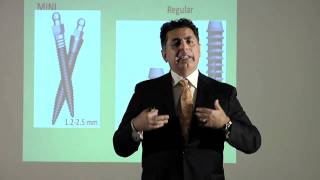
Dental implants can also serve as abutment for several teeth. So if you're missing several teeth, you really don't have to replace every single tooth with an implant. You can put an implant on either side of that space and connect it with a bridge. There are different types of implant in the market. There's a mini implants and there are also what's called regular size. And there's lots and lots of confusion on this because mini implants are very narrow diameter. Mini implants were designed for.
Dentists back in the early 90s. So they can place the dental implants in the jawbone for patients who were having full mouth extractions done, so it will support their jaw. The purpose of the mini implant was really to be more transitional type implants. Implants that needs to be replaced with other forms of implants later on. Well, 18 to 20 months later, the dentists found out that they could not really remove A lot of these mini implants and they were really secure. So the company became somewhat aggressive in marketing it and they started showing more proof that there is long term stability with these mini implants. And, and they started putting out lots and lots of courses for the general dentist to go out there and learn the implants. They're much easier to place because of the narrow diameter size of the implants and it costs a lot less to purchase them for the dentist to place them in their practice than a regular size implant. However, lots and lots of dentists are basically overusing it in their practices. We see sometimes that the implants are placed and then there are bridges anchored as an anchor for bridges and so forth. So you really need to understand if you're having any implant done, is the dentist providing you a mini implant or a regular implant? Okay, so when you see sometimes prices here and there in the newspaper, you know, $500 for an implant, they don't tell you what sort of an implant it is. It is generally a mini implant, not a regular type implant there. Okay. Then we have also what's called premium brand versus off brand type implants. The premium brand implants are from companies that have been around for a very long time. They have exceptional customer service. They have lots and lots of capital behind them to support the service and the quality of those implants. The off brand implants. There are a lot of the companies from China, Korea, other areas that have moved into the marketplace with these low cost implants. The problem with them is some of them are not FDA approved. Some of the ones that are around, they're only around for a few years before they're gone. And what's that's important is that the patients can run into some issues and problems. We had a patient in our practice that she had one of these done and we could not figure out what type of implant it is. We finally found it was an import from Brazil and we had a very hard time to order the parts that attach for the caps or the crowns, the abutments and so forth. So we were not able to do it. So we had to remove the entire implant, do surgery on the patient, graft bone and reimplant again. So these are the problems that we see we run into because.
The implant company is no longer around, or they don't have customer service here, or they're being bought by another company and so forth. So it does cost a lot more for a premium type implant. But you do need to stick with premium companies and we'll talk about what those are. There are generally about over 200 implant companies out there. Some of the major ones is Bicon, Zimmer, Strawman, BioMed, IMTech, like Strauman, for example, is a company that used to make all the precisions and Cartier and Rolex watches. So, you know, it's a big company, been around for a very long time. They've done a lot of hip, you know, titanium replacements. Different things. Same thing with Noble Biocare. Zimmer Bicon is a company that I'm very prejudiced about because of many reasons that we can talk about a little bit later on. But it's been around like, you know, almost 30 years, and they have proven track record.