Dr. Doni Interview on Headstart with Karen Davila
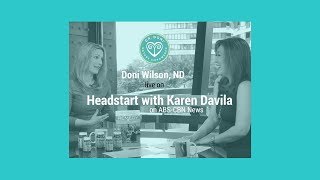
Dr. Doni Wilson shares how to reduce bloating and anxiety through diet. Cut sugars and carbs, eat more protein and healthy fats, and try an elimination diet for 2-3 weeks to find your food triggers. She recommends a seven-day reboot plus supplements like B-complex, ashwagandha, and probiotics to support digestion and stress.
Chapters
I want you to name foods people watching on television. So it's practical. Can you name foods that will help them lessen? Gas and bloating, for example. You know what? They're gonna start today. And they say, you know what? Oh, my God, I'm inspired.
Yes.
What can I cook from the kitchen?
Well, what I would start with is to decrease the sugars and the carbs that would overfeed those bacteria and cause the bloating. So start by decreasing that, and then you want to eat the foods that don't overfeed the bacter. So that would be like healthy proteins. Fish.
So, yeah, so you eat fish, chicken.
And then you want to have healthy proteins. Did you have pork? Yes.
I mean, okay, pork, beef, whatever.
And then healthy fats. A lot of times, for a long time, we were told to avoid fats. You know, like, fats were bad, the evil, and you needed to have zero. But now we know that's not true. We need healthy fats. Our bodies need healthy fats for making hormones, for having healthy skin for so many purposes.
Yes. And what are healthy fats? So you have a virgin coconut oil.
Yes, you can have coconut oil. You can have olive oil.
Avocado.
Avocado oil.
Can you have too much. Can you have too much of avocados?
You could like anything. You could have too much of anything. So you want to have a nice balance. Say I might have a quarter to a half of an avocado at one time and then eat the other half later.
Yeah, but I think essentially what you're saying is you don't have to fear facts. Okay, but we'll talk about diets later. Joint and head pain. Let me. So we talked about disrupted sleep and insomnia. This is interesting. Frequent colds and infection. So we'll talk about joint and head pain and frequent colds and infections. People blame it on the weather. I do.
And sometimes people don't realize that head pain or say, anxiety is related to food. You know, there's something called the gut brain connection where we now understand that what's happening in our digestion affects our nervous system, that the symptoms, like even anxiety or depression is not just in our head. Our bodies are connected.
So what foods can trigger that anxiety?
Same, really. It could be the sugar, it can be the gluten, and for some people, it could even be dairy products. So you really want to learn for yourself which foods could be triggering your nervous system.
And if you're unable to take a test, you can be more sensitive to your body, how it Reacts what you.
Could do if you wanted. There's something called an elimination diet where you take it out, take a couple weeks of time, and you say, okay, I'm going to eliminate these foods for a couple weeks, two weeks, maybe three weeks Journal, and notice how you feel.
Good one.
What do you notice? How are you feeling? And then when you get to the end of that, say three weeks, then you add those foods back one at a time and you again, journal. How do you feel now? Do you get a headache now? Did you get a rash? What are the symptoms that reoccur when you add those foods back so you.
Can do it on your own now? People could be thinking, it's so depressing to live without snacks. I know. I mean, I want a cookie, I want chocolate, I need a brownie.
Well, this is why the unity. We have healthy options.
So what kind of sugar then.
Could you replace if you're about to bake a cookie?
There's so many.
And what kind of flour?
I think people will be really surprised. And this is what I tell my patients. You just have to be willing to be curious and explore new options. Go to the store like you have a healthy option. Store. Go learn of all these different alternatives because they are alternatives to sugar. For example, stevia is a plant that's sweet. The leaves are sweet, and they can turn stevia into a powder or a liquid. And you can use it in baking.
Yes, I agree. Go. Yeah, agree.
It doesn't affect your blood sugar and it doesn't affect your insulin, and it's not a chemical. So it doesn't have the negative of artificial sweetener.
Yes, okay. And other than stevia, the flour, for example, I mean, we're so used to regular flour.
We're used to it. Yeah, that's just it. We're just used to it. But you can make. We can make flour out of anything. You can make flour out of almonds, coconuts. You can make flour even out of other grains.
And what would the healthies be?
You know, they're all good. I would say, like some people, it's more of a preference. Like sometimes people prefer almond flour or prefer coconut flour. You can even have rice flour. And it's sometimes we use a mixture or potato flour that's not yeasty. Well, that's the thing. Yeast. You're mentioning yeast love, sugary, starchy things. And that can also cause bloating. Right?
Yeah.
So if you have bloating, you may need to be careful with these flours made from grains like rice and potatoes. You might then want to choose almond and coconut, which doesn't so much feed the yeast or the bad bacteria in the digestion.
Okay. And of course, this is quite interesting. Okay. If you have a low sex drive.
You could be stressed, but that's a given. But could food give you low sex drive?
Well, it's a matter of the foods we're talking about. So if a person's having higher sugar, high carb, then it creates the bloating, the weight gain, and then it definitely can shift your sex drive. So can, you know, cortisol levels? If cortisol is too low, then other hormones could be too low as well. Estrogen, progesterone, testosterone. When the hormones, which is what happens when we're under constant stress.
Right.
Like financial stress and deadlines. So much to do. The cortisol affects all the hormones in our body. Thyroid in the thyroid gland decreases the ovaries, the, you know, all the hormones start to decrease. So of course it's going to affect things like sex drive, just like it affects mood and memory. People will say that they have brain fog because the stress is shifting their nervous system, their hormones, their digestion, and their immune system.
Now, you talked about brain fog, and I think that's an important topic. Are there certain foods that can actually make you sharper?
Absolutely.
Or if you eat certain foods, it can actually make you slower in the office, make you think slow.
I would say the carbohydrates and sugars tend to make you think slower. The things that will keep your mind sharp is going to be these healthy fats we're talking about. So sometimes even if you feel like, oh, my gosh, I need my brain to work today, you can have even a spoonful of coconut oil.
So this is why bulletproof coffee works.
Yes.
But then the calories so high you have that argument.
You have to sort of shift away from the way the looking at it as calories. You know, we could have a set number of calories that we know our bodies use every day. So we can choose. Are we going to get those calories from carbs? Are we going to get those calories from a balance of protein, fat and carbs? And so that's really the way to look at it. It's not so much, oh, my gosh, this spoonful of coconut oil has a couple hundred calories in it. But you got to look at the whole picture and how that fits into the balance.
Okay, now, talking about the diets, I'm sure you discuss it in your book in Manila. If you look, look at Instagram and social media. I mean, you have the ketogenic diet, the numeric food, and there's the Paleo diet. It became famous. And also for a while, you have each diet in the early 2000, late 1990s. But at the end of the day, people wonder. You won't have a doctor in the Philippines, at least a typical doctor, outrightly endorsing the ketogenic diet. Many doctors consider it dangerous. It can make your cholesterol levels go up. I mean, I want to hear your thoughts.
Well, the way I look at it is we look at the research and there definitely is research that shows that the ketogenic diet can help with certain medical conditions. So they have shown it to be helpful, for example, for diabetes and for epilepsy. So when we look at those studies and we see, hey, it's helping in these health conditions. So then how then could people use it even if they don't have those health conditions? I definitely think there's a healthy way to do the diet. You want to be working hopefully with a practitioner or a nutritionist who can guide you to do the ketogenic diet in a healthy way so that you're making sure you still get all the nutrients you need and that your cholesterol levels are not increasing. So you need to do it in a healthy way and support.
Because the difference. I've done a lot of reading on diets. People often compare the ketogenic diet to the Atkins diet, which it is not the same. Right. The Atkins diet is completely carb free, all protein. But the ketogenic diet, you have I think 20 grams of carbs a day.
Yes, you can, you still have. And that's again, that balance. Right. You don't have. It's not 100% fat. It's usually about 80, 80% fat, the ketogenic diet. And then you still have some carbs and some proteins in the diet. And it's really individualized, like anything. To me, any diet needs to be for this individual. So if that's, we want to look at this person's metabolism, their hormones, their body and say, hey, is this, does it, this diet type makes sense? And even then we want to modify it for them to make it healthy.
Okay, you're gonna be giving a talk and in the talk you'll be sharing, I think you have a seven day, a detox period on how to reboot your body. Okay. I mean they should attend the talk to find out all the seven day method. But essentially how would you do it? What does it include, well, it includes.
Some of what we've been talking about.
Here of what to eat.
Yes. It's gonna help you to shift your diet because it can be hard if you just think of how am I gonna change all of this at once? And, and we don't want to stress about stress. Right. So we want to make this as least stressful as possible to shift your diet. So the idea with seven days is to gradually introduce these changes over time and to inspire you to then continue making those changes over the next months and years of your life. Because it's something that if we can start to learn to implement on a daily basis, that's how we're going to help ourselves to stay healthy even though we're stressed.
Okay. If you're eating right, do you still, do you still need from the food you eat?
Another great question. You know, it's. They're definitely. We can get a lot of nutrients, especially when we're very careful with our diet and we're choosing healthy vegetables and fruits even grown. So you're sure that there's a lot of nutrients in the food. Even better. But in a very fast paced lifestyle, it's hard to get all of your nutrients from food because you're having to choose on the run and you're not. So that's where taking a supplement can really help. Plus, because we do tend to put ourselves under so much stress every time we're stressed, our body burns through our nutrients faster so we're more likely to become depleted in certain nutrients, especially the B vitamins. B vitamins help our body keep up with stress, so we need them. And so taking especially say a B complex can be very helpful. Same with vitamin C. Vitamin C. Vitamin C helps us keep up with stress and we become depleted when we're stressed all the time.
Yeah. So B complex is important.
B complex is important.
And that would be different from the omegas?
Yes, omegas is going to be healthy fats from fish or algae. So that's good as well. Those are essential fats that you can get in a supplement. And then you could choose a multivitamin that would have the B vitamins, antioxidants and minerals together. And then you may want to choose a B complex that has the bees that are especially six, the folate and B12 that your body needs in order to keep up with stress, to keep making adrenaline and keep making neurotransmitters so you can keep your energy going and your mood going and your memory going.
So is it right to say I mean, we have a few minutes before the interview ends that the less inflamed your body is, the better you are.
Yeah.
Is that correct?
I love that you're saying it that way.
Layman's terms, the less influencer.
So you can. And you can do that by. Yes. Adding in supplements that may help you digest your food better, like enzymes. You can help heal your digestion. You mentioned probiotics. We can use a supplement called glutamine to help heal the intestinal lining.
Oh, really? I didn't know that.
Yes, because glutamine as well, our body uses it up when we're stressed. So we need. If we support our digestion with enzymes, we heal our digestion with glutamine. We put in the B vitamins. We can also use herbs to help manage the cortisol. So if cortisol's too high, we can use ashwagandha to decrease it. If cortisol's too low, we can use herbs like green tea and rhodiola to increase it. So we can really use what's from nature, these nutrients and herbs to help our bodies recover from stress.
Okay, wait. Before we go, I have another question. We've talked about sugar, and there's also a lot of thought in. Is too much fruit good for you? You have some people say, well, at least that's natural sugar. Your body's aware of it. But then you do have diets that won't allow you to eat fruit at all.
Yeah.
So where are we with fruit?
Well, fruit does have fructose, which is a fruit sugar. So a small amount is okay. And of course, fruit is good because it has a lot of these vitamins in there. But if we have too much fruit, again, if we're not able to digest.
It all, I think that's the key. If you're not able to digest it well.
Then it could raise your blood sugar levels. It can be more stress on the liver if we have too much fruit. So it's all a matter of balance, really. It's a matter of how to get these healthy foods, but then do it in a small amount that your body can handle. And if you're currently dealing with a lot of bloating, you may need to reduce your fruit intake for a while until you get your digestion healthy again.
We can actually address overgrowing yeast and bacteria using earth as well. Get rid of the overgrowing yeast and bacteria, get the bacteria balance back again, and then you can come back to eating healthy foods and maintaining in a healthy diet.
All right, can you invite everyone to the top? Please do.
Please come. I really hope that you can come. It's going to be tomorrow evening at the Shangri La, and it's, I think. I think it starts at 7pm and I would love for you to come. We'll talk more about this. I'll guide you to do the stress quiz and I'll talk you through how to implement the stress remedy in your life.
Okay? My God, I need the stress remedy. Thank you very much, Dr. Donnie Wilson. Thank you. Thank you. Let's Head Start today. I'm Karen Davila. Thank you for watching. We hope that we've been helpful when it comes to your health this morning. Marketedge is up next. Stay with Ancient.
More from Dr.


#Hypothyroidism and Hashimoto's: How to Know if You Have It and What to Do Next






