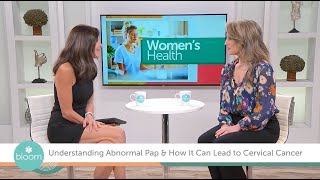
Dr. Doni Wilson explains why Pap smears and high-risk HPV testing matter, especially for older women whose immune systems weaken during menopause or under stress. The HPV vaccine has limits, so ask your doctor for high-risk HPV testing and follow up on results.
Questions this video answers
From age 21 to 65 (and possibly beyond); at least every three years.
99% of cervical cancer is associated with these 13 types of high-risk HPV.
The vaccine covers nine of the 13 high-risk types.
About 90% of high-risk HPV infections go away (clear) within two years.
It states cervical cancer is the third most common cancer in the United States.
Chapters
Cervical cancer is often called a silent killer because it can develop without symptoms for years. That's why our next guest believes Pap tests are critical. Joining me now is HPV and women's health expert Dr. Donni Wilson. Dr. Wilson, welcome to Bloom.
Thank you so much for having me.
So I know you came in all the way from New York, and the audience might be listening and thinking, oh, we know Pap tests are important, but you're kind of taking it to the next level of what we need to ask for the next time we go to see our obgyn. So let's start with that.
Absolutely. And it is important to know to get a Pap smear because a lot of women put it off. But it is still important to get a Pap smear even from age 21, all the way to 65 and maybe beyond that at least every three years. And now the difference is that doctors are also likely to run a high risk HPV test at the time of your Pap smear to find out if you have high risk hpv.
Now, if you do have high risk hpv, this extra layer of testing is really good for taking your health into your own hands because it could be a clue that you could develop cervical cancer.
Exactly. 99% of cervical cancer is associated with these 13 types of high risk HPV. So if you're testing positive, you know, in my mind, then, you know, you need to take action to help prevent it because there are things we can do to stop the virus from causing cancer.
Now, the next question I want to talk to you about might be a little bit sensitive, but I think most women in my age group think, oh, man, that ship has sailed. I don't need to worry about HPV or an abnormal Pap test. That seems to be something like in the 20s when maybe women are more sexually active, maybe they have more than one partner. But you say these cases are starting to crop up in older women, 50 and above.
It's actually, I know. And these women are quite in shock when they find out, oftentimes around menopause, perimenopause, post menopause, because what happens is women's hormones shift. So as estrogen levels drop in the vagina, it changes the vaginal microbiome and bacteria, which makes us more susceptible to high risk HPV virus. And so women are finding that they're testing positive in their 50s and 60s. And I even hear from women in their 70s who are now finding out that they have this high risk virus and potentially abnormal cells that they're having to deal with.
So let me understand this. Could this mean that the HPV was lying dormant and then when we start to go through all these hormonal changes, it rears its ugly head again?
It's possible that that or sometimes women have a new sexual partner. And the other factor that I find really common is it's when women are going through a large amount of stress. So I'm talking to women who maybe have been through a divorce or a loss of a loved one or, or different health stress in their life. Even going through the pandemic was a huge stress on women's bodies. And when we're under stress, our immune system is not as able to protect us from viruses like high risk hpv. So that's when it shows up, is when we've been under stress.
And another thing that I think is important, like I had all four of my daughters have the HPV vaccine, which was not available when I was young and it wasn't offered to me later in life, and I didn't even give it a second thought. But you're saying even women who have received the vaccine aren't getting the protection that they need from it.
The vaccine covers, right now it covers nine of those 13 types. So it doesn't cover all of the high risk types and it's not 100%. So I hear from a lot of women who've had the vaccine and then find out that they are testing positive for HPV. And they're saying to me, now what, Dr. Donney, now what can I do? And the thing that really concerns me is that a lot of women suffer in silence. As you said, women feel embarrassed to say something and oftentimes their doctor is not sharing with them that they're so, so much they can do to protect themselves.
So, Dr. Donney, when we go to our doctor, which you're reminding me I'm late on making my appointment, what do we need to say? Because I think you're right, we get intimidated. We don't want to ask a lot of questions. The doctor knows everything. But this is a case. We're talking about a silent killer cervical cancer. What should we be asking for?
It's the third most common cancer in the United States. So absolutely it's something that we need to have on our minds and be taking care of ourselves. I would ask your doctor to make sure they're testing for the high risk HPV virus. I always recommend that women ask for a copy of your test result because sometimes the doctor might just say, oh, Everything's okay. But I would rather you know exactly what your test results say and then follow up on it. Make sure that if it is a high risk HPV type that you're. That you're following up and making sure. Because it can go away. In 90% of cases, it goes away within two years. Even if you don't do anything to help it, it will go away within two years. And obviously not everyone who tests positive develops cancer. But a lot of women walk out without that information from the doctor's office. So if you're really feeling like you need more information. That's why I do what I do. I have created free resources on my website to help women to know, what is this virus? What can you do to help protect yourself from it? How can you make sure that it goes to negative and doesn't turn into cancer?
Thank you so much for coming on Bloom, all the way from New York. We really appreciate you, Dr. Donnie.
You're welcome. Thank you.
And so you can get these free resources that Dr. Donney just mentioned, I'm going to put everything that you need to know on bloomtampabay.com.