5 Strategies to Revolutionize Your Business Relationships: Insights from Dino Watt
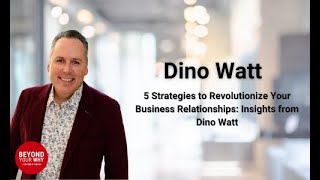
This is a transcript of a Dr. Gary Sanchez podcast episode (Feb 20, 2024) featuring Dino Watt. The interview traces Watt’s path from performer (dance, makeup, acting) to entrepreneur (DJ/events) to international keynote speaker and author. Central themes: the "why" of contributing to a greater cause; practical public-speaking advice (stagecraft, audience interaction, "context over content"); building workplace culture (defined as vision, expectations, support) and communication strategies; remote/virtual selling; and work–life priorities ("No success outside the home will compensate for failure in it"). Watt’s books, speaking focus (culture & communication), and contact channels (website/socials: DinoWatt/Dino Watt Consulting) are also noted.
Chapters
Welcome to beyond you'd why Podcast, where we go beyond just talking about your why and actually help you discover and then live your why. You see, we believe that knowing your why, that driving force behind every decision you make and every action you take, is the essential first step to really knowing yourself. It allows you to move forward faster and have a bigger impact. If you're already a fan of the show, then you know that every week we talk about one of the nine whys and then we introduce you to somebody with that why so you can see how their why has played out in their life. This show will be more powerful for you if you've already discovered your why. If you still need to do that, head over to whyinstitute.com and discover your why today. It'll only take you about five minutes. Now let's meet today's guest.
This week we're going to be talking about the why of Contribute to Contribute to a greater cause, add value, have an impact in the lives of others. So if this is your why, then you want to be part of the greater cause, something that is bigger than yourself. You don't necessarily have to be the face of the cause, but you want to contribute to it in a meaningful way. You love to support others and you relish successes that contribute to the greater good of the team. You see group victories as personal victories. You are often behind the scenes looking for ways to make the world better. You make a reliable and committed teammate and you often act as the glue that holds everyone else together. You use your time, money, energy, resources and connections to add value to other people and organizations. So and so today I have a great guest for you. His name is Dino Watt and Dino is a PhD, passionate husband and dad, is also an international keynote speaker, author of the best selling books the Practice Rx, Hire and Fire Like a Boss and Selling through the Screen and host of the Own your Role podcast. As one of the most exciting business trainers, he has been featured on ABC, NBC, CBS, Fox News, and TEDx with the belief that our greatest successes come when we're able to contribute to a greater cause. He focuses on simplifying complex ideas and data in order to gain the trust of every audience he meets. Audience members have frequently referred to Dino as the Tony Robbins of private practices due to his ability to bring education and entertainment together for what he calls edutainment. His goal is to help business leaders and teams create more passion for what they do and be more productive in the office and create more profit in all areas of their life. His mission to reverse the direction of divorce, addiction and suicide among business owners and their team members. He uses his why every day. Dino, welcome to the podcast.
Wow. Thank you.
I appreciate that.
Good intro.
That was a mouthful, huh?
Whenever I hear that Tony Robbins part, I'm always like, should I get up and start making people jump up and then jump around?
And I think maybe that's a good thing.
So let's, let's start now.
Where are you at right now?
Where do you live?
I live in Salt Lake, a little suburb of Salt Lake, Utah.
Awesome. And then now let's go back in your life and let's kind of bring everybody up to speed on how you got where you got.
So where were you born and.
And what were you like in high school?
So I was born in California. I born and raised in California. We were there until 2006. We had all of our kids there and everything. So Southern California born and raised. I spent a little bit of time living in Japan for a couple years when I was younger. Well, right out of high school, I guess. So younger from where I am now, but right out of high school. In high school, gosh, I was friends with everybody. I wanted to connect with everybody I could, from the headbangers to the emo people to the drama kids. And I was a drama kid and a choir kid and a wrestler. And so I really was the melting pot. I. I really didn't have a click group that I cared about, but that also made me very squarely, firmly in the friend zone with women. So that was the challenge. But I contributed to a lot of relationships. In high school.
You were everybody's friends, including the good looking girls.
So true. Was so true.
So what were you really involved in the most in high school? What was kind of your thing?
Yeah, performing was my thing. I always wanted to be a performer growing up. When I was in Mrs. Tillotson's third grade musical, I knew that's what I wanted to do. The first time I got people clapping for me and laughing at me as I was lip syncing to Don Henley's Dirt Dirty Laundry, I was like, this is what I want to do. So I was a dancer growing up. I started dancing when I was 11 years old and love to dance and sing and perform. And so that was my, my big thing there. And I believed I was gonna leave school and go off to Hollywood and work in, in the entertainment world.
So I'm trying to picture you now as a dancer now. Like, what kind of dancing are we talking about?
Like tap, jazz, and ballet were my staples. Jazz and tap were more than any of them. I did ballet for the. The muscle strength and for the balance, but really into jazz, hip hop a little bit, but mostly jazz. And back then, they didn't have as many offshoots of those than they do now. Like the. Like, we had lyricals, but modern dance wasn't really a big thing back then. It was a. It was a different time altogether. But yeah, that flash, dance, fame, all that stuff. I love that stuff.
Wow. Okay. I'm struggling to picture that, but. But we'll go with it.
We'll go with that video on YouTube. So others. I danced for Disney for a while. I did some backup dancing and stuff, and it was just. It's a good time.
Wow.
Okay.
So graduated from high school, off to college. Where did you go to college?
I didn't go to college, actually. I went off to. I served a service mission in Japan for a couple of years. Came home and I. I mean, I went to college, a trade school. I really did not want to go to college. I was a day away from starting lacc. My parents really wanted me to apparently get an education, but I wanted just to perform. I wanted to be in the industry. I wanted to do stuff. And I had seen a commercial for doing hair for the stars. Like, the night before I was supposed to start school, and it made me think. I had a really good friend that I performed a lot with. Her mom was Dustin Hoffman's hairstylist. And I thought, you know, I never cared about doing hair, but I was always that guy in school in the place who loved to do the weird makeup. Like at Halloween, I had popped out an eye and did weird things like that. So I found the only school in the United States that would accredit you to be a makeup artist. And so I thought, well, if I could be a makeup artist, I could also work behind the scenes and get to know directors and producers and get myself hopefully into the acting world that way. And it worked. I got my sad card through that. I was in a couple little really terrible movies, but I also learned how to do all of that makeup stuff. That was super fun.
Okay, so started in the makeup space and how long were you there?
I did makeup for seven years. I quickly learned I got married pretty young. After I started, I got married, I think like two or three months before I started school. I was barely 22, two when I got married. And after four years, we had our first child and I was working in. In Hollywood. I was doing some makeup stuff. On videos and TV shows. And I was actually on a series after our first daughter was born. And it was good for what it was, but it's very much a feast or famine type situation. And I knew I could not support a family in doing this full time. And it's funny because when I track back just going to the topic of today contributing, one of the most frustrating things about being in the industry was it's very segmented, right? You are in a specific position. You only do that job. There were times where I'd be sitting on set and we'd be waiting, waiting, waiting hours because Hollywood is just a bunch of hurry up and wait. And there'd be a light right over here that needs to be moved. But I. And all it needed, literally was me to go over and take the light and move it five feet and then be done. But I'm not allowed to touch the light because I am a makeup and hair person.
That I didn't know it then, but to contribute was something that drove me crazy because I always was like, let's just get in and get it done. Let me help everybody be successful. And it was those reins that were pulled down on me were. It was very frustrating. But I realized we had. We had three kids in three years. We didn't plan that, but ended up happening that way. Once we figured out what was causing it, we just stopped doing that altogether. And we ended up. I decided to make the decision. I couldn't support a family doing this anymore. I needed to do something else. But I had no other skills. So I started actually working. I had already started working part time as a DJ in LA for weddings and bar mitzvahs and things like that. And the guy who owned the company, after I had done some other things and he basically came to me and said, would you help me build my company? I need somebody to come and manage this. And it was my first opportunity to really build a business because he gave me free reign to do whatever I wanted. And so I spent seven years building that business as well. And that taught me a lot about having employees and dealing with. I mean, we dealt with a lot of brides. So you learn a lot when you deal with brides.
A lot of brides.
And. Hold on, I'm not letting you off the hook yet. Biggest lesson you learned, dealing with brides.
That even though it's not, they. They consider it to be the most important day in their life. So if you can help them feel like you have control of a situation even when it's out of control, or even when you don't, then you will win. And again, I come back to this contribution thing. I wasn't just a dj. We. I literally created a scenario where we were almost event planners for them. We had everything laid out for them from when was going to happen to what on paper. And we'd show them we do walkthroughs, so they knew that I was going to take care of them. And I. I mean, I got crazy tips because I was always like, how can I help you? This. How can I talk to your videographer, your photographer, who's your mom? And I want to make sure she's happy. And I. I did a lot of. Of weddings, too, that were interesting because I spoke Japanese. I still speak a little bit, but back then I spoke it really, really well. So I would do Japanese weddings that were mixed, so you'd have most of the family that were English speakers, and then you'd have a little tiny portion of them that were Japanese speakers came over from Japan. So I had to learn to not only engage the people who could understand English, but then literally turn after I got done doing announcements and things like that to the Japanese people. And Japanese people will always react really interesting when they see a white person speaking Japanese. They don't believe they're speaking Japanese. They'll like, literally ask you, are you speaking Japanese in Japanese? Like, yes, I'm speaking Japanese to you. And this. So finding ways to help everybody feel like they were a part of it was a big part of that. So if you can help a bride feel. But I think that's pretty much in anything, right? Even with my clients, I'm in control. I got this. When I go and I speak, I was just an event. This last week, there is some chaos going on with the AV stuff. And I went in and I was like, you guys, you're good. I don't need the PowerPoint. If you can't get the PowerPoint happening, don't worry. I'm good. And then I encourage them. I actually made the audience give the AV team a round of applause and a standing ovation. Nobody ever does that, because now they're on my side and they're going to do anything that I need for them. Same with the bride. If the bride knows I got her back, I'm going to take care of her. I'm going to support her and build her up. But I think that's anywhere your bosses, your team members individually, whether they have status or not, doesn't matter.
That's a great Lesson.
Okay, so you worked with Brides for seven years helping build that business and.
Then you got out of that. Yeah. So the good thing was that it was, it was brides, it was bar mitzvahs, it was corporate events. I was a game show host for corporate events. We provided the entertainment for the entertainment studios for rap pirate parties and celebrities. I did Will Smith's birthday party or his son's birthday party. I mean, there's, there's all this stuff we got and that gave me a really good understanding of how to deal with people and build a business. And yet, even though part of the deal with the business was I was gaining percentage of the business every year that I stayed in the business to eventually take over the business, I knew I didn't want to do that. I was like, this is not my destiny. I do not want to be doing this rest of my life. And it was right about that time, about the seven year part, where I started also dabbling a little bit in real estate and real estate investing. Read Robert Kiyosaki's book Rich Dad, Poor Dad. It was just kind of like, there's gotta be something else. I need to make more money for my family, you know, live in la. It's pretty expensive even back then. And so I was at a conference and, and by the way, I kind of flippantly said, you know, I gave up on that acting thing. That was really hard. That was something I had dreamed about my whole life and I didn't completely recognize it then. I see it a lot more obviously after the fact that I was pretty resentful to my kids about this. I was resentful that I gave up on my dream for you, you know, and I'm sure there's a lot of people out there who can, who can understand that, relate to that in some way. And I still kind of had this itch to perform and to, to, to be out there and give information. And I was at a real estate conference and I saw a guy talking about taxes. He was on stage, he was talking about taxes and how to structure your entities and all this stuff. And he was so funny and entertaining and he was about taxes like the most boring thing you could think about. And suddenly it hit me as I'm watching him laughing at some of his jokes and the ways that he was, he was structuring things. And I went, oh my gosh, he's on a stage, I'm in the audience, he's going to get paid, he's performing. Dude, can I do this? Like, is that a career? And I started right there, the research on how to be a speaker and a trainer on stage. And it's been ever since then. That's what I have been doing.
And how long ago was that?
Oh, Gosh, that was.
2005. I want to say is when it started. It's almost 20 years ago.
20 years of learning to speak and learn. So you decided you were going to be a speaker. This is interesting because there are probably people listening right now that are thinking the same thing you thought in that moment.
Yeah. And.
And I have some friends. I was just thinking about it when you said that he was in politics and he's just now kind of wanting to go out on the speaking tour.
Yep.
How did you go about doing it? How did you go about becoming a speaker and a trainer? You were already a performer, so that was great. Yeah.
Well, that for sure. Yeah. Yeah. I mean, it was definitely one of those things where I was not afraid to get on stage. I was not afraid to know what it felt like to use the stage and understand where I was on the stage, which is something I was just an event this last weekend. And watching a lot of people, almost every speaker who is professional at what they do, so they get to speak, but they're not professional speakers and they don't know the craft. And. And it's. It's really annoying being in it. I mean, I literally have pages of notes for people like, you should be doing this and change that. That's the producer director of me and still in me. But what I did is, it was right after that that I ended up being at another conference and I saw another person. His name's T. Harv Acry as a book called Secrets of the Millionaire Mind. And he was doing his spiel on stage, but the audience was not just laughing. They were responding. They were doing all this stuff. And basically, I called up his company and I said, I love what he did. Do you guys teach this? And they happen to have a training program called Train the Trainer, which a lot of people back in those days had a program called Train the Trainer. And I went to it. What I didn't know is that in order to go to that, you typically are supposed to go to, like, two or three of their other seminars, so they can upsell you into those things. I just called up and said, I want them. And there happened to be two. There's Training Trainer one, Train Trainer two. And I went, yep, I want them both. And we had no money. I put on credit Card had no idea how I was going to pay for this. And I remember being in the room for the first time and just soaking up everything that was going on and being like, this is the coolest. Like, you can make a living. And. And as an actor who you're trained that your whole career, your income is going to be based on somebody else saying yes to you. Now I looked at it and said, oh, I. I can control this. Like, I just have to speak. And I can either go and speak for other people, train at other people's places, and also I can create my own. And that's been just such an oh, because I literally, I tell people all the time, I made up a job, I wrote a book about it, and now pay me. People pay me to go across the world to do this and talk about it.
What was the. What did you learn when you went to that first training? What was like, the biggest takeaways that you got from how to make the audience laugh, how to engage the audience, how to. How to keep them excited?
The first training on the train, Trainer one was the number one thing that I really loved understanding. I still use it this day, is that context is more important than content. So a lot of people worry so much about their content and how much stuff they have and how they can prove what they're talking about is correct and all that stuff, but they don't think about the context and the way that it was explained to me. And I still use that as an example today to this day, that if I had this, you know, this water bottle here, and it's got the best water ever in it, it's the most expensive, wonderful premium water you could think of. But in the. The bottle itself had a crack in it and it kept leaking. Every time I picked it up to take a drink and it was leaking, no one would be thinking about what's in the bottle. They'd be thinking about the crack on the context of it. So when I realized that me not having to understand everything, not having to be an expert at something, but actually having some knowledge in something, and I could share that with people as long as it was right in the context, then that was super powerful. The other part of it was the interactiveness of that. I talked about this edutainment, and this is what I saw I could do that. They. They did okay there, but I saw this. How I can infuse some of DINO into it is that there's a different way to have some interaction with even whether you're doing a Speech or whether you're doing a training, you can interact with the audience in a different way. Part of that is humor, part of that is stories. But there's actually interaction you can do with one another to control the levels of energy inside of a room. And I thought if I could do that plus infuse a little bit of Dino's silliness in it or awkwardness. And I mean going all the way back to the dancing piece. I dance on stage to this day on in my program, there's two different parts that I have that I literally dance. One of them, I'm doing the latest tick tock trends on stage. I'm doing Beyonce like, and it's not, I'm mimicking them, I'm talking about something specific and I'm teaching a lesson through the dance. And it's. Yeah, it's silly and it's fun to see a 51 year old man up there dancing crazy. But there's a point to it and that makes it memorable, that makes it so people leave there with something as opposed to having just been dumped. Information on. So in seeing that in that first training, I went, oh yeah, I'm all over this. I ever since then I was not, not done that.
Wow. You know, so if I'm listening, you know people that are listening and they're thinking, well, I never was a dancer when I was a kid and I didn't have all those entertainment background.
Yeah.
What are some things that you've seen people do that really engage the audience.
Like what you're talking about there? Well, I think the misconception is that you have to be some sort of. Do you have to have some sort of uniqueness? Everybody's unique, right. But that you have to have some sort of. You have to dance. My friend Jason, he does in impressions, singing impressions, voices of everybody from, you know, Lady Gaga to Elton John. Right. So that's his thing. My friend Clint, he's an amazing speaker and he's a drummer. So he has a full drum set on stage and everybody gets buckets and they drum together. So there's the gimmick, right. There's an old song back in the day a lot of people don't remember called where it says you got to have a gimmick if you want to get ahead. Not necessarily, but you've got to be you and you have to bring your authentic self to the stage. And too many people either try to be someone else or like someone else, or they put on a Persona on the stage and they're different offstage. Going back to this last weekend, that's exactly what I saw. Because I know some of these guys off stage and then I saw them on stage and I was like, not you. Like you. You would not talk to me like this. I'm the same onstage and offstage. I am going to be silly. I'm going to, yes, I'm an introvert, so when I'm home, I'm there. But when I'm in an event, you're going to get the same Dino off the stage and I'm going to be making, you know, little quips and sarcastic comments and because that's who Dino is, when you try to put on this Persona on stage, that's not who you are and it's not authentic. People feel it like crazy. I'll give you a really quick example because people will call you on it and they're, they're, they're intuition will know. Speaker on stage, he's apparently, I've seen him a couple times, he's apparently this big deal. Speaker he's telling a story about. The basic point of the story is he was working too much and his son called him on the carpet. So he comes to, he says that his six year old son came to him and said, hey daddy, Daddy, I drew a picture of you and I wanted you to see it. And he was like, oh, that's amazing, son. And he shows the picture now, he shows the picture up on the screen and immediately I went, bull crap. There's no way a six year old drew that picture because it was made to look like a six year old would do it. But there were parts of the picture that no six year old. Like for example, no six year old does the little ringy, ringy, ringy, like vibration and air sound for phones ringing. No six year old does that. The problem was was that immediately it became inauthentic. Now he could have just said, my son drew me a picture. It may. It was me on the phone. It made me feel terrible. It was kind of something like this that I would have bought. But the point is, is when you get on stage, that stage tells the truth. And if you are not in your own integrity, if you are not being authentic, people will read it and know. So you don't have to dance, you don't have to, you have to be you and just bring more of the you out on stage and people will gravitate towards it. You couple that with training and understanding how to use stagecraft, you're going to do amazing.
So what do you mean by stagecraft?
So stagecraft is the actual understanding of how to utilize this stage. You'll. Everyone who's watching this is going to now have new eyes. And so when you go see another speaker or if you're a speaker yourself, you're going to notice this. A speaker who just paces on the stage doesn't understand stagecraft and they think they're building energy. A speaker who. There was a speaker this last weekend. Again, I have so many examples from this weekend where stagecraft is this. He was talking about how he has some deformity and he went home because he was bullied and his mom took him to the mirror and made him look in front of the mirror. And in his speech, he starts saying, you're the best son. Tell. Say you're the best son in the world and you're a beautiful person. And, like, starts yelling to us about what his mom said to him. There's no way any mom ever starts screaming at their son all the things at the level that he did. And it would have been so much more powerful for him to understand the stagecraft of getting on his knee and saying, son, I want you to look at yourself. You are the most beautiful human being on the planet. You're kind, you're generous, you're loving. And because my mom made me repeat those things, I started to believe them. Then later on, when he starts to tell us, we're kind, we're generous, we're. And he wants to have louder volume. Great. But understanding how that stagecraft works, it's blocking, it's knowing your body, it's being able to know. Know your intonation. When are you yelling at me and when are you inspiring me? When are you being quiet and making me move? And when are you getting the energy up? Because your energy is as big as everybody else's in the room. Like, you have to understand that. And the best speakers you see do this. Some of them do it very quiet, subtle, but it's still stagecraft. They know where they're walking. They know where to stand forward when they're making a point. They know where to when they are deliberately walking to this side of the stage and then coming back and deliberately walking over here, deliberately walking off the stage. That's one of my most. I love laughing at the power move of that. There are so many speakers that think they're being more powerful because they walked off the stage, but they do it for no reason whatsoever. And then a minute later they walk back on the stage and you're like, why'd you get off the stage? There was no point. I thought you're coming to somebody or during the.
So it's understanding stagecraft in that way, and it's, it's so powerful when you know it. And again, there's just a lot of people who are professionals, so they're out there in the speaking world, but they're not trained as a speaker or actually some of them don't even care about being trained as a speaker in that way. And, and it's, it's makes the difference between a great speaker and. And someone who does fine.
Yeah, it's hard. I, I agree with you. It's. It's challenging sometimes to go to different presentations and not be critical of what you see. I always try to find that one thing that they do really well that I'm going to incorporate.
Right. You're.
When you walk, when you, when you're done watching somebody, like that one slide or that one thing was so stinky. I don't care. The risk was terrible. That one slide I'm stealing that I steal almost from every single event that I go to.
Do you feel that you, you brilliantly borrow. You don't steal.
Okay. Because somebody has, you know, there's always that one thing, and I'll go, gosh dang, I wish I, I need to. To take that one and. And then that'll show up in my next one. And you just keep making it better, better. Because I know people steal from mine and. Or whatever you want to call it, brilliantly borrowed, but that's totally fine. So wait.
Goes. No, you're absolutely right. Like, there's always good stuff out of things. And that's where I don't believe in a. When I'm doing my business coaching or even my speaker training, I never talk about right or wrong. I talk about weak or strong. And there's ability to. We all have weak parts. I have weak parts and the things that I do. And so to be able to strengthen that and work on strengthening that is great because then that's. That's the hard part is when people's points, some of their message is so good. It's like, man, what if we could put gasoline on that? What if we can amplify that to where it's not just one or two or three points, because the fact of the matter is, and I mean, this is. Research has been done over and over and over about this is that within 24 hours of you hearing anything, you've forgotten 75% of it anyway. So why don't we make that 25% so good that we're going to be able to, like, maximize it? And so that's why it's all part of it. The body language, the stagecraft, all of that is so powerful. But, yeah, I mean, even in those guys, I, I took away a ton of notes of, this is cool. This is neat. Oh, I like that. Because isn't that the cool thing about just opening your mouth and talking about the thing that you're passionate about, that you have some experience in knowing that somebody probably has a little more experience than you, but your experience is valid. Everybody's got important things to say, even if it's said in a different way. Now, I'm not a fan of people who are claiming to teach you something that is clearly someone else's stuff. Yeah, yeah, that app this weekend, there is somebody who said, let me. First rule. First rule, start with the end in mind.
And I pause. I was she. I wanted her to pause. And I was waiting for them to say, like, Stephen Covey said, no, no, you're not going to say that. You're just going to take that as your own. Okay, like. All right.
Well, this weekend when my wife and I went to this church here in town, the. We went to go see this one pastor, the father, and then this father was out of town, so we got the son. And the son was actually really good.
Surprisingly good. That's good. Different than his father, but. But really good. And just now, when I walked up to the gym that's in this building that I'm in, I ran right into him.
Oh, cool.
And so we got a chance to talk because they're actually going to bring the YOs to their entire church. You know, they have like, I don't know, 40, 000 members. It's a very big church as. As they should because they talk all about it, but never had a way to help their. Their members get it. And so we had heard about each other, but we never met each other. And it was just really an interesting experience because I, you know, I saw him speak in. You know, when you're expecting somebody and then somebody else shows up, you're thinking, oh, man, I think I want to leave. Yep. But he was, in his own way, did a. Did a fantastic job. And he didn't try to be his dad. Like you said, he was authentic to who he was.
Yep. That's funny. I snicker a little bit because I get that in dance. I'm so. I still go to a Dance class. I still. It's my exercise, my cardio. I go when I'm home, and in Utah, which I'm not very often, but when I'm home, I go three times a week. And the class has gotten so big, the instructor's done such a good job of growing this amazing class because it's not just dance, it's dance. It's meditation. It's a community. And I've been doing it for almost 10 years.
She's not always there. And there are times where I get there, and I'm like, I like it when she teaches. But you're right. Every teacher brings their own style, their own thing. And when we can embrace that and we can be in it and be like, all right, like, I'm going to learn something new from someone. I'm going to. I'm going to eat a little different meal this time than I normally would like. It's okay. I'll figure it out. And we're so used to our routines. Right. And our habits that we have, that it's shaking up my comfort zone, you know? But. Yeah.
So, Dino, let's shift gears a little bit. Tell us about the books that you've written. And I know you have, what, three books out?
Yeah, I think there's. There's five all together. I've. All together.
Okay.
But one of them is. I'll explain. So my first book is Practice. The Practice. Well, my first book was called Recession Proof your Marriage. And I wrote that back in2679, I think it was. Yeah, six. When all that stuff was going on with the economy and things like that. And it's. It's not even in print anymore. It's just one. I was like, hey, everybody says, write a book, I'll write a book. And I love marriage. And my first course that I did after I learned that I could do this from Stage was a Court was actually my second course, but of course, around marriage and helping people build their marriage using business principles. So I did that. And then I did a book for small business owners, mostly in the private practice space, called the Practice Rx. And the idea was to build a framework around how can you build a stronger, better, more magnetic culture inside of your office? So I did that. That did really well. That was the one that kind of blew up. And I hired, you know, publicists and all the stuff to do it, and it was great. I really. It's still the staple book that I use today. It's the one I give out to wherever I speak I give that to people for free in a digital form and things like that. I've always tell people the idea of selling my book or having a book to sell it to make money is almost laughable because almost, almost nobody does. But I made a lot of money off my book by giving away for free. It's a calling card. That's all it is, is give people that book. I wrote every word of that book, which is why I'm proud. I'm so proud of it. The next book was, was actually a program first that I did for my clients that I turned into a book called Higher and Fire Like a Boss. It basically is a pretty simple framework on how to recognize when you need to have a conversation with somebody about their performance or their personality, when you need to get put them on probation, and when you finally need to let them go. And the whole premise is you need to hire three times slower, fire twice as fast. And it just gives an outline on how to do that and find people. Then the third and fourth book, or sorry, fourth and fifth book came from COVID and when everybody went to virtual. I had been doing virtual like this since 2011 because we took our kids on a 13 month road trip across the country and I needed to be able to work with my clients and give speeches virtually if I could. So I'd been doing it on Skype back in the day. Right. I would have thought Skype would have been the one that blew up instead of Zoom. But I, I saw an opportunity where there are a lot of people I know your, you know, your background with dentistry. I was very heavily in the orthodontic world and I saw an opportunity to help people understand how to do virtual consults instead of having people come in, especially during COVID and they could still make money, they could close them, they could get treatment purchased and all that. So I was writing it. Actually did a couple of challenges online and that went really well. And I was writing the book because it involves body language and involves what to say, what not to say, all this type of stuff. And I recognize that it wasn't just my industry that would probably need this. So I did two books at the same time for two different audiences, but with a lot of the same information, just different stories. And that is something I will never do again because that was a lot. So one is called Mastering Virtual Consults and that's specifically for the dental and ortho space. And then one was selling through the screen for anybody else. So I interviewed people like a mobile DJ who Had to go virtual. How do you take a mobile DJ department company and go virtual? Real estate agents, fashion people. So I was showing how people are using this in their business and how even after Covid, you can actually continue doing this and still make money. And it's profitable because it democratizes how we actually interact with one another. I can sell somebody something and, you know, New York and I'm in Utah right now because of the magic of this, I just have to know how to do it correctly.
And.
And then I have one more I'm working on right now. But, yeah, those are the books.
So what is it? What's the topic that most companies bring you in to speak on?
Culture.
Culture.
Culture and communication.
Yeah, how do you define culture?
So culture is a. A belief system within an organization that both members of the organization and members outside of the organization believe as well and will kind of defend it if they have to. And it's based around a company's vision, expectations, and support. So Disney's the easiest one to use because what everybody knows. And it's also a great example, what's going on right now, of how you can destroy a culture by not adhering to certain things.
Culture is one of those things that I think a lot of people. I actually have a speech which has a little piece in there where it says, you keep saying that word. I don't think it means what you think it means. Right. From the Princess Bride. Because people, when I ask what culture is, they'll say things like, oh, it's, you know, we have a lot of fun and, you know, we enjoy our work. And it's like, no, that. That's actually the. The byproduct of it, like, right. Or sorry, that's the result of it. That's the result of a good culture. Then there, people will talk about, oh, well, we go on trips as a team or we have parties. And Zappos is a really good example of something like that. We have volleyball tournaments out in our court and stuff like that. Those are the perks of a good culture. But it's not culture. Culture is specifically created through a company or a leader's vision, expectations, or what most people know as core values and support systems. Understanding how to support your team members. Because I don't want to reason why people leave a company is they don't feel appreciated. So you need to know how to appreciate each one of them individually and how they specifically like a. Why have their own way of feeling important. And.
Disney, for example, just make it super simple. Walt Disney's vision for Disneyland was the happiest place on earth. Very simple, very relatable, retailable. I don't care if you like Disneyland or not. Everybody in the world wants to go to the happiest place on earth because they just want to be happy. Everybody wants to be happy. And it's retailable. Pretty simple. Hey, this guy's building a place called the happiest place on Earth. It's easy. Nike just do it. Even Microsoft back in the day. A computer on every desk in every home in America. It's simple. People can't just make their visions way too convoluted and have these like vision statements of all this. And I love visions which go deep, like Cameron Herald stuff where it's coupled layers deep and all this stuff. But when you're talking, tell me the vision. Short and sweet. What is it? Hey, we here at Disney, we believe in creating the happiest place on earth. So the expectation is as a cast member, here we go to expectations. Your number one expectation is to make it a magical day. We will support you in doing that however you feel we can do that based upon the confines of your duties.
So whether you're a big company like Disney or a small company, like an eight person office, I was just up in Santa Rosa last week. All of those things still come into play. And when you do that, you build a magnetic culture. When I mean magnetic, I mean you're going to attract the right customers, you're going to attract the right employees. But better if you do it right and you look at how these companies have done. Apple, Disney, Harley Davidson. You can have the most expensive pro product on the market and people will still buy it. You can have, you can overcome economy, competition. It doesn't matter because people buy into the culture. The root word of culture is cult.
Your job as a business owner is to create a cult around what you do.
Do you? Is culture something that is defined? Is culture something that is just there or where does culture come from?
Now that's a great question. It is not defined. So the problem is most people don't. I mean, sorry, it is defined. Most people don't define it. So I believe that culture comes in different waves. There's people who have a contaminated culture. I don't use the word staff when I talk about employees because I always say a staff is an infection nobody wants. Right. I use team members. And just like we saw last night, you can have like everybody thought, I'm not even big into sports, but I watch the super bowl every Single year. And so we're recording this the day after the Super Bowl. And last night, everybody thought, you know, Kelsey was going to be the man. He's the man. He's the man. I mean, the first half of the game, he almost did nothing. I think he had one yard carry. Like Michael Jordan said it best, great players win games, great teams win championships. So in office, we can have great players, but they're not going to make our lives easier or better. But if we have great teams, then that's what we do. The problem is most people don't define what their culture is. They don't design it. So there's three ways that people typically go about business. Number one is through disdain. Like, it's all everybody's fault. I can't grow my business because I have too much competition or the economy. Or they just use ways to complain about everything and they're just barely making it by. And they'll probably go to business faster than most people. Default is the most popular, which is, hey, we're making money, we're doing fine. And from the outside, if you're looking in, you'd be like, wow, they're doing okay. And. But they're really not thriving. They're just surviving. And then there's design, which is we have an intention behind what we do. We are focused, we're continually growing. We have mentors, and those are the people that usually make the. The most. But the fallacy is that some people believe they don't have a culture. Everyone has a culture. Everyone has a culture. It might not be the culture you want. And if you're not designing it, unfortunately, most cultures are created by the strongest energy inside of the office, and that's not always the leader. So if you've got Tommy over here, who is complaining about everything all the time, or Susie over here, who's overbearing, but she's really good at her job in the sense of what she does technically, but nobody likes her. She's controlling the culture. He's controlling the culture. And so if you're a leader that has that. And I. I have a saying that I use quite a bit. It's actually. It's the. It's a saying that gets probably the most attention when I go to events and talk about is that a.
Nothing will ruin a great team member faster than watching you tolerate a bad one.
And so many team members, when I say that are just like, oh, that's so true. Oh, that's so true. And I know it's true because even Jim Collins or Jim Collins. Sorry. And good to great, right? He says everyone, if you have a list of A players in an office or in a company, you bring in a C player, everyone drops to a B, everyone. Because psychologically they have to go, oh, you're going to accept that? Okay, cool. I can keep my job and do that. Awesome. I'll still do good because I love my job, I love what I do. So the highest energy always wins. So that's why you as a leader have to have that energy and bring it.
I love that. Well, Dino, last question. What's the best piece of advice you've ever been given or the best piece of advice you've ever given?
My. This, this is attributed to something I heard when I was a kid. And it was just something that was important to me my whole life. It still is. Is nothing will that about family is that no success outside the home can compensate for failure in it. I come from two parents who've been married and divorced three times. I, you know, my wife's parents were not very happy together and I was very intentional. I've been very intentional about my relationship. So no matter what I do in my business, that's cool. I love it. But it is number one most important thing is my, is my wife, especially now that we're empty nesters. But as my wife and our relationship and it has been with my kids and.
I, I find it sad that all of us know people who spent way too much time focusing on their business, their business became their relationship and let their personal relationships go. And that, that's unfortunate. So for me, that was the best advice that I held on to. And I still do. I talk about it to this day. It's a quote from a gentleman. It's, it's attributed to one guy, but it's two, it's from a different, different guy. But you know, back in the 60s and I still, I just think it's, it's so relevant to our world today.
Say it again.
Nothing will compensate. Sorry, sorry. No success outside the home will compensate for failure in it.
That's really good. Yeah, thanks for sharing that.
Yeah.
Dino, if there's somebody listening that people that are listening that want to follow you, hire you, bring you in to work with their company, their team, what's the best way for them to connect with you?
Yeah, I'm on all the socials. Dino Watt is a pretty unique name, so I'm lucky that way. There's not a lot of Dino Watts out there. So all the socials are there, but you can definitely just reach out. My website is dino@dinowatt.com. that's my speaking website. You'll see a lot of that. Dino. Dino what? Consulting. Sorry. I get my email address and I dino@dino.com through dino.com is my speaking. Dino Watt Consulting is my consulting company. And on a. I don't really advertise it too much because it's really kind of a private one on one thing, but the speaker side of things, if you're looking at trying to become a speaker or enhance your speaking or become a trainer, which I think is. Is kind of a higher level of training of speaking because it lasts longer, I coach that on a private basis. So you can reach out to me again through dinoinowatth.com awesome.
Dino, thank you so much for being here. It's great to hear your story. I didn't know all this about you and now I'm struggling. I'm going to picture you ballet dancing, which is my time, getting that out of my head.
It's a beautiful thing. I could do things back then I can't do now, but yes.
Well, I'm excited that we had you on and thanks for being here and I'm sure we will be in touch. I know we will be.
Appreciate it, Gary.
Thanks, Dino.
I really hope you enjoyed today's episode and that through today's guest, you heard how important it is to know your why and how impactful it can be in your life and the lives of those around you. Be sure to head over to whyinstitute.com and discover your why today. Remember, the more you know about yourself, the more you'll know about others. I'm Dr. Gary Sanchez and I'll see you on the next episode.
More from Dr.




Women In Leadership: A Need For A Greater Systemic Change With Belinda Clemmensen






