A Better Way to Tell Your Story
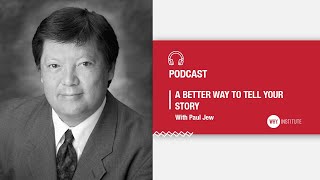
Paul Jew, founder of Moji Cinema, built a photography business serving 30,000 students yearly before moving into video storytelling. He shares a four-pillar framework—People, Place, Plot, Purpose—that helps businesses tell their story through narrative video instead of just listing what they do.
Questions this video answers
February 20, 2020.
2015.
Over 30,000 students per year.
Over 35 years.
Bachelor's in Psychology and an MBA from the University of California, Irvine.
Chapters
This episode of beyond you'd why is brought to you by our why App. Head over to yinstitute.com to take the why app so you can discover your why today. Knowing your why is the essential first step in having the clarity to move forward faster and have a bigger impact.
Welcome to beyond your why podcast where we go beyond just talking about your why and actually helping you discover and then live your why. And so if you've listened to my show every week, you know that every week we talk about a particular why and then we bring somebody on that has that why. And so today we are going to be talking about the why of better way to find a better way and share it. Now, if this is your why, you know that you are the ultimate innovator, right? You constantly seek better ways to do everything from the most mundane tasks like brushing your teeth to improving the rocket fuel that powers the space shuttle. You can't stop yourself. You take virtually anything and want to improve it, make it better and share your improvements with the world. You invent things and take what has already been invented and improve that too. You constantly ask yourself the question, what if we tried this differently? What if we did this another way? You contribute to the world with better processes, better systems, and operate under the motto often pleased, never satisfied. You're excellent at associating and taking from one industry or discipline and applying it to another, always with the aim of improving something. You generally operate with a high level of energy because after all, that too is a better way. Now, today I have a special guest for you. He's from Albuquerque. I've known Paul for quite a while now. Paul Jew has been an Albuquerque, New Mexico business owner for over 35 years. Paul has spent most of his career owning a school photography company that has photographed over 30,000 students per year. Now, in 2015, Paul started Moji Cinema, a video production company that believes story is the universal language and a story told right has the power to change lives. At the end of May of this year, Paul sold his photography company so he could focus all of his time and energy on Moji Cinema. In addition to owning a business, Paul serves on the board of Fellowship of Companies for Christ International, and he's also served as the chairperson for the Albuquerque Chinese American Film Festival. Paul has been married to Judy for over 36 years. They have two sons, Brandon, 25, and Corbin, 18. Paul obtained his Bachelor's of Psychology and a Master's in Business Administration from the University of California in Irvine. Paul, welcome to the podcast.
Thank you for inviting Me, Gary.
Well, let's start first with your family, because your family has been in Albuquerque for many, many years, right? Tell us a little bit about your history, about your family history, because I know you guys started what, in the, in the restaurant business. Is that where you originally started your family?
That's correct. Actually, it was my great grandfather who immigrated to this country from Guangzhou, China. And he was part of that movement of immigrants from China who wanted to find riches in the California gold rush. And of course, he was not able to do so, but the only job he could get was working on the railroads. He was one of the coolie laborers for the transcontinental railroad. But his immigration in this country paved the way for his son, my grandfather, to immigrate to. To Albuquerque. So my grandmother and my grandfather immigrated to Albuquerque in 1929. They were one of the first Chinese families to settle in Albuquerque. And they started a small grocery store and a small cafe in downtown Albuquerque and raised nine kids in the heart of the Great Depression. So that's how our family came to be part of Albuquerque. And then my father immigrated to Albuquerque. Well, actually, not to Albuquerque, but to the United States when he was 15 years old from China. And he served in World War II with the flying Tigers squadron. And then he met my mom while he was stationed here, and he married my mom. And then they started a Chinese restaurant called New Chinatown that was off of Central and San Mateo and had that for many years. So that's how our family came to Albuquerque.
You know what's interesting, now that you tell me that is I bet you your grandfather and my grandfather knew each other, because my grandfather owned a grocery store in downtown Albuquerque as well for the same reason he started a grocery store in order to feed his family during the Depression.
Yes, that was my. My grandmother was a very shrewd woman. She realized that if she had a grocery store, they would always have food available for the family. So that's the reason why she did it.
Same story. So that doesn't seem like the typical history to then jump into photography, which is. I know where your family went next. Now, how did all that happen?
Well, it was my brother's passion. He. He was a passionate photographer starting from high school, and he just became more and more passionate about it. Actually, he wanted to become a dentist when he was in college because he wanted to just please my father. But he realized after taking some of the courses in pre dental work that this wasn't his cup of tea. So he decided that he had to become a photographer. So he actually quit UNM and went to a photography school in Atlanta, Georgia. And he started Kim Joo Photography Studio in 1976. And while he was doing that, I was going to school in California. And several years later he asked me to become his business manager. So that's how I became involved in the photography business in 1983.
So for those of you that are listening that aren't from Albuquerque, which is most of you, Kim Joo Photography is the most famous, I would say a photography studio in Albuquerque, and it's still here in Albuquerque. And how many different locations now does he have?
Well, we grew it to three locations. And basically one thing that we're pretty proud about is a couple of months ago he was voted the best photographer in Albuquerque by the Albuquerque Journal, by the Reader, the subscribers of Albuquerque Journal. But we grew it to three locations. He has a location now on Eubank, and it's just him and his son who are doing the photography. They're really focusing on doing very high end, fine portraiture. So he just went down to one location.
And so then you got in working with him, you were the business manager. And then how did you get into doing photography for students?
Yes, well, you know, one of the things that my brother tasked me with was to grow the company. So one of the things that we did was we, many years ago we were asked to do a school and we'd never done school photography before with Sandia Prep that we were asked to do. And one of the things that happened was we didn't know what we were doing necessarily in the school photography business. But so what we ended up doing was we ended up bringing our best studio lights and cameras. And of course, my brother was doing the photography. And when the parents got the pictures back, they were startled at how good the pictures were. They said, gosh, this does not look like a school picture. This looks more like a very high end studio portrait. So then that's how it all blossomed. And pretty soon we were getting calls from schools from all over the place asking him to do school photography. So then we ended up growing our business from that point on.
It sounds like you found a better way.
Yes, yes. One of the things I think that was happening in school photography at the time, where you'd sit down and they just take a quick snapshot of you and you're done. We really focused on good lighting, good posing, good expressions, and taking that little extra time and care with everybody. And that was something that made the difference where schools were starting to ask and parents were starting to asked for us to do their school portraits for them.
Okay, so you went from business school to business running a photography studio and multiple studios to starting to work with students to take their pictures in a better way. How did that lead you to doing video? What was the reason you've now got into video?
Well, about six years ago, I was going to a photo convention with my photographers and there was a workshop that really caught my interest. It was called Micro Budget Filmmaking and it was done by this company out of Portland, Oregon. And what they are talking about was the advent of the digital camera. And people were discovering that when they used the high definition mode on a digital camera, it was producing as good of cinematic results as the cameras in Hollywood were producing for many years. And it became a big game changer. And one of the things that happened was they were showing this wedding video that they had produced of this couple getting married in Ireland. And halfway through the video, I found myself tearing up watching complete strangers getting married. And I found myself just telling myself, boy, there's something very powerful to this. And one of the things that they explained is it's not just having good camera equipment. It's. It's the importance of telling a story and being able to tell a story that emotionally resonates with your audience. So I was so impressed with this company that I ended up sending one of my photographers to Portland, Oregon, and he apprenticed under them for three months to learn about the art and science of storytelling. So that's how I got involved and immersed into this whole art and science of storytelling. And it's just something that I've just kind of fallen in love with and enjoy doing on a daily basis.
So it sounds so much like me because if I was there, I'd be looking for a better way too. And suddenly you go from, you know, we've got still photography and that's great, but what's better, right? How can we take what we think we see and turn that into something that's more powerful? That's the story behind the picture?
Absolutely. So this has kind of put me on a journey where I've really become a student of the best storytellers in the world. And what the history of storytelling is. What are the components that make a story more compelling than other stories? So that's the thing that I've really devoted my life to in the last several years.
So let's hear. What is the secret to a great story?
Well, there are four pillars to every story. There's people plot, purpose and place.
People plot Purpose and place.
Okay, so the first component of every story is people. And the things that we're looking for is desire, complexity, and uniqueness. The more that you have desire, complexity, and uniqueness in a story of the main character or the hero of the story, the more compelling that story is going to be. For instance, if you look at Yoda, he has lots of uniqueness and complexity to him. And we are just drawn to that character of Yoda in Star Wars. And I think that if you look at every single movie that you're. You're drawn to, there's a hero in the story that has these layers of complexity to them, but they also have a great desire. And usually what that means is that they have a big challenge in front of them that they have to overcome. So another component to compelling stories is the presence of conflict. If there's not conflict present in the story, we're not interested. It's just like saying, if I was to tell you a story, well, I woke up this morning and had a nice cup of coffee, it wouldn't be very interesting. But if I woke up this morning and had a cup of coffee, but then suddenly this bear came invading into our yard and I had to do something about it, then all of a sudden the story becomes more compelling. So conflict is important to every story. So on the people piece, one of the things we're always searching for is who has desire, complexity, and uniqueness that can carry the story forward. And then another component in terms of a pillar would be place. And it's.
Hold on one second. I'm going to interrupt you periodically. No problem. This is interesting to me. So desire, complexity, and uniqueness. Uniqueness. So it's interesting because when I think about maybe telling my story or people that are listening to this that are going to tell their story, and it almost feels like I should hide my warts. If you will. Not really talk about so much. You know, it's uncomfortable talking about the failures versus the successes. And so you might want to, as somebody that's listening to this, might be thinking, well, you know, when I tell my story, I want to talk about how good this went for me. But you're saying that maybe that's not the best, most compelling way to tell your story.
No. You know, as a matter of fact, One of the TED talks that has gotten over 36 million views is Dr. Brene Brown, which is. She gave a talk on vulnerability and authenticity. And one of the things that has happened over the years is people, I think, have really good BS meters. They can see something that just looks like a spin doctor has been giving them messaging, as opposed to people are resonating with people that have authenticated, share authentically and transparently about all of the trials and tribulations that they faced in their life and some of the struggles that they've had to overcome. And that's what resonates with people, because all of us have struggles and difficulties that we have to overcome. So when we see a story of somebody that has faced those types of challenges and has been able to overcome it, that is something that really resonates with people, as opposed to somebody that's been given easy street, so to speak, and. And had smooth sailing without any trials or tribulations that they've had to conquer. So actually, conflict overcoming challenges, those types of things are more intriguing. And there was a guy by the name of Joseph Campbell who wrote Hero of a thousand faces in 1949, and he was a professor of comparative literature and archaeology. And one of the things that he did was he studied stories from cultures from around the world, and he discovered that there was a universality to a certain type of story theme, and he called it the Hero's journey. Every culture, no matter what culture it is, has a story where there's a mythic hero who is given a challenge. He's asked this question of, are you going to accept this challenge? And he accepts this challenge. And typically in the hero's journey, that person might meet a wise guide who can kind of direct him on a path. And that person goes through lots of trials, tribulations, has lots of hurdles to overcome, and then eventually is able to conquer whatever it is that was in front of them. And as a result, there is a transformation that takes place in that character from the way they start to the way the story ends. And Joseph Campbell discovered that that was a blueprint for every culture that had a story such as that. The Bible is full of stories like that, such as David, you know, David and Goliath. A big challenge in front of him, where he starts and he has a big challenge, and then he overcomes the giant and becomes this mythic king of the Jewish people. So one of the things that George Lucas said, he read Joseph Campbell's book when he was in college, and he said, I would not have been able to write Star wars if it had not been for Joseph Campbell. It was Joseph Campbell's readings and research that really gave him the blueprint for how to write Star Wars.
That's awesome. You know what came to my mind right away? As you were talking, was, for whatever reason, Rocky. Rocky just popped into my head.
Absolutely.
And, you know, and I was thinking, he is complex, right. He is unique. He has that desire. He has all those things. And people are so drawn to him or have been over the years. And so that's really helpful when you think about telling your own story. Let's say you're on stage, you're giving a presentation. You know, it's not just about the great things that have happened in your life. It's really more about the struggle that you had and what you were able to overcome.
Absolutely. And that resonates with people. We go to movies to see people who overcome significant challenges. We don't go to movies to see people that didn't have anything to overcome. So those are the stories that resonate with.
Okay, so that's number one. And then number two was place.
And what that means is that people like to escape reality. And when you can take people to a place where the story takes place, they can vicariously experience where that story took place. And it just becomes more believable and authentic when you can take somebody to the place where everything happened. So place is important. Instead of just having a talking head in front of the camera the whole time, we like to take people to the place where everything occurred. And it just helps give people a clear picture in their mind as to what took place and how it happened. And if you think of all of the great special effects that they do in Hollywood, they take you and transport you to a different place altogether. And it allows us to escape reality or just immerse ourselves in a different world. So in terms of place, of course, the things that we're considering are, how do we make this more believable, authentic? How do we set the mood? It helps set the mood for the entire story and the piece. And of course, the things that you're looking for is you can communicate subtle things through lighting and through the time of day, maybe when. When you film a certain piece, what is the overall mood of the piece going to be? And how can we accent that with the places that we film?
Awesome. So we've got people having the desire, complexity, and uniqueness of the people. Now we've got the place so that we can escape reality, so we can set the mood, so we can let people feel it, see it. I guess when you see it versus hear it, that has more power to it.
Yeah, absolutely. It's a combination of both. If you can show it, but also have really good sound, that takes people to how someplace feels when they're in that environment, then that also is important as well.
Awesome. Okay.
So then the third thing was it's plot, plot. And plot is basically how are you going to arrange all of the elements of the story so that it makes sense? And every story has a beginning, middle, and an end. And at the very beginning, one of the things that we're looking for is what we call the hook. The hook is how you can attract attention within the first three seconds so that you compel the viewer to want to see more. So one of the things that we're always doing is we're always thinking, what is the first scene going to be? So that it's going to arouse curiosity. And the viewer is going to say, I want to see more. I want to be intrigued by that. So, you know, one of the things for people who were fans of Breaking Bad was they had a scene at the very beginning of Breaking Bad where they had this stuffed animal just floating in a swimming pool for a couple of minutes. And they showed that opening scene in several of their episodes. And one of the things that it did is it aroused curiosity as to what is that stuffed animal lying in this swimming pool. Why do they keep showing that on several episodes? And it arouses your curiosity to see what is the story behind why this stuffed animal got in the swimming pool, and why are they showing that? That's an example of a hook. So whenever we are telling a story, one of the first things we want to do with the very beginning is identify what is our hook going to be? What is the one scene that we can do that will arouse curiosity and draw attention to that and set the stage for that. Also at the very beginning stages, you want to present what the problem and issue and challenge that the hero was confronted with at the very beginning, the big obstacle and the big question and the big ask, so to speak, in their life that they need to overcome. So that's where you set the stage in the very beginning and the middle is usually about how they overcame those obstacles, all the trials and tribulations and setbacks, but how they overcame these setbacks for that. And then maybe some of the people, the wise guides that came along the way, that helped them discover the answer for overcoming their problem or their challenge. And then the ending is usually the resolution, how everything got resolved and how, like Joseph Campbell talked about in the Hero of the Thousand Faces, the hero comes to some sort of either mastery over the situation or their field, or they come to some sense of peace they have a peace of mind about things. And then again, the whole idea behind this is the transformation that takes place from beginning to end so that it all ties together. And when we see stories that kind of fit that blueprint, it just naturally resonates with us. I believe that God made us to resonate with that story blueprint. And when we see something in that framework, it just seems somewhat familiar. Just like when you hear good music. We don't know why we like good music, we just do. And it's because good music follows certain rules of thumb that make it resonate with us. And it's the same type of thing with stories. There are elements and components of a good story that resonate with us. We don't know why it resonates with us, but these are some of the reasons why it's interesting.
As I was writing this down, so I'm taking lots of notes as you're talking, and when I wrote this down, you said beginning, middle, and end. And the beginning was really why we're doing this, why we're talking about this. What's that problem? And then the middle is how it all happens. And then the end is what actually did happen.
Correct.
And so we're right back to why, how, what. It's really interesting.
Exactly. And it just coincides exactly to all the things that you've been involved with and your research and how you've devoted your life for the last few years.
Interesting. You know, I never really thought about it in those terms. And this is going to. Just talking with you is really making me think about how to present better, how to speak at events better. On next Tuesday, I'm speaking at an event in Seattle, and it's already got me thinking how I can do what I've been doing even better if I start to use these three. And we're about to hear the fourth steps in telling a powerful story.
Absolutely.
Okay, so we've got people, we've got places, we've got plot, and now what do we have?
The fourth pillar is purpose. Purpose. And purpose is what you want the audience or the viewer to take away from the story. So before we even begin planning a story, we want to know, what is the purpose of the story? What do we want the audience to feel, and what do we want the audience to do after they've seen the story? So one of the things that we're very intentional about when we're working with our clients is we ask those very questions. What do you want them to feel, and what do you want them to do. And it kind of gives a guiding light for everything. One of the things that the power of story is, is that if we are to present something in a story form, it's much more powerful than presenting a bunch of facts and figures and trying to persuade somebody. People typically do not like to be told what to believe or what to think or what to do. However, if you can take them on a journey through a story and let them draw their own conclusions about what to think or what to do, it's much more powerful than me saying, this is what you need to think, this is what you need to believe. This is what you need to do. So a story is kind of like a Trojan horse in a way. You can envelop somebody in an emotionally compelling story, and you can communicate something to the audience that's very powerful and let them draw their own conclusion. And when we draw our own conclusion, something, it's much more powerful, as opposed to somebody telling me.
Yeah.
What my conclusion should be. That's the power of story.
So for those of you that are listening, Paul has created a video for me, and we're almost done, and they're waiting on me to get them some things to actually be done. So when you go to my website, you'll see one of his videos that he created, telling my story. So I went through this entire process, and it's really fascinating how it draws things out of you that maybe you hadn't thought about before, because all of us do have amazing stories. You know, when you sit down with almost anybody and you kind of hear their story, just ask them about their story, it's fascinating. At least for me, it is. And when you can put it in a formula and a format that follows the four steps of people, place, plot, and purpose. Wow. You can create something powerful.
Absolutely. And that's the whole idea behind what we do, is we want to make every second count for a finished piece. And that's the beauty of powerful editing tools and powerful storytelling tools, is that you can make every second count. Because sometimes, you know, over the span of a lifetime, we don't have 80 years to listen to somebody's story. You know, our attention spans are not going to last that long, but if we can be able to get to the main things in a short amount of time, we can really tell somebody's story in a powerful way that resonates with other people.
What are some of the stories that you guys have captured on video for your clients? What are some of the typical things? I'm somebody that's sitting here listening to this and saying, you know, I've got a business. What kind of a video do I need?
Yeah. So one of the first projects that we worked on was Bobby J's Yamaha. They're the oldest Yamaha dealership in the country. And it's a fascinating story because Bobby, who started the story, is now in his 80s and he was the founder of the story. So we got to dig into the history behind how he snuck his motorcycle from his parents because they didn't want him driving a motorcycle, and how he just felt compelled to start his business. He was working at a printing company full time and doing motorcycles at night. And some of the struggles he went through to open up Bobby J's Yamaha. And now it's a third generation business and it's being run by his grandson. So one of the things that I'm proud about is that I think it's gotten over 50,000 views on the different platforms that he's put it on. His story has really resonated. A good example was Keith. The grandson who's running the place was saying that after that video came out, there was a guy who said, I was about to go to El Paso to buy the same motorcycle. But after seeing your video and how you guys stand behind what you do, I decided to stay here and do it, even though it's going to cost me a few hundred dollars more to do it, because I know you guys stand behind everything that you do. So those are the types of things. One of the things that we really want to do when we're working with businesses is it's kind of similar to what you help businesses do is you help them discover their why. And when people discover their why and the general public sees the passion behind why somebody does what they do, it resonates. When it resonates with people, they say, I want to do business with this person because it's something that they're doing it for more than just making a dollar. They're doing it because they really want to serve in a deeper and more powerful way. So our job as storytellers is to help show people's why and their passion for why they do what they do and showcase that. There's a great story that heard about this chiropractor, and this chiropractor was struggling to get clients. And a friend of his said, well, why did you become a chiropractor to begin with? And he said, well, one of the things that happened, I was going to study to be a dentist. Another story of how Many people want.
To be a dentist and end up.
And then I was engaged to my now wife, and she got into a very serious car accident, and nothing helped her. None of the medical treatments were helping her. None of the physical therapy was helping her. And then finally she went to a chiropractor and everything got better immediately, and she was able to heal through chiropractic treatments. So I decided that I wanted to become a chiropractor instead, because I wanted to help people the way they helped my wife. And when he told that story, he put that story in video form on his website. And, you know, people would pass 12 chiropractors on the way to his practice because they resonated with his why he was doing it. So that's kind of the idea behind what we do with telling stories for business owners, is we help showcase their why and their passion for doing it. And when they show that to the world, people can identify with that, relate to that, and vicariously say, I want to do business with this person because I identify with their why.
So do you consider yourself a videographer? Do you consider yourself cinema studio? Do you consider yourself a storyteller? What do you guys consider yourself?
Yeah, we consider ourselves storytellers first and foremost. That's the thing that gives us our greatest passion. And, you know, actually I have guys that do much better at filming and lighting and video editing than me. I guess you can, kind of. My role is more like an executive producer type of role where I help with identifying the story, digging deep and discovering what are the components of somebody's story that makes it compelling. So I'm more the executive producer type of role. And my guys do a great job with the filming, the sound, the editing, those types of things.
You know, something I want to explore with you at some point as well. And I can imagine a lot of people listening to this might feel the same way. Is that many of us speak at events, many of us present ideas. I speak, you know, many events around the country. And my mind thinking, to find a better way, how can we run what we run our presentations through you or someone like you, to make them even better, to tell the story. Right.
Right.
To follow the formula, to make sure that it has a bigger impact. And what would you say to something like that?
I would say follow the same principles as I just shared. For instance, when you are coming on stage, what is your hook? How are you going to attract everybody's attention so that they wake up and go, I need to listen to everything else that this person has to say, so if you have a story to tell, I would start with that one thing that's really going to arouse the attention of everybody in the audience and then state kind of the big problem or challenge at the very beginning. Because if you present a big challenge or problem at the very beginning, what that does in all of our minds is I want to see how that person was able to resolve that problem and that issue. I want to listen more. It's just the way we're built. Our curiosity is aroused. If there's a question that needs to be answered, we want to know what the answer is. So those would be a couple of tips that I would recommend for public speakers is give a really good hook, present the problem very clearly, and then really get into the details of maybe the most interesting things and challenges that you had to overcome to resolve that problem. And then. And then the resolution at the end.
Well, I'm going to have to have you come to one of my events and or at least record it and let you look at it and give me your perspective because I know there's always a way to do things better. And so, Paul, thank you so much for being here. Now there's a lot of listeners probably thinking, how the heck do I get a hold of Paul? How do I have him create a video for me? How do I have him tell my story? How do I have him tell my family story? How do I create memory or record memories of our family stories? So if that's somebody that's listening, how should they get a hold of you?
Yes, probably the best way would be pauloji studios.com is my email address. Paulojistudios.com better spell that. P A U L @moji M O J I S T-U--I O S.com our website is www.emojicinema.com and I would be happy to talk to anybody about this. This is something we love to do. We love telling stories. So the more stories I get to listen to, the more blessed I feel.
So you have found a better way to help people tell their story and is through video?
Yes.
And it just works.
We believe so. We really love what we do.
Yeah, I can tell. I can tell. Paul, thank you so much for being here and I look forward to staying in touch and finishing my video finally so that we can. And it's not his fault, it's my fault. And use it on my website so everybody can see the story that Paul has helped me tell. So thanks again, Paul.
Thank you, Gary.
Sa.
It.
More from Dr.




Women In Leadership: A Need For A Greater Systemic Change With Belinda Clemmensen






