Marva Sadler: Growing Up Too Fast And Making Sense
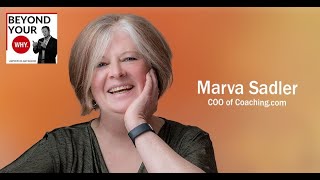
Marva Sadler talks with Dr. Gary Sanchez about growing up fast and building a career in business consulting. She shares how she learned to solve problems early and what that taught her about leadership at coaching.com.
Chapters
Welcome to beyond you'd why Podcast, where we go beyond just talking about your why and actually help you discover and then live your why. You see, we believe that knowing your why, that driving force behind every decision you make and every action you take, is the essential first step to really knowing yourself. It allows you to move forward faster and have a bigger impact. If you're already a fan of the show, then you know that every week we talk about one of the nine whys and then we introduce you to somebody with that why so you can see how their why has played out in their life. This show will be more powerful for you if you've already discovered your why. If you still need to do that, head over to whyinstitute.com and discover your why today. It'll only take you about five minutes. Now let's meet today's guest.
Welcome to beyond you'd why Podcast, where we go beyond just talking about your why and actually helping you discover and then live your why. So if you're a regular listener, you know that every week we talk about one of the nine whys and then we bring on somebody with that why so you can see how their why has played out in their life. And so this week we're going to be talking about the why of make sense to make sense out of things, especially if complex and complicated. So if this is your why, then you are driven to solve problems and resolve challenging and complex situations. You have an uncanny ability to take in lots of data and information. You tend to observe situations, circumstances around you and then sort through them to quickly create solutions that are sensible and easy to implement. You are often viewed as an expert because of your unique ability to find solutions quickly. You also have a gift for articulating solutions and summarizing them clearly in an understandable language. You believe that many people are stuck and that if they could just make sense out of their situation, they could develop simple solutions and move forward. In essence, you help people get unstuck and move forward. So I've got a great guest for you today. Her name is Marva Sadler. Now Marva is the COO of coaching.com she joined the organization in September of 21 when the company was acquired when the company acquired W. Beck's where she was CEO. She is an experienced business executive and consultant with over 20 years leading strategic and operational growth programs for small to mid sized organizations. She also has extensive expertise in strategy creation, leadership development and executive coaching. Prior to joining wbex, Marva held executive management positions evp, cfo, CEO in large organizations including Franklin Covey and Achieve Global. Marva also has substantial experience across a variety of industries leading small private organizations through startup and turnaround efforts, including positions as CEO of Veracity Solutions, a software development consulting firm, president of Hogan Health Industries, a commercial fitness equipment manufacturer, and chief operating officer of Eleader Tech, a startup software firm. She began her career in strategy consulting with international strategy firm Mark Maricon Associates and Bain and Company. She has also served in the nonprofit sector as program director for People Helping People, Unemployment Success Program for low income women, primarily single moms, and as a board member and strategic advisor for no More Homeless Pets of Utah. Marva, welcome to the podcast.
Thanks, Gary. You make me sound much better than I deserve.
Well, that was a mouthful. That tells us that you have done an awful lot in your career so far.
So far. And I think it's actually in part tied to my why. Interestingly.
Yeah, it's funny, when we were talking or when I was going through your bio there, the positions that you've held are all perfect for somebody who is able, who has the why of makes sense, right? That's why people bring you in. Let's make sense of this thing and then move forward.
Well, exactly. And if anybody else picked up on it, I tend to have a little bit of, let's say, career add.
You'll notice that there are a lot of different positions in a lot of different industries doing very different things because I'm driven by the problem solving and my passion is about let me go find a new problem that I haven't solved yet.
So I'm always drawn to very complex problems. And if I haven't solved it yet, it probably means it's because in an industry I haven't been in, or if I really haven't seen it yet, it's because it's a whole new thing.
I love it. So for those of you that are familiar with the yos, the why, how and what, Marva's why is to make sense of the complex and challenging. How she does that is by making things simple and easy to understand. And ultimately what she brings is a way to contribute, to add value, have an impact in the lives of others. And so how does that feel to you, Marva?
Well, it, it feels dead on. I had a friend once in when I was at Achieve Global. There was a executive meeting I couldn't attend and she said, it's okay, Marva. We'll just get a little Marva bobblehead doll and we'll set her up on the table. And every five minutes or so, we'll pop the head of the bobble doll and we'll say, we just need to simplify.
I love that. Well, let's go back in your life now, Marva, take us back to when you were in high school. Where did you grow up? Tell us what you were like in high school. And were people always coming to you as someone to help them with their issues?
No more. I was going to people to help them with their issues.
So give you a little bit of background that is relevant. I grew up in Utah, and that's already going to create images for people. Pretty conservative state. One prevailing religion which has a tendency to. It's a very hierarchical prevailing religion which kind of says, or at least said, when I was in high school, women should be homemakers and mothers. And that's our ultimate responsibility in life. And I actually had a woman in my neighborhood, a friend of my. A mother of one of my friends, who told me when I was about 18 that I could go on an LDS mission if I wanted to when I turned 21. But I needed to understand that that would just be because I'd already failed at my real mission in life, which was to get married and have children. And so that was kind of the environment I grew up in. And I was by nature a bit of a rebel. I mean, I thought I didn't get this brain so that I could just raise kids and be a baby factory. And I realized that's a pretty strong statement. I also came from a family of eight kids, and I was number six. And I had this bad need, this very strong need to be seen by my parents. Because when you're number six out of eight, you just. You're in the middle of the crowd. You're not old enough to have been interesting in the beginning, and you're not young enough to get the attention of being the youngest. And so my response to that was, if there was something that I thought I could excel in, I would go after it. Because I was looking for something that I could do that I could excel at that my parents would go, wow. Unfortunately, my mother was from Danish origin, and Scandinavians basically never say, wow. They always say, oh, someone else could. Had done that. So I would come to her and say, you know, I just did fill in the blank. I just became a National Merit Finalist. And her answer would be, oh, yeah, your sister already did that. I just got this big scholarship. Oh, yeah, your brother already did that. And. And so I just kept racking up things, new things that I would try debate championships, you know, all kinds of things, trying to find something that one of my siblings hadn't already done. And I admit that freely that, you know, this obsessive need to excel was based on the fact that I was number six out of eight. And so I think that that's, you know, a lot of my energy went into that.
When you were even younger, let's say five, six, seven, were you in a position where you had to grow up fast, where you had to be more of an adult at a young age?
Oh, absolutely.
So there was like a six year gap between me and my next older sister and a six year gap between me and my next younger sister. And my mom. My dad got very sick when I was about 3, and my mom had to go to work to support the family, and she would drop me off at the babysitter every day. And my siblings did not pick me up after school. They were busy with all their own things. And I was at the babysitter till my mother could finally come and get me. And it caused, I think, a real strong.
Drive for independence on my part. And I won't go into all the details, but there were a number of situations where even at a very young age, I had to rescue myself. There was one of the simpler examples was.
I really, really didn't like the babysitter because her little boy beat up on me every day. I was about 3, and I on one day begged my mother to let me walk to the babysitter because I just wanted some time and attention, and she was in a hurry, so she tossed me in the car and she got in and I opened the door and she drove off. I fell out and she ran over me and she broke my arm. She. She read the tire, ran over the upper part of my arm and broke my arm. I was lucky it didn't hit my head. That would have been the end of a. You know. And so I ended up with this cast on my arm. And when I went back to the babysitter a few days later, this little boy started beating up on me again. And I had complained to the babysitter and that hadn't worked. And I'd complained to my mother and she told me to deal with it. And so when that cast got hard enough, he beat up on me and I whacked him across the head with that cast. And I just. I did that until he left me alone. And that was kind of the beginning of me recognizing I'm going to have to get myself out of whatever the situations are. So that would be my version of I grew up fast and came to rely on myself very early.
That is really interesting because that's very common. It's the same story with everybody that has the why of makes sense. You can trace that, right? Yes. And I was wondering about it because when you told me where you grew up and how you grew up, I was thinking, because typically I'll see that scenario play out as one of the parents was kind of a mess and the child had to grow up really fast to kind of be the protector of the rest of the family. So I was curious how that was going to play out out with you, but it didn't. You surprised me because I thought maybe it wasn't going to play out that way, but you did have to do the same thing, but you were the one that you had to protect.
Well, and then let me tell you the rest of the story. So I told you I got these five older siblings. I got these two younger siblings. My mother was 45 when my youngest sister was born, and she was done before I was born. She was just done. And so my dad was 51 or so when my youngest sister was born. And they got to a point where he was off doing consulting work.
For Armco Steel, and he would take my mother with him. As soon as I got to the point where I could drive, I became the surrogate parent for my two little sisters. And they would leave us for weeks at a time, and they would leave me with grocery money and they would tell me to behave myself. And I would make sure the girls got up and got to school and that they came home and that they were fed. And I would take care of them for two or three weeks at a time. And my parents would come back and kind of wave and say hello, and then they'd disappear again. And that went on basically.
Through college. My one younger sister was she and my mom really didn't get along. I would go home every weekend when I was in college just to take the pressure off my little sister. When I moved away after graduate school, I actually invited her to come live with me for a while so that we could break that cycle and she could gain some independence and learn to do some things on her own. I remember my older siblings, when my little sister went on an LDS mission, we all congregated to hear her say her farewell. One of my sisters came up to me and she said, you know, I thought you were just a selfish witch to ask her to be your nanny, because I thought you were just doing it entirely for yourself so that you'd have cheap childcare. And now I realize that wasn't your motivation at all. You were trying to get her out of a bad situation so that she could change the way she felt about herself. And. And look at what you've done. And now she's ready to kind of, you know, fly. And I just, you know, I find it sad that my family would have that attitude about me, that I would be that selfish. But, you know, my little sisters don't feel that way about me, so I guess it's okay.
And I can imagine that even way back when you were really good at what you did, and you were very capable and you had a very high capacity, because that's right in line with the why of makes sense. And other people can look at that and think, man, she thinks she knows it all. She thinks she's all this. But you were forced into that situation. Is that right?
You know, I think I leaned into it, though.
Yeah.
I mean, there must have been something in my nature to begin with that caused me to find that as my solution and my problem solving, instead of, say, withdrawal or being a victim, you know, I chose that. That way to deal with it.
Okay, so you went to. Where did you go to college? Oh, you went to byu, right?
I went to BYU for both my undergraduate and my graduate degree, yeah.
Okay, so you got your undergraduate in what and what was your graduate degree in?
I got my undergraduate degree in broadcast journalism. I thought I wanted to be the next Woodward or Bernstein. I loved journalism and. And I loved broadcasting, so I thought going to be, you know, a famous TV news anchor. And then I fell in love with radio and realized that radio had the benefit of anonymity, but also a lot more creativity. And. And then I. So I wrote documentaries for a radio station for about a year and a half in New York City. And I went back to graduate school thinking I would become a business journalist because business journalism was a big deal. And I figured that's how I could make money. And. And I fell in love with business. And I just thought, oh, baby, where have you been all my life? This, you know, this is like the world makes sense to me. And I just. It seemed like a whole series of problem solving that I could use. And instead of just. Instead of just reporting about businesses and the problems they were having, I could actually get involved and solve the problems that they were having. And so I found it that much more interesting. So you became.
Did you start a business or did you become A business consultant.
I became a strategy consultant with Bain and Company. I actually got recruited by the famous Mitt Romney himself.
Wow. And so right out of grad school.
Right out of grad school, yeah.
And so what was that like for you?
It was a mixture of heaven and hell.
From an intellectual perspective, it was fabulous. I interacted every day with the smartest people on the planet who were driven the way I was to solve problems and to find simplicity and to create, understand patterns and find solutions. And from that perspective, it was amazing. And from the human perspective, it was really tough.
I was the first female consultant who had children, because by the time I got out of graduate school, I had one child. I actually had him right after I finished graduate school. And then I stayed and taught for a year while my husband finished his undergraduate. And so by the time I was done with that, I had two kids. So I started as a strategy consultant with two children, which was just unheard of for a female. And so from a personal perspective, it was hard. And.
To give you an idea, you know, this was back in the early 80s. I had a manager who finally came to me one day, and he said, you know, Marva, you're better than. You're getting experience.
He said, I just tried to put you on a project that I thought you'd be really good at. And the managing director wouldn't let me do it because he said, you're not allowed to travel. And I said, what? And he said, yeah, he's made this decision that because you have kids, you shouldn't ever travel, so you're never going to get on a project that takes you away from home. And I, being me, I walked down to the managing director's office, and I knocked on his door, and I said, can I have a minute of your time? And he was a little surprised to see me, and he invited me in, and I stood there in his office, and I said, I understand you've made a decision about the direction of my career and that you've decided that because I'm a mother, I can't travel. And he said, well, yes, I was doing you a favor. And I said, no, you weren't. You're killing my career, and it's none of your damn business.
I have the right to make that decision for myself. It is not your decision to make. And I mean, I literally used those words. And he stood there and he said, I was just trying to do you a favor. And I said, that is not a favor. You have put me on the mommy track, not your decision to make. I would appreciate it if you would withdraw that restriction. And so as a. I think in retaliation, he put me on a project that he thought was going to take me to France. And I went.
But it was a turning point in my career because I was no longer on that mommy track. I was headed towards failure. And I just wasn't willing to accept that.
You weren't getting valued for who you were, but held back because you had kids.
Right, right. And.
Basically it was my decision to make. It was my problem to solve. It was not something that I needed somebody else to solve for me.
Gotcha. So you were there for how long?
I was there for.
Say, five years, almost five years.
And then where did you go? Keep us going on your path.
Okay. I then I then actually took a leave of absence because I was pregnant with my third child and I had some complications and I couldn't work for a while. And at that time, my husband was working for 9X, which was one of the big bell baby bells that then became Verizon. And he was working there, International development group. So he got transferred to White Plains, New York. And so we moved to New York and I took a little bit of a sabbatical and then I went back to work for a strategy firm called Maracon Associates. Who were the.
They were the inventors of value based management, which was the marriage of strategy with financial parameters. The idea was that you could create long term strategies based on projected cash flows and you could understand what the drivers were of a business by understanding what created cash flows. Because value is all created in cash flow, not in revenue or profit.
Wow.
So at that time that was. I mean, it's still not a. It was a very new concept at that time. Right?
It was a pretty new concept. And the reason they were interested in me is because they wanted to understand how Bain did strategy work, because they only did financial strategy work at the time. And so I had been a manager at Bain on my way towards partner when I had left. And I joined Maracon as a manager and.
Helped them really understand how you could apply these financial rules to developing strategies. And it was a lot of fun. I got a reputation of. This won't surprise you, being the kind of person who would take the brand new projects nobody had ever heard of and figuring out how to turn it into a solution that we could then replicate and that we could use the new concept that had been developed to go sell to another client.
Yeah, that didn't surprise me at all. And so you were there for how Long.
I was there for three, three and a half years.
Okay, and then where'd you go?
I then had a kind of personal epiphany. I was living in New York in the Hudson River Valley, and I developed some symptoms that looked very much like multiple sclerosis. I was losing feeling in my hands and feet. I was losing the sight in one eye. I had some pretty serious health problems. And I went to a neurologist who told me I had Ms. And he said, it's chronic, it's progressive, it's debilitating. You'll be in a wheelchair and you'll die. I suggest you try figure out how you're going to take care of your kids. And I wouldn't accept that. So I thought, well, at least maybe I can slow it down if I take care of some of the other issues that I have. And I went to see a really good allergist who said, well, the good news is you don't have multiple sclerosis. The bad news is you're killing yourself because you've stressed your body so much, working 20 hour days for so long that your body is in just complete rejection of everything. And you're going to have to change your eating, your lifestyle, where you live, everything else. But I can make you healthy again. And I got to where I was doing a lot better and I thought I was just going to tough it out. And then it turned out that one of my kids got very sick from a spider bite. And once he was out of the hospital, I took him to see this allergist. And the allergist looked at me after he tested him and he said, if you won't get out of here for yourself, get out of here for your kids, because they've got the same issues and you need to go someplace that freezes hard in the winter, that doesn't have mold in the air. And he had a couple of other stipulations. And so we moved back to Utah. And we moved back to Utah.
Partly to take care of my parents, because, you know, I am. I took care of my sisters. I'm the caregiver. And so we moved back to take care of my parents. And I started into a PhD program in finance at the University of Utah and realized I was not cut out to be an academic. I had professors who would talk about these theories and then they'd go, you know, but we're PhDs, we don't need to use them. The stupid MBAs, they would actually ask, how would I use this theory? But as PhDs we just need to know it's a theory. And I raised my hand one day and I said, I've used that theory. And the professor said, really? Somebody uses this crap? And I just thought, I don't belong here.
No. Oh, my gosh.
And so I went back to consulting for IBM.
Took a step back to consulting for IBM.
Yep.
And then how was that for you?
It was a lot of fun. I saw a lot of the world. I ran a program to teach IBM executives in Asia Pacific how to consult, how to do services consulting instead of just how to sell boxes.
I got to see a lot of Asia. Then I took it around to the issc, the services corporation that was a division inside the US and then from there, you know, I did a couple other things and my husband and I bought a historic woolen mill in northern Utah and brought it back into operation.
And why would you do that?
It was something he really wanted to do. And I realized he wasn't going to be able to do it without my operational knowledge. So we did that for about five.
Years and eventually got into coaching. I mean, how did you get back to.
Eventually went back to work as a finance director for what became Achieve Global and then became the CFO at Achieve Global. And from Achieve Global went to Franklin Covey as an executive vice president. And, you know, training is kind of the poor cousin to coaching. Those of us who were in the training business knew that coaching could eat us for lunch any day because the results were better. And so that's kind of how I got into professional services and from training into professional services and by way of a couple of detours. But that's where my background came from, that I ended up in coaching.
And then. So were you ever a coach? Were you out coaching other people or mainly working with groups of coaches?
I have never actually been a coach. I tell people I'm much more of a consultant than a coach. I don't have the formal coach training, but I do. I have done a lot of small business consulting in my time where I take the, you know, the entrepreneur or the small team and really help them think through how to think about their business differently. And a lot of that ends up being kind of leadership.
Kind of coaching. But I'm not going to call myself a coach because I don't have that classic training.
And so I have a tendency, given the, you know, my. Why I have a tendency to give advice more than I should.
Yeah.
And so then from W. Beck's, you got to coaching.com by. As they got Bought out as we got bought out.
That's right.
Yeah. I don't know if you remember what I said to you way back when we were. It's almost a year ago, I think now when we were talking. Is this before all the dot com happened?
Well, it was in the midst of all of that, trying to sell the company. But of course, I couldn't tell you that at the time.
Yeah. And I was saying that your CEO, I mean, you were the CEO, but I said, whoever gets you is going to be awfully lucky because you're that person that's going to help them solve all. You could take in so much stuff, simplify it down to where it's useful so that it can have an impact in their life. And that is just what it's. I mean, it shows up everywhere in your life from the time you were, what, 12 years old or younger even, or maybe younger.
Yeah. It's very definitely a theme.
You'Ve been coaching since you were the mother to your two sisters.
Yes.
That is what you did for them, right? You coached them through a lot of stuff.
Yes. You know, my little sister was saying something to me a while ago. She was asking me something about my, you know, childhood. And I had said, well, you know, I went to the babysitter for years and.
Nobody would come and pick me up. And she said, well, my family would never have done that to me. And then she looked at me and she said, that's because you're my family. And I said, yeah, because I knew what it felt like.
So I would never desert you like that or leave you to your own devices because I knew what it felt like.
Are your parents still alive?
No. You think I would have said those things if they were still alive?
I was just thinking that.
Okay, so.
I was responsible for taking care of my parents for almost 20 years.
Took care of my parents. I didn't, like, live with them, but I lived around the corner from them so that I could kind of pay attention to them for several years. And then my dad got really sick and we worked through that. And then my mom, I had to put her in an assisted living center. And I was responsible all that time. And then once my mom died, I took over the financial responsibility for my oldest sister and did that for about 10 years before she passed away.
Wow. So here's a question I have for.
I'm curious about. Have you ever had a time in your life where life was easy, where it wasn't a whole lot of stuff coming at you all the time? Has that ever happened.
Does that ever happen to anybody?
I think so.
Because, you know, you've. You've had opportunities probably where things could have slowed down, but then, well, I decided I was going to get my PhD or I decided I was going to. I mean, you take on massive things. Not just like, I think I'll learn how to knit or something. It's more like, I'm going to go get my PhD or I'm going to. I think I'll consult with IBM. Those are not minor little excursions for most people.
Oh, but those are choices, right? Those are direct, intentional choices that I'm making. So I, I'll give you an example of what I do in my spare time. I, last weekend watched a YouTube video and learned how to create a drip irrigation system for my flower beds. Because it's been really hot here in the Columbia River Gorge where I live, and I bought this stuff. And so every night for the last few nights, I've been out every night, I build one irrigation system for one of my flower beds. And then I, I called up a mulch company and I had them deliver, you know, 7 cubic yards of tree bark. And once I build the, you know, the irrigation system, then I put the tree bark down. And that's what I do for recreation. So it's a choice that I'm making.
Because quite honestly, I don't know what to do with my time if I'm not doing something interesting and challenging, where I'm learning something new.
That to me is kind of boring. My son, my youngest son a while ago said to me, mom, you have two gears, neutral and overdrive. You're either in complete overdrive where you're just going, or you're sitting very quietly reading something, doing nothing. You don't have anything in between.
That is great. So tell us about coaching.com. so coaching.com bought out WBEX. And how are they different? And for those people that don't know, I know we have a lot of coaches that listen, but for those people that don't know, tell us, what was wbext and whatiscoaching.com?
Absolutely. Well, WBEX was known for the World Business and Executive Coach Summit, an annual free summit that we run for three weeks in June, which features the world's best coaching and leadership thought leaders. This year, Susan David was one of our headliners. And Susan David is considered one of the top 10 thinkers in the world right now. And we attract some pretty impressive people. Last year, our headliner was Adam Grant. And you know, I measure My success by whether my children have ever heard of these people. And my daughter, I was with dinner, at dinner with her a couple weeks ago and you know, she was shrugging over something, I think over Ray Dalio because Ray Dalio was also one of our headliners and she was like, never heard of him. She's a doctor by the way, so she doesn't care about business. But when I got to Susan David, she knew who Susan David was. And when I got to Adam Grant she was impressed and I thought I've succeeded. My daughter is impressed with something that I've done.
But. So that's what WBUX is most famous for. We have a database of about 100,000 coaches, primarily independent solopreneurs and primarily in the business leadership executive coaching arena. And, and we also run high end educational programs that we run live and virtual globally. So we've had people from 140 countries take our programs with thought leaders like David Peterson or David Drake who are very well known in coaching for really being very independent, creative, innovative thought leaders in the areas of coaching. That's what we're known for is this kind of, let's say the business to coach orientation with this great database of coaches and this educational content. Coaching.com is a software platform which their primary focus has always been on creating a coach management system for enterprises, large enterprises who have big coaching projects to be able to manage those coaching projects in a way where they can track and manage the coaches and the coaching sessions and the feedback and.
They can do all that. And so what we did was they were very good at technology and software and WBAX was very good at the education and actually marketing. So we put the two together so that we could have a two sided ecosystem with the emphasis from coaching.com on the enterprises and the emphasis from W backs on the coaches to try to persuade the coaches to get on the coach version of the platform so that the enterprises could access these great coaches. Because enterprises are always asking for is there an easier way for us to find coaches for our executives? Is there a way for us to find qualified coaches that we don't have to go and contract with them individually or whatever? We're a little bit different than say betterup that a lot of people compare us to or ASAP because.
We'Re neutral. We're not trying to tell the coach how to coach or what to coach or how to price or what kind of coaching to do. We're just saying put yourself on the platform and go ahead and tell people what your specialty is. And with the enterprises, we're saying, go and find the coach you want to find and either contract with them directly or contract through a coaching company that represents a group of coaches. But our job is to be the marketplace that brings the two together. And so we're never going to take sides around which methodology you should use, what training you should go get. We're just going to say we're going to give you access to a lot of great assessments and products and.
Education so that you can continue to develop your skills. And for the enterprises, they can say what their criteria are, and the coaches can meet those criteria. And so we're not in the business of brokering specific coaches. We're in the business of matchmaking.
Gotcha. So like a dating platform for.
Like a dating platform for coaching and the people who use coaching. Yes. And so everything that we've done since then has been to build on that business model. We're now in the midst of creating partnerships with organizations that have things that are very useful to the coaches and useful to the enterprises or the. The users of coaching so that we can create a closed system where by getting the education or the certification, the coach actually also becomes part of the platform. And then they can sell their coaching based on the fact that they're certified to do that kind of coaching. So that we're trying to find a way to create more of a marketplace for coaches. Because at W backs, our mission was to raise the global standard of coaching. And one of the ways that you have to do that is create opportunities for coaches to get better at coaching, but also create opportunities for coaches to do more coaching so that they can get better and get paid for what they do.
I love that you are speaking my language, that is for sure.
And so coaching.com has been around for how long?
Coaching.com started 12 years ago as CoachLogix Inc. Alex Pascal, the owner and CEO, came out of a background. He's actually a Ph.D. iO psychologist, and he worked for the center for Creative Leadership, ccl. And then he had this notion that there were better ways to scale coaching, to take the. Let's call it the administrative out of the coaching, so that coaches could spend more of their time coaching and. And less of their time in all the administration and management functions of coaching. And so that's what the coaching.com platform really is intended to do, is to streamline all of that and then make the connections to the people that they coach much easier to manage so that they can become much more effective coaches and spend a higher proportion of their time coaching.
So for those coaches that are listening, they ought to head over to coaching.com take a look at it and sign up.
Absolutely. Because the first level of use of the platform is completely free. So they can have access to scheduling and to feedback and all kinds of calendaring, even paywall. And they can have access to all of that and not pay anything to be on the platform. They can put up their profile so that they can be viewed by the enterprise clients and within a month or so, external people looking for coaches. And they can, they can learn a lot from our marketplace.
So first step is free. They get access to all the stuff to help them run their business. And if they want more, they can get into the education and the certification and all kinds of different areas to help them grow to be able to offer more.
Exactly.
I love it. I love it. Okay, so I got one last question for you.
Okay.
What's the best piece of advice that you've ever given or the best piece of advice that was ever given to you?
Well, the best piece of advice that was ever given to me was given to a lot of people, not just me. But Marshall Goldsmith said, ask yourself the question, does it need to be said? Do you need to say it? Does it need to be said now? And since I'm a person who has a tendency to be a know it all and want to give the solution, and I frequently do see the solution before other people see it. And I, I don't mean that in an arrogant way, although I'm pretty sure it sounds pretty arrogant. But as a leader, it's really easy for me to just jump in and solve the problem for people. And so I have those questions up where I can see them. Because if people can get to the answer themselves, even if it's not exactly what the answer would be that I would get to, it's more powerful for them. They learn more, it's easier for them to implement. We get more creativity out of the group if I don't step in and give them the answer. And so I just try to remember that, does it need to be said? Does it need to be said by me? Because as the leader, they're all going to have to agree with me. And even if it needs to be said and by me, does it need to be said in this public forum or is there some other way that I could have that conversation with an individual? And so that is probably the best advice that I've received that I use on a regular basis.
That was super helpful because that's a big challenge for, you know, everybody with the why it makes sense. I mean, says, is it just like what you just said right there? They are way ahead of the rest of us. You have to dumb yourself down to let us catch up. And then if so, what has happened to you when you didn't follow that.
Series of questions, when you ignored that?
Mostly I feel really bad because it shuts down the conversation, it shuts down the creativity, it ends the development of the individuals. And I'm really dedicated to people's professional development. And so I disappoint myself because I cut off avenues to growth. And frequently then if I give the answer, it actually takes us longer to get there because then people, anybody who feels like they have a different answer feels like they then have to justify a different answer because they're now combating with the person that's the leader instead of just offering an idea.
It's fascinating because people with the why of making sense are so capable, have such high capacity, are so fast and good at doing almost anything that people stop doing what they can do and just leave it for you to do because you're going to do it better and faster anyway. So then you become the bottleneck, right?
Your capacity becomes the level at which.
We can grow because people are all waiting for me to give them an answer. And the way to solve that is to quit giving answers and to start saying, I trust you. What do you think? You are more of an expert in this area than I am. What is your recommendation? And handing it back to people is one of the hardest things I do every day.
I can imagine. Because we had somebody on our team with your why and he was so good at everything that I ended up just finally watching him. You know, I just didn't watch him. I said, okay, well, you do it because you're going to do it better, faster, quicker, easier than I am. But he ended up becoming the bottleneck and we ended up having to, you know, part ways because we could only grow as fast as he had capacity, so.
Exactly. But if I can help other people get to where they contribute and I can somehow spread that, then my influence is significantly greater than if I'm the one that's making all the decisions or taking all the actions.
You know, I've been looking forward to our conversation for a long time because we talked, you know, almost a year ago about doing this, and it's taken us a while to get to it. But had I not known your yos, if I had just saw your picture. So let's say I'm just looking through LinkedIn. Hey, there's Marva Sadler right there. There's your picture. Could I tell from your picture or your bio or anything that you have available to me any of this stuff about you? Was there any way I would have known just looking at your picture from the bio?
Probably, yeah. Looking at my picture, that's a pretty. I don't know, that's a pretty deceptive picture. It's probably the one picture I've ever had taken of me where I look like I'm having a good time because I always look like I don't trust the camera.
Oh, no. But it's fascinating because, you know, even though I knew your why was make sense, I was really curious to see how it all has played out. Now it makes total sense now that I know your history and I know how you grew up and I, you know, I learned a lot more and our audience as well. But no way would I have been able to tell that from your picture or even, probably even if I watched a video of you speaking somewhere. It would be very challenging. But now that I know, it makes communicating, connecting, understanding you so much easier. Does that make sense?
It makes a lot of sense. And frankly, I'm not sure I would have been able if you'd laid out the whys in front of me and just said, pick which one is you. I'm not sure I would have been able to accurately say, this one is me. This is my how.
But as soon as I read the descriptions after I'd taken the the test, I was like, oh, that makes a lot of sense. And in fact, I'm looking at my, my screen and I still have them up so that I could refer to them.
That's awesome. That's so awesome. Well, Marva, if there's people that want to connect with you, follow you, or follow coaching.com, what's the best way for them to connect with you?
Well, they can certainly find me on LinkedIn and that's probably the easiest way. They can also find coaching.com on LinkedIn. They're also welcome to email me. I don't always get back right away, but I do try to answer emails on a regular basis and it's just really simple. It's Marva. It helps to have a really unusual name, by the way, but it's marvaoaching.com.
And interestingly, I was introduced to you by Magda. So I got Magda and Marva.
Yes. And people frequently get the two of us mixed up and call me Magda and call her Marva.
Well, Marva, thank you so much for being here today. I really enjoyed our conversation. I look forward to staying in touch and working with you guys because you've got a great organization there, and it's growing. Leaps and bounds right now, right?
It is. We are on the fast track. Absolutely. And it's so exciting. There are so many things that we're doing that the merger actually created the ability for us to take paths that neither one of us could have taken on our own.
Well, that's awesome. Thank you so much for being here.
Thank you.
I really hope you enjoyed today's episode and that through today's guest, you heard how important it is to know your why and how impactful it can be in your life and the lives of those around you. Be sure to head over to whyinstitute.com and discover your why why today. Remember, the more you know about yourself, the more you'll know about others. I'm Dr. Gary Sanchez, and I'll see you on the next episode.
More from Dr.




Women In Leadership: A Need For A Greater Systemic Change With Belinda Clemmensen






