The WHY Of Make Sense In Analytics With Kavita Ganesan, Opinosis Analytics
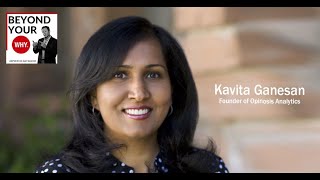
Transcript of a Beyond Your Why podcast episode (recorded Mar 15, 2023) in which host Dr. Gary Sanchez interviews Kavita Ganesan, an AI advisor and founder of Opinosis Analytics. Kavita describes her background (born in Malaysia; MS at USC; PhD at University of Illinois Urbana-Champaign), career path (industry roles at eBay, 3M, GitHub; consulting and book author), and practical explanations of AI (how learning from data works, use-cases such as recommendation systems, ICD billing-code generation, computer vision and ChatGPT). The episode also discusses business opportunities and risks with AI, the changing nature of work, and Kavita’s focus on executive education and consulting.
Chapters
Welcome to beyond you'd why Podcast, where we go beyond just talking about your why and actually help you discover and then live your why. You see, we believe that knowing your why, that driving force behind every decision you make and every action you take, is the essential first step to really knowing yourself. It allows you to move forward faster and have a bigger impact. If you're already a fan of the show, then you know that every week we talk about one of the nine whys, and then we introduce you to somebody with that why so you can see how their why has played out in their life. This show will be more powerful for you if you've already discovered your why. If you still need to do that, head over to whyinstitute.com and discover your why today. It'll only take you about five minutes. Now let's meet today's guest.
Welcome to beyond you'd why Podcast, where we go beyond just talking about your why and actually helping you discover and then live your why. So if you're a regular listener, you know that every week we talk about one of the nine whys and then we bring on somebody with that why so you can see how their why has played out in their life. And so this week we're going to be talking about the why of make sense to make sense of the complex and challenging. So if this is your why, then you are driven to solve problems and resolve challenging or complex situations. You have an uncanny ability to take in lots of data and information. You tend to observe situations and circumstances around you and then sort through them quickly to create solutions that are sensible and easy to implement. Often you are viewed as an expert because of your unique ability to find solutions quickly. You also have a gift for articulating solutions and summarizing them clearly in understandable language. You believe that many people are stuck and that if they could make sense of their situation, they could develop simple solutions and move forward. In essence, you help people get unstuck and move forward. So today I've got a fascinating guest for you. Her name is Kavita Ghanason. She is an AI advisor, strategist, educator, and founder of openosis Analytics. She works with senior management and teams across the enterprise to help them get results from AI. With over 15 years of experience, Kavita has scaled and delivered multiple successful AI initiatives for Fortune 500 companies as well as smaller organizations. She has also helped leaders and practitioners around the world through her blog posts, coaching sessions and open source tools. Kavita holds degrees from prestigious computer science programs, specifically a master's degree from The University of Southern California and a PhD from the University of Illinois at Urbana Champaign with a specialization in applied AI, NLP search technologies and machine learning. Cavita has been featured by numerous media outlets including Forbes, ceoworld, CMS Wire, Verizon, South Dakota Times, Tecopedia and TED Magazine. Kavita. Welcome to the podcast, Gary.
Thank you for having me. I'm really excited to be talking to you today.
This is going to be fun. So where are you right now? What part of the country are you in?
So I'm in Salt Lake City, Utah, so that's where I am in right now.
So where were you born and what were you like growing up?
So I was born in Malaysia. That is like south of Thailand and north of Singapore is part of Southeast Asia. So that's where I grew up. And I came to the US when I was around 20 years old and being in Malaysia. So I personally was a very quiet individual, Very quiet, very observant, very reserved, but very sharp and smart in academics. And I did well in school. Then after my bachelor's degree in computer science, which I did kind of well in, I got admission to the University of Southern California in Los Angeles. So that's where I did my Masters and that's where I got introduced to this whole world of AI. And I was completely taken up by the complexity of AI as well as the opportunities that it presents for each new problem. So I really love problem solving and I really like algorithm development. So the AI is basically a combination of the two.
Yeah, so that's how I really got into it. And USC has Even back in 2005 they had really cutting edge AI research going on. And this was long before AI became a really mainstream topic that it is today.
So at that time there were no jobs in AI. So I went and worked at ebay as a software engineer. But I was still very intrigued by AI. So I was still attending conferences related to AI, I was publishing papers, so I was still doing AI on the site. And I really wanted to get deep into AI. So I said, okay, do hell with this job. I need to do my PhD in AI. Whether there are jobs or not, I'm going to do a PhD in AI. And at that time I was ready to become either a research scientist because that's where people with AI background go, or become an academic professor. So I wanted to be the research scientist so I could stay within industry jobs.
So I had a blast. And people would think I'm crazy leaving a high paying job and going becoming a student, graduate student, earning only like 1800amonth. But to me, I was like that. It's okay. I'm okay with that for a while. Yeah.
So a couple things, then. Let's go back a little bit. So you went. Where did you do your. So in high school you were. You were quiet, but really interested in problem solving. Really interested in learning.
Really interested in learning as a good student, basically. Yeah.
And then off to. So for those that are listening, Kavita's why is to make sense of the complex and challenging her how, how she does that is by seeking mastery, right. Diving in, deep, learning all the nuances, learning as much as she can. And her what ultimately what she brings is a trusted relationship to be that trusted source. So let's see how this plays out for her. But it's like. So your bachelor's degree was. Where was that? In Malaysia?
Was in Malaysia, was in a public university. And I was really good in programming, so I did a computer science degree and I excelled at it because it just came very naturally to me. So a lot of algorithm development and, you know, problem solving, again, makes sense. Yeah.
So then you see, which is where I went. I went to USC as well. And what your story. Yeah, it sounds very familiar to me because when I went to usc, cosmetic dentistry, there was no such thing as cosmetic dentistry at that time, but USC was on the cutting edge of all of that. And so they were the first ones to come up with this cutting edge. I mean, with this cosmetic dentistry degree. Which is what I went. Which is what? When I was there, but similar to AI when you were there. So, yeah, that. It's kind of. Kind of similar. But tell everybody what is AI.
So AI is just like a very specialized software automation that helps you mimic human like thinking and decision making problems. So let's say right now a doctor uses his years of experience to decide if a patient has lung cancer based on the patient's data, his experience, his training, and a range of other factors like images from their scans and stuff like that. So AI tries to replicate this by learning from the data point, historical data points. And then when a patient comes along, it looks at their data and then makes predictions. Hey, this patient may have a high risk of lung cancer. So it's basically replicating how humans think and reason. So that's what AI is at a high level. Yeah.
How does it do that? How does it learn? What. What the heck is it? Where is it? I mean, I've been using some AI stuff lately and chat, you know the chat GPT.
Yeah.
Where is it? What is it? Is it one computer?
How does this happen?
It's algorithms behind the scenes that thousands of different algorithms. And the way it learns right now is based on seeing examples in data. I've seen thousands of different patients with lung cancer, and I'm seeing also thousands of different patients without lung cancer. By mining the patterns with patients with lung cancer and without lung cancer, I know what are the underlying factors that results in a patient having a high risk of lung cancer. It learns based on the patterns that it sees from data. That's why data is a very important piece to AI systems today. So it's same thing with ChatGPT. The reason it's able to generate text that's so accurate is because it's seen all this data across the web. So it's putting together words and concepts that it thinks are the answers that you are looking for, and it's generating that with a certain degree of certainty. So it's not 100% sure what it's generating, but it's like it generates a probability along with the answers.
So that's how it works today. So by looking at data and the different algorithms to learn from that data and what probabilities to compute, what mathematical functions to use and actually how to generate that data for you, the answers for you.
So explain to us what you mean by learns. How does a computer learn?
So learn is like in statistics, you try to fit a function to data, right? So that's basically what it's trying to do. But this function may not be a linear function. It might be something really complex, like it is in our brains. Like we don't know how we arrive at certain answers, but we get to the answer. So that's how it's learning. It's creating this internal complex function that helps it make the predictions. So that's essentially what it's doing.
So if I gave it two plus two equals four, where does it store that? Or how does it know? How does it keep track of that? Is it just like saying, okay, two plus two equals four, I'm going to stick that over here in case I ever get asked two plus two again, I'll know where that is and I can just spit out the answer. But it just seems like somebody or something has to be orchestrating it in the background. But is that not true?
Right, that is true. But the thing that's orchestrating it is the underlying computing unit. So, like, mathematical operations is already supported by computers today. So those basic operations like additional multiplication, so that's already supported, and then it just uses the memory that the computer has to store the information and retrieve it later on. So all that is already there. So what AI brings to the table is more how do you use all these numbers in a way that will generate the answers for the end user? So that's where like the function comes in. So AI creates this really complex function using all those numbers that computers can already generate and compute. And then splits are the answers for you.
Still confusing. And I bet it's still confusing to the people listening. I was a computer science major in college, and I still don't get it. So you graduated with a PhD in AI and then what happened to you after you graduated with your PhD?
As I was about to graduate 2013.
I was ready to become either a research scientist or an academic research professor. But that's the time that big data data science AI really started to take off in industry. So instead of doing all the research stuff, I went on to solving industry problems. So I worked at different companies.
Like 3M, GitHub. So I basically solved some of the AI problems at those companies. And as I was doing that, I was also getting requests by other companies on a consulting basis to help them implement AI in their organizations. So that's kind of how I kind of morphed into more being a consultant. And actually I actually found that a lot more rewarding because I got to learn different domains, different problems, and I got to impact problems more directly. So there was less bureaucracy, less all the politics. I got to just work on the AI side of things. So that really interested me. And so in 2020, I said, okay, I'm not going to do employment anymore. I'm going to go full swing into consulting. So that's how I wrote my book. That's how I started doing speaking and a lot more consulting now. And I really like it because it's like intersection of what I am. It's like problem solving AI and making the complex simple for the customers. Yeah.
So give us an example of what you said. You went in and solved AI problems. What would be an example of an AI problem? I'm still struggling a little bit to understand what the heck I mean, I get. Since I've used some AI, I get what I can do. But what would be an AI problem that a company would have?
Yeah, a very common one is like the recommendation systems that you see on Amazon. That's essentially an AI problem. So it understands your browsing history, it understands what you like, and then it makes recommendations on what you might buy. So it could Be books, it could be other electronics. So it's trying to basically.
Understand the customer's taste and predict what they may buy. So it increases revenues for them. So one of the problems I worked on was kind of like that, but more in, not in a monetary way, but more for more discovery, more engagement. So recommendations to increase discovery and engagement. Another problem was trying to generate billing codes. Have you heard of this? ICD9, ICD10 billing codes?
No. Yeah, so those, that's how insurance hospitals get reimbursed by insurance companies through these codes. But you'll have by. But a medical coder has to read lots and lots of documentation in order to get to those codes. So I developed AI systems to actually automatically generate those codes based on the data itself, just by looking at the data. So then the medical coder just has to verify, hey, okay, this one looks right, this one looks right, this one doesn't. And then so you're basically improving their productivity. So those were the types of problems I worked on on the healthcare side and then on the code side and the recommendations. So these were the problems. Yeah.
So is AI something that's already out there that anybody can use? Is it a, like, how do you go about building something like that? So if I were to hire you and say, hey, I want to figure out what, like you said, what people might want to buy on top of what they've already bought and purchased. How do I, how did you, how do you solve that? How do you create that? What do you have to actually create?
So there are different types of AI systems. There's AI to understand natural language, there's AI to understand images, there's AI to just make predictions.
Like self driving cars. Use a branch of AI called computer vision to actually help it see where it's going and how it's moving. So that's how it avoids obstacles. It's constantly processing images, detecting objects, and then making decisions. So it, it really depends on the problem. So for most problems we have the tools to solve using AI, but your problem may be very futuristic, like you want it to think just like you. And that type of AI is just not there yet. Although ChatGPT seems like it's there. It's, it's just stringing together text that it already knows. So it's not really thinking like you.
Yeah.
So does.
AI, I probably already know the answer to this, but does AI excite you or scare you?
AI excites me, especially from a business perspective. Businesses have barely scraped the surface in using AI within their business. So There's a lot of opportunities for solving.
Productivity related problems, revenue related issues.
Human error related issues, using AI. And I see a lot of opportunity and that really excites me. It doesn't scare me at all because.
AI systems are not humans. We still need humans to do a lot of the other tasks. It's going to make us more efficient, it's going to be helpful. But I don't think and do what we do right now as a whole.
When will it be able to do what we can do?
Well, a recent prediction is that in 75 years. But, but we'll have to see.
And so that, I mean when I started I didn't know much about Chad GPT. I think it's GPT right now.
GTP Chat GPT. Yeah.
I didn't know much about it at all and then I started to play with it and then I saw, I was at this event and they were talking all about it and then I've since shown it to some other friends and other people and the, the first thing I hear is, man, that scares the heck out of me. Oh, everybody seems scared of, of it because maybe it's unknown or maybe because what it can do and who it's going to replace. I mean it just seems like it's going to replace so many people.
Yeah. Tools like ChatGPT.
They have no regulation right now. So people can use it in any way they want. They can use it for disinformation campaigns, they can use it to plagiarize other people's content. So that's the problem with ChatGPT because it's so open ended, you can do anything with it. And. Yeah, and I think this is mainly scaring the marketers and people who are on the creative end. Yeah.
It seems like it moves. You can get it to create slides for you, you can get it to so many things, it'll do for you better than you can do it. And free.
And free. Yes.
Free to a certain extent. You still need to pay for the API usage.
Yeah. So I had it do a, I fed into it a.
In a.
Like an introduction to introduce somebody.
Yeah.
Make this more compelling. And in two seconds it created something that might have taken me a couple days to do and redo and it was very, very good. I was amazed how good it was. I saw a guy give a whole speech and he started it with a poem. He told everybody that he had been trying, he had been learning poetry and of course he hadn't been. He just asked Chad GPT to create a Create a poem for him. Yeah, his whole presentation using, using artificial intelligence. It was fascinating.
Yep. Yeah. So marketers are afraid. Yes, but I think, yeah, but I think they still need to add a layer to check the facts within the. Whatever article it produces, ensure it's not plagiarizing content. Word forward. So there are a lot of problems within text generation, I feel.
So what do you see as some of the, you know, some of the.
Innovations that are coming in the near future, like in the next five to 10 years, what are you seeing happening and maybe that you're going to be even part of?
Well, I think there'll be more like prompt based automation where you basically specify.
You give some text to specify, like in the form of audio. You basically say what you want done, like a series of steps and the AI actually understands what you want and goes and does it, like schedule my newsletter, then create a short email that says something, something, something and then track the analytics. So that type of automation I think is in the horizon or might already be there, but I think that's really going to help us as.
As business owners and entrepreneurs.
Yeah, it kind of feels like the skill involved in being better than your competitors is going to go away because everyone's going to have access to everything at the same level. So how will. There won't be like a way to determine who does what better because everyone's going to have the same thing. Is that making any sense?
Yes. Yes. So you're saying we all have access to the same tools, so now what? Where we're going to stand out is in how we deliver the service or maybe in the knowledge that we have. Yeah, that completely makes sense. Yeah.
And then we'll have robots and automation that will be delivering everything. So that'll be standardized, so it'll be hard to. And maybe that's a good thing. I guess it's a good thing, but it does take the human element out of it.
Depends on the type of automation. Like I said, even for marketing campaigns, you still need a human to oversee the ads that it generates, make sure the facts are correct. You still need a fact checker, you still need all those rules. So maybe we will transition from just being writers to actual fact checkers and proofreaders or just providing the high level guidance to these AI systems.
I remember reading an article where somebody said that when the telephone came out, there were so many people predicting the end of humans, the end of communication, the end of this, the doomsday. Right. Everything's going to fall apart. And of course it didn't, but that was all the predictors. And then you hear the same thing right now about AI, Right?
Yes. Yeah, yeah. So the nature of your job will definitely change as a marketer, as an SEO person, as even a physician may be able to use ChatGPT to see what are the available options, treatment options. So your. Your. The nature of your work will change.
When I was in recently, I had a kind of a crazy thing happen to me where I was in the hospital for, like, nine days. I can't tell you how many times I saw the nurses and even the doctors Googling.
You know, my symptoms or what was going on or what we should do. It was. They're already doing.
Oh, they're already doing it. Okay. So, yeah. So then ChatGPT just makes it easier. Yeah, exactly.
So, okay, last question for you, Kavita. What. What's the best piece of advice that you've ever been given or the best piece of advice that you've ever given?
The impossible is often the untried is something I think I learned from my dad. Like, if you don't try things, you'll never know what's possible, which is kind of how I've lived my adult life. Even though people think I'm crazy, I'm quitting my job and doing consulting. I just did it. I just did it because I don't know what I'll miss if I don't do it. And it's been rewarding. Taking those unnatural parts has been rewarding to me.
I'm sure it was scary along the way.
It's scary. It still is. But I'm slowly learning how to navigate this whole entrepreneurship in combination with my technical skills.
So it takes. It's a steep learning curve. So if you're willing to take the risk, the rewards are, I think, high.
So what's next for you? What's next on your path?
So I feel like I'm still new in my consulting work, so just to grow that.
And to do more training, corporate training at the executive level, because I think that's where the misunderstanding of what AI is, what it can and cannot do exists. And unless they understand AI and see where they can use in their business, businesses are not going to really get into AI the way they should. So unless I change thinking at that level.
I don't think there'll be enough progress. So I have a big vision to change the thinking of executives when it comes to AI.
Yeah.
So if there are people that are listening and they want to get a hold of you, they want to follow you. They want to learn more about you. What's the best way for them to connect with you?
They can visit my website to start with to just learn about what I do and how I do it and.
The things I talk about. And you'll also get three free chapters of my book on my website. And my book is very high level, so anyone can read it and get value from it. And if you want to follow me on social media, I'm mostly there on LinkedIn.
So what is your website?
And yes, my website is Kavita K A V I t a dash Ganesan. My last name G dash a n e s a n dot com. And LinkedIn is just my name. Kavita Dash Ganeshan. My handle. Yeah.
And who would, who would you reach out to?
You.
Who would be like your ideal client? Who's, who would you. Yeah. Who would be find the most value in connecting with you?
Data science team leaders, IT leaders, directors of technology. So those are the types of people I usually work with.
Excellent.
Yeah.
Well, Kavita, thank you so much for being here with us today. I've thoroughly enjoyed it. I'm fascinated by AI. Scared to death of it still, probably. But I do appreciate you being here to enlighten us with a little bit more about what it is. So thank you so much.
Yeah, thank you, Gary. Thank you so much.
So it's time for our new segment, which is Guess Their why. And this week, I want to use the quarterback for the Cincinnati Bengals, Joe Burrows. So hopefully you have been, you watch sports and you've seen that the quarterback for the Cincinnati Bengals, who have had the worst team for many, many, many years, has turned it around. So Joe Burrows was a quarterback for in college who was supposedly not good enough for his team. I think it was Ohio State. And so he transferred to lsu and he had what's arguably the best college football season ever at lsu. And then he was drafted into the NFL to the Cincinnati Bengals, and he was the number one pick. So that tells you how bad the Cincinnati Bengals were, because the worst team gets to pick the best player. And he turned a franchise that has been a perennial loser into a winning franchise. They were in the super bowl last year. They almost made the super bowl this year. And so much of that can go back to Joe Burrow Burroughs and his ability to bring his team forward. And if I were to guess at his why, I would guess that his why is trust. To create relationships based upon trust. To be the trusted source, to be the one that others can count on. He's the guy that everybody counts on and he loves that they count on him. And he doesn't necessarily look for the limelight, but he gets it. You know, if you see him on the sideline, he's not the guy screaming and yelling at everybody's face. He's not the one that's trying to say, look at me, look at me. He's not the one that pumps his, you know, beats his chest. When he does something good, he just goes about his business and he's very professional and he's somebody that his team can count on and he's very precise. And so I believe that his why is to create relationships and based upon trust. What do you think? If you know who Joe Burrows is, let me know what you think about his why and his yos. So thank you for listening. If you've not yet discovered your why, you can do so@why institute.com with the code podcast50 and get it at half price. If you love the beyond your why podcast, please don't forget to subscribe below and leave a review or rating on whatever platform you listen to. Thanks very much and I will see you next week.
I really hope you enjoyed today's episode and that through today's guest, you heard how important it is to know your why and how impactful it can be in your life and the lives of those around you. Be sure to head over to whyinstitute.com and discover your why today. Remember, remember, the more you know about yourself, the more you'll know about others. I'm Dr. Gary Sanchez and I'll see you on the next episode.
More from Dr.




Women In Leadership: A Need For A Greater Systemic Change With Belinda Clemmensen






