The WHY Of Simplify: Navigating Towards Midlife Success With Greg Scheinman
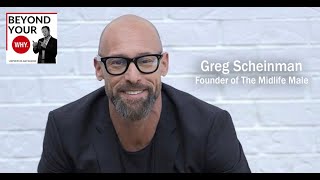
Episode of the Beyond Your WHY podcast (host Dr. Gary Sanchez) featuring Greg Scheinman (founder of Midlife Male). The interview traces Greg's life from Long Island childhood and the loss of his father, through University of Michigan and early entertainment work (assistant at Miramax), to founding Team Baby Entertainment (sports-themed children’s DVDs; partnered with Michael Eisner) and a long insurance career with INS Group. Greg now runs Midlife Male — a media, newsletter, podcast, coaching and speaking platform focused on helping men maximize middle age by simplifying life and implementing practical, measurable habits (his framework: six Fs, five rules). Discussion covers definitions of success, balance vs harmony, authenticity, avoiding midlife crises, and actionable how-to steps. Practical links and freebies (newsletter, free ebook, book on Amazon) provided.
Questions this video answers
April 12, 2023
Approximately 15,000 people (weekly reach)
Houston, Texas — for 21 years
University of Michigan (Ann Arbor)
Assistant at Miramax Films (worked for Harvey Weinstein)
Chapters
Welcome to beyond you'd why podcast, where we go beyond just talking about your why and actually help you discover and then live your why. You see, we believe that knowing your why, that driving force behind every decision you make and every action you take, is the essential first step to really knowing yourself. It allows you to move forward faster and have a bigger impact. If you're already a fan of the show, then you know that every week we talk about one of the nine whys, and then we introduce you to somebody with that why so you can see how their why has played out in their life. This show will be more powerful for you if you've already discovered your why. If you still need to do that, head over to whyinstitute.com and discover your why today. It'll only take you about five minutes. Now, let's meet today's guest.
Welcome to beyond you'd why Podcast, where we go beyond just talking about your why and actually helping you discover and then live your why. So if you're a regular listener, you know that every week we talk about one of the nine whys and then we bring on somebody with that why so you can see how their why has played out in their life. And so this week we're going to be talking about the why of simplify. A very rare why. And so if this is your why, you are one of the people that makes everyone every else's life easier. You break things down to their essence, which allows others to understand each other better and see things from the same perspective. You are constantly looking for ways to simplify from recipes you're making at home to business systems you're implementing at work. You feel successful when you eliminate complexity and remove unnecessary steps. You like things direct to the point. Don't give me the fluff, just hit me with the facts. So today I've got a great guest for you. His name is Greg scheinman. He has 20 plus years of experience launching and leading businesses to success such as Team Baby Entertainment, INS Group and Rose Studios. Team Baby was acquired by Michael Eisner, INS Group was acquired by Baldwin Risk Partners, and he is currently the founder and face of Midlife Mail, a media company and performance coaching program helping men maximize middle age. His weekly podcast and newsletter reach 15,000 people. He is a best selling author, coach, athlete and most importantly, a husband and father to two amazing sons. Greg, welcome to the podcast.
It's great to be here. Thank you for having me. That doesn't sound so simple. Okay.
As you read.
Yeah, we really do.
Well, where Are you at right now?
Tell everybody what city you're in currently.
Yeah, so I'm in Houston, Texas. Have been in Houston, Texas for 21 years now. My wife is born and raised here. I am a born and raised New Yorker who happily has migrated and now has a life as a Texan. I love it.
Okay, well, let's go back in your life. Take us back to when you were in high school. What was Greg like in high school?
Yeah, look, right up until the end of high school, life was pretty simple.
I was born and raised in the north shore of Long Island. We were in a. In an upscale community.
Mom and dad were together, two younger brothers, privileged, if you will, you know, very much so. Um, no hardship. Went to the school closest to our house, you know, all of that. Went away every summer to camp and played ball up in New Hampshire. And life was very simple and life was very good.
I was popular in high school.
By default. Things came pretty easy to me.
No.
Back then.
I did sports. Yep. I was athletic, you know, I swam, I played tennis. I, you know, did.
Later on towards that, sophomore, junior year, senior year of high school, I got very into fitness and lifting weights and getting, you know, had knee surgery early. So it got me into lifting weights and taking care of myself, though. But always athletic.
And happy, you know, there.
Okay.
Senior year, my father got sick. He got cancer and got sick and ultimately passed away not long after. And that is when simple got very hard.
Heading off to college.
First real trauma, first real hardship. Losing father, father figure, the actual father figure.
The changing of the family dynamic and going off on my own to college all at the same time.
And where did you go to school?
So at the University of Michigan in Ann Arbor. It was.
The best school I got into. I wanted a Big Ten kind of atmosphere. Great school. I knew a few people there, had a good experience when I had gone out to visit, and that was kind of where the dividing line in the country was set from. My mother and didn't want to be too, too far away.
At that point.
So I said it. I don't know if you heard what I said, but I said it's too bad. And the only reason I said it's too bad is because I went to usc, and USC has a big matchup with Michigan. And.
I hear a lot from people that went to Michigan about those rivalries.
But, okay, so you're the better of us for quite some time now we're starting to get good again. When I was there, we were real good.
We had a rough Patch.
For many years. We're starting to get back again.
Yes. And same with us. We hit a pretty rough patch and now we're kind of getting back. But it's a lot of money is now being poured into it, good and bad. I don't know how I feel about that, but. Okay, so you're at University of Michigan. What did you major in there?
Partying, drinking? Okay, yes, that was, that was, you know, that was really it for a while.
That, you know, I had a bunch of you. I spiraled out of control while I was in college. I didn't really have anybody looking over me or really paying attention to what I was doing. So short of making sure that I passed and continued to have school paid for and taken care of, I didn't really. I didn't over index in academics. I was a communications major. While I was there.
I thought that I wanted to be in entertainment and film. I was gravitating towards anything that did not seem serious.
That didn't seem like, okay. I had to put a lot of work in. I was the guy who was looking again for the simple way, the easier way out. The path of least resistance. Let me just do what comes easy and natural to me.
Yeah.
And so did you end up with a degree in communication?
I did. I also was in a rush for whatever reason.
To get out of there early. So I ended up really graduating in three and a half years rather than four and just staying and using the extra time to have more fun again. It was always the what's the easier. I could take a course that's less challenging, pick up the credits, get through it. You know.
I thought I had, I always had thought I had to have like the way there had to be an angle on it. So I did graduate early and I had a, from what I remember, a positive experience at school. But I was also dealing with a lot of personal trauma and a lot of loss.
And a lot of grief that I wasn't really addressing.
Got it. Okay, so you graduate degree in communication early. Then what happens to you? Off to get a job or where did you go from there?
Yeah, I guess that's the path, right, as a young man that you're supposed to follow. So you graduate college. So I come back to New York, where I'm from, and you're supposed to get a job. So what did I do? I wanted to get a job in the entertainment industry. I thought I wanted to be a film producer and get into that industry again. So I got the apartment in Manhattan in the Shoebox type apartment. And I ended up getting my very first job right out of college.
As Harvey Weinstein's assistant at Miramax Films. I landed on Harvey's desk right out of college as the number four assistant. Know somebody that knows somebody. And the next thing I know, I'm there as assistant number four. So when you think about mentorship, or you think about.
Father figure even, or you think about who is the next man in your life post graduation. Remember I didn't. Dad wasn't around anymore. No room. This, this was what I got. Got hit in the face with right out of school.
Wow.
Yeah. And I landed on Harvey's desk as the number four assistant. Within a couple of months I ended up being basically the number one guy. Promoted one, fired another, refused to travel with a female. And boom. The next thing I know, I'm the guy.
So what is he like?
So I would say this. I guess one of my.
Crowning moments was I have the distinction of having told Harvey to f off 30 years before the MeToo era.
And my rationale for that was my father would roll over in his grave if he knew I let somebody talk to me and treat me that way without taking care of this situation.
So what do you mean?
You know, I never saw. This comes up a lot. I never saw Harvey do anything illegal. That being said, I believe everything that I'm hearing and what everything that he's doing now. Absolutely. When I was with him, this goes back again 30 years. He was just a prick. He was already on the list of worst bosses to work for in America. All of that was there, but it had not transcended and crossed the threshold into.
Absolutely illegal. Everything that has gotten him exactly where he deserves to be today.
It was just completely inappropriate and hostile work environment. And I'm a 21 year old kid and most people put up with it because they wanted to get promoted within the industry. I was either too egotistical, narcissistic, ego driven.
Stupid, immature, whatever. To think that that was the only way you could succeed in the industry or that this could possibly hurt me if I just got up and left and did it anyway. So that's what I did. I left. I still ended up producing a few movies on my own. I accomplished my goal of dedicating them to my dad and seeing his name up on screen and doing that. And then it became a little bit of be careful what you wish for. Because it really wasn't what I wanted. Really wasn't the healthiest lifestyle, really wasn't what I saw Myself doing long term.
What do you mean by that?
I think early on you don't know what you don't know.
And I think because I didn't have a family business to go into anymore, I didn't have anybody necessarily advised advising me or mentoring me and getting great advice. I had this opportunity, good or bad or both, to try different things and to wing it and to be curious. And I believed, you know, we're bought into certain stereotypes or perceptions or ideas that I thought it would be this and it turned out to be that. You know, once you tried it.
I didn't like the downtime, quite frankly, between projects. You know, like they say about acne and film, sometimes, like, they don't pay you for the acting and they pay you for the waiting. There's just a lot of time, you know, in development and waiting around. And I'm somebody that likes that. I think requires a little bit more movement.
Yeah. So, okay, you leave Harvey Weinstein, you start doing some other movies yourself.
And then.
Is that when you got into Baby Enter team Baby entertainment or what is shortly after?
What happened was, you know, I thought I was going to get out of the entertainment industry. I made a few movies, sold the production company.
From there had a little bit of Runway, and ultimately around that time had met my wife. Well, Katie's now my wife. And we decided to relocate to Texas, to Houston, where she was from. Get out of the fat, get out of. I wanted to get out of New York and the LA and all the other Miami stuff that we had done. And Houston was where she was born and raised. And we decided to settle down here. And that's where the impetus for Teen Baby came from. When we had our first child, our oldest, who's 19 right now, and I'm there like a lot of our entrepreneurs. Where do you get ideas and how do things happen? You know, you're sitting around with nothing to do, basically. And in this case, I have nothing necessarily to do, but I know I need to do something because I now have a family to take care of. And this Runway is going to continue to get shorter if I do do nothing. And then sitting at home as a new dad. What are we watching? We're watching, you know, Sesame street and this time Baby Einstein. And for reference, guys, like, I'm 50 years old, so go back, give or take 25 years at this point. And there's picture in picture on these giant TVs. And in one little tiny picture, I got ESPN on, because that's what I want to watch. And in the big picture, you got the kid plopped down in front of you glued to Baby Einstein and Sesame street. And I'm sitting there going, well, what if we just combine these? There've got to be other dads at home that like sports and that are saddled with their kids overall. And how do we brainwash them, if you will, into becoming fans of our teams or using the things that we're into to help our children or do this? It's a win, win for both of us. And that really was the impetus of Team Baby Entertainment. And we created this line of sports themed children's DVDs that caught fire. You know, if you were a Yankee fan, we had a baby Yankee DVD narrated by George Steinbrenner. If you were.
A USC fan, you were talking about usc. I had Rodney Pete. Rodney Pete narrated Our Baby Trojan DVD. Matthew McConaughey Did University of Texas and created this whole line of children's DVDs. And that's what really blew up. And I ended up partnering with Michael Eisner after he left Disney. We were the first acquisition he made and building up the company for a period of years before ultimately selling the rest of it to him. And he put it in with the Topps baseball card company which he had acquired along the way. So we saw quite a meteoric rise. And then we saw a collapse when the DVD market was changing and things were becoming app based and going online. So I really got to see all sides of that. It was an interesting dichotomy in my identity, I guess.
Okay, so from there you switched over to INS group.
Yes. So I did the exact opposite again. I decided to go from risk taker, if you will, risk manager. All this risk was making me was stressful. I didn't want to move back to New York. I didn't have another million dollar idea. We're sitting back here in Houston now. I have two children.
This roller coaster of life is happening. I'm like, what am I going to possibly do, you know, next?
And this is a theme that's come up in my life a few times when I don't know what to do. I typically like to go out and talk to people. If I don't know the answers, let me start asking better questions to people that might be able to help me. Because again, I'm a simpleton, you know, like, hey, give it to me simply. So I knew how to make things, I knew how to produce things. That's what I'd always been doing. And here I am back in Houston again, without an idea, no idea what to do again. So I actually started a television show. I said, if I don't, I want people to talk to me. So what's the best way to get important people who are smarter than me and more successful to talk to me? Let me bring a camera and a microphone. Typically, people like talking about themselves and want to do that. So I started calling very important people in and around the Houston area and asking them if I could spend a day with them. Hey, I have a television show. I interview entrepreneurs and risk takers. I'd love to come and spend a day with you and learn. And they started saying yes. This was Jamie Roots, who ran the Houston Texans. This was Deborah Cannon, who ran bank of America and was the chairman of the Houston Zoo. The list went on and on. McClellan, who ran HEB, the largest chain. I made a list, the bucket list of who would you want to talk to? And then I went to PBS and I said to PBS television here, I've got a 30 minute talk show interviewing the top entrepreneurs and risk takers in Houston. Can I put it on tv? And they were like, what? Like, what do you mean?
Like, no, no, no.
Like, seriously, I'm going to bring you fully completed episodes, 30 minutes long. Here's to the guest list. Here's who's on it. All I need is some airtime. And they're like, okay, if you're telling the truth. They checked out my background and they thought, this guy actually has made some stuff great. We'll give you Thursdays at 7, okay? So then I went back to more people and said, hey, I've got now. I'm Greg from PBS. I've got 7:00pm on Thursdays. And we ended up doing 24 episodes of this. Along the way, I joined INS Group, which was short for Insurance Group. And I was a client of the firm. And I knew the principles for years. It was the least. It felt like. It felt like the least creative and least entrepreneurial thing I could possibly do after I had done everything I had done. But also seemed responsible as a man, as a husband, as a father, and as a provider. Remember, this is what we're supposed to do, right? We're supposed to follow this path. And I'm like, maybe this is the time I'm supposed to follow the path. Residual income, build a book of business, finally have somebody paying for my benefits and a 401k rather than me. These seem to be the right things to do. So we had a conversation. They encouraged me to join the Firm.
You can insure anything you want, Greg. You can make it as entrepreneurial as you want. So we became partners. I ultimately invested in the firm. That was the best move I've ever made in my life, was to at least have been smart enough to work out an arrangement with them that I could have a seat at the table. If I achieved this, I could have equity, and I was able to invest in the firm, achieve certain benchmarks. That turned out to be the best move I ever made. I used the talk show to interview these types of clients. Prospective clients didn't know that at the time, but that's what it really even became. And that's how I built my book of business within the firm. And I never controlled anything there. I was a smaller partner with incredibly smart people and successful people that surrounded me. I learned a ton of it never was a great fit for me.
Personality wise, dress code wise, office wise, everything. And there's a lot in my book about that and what I coach guys on and work on now about authenticity and being able to differentiate yourself and working within a system or getting out of it in there. But ultimately, I spent 14 years there. 14 years until the firm was acquired.
Which is really what also allows me to do what I do today.
Longer answer than you want. So thank you for listening.
No, that's really good. And so for those of you that are listening, Greg's why is to simplify, make things simple, easy to do and understand. But your how. How you go about doing that is by challenging the status quo and thinking differently, right? Putting on no limits. And ultimately, what you bring is a way to contribute and add value to other people. So your why is simplify, your how is challenge, and your what is contribute. And so, okay, so once you were done with the so it's INS group instead of INS group.
So INS group, but everybody would say INS group. And by the way, I do have a funny story for you, if you ever get it, that I used to represent a. A slaughterhouse in Corpus Christi, Texas. This is when I knew that this business was not for me, the way that was doing it, that I would have to go down to Corpus Christi, Texas, and I represented a slaughterhouse down there.
And I would show up at the gate to go have a meeting there, and I would hand them my card and then. And they would see INS on the card. In Corpus Christi, Texas, at a slaughterhouse that employs 2,000 people. You know where I go with this? And security would radio to the back, okay. And you would see people leaving, running out because they thought the INS was there as opposed to the guy who was the insurance agent. So I know both the card design was wrong and the pronunciation was constantly wrong. And I would have to tell them, no, no, no, you people can all come back. They don't have to.
Nobody's getting deported today. Premiere.
I love it. Okay, so you're out now of INS group or in school group.
And now you're.
You're onto your. Your next thing, which is.
Midlife male. Let's talk about that for a minute. What is that about?
So what happened during my time at Inns Group was I continued to search for a way to bring creativity.
To a professional service business. Remember, the way I operate and the way I think is different from most.
Out there. Now, while I want things to be simple and efficient and effective, the manner in which I go after simplicity.
Is hard for certain people to understand. This was always part of the bone of contention, even with my partners and so on. I have a tough time.
Doing things. The quote unquote. To me, it seems like the normal way to do things or the way I want to do it. Now I can do that habitually, I can do that consistently, I can do. But for us, that seems a little bit different out there.
So what happened was I started writing.
The TV show became a podcast. People stopped watching no tv and pbs, my book of business, got really big. Podcasts became big. So I said, okay, I'll start a podcast. So the TV show really became a podcast. Those conversations on the podcast started to transcend business, insurance, and become very deeply personal. Because, remember, I really wasn't interested that much in insurance. I was interested in personal connection. I was interested in networking. I was interested in content creation and relationship building and all of that. So that's where the conversations went. So I rebranded under this moniker. I still don't know who actually said, coined the term midwife male. They're like, these are like conversations with midlife males. And that's like, you know. And I was like, oh, okay. So I kept it. So I rebranded around the moniker of Midlife Mail and the podcast became a newsletter, which started going out every week, which was like a tree falling in the woods for a while, but it was therapeutic. It was a way for me to express myself. And I talked about redefining and reframing success. What was happening to me was the metric for success was not really salary and title and what I had been taught to believe in chasing these things, but it was really a more holistic view of what success looks like in happiness, I was finding myself, if you will. I was looking and leaning into what that authenticity really was. Because when you chase one thing is when you chase authenticity where it does not exist, it's exhausting. And I found myself exhausted constantly. So what salary and title became was what I started to call my six Fs. It was family and fitness and food and finance and fashion and fun. Like, these were the things that I was really interested in. So these were the guys I would bring on the show. And then I would write about what I learned from these conversations and how I could aggregate it from everything out there and curate it down to what really landed with me in the simplest ways and then eliminate everything else to create a personal operating system and a way for me to live that seemed like it simply made sense.
And that started getting read by people and that started getting circulated around and the podcast started getting listened to. And then the combination of the podcast and the newsletter 100 episodes later became my book. Now we're 200 episodes and growing. And that became a coaching program for guys reaching out, saying, can you help me? And now that's gotten into speaking. And it's this combination. I know this bringing it full circle into this why and how.
Which is so brilliant with what you do. And taking the assessment. And now having retaken the assessment into the why is so interesting and so fascinating. And we get so. We hear so much about finding your why. And what I get, Gary is okay. Yeah. And one way is like, they found their why. I get why you want to be a better husband. I get why you want to be a better father. I get why you want to be in better shape. I get why you want to always. But where a lot of these guys are getting hung up is they're getting hung up on the how.
And that's a lot of what Midwife Male and what. And what I'm doing is really. Is really structured for how can I help men really maximize middle age in the how portion? Yes. Help you find your why and identify your why. But a lot of the guys I see.
They have it or they'll do something. They know it. But it's. Now how do we go from why into how and into implementation? What are the daily positive action steps that are going to get you to realize that why and the outcome that you're looking for? But we got to get real on this stuff. Can you quit your job and follow your passion? Okay, theoretically sounds great. But it might be the most galactically irresponsible thing you can possibly do in middle age if you don't have any money and you got kids and an overhead, how can we strategically and tactically make a plan for you to transition.
Or do certain things? A lot of white space between being, you know, overweight, out of shape, you.
Know.
Just, you know, not moving and being, you know, jacked and physically fit. And like, how do we make these steps and set it up so that it's realistic and it's quantifiable and it's achievable and measurable. That, to me, is really, really super interesting stuff that's out there. So that's really what the conversations are about. That's what the coaching is about. That's what all of this is designed to provide hope and to provide possibility and more importantly, probability and likelihood of succeeding once you also know what success looks like to you.
How do you define success now?
It's such a great question.
For a while, I thought it was about needing to reinvent myself. What I've really learned now is that it's more about releasing myself than it is about reinvention.
About acknowledging and recognizing really what fills my tank and what empties it.
Back to again, my six Fs.
That are my balanced, if you will, or like harmony better harmonious allocation of what my life's portfolio looks like in there versus over indexing in any one area.
It's following the five rules that created and live under, which provide simplicity and structure and framework. Knowing what's important is what's most important. For me, that always starts with family.
My wife, my two boys. Breaking the cycle of what I went through with my father, with my brother. Other situations with health, sustainability and longevity, finance and money is super important to be successful. But how much do you need to do what you want to do, when you want to do it with who you want to do it? That's really it in terms of success. To me, the other fun stuff that I think are markers of success. What do you put on your body? What do you put in your body? These things matter. They matter to me. And then are we having any fun? Because what are we doing any of this for if we're not having any fun? To me, success looks like all of those things and it's revisiting them every single day.
To remind myself that it is about what you're doing and living every day and not this destination or this outcome that is seemingly out of reach or so far ahead. I think that's what gets lost so much in the definition of success is that it's defined by outcome or achievement or a milestone moment. And it's not like success is being able, I think, to live it, to live your message every day. To have those normal days.
That really feel good to you. Like, my wife and I were just talking about it yesterday. Today's Monday, I guess. Yeah, today's Monday. I always track it. They're all the same technically. But we were talking about it because like Sunday was a really nice day for us and it didn't involve anything special.
Didn'T involve spending a lot of money, didn't involve doing anything like super. We weren't on vacation at some beach, you know, there were no rainbows and unicorns or anything on. But it was just a nice day.
We exercised, I got the car washed, you know, we walked the dogs, had breakfast. She went out and did some of her stuff, I went out and did some of my stuff. You know, we regrouped, had a nice one. Yeah.
Okay. This is a nice day. How many of these can I string together?
I love that. What? You know, that whole concept of balance is. I love your take on balance. Does balance really exist? If you want to accomplish something in your life, does balance exist?
Well, I think it's a double edged sword and I think it's a fantastic subject and it's a fantastic question. And I love this area. It's just like consistency. What does it look like? Are we talking about balance in a day? Are we talking about balance over a year? Are we talking about balance in our again, overall life? Same thing with consistency. What does it look like?
You know, I can say I want to be consistent and work out seven days a week and consistency looks at that to me, is that is perfection, not consistency.
And I am never going to be perfect. So does consistency look like seven days a week or I am failing or does it look like I look at my schedule Monday off Tuesday with my trainer, Wednesday yoga, Thursday off Friday and I can literally look at it and go, okay, well that's what consistency and that's what success looks like. I think it's the same with balance. I think overall balance is bullshit. I think harmony is a better word overall. And I think that balance needs to be looked at contextually. If I say I'm going to sleep seven, eight hours and I'm going to spend 30 minutes in my sauna, I'm going to do three minutes in my cold plunge, I'm going to eat perfectly breakfast, lunch and dinner today, I'm going to exercise for an hour, I'm going To podcast with Gary. I'm going to rehearse my keynot. I'm going to be the ultimate father and husband. I'm going to do all these. There is no way that could be a perfectly balanced. I hit everything, but I'm going to burn out from that. That's not balance in a day. Now if I say in a week, here's what I'm going to do. I'm going to exercise five times in a week. I'm going to take two days a week off. I am going to saun and cold punch. I'm going to do it four times a week in there. So I got three days that I can miss throughout. I am going to attend 90% of my son's games.
100.
I am going to record a podcast on Monday and I am going to do my newsletter on Friday and I am going to coach my clients in between. No more. When you really start to stretch it out again back to making it simple and achievable and measurable and quantifiable, now I think you can have harmony. I think we underestimate what we can do in a year and we significantly overestimate estimate what we can do in a day. And I think that's what trips a lot of people up, especially in the hustle and grind. 247 sleep when I'm dead, social media pressures of seeing everybody doing so much.
I look at some of these guys morning routines and I'm just like, I'm exhausted. Seriously, I couldn't do that. And then I look at their going to bed routine, evening routines and it's like adjusting stuff. How is this sustainable now? Some guys might have bigger engines. Everybody's got a different bandwidth or capacity. But that's also what the system is set up to do, is figure that out. Yeah, what success looks like for you is different than it does for me and so on and so forth. But the rules still apply. The framework in the system still works. You just get to develop your own personal operating system from following these rules.
Yeah, I love that. You know, the, the.
It kind of gets back to that saying, you know, what's the best exercise you could possibly do? The one you will do.
Yes, that's exactly, that's exactly right. Again, I don't think there is any perfect. There's no perfect way to eat. There's no one way to do anything. There's no one way to be successful. I think there's one way to fail.
I think when you stop trying, when you stop learning.
I think there's a really easy way to fail. But I think the beauty of this is that there's so many ways to succeed. And how do we know that? Look around at this point, I've interviewed 200 plus.
Successful from the most successful men on the planet. Every one of them does something different.
Now, fundamentally, they operate very similarly in terms of whether that's morals, ethics, structure, preparation, consistency, accountability. But what they do for a living, what their backgrounds are, what their family situation is, what their financial situation, all of these things are different. But I can promise you this, if you put them all in a room.
They'Re going to get along.
Because what makes them part of the same tribe, what makes them like minded men, are these other character attributes that have made them successful. And they're also going to be in there talking about their shortcomings and their failures and not their successes and sharing and helping the other guy. Like those things that are, wow, those are almost universally consistent with everybody that comes on. Hey, is there anything I can't ask you about? I always ask that question too. Anything. Like anything you don't want me to ask about. Anything we don't want to talk. I have never gotten that one. Do me a favor, don't talk to me about this. They don't. You know what, I'm an open book. Bring it. I'll talk about anything.
All right, Greg, last question. What's the best piece of advice you've ever given or the best piece of advice you've ever gotten?
Wow, that's really good.
I need to use that too. That's a good question. This might be the best piece of advice I've ever gotten is use this question. Okay. If you really want to learn, learn something.
I would say I don't think it's a singular piece of advice. I'm going to try to answer your question as directly as I can without.
But.
My dad wrote me a letter shortly before he passed away.
And in that letter it said, there may be men out there with more money than I have, but there is nobody that is richer than I am, that feels richer than I am when I look at you and your two brothers.
And that I've held onto as far as what's really important. I thought that was really good advice. That again, the metric for success.
Is not monetary purely. And my dad was a successful guy for the majority of his life, but it put things in perspective for me. And that letter sits right over on the side of my bed where I sleep on the wall right next to where I am. And it has really helped me.
With my two boys and focusing on what's important, to live your legacy, not wait until you're gonna. So I think that was the best advice as far as maybe the best advice I've ever given. I think it's the same.
I would take that and pay it forward, that statement. And I see and work with a lot of men who unfortunately, I feel are squandering their time. They're missing those big moments and they're missing the small ones and the ones that add up with their kids, with their wives. They're choosing to stay in the office a little bit later versus make it to that game. They're choosing to let the other dad coach because they're too busy. They think that sponsoring the team is the same as being around the team.
They think that it's the one week vacation in Mexico.
When it's the other 51 weeks that matter in there. So to your point about balance or harmony, you know, we go back to rule number one. Knowing what's important is what's most important.
And it sounds a lot like it's being the man in the arena, right?
Yeah, the Teddy Roosevelt. I think it's. It's. Yeah, it absolutely is. I think it is about living your message. I think first you got to understand who you are and what your message is. And you gotta. My book goes into this a lot. Like, you gotta get real, you gotta get raw, you gotta get naked, you gotta get vulnerable and take that real hard, long look in the mirror.
And decide what kind of guy you want looking back at you. And none of us start with perfect and it's never going to be, but what are you willing to do each day to get better, to have your actions match your words, or to get that reflection to feel differently.
In the game. I love that phrase. The arena, you gotta be in the arena.
Yeah, the man in the arena versus the critic on the side. You know.
Talking about the activity. You're the man in the arena doing it.
Yeah, well, you know, it's the. It's like the Jim Rohn quote also. It's like mediocrity is not an unwillingness to change. Like, the signature of mediocrity is not an unwillingness to change. The signature of mediocrity is chronic inconsistency.
It's. Yeah, I get that you want to change.
And quite frankly, I don't even think it's the chronic inconsistency. I think it's. You are consistent. You're just consistently making the wrong choice. So how can we take the willingness to change and what you're consistently doing or not doing and just put them in the right order.
And the right prioritization because you got all the skills to do it.
Are you finding that people are willing to explore authenticity? Let me change this. They're not willing to explore authenticity until they've experienced enough pain. Do people just. Is it. Is it related to the amount of pain they've experienced or loss they've endured? Or is it, I guess what, I don't know if I'm asking this correctly, but is it, is it a avoidance of pain or wanting to seek pleasure that allows people to explore authenticity? Hmm.
You know, I think it's. I think again.
One of the answers I give most frequently is maybe or it depends. And because who's to say what somebody's degree of pain or trauma is? And again, what's real, you know, to them? I have mine. You know, like the other saying, take all your problems, throw them out on the table. We all put them out there. What are you going to want? You're going to want your own back? Okay, so, like, yeah, I've got death in mind. You know, my brother went to prison. I struggled with alcoholism and body image. Another. Okay, throw it all out there. I don't know what everyone else is throwing out there, but I do know how to at least, you know, handle mine to an extent, you know, and work on, and work on that. What I do think is a few things on there. I feel like the younger guys that reach out to me, and when I say younger guys, I'm seeing a lot more guys, you know, in their 30s, you know, if you will, that again, are successful, but are looking at 40 and they want to see what's around the bend. They do not want to go down that midlife crisis path. They've seen it with either their father figures, their fathers, their father in laws, their bosses, you know, and they're much more proactive in addressing vulnerability, authenticity, emotion, asking for help, looking around the bend. Hey, can you save me five years, $500,000? How could.
They're out.
So I really have a lot of respect for that. And in a lot of those cases, they're not unpacking a lot of baggage. They're not saying, I'm coming to the table with all these problems and all this trauma and all this, everything. It's, hey, this is important stuff to pay attention to. I actually want to avoid trauma and pain and loss and all of these other. So what can I do to Learn and get out ahead. And it's not a sign of weakness, it's a sign of strength to talk about these things and to get out ahead of it. The guys right smack in their 40s in a lot of ways, very set in their ways, not as comfortable with admitting we don't have all the answers. We're not who we thought we were going to be. This is not where I thought I was, how I was going to be living. This is not what I thought I was going to look like. This is now what I really struggle with that, really struggle with opening up on that.
Trying to continue to do the same things and expect a different result.
And then the guys, kind of in their 50s in a lot of ways, are coming out the other side. Hey, I've weathered the storm in a way. Now what I do have some money, my kids are out of the house, I've been married 100 plus years.
What do I do for fun, like in that authenticity side, what do I really want to do now?
And that takes work to figure out. Used to think I like to paint. I had one guy, he's like, why don't you try painting again?
We give up hobbies, we give up passion, we give up things because again, we think that's what you're supposed to do. Or time and life gets in the way. How do we bring some of those things back authentically, take some work, go back and figure out who you really are.
Can we avoid. Is there such a thing.
As avoiding midlife crisis and is it even healthy to avoid it?
Yeah, you know, I think we feel like we have to put again, a name or a title or something on everything. What I'd say is I know some very old 30 year olds and I know some very young 60 year olds that are out there. So I don't think that it's just about a number or just about determining. I get asked all the time, you know, where middle age is or, you know, or Men's Health will put out an article and they'll say it's 37 based on a life expectancy of, you know, 75.
Okay, not as simple. Is it a real thing? Yes. Does it affect guys at different ages and stages of their lives? Absolutely. Can you avoid it 100%? Can you get out of it and course correct. If you're right smack in the middle of it? Absolutely. Is it a death sentence? No. Can you start seeing aging not as something to fear, but as something aspirational? Absolutely. I believe all of these things are true.
We just Again, have to embrace possibility and probability. It's not going to happen by default. It's going to happen by design. And you have to be willing to do the work.
In there. And then we've absolutely. I genuinely believe my best days are in front of me, not behind me. I believe I have more energy, I know at 50 than I had at 30.
I feel I know where I'm going.
Now more clearly than at any other point.
All of those things. But that took a lot of time. It takes constant work, constant reinforcement, conversations with men like you. Going back and revisiting the why, adopting and working on the how, testing and retesting over and over again and believing that that's also where the magic happens.
Not this is where I have to be at 55, but like Jesse Itzel says, it's going to be where your feet are. Like, this is where I am right now. On Monday.
At 3 o'clock in the afternoon, the phone is on. Do not disturb. You know.
Spend some more time being present, being engaged. Say, when you get off this going, you know what? This actually energized me versus drained me. We don't spend enough time taking our own temperature on things.
Don't like the way you feel around certain people. Maybe you shouldn't be spending so much time around them. Don't like that activity. Maybe you should cut back on that activity. It's scary. A lot of those things. We think we got to change our peer group.
Or.
I get maybe, yes, but you can.
That's the other thing. You truly, you truly can. My friends, my peers, my lifestyle, my actions today are very different than they were 10 years ago, very different than they were five years ago.
And they'll be different five years from now.
Greg, if there's people that are listening that say, man, I love what you're talking about. I love the whole idea of having someone to coach, coach me through this process. What's the best way for people to get in touch with you and follow you and see what you're up to?
Yeah, I appreciate it. I am, I am not hard to find one. You can go to midlifemail.com.
So all the information is there. You can subscribe. A lot of free stuff is out there. You know, my newsletter is free every week. The podcast is I have a no BS guide to Maximizing Middle Age, which is a free ebook that you can download. You can email me. You know, I'm very reachable. Gregidlifemail.com, you can DM me on Instagram @gregscheinman or LinkedIn. Again, I'm not hard to find to talk about coaching, workshops, speaking, any of those things. I try to get back to everybody, certainly through social or the other ways that they reach out, and I'm really fortunate there. And you can buy the book on Amazon, like that's, that's where everybody's getting their books these days. So you can buy your copy of the Midlife Mail at Amazon. There's an audiobook version. I try to be accessible.
Accessible to everybody out there and understand that, hey, we are all in this together. I am no different, really, than even the guys that I am coaching right now and speaking and writing to and working with. We're just sharing experiences.
Love it. Greg, thank you so much for being here. I appreciate you taking the time to be on the podcast and I look forward to following you because I am that midlife male. I'm probably a little past midlife male, but it'll be fun to follow you. So thank you again.
Not by the way you act, man. As I said, we're all in this. We're right there. And what are guys like me looking for? We're always looking ahead, too. So that's the awesome part. Thank you so much, Gary. I appreciate it.
There's time again for our new segment, which is guess Their why. And recently my wife and I have been watching the series the Crown. And if you haven't seen the Crown, it's about Queen Elizabeth. At least so far. It's all about Queen Elizabeth. And so she took over the reigns of England when she was in her early 20s. And so I wonder if you know anything about her. And she just recently passed away. What do you think her why is? Because I can tell you what I think it is based on what I've seen so far. She thinks differently. She pushes the limits. She changed things to the way that she wanted that were different than what was typical or traditional. They didn't really have a woman leading these older men at that time. And here she comes along in her early 20s and has to figure things out and make some really big changes. And so I believe that her why is to challenge the status quo, to think differently. And my wife has the same why as challenge. And she's very much similar to her and connects with her, at least what we're seeing on tv. So I believe that Queen Elizabeth's why is to challenge the status quo and think differently. What do you think? Does that jive with what you're seeing? So thank you so much for listening. If you've not yet discovered your why, you can do so@yinstitute.com you can use the code PODCAST50 and get it at half price. If you love the beyond your Y podcast, please don't forget to subscribe below. Leave us a review and rating on whatever platform you're using to watch and listen to the podcast and I will see you next week.
I really hope you enjoyed today's episode and that through today's guest, you heard how important it is to know your why and how impactful it can be in your life and the lives of those around you. Be sure to head over to whyinstitute.com and discover your why today. Remember, the more you know about yourself, the more you'll know about others. I'm Dr. Gary Sanchez and I'll see you on the next episode.
More from Dr.




Women In Leadership: A Need For A Greater Systemic Change With Belinda Clemmensen






