Using The Make Sense WHY To Win In Sports & Life
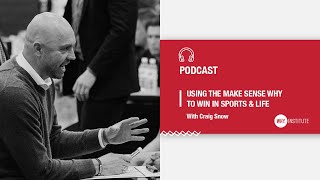
Craig Snow, head coach at New Mexico Highlands, talks about building a winning program through player leadership and character. His team set a program record with 22 wins and made the NCAA tournament. He explains how his coaching philosophy of freedom within structure works in sports and business.
Questions this video answers
April 14, 2019.
University of Evansville.
2012–2014.
A program-record 22 wins.
Their first conference tournament championship and the program's second NCAA tournament appearance.
Chapters
This episode of beyond your why is brought to you by our why App. Head over to yinstitute.com to take our free why app and discover your why today.
Welcome to beyond you'd why podcast, right, where we go beyond just talking about your why and actually discovering and living your why. And so you know that every podcast we talk about a different why, and then I introduce to you somebody who has that why, and we can see how it has played out in their life. And so today we're going to be talking about the why of make sense, to make sense of the complex or challenging. And these are people that you might hear them say something like, I got it. You know, you tell them a lot of information, they say, I got it. Let me help you figure it out. Or I've already got it figured out. So let me tell you a little bit about the characteristics again of this why. These are people that are driven to solve problems and resolve challenging and complex situations. They have this uncanny ability to take lots of data and information and observe situations and circumstances around them and they can sort through them really quickly and create solutions. They take problems and challenges and organize them into solutions that are sensible and easy to implement. They're often viewed as an expert because they have the ability to find solutions quickly. They have the gift of articulating the solution and summarizing it in a clear and understandable way. You know, they believe that people are stuck and that if they could just help them make sense of their situation, they could help them find a simple solution and, and help them move forward. So in essence, they help people get unstuck and move forward by helping them solve their problems. So today I've got a real interesting guest for you. My guest name is Craig Snow. Now, Craig is the interim athletic director and the men's basketball coach for New Mexico Highlands University in Las Vegas, New Mexico. Now, Craig played basketball for the University of Evansville, ending his career 10th all time in points and 10th all time in three pointers made as well as the all tournament Missouri Valley conference team in 1999. After college, he played professionally overseas and eventually he made his way back to New Mexico where he began his coaching career as well as being the athletic director at Bosque School in Albuquerque. As their head coach, he compiled 12569 record with five state tournament appearances, three district championships and state semifinal appearance. He then went on to become an assistant coach for the University of New Mexico from 2012 to 2014, where the Lobos went 277 and won the Mountain West Tournament and went to the NCAA Championships. He then became the head coach for New Mexico Highlands University, where he finished this last year with A program record 22 wins, the conference title, and only its second NCAA tournament appearance. I personally got to witness the quick rise to prominence of our guest. Please welcome coach Craig Snow.
Happy to be here, Gary. It's good to talk to you.
Hey, I'm glad you're here. And look, you and I could talk about a whole lot of things. There's so much for us to talk about. But what I think we ought to start with is, you know, tell us what's happened to you this year. Let's start with right now.
Well, it's been. It's really been phenomenal. We've had an exceptional into our season. It's my fifth year here, and we finally felt like we had built the type of player and the type of kids and the type of system that we really were aspiring to here at our school and our guys. Towards the end of the year, something clicked. It's really hard to explain when teams do that. We went on an exceptional run towards the end of the season. In our conference tournament, we went 30 against teams that had previously. We were 0 and 4 against, all away from home, all with difficult travel. We're able to win the first conference tournament championship in our school's history, the first conference championship in our school's history, and make it to the NCAA tournament. And it was just an exceptional group of young men, and it was really fun to be along for the ride.
All right, so what do you think? You know, I know you've had some years in the past where you had maybe more talent, but you had more challenges. What were some of your teams like in the past, and how were they different than the one that you had this year?
Well, we've always kind of been known here for being really talented and athletic and a little bit wild. And for us, the change this year was. It was more of me embracing, I think, and us embracing who we were as a coach. I spent so many times, like, as a young coach, I should say, and I still would like to consider myself a young coach, focused on the system and the execution and how we get from A to B and how can we create things both offensively and defensively. And to be frank, this year, I focus a lot more on the people involved, and I really try to work on the individuals and try to find ways that I could get with them, like in a better relationship, I guess you could say, and really try to understand my team more. And I think it got us to a point where it felt like I wasn't coaching. Towards the end of the season, it felt very hands off and very kind of natural and organic. Like how we were playing and might be kind of difficult for me to describe, but it really felt like I was just getting myself out of the way and allowing our team to go the direction that they wanted to take it. And it was. It was an exceptional experience for me. It was really one of the first teams I've been around as a head coach that was truly player led. And I think a lot of it had to do with. With us and our coaches kind of just getting out of the way.
What happened to you to make you think that way? Right, because most coaches, they're hands on, they're pounding their players, they're. They've got. There's systems in. If you don't follow my system, you're on the bench. You know, you see it all the time. Especially right now, we got the NCAA tournament going on. You see that with so many coaches. What led you to the decision that you made to take a step back and let the players take control?
Well, I think there's really a fine line between being like overly domineering with your team and to where you tap out their instincts. And throughout the season this year, for me, it became. I really wanted to be true to kind of my philosophy, which is to have a lot of freedom within a really broad framework. So to establish some very simple rules of this is how we're going to play, and these are the basics of what we're going to hold you accountable with. And within that, there's all kinds of freedom for you to be creative. And we had recruited what I would consider a really creative team. I mean, you can, you can talk about it. There's a lot of negative ways that people would talk about our style of play. They would call it, you know, undisciplined or. I've heard the term rat ball. I've heard different things, but it was almost by design that we wanted to, you know, create an environment that our players could use their natural instincts. Because we felt like it was the biggest way for us to tap into our biggest strength, which was our quickness, our athleticism, our creativity. And we. I felt like in the past we had kind of tampered some of that with too much structure. So we really tried to open it up. I mean, it is almost, you know, you talk to. I talked to other coaches. I am almost embarrassed to talk about the simplicity of the way we went about things this year. But for this group and for me as a coach, it was the right direction to go, and. And our guys really thrived in that type of environment.
So it sounds like you took a step back, looked at your team, looked at the talent you had, look at the situation that you were in, and you figured out a way to maximize what you had, no question.
And it was really. We had some dynamic guard play. And guards, you know, in basketball kind of run. They make the game for you. If you have. If you have great guards, they will keep you in a lot of games you might not, should not be in. And if you have bad guards, it's almost impossible. And we had tremendous guard play, and it was just allowing them, putting them in the appropriate space. Now, we did a lot of teaching along the way. There was intense film work of showing them what was there, what the opportunities were. Whenever they made a decision, whether they shot the basketball or they passed it, or they. Or they dribbled it into traffic too much. There was a lot of teaching that went on, but it was in film work, it was in drill work. And then when the game came to play, when it came to the game, it was them making those decisions and making the right play. And I felt like it was just. We struck a really good balance of teaching, of holding our players accountable, but at the same time putting them in an environment where they were truly enjoying themselves and they had fun playing, we had fun coaching. And I think that's really what got us to the point where we were having more success.
Okay, so take us into a game with you. You're now in the. You're in the conference tournament, and what's it like coaching there? Your team? Are you somebody that's just sitting on the bench because, you know, your team already knows what they're doing? Are you up coaching and telling them what to do? Bring us into what's going on in your mind to create this type of a team and to have this kind of success.
Well, the first thing I'm a stand. I stand. I have a hard time sitting down. I still have a lot of nervous energy that I'm trying to work out. So I stand frequently almost the entire game. You know, for me, I think one of the worst things that you can do as a coach is negative body language and negative reactions with your players. I shouldn't say the same. I have a lot of growth to do when it comes to officiating. But.
Players themselves, if they take a shot or they Make a bad decision. I think you have to be really cognizant of what they see in your reaction and if your hands go up or if you stomp your feet, especially when it comes to offense. And my philosophy has always been, I don't want my best players questioning whether or not they're making the right or wrong decision. I want them being as aggressive as possible, and so really trying to. To fight the urge that a coach might have whenever the play gets a little bit wild or sporadic and trying to maintain a calm. You know, it's interesting. I do. I watch a lot of fight fights like UFC and boxing, and I find it really interesting, the corner communication that goes on whenever they have a break and how oftentimes it's a calming rest, you know, and so whenever we would come into timeouts, I would try to really try to bring them back down to, you know, the game's intense, the opponents are always difficult to beat. A lot of times you're playing in hostile environments. So that huddle, I think, has to be a calming influence and a calming place where the players can kind of find their emotions and kind of reconnect. So we really focused on that. I mean, I'm sure that maybe from the outside, it's viewed a little bit differently, but internally, I feel very calm, I feel very confident. Whenever we play in games, we prepare as if, you know, there's no way we can win. And then once the ball goes up, I feel like there's no way we can lose. And I think that kind of mindset kind of permeates throughout our team.
So, you know, we were talking, or I was talking at the beginning about the why of makes sense, which is exactly what you just said there. It's someone who can take lots of stuff coming at them from lots of directions. You can sift through it, filter it out to that thing that you need to focus on, and you help your team make sense out of it. So instead of throwing a bunch of junk at them where they can't even whether you're going to make them stuck, you try to keep them unstuck so they can flow and. And so they can perform at their best.
Yeah, And I mean, some concepts that basketball, you know, you could relate to is when you have quickness, you know, teams try to clog up the driving lane. So for us, a big focus offensively is we just had to keep our, like, our spacing integrity in place. And for us, that means we needed to always have the corners filled. So it was just a simple Reminder oftentimes, let's just make sure we're filling the corners. That drags the defense down. It opens up more driving areas for guys up top. So we were really spending a lot of time, you know, just talking about spacing. A simple concept, but one that was really the difference for us as we got better at it throughout the season.
You know, when I, when I think about you, Craig, you do that everywhere you go right in knowing you the way that I do, you're somebody who, wherever we are, whatever the situation, you are that calming influence. You are that one that's like, okay, give it to me, give it to me. Hit me. Okay, what's going on? What's going on? What's. Okay, I got it. Here's what we're going to do. Here's next step. And it's a very calming leadership style that you have that's very powerful in those high pressure situations. And I'm sure your team feels it. I'm sure the other opponent feels that. I'm sure the crowd feels that. And you can't have that from a seated position. Right. You've got to be involved.
Yeah, I think that's something for me. It's still being attached to the game and I think I do have a little bit of nervous energy that I work out. But yeah, I mean, I feel confident in those decisions. I think, you know, from the time I was fairly young, I've been in leadership roles with even when I played in college, to being at a high school AD, even a high school coach at like 25 years old, to run an athletic department and a basketball team at a young age. And I've been around a lot of good leaders and I've been fortunate in my career and I just feel pretty confident in the ability to make the sound decision at the time. And you know, in basketball it's interesting. You know, I read a lot of books about CEOs and everything and their decision making process. The challenging thing in sports is that the time that you have to make these decisions, you're making, you know, outcome related decisions. In a span of five seconds, a player quickly picks up a third foul. You know, do you pull them right out? Do you sit up for two more minutes? What do you run in a span of a 30 second shot clock? So all of those things kind of come together and you have to make the decision quickly. And I've always kind of been of the belief that it's better to be decisive and wrong than to be indecisive. And I've read that places, and I couldn't agree more. And it's something I try to implement with my decision making.
So who are some of your mentors? Who are some of the basketball coaches that had an influence on you, ones that maybe still you connect with? Who are some people that have had that kind of effect on you?
Well, my high school coach, Rick Johnson, was absolutely tremendous. He came my sophomore year of high school and he just finished up being a superintendent in Illinois. And my college coach, Jim Cruz, who had played for Coach Knight on the undefeated Indiana team, and then he was an assistant for Coach Knight for years, which kind of led into me working for Steve Alford when he was at New Mexico. And that Indiana connection of, you know, Coach Alford had played for Coach Knight and won a national championship. And just that kind of. That was kind of my nurturing point when it comes to how I understood basketball and where I grew up in the Midwest from a really small town where sports was really important, I played pretty much everything through high school and had a really good, you know, experience with that. I would say those guys would be, you know, my coaches tended to probably have the biggest impact on me, the different roles I played. I mean, I played sports where I was just one guy out there, and I played some where if I didn't play well, our team wasn't going to win. And, you know, I think I've been able to experience it from a lot of different, you know, angles. And that's allowed me to relate, I feel like, with a lot of the guys on the team and just try to understand. They understand that, you know, they might not be our leading scorer, but their contributions are really important and you really want them to feel that way as well.
So there's going to be a lot of people listening to this that are not involved in coaching, but are involved in building a business. And in business, you have teams as well. Like I have a team here at my office and you have a team. As far as being an athletic director as well. So what are some of the things that you've learned as a coach that have helped you as far as being an athletic director and things that others could take from that?
Well, I think the biggest thing is what are your core values? What do you want to put into your work and into your business or into your. For me, an athletic department that when people walk in, they recognize it and they know it. For me, when I got here at New Mexico Highlands, I was still trying to adapt to what I wanted my basketball program to kind of reflect. And I really came down to two words. We wanted to recruit character and we wanted to build confidence. And we focused on, you know, we weren't going to sacrifice character for talent. And that happens so much in athletics where you have this super talented young man or woman that might have some character flaws that you take and you're unable to coach. So it became me coming to terms with who could I coach, who could I relate with, who did I want to bring into our family and our program? And then could we build confidence in that person so that we could help them become the best version of themselves? And that's really been the focus that we've had here. And then taking that to an athletic department level, which is a little more macro than a basketball team is, we want to do the same thing. I want to surround myself with good people. I try to do that in my personal life as well. People that can enrich your life. And so we try to bring good people that will in turn help our program grow and help our department grow. Because for me, it's much more about the person than like, say, the position. So whenever we hire a coach, you know, yeah, you're hiring a softball coach or a volleyball coach, what have you, but you're really hiring that person to what? That person can change that entire position. You can, you can have a person that just coaches a sport, or you can have a person that really creates positive goodwill within a community and can be a bigger version than just being a coach. And those are the type of people we try to bring in and the type of people that we want to surround ourselves with.
And you can just see how that would play out in a business as well. I mean, if you, you know, plenty of times we hire somebody who can do the job and do it really well, but they don't have the character and they don't have the, the right fit for the team. So you've had teams where I know you have, because I know for where you're coaching, you've had some amazing talent. You've had some seven foot, what, three or four inch players and you've had people that you kind of got last minute or. And it didn't work out.
Yes, I mean, we've had multiple players want to play professional, we've had a lot of transfers, we've had a lot of different kids. And it's kind of allowed me to grow my own version of like the model that we want to build. And some have worked out and some haven't. And I think in Each situation, I'm thankful for, you know, the lessons learned in each of them. The ones that did work and the ones that haven't. We've had players come onto our doorstep two days before school started, and they've ended up being high academic graduates and honorable mention, all Americans. And we've had some that didn't work out that we were recruiting very early. And, you know, when you're dealing with young men, it's difficult all the way always. And you never know where a person is going to be influenced. But for me, I usually go into each of those with an open mind, and we have great conversations. But I've gotten to be a lot more comfortable in kind of who I am and what I want to do as a coach and being able to explain kind of what I'm all about. And if you're all about this, too, then we can have a great relationship. But if you're not all about working hard and being a part of the team and sacrificing yourself for others, then. Then let's just cut to it right now because there's a lot of other opportunities out there for both of us. So I think that honesty is really important on the front end. And I think the more I've become comfortable with my own philosophy and who I am as a person has allowed me to communicate that much better.
So let's go back a little bit. Let's go back to what it is that brought you to coaching. Why did you get into coaching?
That is a great question. I tried to get into law school at unm. I was playing basketball in Europe. My wife and I were figuring out what to do next. We were living in Luxembourg City. I had decided I was gonna go to law school. I had a brief stint working for a U.S. congressman. I was a district aide in Southern Illinois for Congressman Tim Johnson. That was like the first real job I had. And I would go door to door. He was amazing. He won the constituent service award almost every year we were there. And he may have won it every year he was in office, but he would be in Washington, D.C. walking on the treadmill, calling people in our district and kind of cold calling people. And if he found one that had something they needed, he would call me. And I would usually come into the office in the morning, and there would be five or six messages that I needed to go see someone at such and such address in such and such town. And I would go to the door, and I would know that they needed help with their Social Security or they needed help with an education issue, maybe a student loan. And I would go there and try to troubleshoot and try to work, work through it with them. And that was really my first job that I had. It kind of opened my eyes to how government works in the bureaucracy of things. And it really kind of impassioned me to get involved. So I thought, hey, I'm going to go to law school. I'm going to figure this out. I'm going to, I'm going to maybe run for office someday. I'm going to make a difference and move to New Mexico. Thinking like that, I would get into the UNM law school. I mean the test scores and everything, I felt like, okay, well I should be able to get in there. And we moved and I didn't get in. And my wife ended up getting her PhD from UNM and I was job hunting and I sent my application to three schools. Powake, who at the time I couldn't pronounce how to say it, and Moriarty and Bosque School. And the only one that responded was Bosque. And I went there and I had an interview. I met with the team. Fortunately they hired me. And that's, that's how I got into coaching. And coaching had always kind of been in my, the back of my mind. But how I got into it in New Mexico was really a kind of by accident, but I think it was meant to be just based on the people that have come into my life through that and the amount of fun and enjoyment I've had for the last, I don't know, 15, 16 years. So it's been pretty cool.
And so for those of you that don't know, Bosque is a. How many kids did you have in the scene in the senior class? Like 90?
Yeah, I mean maybe not 90 in the senior class. I want to say it was. The school was maybe 200ish. It was a very small school, private school, great kids. I say this a lot like, in terms of just like enjoyment. It was probably one of the best coaching jobs you could have. I mean we had high academic students that cared about school and parents that were invested in the kids success. And it was interesting because we were able to build our program there to where we were pretty good the last three or four years. I think we won 24, 25 games every season. But it was interesting. It was kind of different. It was different in the way that I had young men that had no idea how to play basketball, but they were around success their whole lives. Their parents were successful. That's all they knew. All they knew was that it was important to do well. And I always felt like, man, if I can just teach these kids how to play basketball and it starts to take off, we could have some success. And we eventually did. And a lot of it was due to just the parents that were there and the young men just buying into what we were doing. And once they learned how to play the game a little bit, all they knew how to do was win. And it became really fun.
And so you created a winning tradition there, and then you. How did you end up at unm?
Well, obviously. Well, Coach Alford being from Indiana, and he was at Missouri State back then, I think it was Southwest Missouri State whenever I played in the same conference against him when he was coaching. And the year that he went to the Sweet 16 at Southwest Missouri was 1999. That's the year that we won the Missouri Valley at Evansville. And Coach Alford had recruited me, and his dad had actually seen me play in high school a few times whenever I was going through my recruitment process. So it wasn't like a totally cold introduction whenever I was introduced to him. And I ended up coaching his two sons, Cory and Bryce, and AAU for the Danny Granger Hurricanes. That was an AAU club based out of New Mexico. And whenever I was done, they had an opening as a video administrator. And I. I applied for that job and talked to coach about it. Was fortunate enough that he gave me the opportunity.
And then worked your way up to assistant, then to head coach. And.
It hasn't all been rosy, I'm sure, but it sure has been fun, right?
Yeah, I think that makes it fun. It makes it so much fun. It's not fun whenever you're going through it. I know, but you have opportunities to learn and to get better and just to change course. And, you know, we won seven games my first year at Bosque, and I think we won 24 my last, and we won five games my first year here, and we won 22 this year. So, like, you know, you have opportunities to grow and to find the right way. And for me and, you know, as you mentioned, it with the why of makes sense, like, it's kind of what I've always sought are situations and problems that are challenging and you can figure them out. And once you do figure them out, it's a lot more fun and enjoyable knowing that you figured out the problem and it's not a problem that had always been solved. You know, there are a lot of basketball positions out there that they win regardless of the coach, regardless of the person, they're always going to be good. And there are others where you can have a much bigger impact on changing the course of a program at a school and a university. And I feel like that's what we've done here.
We sat down, I'm trying to think. It was a couple years back and went through the process of discovering your why and realized that your why is to make sense of the complex and challenging. And now when I look at you, it's funny because I can just see your looking at your eyes. I can see all this clicking going on and all this thinking and figuring stuff out. And when you had the opportunity to become a head coach in Las Vegas, New Mexico, I remember we talked about it and I said, that's perfect for you because you're going to have a lot of different challenges to face. But you like challenges. You like figuring things out. You're good at that. That's your thing and it's working out that way.
Yeah, I couldn't say any more clearly than that. I think it really is a challenge. You can look at the challenges we have here. We're a small community. We have to recruit athletes to a very small town. There isn't really a college life necessarily. It's study and it's basketball. But that allows me to recruit kids that want that, that need to either get away from a difficult situation. We have a lot of inner city kids here that have grown up in harm's way and have been around a lot of bad things. And this is a place they can be that is safe and they can focus on what's most important, which is getting a college degree and playing college basketball along the way. And it's been really good for us. It's been good for us in a lot of ways from. From that standpoint with me building a relationship with the kids and trying to keep them on course. And it's challenging in the fact that it's a place that hasn't seen a lot of success in men's basketball historically. So knowing that it's something that we're doing, that's new. And anytime you get to do things that have never been done before in a program that's been around for 80 plus years, you know, for me, that's exactly what I. That's exactly what I seek out. And that's exactly what brought me here. And I'm happy to say that hopefully we can continue to do that.
So what's next for you? What's on the agenda for Craig Snow.
That's a really interesting question. For me, it's never always been about what's next. I visited point guard college whenever I was a high school coach. Point guard college is a really good camp and I mean, unbelievable basketball camp. And Dina Evans was the director and she was the, she's the owner and she's directed these camps. And one of the things she talked to me about there was, you know, you focus on the job you have, you don't focus on where you want to go. And you know, if you look at my, my career kind of historically, you know, I was hired into the video spot, then I was promoted to the operations spot the next year and then I was promoted to the assistant spot the next year. That was at UNM both at the high school level and here I was the head coach. Then I was quickly promoted into the athletic director role where I performed both. So in a lot of my past, I feel like that kind of mindset of just focusing on what I'm doing, focusing on doing a good job with my current position will open up what's next. And whenever that opportunity comes, I'm sure I'll be very excited about it. But day to day and what I try to do is just I want to be the best basketball coach here I can be. I want to be the best athletic director I can be. And then, you know, the opportunities will come if I do continue to do a good job where I am.
Let's think about that for a minute. Because when you went from, I know it's not just about money for you because that when you went from UNM to New Mexico Highlands, it wasn't like this big jump for you in pay that said. Oh for sure. That makes sense that he would do that.
No, both. When I left Bosque to go to unm, I took a pretty significant pay cut. And whenever I left UNM to come here, I took a pretty significant pay cut. So it's never really been about that hasn't been my driving force. My driving force has been I want to be at a place where I feel like I can have an impact on success and I can make a difference in kids lives and I can have leadership opportunities and I do struggle sometimes. Whenever I don't have decision making responsibilities, I want to make decisions. You know, I feel like I'm a good decision maker. I feel like that's one of my biggest strengths. So I seek out those opportunities and I've been fortunate enough that opportunities have been presented to me that allow me to make Decisions and allow me to lead. Because at the end of the day, even though my title's coach or athletic director, I feel like the real title is leader. And you try to be the best leader you can be on a daily basis. Yeah.
How did you end up becoming an athletic director as well?
Yeah, so many things just happened. It was. Our previous athletic director was let go. I got called to the president's office. I thought I was in trouble.
I was driving over there. I got a call from his secretary, his admin assistant, and she said, craig, president Minner needs to see you immediately. And I was like, oh, shoot, what happened? What did I do? I'm going through my head, like, surely, goodness, I have no idea what's going on. I get over there. He sits me down and explains to me that he had to make the always difficult decision of making a change and personnel. And he asked me what I thought about if I would be interested at all in serving in that position. So, you know, immediately it was. I told him I needed a little bit of time to think about it, but I was flattered that it gave me the opportunity. And after thinking about it a little further, I just felt like it was a good opportunity for me to be a leader at a NCAA Division 2 athletic program, and I could continue to coach for, you know, the foreseeable future. And it felt like a good opportunity. And when I got into it, I really started to enjoy. I kind of like all sports, so baseball, football, you name it. I like all sports. So I've always had an interest. I was always at the games, had good relationships with the coaches. It was a pretty easy transition for me, and I've enjoyed it. I've enjoyed to get to know more of the students here and get to know more of the families and help recruiting on a bigger scale. You know, going to the Board of Regents meetings and attending the President's Council meetings and getting just a bigger grasp on, like, what it's like to run a university. Like I was as a basketball coach. I really didn't know what the Board of Regents. I had no idea what it was. I had no idea who was on it. I was just here coaching basketball, focused on, you know, building that program, and now I have a bigger kind of idea of what it's like to be involved in the university. And it's been. It's been a tremendous experience for me.
You know, I know when you became athletic director, you. You and I talked, and you had me come up there and work with all the coaches and assistant coaches. And trainers. And that was an interesting experience, one for me, and seeing how nice of a school that is. And it was way nicer and newer and more modern than I had expected. And on top of that, it was interesting that they hadn't done a lot of that type of team building, team bonding, getting to know each other type work until you got there.
Yeah, it was interesting. And I think that's how that happens at a lot of universities. And it's unfortunate I mentioned this, like, when I was at unm, and it's just the nature of. It's the nature of different departments. You know, they would have a one once a month department meeting, which was nice. You'd get to meet other coaches, but everybody. At the bigger schools, you tend to be just a little bit more separated from everyone. And in men's basketball, we were just there at the pit, and the women's basketball staff was there, but you were really separated from a lot of people on campus. And I think that's just how it is at a lot of big universities. Whereas here at a smaller school, we're sharing printers, we're sharing coffee machines. It's just much more of a family type feel. So when we had the opportunity to bring someone like yourself in and to talk about, you know, to learn more about the psychological of how people think. And for me, it's been important to know that from a leadership standpoint of how to communicate better. And I think more than anything, it's allowed our coaches to understand me better. Like, if I had a dollar for every time that a coach has asked me, Craig, does that make sense? It happens all the time. And I almost feel like they're having their own, like, side meetings just to see if they can keep saying it. To me, it happens daily and every time. And every time they say it, I always think about it because I'm like, yeah, it does make sense. Like, but it's allowed us to communicate more effectively, and I think we understand each other a little bit better. And it's definitely been a positive impact for us.
Well, that's awesome. Well, look, I know we've probably gone over our time already, but I really appreciate you taking the time to come onto the podcast. And it's been great. It's been great to watch your progression because, you know, I've seen you go from. For those of you on the call, my kids were at Bosque at the school that Craig coached at. So I got to see him from the time he was coaching to the time he went to UNM to the time he's gone to New Mexico Highlands. And it's been, you know, just awesome to see how fast you've gone on that trajectory and how much you've been able to accomplish in such a short period of time. And I think that's probably just the way it is going to be for you because of your, you know, your particular why of making sense out of the complex and challenging is great for what you are doing. It's the perfect why. For being a coach, for being an athletic director, for being able to handle so many things and be confident in the decisions that you make. And so wherever you are, whatever you're doing, you're going to bring that to it, which is wonderful for the place. Wonderful for the place that gets you. So it's been great to see it and I really appreciate you being on the. On the podcast today. Is there anything else that you'd like to talk about that we haven't covered?
No. Gary, I think this has been great. Thank you so much for having me. I feel humbled to be on here. I've listened to a lot of your podcasts and I really appreciate the time you've given me today.
Great. Thanks, Craig. Have a great weekend.
Thank you. Likewise.
More from Dr.




Women In Leadership: A Need For A Greater Systemic Change With Belinda Clemmensen






