WHY Not Wednesday on Friday - because - WHY Not
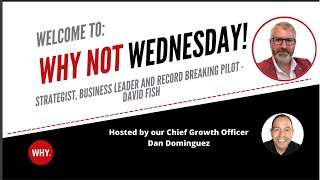
David Fish discusses his Why Operating System for leadership coaching, using aviation analogies to help teams simplify complexity and align strategy with execution. He shares stories from world-record promotional stunts and explains three listening styles and perspectives, from helicopter view to ground-level weeds, that coaches use to push teams beyond comfort zones.
Questions this video answers
July 1, 2022
21 countries
1,200 skydives
24 hours in free fall
Dropping 16 skydivers from a hot air balloon to break a world record
Chapters
These last few years have made us question everything.
Our relationships.
Our jobs.
What constitutes an.
Office.
And who we are.
In a.
World filled with chaos, confusion and uncertainty.
It's time for some clarity. It's time to start understanding one another.
It's time to start understanding ourselves.
We envision a world where everyone knows their why. But even more, we envision a world where everyone knows their why. O s, their why, their how and their what. The operating system that drives you, that lets the world know where you stand.
What your unique gift is, and most importantly, who you are.
Yos.
Are you ready?
Hello, David, and welcome to why Not Wednesday.
Amazing. Thank you very much and great to connect and great to be here with you today.
Now we are talking to you in the future, right, Because Australia is about, you know, I want to say five to eight, about 13, 14 hours ahead of us. So we are talking to you in the future, but we are going to be live on YouTube, on Facebook and on LinkedIn. So really appreciate you getting up early and doing this with us today.
Absolute pleasure. No, it's great. We've made the time work. It's always a juggle across dates, across the dateline and international time zones. But it's, yeah, great to connect and chat and share, share our experience with the yos.
Yeah, absolutely. So I want to introduce everyone to David Fish. David Fish is a globally recognized strategist, a business leader and a record breaking pilot. We're going to want to hear more about that, David. He works with leaders and business owners to help them set direction and unlock an inspiring ambition for their organization. Creating alignment within and across teams, including their leadership teams, to bring out their full potential. And that sounds really cool. He is passionate about guiding teams to turn strategic thinking into action. Aligning goals, roles and ways of working with the executional discipline to get results. Man, that is a mouthful. David, did I get it right?
She did, yep. Sounds pretty good. But I hear it back.
Well, you know, you've done a lot. We've been in conversations probably about a year and a half. Right when we first met, we met via LinkedIn and I introduced you to the concept of why. And I think it was great that you were patient, David, because you waited till the YOS was launched and now you don't have to do it manually. You get to share the YOS discovery with your clients. And so you're a recently certified, certified YOS coach. Your why is to make sense of the complex and challenging, your how is to find a better way and your what is to simplify and make things simple and easy to understand. How does that fit for you?
Actually, there's my why. There it is, beautifully brought to life, and it lives on the wall next to me, so I can always refer back to it and remind myself, yeah, when I. When I. When we went through it, and certainly when we caught up and sort of dived into the discovery and got into the detail of. Makes sense. I'm, you know, I like to understand how things work. So you remember we talked a lot about the algorithm and the 13 years of research to get to this point, because I need to know how things work. That's. That's in my makeup. And so makes sense. Absolutely made sense to me when that came through as the why. And then better way is very, very much core to what I do. I'm always looking to remove complexity off the basis of understanding how something works. If there's 30 steps, can we make it 10? But knowing why those 30 steps exist, rather than just going, gee, that looks complicated. Let's make it simpler. And I do believe that when we make things simpler, they're easier for people to use. I used to have this belief that complexity was good, you could charge more when things were complex, you were smarter when things were complex. And now I'm completely the opposite. And I see value and I see utility and simplicity.
You know what? I love that you brought that up, because simplify is a rare why. So it's one of the nine whys. So we've got make sense, better way, and simplify your top three. Simplify is one of the bottom three in terms of most common. But what I find, it is such a great superpower, because, like you said, a lot of people think the more complex, the better, the more you can charge. And literally, I have one of our coaches, Lisa Schermerhorn, if she's listening, will chime in. She had a client in Europe that she was working with, and he was working with engineers, and he thought that his stuff was too simple, and he didn't feel like he could charge as much if he made it more complicated. But what he found is that the reason they came to him is he could take their complicated stuff and make it simple and easy for their end users to understand. And once he came to that realization, he actually doubled his fees because he realized what a gift that was. So what people can count on from you are simple solutions. So you make sense of things that are complex and challenging. You find by finding a better way to do them and sharing it with your clients, but you ultimately Deliver simple solutions. Had you heard that before?
No. Well, actually, no, that's not true. Yes. So where I was getting traction with clients and where people were saying, wow, that's, that's a much better way of doing things, that's a simple. Those words resonated. Once we've done the discovery and got. And then I was able to reflect back and go, actually, you know what? That has been played back to me. People have said the way you framed that is such a simpler way to do that than the way we've been doing it. Or we can adopt that now because we can see there's three simple steps. And I do believe in the magic of three. And I do believe if you can get everything on a triangle, that's a good discipline. And if you page is another good discipline and just screw up the second page and throw it in the bin because whatever's on the second page no one's going to get to. So that, that for me is a simplified discipline in terms of a delivery mentality of three points of a triangle and what goes on the second page goes in the bin. So yeah, it had been played back to me. And so I think, and I see this with clients now when I use the why discovery and we have a conversation in teams and with leadership teams, you get that light bulb moment of yeah, I have heard that before and now that makes sense to me and.
It goes back to making sense. Right, so you're solving the problem you're finding by finding a better way and ultimately delivering it in a simple way. Really cool how that that has come come to work out for you. So. So David, tell us about this world. World or record breaking pilot? Tell us about that because I know that that's an interesting part of your history.
Yes. So we'll go right back. So I've been into aviation and flying since a kid. I was the kid that made the little Airfix planes and the model remote control planes and then eventually got at 15. So I turned to fly, got into real planes. I got my airplane license before I got my driving license and I might have been slightly arrogant and took my airplane license to the driving test as a form of identification, which kind of worked. It kind of didn't got through that. And then I got into hot air balloons, then I went to skydive. And then I was, I've grown up in the advertising media marketing world. And so I started to blend my ability to fly hot air balloons and skydive with working with clients who wanted to make brands famous. And so we did the world's highest Bundy jump. We dropped 16 skydivers from a hot air balloon to break a world record. We flew a car to launch a car for Citroen. We flew a bed for promotion for Polaroid in Europe. And so we did the world highest pillow fight, the world's first flying car, the world's highest Bundy jump. And so we just started to blend these, these skills and amazingly fantastic opportunities together to make brands famous. And so I had an absolute ball. I've flown in 21 countries, 1200 skydives, 24 hours in free fall.
And a lot of that now comes into my work. I love the discipline and the structure of aviation, commercial aviation. I've been a chief pilot of a passenger company and so I've learned the discipline and rigor that often we miss in business or we shy away from. And it kind of goes against simplified to an extent, because aviation is not simple at all. But when you strip down and go through the regulations and understand what sits behind them, which makes sense, I am the person that reads the air law book and understands the regulations, then you can actually find a better way to interpret that and then you can simplify how you apply that when you're in the cockpit and you need to make decisions. And again, that discipline that I've learned in aviation, even though I've had a huge amount of fun and I've done some very what people would consider out there and extreme things, there's a huge amount of learning and discipline that comes out of that now that will make it through into a workshop that I run.
Yeah, so. So how do you apply that to your coaching? You and you mentioned a little bit of, you know, how much complexity there is to it and how you're able to make things simple. So how does play into the work that you do with your clients?
Often it's through an analogy or even a relatable experience. So for instance, in aviation, we talk about aviate, navigate, communicate. So if something is going wrong and you're under an extreme amount of pressure, the first thing you have to do is fly the airplane. Knowing where you are on a map isn't that helpful. If the airplane is spinning out of control and heading towards the ground, all you know is the point on the map that you're going to hit. It's not actually that useful in survival at that moment in time. Right. And so if I've got a leader who's in the same situation in a crisis, they're spinning out of control and they're worrying about communicating or navigating. We can go back to. Hang on. What do you need to do? You need to fly the business. Who is in control of business? What are the two or three decisions that you need to make right now to keep the business in the air? And when you can relate that analogy, you can take them out of their current situation where they're super close and super in the detail, and just elevate up into a different conversation. It changes the perspective and it rewires the brain to think about that problem. Most of the leaders I work with are incredible problem solvers, but sometimes they're too close to the problem. And so a little reframe using an aviation analogy, which is a true metaphor. It's a relatable piece of experience that I have that can trigger the brain just then get into problem solving, and we go from catastrophe to if I do this and this, we'll be okay for the next couple of weeks. Okay, let's do that. So that's a simple example, I guess, of how an aviation analogy and experience will make it through into some of my coaching conversations.
No, and I really like the thought of getting up above the trees, right? Because so often business owners, entrepreneurs, are so busy working in their business that they can't work on their business because like you said, they don't see the forest for the trees. But you elevate them. You say, hey, come on, let's look at this from a different perspective. And let's look at it. You can see everything that's going on in your business, but if you haven't had the time to step back and look at it, you don't, you, you don't get that perspective. I, I love that analogy, David, and I know it's been used before, but I love that you bring in that practical experience and that, that, that example of if you're spinning out of control and into the ground, it's great to know where you are, but all you're going to know is where you're going to die, right? That's where you're going to crash. Now, you can pinpoint that versus hey, let's get control of this plane and let's, let's survive. And we'll maybe land where we want to, not where, where we are.
That's right, where gravity takes us. And I use a helicopter analogy. So a leader should operate in the helicopter, not in the weeds. So the helicopter gives you that perspective of the operation and the business. And actually, strategy should be in the stratosphere we should get into the spaceship to do strategy. We should see the biggest possible picture that we can and then we operate back in the helicopter. The minute you are down in the weeds, you're no longer leading, you're just farming, you're doing like everybody else is doing. And a leader should be above that. So helicopters are good place for a leader to be and that's team leaders as well as business leaders. But then we need to step out of that space as well and go even higher. So strategy, when we get into vision and ambition and long term planning, which has been sorely missing for the last couple of years as we've dealt with the pandemic and got into super short term tactical thinking, we actually now need to get in the spaceship, we need to look at the earth, we need to look at the business environment, we need to look at the category and the categories around the category that we operate in from that absolute sort of extreme perspective, that super macro perspective before we get back in helicopter and start operating again.
So what is, as you're talking about these issues, I'm trying to think, okay, who would David want to work with? So who are your ideal clients? Who is it that you love working with?
So my ideal, I work in sort of mid to large size clients. So I go startups of 50, 100 people through to team sizes of 150, 200.
I do work with some sizes. Are we going. I always use size to describe types of business, but it's actually a leadership ethos. So I work with companies that can change that, want to change that they know that they can grow, that there's opportunity as opposed to companies that want coaching or facilitation or support, strategic support to tick a box. And I can sense that when I have a conversation with somebody. So size does play a factor in that, you know, the bigger the organization often the more there'll be a budget just to be running some programs, to be doing some things right. Interested in that. I have to work with people and groups of people and I work up to 150 people in a team size down to as I say, groups of two or three, I'll typically work with. I say leadership. Leadership can be functional leadership. So a marketing team, an operations team, a sales team through to executive leadership. And then all of my work is around strategy. So whether that's strategic leadership, connecting strategy to execution, which is where I use the wide discovery quite a lot in team dynamics or the strategic proposition of the business. So how is that business taking itself to market? So it's its proposition, how it positions itself in market, how it tells its story and then how it presents that story. So a lot of work around strategic solution selling in presentations.
You know, I love that you said you want to work with companies that are, that want to change because as someone with the how better way you're going to come up with better ways of doing things you're going to come up with and you're going to want to share them with your clients. But if they don't want to change, you're going to be frustrated and they're going to be frustrated because you're going to be trying to change something that they don't want to change. So have you changed your messaging? I know I've had coaches come on and say, look, you know, Simon Sinek talked about if you tell people what you believe, you're going to attract people who believe what you believe. And so quite a few coaches, once they know their why operating system, they change their messaging and they put it out there. Hey, I believe in making sense of the complex and challenging and how I do that is by finding better ways and sharing them with my clients. And ultimately what I bring are solutions that are simple and easy to implement and what that'll do is attract people who are looking for that. Have you done that?
Yes, I think I mentioned there and when you talk to people you get a feeling and I think I use that language now, I will talk about a better way and simplify and if, if the people I'm talking to aren't actually looking for a better way to do something, they're looking for just some activity to be in motion or they actually believe in complexity and they're looking for a consultant that's going to come in and create reams and reams of documentation to make things more complex. Then they're not a client for me. And so I think what I sense when I talk to people is do they lean in at that moment when we're talking about finding better ways, understanding how they do things and then simplifying that so that people can adopt a three step process or find simpler solutions to move forward faster. You either get that lean in, yes, this is interesting. Or you get that lean back. No, it's not. And that's a cue for me to go, this could be a really great client. We could do some amazing work and genuinely see the people in the business move forward and change. Or no, this is a client that's looking for something different and I'm not right fit and that's okay. Like, you know, we can't all work with everybody, so we have to find our fit and we have to find that relationship and know where you can make a difference.
And you make that determination pretty early on, right when you communicate it out. So you say you use your language and even in that initial interview.
Yes, absolutely. And often that will be maybe even just a quick phone conversation. Someone's introduced me to someone. We're just catching up on the phone and having a quick chat or a zoom call and just getting a bit of face time before we meet and sit down and start drawing things on napkins. Because a lot of meetings still in the virtual world and it's a great way just to do quick introductions. That quick 15 minutes speed dating. Are we going to be a good fit before we commit an hour of our time and meet face to face? Often in that 15 minute speed dating call, we can both get a sense of, you know, what do we want to take this further? And so I actually don't mind those 15 minute quick catch ups. You know, you get referred to somebody, they don't know me, I don't know them. We literally speed dating, we're literally going, is there something in this that we want to explore further? And again, I'm super cool when there isn't because we save a lot of time and to your point, a lot of angst. When you get into a relationship where you're trying to give something that someone doesn't want or someone's wanting something that you're not giving, that's friction. And a lot of my work is about taking friction out of teams. And so I don't want to be part of the friction. I don't want to be in a race.
You don't want to create friction in order to take the friction out of the team. Right.
Kind of goes against my whole ethos of the work I'm doing. So it's really important for me and I think the yos and understanding and using that, just bringing in that language and I don't even think about it now as being a tool that I use in that way because it's just part of my bio, my setup, my conversation, because I've become comfortable with that language. But it definitely forms part of that narrative up front to just establish that connection.
So do you find that you're working with more of your ideal clients now that you're using that language and less of those clients? Because we've all had that client that when they call you look at the phone, you're like, gosh, I don't want to pick up. Because that's going to be a long conversation or a tough conversation. You find that you're finding more of those ideal clients sooner, working with them longer, and able to filter a little bit better.
Yeah, I think we get there quicker. I think it's a more discerning approach to that. Find that connection point earlier and even dig into it. So part of the work I do will be to walk into difficult situations or difficult conversations. And again, I do that with clients, even in the early phases of onboarding them, which is confront the tension. If there is a tension in the conversation, if we're not quite connecting on something, then we should talk. So I'm sensing that I'm trying to get to here. It feels like you're trying to get to there. Is that what's going on? Because if it is, let's talk about it. Because if we're. If we're misaligned now, where would be a good time? So it enables, I think it enables us speeding up the conversation, the connection, to identify if there is a connection, if there is a gap in the connection, explore what that is, and then make that decision around, do we move forward? It's a. Everyone's investing time. Let's put the money to one side. We're all investing time. The businesses are investing time to work with me, I'm investing time to work with them. And if we're wasting time, regardless of the financial side of it, none of us are getting out what we. What we want, what we're putting in. And so I really value people's time, both in a meeting context, in terms of onboarding clients and new business. And I value the time I spend with them and the time they put in to do the work we do together. And so finding that connection, speeding through that process, making sure we are the right fit, we're doing the right work, we're on the right path together. We're removing tension, not creating tension. All of that, super important to me.
I love what you said, because we all know time is a great equalizer. Doesn't matter how rich you are or how poor you are, we all only have 24 hours in a day. You cannot buy more time. You can buy more free time, but an hour spent is an hour spent. Whether you spend it or your client spends it, or it's your butler, your cleaning lady, it doesn't matter. Right? It's an hour. It's the same for everyone. That's a great analogy. David, what's the work you love to do?
That's a great question. I still love being on my feet. So facilitation. I had a sales conference a couple of weeks ago with 80 people. We were doing connection, so storytelling. So discovering their personal stories through a nice playful exercise, creative exercise that got. They build a life storyboard and they share that with authenticity and vulnerability to build a connection, that builds trust. And it's such a powerful exercise. And I love that kind of work. I love seeing large groups of people discovering things about themselves or sharing things and connecting. So that's a big team exercise. But I get a lot of energy back from that.
At the same time, I love the work. I do. Most of the work that I think is the greatest reward for me is when it's with teams, so groups of people. And you can start to see those connections and relationships change.
And ultimately work. Where I can see the impact when the light bulb moments are going off, even when we're doing why. Work around the dynamics of a team and a team, but they don't know why they're dysfunctional. They get on that. They're good people, they like each other, but they don't work well together and they're tripping over each other and there's complexity and confusion in the way that they work and double handling and all of those things are coming up and they don't know why that's happening and what to do about it. And when you start to unpack the dynamics of the team and how people work and what motivates them, what drives them, you see these little light bulb moments. Ah. So every time I say that, that really annoys you. Yeah, it does. And every time you do this, that really annoys me. Yeah, I can see that. But they don't understand what it is that's driving that and those. So I love those light bulb moments. When you're working with teams and you're basically solving problems or helping them solve problems. I work in the facilitation space, not the consulting space. So I don't do the work. They do the work. My job is to help them do the work knowing that they know the answers, but they don't know how to find the answer. And so I just love those light bulb moments. Whether it's with a group like the other day with 80 people, where there's lots of light bulb moments, lots of amazing connection and stories being told and. And you know that people are making lasting connections, not just in the workplace, but beyond that's that's amazing. And then, yeah, those team situations where you're starting to unravel big problems, that is causing huge tension, but they don't know what to do about it.
You know, one of the things you mentioned, and it is such a, it shows your maturity as a coach, as a makes sense person, you, you can solve problems fairly quickly. Things come to you easily, probably faster than most and probably when you were younger, you were the guy, the guy that said, well, here's what you need to do. And I like what you talked about is now you help them do the work to get to where you probably know that's where they're going to go. But you have to let them come to that conclusion on their own. And that's just maturity and knowing yourself.
100%. And I don't know if you've heard the three listening styles, this really resonated me. The listening to win, the listening to learn, and the listening to help. And I was listening to win, then I became a listening to help. So a coach often will be a listening to health. You're hearing something, you know the answer and you want to dive in and start solving. Listening to win is where politicians play. They're listening for the floor in your argument to jump in and sell their story and their thing. And listening to learn is where you sit back and you let the conversation unfold and you're probably the last person to speak, if you speak at all. And you're just prompting with questions to get things out and understand. And it's again, it's kind of back to make sense. You're just teasing more and more information out to understand and understand, understand. And when I, when I've learned that and got practiced in listening to learn and being the last person to make a comment and to let the conversation go and to use the power of the pause, then the magic happens in listening to help. You're a coach that's too quick to answer. And in listening to Whedon, you shouldn't be. In coaching, that is very much where you think you've already got the answer and you're not listening at all. And so I love those listening styles and I use them when I'm running workshops and retreats with leaders just to get people to think differently. And you can, once you explain them, you can say to somebody, this is great, but you're listening to win right now.
I can't wait to share that. So listening to win, listening to learn, and listening to help. So there are the three different styles and you probably need them at all at a certain time. But it sounds like for a coach, you really need to be listening to.
Help, listening to help, and then listening to learn. Listening to learn is the third. So it's win, help, learn, and learn is where you're sitting back, letting things come out. And often in that process.
You'Re learning as much as the person that's speaking is learning. They're hearing themselves. They're saying it out loud for the first time. Someone else is hearing it. And the solution is becoming apparent through the conversation as opposed to listening to help, where you're giving them the solution.
Love that. Well, all right, last question, because we're almost out of time. This has been so good. David, tell me about your biggest why not Moment Moment when you said why not to something, and you're so glad that you did.
So I think. I think I said this a lot. We talked about time. I believe in living in the moment. So often with a sharp intake of breath, I will jump in. I have been an over. I'm a strategist, so I've been an overanalyzer in the past. But some of my biggest achievements have come from that idea of why not. So that is the world records and Cruise doing crazy stunts and just going, why can't we break that? Why not give that a go? Why not put that proposal on the table to that client and see.
As well as moving into new industries, taking on different clients.
So, yeah, and there's an interesting parallel with this. So again, it's part of my things that make sense. When you fly aerobatic aircraft, you find out that the performance, the best possible performance, is right at the edge of the flight envelope. It's just before the aircraft stops flying. That's where the best performance is. And we live our life in our comfort zone, in our normal lives, not at the edge. And so why not for me, takes you to the edge. It takes you into that place where you're uncomfortable and you might be 5 or 10% at the very, very tipping point of your performance, or you might go over it, and when you find the edge, then you know where the edge is. And that's the thing I learned in aerobatics was you fly the aircraft to the edge of the envelope and then past it, so you know where the absolute best performance is. And so I think that question why not have a go do it right now.
On a Wednesday? Just why not? Works for me in pushing you out of your comfort zone and taking you incrementally closer to where the edge of your performance, which is the peak of your performance might be.
Oh, man, we've all seen the T shirt. You know, if you're not living on the edge, you're taking up too much space. That is exactly what you're talking about. And I love that you're taking the analogies from your aviation career and using them in business. So don't be afraid to go out on that edge and push past that edge, because then now you know where the limits are, and now you can come back and live nearer to the limits than those that fly in the comfort zone. Your commercial pilots are flying in that comfort zone because they've got responsibility for 130 lives in the back. When you're flying aerobatic aircraft, it's you, right? So you can take those chances. And I love that. Great interview, David. We really are glad. Any parting words for our listeners?
I think dive in. Like everything we've talked about is about experience and having a go and pushing. And that to me was the why. To be honest, I took the why with a bit of a why not attitude. You know, why not give this a go? And I did the why and then the why discovery. And then we caught up and expanded on that. And so, yeah, I think use that question, why not? And play with the why and make it your own.
And see what comes of it.
I love that. Thank you so much, David. I look forward to talking to you again soon and welcoming you. I want to make sure and welcome you to the team all the way from the land Down Under Australia. Welcome to the Y Institute, welcome to Y society, and hello to Y Nation. Thanks, David.
Thank you.
More from Dr.




Women In Leadership: A Need For A Greater Systemic Change With Belinda Clemmensen






