WHY Not Wednesday re-air Janice Martinez Interview with High Speed Internet
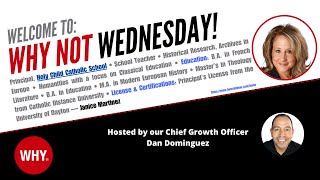
Janice Martinez, principal of Holy Child Catholic School in Tijeras, New Mexico, talks about her 27-year teaching career and 15 years building a classical curriculum. She discusses the school's funding challenges, her podcast Raising Saints, Forming Scholars, and why she committed to classical Catholic education and the Great Books.
Questions this video answers
27 years.
15 years.
This is her eighth year as principal.
Bachelor of Arts in French Literature; Bachelor of Arts in Education; Master of Arts in Modern European History; Master's in Theology from Catholic Distance University; principal's license from the University of Dayton; currently a graduate student pursuing an MA in Humanities (focus on classical education) at the University of Dallas.
The St. Jerome curriculum.
Chapters
There's a certain kind of coach who believes what we believe.
Who leads people to greatness, who gets people unstuck, who unlocks all of your passion. A coach who helps people discover what drives them to tap into their superpowers. Then knowing your why is the first step to untap potential.
To focus.
To breakthroughs.
A coach who's looking for a better way.
Are you that coach?
Hello, everyone, and welcome back to why Not Wednesday. Today is a really special day because I get to interview one of my favorite humans in the entire world, Dennis Martinez, who happens to be a principal at my daughter's school. And those of you who've watched the show or who know me, you know that I always talk about Sophia, and she's a big part of my life. And Mrs. Martinez, Janice is a big part of my life, too. So let's tell you about our guest today. Janice has been a Catholic school teacher for 27 years, teaching elementary, middle, and high school throughout the Archdiocese of Santa Fe, New Mexico. This will be her eighth year as the Holy Child Catholic school principal. She has spent the last 15 years developing and teaching a classical curriculum. Curriculum. And she truly believes that classical learning is the solution to many of the problems facing education today. She has also conducted historical research in archives in Europe and was a graduate teaching assistant at the University of New Mexico. She received her principal's license from the University of Dayton. She is a graduate student at the University of Dallas, working on a Master of Arts in Humanities with a focus on classical education. Welcome to the show. Janice, how are you?
Oh, I'm really humbled to be here. This is wonderful. And I'm so grateful that you have me here.
I am so glad you're here. I love interviewing leaders and impactful leaders. And I truly believe that our educators, our principals are some of the most underrated leaders in the world because you're bringing in, you're helping us raise tomorrow's leaders. And I know what a tough job it is because I have one of those little leaders that lives in my house, and you get to have her for seven hours a day. And she comes home better every single day that she spends time under your tutelage. So I want to start by thanking you for that.
Oh, well, that is my pleasure. It's my pleasure. She was, she was actually just in my office chatting about a book. So this is what us teachers live for.
I love it. I love it. And the other thing, so, you know, we're going to give, give you guys some, some history about Janice Martinez. She was also the third grade teacher for my now 34 year old daughter Jasminique, who is living in Chicago and who has two of my grandchildren, Amelia and Benjamin. So, you know, it's been a long time since we met way back at St. Mary's in 19, I want to say 1998.
Was that exactly? That was exactly it, yeah.
Hey, you have a song I want to make sure and play it. We always ask our guests, hey, do you have a favorite song? So I'm going to play a few bars of this and I want to talk about this song because it's a really cool song and normally I get hip hop or some really up jazzy, but this is really good.
April in Paris.
Chestnuts and blossom.
Holiday.
Tables under the trees.
April and Paris.
This is a feeling.
Why that song, Janice, what is it that you love about that song by Ella Fitzgerald?
Well, there's two things I love. Well, first of all, I love, love, love Ella Fitzgerald. I love Frank Sinatra, Ella Fitzgerald, all those greats. They're just, I grew up on that coming from New York. But I, you know, I have a background actually in French poetry and even though I'm full Italian, I just love France and everything French. And it just lifts my spirit. So no one ever asked me about my favorite song before for a podcast, so I thought I'd have fun with it.
That is a great song. I can't wait to listen to the full song because you know what, I think I've heard it, but I never listened to the whole song. So now that I know it's important to you, it's going to be important to me to listen to the whole song. So I know in the background we're going to have to play this after we're done. But thank you for sharing that with us. And you know, you mentioned something that is really important. And one of the ways I like to start the show, Janice, is going over your yos because that tells our guests, you know, we're our audience or a lot of our Y Institute coaches who are certified in yos and are using this every day. And a lot of times people who have used yos or they're using it with their teams. And one of the great things about the tool is it helps us get to know the people we're talking to a little bit better. So I'm going to go over your yos and then I'm just going to get your thoughts on it. Your why is trust. So that tells us that you're somebody who believes that trust is very important for you. If I trust you and you trust me, sky's the limit. If I violate your trust, we're probably going to have some issues, right? So that's very important to you. Your how is mastery. And as we get into your educational background, we're going to see just how much mastery there is. People with the how of mastery love to learn things at a deep level, understand them deeply and go deeper rather than broadly. So you're not going to be a master of none. You're going to be a master of a few things that you know really well. And I've known you for so long and that's definitely you and your what is right way. You bring solutions that are. You have systems and processes in place so you can deliver consistent, reliable results. And one of the things that I do is I'm, I'm the, the track and cross country coach at your school. So that right way. I know there are ways you, there are things you have to do as a coach at Holy Child Catholic school. And boy, Mrs. Martinez, make sure that you do that. So Janice, when you found out your why, your why of trust, your how of mastery and your what the right way, you're a very self aware person. You shared with me how many other assessments you've done. How did the discovery fit for you?
I thought it. You know, of course I've been trying to do different programs about self awareness since my 30s and now, you know, I'm 53. So I think doing something like this at a different stage in your life gives you a different perspective. And so I thought it was really helpful. For example, that word trust.
I don't think it had quite come out that way in some of the other programs that I did. But I. When you're in charge of someone else's child, it, it's, it is a heavy burden. I take the burden very seriously that I'm going to have to answer to a higher power, to God someday about the way we're leading the children. So I, I can tell you like, these are the kinds of things I lose sleep over. I take that very seriously. So I thought it was helpful to see that word trust and in that word mastery. I guess I hadn't really ever. That I hadn't come across that either. But it does help me understand myself and my team because you just mentioned it's the truth.
I.
There are certain things I'm really passionate about that I study and there are certain things I am hopeless, hopeless that I'm not going to be good At. And so I have other people around me, always helping me, strengthening me in the areas where I am not strong. And it's just helpful for us all to know where our strengths and our weaknesses are. I just think it makes for a smoother team, personally, you know, and the right way, I was really reflecting on that.
That gives me, I guess, even a whole different awareness about how we. How I do things. Like, I was reflecting on this when I got hired at Holy Child in 2016 and found out we use the St. Jerome curriculum. I got on a plane, I went to St. Jerome's I spent three or four days there. I stalked all their teachers. I went to every classroom. I literally got on my hands and my knees. I went through every book, lesson plans. I really worked hard to make sure that our school has the best in terms of that curriculum. What are the best books? What are the best ways to do it? So I think it was illuminating to see that term because I. I definitely do want to do it the right way. If you get. If you hand me a curriculum like that, I want to do it the right way.
Well, and the other thing, that. That also goes to your mastery. No, it's not. Every principal assigned a woman, goes to the source and then learns as much as you can about it. So I think it was your mastery and right way kicking in there. Would you agree?
Yeah. And I just. Our curriculum, so beautiful, the classical curriculum, it is so gorgeous. You could never spend enough time digging and looking for all the different facets of the diamond, you know? So it's really beautiful.
Well, the other thing that I wanted to share that because. Because when we look at your education, you have multiple bachelor's degree. You have a Bachelor of Arts in French Literature, a Bachelor of Arts in Education, a Master of Arts in Modern European History, a Master's in Theology from the Catholic Distance University. And you're working on a third master's degree. Right. Which is.
So this is. It's a long title. It's a Master of Arts in Humanities with a dis. With a focus on Classical education. And I will say, this is at the University of Dallas. And I have never. I've never had professors like I've had here. And I. Every class that I take, I keep saying, why didn't I learn this 30 years ago? My first class was learning about St. Augustine as a teacher. And when I was done with that class, I remember thinking, how did I ever say that I taught the Confessions before? Because the way Dr. Layman presented it is life changing. So it is an amazing, amazing place.
So.
And I love that you continue to search for that. One of the things we know about people with mastery in their Y operating system is your lifelong learners. I don't think you're ever gonna want to stop learning. So there are probably a few more master's degrees in your future.
Oh, dear. Well, you have to tell. My husband says, janice, when are you gonna start making some money and stop going to school? So, yeah, I don't know if he'd be thrilled about it, but, yeah, I. I don't want to graduate. When they bring up, you know, here's your list to graduate. I don't want to graduate because I know I have a lot to learn. I know I have a lot to learn.
Well, one of the things I want to talk about is your mission. You're excited to be a part of the classical movement in the Catholic Church, which is reforming education by returning to our roots. Tell me where that mission comes from.
So I. As you mentioned, I taught in the Catholic schools. I taught elementary school, middle school, and high school at our archdiocese. I worked with amazing teachers, amazing families, But I always knew there was something wrong and that we weren't winning the battle, that there was a problem with education. And when I went back to school to get my degree in education, I was just shocked to learn how the whole system in America is designed. It's designed to move students away from searching for the truth. By its very nature, it's designed to give this idea that there is no truth. And I see that it leads young people to despair, and it's gotten much worse. So I really felt like something is wrong here. And I'm actually surprised I had the courage to do it because I'm a pretty conservative person. But I left a really nice paying job and started a homeschooling movement. So I had, like, hundreds of students, and then I had three students. And we just read the great books together. And sometimes we just sat at my dining room table reading the great books. And I knew this is the only way to do it, but it was pretty radical and scary. I'm surprised I had the courage to do it.
I think that's a. That's, you know, as you. As you know, the name of the show is why not Wednesday? Because we talk about why not moments. So that probably. That sounds like a why not thing. You left a really good paying job.
To go back to your mission to bring the classical movement back to homeschoolers. So you went from hundreds of students to three students. Your goal is to bring the true good and the beautiful to your school community. So what that means is you want to recover the intellectual traditions of the church and reject the progressive, secular, and Marxist agenda that has overtaken education programs in our country. Whoa. Big goal.
Yeah, well, I just personally knew I couldn't devote myself to something that I didn't believe in. If anyone's a teacher out there, when you're a teacher, you are devoting, like, every cell in your body to teaching real teachers. We eat, drink, and sleep our content and how to bring it to our students. You know, and I will do everything for my students, but I will only do it if I really believe in it. I can't do it just sort of half hearted or just kind of, you know, I want to give my students the filet mignon of education. And, you know, initially when I went to school, to be honest, when I studied history, I wanted to really figure out my own family. And because my grandfather in Italy, he died in a concentration camp, he was a partisan against the fascists. And my dad was a pretty tormented man. And I wanted to learn how all of this happened. So that's where I encountered, you know, Marxism, Progressivism, deconstruct all these different isms. And I was really surprised to see that they were in the educational system. So I had kind of already had those things.
In my view.
Excellent. So I want to get, you know, there's. There's some parts that I want to make sure we get to. Because you mentioned the great books a little while ago. So your passion is you're passionate about preserving what is human in education, which includes giving students access to the great books so that they can be a part of the great conversation that has been happening for thousands of years. I really like that because one of the things that was so attractive to me and Monica about what you do at Holy Child is you've got little first graders reading Homer, and they're learning the great books at a very young age. I mean, there are adults I've talked to that they think Homer is Homer Simpson. So I love that these kids are getting exposed to these great books. So tell us about that passion.
Yeah, and it's interesting because I, like I said, I was cheated myself. So when I left high teaching high schoolers at the archdiocese to homeschoolers. Homeschoolers. I was shocked to learn that I have a master's in history. And I had never read the Founder of History. I had never read Herodotus, Thucydides, Livy, none of these People, my professors started me with Marx, so I read them with my students, my homeschoolers, and they taught me a lot. And I could not believe how beautiful it was. And I also saw how these ancient writers, they have the recipe for preserving what's human in our curriculum and in our students. Because the pagans were very devoted to searching for the truth, even if they didn't fully find it until Jesus Christ. They had this beautiful passion for truth. So I was shocked at how beautiful it was. I was sad that I had been cheated, but I was determined to bring it to others. Well, studying the great books is not easy. It's a lot of toil. It was very hard work. My students struggled, and so did I. So when I was invited to come to Holy Child, I really saw the big picture. Like you just mentioned, if you don't really want to throw a ninth grader into Sophocles or Homer, you want to prepare them. It's a whole lot of preparation, and it should start in preschool, kindergarten, first grade. And I'll tell you, I just had a student last year who goes to a classical high school. She said, Mrs. Martinez, I got my preparation. And she said, what you just said.
She.
She said, when I was in first, second grade, I read about Achilles and Odysseus, and then I learned more about them in sixth grade. And then here I am in ninth grade, and I picked up Homer and I was ready. And you know what? That is for me, that is the meaning of my life, because I want to prepare all my students for the great books that they will encounter. Should they go on to a classical high school or a classical college or really just want to encounter them on their own? And so that's what we live for. And it's so funny you mentioned your daughter. She and a few other friends just came to see me in my office because we bought beautiful books, beautiful versions of Little Women. They're reading Little Women, and they asked me if they could pay for the other versions of Little Women so they could keep it with them at home. So this is like, again, this is what every teacher dreams about. This made me so happy.
Having. Having a way for the students to be involved in this great conversation is really worth a million dollars.
So one of the challenges. And you brought up a couple of things there, you know, the. The reward that you get is not financial because there's. We know that as a whole, Catholic school teachers make less money than their public school counterparts. Catholic school principals make less money, and you have less funding. So one of the challenges that you have is constantly looking for funding. So tell us about how you fill that gap currently.
Right, as you mentioned. Yeah, it's expensive to educate a child. It costs at least $8,000. We only charge just a little over $5,000. So we work, we do podcasts. For example, we have a podcast called Raising Saints, Forming Scholars. We're hoping to find someone who has the same values that we do that would want to give. We have an intellectual society where we read the great books two years ago, we read Dostoevsky's Brother's Care Mats Off. So we're trying to find like minded people who would want to give. Our parish here at Holy Child is very generous. We have parents who are very generous, who are monthly donors. We have, I have friends who don't even have the kids of their own who are donors. So we just keep trying to find like minded people who want to raise up saints and scholars or help young people have a reward that goes beyond the, the financial, as you say. You know, one thing I like to think about is as I mentioned, my grandfather died in a concentration camp. And I visited that camp in Austria. It's actually in the Sound of Music area. And I was stunned to discover they have the original gate there. And the prisoners were wrote the words from Dante's Divine Comedy on the gate. Because at that time everyone had had a classical education. And whether you were Christian or not, you memorized parts of the Iliad, parts of the Odyssey, parts of the Aeneid and the Divine Comedy. So this is how they survived a terrible event through the memorization of poetry. That is such a priceless gift that we do bring to our students. And you're right, the rewards, you know, they're eternal. They go beyond finances.
I love that. And we put the banner there. So if, if you're listening and you're someone who believes in the same things that Janice is sharing and you believe that children should know the great books and you want to support this kind of education going forward, go to www.holychildnm.com give. And there are all kinds of different ways that you can give. I know that Janice has lots of different programs, some of which she mentioned, and lots of ways that we can support her. So if this is something that appeals to you, something that you want to be a part of, we are always looking. They are always looking. And I'm a part of the school. So I say we, we are always looking for people who believe what we believe. That's a big part of what we talk about at Y Institute because when you talk about your yos, you're looking for people who believe what you believe. And so for you, I know that your big mission, and we've talked about your passion, but even in your yos, you believe that success happens when we build trust. And then how you do that is by learning things at a deep level, seeking mastery. And what you bring are solutions that are done the right way and produce consistent, reliable results. And you've done that throughout your career in education, and you continue to do it today. So I have a great quote that you shared with us that I want to ask you about. The quote is from Saint Pope John Paul II says, the mystery of language brings us back to the inscrutable mystery of God himself.
Why did you want to share that with us?
I really love this quote because if you know the story of caribou to a future Pope. He was a poet and an actor who was immersed in the poetic traditions of his homeland of Poland. When the Nazis occupied his area, he joined the underground. And the underground movement was to preserve. Preserve beautiful words, to preserve the poetry of their land. And he risked his life to do that. And he was practicing his poetry, and the Nazis were making a loud announcement over that, and he continued to speak. And I feel like in America in these times, we are facing a similar battle because there is a huge movement trying to take the beautiful books outside of our educational establishments, and we have to really fight to preserve them. We have to really fight to give our students the space to have a literal book in their hands and turn the page. In other words, let's move out of being on our devices all day and let's read important, powerful words in books. You know, Nietzsche had a famous quote where he said, if we get rid of grammar and we get rid of words, we get rid of God. And so we know in the opening of the Gospel of John, it says in the beginning was the Word, the Logos. This whole subject of communicating of words, it's what makes us human. Because God came, He became human. It's the incarnation. And I see a lot of obstacles in keeping humanity in education because we are always sort of being pushed to do everything digital when there is nothing like a teacher and a student and a book like those three things, I think are what make education beautiful.
And you. And that. That's something I hear you say all the time. You talk about the true, the good, and the beautiful. One of the things we just flashed up on the screen, your podcast. Who.
Who do.
If. If we listen to your podcast. What are we going to hear?
So we tried to take up different topics that we think are timely but that we are also see are relevant in our particular school community. So, for example, we just did a podcast about fairy tales because our school does Fairy Tale Friday. But we emphasize the tales that are disturbing or uncomfortable. In other words, we're not emphasizing Disney or Hollywood. We're emphasizing tales that help build virtue in students. And so why would we do that? Well, we had a conversation about an author who writes a book about virtue and fairy tales. So that's a timely topic, I think, because right now, librarians, libraries across the country are having sort of an identity crisis. What kind of books should your child read? So that we we also did another podcast on, on Good Books because and we are also doing a study on St. Teresa of obvious Interior Castle. We'll study the life of St. Teresa. She says flat out. She says, I was on the way to hell because I was reading bad books. She says it was a good book that saved her life. She picked up a couple of Spanish books and Augustine's Confessions. What about Augustine himself? He was on a bad road. He picked up a book by Cicero and his life was changed. If you study the saints, they all warn about bad books and the importance of good books. And I will say there's just so many silly books out there and they're not harmless. So I think so going back to your original question, if you listen to our podcast, we talk about books at different traditions that we have at our school.
I love that and I love that you're sharing that because if people are looking for that. So your whole your Holy Child Catholic School podcast channel is on, on the page here. And I wanted to make sure that if, if you're interested in helping the school, we're going to put that banner up. Holychildandm.com.
Give me, tell us. You know, one of the things that I want to end with and we're getting close to our time is, I'm sure, in your life. And you know, as we both have gotten older, we've, we've got a lot more life that we've lived. But I always like to ask our guests, tell me about a time in your life. Tell me about your biggest why not moment, a time in your life that you said why not to something and you're so glad you did it.
Yeah. And it's kind of going back to what we mentioned earlier. I was teaching high school, making a nice salary. I love, love, love my students Loved my classroom. But like I said, I knew something was wrong. And one day I was on the telephone with one of my girlfriends. We were talking about education. We were looking at different homeschooling movements. She said a friend told her to take a look at Colby Academy. It's K, O, L, B E. I looked on that, I clicked on it, and it was sort of a snapshot view of a classical curriculum. And when I saw that at that moment, really, I'll never forget, it was just, you know, at that moment, and I was probably 38 years old, it was 2008, and I said, oh, my gosh, this is it. Like, this is what I've been looking for all these years. And at that moment, I knew. And that's really not like me. I'm not an impulsive person. I have to really stick study a lot before I make a decision. But at that moment, I knew it. And so that's something I'll never forget.
That is such a great answer. I. I love that origin story for what. What you do. And I'm gonna say, why don't we end the show on that note?
Why not?
Thank you so much for being with us today, Janice. You have added so much wisdom and knowledge about not only your yos, but also what you do and how you've succeeded in bringing your passion, your dream, your mission to everything that you do every single day at a small Catholic school, a classical Catholic school nestled in the mountains of New Mexico in Tijeres, New Mexico. So thank you so much for being on with us today.
Thank you for having me, Daniel. It's wonderful.
Have a great rest of your week. We will be back next Wednesday with another great guest. Thank you so much, Janice Martinez, for being with us today. And have a great rest of your week.
You too. Thank you.
More from Dr.




Women In Leadership: A Need For A Greater Systemic Change With Belinda Clemmensen






