WHY Not Wednesday with Brandon Eastman
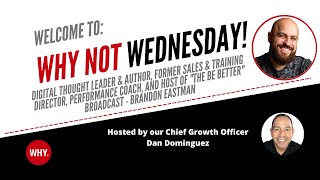
Brandon Eastman, host of the Be Better Broadcast, talks about his personal why (contribute) and why most sales coaching misses the mark. He says 80% of performance comes from mindset, habits, health, and relationships, not scripts. His six-week Be Better Bootcamp focuses on life-and-work integration through five practices: Plan, Power, Purpose, People, Progress.
Questions this video answers
Why = contribute; How = "Better Way"; What = trust.
Six weeks.
Plan; Power; Purpose; People; Progress.
Chapters
In a world filled with chaos.
These last few years have made us question everything.
Our relationships.
Our jobs.
What constitutes an.
Office.
And who we are.
In a world filled with chaos, confusion and uncertainty. Certainty. It's time for some clarity. It's time to start understanding one another.
It's time to start understanding ourselves.
We envision a world where everyone knows their why. But even more, we envision a world where everyone knows their why. O s their why, their their how and their what. The operating system that drives you, that lets the world know where you stand.
What your unique gift is and most importantly, who you are.
Yos.
Are you ready?
Foreign.
And welcome to why not Wednesday. I am so excited to be with you guys today. Welcome. Wherever you guys are watching from, make sure you comment and tell us where you're calling in from, where you're listening from because we got a great guest for you today. I see that Bella Sanchez is in calling in all the way from Dublin, Ireland. Bella, we're so glad we miss you in Albuquerque, New Mexico. We're glad you're having fun out in Ireland. And let me introduce our guest, Brandon Eastman. He is a the sales guy. First of all, he's known as the sales guy. He's a digital thought leader and author, a former sales and training director of a multimillion dollar retail company and he's a sought after performance coach. He helps sales and leadership teams break through their limitations and perform at their peak. He is on a mission to make a 1% difference in in the world by empowering leaders to uncover their gifts and abilities and use them to positively impact others. And when we get into his yos, you're going to, you're going to see where that statement comes from. So welcome to the show. Brandon, how are you?
I'm doing very well, Dan. I'm excited to finally make this happen. We had you on the broadcast, had a really great conversation and we're going to continue it here. I'm excited.
I had so much fun on your show, Brandon. And for those of you who have ever been a guest of Brandon's or a future guest of Brandon, let me give you, give him a full ringing endorsement. It was such a great show and the material that you sent our way that we've been able to use in our social media and the clips were amazing. So thank you very much for that opportunity. And there's Brandon's LinkedIn if you want to connect with Brandon. It's Brandon Eastman at AD LinkedIn. So just look him up. I see kid casting him calling us From Ridgeway, Colorado. Kit, so glad that you're here. And then, let's see, Bella says the better behind you has me hoping your why is better way. Well, the name of his show Bella is be better. So absolutely, let's talk about his yos because that's the way we start every show, Brandon. So let's get to talking about that. So your why is contribute. You believe in contributing and making a positive impact in the lives of others. Your how. Bella, get ready. It's better way. So how he contributes is by finding better ways to do things and sharing them with others. And then your what is trust. So what you believe that relationships based on trust are important. So that's your why, your how and your what, how you bring that all together. And then we got Lynn Everard and we're going to do this brand. We're going to say hi to our audience. Lynn is. Is one of our yos coaches and so is Kit, by the way.
Cool.
And those guys are always on and they're always putting on good comments. Guys, if you're. If you haven't told us where you're calling from or you have a question, just put it in the chat. We'll try to get to it because I've got some good questions for Brandon to begin with. Let me ask you the first question that I ask every guest. How does your why, your how and what fit you?
You know, I didn't know that they fit me for a very long time. I've been in sales, obviously, as from your introd production, for a very long time, since I was 18. And my why at the very beginning, I didn't intellectually understand it, but I just knew that I wanted to make a lot of money. So for a long time it was, I want to make money. I want to be at the top of the leaderboard. And it got to a point where I was almost, in a sense, whyless, right? I thought I knew what I wanted, but I was getting it. And. And now I had no target that I was going after. And I rediscovered my why when I was 21, actually with the help of a mentor who introduced me to personal development. And I quickly realized, again, not intellectually because we just met Dan, but I quickly realized that I loved helping people, Specifically, I loved helping salespeople to not just make more money, but to live a better life at the same time. And I realized I feel best when I am contributing and helping people. And again, it wasn't until you and I met that I put, you know, the better Way into everything I do. But it's funny that I think it was Bella who mentioned, you're better, your why it should be better way, or hopefully it's better way. I didn't name the company with that in mind. Like, it's interesting how these things happen without even intellectually knowing or understanding what your why is. They just kind of fell into place that way.
Well, you're not the first one that we've had that experience with. There's a gentleman in Albuquerque, his company, and he works all over the world. His company. His company is called We Simplify Internet wsi. And guess what? His why is simplify. And he had named his company way before he took the y discovery. Hey, T.J. davidson from. From Texas. Dan and. Hello, Dan and Brandon. He says howdy, actually. So good to have you, sir. Hello. In Texas. Right. Thanks so much, tj, for being on and for commenting. We. We like to. The more interaction we have from you guys, the more we know that you're there. You know, Brandon and I were talking. He has a podcast. I have a show, and we often run into people that say, hey, I've been listening to your show for a long time. But we don't know that they're there because they don't comment. So when you. When you comment and you let us know you're there, we. We appreciate that. So tell me about, you know, your personal story. So how did you come across your why? What were the challenges you faced along the way?
Yeah, I came across my why on accident, actually. Like I said, I was, you know, top in sales from 18 to 21. I was doing well for myself, but I was doing well professionally. But practically every area of my life personally was in shambles during that time. I'd gained 60 pounds. I'd gotten myself into a ton of debt. I was unhealthy. I didn't feel good about myself. Looking back, it was easy to see that I was actually depressed, but when I was in it, I didn't realize that. But looking back, it's very clear to see that. And again, I do attribute it to the fact that I didn't know what I wanted. I didn't know why I was doing what I was doing. And I got myself into the rut that I think a lot of salespeople get themselves into, especially these days, where they're just doing the same thing day in, day out, not quite understanding why it is they're building the book of business or why they're making a certain amount of money or why they're in sales in the first place. One of the hardest professions in the world. You should have a very clear idea why you're doing what you're doing. And it wasn't until my mentor sat me down and said, brandon, you want to become a leader here, but you're not taking care of yourself. And the first thing you have to do as a leader is you got to take care of yourself, right? You can't lead other people if you're not leading yourself. And he said, I want to help you. So within six months, my mentor, Keith, he helped me to transform my entire life. And when I say that I came upon my why by accident, it was because I was moving up into leadership in this company. And Keith said, hey, did you want to give a presentation to the team about some of the changes that you've made in your own life? And I was like, oh, my God, I've never spoken in front of people before, but. But if it means helping people and contributing and helping other people find a better way, I didn't use that language, I promise. But it was in my mind. I was like, I'll do it. And after I did it, I remember my notes looked like a serial killer. Like, they were small. I had like four pages of notes on the outline and like, almost scripted what I going to say. But afterwards, people came up to me and they said, brandon, your presentation on goal setting and time management, it really spoke to me and it really helped me. And I thought, wow, I want to do more of this. Dan, I'm sure you get the feeling all the time, maybe even when you do this show afterwards, you just feel really good about what you did, right? I believe that it's because you were aligned with your why. I feel that you feel great when you're aligned with the purpose of why you're doing what you're doing. And again, I didn't know it intellectually then, but whenever I spoke in front of people or even helped a salesperson or anybody one on one, it brought back that feeling. And I realized this is what I want to be doing with my life.
When you were making a difference, right, you felt like you were making a difference that aligned with you. And then you even mentioned it. And you're helping people find a better way. And I love the way you brought the why of contribute. And whatever your why is, whether it's contribute, better way, challenge, make sense. Whatever your why is, when you do that, you just feel good and you're compelled. You can't help yourself, right? Because here was something that was scary, right? Getting in front of people and talking. But you said, if it's going to help people, I'm going to do it right. So that drove you more than your fear of public speaking. And you mentioned something there that I think is really important. A lot of the people, when I was posting about this interview, I wanted to make sure that people knew, hey, we're going to be talking about sales. Because you said sales is hard. It's a tough thing to do. It's one of the hardest professions in the world. But you embrace it. You call yourself the sales guy. What, what do people get when they're working with you? Because people come to you that you have the Be Better podcast, which is amazing, but you help people and organizations find themselves. So you help, you help them perform better, find themselves and lead better. What's the, what's the, what's the focus when somebody works with Brandon?
Yeah, I realized very early on what sales companies wanted from me. And I also realized very quickly what it is they didn't know that they needed. And what a lot of companies want, especially the company I worked for for years where I discovered this is they want a sales process, which is very important. They want a strategy to get referrals. They want to know what to say to people when they make phone calls. They want the scripts, they want the know how. All that's very important. But I would gather to say it's only 20% of what really matters. I discovered that sales companies really need the 80% of what they're not getting because as a top performer, I had all those, those first things. I had the script, the process. I was doing it day in, day out, but it's the 80% that they're not getting. So sales companies bring me in because they want to tighten up their sales process. Not necessarily make a new one, not necessarily reinvent the entire wheel, but to take the existing process and make it better. And I, you know, it's weird saying these things out loud now because I know you're thinking, ah, there, there's his how or the what. But that, that's how it started for me. And I realized that the 80% of what they needed I incorporated into the training. And that's how sales Companies see a 20% boost in sales quarter over quarter. Once they go through a be better boot camp, once they go through the selling from strength. It was those mindset principles. It was having a plan. It was powering your mind, powering your body. It was building those business relationships. It Was it was the soft skills that mattered even more than the strategy. So when you bring me in, you don't just get the sales strategy. Yes, we make it better. But your team and your people get the things that they really need in order to be tied into what they do in order to feel good about what they do. And when you have a team that feels good, you've got a team that sells good.
Oh, man. Well, that, that's got to be a quote that we're going to say. We. When you have a team that feels good, you have a team that sells good. Love that. And that was, you know, that was my strategy when I was a sales leader. I wanted my people to be happy. You mentioned something that's really important. And we have a common friend. Jim Packard talks about the 8020 rule, right? We don't need to improve everything. Guess what? Sales out there, you, the top 20% of your sales force doesn't need it. Brandon. It's the bottom 80% that need Brandon, because we got to create those habits that don't break the chain. So, man, you said something else that, that caught my, my attention. The, the Be Better Boot camp. So what's, what is the Be Better Boot Camp? You notice I, if you, if you know me, I'm, I'm a former military guy. So you talk boot camp, you get my attention. So tell me about the Be Better Bootcamp.
It's funny because when I first released the bootcamp last year, I had like six people on the first one that we ever did, which was great because it was very intimate. But I'm thinking I want 20 people, 30 people in this thing. But I asked people, you know, what were your qualms about joining this? And they said, brandon, when you said boot camp, I thought we were going to be up until like 2am I thought we were going to literally doing exercises on the Zoom call because it was virtual at first. And I'm like, wow, I guarantee I scared a lot of people away from this. But at the same time, I thought to myself, maybe it's good that we're scaring people away from this. Maybe we only want those people who do have that boot camp mentality, because I know that's, that's who I would have been. So to answer your question, the boot camp is very much the 80% of those things that we mentioned. And you said that the 20% of the people at the top, they don't necessarily need this. Right. And I, I, I'll reiterate and say I agree to an extent I agree because some of those people at the top, I think of someone I know who's in sales. His name is Jason. He's in real estate sales. And Jason just knows what he wants and why he does. He wants to provide a great life and a legacy for his family. He wants to put his children through college. And he shows up and wakes up every day at 5am in order to make that happen. And he goes to bed at 10 and redo it the next day. But I remember I was top in sales and I was struggling hardcore in every other area. My fitness. A lot of the things that sales companies don't think that they need, like I mentioned, they're not looking to bring in a fitness trainer. They're not looking in to bring in a mindset coach. But really the bootcamp is all those things. The Bootcamp is. It talks about the five Ps of self mastery. And I'm sure we'll get into what the 5Ps are. But it's a process to go from where you are now to where it is you want to be. Not just professionally, but if you can have a strong personal life, then your sales are, you're going, are going to going to explode as a result. If you have a plan for what you want in your life, then your sales is going to be a means to an end in order to enact that plan and make it a reality. So the Bootcamp is, it's a six week experience that by the end of it, Jim Packard went through it. By the end of it, your life can transform and your sales transforms as a result of that. It's extensive.
I love that you bring in that life and work integration because as salespeople, you know, and I led sales teams for a long time at a high level and at a regional level. And I remember because the quota is everything. Hitting the number right, you never want to miss your quota. And you'll give up on things. You'll give up on going to your kids soccer games. You'll give up on, on being home for birthdays. You give up a lot of things in order to achieve those goals. But I think you're absolutely right when you balance and you say, okay, what are the. What. Why? There's a reason I'm doing this stuff, right?
Yeah.
And, and like you said, maybe you just get up earlier and you can get a lot of stuff done. Maybe you watch less tv. So I'm sure there's a lot of that in the boot camp. So hey, there's a couple of people that came in. I want to make sure I say hi to Lynn Everett. He' of our Y coaches in Boca Raton, Florida.
And.
And Lynn, I need to get to Florida because the next person I want to recognize is Pamela Ferguson Bishop. I actually was in Louisville, Kentucky a couple of weeks ago and got to meet Pamela in person. And it is so cool that we're out of the pandemic. We're able to meet some people in person, and Pamela was one of them. So, Pamela, glad that you're on. Hey, you mentioned the one. The question. The next question I had. So we're, you know, I. I told people we're so simpatico, we'll probably be finishing each other's sentences. I wanted to ask you about the five Ps of self mastery. What are they?
The five Ps is a process I created from the very experience that I went through when I was 21. Overweight, unhappy, depressed, to go from where I was just six months to a year later, moving into leadership, feeling good about myself, having the body that I want, but not even the physical aspects, but thinking the thoughts that I was thinking. Right. The. The five P's of self mastery. I'll go through them very quickly, if that's okay with you, Dan.
Absolutely.
And they. They do go in a specific order. So the very first thing is what a lot of salespeople are actually missing right now. But not just salespeople. I know that's, like the focal point of this conversation, but everybody. It's a plan, right? You need to have a plan for what it is you want to achieve. I see so many people, especially people who've been in sales for several years, three years, four years. This is why a lot of people who've been in sales for a while begin to rank their company at a lower level because they think that the company does a lot of things more so for the newer people and not as much for the veterans. But it's not even that. Sometimes that's the case, but sometimes it's the case that a lot of people who've been in sales for a while, they had a goal that they hit, but they failed to set another goal. Right. And we don't set goals just to achieve them. Right. Because once we achieve it, what's. What do we do? Most people set a new one. Some don't set one at all. That was me. But that goal, it gives us a target. Right. I used to talk about why all the time with salespeople, and I'm sure we'll talk about this, too. And I said that your why as a salesperson is really your red dot, right? It's. If you think of a bullseye, what's in the middle, the red dot? You're going for the bullseye. Going for the bullseye. If you miss it, do you just stop? No. You keep throwing the targets at the bullseye, right? Until you hit it. So you keep going and going, but once you. Once you hit it, you got to send another one. So that's the first P. The second P is how do you fuel the plan? You've got to have power for the plan. Power is the second P. A lot of people think power is just what you do with your body, and that's a big part. Because if you're unhealthy, if you're not in the best shape, then it's going to be hard to show up and perform at the level that you want to. But power is also your thoughts, your mental place, how you feel about yourself, the thoughts that you're thinking, the way that you start your day, the way that you prime your day. That's the second P. And then we've got the third P, which goes along heavily with why, which is your purpose. Why are you in sales? Why did you choose the most difficult profession to be in? And for everyone listening, who's not in sales, even though I think all of you are in sales in some capacity, why are you doing what you're doing when you could be doing anything else? What is your reason why you're doing it? What's. How are you tying your purpose to what it is you're doing professionally? Because if your purpose is tied to it, then it's going to be a lot easier to make the difficult decisions. It's going to be a lot easier to show up. So that's the third. The fourth one is people. Surrounding yourself with the right people. It's the only reason we met today, Dan, is the only reason why. One of the reasons why you weren't in Kentucky and you met Pamela. Right. It's the people you surround yourself with, the people that you meet. Me meeting Jim Packard led me to you, and someone led me to him. So the business relationships that you're creating, but also asking yourself, who are the three to five people I spend the most time with? And really curating that group of people. Jim Rohn was a giant influence on me when I was 21 and when I discovered personal development. Are you. Before I go, are you familiar with Jim?
Absolutely. You are the average of the five people you spend the most time with? Jim Rohn.
That's right. And I was spending my time with a lot of people who I didn't want to be like. That was one of the first things I had to change. And the fifth P sounds like the easiest, but sometimes it can be quite difficult, which is progress. Making 1% progress every single day in the direction that will bring you to fulfill the plan that you created while staying aligned with purpose. So the boot camp and everything I talk about aligns those five Ps and helps people create a system and a plan in their life in order to not just make more money and make more sales, but to reach self mastery in every area of their life.
That is awesome, Brandon. You know, I'm so glad I asked that question because there's. I'm sure when you go through the Be Better bootcamp, there's a lot more detail to it, but you brought a lot of things that are so important. I think purpose is so important. The people you surround yourself with making it. I looked at, you know, you want to help people make a 1%. You want to make a 1% difference. Right. It seems like not a lot, but if you improve 1% every single day, that compounds you. What are you doing better today than you did yesterday? You don't, you know, Jim says it, you don't have to be the best. You just have to be better than you were yesterday.
That's right.
Better than you were every single day. Think about how much better you're going to be at the end of a year.
Yes. And there's math that goes behind that. So I used to think that if you improved 1% every day that you'd be 365 better. Because my non math brain, that just makes sense for me, but there's actual math behind it, which is still impressive. If you improve 1% each day intentionally in a specific area, then you'll actually grow by 37% in that year. So some people hear 37 and they're like, well, that's not the sexiest number. Okay, well what if you do that for three years, for five years, for 10 years? The reality is, Dan, you know this. I know this more so now. I just looked at my memory on Facebook and I graduated high school 10 years ago and I'm thinking, oh my God, 10 years passes so quick. Well, what if you grow intentionally during that time in whatever area that you choose? Like you said, exponential results.
Yeah, and that's the, and that's the key of the Compound effect, right. Darren Hardy talks about the compound effect. You just keep doing it. Jim talks about it. You don't have to get, you know, you know, if you're an 80 percenter, all of us are 20 percenters in one area and 80 percenters in others. So if you're an 80 percenter and you just have, you want to get better, go for that 1%. Don't break the chain is what, what, what Jim talks about in his book, the consistency chain. So that's fantastic. So you, you take a lot. I mean, you've done a lot in a short amount of time. You've developed some systems. Kit castingham says your 5P program is brilliant. Pam Ferguson is a woman. A few words. She just said, so.
I do, I agree with them. So tell me about your biggest why not moment, Brandon. That's, you know, I did this with Larry Levine, whom I've got, you know, he's in our network, but Larry Levine has says, hey, look, every show has to have a signature question. So my signature question is, what is your biggest why not moment time in your life when you said why not to something and it's made a significant positive impact for you?
Well, sometimes I'm also a few words, but I actually want to mention two very quick why not moments that were pivotal in my life. The first one I kind of already mentioned to you, which was when I went to my leader when I was 21 and I said, I want to be a leader in the company. And he said, like I told you, Brandon, you can't be a leader until you can lead yourself. And I was angry at that point, Dan. I was again, £260. I'm £195 now. And I was like, this is ridiculous. I'm a top salesperson. I'm number one on the team. Why can I not be a leader? I worked for a sales, a wireless sales company at the time, Verizon Wireless. And I started looking at competitors and I was like, I'm going to show them. I'm going to go to a different company. I'm going to start over. I'm going to pave a path there and really just show them what they're missing out on, right? And that's one of my biggest, biggest, biggest why not moments. Because if I had decided to leave Verizon and go there, my life would look very, very, very different. I remember the reason I didn't make that leap is actually it's all centered around why my regional director said, brandon, you've got a Wedding coming up soon. You mentioned how you wanted to start a family, you wanted to move into a home. You're going to cut your income in half if you leave for this other opportunity. And I said, okay, well, what can I do? And he's like, you can work on yourself. He's like, brandon, if you start working on yourself now, then within a year, you can be in a very, very different place. And I said, well, what do I need to do? And he said, you need to read this book. And he gave me the book called the Secret by Rhonda Byrne. You've read that book.
I'm assuming it's something Gary read before he started why Institute? So, I mean, it's such a great book because there's so much in there. Absolutely.
So I read that book, and as we talked about earlier, I made big changes in my life. That was the biggest moment. The second one was I'm now the training director of this company. I'm 20, 26 years old. And I say I want to help people outside of the company. I want to help people everywhere. But I was between staying with this company and going all the way, becoming a regional director, owning my own set of Verizon stores, right? And I said, if I go that route, that I'm not going to be able to go this route with my own business. Which route should I go? And it all comes back to my why of contribute. I asked myself the question, how am I going to be able to impact the most people possible here with this one company, or if I start my own business, my own show? All those things I didn't know yet, but they happened as a result. And I decided to start Be Better Industries. That's how my business started. I was afraid to do it. I was unsure of whether I made the right choice. I still stayed with that company for a long time in that role until I went full time with what I do. But it was one of the best decisions I could make because it really allowed me to fly. Reflects my why. And as you know, I feel much better as a result because now I get to truly do what I want to do and help people the way that I want to help them.
And I can see in, in everything you talk about, I. I see your yos of contributing, making a difference in the lives of others, helping them do things better, and then you build that trust. I had no problem, you know, confiding my connections with you, wanting to connect you to other people in, in my network, because you come across as so genuine. And we had such a great connection. And I think that all comes from your. You're driven by. By your why of contributing to the success of others, helping people find better ways and building trust. So kudos to you. And I think that's such an important factor. And our coaches that are on the. On the. On the call that are listening, they. They understand that. That aha moment that we get when we learn our own op why operating system. We learn our why, our how and what, but also we help others. I just did this with the. I did a workshop today. I often get to do that, but it was one of our clients that wanted a why, how and what for their team, and I got to do that. Man, that is so fun, Brandon. And it's so fun watching you talk about it. So how has discovering your yos impacted.
Your life in so many ways? Now that I understand that a better way is my what right and how is through trust. It's helped me to communicate with people. As you said, when people say, who are you? What do you do? Well, I contribute to the lives of other people. I do that by helping people to find a better way with what they're doing. And I do that by building a foundation of trust. It helps me to communicate what I do better, but it also helps me be very clear on the opportunities that I take. I'm not going to be the one who asks a ton of questions like, I know it was Larry who it was clarify, right? Was his. Was his what? So I'm not going to be doing what Larry's doing. But you need a Larry at the table, right? You need. We're talking about Larry Levine for everyone, for everyone listening. But mine's better way. So I might not create the system, but I will look at it, I will put it into action, and I will ask myself, how can I make this even better? And then we can get people to clarify. We can get people to create. We can get people to innovate all those different things. But it helps me to know what to say yes to. I think would be the best answer to that question.
I love the way you brought that example together. Hey, Bill Summers wants to know the five P's. Can you go through them real quick? Just. Absolutely.
And, Bill, you can always go back, too, But I'll just name them real quick. The first P is you got to have a plan. The second is you've got to have the power to fuel the plan physically and mentally. The third is you have to align it with your purpose, which is what we're talking about right now. The why right, you have to align it with why are you doing what you're doing. The fourth is surrounding yourself with the right people.
Right.
You are the three to five people you spend the most time with. And the fifth P is progress. Making 1% progress every single day, not doing 500 things a day to get where you want. But even just one thing over time compounds to a greater result.
Yeah, don't break the chain. I love that. That is so good. So have. So you. How did you learn about why institute? What made you come to us? And then how have you incorporated the tools, what you've learned into your business?
I met you through Jim Packard. He said, you need to meet Dan. Jim actually went through my boot camp. That was for the public, not even a company. He joined it and I got to meet him, work with him really closely. I think I helped him improve his golfing average. You can ask him.
Good. We'll have to ask him this.
So for you golfers, this might actually be good for you. But I incorporate it every day, Dan. I mean, I have a show, the Be Better Broadcast, where I talk to people from all different areas of life on how to live a better life who incorporate that 80% that a lot of sales teams and salespeople aren't incorporating. And constantly I'm asking people, what's your why? Why is it that you do what you do rather than ask people, what do you do? I love to ask people, well, how did you get into that? Why do you still do this when you could be doing all these different things? It can't just be because of the money, right? So why are you doing what you do? So every day I'm asking people why they're doing what they're doing. And now I'm able to go deeper with that because I better understand this beautiful operating system that that has been created.
Well, I want to get credit. I think it was Bill Summers or Lynn. Never. I can't remember. One of our coaches said it's how you're wired. And they spelled wired. W H Y. I. I just. I just got to give a shout out to either. It's either Bill or Lynn. One of them. Whoever it is, both of you are on put it in the chat. Tell us who, which of you came up with that? So. So, Brandon, what would you say to someone that, you know, I like to close with this question. What would you say to someone that's looking at becoming a YOS certified coach and learning how to do this for their clients? They're sitting on the fence. Maybe they're. They're. They're wanting to clarify and ask some questions. What would you say to someone who's on the fence?
Well, I would say that, you know, to take a look at how you're helping your clients right now. And I would add to it, if you're not incorporating why those individuals are doing what they're doing, both the leaders in that room and the representatives in that room and the team members, then all. All that you're doing is only going to bring them to maybe 40 to 50% effectiveness. If you're just teaching the strategies, just teaching how to make customers happy or a sales process or whatever you're teaching. But when you're able to tie that to what a person's why is what their real motivations and drivers are, that's how you take someone from 60 effectiveness at best to their full capacity to their full potential. So that why only greater enhances. It's like throwing gasoline on the fire. The reason why people are doing what they're doing, it's. It's a. It's a needed thing, but it's something that not a lot of people understand and recognize they need until it's incorporated.
Man, what a great answer, Brandon. I'm going to finish on that note. That is a great half hour we got to spend with our why coaches, why nation? So, hey, just the definition for everybody out there. So why nation is everybody all our followers, all our friends and all our coaches, and why society is all our coaches. So that's that. That inner circle we call them why society? Thank you for being on. Brandon. This has been so much fun. Really enjoyed your energy and we can't have wait to have you back. I think I'm gonna. We're gonna have to do a return engagement just like we did with Larry levine. Are you up for that?
I'm up for that, Dan. Thank you. This has been a lot of fun.
Awesome, my friend. Have a great week and we'll talk to everybody next week on why not Wednesday.
You too, sir. Thank you, everybody. Great seeing you.
More from Dr.




Women In Leadership: A Need For A Greater Systemic Change With Belinda Clemmensen






