WHY Not Wednesday with Brenda Cox Harkins - Life and Leadership Coach and Consultant!
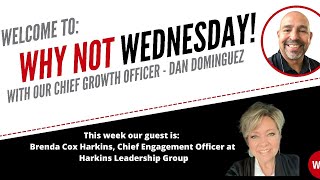
This is a recorded livestream interview (Dec 30, 2021) in which Dan interviews Brenda Cox Harkins about her work as a life and leadership coach, author, speaker and mediator. Brenda describes her Why Operating System (Why: 'make sense'; How: 'simplify'; What: 'contribute'), shares a formative why-story from a trip to India and explains how that shaped her approach. She discusses her book (Crossing Over: Living Your Purpose on Purpose), ideal clients (leaders willing to change from the inside out), a business transition from nonprofit to the corporate world, and practical emphases like nurturing relationships; contact via harkinsleadershipgroup.com.
Chapters
Hello and welcome to why Not Wednesday. It is our last why Not Wednesday of the year and I'm so excited to introduce our guest today. We have Brenda Harkins with us today. Brenda is the founder of the Loud Is Not a Language Model of communication and is also the founder and CEO of the Harkins Leadership Group, a company that develops relational leaders, creates collaborative communities and builds foundations of trust. Brenda is also a best selling author, a life and leadership coach, a speaker and mediator. She loves coffee over conversations with old and new friends, quiet time that focuses her faith, and West Texas sunsets. I love those two, Brenda, not necessarily in that order. So let me introduce and bring her onto the studio.
Hello Brenda. Welcome.
Oh, thank you. I'm so glad to be here.
Thank you so much for being here. It's our last one of the year. You know, everybody takes this time of the year and does different things with it. You're doing something completely different this week. Tell me what you're doing this week and let, let our listeners hear what you're up to this week.
I am in a hotel room by myself all week long. So I'm focusing, I'm getting quiet.
Evaluating the past year, getting ready for 2022 and just know that I need to enter 22 being tightly and rightly aligned. Like those words keep coming to me and so figuring out how to best do that, that's what I'm up to this week.
Tightly and rightly aligned. So tell me what, what tightly and rightly aligned means for someone. So, so you're someone with the why of makes sense. You're someone with a how simplifying a what of contribute. How does tightly and rightly aligned fit in?
I tend to.
Have many, many interests and I can get really scattered. And so I have been in the past kind of like, sorry, I'm from Texas, y'. All. So this is like a machine, this is a gun analogy, but it's like a machine gun. You just shooting bullets everywhere. And I'm working on being a sniper. I'm working on getting really focused on what I'm supposed to be doing, who I'm supposed to be doing that with. And I'm excited about that.
Ah, great, great analogy. I was talking to our COO Maria earlier today and she just read American Sniper and she's telling me about reading that. But of the lines I remember from that, you, that movie or that book was aim small, Ms. Small. Right? So you're, you're aiming small. You're going to make smaller misses versus being scattered Everywhere. Is that. Is that kind of what you mean by tightly and rightly aligned?
That is. It is. I just want to be really, really focused. That's really what that means. Focused on the right things to do and the right people to be doing it with.
Well, you mentioned in the intro, we talked about quiet time that focuses your faith. So tell me what that looks like for you.
It looks like really getting very quiet and listening for the voice of the Lord for the day, sometimes just for the moment, and knowing that.
Knowing that I have my direction from. From the Lord is good. And I don't know if you can hear me. You're doing funny things on the screen. Can you hear me?
I can hear you just fine.
Okay. All right. Your face is. Is like. I don't know. I thought maybe I'm freezing up, but yeah, it focuses my day. It's how I start my day. It helps give me direction for. For every day.
Excellent. So tell us your yos in your own words. So I mentioned it at the beginning, and some of the folks that are listening or tuning in for the first time may not even know what that means. So, Brenda, you're yos certified coach. Tell me. Tell us your yos and then explain it to us in your own words.
Okay, so my why is to make sense. And what I do is I make. I tend to make sense of the overwhelm or the chaos of a situation of a relationship, whatever's going on. How I do that is to simplify. So I kind of step back, take a deep breath, inhale what's needed, exhale what's not, and.
Get rid of all the fluff so that I kind of have a 1, 2, 3. This is how we're moving forward. And the contribution, hopefully and generally, is to help people move forward in whatever it is, whether it's. Whether it's a relational issue, a business issue, personal, whatever, just to help people move forward in their destination. That's the contribution I love to make.
So when you talk about making sense and simplify, those are just such efficient, wise, how, you know, make sense people. I love make sense people. Because when I talk to somebody that makes. That has the why of makes sense, I know I don't need to explain things at a really deep level. They get things, and they get things quick. And when Brenda says, dan, I got it. She's got it. Stop explaining.
Right.
You pair that with simplify. So you like things simple. You get. You cut to the chase, get to what's important, and move and move on. And then Ultimately, you contribute. You're here to help people. So that's such a great combination. One of the questions I wanted to ask you about is, because we've talked about it, you had an experience about 15 years ago that proved to you what you knew in your heart at the time, but has since become one of your why stories. Tell us about that experience, Brenda.
Okay. Well, about 15 years ago, I went to India for the first time. And I'm. I'm a Texas girl who really just likes. Liked being a Texas girl. Wasn't a whole lot into travel at the time. And so my husband had warned me about what the streets were like in India and that we don't have enough money to, for you to give to every single child that's going to run up to you. And you need to be prepared for this, right? And so it really bothered me, you know, I mean, I didn't want little children running up to me needing money, you know, and, and me saying no. And I was just really torn. Like, I don't know how to. I don't know how to deal with this. So in the midst of the situation, we're on the streets and I mean, literally, I've never seen anything like it. And I've been in some other. I've been in some third world countries, never seen anything like this, surrounded by children, holding out their hands, wanting money. And it was just. It was that moment where you just know what to do, you know, and you haven't really thought it through. And I started looking at each one of them in the eye and just saying whatever came to mind, like, you are so beautiful. Do you know that you have got a special purpose? Like whatever it was. Well, I don't know. I don't know what I said, but whatever I said, it came from my heart and literally watched touched their hands drop. They quit begging for money. They smiled, you know, like somebody took the time to make eye contact and show them value, right? So what. What I've known, you know, in my heart all my life is that everybody on the planet has value. And, you know, it's sad how we station people in different lots in life. But what this showed me with my why story, it was like I didn't know what the. I didn't know about this. This wasn't even developed at the time, right? But when I look back at that, I was so overwhelmed by the situation. I had to make sense of it, you know, I had to make sense of it. And how I did that was by simplifying how I dealt with it and that was just to look at each one and tell them what was beautiful and special about them. And the contribution was them actually receiving.
Value, which they don't get.
So that was just really precious. So different things over my life since I've done this, just looking back and thinking, well, I didn't have words for that at the time, but that's so much a part of who I am. I can now go, oh, that was my makes sense, simplify, contribute going on right there.
Ha, I love that. So, so your. Your why is. Why why is make sense? How is simplify or what is. So tell me about when we first talked and you discovered your why operating system. We talked about it. How did that feel to you?
Well, I don't know if you remember this. The very first time we talked, I had only taken the assessment that gave me the why. They didn't give me the how and the what.
Right.
And so when I did that, I was like, well, I don't know, maybe. I mean, I like things to make sense, but I'm also extremely relational. And that didn't really feel very relational. And so that's when you said, you need to take the yos and get all three. And when I did, all of a sudden all made sense. It all made perfect sense. And I also realize I say that way too often.
But yeah, it was like, oh, I see in relationships I want to make sure that what's happening makes sense. And if it doesn't, then I'm going to simplify it so that it does so that we can move forward together. You know, that whole makes sense, simplify, contribute in everything from business to working with teams and organizations to just one on one with people. It fits it all.
I love, love, love hearing that, that when the light turns on. Basically, right, because it all. And you. Every time I talk to someone with the why of makes sense, they say, I didn't realize how often I say makes sense until I found out that my why is make sense. I ask people, does that make sense? Or I say, oh, that doesn't make sense. And so then you try to fix things. Right. So you wrote a book soon after that experience that. By the way, Watson, thank you for commenting that Watson is talking about you. You wrote a book about that experience that talked about living your purpose on purpose. Living your why. Tell us about that book, Brenda.
That book is called Crossing over and the subtitle is living your purpose on purpose. And it's an analogy of the Israelite. Israelites leaving a place of slavery, going into the wilderness, moving from there into the promised land. And even when they got there, there were giants. And so that it's about making sense of every season that you're in.
And in looking back at it, I'm like, oh, that's what this book does. It like, it helps to make sense of the different seasons that we're in. Like when we're in those places of bondage or when we're in that wilderness and we feel isolated and all alone.
But it's like, yes, I've arrived. And then it's like, oh, my gosh, what's this giant doing here? It's not supposed to be here. You know, all of those different things we can relate to, to in our lives, making sense of that and then simplifying the lessons that are learned in each one of those seasons. And. And it's. It's just been fun to look back at the book and see, like, there's applications with each chapter, which is the contribute. There's the applications with each chapter that help you to apply the lessons in the different seasons of your life. And so, yes, again, it just continues to be like, oh, that's what was going on there.
Steph McPhee says it's so amazing how it all fits together. We had her on why to Y.
This month, and I saw you, Steph. Great.
Yeah, you were on and you were commenting, so, you know, that's one of the things I love about our Y community. I mentioned it to you in the pre interview. Brenda. It's so cool to see the connections being made. The. The folks that. That connect with each other from our community and are supporting each other and are referring to each other and starting to work together. You're on each other's podcast. Have you made any connections with the Y community other than myself since you. Since you started that have made an impact for you?
Well, yes. Can I think of any off the top of my head? No, I follow everybody and I love their comments and relate to them, and it's fun to be able to put them in the context of.
Though. Why? How? What? You know, I mean, it's like we have a language we can understand each other with, and it's just really fun.
Well, that. I'll give you an easier question, Brenda. You recently had a friend take the yos and it had a tremendous impact on them. I want to hear that story. I'm sure people who are listening want to hear about that.
Okay. Yes. This particular friend.
Has done several assessments because that's a Big thing that I love to do, and I always test them out on my friends.
And so she really hadn't gotten anywhere. That was an aha moment. It was kind of a.
You know, okay, I can kind of see that, but nothing really overwhelming. So I'm like, okay, I've got one more I want you to take. And she did, and it was just.
Really exciting to me. She has better. Better way is her why her how is challenge and her what is trust? And so she's. She's motivated. You know, she believes that there's a better way to do things. How that shows up is by, you know, causing people to think out of the box and, you know, just kind of shaking things up a little bit, challenging the way that they think even.
Right.
And that really does result in super strong, trusting relationships with her in the business and personal aspects of her life. But what was so great was in the. In the how part of it, with the challenge, she was blown away that that was a good thing. She said, wait a minute. Like, that's okay that I do that? Yeah. And I'm like, okay. Oh, my goodness. That's how you do that. If you didn't do that, you wouldn't be who you are. That's so. I think there's so many times that each of us depending on what. What it is, we think we're not enough. We think we're too much, whatever. But that. That challenge for her had been challenged enough by other people, I suppose, that had her thinking, this isn't a good thing. I need to really be careful, tone this down. Maybe I need to do it a different way. When that is actually one of the most beautiful parts of how she just lives life. And so she has Had. She said, she has her words. This has been transformational.
You know, we often hear that from people who have challenge in their top three. I often hear it especially from people whose why is challenged. Because as we talk about in the description, somebody whose why is challenged is somebody who's always looking at things from a different perspective. They're the people that think outside the box. They're the kids that have purple hair in high school, and they do things that nobody else will do. So I have a daughter who's 10 years old that says, you know, dad, and her why is challenged? She says, you know, dad, somebody had to be the first person that said, hey, I wonder how milk from a cow tastes, Right? It takes somebody that's willing to think outside the box and do something differently to innovate and do Things that have never been done. So these are our visionaries. And I've heard that so many times from people with the Y of challenge that now they see it as a gift. Whereas before they might have thought, this is what makes me different from everybody else. Not fitting in.
Yeah. Now they can embrace it and go, yes, okay, I can be me. You know, I don't have to filter who I am.
Exactly. Well, here's a. Here's a comment from Watson. I'll let you respond. Great insight. Seeing that our identity works for us. Not something to manage away, something to embrace. So you embrace your better way. Embrace your challenge for yourself. Embrace the fact that you love to solve problems. What do you think of. Of Watson's comment?
Oh, absolutely. Absolutely. To be able to embrace who we are. And so with mine, I'll use this as an example. Several years back, I had. I was starting a new venture, and there was a friend who came up to me, put his hands on my shoulders and said, take a step back. And I was like, what? He was like, no, physically take a step back. And I did. And he said, now take a deep breath. And I did. And then he let go and he said, now charge. And when I look at my, my why, how, what I see that and I can embrace that. It's like that step back is. I'm going to step back and I'm going to make sense of what's going on or I'm going to see if it makes sense. I'm going to take a deep breath.
And just clarity comes with. Simplify. It's just like I just see the 1, 2, 3, and then I'm going to charge forward with making that contribution. And so I don't question it as much. You know, like Zig Ziglar has. What is he. Okay, I don't want to mess this up. He has a quote. It's impossible to consistently act in a way that's inconsistent with how we see ourselves.
It's impossible to consistently act in a.
Way.
That is inconsistent with how we see ourselves. And so when, when we can, we can, we can look and embrace that this is who we are.
Then it. Then we can consistently show up as that and not feel like we have to, you know, be and fit into whatever box others would like for us to be in so that they're more comfortable.
What do you think of Lynn's comment? He has a friend who is in her 50s with the Y of challenge who has perfect. Right. Embrace that.
Different.
Right.
That's great. That's fantastic.
Oh, I love that. Thank you so much for sharing that comment, Lynn.
Thank you.
So, Brenda, in your coaching, because you do, you, you have a lot of things. You have the Harkins leadership group. You're also an author. You're, you're a speaker, you're a mediator. So who is your ideal client? Who are you looking to help? Who. Who are you going to have the most impact on?
I love working with leaders who.
Who really desire transformation enough that.
That they're going to pair courage and tenacity with it to make the changes that are needed, you know, because.
When you change, nothing, nothing changes. And so, you know, change is needed. And so those leaders that are willing to not just have the desire, but to have the courage and the tenacity to make those changes. And when I say leader, I don't necessarily mean CEO. You know, are we not all leaders? I mean, isn't somebody following us no matter what?
Sometimes you don't even know, right, Brenda?
Yep. Like, somebody's following each one of us. And so people who are willing to make those transformative changes to be more of who they're created to be so they can make the impact that they were designed to make. That's who I like to work with.
Perfect. So how do you, how do you filter? Right. Because there's a lot of people. So when we talk about ideal client at Y Institute, we talk about that client that's looking for that special fit that Brenda Harkins is somebody that's looking for a coach that's going to help them make sense of their complex issues, that's going to help them, simplify them and ultimately contribute to their success. So how do you find those ideal clients?
Well, you're, the first word you used was filter. How do you filter? And so I'm going to, I'm going to go there first because what I thought of, there's only one, only one time that I've ever.
I don't know, fired a client. You know, like, I don't, you know, like said, I'm not this, I'm not the best person to work with you.
And that was I, I'm going to jump to the John Maxwell team, okay? Because he has one of, one of his laws of growth is, he talks about is the law of the rubber band. And.
When you think of like one of those fat rubber bands, I wish I had one here. If you squeeze the ends together and you just pull, you know it's going to get some stretch to it. But if you open that rubber band up into a circle and put your fingers inside side of it and stretch it. It's going to stretch a lot more.
Right.
And so it's like those people that are willing to stretch from the inside out are going to get the most growth and the most benefit. Those who just want their circumstances to change on the outside. That's not who I need to be working with. They don't need to be working with me. We're going to frustrate each other.
Okay. So people that want to grow from the inside out. Right.
I know that it's got to start in here. I mean, it's. If it's the circumstances, then I mean, I guess you can kind of. Well, I won't. I won't go there. But if it's all about the circumstances, you're just wanting the external to change. And we have.
I love that chapter in the 15 laws of growth, the law of the romance. It says growth stops when you lose the tension between where you are and where you could be. And then the quote from W. Somerset Maughan is, only a mediocre person is always at their best. Yeah, you're here to stretch people. Right. You're helping. And with the why of makes sense. Do you often just find yourself helping people get unstuck?
Yes, yes, I definitely do. I would say it more as I help them realize they're really not stuck. They just think they are. Because I don't think people really are stuck. I think they just don't see the resources available to them. And once they do, they start moving forward.
I love that Jordan says, in the end, it is always an inside job. You know, at Y Institute, we believe that knowing your why is the first step in self awareness. And we know that for most coaches, the first step to improvement is self awareness. You got to start with self awareness. So it kind of makes it such a great fit for Watson, for Lynn, for Steph McPhee, for Brenda that you have a tool now that helps you with that very important first step. Let's get self. Aware. So where are we? Who is Brenda? So now that we know who Brenda is, she's a person who loves to solve problems, loves to simplify in order to solve problems, and ultimately wants to help people. Now you know who you want to talk to, people that are looking for that. Right. Because there's tons of people that need coaches, but not all of them are a great fit for Brenda.
When we message that way, we get to that right person. So. All right, so we've talked about your ideal Client. The name of the show is what is why not Wednesday. So what is your biggest why not moment that you want to share with us today? The time that you said why not? And it's worked out beautifully for you.
I was pondering that question. Oh, oh, oh, my coffee mug.
Yes. You've got the why not mug.
Judy Schulte is on here. I think she's the one who gave me this coffee mug. I love it.
Thank you, Judy, for that coffee mug.
Yes.
I, I asked some friends, like, you know, did they see some. Some areas? Because it was like I couldn't think of a specific why not. And they pointed out that it's because I kind of live my life that way. So I kind of live saying, oh, why not? Let's just do that. So I had to really put some thought to that. And I believe it was moving from the non profit world to the business world, that was. That was the hardest why not. Most why nots are just fun for me. I like driving and getting lost and finding my way back home. I mean, like, I just have fun with that stuff. So. But that was not fun. That was scary. And, and it, it's been wonderful. I think I had a different picture of what the business world looked like. For some reason, it wasn't about people in my mind, you know, and everything's about people. There is no business if there aren't people. Right?
And so we, we are in, you know, as leaders, we're in the people business. And so if. So if leaders are in the people business and we're all leaders, then we're all in the people business. Right? And you mentioned that earlier. We're all leading at somewhere. Somewhere or another. Judy Schultz says we can get that mug. Let me, let me put her comment up. She said, we can get that mug at Target.
There you go.
And you're gonna love this comment from Steph McPhee. She says, yes, Brenda, everyone needs to embrace and live in the why not. You know, I don't know if I stole it from Steph or I just heard it, you know, so subliminally she got in my head. But I said, you know, when we. We started doing this live show, I said, what to call it? And it's got to be related to the wine. I said, why not Wednesdays? And of course, you know, Steph is the Y coach, but a big part of what she does is why not. It sounds like that's a big part of you too, Brenda.
Yes. If. If I get too comfortable, I have to figure out what's going on because that's not ever a good place to be when you're just really comfortable. There's just no growth that happens there. So it's like, what's next? You know?
Yeah, I had a, I had a person I worked with, they used to say there's no growth in the comfort zone and there's no comfort in the growth zone. Right. So that's, that's a lot of what you're talking about. So let's get back to that. That stepping into the business world from the nonprofit world. There was an experience you had at your first international engagement that shifted your perspective. You want to tell us about it?
Yes, sure.
So I.
Had, it was fairly new in the business world, had been working in the non profit world for a long time, but I was in Canada and.
In a.
Week long engagement that for the first three days had been fantastic. Day four, for some reason I got all freaked out going into the meeting and all of these, you know, like thoughts will just bombard you. And it was like, what are you doing here? And, and you don't even know this industry. And what if they start using acronyms? You don't even know what they're talking about. And you know, just, just stuff that made me start feeling like, oh my gosh, what in the heck am I doing here? And one of the tools that I use, which is core clarity had helped and I was there doing that with this team. It had helped me to identify like a five to seven word statement that just nails who you are and that. And so as I was trying to breathe and not have a panic attack and think, what in the world is going on? That statement came to my mind as I'm saying, what am I doing here? The answer came in, we're here to mine the gold in people. People. Yeah, because that's my statement. I mind the golden people. And all of a sudden everything just fell away. All of this stress and it was like, I don't need to know their acronyms. I don't need to know their industry. I need to know these people and what their needs are and their strengths are and their conflicts are and how to help them move forward and mind the goal. That's all I need to know. And so.
Yes, that put a lot of. It's that focus of another one of this is who I am and I have the freedom just to operate in that and then I'll be the best I can be.
Exactly, exactly. Well, one last, one last question, actually a couple more questions. One, you were recently named a top 15 coach in Fort Worth. Tell us about that. I saw that on your timeline and absolutely.
Thank you so much. I am honored and was surprised. I didn't even know I was in a running for that. And so when I received that, I was, yeah, I was very honored.
Well, congratulations on standing out from all your peers in Fort Worth. One last thing. You put something in your timeline about, you know, I can't remember where it was, but you talked about what does the classic Christmas movie It's a Wonderful Life have to do with nurturing business relationships? I'd love to finish on that note. Tell us about what, what that's all about.
I was just thinking about that movie today because I, I love that movie and didn't watch it this year. And I was just thinking about it.
And thinking, and then I ran across on my phone a pick that picture that went with it, which is like Dallas, Texas, in rush hour. And the two of them just kind of collided, you know, and it was like, oh, my goodness, life back then and life now. How different that is. And George Bailey, the star of, of, you know, It's a Wonderful Life, he's nurtured these relationships all of his life. And his friends and his neighbors are his business partners, right? And so when he is at the roughest place in his life.
They come along, they reciprocate. And so it just got me to thinking as. As different as the world is right now, it's different as the world is right now, period. But as different as the world is from back then, you know what? How do we nurture business relationships in this day and time? And that, that's something that I want to really, as I'm away this week by myself, really focus on, to be more intentional, to value the clients and the business people that I work with, because they're all pretty awesome. Well.
That is a great statement. The nurture the client, the relationships with the clients and the people you work with, because they are pretty awesome. And when you're in the people business, that is what you do. So, Brenda, we're at the end of our interview. I just want to ask you, if somebody wants to get a hold of you, what's the best way to get a hold of you? If somebody wants to work with Brenda, I'll put your website up on, on the screen. What is the. The other way that people can get a hold of you?
So, Brenda, at harkinsleadershipgroup.com is my email. So just shoot me an email there. There's a contact place on the website as well. And I would love to have a conversation with.
Well, this is a great way to end the year. We've got a couple more days left of 2021, and then we're fully going into 2022. I can't wait to work with you in 2022. Work with the people in your network and. And get to meet them. I hope this has been as fun for you as it's been.
It's been great. Thank you for having me.
Enjoy the rest of your week at your retreat this week by yourself. Have a very, very productive rest of the week, and we will talk to you in 2023. 2022.
Okay. Happy New Year.
Happy New Year.
Bye.
Bye. Bye.
More from Dr.




Women In Leadership: A Need For A Greater Systemic Change With Belinda Clemmensen






