WHY NOT Wednesday! with Brenda Risner
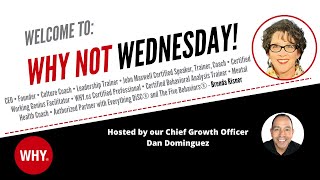
Brenda Risner, a Kansas City culture coach and John Maxwell trainer, works with teams in conflict to turn disagreements into productive outcomes. She left her job a year ago to start her own practice, spending eight months building confidence in client prospecting and her marketing choices.
Questions this video answers
February 16, 2023.
February 2022.
October 2–4, 2023.
About eight months.
About one year (as of Feb 2023).
Chapters
These last few years have made us question everything.
Our relationships.
Our jobs.
What constitutes an.
Office.
And who we are.
In a.
World filled with chaos, confusion, and uncertainty. It's time for some clarity. It's time for to start understanding one another.
It's time to start understanding ourselves.
We envision a world where everyone knows their why. But even more, we envision a world where everyone knows their why. O s, their why, their how, and their what. The operating system that drives you, that lets the world know where you stand.
What your unique gift is, and most importantly, who you are.
Yos.
Are you ready?
Hey, good afternoon, everyone, and welcome to why not Wednesday. I love the end of that video, Brenda, because it says, are you ready? And today we have a guest who was ready. You know, we had a great conversation almost a year ago to the day when she joined Y Institute as one of our wise certified coaches. I'm so excited to introduce Brenda and for. For those of you that are veterans of the video broadcasting and. And podcasting, and this is Brenda's first podcast interview. So I'm excited to have you on and introduce you to why Nation Brenda. So let me tell you guys a little bit about Brenda. She's. She's a CEO, a culture coach, a leadership trainer. She's John Maxwell certified. She works with leaders and teams to build and maintain healthy work cultures where employees are happier, work together better, and produce better results. I mean, who doesn't want that in their workplace? So we're so excited to have Brenda as part of Y Institute and as one of our coaches, and I'm excited to introduce her to you guys. Brenda, welcome.
Thanks so much, Dan. I appreciate you having me on.
It is so good to have you. And I didn't even get to ask in the pre show, but are you a big Kansas City Chiefs fan? Because you're coming to us from title town.
I am a Kansas City Chiefs fan. Not as big as some of my family, but I am a big fan. Yes, the game was fantastic.
We didn't watch it because I no longer watch sports just because they take up so much time, but I do like watching the highlights. And we finished watching our family movie on Sunday, and then we turned on the game for the last, like, six minutes, which was the best part, right? The final drive, which the best part for you and I, that you know, me, who didn't care who won and you who. Who cared who won in your team, won. But those Philly fans had to be heartbroken, right?
Yeah, I'm sure.
I don't know if Bruce Kirk is going to be on today, but he's from Philadelphia and he was on another call that I was on recently, and he was definitely licking his wound. So, Brenda, let's talk about, you know, what we start the show with all the time is what's your yos and. And let's. Let's share it with everyone. So Brenda's why is contribute. She believes in making making a difference in the lives of others, being a part of causes that are bigger than herself. Her how is make sense? How she contributes is by making sense of things that are complex and challenging. She's really good at taking in lots of data and coming up with solutions, which makes her a great coach. And her what is trust? Which means that what she brings are solutions you can trust that you can depend on. So, Brenda, first of all, how does. How did that tell us how that felt to you when you first learned it?
When I first got my results, the contribute and trust were like, absolutely no question, 100% agree. The make sense took me a little longer. I had to think about it because I don't think of myself as a logical person or, you know, I always make sense. But since kind of ruminating on it, reading through the information, then I recognize that, yeah, that does fit me. Oh, yeah, I do that. Oh yeah, I do have that challenge. Oh yeah. You know, and it makes really good sense. And then now I am very aware that I say, does that make sense to people all the time. And I didn't notice that that about myself before. So, yeah, it's perfectly spot on.
You know, you're bringing up something that's really cool about what Jerry, what Gary did in creating the why discovery, one of the things he loves to do is he said, I use the language that people use. When he was doing his research and developing the discovery, he used the language that people used and makes sense was something that makes sense. People ask all the time, does that make sense? Because you were such great processors of information and you're moving so much faster than everyone else, you're kind of almost always having to make sure people are keeping up and asking the question, does that make sense? Is a great way to keep up with people. So you've got, you know, one of the things I remember that from that initial conversation you and I had, Brenda was around your certifications. You, you're a, you're a John Maxwell certified speaker trainer coach, working genius facilitator, obviously yos certified behavioral analysis. Certified behavioral analysis trainer, a mental health coach, and you're an Authorized partner with everything, DISC and the five behaviors. So when I look at that, it's like, whoa, you've got pretty much anything that we want to know about ourselves. Brenda's got a certification in it. You have a lot of certifications. Which is your favorite, which is your favorite assessment or tool that you use?
I don't know that I really have a favorite. I'm all about self awareness, and from a personal perspective, I've taken all of them and I learned something new with each one. So I use them for different purposes. You know, the why is all about recognizing what your driver is. And I use DISC for communication style and working genius, for how you do things, how you get work done, for productivity style. And so I think it really depends on the needs of the team. And that's one of the things I try to do in my business is, is customize the solutions to what the team is looking for or what they need. So I use all of them for different reasons.
So you, you, you know, and I love your, your mission, right? Your mission is let's, let's look at that mission to help leaders and teams relate better and achieve better results. So you're, you come in. Who's your, your favorite client to work with? What's, what's like the ideal problem that they present, and how do you work with them?
I love it when there is conflict on a team, and as a result, the team's not functioning well.
Right.
So I can go in and help them work on how they communicate with one another, how they resolve conflict, or how they can sometimes turn negative conflict into productive conflict. Patrick Lencioni's work and, and move forward better together as a team. Because a lot of times it's just in, in how they're connecting or not connecting with one another that's causing that friction and it affects their work. So once we can resolve those relationship issues, the rest of it falls into place.
Excellent. And, and I love that your, your how of makes sense, by the way. Let me, let me say Jerry Fletcher says, hey, Brenda, good to see you.
So you remember, hi, Jerry.
Meeting at ycon. So welcome and thank you for being on Jerry. You know, one of the things that I noticed in your answer is, and, and this is a superpower, right? You have the superpower that you like to solve problems. So you actually said, I love it when there's conflict. And so there's conflict, there's. There's a problem for you to solve. And that is so. Makes sense. A lot of people don't realize that. That's. That's actually a superpower. You actually look forward to that because now you can come in and. And bring a solution, which is how you contribute to the success of that team. What's the biggest challenge you've ever had? What's the one that really made you work?
Biggest challenge, probably when the conflict is at different levels of authority, and so the person who is at a lesser level of authority doesn't feel like they can approach the person who has the authority to resolve it. So. And if the leader. If the person in authority is not on board with making some changes and.
Not willing to talk through some things, then it's very difficult to make things happen.
Wow, that's. That sounds hard. How do you deal with that? How have you dealt with it?
You know, sometimes it's. Sometimes it's a matter of just saying that, you know, I can help you. I can help your organization, but if you're not willing to do anything different.
Yeah.
You're not going to get different results. So you tell me, do you want to keep working together? Are you willing to make some changes, or are we done? And that's hard because, you know, I don't want to lose the business, but if it's not working, then I'm not contributing. Right.
Right.
So I need for them to. To be on board with making some changes if my working with them is going to be helpful.
So you're going to come in. Yeah. And we know that. Right. You want to contribute to their success, and you're going to help them make sense of what's going on. But if they're not ready to make changes, then that becomes frustrating for you as the coach.
Yeah.
Hey, look at this. We got Lynn. Lynn Everard, who says, hi, Dan and Brenda, but the captain is on, and he's our Philly guy. Welcome, Brenda. Thanks for stepping out of your comfort zone to share your gold with us. And we're going to ask you some great questions, Brenda, because this is really cool. We rarely have the opportunity to talk to one of our newer coaches on the show. So I asked you about the certifications and how you kind of. As a matter of fact, when you added the yos, you were like, okay, I'm done with this stuff. But then you added yos. What appealed to you about the yos that said, hey, you know what? I think that's something else I want to add.
Yeah. So I had decided to add no additional certifications because as a certification junkie, I would just continue to get certified in things and Then not use them. So I had made a decision to sort of cut that off and then you reached out to me and I took the yos and I discovered my yos and.
Decided that the value of having that information for my coaching clients, it would be ludicrous to pass that up. So it just adds a lot of value when I'm focused on self discovery for my clients.
That is excellent. Hey, I want to recognize Kurt Von Ahn and he says, good afternoon, Brenda. And he's a great friend of the Y Institute. So Kurt, thanks for being on. So, you know, one of the things I loved about, I like doing before we talk is going through your history and you post some really good stuff. I love one of the ones you posted recently. It was a Sugar Brain Leonard quote. It says if you never no failure, you will never know success. What does that mean for you, Brenda?
I feel like if, if you are just always successful and everything always comes easily to you, then you don't recognize what an amazing thing that success is. It doesn't feel like success, it just feels like normal. And so if you struggle and then you work towards the success and then you get that endorphin hit for. From achievement, you might not get that otherwise if everything came. Came really easily to you. So I think we should appreciate failure fail forward. Use it to propel us instead of to hold us back.
And I love that because. Yeah, you're so right. You know, we talked. I was listening to someone talk about the generations, the millennials, right? Our kids that we raised and we gave them participation ribbons and we. And they never knew failure. Right? And then they get into the real world. And in the real world, you either produce or you get fired, Right. Or you don't have that client, that client leaves. Right, Whatever. Whether you're an entrepreneur or an employee, it's a different situation that we've created for them. How much are you dealing with that with the clients you work with? What's your. The age of the clients you're working with, the teams? Because I'm sure there are five generations in the workforce right now. So how do you deal with all of those age groups?
Yeah, that's phenomenal.
I haven't had a lot of organizations that had that huge span under one roof, so to speak. But when I do have multiple generations in one organization or team that I'm working with, then we do talk a little bit about some of those organizational differences.
And yeah, the young, the youngest employees did, they grew up without that sense of achievement, without that internal Drive to accomplish because they never had to do that. And so in some cases, people view those younger employees as having less.
Motivation, less interest, being. Being sort of entitled. But. But in some ways, they have just a different perspective on work. They're really looking for purpose because they're seeking that. They need that. It's less about I need to make a paycheck and more about, am I making a difference? Which, you know, feels good to me as a contribute person.
Yeah, so. So no. That is such a great point. And we have to embrace that. Those. That generation is brilliant. They know so much. They grew up with technology all around them. They could. They are so good. And we have a few on our team that, you know, you give them a problem, they'll find a YouTube video on how to. How to do just about anything. There's pretty much nothing stops them. They. They're really good at condensing time and getting through stuff way faster. So you. And you brought up a great point. We just deal with them a little differently. Hey, Gary's on. He says, hi, Brenda. Thanks for being on why not Wednesday. Great to hear how you're having an impact by helping people solve complex challenges and being their trusted source. Sounds like a guy who knows your yos, Brenda.
Thanks for being on Gary.
So, you know, how do you. And you talked about, you know, you haven't had the five generations, but you have dealt with that. Ira. Oh, gosh, I want to forget Ira's last name, but he's. He's on. He's one of our. Our partners, and he talks about. He's a recovering millennial hater. He actually has learned to love that. That generation because they. They get stuff done, and we just have to understand, hey, we did it right. It was our generation that raised them, and so we've got to learn to work with them and take advantage of their strengths. I think that's what's great about the yos. I think the yos kind of breaks people down and says, hey, these are your. This is your motivations and beliefs. And you add to that the work you do with disc and emotional intelligence and all the things that you do. You probably get to know people at a really deep level so you can work with them regardless of what generation they are.
Yes. That is certainly the intent to build relationships.
So you talk about.
You know, I saw that. I posted today. Are you a coach that's new to coaching? You're fairly new to the space. You've been in it since 2018, 2019, but you're now in your own practice for the first time, now for about a year, doing your own thing. So you took that leap from being an employee to being entrepreneur. What's been the biggest difference for you?
The biggest difference, the biggest challenge would be seeking clients. So when you're an employee, even doing the same work, you know, I did leadership training before, but the client was there all the time. So I got to provide services all the time, which I love. And when I become, when I became an entrepreneur, then I was ready to go out and provide those services, but I had no people to provide them to. So I had to kind of learn that part. I had to learn the business strategy part and the, and the prospecting and find how do I find my leads. And all of that was new to me. So that was probably the hardest and biggest change.
I'm going to give Nancy Sare a shout out. She's a LinkedIn coach who helps people. She also works with successful or brilliant entrepreneurs who don't like to sell. So what was your biggest challenge? You know, you said the clients aren't there, so you have to prospect, you have to look for them, you have to decide who you're looking for. So what was the biggest challenge for you on that side of it, creating business?
I think it was learning to trust myself because there are so many marketing type people out there that I was just suddenly flooded with advice and people reaching out on LinkedIn telling me how to do it, this is the right way to do it. And so then I was trying to do all of those things and I can't, I can't. I don't have the bandwidth to do all of those things. And they don't all work for me because of who I am. They're not all sort of in alignment with my personality, my style, my belief system. So I had to learn to trust myself and quiet those other voices so that I would know where I was going to be successful.
Yeah, and that is so hard. Right, because everyone has an idea of how to do it and it all sounds great. You know, Gary mentioned one of the best advices here. One of the best pieces of advice he ever got was don't take advice from people who don't think like you do. You know, I think us contributes have to listen to other contributes because what they do will work for us. If you're a contributor and you listen to a better way, that's going to work really well for the better way person, but not so much for the contribute. And so do you. Do you agree with that.
Absolutely.
100 and so you have to kind of find. You built, you build your, your community. Right. And you surround yourself. And I think we have, we learn from those people that are different from us for sure. But you may not be able to implement it the way that they would implement it. So what's the most rewarding part of being an entrepreneur and a coach?
It's hard to separate that from the, from the actual service provision. My favorite thing about my job is when somebody comes back to me after I've worked with them or with their company and told me how it has changed things, giving me those sort of after the fact success stories, that that's the best thing in the world for me as far as doing that for myself. Because I could have that before.
Right.
As far as doing it for myself, probably.
The, the ability to work with who I want to work with and the people I've met, I've met some really great people.
That's, you know, that's, that is so cool. And you're, you're. This is your, this is your business now. And Lynn, thank you. Our beliefs are so important. It's a factor that we often overlook. So true. Right. You know, that's, that's the other thing I think I like about yos is it kind of is our beliefs. Right. If I was to say, look, Brenda believes in contributing, that success begins when she contributes to the success of others. She believes that the best way to do that is to help people make sense of the complex and challenging. And she also believes that trust is important. Those are three really important beliefs for you and they're your top three in your why operating system. So very important. And you've been doing this now. Let's. How much, how long would you say it took you to really feel comfortable in your skin? And like you said, stop listening to the other voices, listen to yourself and go out there and get Brenda Reisner type clients.
Yeah, probably about eight months. Yeah, it was, you know, it was kind of back and forth. It was two steps forward, one step back kind of a thing for a while. And it was probably eight months before I said, okay, I'm done. I know where I want to be. I know who I am. This is what I'm going to do and how I'm going to move forward.
That's awesome. So, you know, here's the other cool part. Brenda, you signed on in February of 2022 and then we had our Y conference in October and you came down from Kansas City. Did you drive or fly I'm trying to remember.
I drove.
You drove down from Kansas and you came to New Mexico from YCON23. What was your favorite part of coming to Y Con?
It was fantastic. I loved all of it. I don't know if I can pick a favorite. The teaching was great. I learned so much. The people are great. I felt like it was a fantastic community building opportunity to. To integrate with those other Y coaches and feel like I was a part of that. The, the whole experience, kind of witnessing the perspective of the Y Institute and, and learning about the background and all of that, you know, just helped with that trust piece right now. It built that trust between me and the Y Institute where I feel very confident that what the institute is putting out is aligned with what I believe. So it was great.
Excellent. Thank you so much. And. And we're so glad you were there. They were. You know, it was fun to have our first live Y Con because the year before we had to do it virtual because of COVID It was so nice to have everybody there. By the way, if you're. If you're a Y coach and you're listening, put this on your calendar. October 2nd, 3rd and 4th of 2023. We're going to be back together in Albuquerque, and our goal is to have all of you there. So start blocking your calendars and join us. Now. Let me ask you this. What was. This is the key question of the show. What was your biggest why not moment? Brenda, what's the thing you did that you said why not to? And you're so glad you did.
Yeah. My biggest why not was actually taking that leap to starting my own business. I had been doing some leadership training before, and I had toyed with the idea. I would like to do that, and it was a someday thing. Maybe I'll do that when I retire. Maybe I'll do that someday as a part time hobby thing. And then we moved and it was, you know, I can look for another job or why not? Let's just start a business.
Yeah.
So that's what I did.
And you're in Kansas City. Did you have a lot of connections already? How did, how did, how. How did you start?
I had no connections virtually. I have a sister who lives on the other side of the metro. But as far as business connections, I started networking. I didn't know Kansas City. I didn't know what my interpretation of businesses in Kansas City. All right, there's the Chiefs, the Royals, and Hallmark. So that was pretty much where my knowledge landed when I started. So I started Doing research and attending every networking group I could find for a while. Again, I had to decide where I wanted to land as I figured myself out a little bit. But that's how I. How I started. And social media, getting used to LinkedIn, which I hadn't done before, so.
And you're doing a great job on that, by the way. Love seeing your posts every week. And I try to follow a lot of our coaches, and you've always got some very good and insightful stuff. So how have you incorporated the yos? Because you said, you know, this was the last tool you added. How did you incorporate it? What was that process like? Because you were still figuring things out. I remember. But you figured some things out. How does it. How is it fitting into your coaching now?
Yeah, so it's such a great tool to use at the beginning when you first start working with a coaching client. So I use it a lot as the initial thing. Right. Let's get started. Let's get started by getting to know a little bit more about you and how we're going to work together. And so we. We look at the yos and we look at the client's yos relative to my yos and talk through how that's gonna. Gonna color our relationship. And. And then we go from there for other tools if I decide to use them. And then I am just now starting to incorporate it into. Into teamwork as well, to do the team yos and do a workshop and that kind of thing. So.
Excellent. So you're taking advantage of some of the stuff you learned from the conference. Right? Because we talked a lot about the team yos helping teams understand each other, understand the drive, the why, how, and what of the leader, the why, how, and what of the team members. And then I think understanding why they do what they do and how they go about it and what they bring, but really working and talking to them in their language is which we think is so important.
Yep, I agree completely. It makes a huge difference in how the team members relate to one another.
So, Brenda, how did tell us, you know, you learned about Y Institute. You kind of told the story and what. What was it that made you decide, you know what? That's something I want to do and I want to add because you were. You were like. Like I said, you were. You had limited. You had already told yourself no, but then you decided to add one more thing. What was the one thing that made it. Made you say, you know what? I think I'm gonna add that.
Yeah. I just think the the insight that it provides is invaluable. So I felt like it was something that I couldn't pass up. And to be fair for myself, I wanted to get in on the ground floor. So I said, man, this is something I'm definitely going to do. Do I wait? Because I had decided I wasn't going to add anything or not. I said, no, I'm not going to wait. This is valuable as is. It's only going to get better. I'm going to start now. And so I jumped in, never looked back.
That is awesome. Well, it's so good to hear. You know, often we don't do that, right? In business development and sales. We don't get the opportunity to go back and talk to the clients that we brought in. So this is such a great opportunity for me to talk to you and kind of hear what your journey's been like. I hope it's been helpful for those of you that are listening out there. If you're an employee and you've got a gift and you've been using it like Brenda, she was already doing learning and coaching and she was helping people. And like she said, you know, the clients were coming to her. But when she went out on her own, all of a sudden it was a different world and she had to go out and find the right clients. But it sounds like your practice is thriving, doing well. You've got a lot of great stories that you've shared with us. And by the way, Branda, Kurt says nice site. He's already looked at your website. Is all your. Oh, great question, fellow jmt. Do you have courses on your site or is all your training in real time?
Hi, Kurt. Yes, at the moment, all of my training is in real time. I am working on putting at least one course up this year, but it's not there yet. But thanks for the question.
Excellent. Thank you, Kurt, for contributing. So again, as I was finishing up, I wanted to make sure and get Kurt's question in there because that's a great question. But it is so good to have you back to listen to your stories. We're looking forward to having you. October 2nd, 3rd and 4th, coaches, put it on your calendars. If you're a pending coach or a new coach, put it on your calendar. October 2nd, 3rd and 4th. We're probably going to be in Albuquerque and Brenda's going to be there. So let's have a great y con 2023. Any last words for our audience?
Brenda, thanks for being here. I appreciate it. And if you haven't done so yet Give why a try?
I think that's a great way to finish. Thank you so much, Brenda. We'll see you guys next week. We've got Jerry Fletcher, who's also a wise certified coach and a marketing expert next week. So join us next Wednesday, Brenda. Have a great rest of your week. And until next week, don't forget to say. Why not?
Thanks, Dan.
More from Dr.




Women In Leadership: A Need For A Greater Systemic Change With Belinda Clemmensen






