WHY Not Wednesday with Brian Brogen
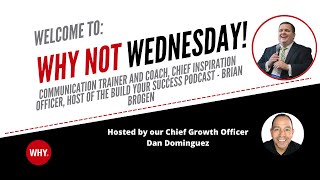
A YouTube interview (WHY Not Wednesday) between host Dan Dominguez and guest Brian Brogen. Brian describes his transition from a 28-year corporate career to working as a communications trainer/coach and self-styled “Chief Inspiration Officer,” hosts the Build Your Success podcast, and founded the Voices for Leadership book project (Volume 1 published; Volume 2 recruiting contributors). Conversation covers the origin of Voices for Leadership, the Volume 2 format (40 authors across four pillars: leadership, communication, mentorship, purpose), featured authors (Stephanie Stuckey, Mel Lau, Gigi Sabat, Dan Dominguez among others), leadership themes (vulnerability, listening, modeling), signature workshops (Listen Up; John Maxwell leadership game), solopreneur transition challenges, and contact paths (LinkedIn: Brian Brogen; websites: buildcs.net, voices4leadership.com).
Chapters
There's a certain kind of coach who believes what we believe.
Who leads people to greatness, who gets people unstuck, who unlocks all of your passion. A coach who helps people discover what drives them to tap into their superpowers. Then knowing your why is the first step.
To untap potential.
To focus.
To breakthroughs.
A coach who's looking for a better way.
Are you that coach?
Hello, everybody, and welcome to why not Wednesday. I am so excited to be with you today because we have a really special guest today. Brian Brogan is a communications trainer and coach. He's a chief inspiration officer. We got to figure out where that title came from. He's the host of the build you'd success podcast, and he's also the founding author of Voices for Leadership, a tremendous book, and it's going on to its second edition. So we're going to hear more about that today. So let's bring on Brian right now. Let's see here. Brian, where are you? There you are. Let's bring you on board. Welcome to why not Wednesday. Brian.
Hey, Dan. It is a privilege to be here. So excited to be introduced to your team.
I can't wait for everybody to learn about you. You know, there's a lot of people that are going to be listening, Brian, that may want to be part of Voices for Leadership, too. So let's make sure we talk about that today. So, like, I like to start every show, Brian. I like to go over the. The. The guest Y operating system. So you and I met about five months ago. Can you believe it's been five months already?
Unbelievable. Time flies.
Time does fly. And you've had a lot of changes in your life since we met, so we want to definitely talk about those. But, you know, let's let the folks that are on the phone that are familiar with Y and Yoshi be familiar with who Brian is. So Brian's why is to contribute to the success of others, make a difference, make a positive impact. His how is to find a better way and share it with others. And his what is to build relationships based on trust. So what that tells me, Brian, is that you're somebody who cares about other people. You like helping other people. You like to be causes, part of causes that are bigger than yourself. Does that sound like you?
You know, Dan, it does. And in fact, sometimes that gets me in trouble finding a better way. Sometimes I need to be cautious with that because not everybody wants a better way.
Right.
And then I do volunteer for too many things. It seems I'm having to Learn to have a filter of focus on what is important and what I need to stay focused on.
Absolutely. So the contribute part, I mean, I definitely saw that in you, in a lot of what you do. It shows that contribute heart, that, that heart for helping others. Your how as you said, is to, to find, is to find a better way. So how you contribute is by finding better ways to do things and then sharing them with the world. And that's really what Voices for Leadership is. Right. It's, it's. You found a better way to get, let's get the voices of leaders out to the world and, and let's share them with everyone. So that's what you're doing there. You're getting people together and you're sharing. So I'm going to ask you more about Voices for Leadership later. And then the third part of you is trust, to build relationships based on trust. So what that tells me is that trust is very important to you. For you, if I can trust you and you can trust me, sky's the limit. But you know what? Brian is somebody you can count on. If Brian says he's going to do something and so you have that standard for the people you work with. Would you agree with that?
I do. And I hope everyone wants people to be trustworthy. I mean, that's just a great treat trait, if you will.
Right, right.
I, you know, just got to be cautious. You don't overuse your strengths. We know that.
Right. Well, Bella said, you know, hey, the honorable Y sandwich when somebody has the trust and contribute, you know, on, on the bookend. So you got contribute on one end and trust on the other. Hey, this is a guy that just wants to help people and wants people, wants to be trusted. So he's somebody you can count on who doesn't want that. And then you put better way in the middle. So you're somebody who's looking for better ways. You're innovating and helping others by innovating. Love that. Lynn Everard, I want to say hello to you. I know you said hello a little while ago. Thank you for joining. And then we got, hey, the founder is here. Brian and Dan. Brian, you have a big act to follow from last week. So there's a comment about Sophia from last week that's. I think you'll be just fine, Brian. And then we got Kimberly who said hi, Dan and Brian, great to see you both. Kimberly might be someone we want to, we want to talk to about Voices for Leadership, Volume two. Brian. So tell me about that because that is really your big project right now. Voices for Leadership, Volume 2. Tell us about Volume 1 first. Where did that come from?
Yeah, so I host a podcast, and I had no idea how long my podcast was going to last. In fact, I said, I'm going to do this 52 weeks, whether someone listens to it or not. And here we are three years later, met a lot of amazing people. And through that, one of my guests, I always ask my guest, hey, you know that better way, right? What can I do to improve the podcast? And we had Larry Levine on. He's the author of Selling from the Heart. Wonderful guy. If you're not following him, please do that. But Larry said, brian, I have one suggestion for you. He said, I think you should create a signature question for your leadership podcast. He and I went back and forth, and finally we settled on, what does leadership and being a leader mean to you? So now that I've asked that almost a hundred times now, right, I've realized there is no law on leadership. Leadership's more like DNA. It's more like the why we all are very different, and we have different answers for that. And all of them really work towards a very diverse group of people that have really good answers for leadership. And after doing that so many times, I said, well, this is a book, right? And I thought about. I thought about taking the text and the script from the podcast and saying, hey, I'm going to write this book myself. And then I'm like, no, I would prefer I hear it in their voice.
Right?
And hence, Voices for Leadership was born. I started off with Voices of Leadership, but I found that Harvard, when you do a search on that, that combination of words, Harvard has that sewed up, all right? But I was able to buy the Voices for Leadership domain. So that's where we're at now. Voices4leadership.com and I feel it's better anyway, because being for something, you could be passionate about it.
I love that so much. And you know what? You found a better way, right? So Voices of Leadership was gone, but there's a better way to do that. Let's talk about Voices for Leadership. And of course, we know Larry Levine. If you've been following me on LinkedIn, I'm actually reading Leadership Selling from the Heart right now and reviewing it for everybody on LinkedIn that's following me. And I just talked about one of the things Larry mentions in the book, and that is always be learning. So that was my post yesterday, and I put a picture of myself. I was on vacation for two days the last two days and I posted myself reading and out in the mountains and, and having a great time. So it's awesome that you, you and I both know Larry Levine. I think contributors, we all kind of run in the same circles, don't we, Brian?
We do. And in fact, because of Larry's, the seed he planted. He was our four. He wrote the forward for volume one and he wrote a chapter for volume one. So pleased to have him along for that ride.
Well, you know, and, you know, we talked about that because when you and I met, it was through Melanie Ache, who was on volume one, and also Eileen McDarg, who was a featured author on volume one. And they introduced me to you and, you know, that conversation sprouted. I love that. When I, when I posted your why, how, and what in a post, you were like, oh, my gosh, thank you so much. That's me. Right? So that resonated with you. And then we got to talking a little bit more, and now we're starting Voices for Leadership, Volume 2. Tell me about that.
Well, so what we have learned along this journey of volume one is we help authors, coaches, and speakers grow their audience and improve opportunities for growth and collaboration. Isn't that something we need in today's world to grow more and to collaborate more, to get together and work together? And so that's what we've done. We've put together. The model now is 40 authors. We have four pillars in our, in our book. That's going to be leadership, communication, mentorship, and I gotta remember my fourth one. Communication, mentorship, and the vision, not purpose. Purpose is the purpose.
That is the fourth one. That's correct.
So, so those four items, we, we've dedicated the authors, the featured authors are using that as their, their pillar part of the book. So it's, it's broken up into sections, not chapters.
Right.
And so we, we decided on the second round. We're going to actually assign that. The first time, the first time around, we learned a lot of lessons, but we just had them write their chapter. And then I determined which. Which pillar belonged in this time. We learned some lessons. And so, you know, your chapter is, is going to be on the. It's not mentor. It is mentorship.
It is mentorship.
Yeah. So you're gonna, you're gonna work on that, be that pillar. And then we have these other authors joining us. I think you said you're going to mention that later, so I'll leave that, Leave that alone now.
But. Well, definitely. Yeah. Let's talk. Let's talk about them as soon as we're done with this question. But let's. Let's continue. Tell me more about volume two.
And so that's what we're doing now. So we're putting together. We're right now taking applications. This isn't a place where you can show up and drop your credit card and give us some work that you wrote overnight. We actually want to understand that what you're going to provide to us is going to be something that meets the requirements of our audience and the purpose of the book. So that's what we want to make sure of. And that's what we're doing now. We're accepting applications. People can go to our website, fill out an application, and then be considered to be in the book.
There are so many authors amongst the coaches at Y Institute. So if you're one of our coaches and you're an author or you have a message, how big of a commitment is it to write one of the chapters?
That is one thing that Brian made, what I call Brian proof.
Yeah.
It's only 750 to a thousand words. So it's a small contribution of time and it's a small commitment to mice. This is crowdfunded. So each of our authors that are selected will help us, you know, pay for the publishing of the advertising and all those things so that we can promote this book.
All right, so Bill Summer says he can contribute his seven Cs of leadership, communication, collaboration, coaching, change, conflict, creativity, and courage. And Bill is one of our coaches. And I saw that Melanie Ache just popped in a little while ago. She said another volume of Voices for Leadership. Two great men. Thank you so much, Melanie. You're so complimentary. Always. And Gary, Gary says, hey, love that Voices for Leadership. And Bell is. Hey, you got another reader. You got another reader here, Brian. So, you know, so I'm very honored that you asked me to be a featured author. On the second volume. I'm going to talk about mentorship. I'm going to write a lot about what brought me to where I am today so that others can learn from it. But we've got. You got an amazing three other authors. So tell us about Stephanie Stuckey. Is. Is. What is her. Her. Her chapter or her section?
So Stephanie Stuckey, what she's doing, she's rebuilding the Stuckey's brand. If you've traveled along our eastern seaboard up 75, 95, you've probably seen an Old Fashioned Stuckey's grocery store.
Oh, I love those. Yes.
Yeah, they have the Con Law for their pecan log rolls.
Yes.
But the brand kind of lost its venture and her. Her family sold it a couple times and it got into a. Just an investment firm that really wasn't interested in maintaining the brand.
Right.
Stephanie was able to buy it back. So now she owns the family name brand and she's trying to rebuild that back to what it should be. And Stephanie does an amazing job of grassroots communications. So she's going to write in the communication chapter and talk about how you do grassroots and rebuild a formerly iconic brand back to its heydays.
And I hope. I know. Well, listen, I'm not even going to hope. I know she's going to be successful. We've had that one brief collaboration call already. And I just enjoyed meeting the other fellow featured authors. Who. Who else do we have? Brian, I'll let you introduce the other two authors.
So we have coach Mel Lau. He's based in Australia, but He has over 100 coaches in Asia that he participates with. He's very big in icf, International Coaching Federation.
Right.
And he is just phenomenal. I've had him on my podcast. In fact, everybody except for Gigi, who's the last one we'll talk about, has been on the podcast as guests. And that's kind of where we kind of build the momentum to understand what they can deliver. And so that's where we did. And we really wanted to make it diverse. We understand that people mirror what they see, people repeat and they. And they act upon what see. So we wanted to make sure our featured authors are diverse and our contributing authors come from a diverse background and diverse experiences.
And so you're doing that intentionally, so that's awesome. So it's myself, Melissa, Stephanie, and we got one more author to talk about Gigi.
Yeah. So Gigi and I've just like we gave it to you earlier. I've lost the last name now. It's.
Yeah, the Sabat. That's right. So. So Gigi's new. I just met was introduced to Gigi. She got recommended as an author and we're excited about what she's going to bring to the table. She happens to be a fellow John Maxwell coach, trainer, speaker, which I am involved in. So is Mel.
Now you're going to get some cheers from the audience for that, Brian.
Absolutely. Absolutely. And. And we have probably in the book, I think there's about seven of us in volume one, so I fully expect to pick up a few more John Maxwell coaches that can write about something in the Voices for Leadership Volume two.
And what is, what is her area of concentration that you're going to put Gigi in?
That's going to be leadership.
Leadership, excellent. So it's leadership. We've got mentorship. We've got. What was the, the third and fourth. I forget them.
Purpose and communication.
Purpose and communication. That's right. And I think Stephanie's going to do communication, right?
Yes, sir. So by process of elimination, that leaves coach Mel with the purpose.
That's awesome. So, you know, we introduced you earlier as a communication trainer and coach with an emphasis on team building, but you're the Chief Inspiration Officer and I love these new titles. You know, I'm a Chief Growth Officer and that's pretty cool, but it's not as cool as a Chief Inspiration Officer. How, where does the title come from? What does it mean?
Well, you know, I had a career, a 28 year, very rewarding career in a construction company led into me becoming the Vice President there.
Yeah.
So I had to sit down and redo my LinkedIn profile with a new title and I didn't know what to call myself, so I called myself a Chief Inspiration Officer. And, and I had several comments about. They love that title. So then I googled it after putting it on LinkedIn and there are other people that have that. Chief Inspiration Officer. But that's what I want to do. I want to inspire others to be the best version of themselves and companies to grow and become the best version of the company they can be.
So Brian, you, you just mentioned something that, and we want to definitely dig into that because you recently made a big life change, right? 28 years at one company, you rose to the level of vp and then recently you made the choice to go out on your own, be the Chief Inspiration Officer, be the featured, the, the founding author of Voices for Leadership and to help companies and individuals be the best version of themselves. What was that decision process like for you?
You want to see my fingernails?
So, you know, there is a lot of security in a 28 year career.
Yes.
Let me tell you what else is going. You know, this is why not Wednesday? So let me just tell you the why not side of this, right? We have, me and my wife have four children married for 25 years. We just celebrated our silver anniversary. We had no idea when I made these plans that three of our four children would decide to be married in 2022.
Wow. So three weddings this year. Now, are they all girls?
No, sir. My youngest daughter, she decided to go first. She got married in March.
Okay.
And then my. We have twin boys so one of the boys got married in May, and our oldest daughter, she's 24. She'll be getting married in October. So here we are. Brian's going to change his career, and we got these things going on at the same time. So, hey, it's. Why not Wednesday? Why. Why not 2022?
Why not the year that everybody gets married? So one of the twins is not getting married.
Correct. So hopefully he's, you know, doesn't pull it off in the last thing at 2022, 2023. So, well, we'll see how that goes.
There's five months and a week left. Brian, he can still pull it off. I don't know if there's any pressure from the other siblings. That would be fantastic. Everybody would always have, you know, the same year of their anniversary.
Stop it, Dad. I hope they're not listening to this.
You know what? We'll make sure that Lynette sends them all a link. We're gonna find them and get them. Get him a copy of the. Of the. Of the podcast. So, hey, let me ask you this. The build you'd success podcast, you said it started, you decided you were going to just do 52 episodes, whether anyone listened or not. And that's led to the book. It led to you meeting Larry. It's led to you meeting a lot of amazing leaders. And they're interviewing them with that signature question about leadership. What have you Learned from those 52, or more than 52 over 100 times you've asked that question? What's the most important thing or the most insightful thing you've learned from asking that question?
Wow. That. That. Answering that question is a hard question. I know how some of my guests get put on the spot. You know, one thing that comes out is vulnerability. It seems to be something that. That people struggle with as leaders to show themselves vulnerable, but it also is. So your team members love it. In fact, I was doing a training yesterday, and at the end of the session, so many of the team members love to hear the vulnerability from their leader. They didn't know they experienced some of the same concerns. Hey, guess what? Your leader is a human being, right? So we all experience these problems and trials. And you know what? The people that you're leading, they have things they're struggling with, too. And if we can recognize that, be vulnerable for others, I think that's one of the key components for leadership. And then. And then modeling, setting an example for others. So if you're. Say you're going to show up, show up, you Know if you're, if you're going to do these things, if you're going to have an open door policy, I like to call it an open ear policy. If your door's open and you're still working on your computer when your employee comes in.
Right.
You're not, you're not very being open door. So you know, take, take time. Someone comes to see you, give them your ear, be that person they can depend upon to listen, to be listened to.
So your man after my own heart. Brian, My word for the year is to listen and listening. You know Melanie, as a matter of fact, who she just commented on Stephanie. She said she's awesome. I don't know if she was commenting on Stephanie or on Gigi, one of the two, but thank you Melanie for commenting. But Melanie sent me something last week in a text that said, did you know that listen and silent use the exact same letters? So it's very important. Like you said, it's important to be silent in order to listen. And I love the point you made. You know, it's not an open door policy, it's an open ear policy because you can't listen if you're on your computer, if you're looking at your text or so I think being present is so important. So I love that you, you teach that and that you, you, you model that too. And I love that you brought up, you know, if do what you say you're going to do as a guy with trust in his yos, of course you're going to say that. So I love a lot about what you're talking about. So tell me a little bit about your why not moment. What is your, your biggest why not moment that you would, that you want to share with our audience?
Well, you know, I guess it would be this, this transitioning from, from a full time job with benefits and all those things to just now I'm responsible for my why and, and it's, it's all the shoulders on me. And in fact, you know, I had a lot of employees I was responsible for in my previous career and one of the things I was looking forward to was having less employees. But Dan, you and I just had a conversation. Now I'm doing everything myself on my own admin, I'm own invoice. I'm all those things that I used to delegate. Now I get to do that myself. So learning to transition and be the catch, all to do everything needs to be done to keep a solopreneur going is a new learning curve for me. But it's still the why not? Because the drive and the motivator is I'm getting the opportunity to go out and train and coach people to have better communication skills, better leadership skills. One of my signature workshops is titled Listen up. And I love to get a group of 20 people together at roundtables and we start talking about ways to improve listening skills.
Right.
And we use some, some really cool team building exercises that help them see and understand how important listening is. And then what happens when you don't listen, what the outcomes are.
That's awesome. Hey. Well, you posted about this yesterday. You did a workshop yesterday. Tell, tell me about that. What was there was a game you played with them is the leadership game, right?
That's correct. That's a John Maxwell product that several of us coaches. You know, there are over 40,000. Last time I paid attention, it was 40,000 coaches across the world that are John Maxwell certified. So I'm just one of those people. But we do have this, what I call leadership training in disguise. It's, it looks like a game and it plays like a game, but it starts opening up communication and dialogue and transparency that you can't imagine. Typically we get a lot of laughter in the room. Sometimes there's tears in the room when people start realizing the appreciation of others and realizing, hey, I'm in this with these other people that have same problems and situations. So that's a lot of fun. If you have a John Maxwell coach, trainer, speaker in your area, definitely ask them to use that tool with your team.
Awesome. Well, we, we have a few John Maxwell coaches on the Y Institute coaching team. Melanie is one of them. James Madison, Laura White, Mark Caldwell. I could probably go on for a little while giving you all those names. Pardon me, I didn't hit my cough button before I did that. Sorry about that, Brian. But one of the things that I love to do, especially as we listen to your why not moment.
Who is it that you want to work with, Brian? Who is your ideal client?
So it's going to be a corporation typically that has 30 plus employees and that I can help them get this communication piece down, refine it, work on it. It's not always been my strong state to teach us to learn and I love learning new techniques about listening and communication. What we typically are going to do is start off the leadership game is a great lead into to find out what's going on in someone's organization and then we're going to go into more about how each team member can help each other and support Each other recognize we're not all the same, and let's work on each other's strengths. Let's lead with the strengths, and let's help each other understand that, but also to recognize where our blind spots are and where we need support, where others can help us and accept that help. Hey, leave ego out the door and understand I need help. It's just me. I'm just like everyone else.
I love that. Hey, listen, you, you, you. You caught Stephen Brooks attention says, I always tell people to listen, to understand, not to respond. Too many people only listen to half of what you say because they're focused on their response. You know, David Fish was on a few weeks ago. He's one of our Australian coaches, and he said, look, people listen. There's three, three ways to listen. There's listen, listen to win, which you're trying to just listen for weaknesses in the other person's argument. You're just trying to win. There's listen to learn, which is you want to learn from the person you're talking to, and there's listen to help. And I think if you're a coach, I think that's where we want to spend most of our time as a contributor. I know, Brian, you want to help people, so you're listening to see where you can help. But so much of the time, we're listening to respond. So do you have any tips on how to get rid of that tendency that we all have at some point?
Well, first of all, one thing I've had to learn is, again, I want to help people. But guess what? Not every time someone tells me something, they want my help, sometimes they strictly want me to listen. And I am learning to be patient and understand. Hey, you know what? They're just bending my ear. They're just leaning on my shoulder. They don't need me to solve their problem. In fact, I probably don't have the answer to their problem. I just think I do.
Right.
The other thing I've learned is I take notes as people are speaking, especially. And I've learned it with the podcast immensely because nine times out of 10, if I have a question that's bouncing around in my head, if I can get that question down on paper, at least head and distracts me from the conversation.
Right?
But secondly, I realize if I'll just pay attention, they'll answer that question for me without me having to ask the question. If you listen in and pause, you're going to hear the answer.
You did that today. There were so many questions that I was planning on asking. But you, if we, if we give our guests. And you've learned this on the podcast, we give our guests time to expand on their answer. A lot of times that question you had for later on in the show gets answered. So there was one thing that I think we, we got to it you, you mentioned or you're going to ask about that later. But it was who is the, who are the other authors, the other featured authors? So how did you learn about us, Brian? You know, you, you've now you've been on a post. I'm gonna write a chapter for your, for your second book, how did you learn about why Institute?
So my first exposure was Ali McDar. She offered me one of those reports of why your. Your why.
Right.
Amazing. It always astounds me how these, these simple things that you take about 15 minutes to work on can come back with such a diagnosis on you, right. That you realize, oh, wow, that's pretty cool. Somebody's really worked out some crazy algorithms to make that work. But so, yeah, Eileen gave me that when she had a little coaching session with me about that. Eileen McDar, if you're not following her, please do that. She's hilarious, number one. But she's also very engaging and inspiring. She helped me all the way through this whole book process. Listen, I barely graduated high school. Nobody ever thought Brian was going to be an author. English was my worst, my least favorite subject and my worst subject. But thankfully I realized there's people to help me. I've got a message and someone can help me get it out in word, in written word.
I love that you said, you said it's not. It was your worst subject and it was also one you didn't like because there's a lot of people that sometimes we're good at something, but it's not something we like. And just because you're good at it doesn't mean you have to do it right. I'm good at math, but I don't like doing math. For me, it's not. I could never be an accountant. God bless people that are accountants. God bless analysts who love doing crunching numbers. I couldn't figure out how to divide 800 by 50 a little while ago. So I was trying to figure that out a little while ago, and now I said, you know what? I'm just going to put that into the calculator. That's what, that's what it's there for. So, Brian, if somebody wanted to get a hold of you and wanted to work with you, either as as a, as a coach or if they're interested in being part of Voices of Leadership, Volume two. What's the best thing to do?
Well, let's, you know, get on LinkedIn. I'm, I'm very active there. We try to post every day on LinkedIn. So that's Brian B R I A N Brogen. B R O G E N. I think I'm the only one out there with that spelling. But then Also, you know, buildcs.net is our coaching platform where we do coaching and training for corporations and individuals. And then the Voices for leadership is voices4leadership.com so that's pretty easy. Remember, the build consulting is buildcs.net and either one of those, depending on what you're looking for, those will be the right websites to go to, but I.
Think the easiest one is find you on LinkedIn. Right, Brian Brogen.
That's a great way to do that.
You're right there. You can follow your post. So you're posting every day. You're giving us some valuable content. And I really enjoy your post. So, Brian, thank you so much. I love knowing more about you. I loved getting to know you over these last five months and I thank you for being on the show. I love that we gave people a way to connect with you. So what do you say we end on that note?
Why not?
More from Dr.




Women In Leadership: A Need For A Greater Systemic Change With Belinda Clemmensen






