WHY NOT Wednesday! with Bruce 'Captain' Kirk
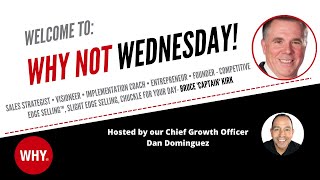
A live YouTube interview (WHY NOT Wednesday) with Bruce "Captain" Kirk, a sales strategist and founder of Competitive Edge Selling. Central themes: Bruce's core WHY is "a better way"; his HOW is "challenge" (constructively) and his WHAT is "clarify" — helping experienced B2B service entrepreneurs prospect, sell, recruit, and lead more effectively. He emphasizes "story listening" (trademarked) as an advanced form of active listening that shortens sales cycles and builds trust — illustrated by a pharmaceutical-sales anecdote where listening reduced the typical 3–6 month cycle to ~2–3 weeks and eliminated competition. Bruce also describes faith-driven mission work leading a team to equip ~1,600 chronic drug addicts toward recovery, a background in forestry entrepreneurship (Woodland Investments) representing private landowners, and practical adoption of Y Institute tools (LinkedIn updated, website pending). Ideal clients: business owners/sales professionals frustrated with the status quo and seeking better ways to grow and improve profitability.
Chapters
There's a certain kind of coach who believes what we believe.
Who leads people to greatness, who gets people unstuck, who unlocks all of your passion. A coach who helps people discover what drives them to tap into their superpowers. Then knowing your why is the first step.
To untap potential.
To focus.
To breakthroughs.
A coach who's looking for a better way.
Are you that coach?
How cool is it that today we, we get to have that coach with us today? So we're back to the coaches and I'm so excited to introduce Bruce Captain Kirk to the why Not Wednesday audience. Why Nation? Welcome. I'm going to tell you a little bit about our guest today. Bruce Kirk equips experienced entrepreneurs who sell their expertise B2B to discover better ways to prospect, sell, recruit, and lead. He's the founder and president of Competitive Edge Selling, located just outside of Philadelphia, Pennsylvania. He is the consummate Better way guy who expresses his curiosity and innovative spirit with passion, purpose and energy in everything he does. Welcome to the show. Bruce Kirk. How are you?
Welcome, welcome. Dan. Great to be here. Thanks for having me. It's a thrill and a privilege.
So.
It'S great to have you here. Danica Treble. You know, I love it when the, when the, the attendees start putting out the comments. Danica Treble, you're gonna love this one. She says get ready to take a trip on Starship Y.
And Lynn, absolutely. Danica, thank you.
Thank you for being on. Danica Lynn Edwards says hi, Dan and Bruce and hey, David Mills wants us to know he's looking forward to it and that wants us to know that Bruce invited him. David, we're so glad you're on. Hey, you know, Bruce, I'm so excited to introduce everyone to you because it's been so fun getting to know you since you joined Y Institute as one of our certified coaches. You are an ultimate better way guy. And you know how you know that somebody's an ultimate better way guy? Because Bruce is always looking for better ways. And one of the, one of the characteristics of better way people is they share when they find a better way to do something, they share. And I can't tell you guys how many emails and notes I've gotten from Bruce of better ways for us to do things at Y Institute. And we really appreciate it because we can't get better without that feedback. So thank you so much, Bruce. So you're a sales strategist, a visioneer, an implementation coach, an entrepreneur, your founder of Competitive Edge Selling, Slight Edge Selling and Chuckle for your day. I've actually enjoyed the chuckles for your day going through your, through your newsfeed, Bruce. What, what is, what, what would you say is your, of all those titles, which is your favorite?
The visioneer would be first. Sales strategist emanates out of that. And I'm always coming up with new ideas and connecting dots and looking for obviously better ways to do things. And then.
You know, the, the key to all that is you can have all these great ideas, but you need to implement them. So it's, and by the way, when I share better ideas with you, Dan, with anyone else, I do it intensely with a lot of intensity, but I also do it as much as I, I can, respectfully. So it's, it's meant to contribute. I know you're a big contributor guy, but it's, it's meant to, for me to contribute to you and to the people that I interact with. So it's no.
And absolutely you, you absolutely do that, Bruce. And that's a great point you bring up because, you know, when we're working with different groups or executive groups, let's say I'm working with a, with a non profit and we're going through the yos in a non profit. What. Why do you think they all want to have.
Better ways? Better way?
No, they all want to be contributing.
Yeah, they are the contributors. They're the ultimate contributors. Right.
But you know, you, if you're going to run an organization, you need all the whys. Right. And so, and so one of the things I love to say is, look, if your why is better way, you are an ultimate contributor because you contribute to the world by finding better ways, finding innovative ways to do things differently. Hey, we got a great crowd today. Liz Wendling is in the house. Hey there, Dan the man. And Bruce, Hugh Hornsby is on. He says you're, you're a better way rock star. And I can't, I can't agree with you more, Hugh. Stanley Green is here. He says great stuff, Dan and Bruce. So Sarah, Sarah's here. She says contribute. Thank you, Sarah, for being here. So let's go over your yos, because there's more to you than just finding a better way, right, Bruce? So finding a better way is your why, your how is to simplify. No, no better way challenge.
That's right. That's right. I'm no better. That's Dan's right. Mine's a better way challenge and clarify.
Yes, your how is to challenge. So man, what. That goes really well with the why a better ways. Right. Because how are you going to find a better way unless you challenge what's currently being done? So you're having.
I can, I can read into your mind when you say, oh man, here's another email from Bruce. What's he going to be challenging me about today? Perfect. It's in a, it's in respect and in just in all behind you and to support you, Dan.
No, absolutely. Hey, listen, one of the things I know and we, we experience Bruce's clarify because that's your what? Right. Clarity. And we, Sunil and I, Sunil's producing our show, we experience that clarity because somewhere in the email that we sent to, to Bruce, we said, hey Bruce, you'll receive the streamyard link for the show before the show. And, and Bruce was looking for that, her Streamyard email to get sent to him and he's emailing me, he's emailing Sunil, I'm getting, I think you emailed me and then you LinkedIn message me and you texted me because we weren't clear that hey, the streamyard link is in the invite. So, so very important. Right. Clarity is so important to you. So your why is to find a better way and how you do that is by challenging the status quo and ultimately what people can count on from your solutions that are clear and easy to understand. How does that feel for you?
Feels so congruent. I mean the congruency that I felt once I got the results and read through all the results of my why discovery was amazing. And it, it's so fun to reflect back through my life and find and just realize all wow. That's why I did that because I was trying to find a better way and because I, you know, you know, there's, I ask a lot of questions because I, I want to, I'm challenged, I want to understand which is the clarity aspect of it. But I also.
You know, have a process that's diagnosed first. So I'm asking questions so that I can get a clear understanding before I present clear strategies to how to implement the better way. So it's, the congruency is really fun, but the, you know, back in college, back in high school, it's all related to fun and better ways and it's just, it's so exciting. They keep coming into my mind and into my consciousness more and more the more I work with this.
So, so there's a better way to do this stuff. So you know what, I'm going to share a video because I've got a Good video clip of you br. So let me put that. Let's see how well I do at this. But I'm going to see if I can get over to. Let's see here. Yeah, no, I've got to figure that out. So we're gonna show a video of Bruce. Oh, I know what I'm gonna do. I'm gonna put it over here.
You found something from when I was a youth or in college.
No, it's not, it's not quite that. It's not quite that bad. But let's, let's check it out, I'm sure. And then we're gonna have you talk about it. Let's see. Share screen. Going to share that screen.
All right.
Can you see that, everybody?
Yeah.
And see, can you hear it?
Timing of telling our story is key. So if we tell our story at the wrong time, it loses all its power. We want to first become great story listeners, and then we'll know how to become great storytellers.
Wow. I just love that quote. And that's from, that's from Bruce's website. And it's. If you're watching on, on, on Facebook or on YouTube or on LinkedIn, we link to Bruce's website. So I love that. You know, that's one of my favorite quotes of yours about being a story listener, which, by the way, you've trademarked. So tell us the difference that being a story listener makes in terms of your sales presentations, your. Your keynote presentations. What's. What's the difference between being a story listener? Storyteller?
Yeah. So from a big picture perspective, storytelling is.
Often one to many. So like today, I mean, I, I'll share a backstory about story listening, but it's one to. One to many. But I observed a lot of sales people, sales professionals even, that are using storytelling in their discovery phase when they're actually should be listening to the prospect and allowing the prospect to tell their story. Because as a salesperson, we want. I want to understand your story.
Right.
You know, I want to understand so that I can.
You know, guide and have an adult, adult conversation with you on whether there's alignment between the issues and challenges that you're facing and the services that I can provide. So, you know, let's have a respectful, open dialogue about what you're facing and that's, you know, tell me what's going on and that typically people will. Will share stories and part of the art of, of active listening. So I view story listening as an advanced form of active listening, but it's, you Know, it's just not. It's asking questions and, and digging deeper so that you truly understand what's going on in the circumstances and situations of the person you're talking to. And a lot of people are becoming more astute in terms of telling stories. So why not elicit the story of your prospect? And, and they'll tell you exactly how to sell them. So it's in a good way. You know, it's not, not, not to manipulate or, or to.
Pull one over on somebody, but it's to truly understand whether there's a connection and a current congruency. But what I. Between what I can provide and, and what situations you're facing. So it's so story. That's where I came up with the phrase, you know, being a great storyteller is a phenomenal skill. Right. But to be a great storyteller, my position is you first need to become a great story listener and, and then you'll know exactly what type of story to tell in your presentation. So.
All right, so I'm going to. So you're a great story listener. So I'm going to put up a quote. Jackie George just put up a great quote. If we didn't have challenge, we would all be driving white Ford Pintos. Lol. So listening to that quote, what, what can you tell us about Jackie?
Well, she's very much of an encourager. I know that's not a specific why, but she's, but she's a, she's a, A contributor. Yeah.
Yeah, she is. Hey, Hugh Hornsby says, I love this statement and Liz Wendley said mic drop. So I know Liz is cheering for you, Bruce, because she, one of the things she teaches, one of the things she preaches is listen, you know, listen before diagnose, before you prescribe. I think you talked about that. So I know she's, she's cheering for you. And Danica, of course, is putting in her. Her 22 cents. Jackie Joy. LOL. And so true. Who wants to be driving around in a bunch of white Ford Pintos? And you live, you live your. Why, Bruce. You really do. You challenge the status quo. You definitely, you definitely are always looking for a better way and you're definitely looking to give people clarity and addition to that. You know, one of the things I want to.
Just let me add to that. So one of my, my growth initiatives is to refine my ability to a challenge without offending someone. You know, because when, you know, I can come off really hard in challenging or I can soften it. So if I do it by challenge in the wrong way. I can, it can be a turn off to people and that's so people who have the better way and the challenge.
As, as they're one of their operating systems. It's, it's. I would love to have a conversation with you because I'm exploring better ways to soften the ability to challenge. I mean sometimes we need to hit people between the eyes, but not all the time.
Not all the time. Right, right. And, and, and if you, and when you're looking for a better way, and I'm glad you brought this up because if you're someone who's constantly looking for a better way, no matter what people bring to you, you're going to find a better way to, you're going to find a way to make it better. Right. And so often in doing that, you, you come across as somebody that's never pleased no matter what we bring to you. It's.
My wife wants a trash can in a certain spot in the kitchen, but it's a better way if it's over here. And I keep telling her that and she keeps moving it back.
So do you guys have the, the, the, the, the traditional argument when you first got married, which way does the toilet paper roll? Which way do you put it? Under or over?
Well, we're, we're both aligned on that, so we can be good.
What about the towels? The way you fold them on the rack, that was a big one for.
My wife and I.
So you just, you'll use it however she puts them up. Good.
Right? Yeah.
So good.
Good. Well, a little backstory on story. Listening. So.
I was in pharmaceutical sales and back in 2004 I got assigned a new doctor and.
It was in Chester, which is, you know, a bladed area south of Philadelphia. And I worked there for 12 years. So I was comfortable in there. It can't, can't be stupid in terms of going in there. You have to be smart and aware. But I was comfortable. So I went into the doctor's office. It was female doctor and.
She was dressed in all black, full length dress, full length black dress, full length sleeves and stethoscope around. Well, that's not your typical doctor outfit, you know, so you know, standard. Typical where? Go in there and share our spiel. The receptionist said, well just stand over there, she'll be right with you. She comes over and I said, you know, told her who I was introduced. I said, but before I get into my, my what I wanted to share with you, I, I, I'm curious You know what.
You'Re wearing black, and doctors don't normally wear all black. What's. Right. Curious what's going. What. What that's about. And I said it more tactfully. And she looked me in the eye for what seemed like eternity, but it was probably only 10 seconds. And she was checking me out. And she said, well, go in my office. I'll be right there. And so she did come in there, and we. We talked for three hours.
Now that.
So, I mean, you think the doc. The receptionist had to, like, either tell the patients to wait or.
Right.
Or reschedule them. But she was totally. And I was very interested. Well, she turned out she was of Jewish faith. And I'm a very. You know, I have a strong faith. And so I was curious to me what that meant. I didn't know much about the Jewish faith. Well, she would. She's a single woman. She was in practice with her father, who was also a doctor, and her mother had died several years ago. So the. The father and the daughter, both being single, kind of became soulmates, and they were talking to one another. Well, he had just died two weeks ago, so of the Jewish faith, they were wearing all black in 30 days of mourning. So I wanted to know more about that and why 30 days and things like that and. And, you know, in retrospect, debriefing myself after the call, she didn't have anybody to talk to. And here I was willing to genuinely listen to her, right. And I was scratching an itch that she had that her father was providing, but now that he was dead, she really didn't have anybody to talk to.
Right.
And.
So at the end, when I was reviewing background, typically it took three to six months for a new doctor to start writing my prescriptions for my medication. She started writing right away. And I'm there, like, wow, this is interesting. And I asked her about that. She goes, well, you know, I kind of feel I trust you. And. And then.
So the long and short of it is what story Listening did for me, even though this wasn't planned or anything, it reduced my sales cycle, right. You know, three to six months, down to three weeks and two to three weeks, and it eliminated the competition. So, I mean, there was other reps calling on her and the same class of medication, but she didn't want to write anything for them. She only wanted to write for me in that class. And she did. That's all she wrote. And so it eliminated. It leveled the playing. The competitive playing field, and it reduced the sales cycle and I said wow, this is pretty cool. What if I, I did that on purpose. But, but genuinely, you know, authentically not, you know it, that can easily be man manipulated. But when you do it genuinely, you know, prospects have a great BS meter. So if, you know, rare, rarely astute, they can pick up on these things. And if you're not genuine about it, it's going to be be aware by the prospect.
But so don't, don't listen to the story with an agenda. Be there if you truly are interested, ask the question. Right, absolutely. And it's, and I think, I think you bring up a great point because how much did you talk about your product in that on that call when you were listening for three hours?
Nothing.
Right. And how often did you have to tell her about your product in the indications and warnings and all those things that come with, with the pharmaceutical spiel?
Well, the doc they really know about, they know what's out there. If right. We're supposed to tweak what the, you know, and how to apply it and how to implement using it, which I would do. But she was, I mean she was so on my side. She, I had her, she asked her if she would speak to a pharmacy group that I was sponsoring and she goes absolutely, I'll do that. And she could sign me up, you know, anything I asked. And next. Other times when I went in, into her office, she would literally stop talking to anybody and come over and here, let me sign for your inventory so you can get out of here and get on, get on your way because I took so much time of your time last time. She was just so, I mean it was a true alliance at that point.
I love that.
Versus a salesperson trying to get someone to buy. She was, she was just so excited to, to work with me.
And yeah, Hugh Hornsby says we call the storytelling guns a blazing. Well, you know what, you just talked about your faith and I want to make you make sure and ask this question. You're you, you served as a spiritual entrepreneur, Bruce, founding a missions agency and leading a team of local missionaries to help equip 1600 chronic drug addicts towards recovery and a faith driven life. Man, Tell us about that.
Yeah, well.
So I was in a group of small group of 12 men that were studying the Bible and, and we had a service component to it. So we were one of them. We were going over to have a game night in this residential drug treatment center. And so I.
First time I went in there, you know, I felt called, like, called to be doing this Like I, I was being led to do it, but my hands were shaking, and I had never even talked with a heroin addict before, let alone sit next to them and play. Play games and stuff like that. So we went in there. But soon I, you know, they, they wanted to play Yahtzee with me. And I rolled two. I, you know, you have to roll the dice. Why? I rolled. What is there two dice in Yahtzee or three?
Man, I'm gonna have to defer to you on that, Bruce.
But I rolled two consecutive six, six, six. And that, you know, anybody who knows scripture, that means the devil. And they started laughing at me and saying, oh, Bruce, you know, the devil's gonna get you, and stuff like that. Finally I said, you know, what am I doing taking time away from my family to come play Yahtzee with heroin addicts? So I said, told the leader that unless I can start a Bible fellowship, a Bible study here, I'm out of here. And so he, it must have come on pretty strong because he said, whoa, okay, you know, and, and that was in 2007. And I, so I let it, let it for 12 years from there. But.
Yeah, it became their church. And it was, it was one of the most authentic, realistic church experiences I've ever had. Because these people weren't hiding their sins. They were just right. They were wearing their sins on their sleeve and saying, you know, I'm. I want to get better. I want to do this, I want to live a different way. I'm sick and tired of this. And so that's what our focus was. And it was pretty cool.
Sounds like you found a better way to turn that game night into a, into a faith driven mission.
Well, they have, you know, you've heard of the 12 step plan for, you know, I came up with the one step plan. You know, it's just go right, right to a new relationship with Jesus Christ. And because I noticed that the people that do have that relationship before they go into the 12 step plan, achieve better results than those who, who don't have that relationship. So I, and the, and the, the mo of an addict is I want what I want and I want it right now.
Right?
So, you know, let's go right for it. The one step plan.
Well, I wanted to let you know that Sarah was cheering you on when we talked about your, your work in, in helping those, these people just come out of their addiction. And, and I'm sure you had some success. You had some impact on those people. Hey, let's talk about your biggest. Why not moment before we run out of time, Bruce, because we're having so much fun, we're going to run out of time. But tell me about your biggest why not moment. A time when you said why not just something. What was, what was that moment? And, and tell us about it.
I have an undergraduate degree in forestry and my father's was an entrepreneur and he was wanting me to come work for him when I graduated. Had a manufacturing company and so I was taking a lot of, you know, I double majored in business. So I, I taking a lot of business courses and I got this idea that, well, wait a minute, I'll start a forestry consulting company in West Virginia, which is where I went to school. And I had worked in southern West Virginia. So I understood the landowners down there and, and there they weren't really represented. There was the coal companies, the lumber companies and the.
Companies that were looking to buy the timber off these people's land. Right. I said there's nobody really representing the private landowner. So I started a company called Woodland Investments. And so I was a consulting forester right out of college and I said, why not? I talked to my dad about. And he, I said, well, I don't have anything to lose. I might as well get. Go for it. And he said, go for it.
Yeah. Love that. So tell me how that looking back on it, how was that about discovering a better way and sharing it with others?
Well, there's. One of my professors shared an account where a.
Timber buyer came to a. Is very common for people that lived in a shack and had an outhouse and a satellite dish on their front porch to own 200 acres of timber. You know, we, you know, we think in urban and suburban America, you know, it's half an acre or one acre is a pretty good. They own 200 acres of prime timber and they didn't know what the value was. So it sawmill came and offered 20, $50,000 on the spot for the, the timber on this 200 acres. Wow. And these people never saw $50,000 in their lifetime.
Sure.
So they thought this is a great deal. So I mean it is, it's fair to both parties. And that's the nature of a, a respectable deal. Right. By inventory that it's worth over $200,000 the timber. Right. So, you know, there's. So who's getting that, that the delta between what the, the, the mill offered and the landowner got.
Right.
It's the sawmill, you know, so. Which is fine. So I represent, I saw that they needed representation so they could get the value that they was truly on the property. So that's the, the purpose and the, the mission, the vision I was fulfilling in that business.
Fantastic. That's really good stuff. Hey. Hey. Bruce, I know soon after you and I met you were going on vacation. I think with your wife. It was. I think maybe it was Thanksgiving and it was a holiday coming up. It was an anniversary.
I think it was 35th wedding anniversary.
35Th wedding anniversary. How has discovering your yos and I don't know if you've done this with your wife, how has it impacted your personal life?
It. It's given me a lot more clarity. You know, that's my what. But it's. It's really so. But in terms of my specific business and prospecting, it's allowed me to fine tune who are my ideal prospects. So. So my ideal prospect is now who's. Who's frustrated with their status quo and once and is wants to discover better ways to grow. Grow their business, earn more trust and improve profitability. So if someone's happy with their current sales or, or their profitability, that's terrific. I'm happy, I'm thrilled for them and celebrate with them. But they're not an ideal candidate for me because I know they won't listen to my better ways because they're happy, they're satisfied with the status quo and I'll get frustrated. So because I want to implement these things, I'm seeing these better ways and I want to implement them now, now and give.
And give them that clarity. If they're not looking for clarity, they're not looking for a better way and they're not looking for an out of the box solution. How much fun you can have working with them.
It's. It's gonna. I'm gonna be founded pounding my head against the wall. So. Right. And how it's my wife. Yes, I did it and she's a contribute Dan. So. But you know, I, I've been able to see that in her and how she approached her job. And she works as a triage on staff in an emergency room. So she's looking at the, you know, how she. How can she contribute to people that are coming into the emergency room under stress. They don't want to be there. Right. And make. Make their experience a little bit more easygoing and comfortable. So.
Yeah, that's a nurse for you. Right. She's the ultimate contributor. So how have you. You know, we've talked a little bit about this, but how have you incorporated the tools, everything that you learned when you went through the YOS certification, the teaching, the tools and the mindset of why into your business.
Well, I've, I've retooled my LinkedIn profile to incorporate it. I've not yet done my website, so I'm getting to jump on you on that because I know, you know, you talked about that, that it hadn't been built into my website yet, but, but it's.
It just, it has brought so much.
Added meaning to what I'm doing because it's greater focus, it's greater implementation of and it's just a lot more fun being who I am rather than trying, you know, wondering why I'm frustrated. Frustrated when somebody's not, not.
Getting excited about these better ideas that I came up for them. Well, because they're happy with how things are or they could be.
Not happy with how I'm presenting it too. So I have to, I'm working on that.
Yep, I love that banner. Gain your advantage with breakthrough strategies that earn trust, boost sales and drive profitability. But even more, I love how you've got your YOS right under your name, Captain Kirk. I believe success happens when you discover better ways to do what you love to do. I work with business owners and sales professionals who are in sick of the status quo and want better ways to grow and prosper their business. Have people commented on it?
I had a one to one with Hugh Hornsby about it, so we're, you know, I'm working to incorporate some of his suggestions there, but.
Outstanding.
Yeah, but.
It'S just, it's, it's a lot of fun knowing, knowing. I mean, I'm very.
Focused on, on self awareness and knowing who I am. But this just takes it to a new level. And I'm really thankful for you, Dan, and grateful for you and grateful for Jackie. And Jackie Joy and those who entered and ultimately through Hugh Hornsby introduced me to Y Institute. So.
Well, we're, we're so glad to have you on board. You know, I give you a hard time because as a better way guy, we do hear from you. We hear from all our better way coaches. Danica's always got suggestions for us. Hugh's a challenge guy, so he's always asking why we have to do it that way. Jackie Joy is contribute mastery. So, you know, we've got, we've got a great group here and I'm so glad you joined us. Let me ask you one last question. And then I think we're going to finish up because we're right at the, at the top of the hour. What would you say to someone who's considering adding yos to their repertoire?
Give me a call.
Call Bruce.
Call me.
I'll introduce you to Dan. But, but yeah, no, it's, it's. It really provides the clarity that, that I think a lot of. A lot of salespeople. Yeah. Are missing. And, you know, I'm joining you with. On this mission to introduce it to the sales world and the sales industry that. So they can be better representations of who they are. I mean, each one of us has a uniqueness. That's our differentiation, our uniqueness. So let's understand that to the. The greatest degree that we possibly can, because nobody can compete with us when we're the best. We are.
Yeah. I love that.
So it doesn't mean everybody likes us, but. Right, but nobody's gonna. If somebody wants us, they'll. And that knowing yourself, the way the Y Institute and the Y Discovery does, it's a law of attraction type. You know, you attract the people that like you and want you and respect you for who you are.
I love that. Yeah. Because you're, You're. You're sharing that. Right. Just like you did on your LinkedIn profile. Say we end on that note. Bruce, thank you so much.
Yeah, thank you, Dan. And thank you everybody who attended and really appreciate you being here.
Thank you for being on. Hey, guys, next Wednesday we're gonna have Mark Hunter on. So make sure you guys tune in. Next week. We've got the sales hunter. So we're on this sales click here. You know, we had Connie Kodansky. We. We've got Bruce today talking about sales excellence and using understanding your why and being your authentic self. And next week we're going to have Mark the sales Hunter. Hunter on. So thank you, Bruce. Have a great rest of your week. And we'll see you guys all next Wednesday on why not Wednesday?
All right, thank you.
More from Dr.




Women In Leadership: A Need For A Greater Systemic Change With Belinda Clemmensen






