WHY Not Wednesday! with Connie Kadansky
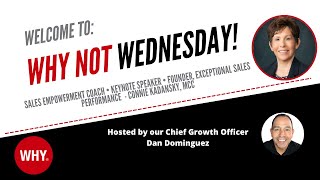
Connie Kadansky, a sales-call-reluctance coach, explains why salespeople avoid making calls. The SPQ Gold assessment identifies 16 types of reluctance, from telephobia to self-promotion anxiety. She recommends scripting, focusing on tonality, and using mindset techniques like essential oils to ease phone anxiety.
Chapters
These last few years have made us question everything.
Our relationships.
Our jobs.
What constitutes an office.
And who we are.
In a world filled with chaos, confusion and uncertainty. It's time for some clarity. Clarity. It's time to start understanding one another.
It's time to start understanding ourselves.
We envision a world where everyone knows their why. But even more, we envision a world where everyone knows their why. O s, their why, their how and their what.
The operating system that drives you, that lets the world know where you stand.
What your unique gift is, and most importantly, who you are.
Yos.
Are you ready?
Hello everyone and welcome to why Not Wednesday. What a fun interview we have for you today and for those of you that missed us last week. I know we made, we had a time change, Connie, and it some of our listeners were upset because they logged on at 1:30 mountain time and I wasn't on. I had to do it a little bit earlier. We're back at regular time. So good morning, good afternoon, good evening, and for those of you in Australia, New Zealand, in the southern hemisphere, on the other side of the world, happy Thursday. I know it's Thursday morning out there for you guys. So we are here today with Connie Kodansky who is a sales call reluctance coach. She is an SPQ gold assessment expert and a sales reluctance coach slash trainer. She understands the consequences of a bad hire both in terms of the huge expense of training, coaching and dealing with a poor performer as well as the as the effect that that has on the sales staff. Her expertise in administering and interpreting which is she's really good at this. The SPQ gold sales test prior to the hiring decision helps prevent employers from dealing with all the, all the bad things that happen with people who will not prospect consistently. She's been world working with the world renowned SPQ gold sales assessment for 26 plus years. So all you young sales professionals out there, she's been doing this longer than you've been alive and, and she's interpreted thousands of assessments and is unmatched and understanding the subtleties of the test results. I was so completely impressed with it that I met Connie through the ICF Arizona and we've just been having conversations. I think we've probably talked three or four times since I initially met her. Connie, welcome to the show.
Oh, thank you.
You have been such a wealth of knowledge and I really appreciate, number one, all the knowledge you have, but also how generous you are and in sharing it. So we've had some very powerful good conversations. Obviously our conversation started because you discovered your why at that meeting in Arizona, at the ICF Arizona meeting. So your yos is to find a better way to simplify. And Liz Wendling is on I want to say hi to have you. I think you and Liz may have already met, but Liz is better way simplify also. So your yos is better way simplify challenge. So that tells us is you're someone who's always looking for a better way and to share it with others when you find those better ways. And how you do that is by making things simple and easy to understand. Which I think you do a great job of that with SBQ Gold and your what is to challenge. So what people can count on from you are solutions that are out of the box and different can challenge the status quo. So Connie, I know I've asked this before, but now we want you to share with the audience. How did that feel to you?
Well, it felt affirming because it is so true. I mean think about, I have a sales training and coaching assessment company. I'm always looking to help people move from their current reality to a desired result, helping them move from that to a better way. And one of my the things that I have in a mantra is the better it gets, the better it gets.
And is that not a better way? Mug guys if you're, if you're listening and you want to comment. Liz Wanley, I know you're going to comment because you're a better way person, but that is awesome.
Well, and you know, when my clients call and they have exciting news, I always go, hey, the better it gets, the better it gets. What? What an uplifting way to look at it. Yes.
Yes. Well, you talk about embracing your why right there are, you know, often our strengths as you know, are our challenges too. So our biggest strength can sometimes be a challenge. But you look at your biggest strength and that for you it's to find a better way and always look for a better way and share it with others. So let's, let's just start with that. Let's let people know, hey, if you work with Connie, she is going to help you find a better way. That's what she does. And so one of the things that I know is very important, Connie, is if your why is better way, you better let your clients know. Right? Because if, let's say a sales leader hires Connie to come in and work with do SPQ Gold with her team or his team and but they're not, they're not wanting to change. They don't want a better way. How Fun. Is that client for you, Connie?
Well, and the, the fortunate thing is the assessment tells me if people really do want a better way. And it is so true and that your introductory video is so true about how things have changed and the sales world has been turned upside down and people are trying to figure out, you know, and stabilize and I think a lot of, lot of the old sales techniques, they don't work anymore. We need to up level our skills and be too good to be ignored.
Yes. And, and you know, and again we've got Jerry Fletcher is on too. He's, he's greeting us from rainy Oregon. He's one of our coaches, he's a consultant and I know he's a better way guy too. So you're attracting all the better way people, Connie. I love it. Danielle Dobson is here. She's, she's in the future. She's actually in, in Australia. So her what is challenge also. So thank you Danielle for being on. So tell me about, you know, when, when you discovered your yos, how do you, when you look back at your life at better way simplify and then challenging the status quo, how, how has it played out in, in the decisions you've made and the work that you do?
Well, I, as a sales coach and trainer, I, there are formulas and there and so the way I do is I simplify by putting it into a roadmap like the basic sales map model into a six step roadmap and that just you know, you and then a different, you have a prospect who has a problem. They meet the salesperson that has tactical empathy and authority, that has a plan. So a lot of it is the way that my brain is structured to create those formulas. Even when people sit down for their first discovery meeting to be able to have a real, in their mind a very simple way to have a formula to walk people through the discovery process. So that's how it works in my world and in my brain.
And I see that, you know, hey, you boil it down to six steps because there's, you can make sales about as complicated as, as you want to. Right. There's tons of advice out there, tons of processes to follow. But you break it down to six simple steps and then you say okay, if we do these six things, you're going to be successful and then you coach on the six steps.
I imagine, yes. And I believe that 70% of the sale is initiating contact and discovering the need. 70%. We get that right? Wow. We're cut. We're, you know, it'll just organically unfold and hopefully close.
You know, you did, you just said something that's very important, Connie. And I want to read this because I posted about this this morning because it's so brilliant. You, you define sales call reluctance. Sales call reluctance is the emotional hesitation to initiate contact with potential buyers. It is a well researched behavioral issue that is universal to the human condition. So that means we all have it and it is unique to the individual sales professional. And what that tells me is probably different people have different levels of it. Right. So how do you, is that 70% that you're talking about? Are we talking about sales call reluctance there?
Well, yes, because when you look at a basic sales model, you have to identify your prospect.
Yes.
Then you have to initiate contact. Then you have to introduce yourself in order to have that all coveted meeting that sales people just want so much. Right, Right. So we've got to initiate contact in some way, shape or form. And that is an emotional process. Now there are technicalities involved and skills involved, but emotionally reaching for the ph, picking up the phone, reaching out, having a conversation at a networking event is that it's that proactive. Initiating contact with a potential buyer and starting that conversation.
I love that because that's so, you know, we, we posted about this. Jerry Fletcher talked about it. How many people today are just afraid to pick up the phone? Right? Pick up the phone and have a conversation with your potential client, with your existing client, versus sending an email blast, versus sending a, putting up a social media post. So what are some, what are some tips that you have for somebody who doesn't like talking on the phone? How do they get themselves past that fear of talking to that all important prospect on the phone?
Well, the telephobia is one of the 16 types of sales call reluctance. So there are 16 team types and it's one of the easiest to overcome. I overcame it in one morning in my office. And it's really, is that your phone is your ATM machine. And also when you're ready to pick up that phone, just to say to yourself, this is not about me, it's not about me. And that you really do. I believe in scripting, that you have some kind of a script. And you know, everybody has their own comfortable script. There are people that have the, the best script in the world and they give it to everybody and it doesn't work. How come? Because there's a lot of customization there with tonality. Our tone is 5 per 5 times more important than the words we say. So with that telephobia is the way that I overcame it. And there are going to people that are going to kind of roll their eyes here contemptuously. However, it is so true is using an essential oil because when we smell something, it instantaneously takes our brain another place. So if somebody is having. I'm greatly simplifying this, but if somebody is uncomfortable picking up the phone, there's a way and you can email me, I'll send you the instructions. Because if you. That you can absolutely change your brain by having an essential oil that takes your brain to another place and it just, it works. I've had male clients. I had somebody who'd love to play golf. He found an essential oil that smelled like cut grass. And so it helps in that instantaneous moment. And then you say to yourself, it is not about me because it's about creating a conversation and value for that prospect.
I loved what you just said. So many. I have so many great sales leaders that I've had on recently. And you all share that. It's not about me, it's about them. Right? What's in it for them? I had, I had Scott Schilling on last week and that was a central point of his conversation. What is in it for them? Not for you. What's in it for them? How can you help them them. So we've got a couple of comments I want to make sure I recognize Bruce. Captain Kirk says he's totally syncing with what you're sharing. And Sarah says, I think we all face sale call reluctance every time we're in a new sales role. And I think that is so true. I remember being in different sales roles throughout my career before I went into management and leadership. Every time you're selling something new, you do become. You have a reluctance because, hey, now it's something completely new. And. And then I did want to say Dave Tegmaier says there's no substitute for a friendly and caring voice. So I'm sure you coach on that also, Connie. Because by the way, guys, as you're listening to Connie, does she not have just a great soothing voice? So she's got such a great teaching voice and I just could listen to her for a long time. And you know, she, she may not take my next phone call because I do. Our calls tend to last a while, right, Connie? And it's probably because I'm enjoying him so much because you're so easy to listen to. And Danielle Dobson in Down in Australia says, thanks, Connie, Very generous for you to share this with us. So you may get an email from Danielle, you may get an email from Sarah because everybody's saying, hey, there's a new use for essential oils. Or Bruce is saying new use for essential oils. And I can totally see that use for essential oils. I love the fresh cut grass smell. I'm gonna find that because a lot of people who know me, as a matter of fact, that trophy back, there's a golf trophy, there's a couple of them behind me. So maybe I just need that, that fresh cut grass and who knows where we'll grow with the Y Institute if I can even do more than I'm already doing. Great stuff. So Connie, what makes the SPQ Gold assessment unique in the world? I mean there's a ton of pre hire assessments out there.
Yes. And it is the only one that measures that emotional hesitation to prospect and self promote. And so it zeros in on what your strengths are, where you're comfortable. There are some people that are great on the phone. There are some people that are very good at getting referrals and it just zeroes in on that. And when people take the assessment, the unique thing is just by answering the questions, not even getting their results yet, they start to self correct, they become more aware. Just like your opening video. This is all about self awareness.
Yes. That is so true. You know, here's the thing. The SPQ Gold is not just an assessment, it's a coaching and development tool. So you use it extensively in your training and your coaching business. Taking the, as you said, taking the assessment, people start self correcting all on their own. So if there's a salesperson in, and I know Danielle Dobson just says that there are so many other tasks that we prioritize over making that call. And for, you know, and a lot of our audience are coaches, consultants and, and professionals in the personal development area. And they're so good but they're hesitant to call that prospect and say hey, I think I can help you or how can I help you? Right. Let's make it about them. They're so gifted and so talented but if they don't get on that phone, they're not going to get that person. They're not going to be able to help that person. So I think Danielle Dobson is right on. So what is the process if somebody, if there's a sales professional out there, a sales leader or as I said, a lot of our audiences, coaches and consultants who are struggling with sales, how can they get, get ahold of you so that they can engage your services?
Well, you can go to my LinkedIn profile because I'm one of the very few that has my phone number on there, because I don't. I like people calling me and so feel free to call me and then also you can email me and we'll set a time to talk and find out. You know, we just go through and find out what is important to you and just have a good conversation from there.
I love that, you know, Connie, and I love that you have your phone number on there. So just, I'm going to give fair, fair warning. I used to have my phone number on my LinkedIn profile and I took it off not because I don't want to receive your phone calls, but I was involved in a scam with somebody, had my phone number and was texting people that I knew because of what they do. And I don't want to make you paranoid, Connie, but what they do is they get your phone number off your profile and then they find other people in your LinkedIn network that have their phone numbers and then they text as if they're you. And then all of a sudden then they're trying to get people to get money. It was horrible. And it was, it was, it was. It cost me a little bit of money. Not too bad. But just be, be aware and call Connie. She still has her phone number on there. Let's use it for a good cause. Hey. Bruce says it's almost like jelly beans, the many worlds of essential oils. And Hugh Hornsby said he's never heard of that essential oil before. But changing the mindset of that really works. So love it. Love it. And Bruce wants to know what are your preferred hours? So you might just get a few clients out of this, Connie. And I love that because I can tell you, you know, Liz Wendling, I learned so much from her when I had her on the show. And another better way, simplified person. And. And I've learned so much from you. So I want to make sure people can beat a path to your door so you can help them out. So let's ask the next question. What is the process if there's a leader out there? So somebody who's a hiring authority that wants to pilot the SPQ gold in their interviewing process, how do they do that?
Well, you reach out to me and invest in one. Just use one. If you have somebody on your team who you just feel that they have good pot, but you're just not quite getting them there or they're not quite getting themselves there, invest in an SPQ with them, position it as a coaching and development tool. And I can guarantee you that you will find out some information that is going to help them to start self correcting and, and coaching and developing.
Excellent, Excellent. So you say just one, let's find that one person. Let's go through it together. We'll go through the results. You'll go through the results with them and then kind of figure out how to coach them appropriately.
Yes, yes. I love that, you know, people are uncomfortable with prospecting and I coach people to get emotionally comfortable with their relationship with prospecting.
Right.
So people have an acrimonious, uncomfortable relationship with prospecting. And I've got a way to coach them so that they get comfortable in that dynamic because, wow, when people get comfortable there and a lot of the sales training and sales coaching is helping them convert, they can be off and running.
You know what I love about what you just said is so prospecting is so important, right. Finding and getting that phone call and working with Liz. Liz is all about helping you nail that first five minutes, that first five minutes with the client. Right. So between Connie and Liz, we should have some just amazing sales professionals out there that are killing all of their goals. So I, I, I'm probably just gonna have to put a post with both of you together so people could contact the, contact you both and, and work on what it is that they need help with. Right. For some people it's that prospecting sales call reluctance. And for other people is, have no problem getting people on the phone. But then once you get them on the phone, you don't do a great job. Right. And what's more frustrating than having that perfect client on the phone? And you know, you, you have the solution for them, but if we don't do our job right, we can lose that opportunity to bring that person the value that we have for them.
Yes. And I want to hear on Liz's first five minutes. So do, do help us out with that because that is so important. I had a client that got real gutsy and he was going to call a CEO and he was going to call the CEO. I had the direct line, yeah. Four business hours, and the CEO answered and this salesperson wasn't prepared. It's like, whoa. And so a lot of times people are making their calls and then they're surprised when somebody answered.
They're ready to leave a voicemail. And then the person answers, right?
Whoa. You answered your phone.
I love that Liz says you guys are talking next week. So I love that you guys are connecting. Dave Tegmeyer says prospecting requires you to be vulnerable. That is so true. Right. What can you tell us about that comment? I know you have some insights on that.
Well, it's humbling. It's humbling because sometimes we reach people that they're not happy that day, you know, and so it can be a little humbling. And you know, even today sometimes I make big boo boos and I'll just say, you know What? There are 8 billion people in the world and I just kind of messed up with one of them. We've got to really learn how to be resilient and you know, it's, it just make it fun and have conversations and hopefully that we're calling people that we know that is a warm prospect. I mean there's so many things out there now that we can do that. And yeah, you know, it's just, it's. It's a, it's a fascinating world around, around sales and prospecting is most people's weakest link. And so to help them with not only technique. So Liz, looking forward to that. The techni prospecting but then that emotional component where we're confident and comfortable at the same time.
I love that. And, and we, and we are vulnerable. So if we are vulnerable, let's just be as good as we can while we're being vulnerable. Right. So let me ask you this and I know you've only known your why for a couple of weeks, Connie, but how does a salesperson's why impact their ability to prospect, in your opinion?
Well, the, the why is if you don't know your why, it's kind of like it's just you're not as clear. And so the reason that I am so interested and believe in the why is it gives clarity on self awareness. It gives you clarity on what you're good at and the way that you navigate the your world. And then also, you know, Dan shared with me with his prospects. He has them take a why assessment before he has a sales conversation with them because it only takes 10 minutes. And I think that that is really brilliant because not only do you understand your why, but other people's why. And what do all. What are all these and how do they come together so that we can connect with people differently? And I think that that's what something that Dan promotes and Dan, anything that you would add there around learning about the otherwise so that we can accommodate and be flexible with that.
Well, well, you know, here's what I will add because this is about you but I'll add this comment everybody that's you know, commenting, Bruce, Liz, Sarah, you know, they're. They're either coaches or they're people that I've talked to. And, and here's what I say. If you can know somebody's why before you talk to them, you take a little bit of the guesswork out of what's important to them. Right. So when I talk to. To Connie and I know that her why is better way, I know that if I can frame my conversation around showing her how, working together, we can find a better way to do what she does best, I know she's going to be a lot more open. So, you know, a lot of sales professionals where we're throwing stuff against the wall and hoping something sticks. We're watching for visual cues. What's important to Connie? Oh, that. That livened her up. Let me talk more about that. Well, if somebody, if I know somebody's why ahead of time, I don't have to guess anymore. And so I can tailor my conversation to them so that we can make that connection. Right. That connection is so important, and so we can, as Liz would say, nail that first five minutes and make that connection so that it makes it a lot easier. If we're a fit, then we're a fit, and then we can. When we can make that natural conclusion to open the relationship, not close the sale. Open the relationship.
Yes, yes, yes. So the why is vital. It's kind of like if people really are emotionally connected to their why and their personal and professional goals, that's their want, too. That's the, that's their gas in the gas tank.
Yeah. And. And you know what? What, what I love about that, too, is that that's the energy. Right. When we're operating in our why. When you're finding better ways, you're. You're, you're simplifying things and, and you're challenging the status quo. I bet you have energy for days. You can do that all day long. Right.
Jill says that's hilarious. Regarding the CEO answering the phone, be ready to close the sale no matter who answers the phone. Your conversation, even with the receptionist, could get your foot in the door or not. So be ready and be kind. Great advice, Jill o'. Boyle. We love that Bruce says the Y discovery is like a disc profile on steroids. And I think you use disc also, right, Connie?
Do I use the disc?
Have you used the disc profile before?
Not really. I've taken it, and I know a lot of people use it very effectively, too. Yeah.
Yeah. Well, let me ask you this question. So now we Talked about how a salesperson's why impacts their ability to prospect. You said you had a question for me, so I want to make sure and give you time to ask that question so I can answer it. Because you thought it was important.
Well, it was finding out your prospects why before you have an extended conversation. So you answered it beautifully.
Perfect. Perfect. Thank you. So let me ask you this. What would you say to someone who is considering adding the why to their tool belt? They're a sales coach, they're coaching professional, they're consultant and they're thinking, hey, you know what? I think I want to add that to my toolkit so I can know my clients better. Based on your limited experience, what would you say to someone who's considering doing that?
Well, when I started my business 26 years ago, Bill Johnson, who was at National Speakers association, he said, connie, get an assessment. They're really, really important. They're out there. There are different kinds and it just adds tools to your toolbox. It's a nice stream of income and time. I was kind of like, I didn't have a sales assessment yet. And it just makes so much sense. So get an assessment because it opens doors, having conversation, it gets people intrigued. People like to learn about themselves and it's a nice, lovely stream of income. So I'm a big believer in assessment.
I love that. Connie, is there anything I've forgotten to ask? Because I want to make sure we get, get value out of this time. Guys, if you're interested in working with Connie, you know how to get a hold of her. She's on LinkedIn and, and what's, what's your website, Connie?
Exceptional sales.com.
Perfect. So it's exceptional sales.com or Connie Kadanski on LinkedIn. She's connected to me. She's connected. If she's connected to me, she's going to be a joint connection for a lot of us. So get a hold of her. But what have we forgotten to ask?
Well, I'll tell you, my tagline is I help salespeople get their ask in gear.
Yes.
And is just so many times if you, you just ask, it's amazing. Just to get rid, you know, curious and ask. It's amazing. And asking people, you know, it's so funny. I reached out to somebody who could be in a strategic partner with me and so we're, we're not, we don't have any conflicts in our business. And strategic beautifully. And I reached out to him via email and LinkedIn and I didn't hear from him. And I couldn't find a phone number. Well, I got an email from him about a month ago. He goes, Connie, 770 days ago, you emailed me. And it goes to this remote box and. And I want to talk to you. And so it was like, wow. And some. And it is a good strategic partnership. So for many of you is learning that. I know there are coaches and trainers that are on the call today is think about prospecting not only direct prospects for you, but strategic alliances, people who already have your clientele as their clientele and match up with them because it can be a match made in heaven where both of you can grow and develop and through each other's network. So I'll leave you with that.
Oh, you know what? That is beautiful. We're gonna end on that note. What do you say we end on that note, Connie?
Sure, why not?
Thank you so much, Connie. Guys, I hope you enjoyed listening to Connie as much as I enjoyed asking her questions and listening to her brilliant answers. I want to thank everybody who commented today. You know what I know is that for everybody that comments, there's like 20 people that aren't commenting. Right. So we. We're so glad all of you tuned in today to learn from Connie, get in touch with her, and as always, we'll see you guys next Wednesday on why not Wednesday. Have a great rest of your week.
Thank you.
More from Dr.




Women In Leadership: A Need For A Greater Systemic Change With Belinda Clemmensen






