WHY NOT Wednesday! with Coryne Forest
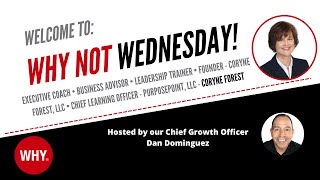
Coryne Forest, an engineer turned executive coach and Chief Learning Officer at Purpose Point, talks with Dr. Gary Sanchez about helping organizations reconnect to purpose. She built her own why around trust, wrote 50,000 words for NaNoWriMo, and is organizing the Purpose Summit 2023 at Notre Dame in May.
Chapters
These last few years have made us question everything.
Our relationships.
Our jobs.
What constitutes an office.
And who we are.
In a.
World filled with chaos, confusion, and uncertainty. It's time for some clarity. It's time to start understanding one another.
It's time to start understanding ourselves.
We envision a world where everyone knows their why. But even more, we envision a world where everyone knows their why. O s, their why, their how, and their what.
The operating system that drives you, that lets the world know where you stand.
What your unique gift is, and most importantly, who you are.
YOS.
Are you ready?
Hello, everyone, and welcome to why Not Wednesday for the week of February 8th. I am so excited to introduce our guest today. We have known Corinne at Y Institute for a while, but you guys at Y Nation have not had a chance to meet her. So we are looking forward to introducing you to her. Corrine is an executive coach. She's a business advisor. She's a leadership trainer. She's a founder of her own corporation for Corinne Forest, llc. She's a chief learning officer at Purpose Point. I love this about Corrine. She says she works with businesses and individuals to help them determine a development path that excites them by nurturing their individual growth journey. She says she. Now get this. She has spent her entire career with engineers and scientists at an Army R and D facility, first as an engineer herself and then eventually as a leader for an entire tech area. So she says if she can help them embrace emotional intelligence, she can help your business, too. So let me introduce you guys to Corrine Forrest, and welcome to why Not Wednesday. Corrine, how are you? Hi.
Thanks for having me, Dan. I am doing well this morning or this afternoon?
This afternoon. Yeah, it's. It's afternoon even In New Mexico, it's afternoon even. Even our friends on the left coaster, it's afternoon. It's 12:30 for them. So we've got a few people that are always here. And we're so glad to have Bruce. Captain Kirk is on deck. Hello, Dan. And Karine, he says. And. And of course, Lynn Everard, who's.
A regular here on the show. So, Karine, so glad to have you here. I'm excited to. To talk to you. To talk about trust, making sense and. And clarifying. How are you doing today? I know you're coming off a vacation.
Yeah, yeah. I just spent 10 days on a Caribbean cruise and I brought back a head cold along with all the amazing memories.
Yes. And I understand you were with family for that, right?
Yep. My daughter and her boyfriend were able to join us for that. My son's in college his last semester, so he needed to be there.
Fantastic. Well, that's great. Welcome back, and I hope you feel better soon. So, Corrine, let's talk a little bit about you because you've got such a diverse background. I mean, you're a former engineer, former leader of an entire tech area of engineers, and you're now in the coaching business, and you're a chief learning officer, and that's how we met with Purpose Point. So tell me, as a chief learning officer, you have a mission to engage, inspire, and impact others to achieve their potential through purpose. Tell me more about that mission.
Well, it really comes down to the core idea that people that are excited about the work they do, that they feel like they're. They're bringing their whole selves to work.
Right.
They just do better. They're happier, they're more resilient and resistant. They. They handle conflicts better. And so really, at its heart, Purpose Point helps organizations find that again. Why did you go into business in the first place? And why did you get people on the mission? So we help the people connect back to that.
So it's just about coming back to why did you start doing this in the first place? Right.
Yeah.
Love that.
And tapping into that. Because life is hard, right?
Yeah. So that, you know, it is. And we spend so much of our time working. Right. You might as well be working on something you believe in, something. Something that. That motivates you, that drives you towards your purpose. So I love that you help companies do that. And how do you unleash the potential in. Everyone at Corinne Forest, LLC talk about that.
Yeah, that is all about, you know, leadership theory is great, and there's a lot of it out there, many thousands of books, in fact. And you can go to leadership development classes, and I think that those are a great, you know, place to learn. But at some point, you have to take that information and turn it into knowledge. You need to apply it to your life.
Right.
And that comes, I think, with the meeting people, where they are. I can teach the exact same material to 25 people in a class, and I can ask every single one of them, what's your key takeaway? And they're going to have something different.
Right.
So to unleash people's potential, you absolutely have to start where they are so that you can. You can bring everybody along.
You know, I just heard, I think it was on Larry Levine's feed today, talking about, you know, action. Right. You can you can. You can have all the plans in the world, but you got to take action. And watching Jordan talked about that this week. He had some. Some change of plans this this week and on Monday. And when his plans changed, he just decided to take action on what the new path was. And I think that's what you're talking about, because I think knowledge, you know, Drew, Darren Hardy talks about this. He says, hey, you know, we all have access to information today. There's no reason. The World Wide Web is full of all the information we need. It's, what are you going to do with that information? It's the people that take action that are achieving the great successes. So I love that you're driving people towards that. Let's talk about you, Corrine, because you took an action. You know, now we've. We've known each other a little bit over a year, but you and I met through Purpose Point. I reached out to you. I had met our common friend, Paul Epstein, and he said, oh, you got to Corrine. And I remember taking you through your why discovery, and your why came why came back as trust. Your how is make sense and your what is clarified. But I love the reaction you had to your why of trust. Let everyone else know what that reaction was.
Well, I think being in the leadership development space, I have taken every assessment out there. You know, I know my Myers Briggs and I know my strengths finders and I know my standout, and I know my big five, and I know my emotional intelligence score and everything. And then when I. So when I take an assessment, I'm really used to it. Right, Right. And I get the. The results back and I'm reading through it and I'm like, I've never had an assessment. Tell me this before. And I learned something new about myself after 10 years of being assessed to death. I was like, wow, this is really good stuff.
Yeah.
And I really appreciated not just the why, but the how and the what that goes with it. Because the why is that for me, at least, the way it came across when I first read my results is that's like the deep me. And I don't know if people, like, see that part. What they see is my what and my how.
Right.
But I don't know if they know that. That the driving force was that why behind it.
And it really resonated with you and our good friend. I got to give a shout out to. To Larry Levine, because I just quoted him. He says, nothing happens without taking massive action. And of course, he's connected to Davin. And he says, davin, Sovan, your purpose point is amazing. I'm sure you agree with him, Karine. But one of the things that you said that really struck me as you said, Dan, I teach entire workshops on trust.
Yeah, yeah. And I'll tell you the genesis of that. That comment to you was to be. I'm going to really, you know, be perfectly honest here. When I saw my why of trust first, because that's the first thing you read, right? I was like, oh, I want a cool why. I want a better way or right way, you know, but trust, what kind of why is that? And then, then the reflection comes in and I'm like, oh, oh, I teach a workshop on trust. As a matter of fact, it's my favorite workshop to teach. And I, when I go in and I start talking to an organization, I'm always like, you know, you guys have no trust in your team. And then I read Patrick Lencioni's you know, five Dysfunctions of a Team, and the bottom of the pyramid is trust. And that's another one of my favorite workshops to do. Oh, I think I need to own this trust thing all of a sudden.
You know, what I hear a lot from people is, hey, I kind of have always known this about myself, whatever their why is. But this kind of gives you the language to express it and let people know, hey, I believe that success begins when we build relationships based on trust.
Right. And I knew I was a people person, which is rare enough in the engineering field to have this people orientation and getting things done through relationships. But again, I would have never, like, pinpointed the word trust into why I work so hard to build relationships or why I work so hard to be trustworthy myself. My number one value is integrity. So all that came on that reflection, right. Of my why, you know, because at first I'm like, oh, I want to be a better way.
You know, I don't know. I don't know that any of us really think our why is the coolest. You know, Larry Levine, he's. He's a contribute, clarify, trust. So you guys share two of two of your top three. But, you know, his clarify is so strong, Corrine, that it really comes through. When you meet him, you think, oh, he's got his wife's got to be clarified. But he's all heart. He's all about contributing to the success of others. So you see that as you get to know him. But the clarify really comes across really strong for him. Just like with you, you you said, you know, you're how and you're what. Those, those you could identify quickly. But the trust, you, you had to do a little reflecting first.
Yeah. And it really made sense to me, you know, after we did our debrief together and, and you' the how and the what is really how that manifests. So that's what other people see. And I'm like, well, of course that makes sense.
Right? And then it made sense, Right.
Yes, I was, I was completely happy with that.
Yeah. That is so funny. So, Karina, I want to let Bruce say, he says, better way is by far the coolest. I think the better. You know, I, I, I'll take it back. I said, so, you know, all of us want to say the same thing. We want to say, oh, you know, maybe my why is not as cool, but the better way people think their why is cool. So maybe, maybe that there, maybe I, I misspoke. I think the challenge people think their why is really cool too. So let's see. Francisca says, so funny you mentioned that is my why is trust. And I had the same reaction. I wanted a cooler why, but it's spot on. Trust and yep, integrity is tied in for that as well. I love that. Thank you, Francesca.
Go, Francisca.
Yeah. So, hey, let's talk a little bit about what you've got going on. You've got it. You and you and Purpose Point have an exciting event coming up. Tell us about the Purpose Summit 2023.
Yeah, the Purpose Summit. This will be our fourth iteration. And it's something that my company, Purpose Point, puts on every year. This year, it's May 23rd, 24th and 25th at the University of Notre Dame in South Bend, Indiana. And what we try to do is bring together.
CEOs, business owners, coaches that work in the industry, leadership development people who I have coined the term that are in the purpose verse.
Oh, purpose.
They believe in finding your why. They believe in working in your purpose, you know, to find that significance.
And we're very much looking forward to it. We just nailed down last week the, the agenda of all the keynote speakers. And we have, like, Nick Vojcik is gonna be there, and John and Jade Gordon are gonna be there. John Gordon's gonna be there, and he's gonna be kind of launching his daughter Jade out on that. They're gonna be talking about her experience in this servant leadership kind of ideal. So I'm extremely excited. I mean, I'll be leading a workshop on day two, but I'm excited about Nick and John and Jade and of course Amber Sel there again. And anybody who's seen her, she is a dynamo. Dynamo.
Excellent. And you know, I always ask people, hey, do you have something you want to share with the audience? And you've got a free giveaway. So I know Sunil put it up on, on the screen. So if you want to get a, you get a discount right on your, on your ticket to the, to the Purpose Summit. So we want to make sure you guys are able to get that link capture it. We'll have a replay if you want to type real fast. But Steve Adams says, hey, Purpose Summit is a must attend. We probably, we probably are going to agree with you on this, on this podcast, Steve. So thank you very much. Danielle Dobson says, hey, I actually love my why. It makes complete sense to me. I wonder what, what her, her why is right.
Yeah, come on, Danielle, let us know.
Let us know.
Danielle, do you have one of the cool ones?
She does have one of the cool ones. Danielle, go ahead and put it in the comments and we'll share with everybody. But let's ask, let's ask another question because, you know, you, you, you did something really cool. You. NaNoWriMo. Tell us about NaNoWriMo. What is that?
Yeah, NaNoWriMo is a acronym of sorts. It stands for National Novel writing month. So NaNoWriMo, and it's every November. And I was listening to a podcast in mid October and they were talking about NaNoWriMo. So I was driving at the time. So as soon as I had a chance, I looked it up and I'm like, oh my gosh. It's this community of authors and want to be authors that make a commitment to write 50,000 words in the month of November, which breaks down to like 1700 words a day. And I literally was like, I've always wanted to write a book. Why not? So right there, I just made the commitment and I started on November 1st and I wrote my 50,000th word on November 30th and it didn't complete the novel.
Right.
You know, had to go back. There was about maybe another couple thousand words I needed to finish it up. But yeah, that was, that was truly a why not moment for me. That, that was really.
Very, very spontaneous of me. And I do have enough of an engineering brain that spontaneity needs to be scheduled in the calendar.
Yeah, you've got to schedule spontane. Love that.
That's right. Fridays from 6 to 8pm Spot and spontaneous.
We're going to be spontaneous at that time, you know, There's a couple of things. Lynn Everett says only nine of the wise are actually cool, which I love. If you're one of the coaches like Corrine or like Lynn, you know that there are only nine whys, So I like that. Very funny, Lynn. Thanks so much. So that's your first one. What's your biggest why not moment, though? Because I like to ask that question ahead of time. And you have a pretty big one that I want to. I want you to share with everyone.
Yeah. This goes back to being an engineer. I worked for the US army and I worked there from infancy. And I, you know, I was an engineer. They actually paid me, paid for me to go to engineering school. Yeah, I was, I became a project engineer. I got into engineering leadership. You know, I got that first team lead position. And it was really when I made that transition that.
To be honest, I'll say I enjoyed my career more because again, of that people orientation. So I really loved leading, leading other people. And then from the time I got my first team lead position, apparently they thought I was doing a really good job because they promoted me like five times in eight years.
Right.
In that time. And I was all for it, Right. Who am I to, you know, argue with the US army, right. And. But I looked at the next promotion and the light at the end of that tunnel kind of looked a little bit like a train. And I said, you know, I don't want that position.
Yeah.
So that led me to look around, okay, whatever. I was only at the 24 year mark of my career. I'm like, what am I going to do?
Right.
And that's when the head of OD Organization Development tapped me on the shoulder and he says, we've been watching you for a few years and you lead different for an engineer. How would you like to come and teach other engineers how to be human that other people actually want to follow? And I'm like, that was a huge why not for me. And I am so glad I did because I had a lot of people who were like, you know, you're shooting your career in the foot, right? Doing this. And I'm like. And that still looks like a train. Yeah.
That light at the end of the tunnel looks like a train. Right. And it's an oncoming train. It's not a taillight.
Yeah. No. And so I did it. I did that. Why not Attitude. And I am so glad I did because I do believe that that is the point where my career, you know, of first being an engineer, then leading this tech area Became my calling. Yeah, I absolutely loved what I was doing to the Point. When I retired, I took an early out because they offered it to me, but I wasn't done contributing. So that's when I started my own company and got involved with Purpose Point as well. I love that doing it.
I love that you're still, you're still, you know, and for those of you that are listening, look, you know, 24 years into a career, there's no right time to make a pivot. But that was a significant pivot for you to go from an engineering leader background to go into the. I love what, what the, what you're the person offering you the job said would teach engineers how to, how to feel. Right.
Well, it's how to be human and.
Not how to be human because, and you know, we're in Albuquerque, so we have the Sandia National Laboratories and we're also really close to Los Alamos. So we have a lot of engineers. What's the biggest challenge you would say that engineers that you, you had, you had in leading engineers in terms of how to be human?
Well, I think it comes down to.
The idea that.
The way, the way I teach leadership is the whole person paradigm that everybody comes to work as the whole person. That, that you can, you, if your home life is terrible, if you're going through a divorce or, or you're a primary caregiver for a parent or you have a special needs child that when, when you're at work, that matters.
Right.
You know, and I think engineers are like.
Often I don't want to, you know, stereotype generalized. Yeah, they, they look at that as, as kind of just another data point and. Well, I'm sorry to hear that. Can I have that report by Friday?
You know, and it just doesn't, it just doesn't compute. And how that might affect the performance of their job.
That individual.
I pay you, especially engineers and scientists tend to get paid fairly well. And there's a prevailing theory of, well, I pay you really well to do a good job. I expect you to do a good.
Job regardless of what's going on at home. Right.
And really the data, and that's what I tried to bring is.
The evidence that says that, you know what, happier people do better work anyway.
Right.
You know, and they give that.
Extra effort like, you know what I might need to or I want to leave early to get my kid off the school bus and get them to little league practice. But I'll put him to bed at 8:30 and I'll work from 8:30 to 9:30.
Right. Make up that time.
Yeah. Before the pandemic, I didn't know any engineer who thought that was reasonable.
And now. Yeah, we've learned a lot from the pandemic. Right. A lot of, you know, I saw a brilliant post yesterday talking about the fact that so many people are not in that environment where they need to come in the office every day. You can be productive from home if necessary. And I think that gives everybody just a lot more flexibility that we didn't have before.
Yeah, yeah, for sure. Unfortunately, Bruce is right with the empathy on the job thing. It's just, you know, empathy is a cognitive thought for an engineer and a scientist. It's not a natural tendency for them.
Exactly. Well, I was going to say the, the other part of that is. And, and I love the work that you do, Corrine. So let's talk bit about how did you learn about Y Institute and what made you, what made you decide to become a certified Y coach?
Well, I think the Y Institute happened through, through Paul. I think you connected to Adam Richie, another Purpose Point guy, and he often is out scouting. He's a better way. So if Purpose Point is helping people and companies get in touch with their purpose, you know, to, to engage, inspire and impact their performance.
He took the assessment and then right away he was like, oh, I think this has value in what Purpose Point does. This is a better way to help people get to that point that I want them to. And so he had all of us take it, the six of us in Purpose Point. So that's how I came to the Y Institute. And I quickly saw and agreed. So I'm the chief Learning Officer for Purpose Point. And so if someone was going to become certified to conduct the workshops and do the coaching around the Y assessment, I was a good candidate. And as a matter of fact, another one of our Purpose pointers, Paul Epstein, that you mentioned earlier, also became certified just about the same time I did. We truly do feel that it's an integral part of, of, of what, what we bring to the table.
You know, I remember going through that. We had an amazing email thread. I think you were on it. Karine, Paul, Devin. I'm trying to think who else was on there. Adam Richie was on.
Yeah, Lisa.
Yeah. And Rick, I think. Rick Misso. I just remember all those responses as you guys were each going through the experience and the different whys and everybody giving responses from their perspective. And so we had a great thread going. Learned a lot about the team, learned about a lot about you Guys. And now we're so, so lucky to have both you and Paul as certified coaches. Paul was actually at ycon last year in Albuquerque, so we're hoping we get Corrine to Albuquerque this year in October. So it's October 2nd, 3rd, and 4th. For those of you that are coaches that are listening, put that on your calendars. I know the invitations are going to be coming out soon, so we're looking to have a great meeting this year. We've got a great location planned out and more details to come. But, Corinne, let's. Let me ask you this question. What would you say to someone who is considering joining and getting certified in why they're a coach. They believe in why, like yourself, they're involved in an organization or they work. A lot of their work is around why or purpose.
And.
And what would you say to someone who's considering adding this to what they do?
Yeah. Well.
I will say the engineer, the strategic planner in me.
Believes that you should look at what your offerings are in the coaching space, what your niche is, who your clients are, and that kind of thing. But then as I was.
Thinking that further, it really boils down to.
Most things boil down to having good relationships with people. And of course, someone with a why of trust is gonna obviously believe in that. Right? So how are good relationships made? Emotional intelligence. Where does emotional intelligence start? Know thyself. Your self awareness. So the y O S is a beautiful tool to know thyself. But emotional intelligence comes when you start recognizing how others are like you and how others are different from you. So that's why yos in a team setting is so valuable and that building relationships comes down to how you're communicating with people and talking to people with their why in mind. You know, I know that when I talk to and you mentioned, you know, the purpose point team, we did it as a team. Of the six of us, there are five different whys in there. So I know when I talk to davin, I talk in the language of contribute. And when I talk to Steve, I talk to him in the better or the right way way. When I talk to Adam, all I need to do is say, hey, can you figure out a better way to do this? And he is. He's my guy. So that communication and being able to build relationships. So while you should look at your niche and clients, I'm going to mostly tell people that this is a valuable tool regardless of whatever. Whatever it is.
I love, love that answer. Corrine, thank you so much. And what do you say we end on that note.
Absolutely. Why not?
Why not, Right? Thank you so much, Karine. I am so excited that you came on. It's been a while to get you scheduled, but you were a great guest despite the fact that you're fighting a cold. So we appreciate you being on and we want to invite everybod to join us again next week. For who is our guest next week? I've got to look that up because I can't leave you guys hanging. Let's see here. I should know that off the top of my head, but I haven't looked at it. Oh, my gosh. We have Brenda Reisner next week. So if you are on next week, you're going to get to hear from Brenda. So we're on a coach streak right now. This is our second week in a row. We had a coach for a while. We had challengers. Everybody that came on was a challenger. But now we're on a coach streak. So we're going to bring on Brenda Reisner next week. Thank you so much, Corrine. Have a great rest of your Wednesday and we'll see you all next Wednesday on why not Wednesday.
Thanks. Thanks for having me, Dan.
More from Dr.




Women In Leadership: A Need For A Greater Systemic Change With Belinda Clemmensen






