WHY NOT Wednesday with Damon Wallace
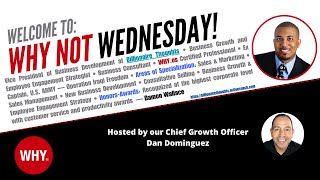
Damon Wallace, CEO of Billionaire Thoughts, shares his military leadership background and his mission to help 1,000 business owners earn an extra $1M each. He explains his approach to team building, asking for input instead of giving orders, and how he applies those lessons to tackle homelessness, education, and business development.
Chapters
These last few years have made us question everything.
Our relationships.
Our jobs.
What constitutes an.
Office.
And who we are.
In a.
World filled with chaos, confusion and uncertainty. It's time for some clarity. It's time to start understanding one another.
It's time to start understanding ourselves.
We envision a world where everyone knows their why. But even more, we envision a world where everyone knows their why os, their why, their how, and their what. The operating system that drives you, that lets the world know where you stand.
What your unique gift is, and most importantly, who you are.
Yos.
Are you ready?
Hello, good morning, good afternoon, good evening. Whatever time you are at somewhere in the world where you're watching. Welcome to why not Wednesday. I'm excited to introduce you guys to our guest today, Mr. Damon Wallace. He is the CEO and I'm gonna put this in parentheses, parentheses and BP of business development at Billionaire Thoughts. He's an executive level problem solver with proven technical communication, sales and marketing skills. He is responsible for overseeing the sales and marketing the full line of products and services at his own company to current and prospective customers in both the business to business and the business to consumer sectors. I had the pleasure of meeting Damon Wallace at Biz X in Nashville along with a bunch of awesome action coaches in 20, in April of 2023. Welcome to the show, Damon. How are you?
I'm doing phenomenal. Thanks for having me. I mean, it's always an honor. You know, I'm a big fan of this show and so I'm grateful to be a part of it.
I'm thankful that, that you're here, Damon. You know, there's a lot of good stories I can tell about our relationship just in the few months that we've known each other. But we'll, we'll get to that. So, Damon, I, I mentioned in, in the introduction to the CEO and the VP of business development at Billionaire Thoughts, one of the things I believe if you're the CEO and you're not doing business development, you're not doing CEO, Right. So tell me about that dual role that you, that you hold at your company at Bill as Billionaire Thoughts.
Absolutely. I mean, nobody has the same passion for, for your company as the, the CEO or, or the, the business owner. And so I think it's important that, that, that you're the number one advocate for your company, that you're out sharing your story as, as much as possible. And so that's why I wanted to make sure that if, if anybody was going to hold on to that in the as where Our company began to grow that I was that face. I wanted to be that one to who, who took that mantle on. To go out and share the story and to, to pull about the vision of our company.
Hey, and, and you and I have something in common. And I read this in your bio. So you served as a captain in the United States Army. So thank you for your service. I, I also left as an O3. I was one of those junior officers that got recruited out. I'm sure that was probably the same thing that happened to you. Tell us what, what did you do in the army?
I can't tell you what I did in the Army. No, I'm just kidding. So I did, I actually did movement control and I also had a background for doing close quarter combat and close quarter marksmanship. So I would go around to different units and actually teach them, you know, different techniques and really it was, it was part ones for them to be able to use if they went overseas, but it was also part, just for you know, the esprit decor just to have something. They said they did something cool and had some new training. So a little bit of both, a little bit of building up the, the, the army and preparing them for combat.
That is awesome. Well, again, thank you for your service. Damon. Always great to talk to a fellow veteran on the show. Let me, let me ask you about your yos, Damon, because we as we met in April when we, when you did your, your yos and your why is to find a better way and share it with others. You've already shown a little bit of that. Your how is to make sense of the complex and challenging and your what is to challenge the status quo. So let's, let's break that down. Better way. You like to find better ways to do things and you like to share those better ways when you figure them out. Your make sense is you're, you're good at taking in lots of information, lots of data and coming up with solutions, which is great. A great trait to have as a coach. And your what is to challenge the status quo. What people can count on from you are solutions that are out of the box and different. And just my experience with you, I've seen those three. But tell me how did that feel to you when you found that out about yourself and you started using it?
Well, considering what we do, I mean I thought man, wow, what an ideal combination to be able to go out there. So if I can help entrepreneurs find a better way of doing the things that they need to do to consistently go out and help them to look at what's working well and how can we improve on some of the things that maybe aren't working as well. Make sense of complex tasks that it takes most. Most business owners don't necessarily know how to grow a business. And so we make that process make sense, that roller coaster a little bit easier to navigate. And then ultimately, if we're looking at it and we're challenging their status quo, most people just don't set their goals big enough. Most people don't go out and actually set a limit that is so far that they are motivated to go out and accomplish it. So I like pushing people a little bit more, not letting them just kind of rest on their laurels. So from a coaching style, that's absolutely how I approach it. My wife is not a big fan of my better way.
My better way nature, but once I became more aware of it and she became more aware of it, she actually, she understands where it comes from. Because I often talk about, you know, what would be cool if we did something like this. She's like, you don't pay attention to what I'm already doing. I don't pay attention, don't observe it. I just always look for, you know, a better way to get things done. Not to dismiss, but to enhance.
And I think that's one of the, one of the. I thank you for sharing that and that that came up in the interview with Rory that I did some time back. Rory, is he. His why is simplified, but one of his, his, his partners is better way. And so when she comes in with those better way ideas, he's, he's make simplify, make sense right way. And so she comes in with those better way ideas and he's like, well, slow your roll. Let's make sure we're doing it right first. Let's make sure it's simple. So in how they interact, do you know your wife's yos, what's hers?
Hers is.
Contribution.
I want to say his contribution makes sense and, and right way.
Okay, so contribute. Makes sense in right way. So the right way, you know, she's got a process and a system, right? And you're coming in saying, let's do it better. Let's, let's do it different. And so, yeah, I could see where. And it's important. I think it's great self awareness on your part when you even said it as you were talking. Look, I'm not discounting what you're doing. I'm just saying, hey, there might be a better way to do it. Let me talk to you about it. So having that language to let people know, hey, I'm not saying what you're doing is bad. I'm saying there might be a better way because you can't help yourself. You look at everything and you find a better way to do it. How did that go over for you in the military? You know, where things are, you know, commander says, this is how you got to do it, and that's how you're going to do it. How did you channel that? That want to make things better and to make sense of things and challenge the status quo?
Yeah. So I found that I'm. I'm good at taking orders in terms of, like, if you give me an order, you tell me that you want it done a certain way, I will do it your way. You have to then, you know, deal with the consequences of whatever that action may be. If it's right or wrong. It was your call. I did it the way you asked me to do it. But if you give me an overall mission and you give me the freedom to go out and do it, then I'll. I'll look at the way that it's always been done and then see if I can find better ways or ways to improve on it in my units. They've always loved it, as a matter of fact, you know, I never had a commander who was overbearing, who had that, you know, kind of bravado beat on their chest. If we got the mission done, if it was successful, and they were happy with it. And they, you know, I gave some ideas on how things could be improved, how we, as a unit could be better, and, you know, fortunately had great commanders who really went with me on it. And as a matter of fact, we actually changed the way that the road network in Afghanistan and Kuwait worked and also in Iraq, because we were looking at the way that it had always been done. So several of the commanders who were, you know, or, you know, we're talking about lieutenant colonels and, you know, full bird colonels, lieutenant colonels. I mean, they. They got kicked off of the floor. What this thing called the C Flick force, like, this whole screen, you know, where there's like, literally something off TV, there's like 40 screens and telephone in front of you. You're looking at the news on one thing, you're looking at the, you know, some drones going off in another place. But everybody had a focus on, you know, on. On making sure that the road networks were going well. Well, the way that they were doing it, it had a missing piece of it, and where it was taking everybody, you know, hours and hours to give reports, and it wasn't quite as accurate. I came in and I said, well, why don't we just have the people who are there do account, send us the count and we just tally it up and then we can give the report based on that. So my reports were taking me about 30 minutes where it was taking other people, you know, a full night, and they were still getting it wrong. So the commanders ended up loving it. And I think it's, to this day, from what I'm aware of, they're still doing it that way today.
Definitely a better way, right, David, there's got to be a better way to do that. You know, I think that that speaks volumes for your leadership, your leadership and the leaders that, that, that had the opportunity to lead Damon, in that. They didn't say, hey, let me put you in a box, and this is what you got to do. They kind of gave you the mission and they allowed you to use that creativity, that innate creativity to find better ways and get the mission done better. Because I think when, you know, there, there's, there's a lot of very smart people in the military, but, but the really smart ones understand that the people below them also have great ideas. And it sounds like you were given some great latitude to be able to.
Improve on some things and vice versa, just like you said. I mean, I also went to my soldiers to go ask, how would you do it? You know, they taught us in training to go out and look for three courses of action and then pick amongst the best course of action. Right. But so many officers, once they got into their, you know, once they got their bars or they got, you know, you know, their, their leaps or whatever, they forgot that we're supposed to talk to our soldiers, get ideas from them, and then look at the best course of action. And they just kind of started issuing orders. And I think that that was, that's a big mistake that people in the military, but also in corporate America have. They look at leadership as a position as opposed to the entire organization. And John Maxwell calls it 360 degree leadership. Right. Looking at everyone as an actual leader in an organization.
So that's so good. What, what would you, what do you take away, Damon, from. From your military experience? Because, you know, we look at your areas of specialization, sales and marketing, management, new business development. What, what lessons do you take from the military that you still use today? You, you mentioned one which is understanding that everybody in an organization contributes and is a leader. That's from the military. And from John Maxwell, what you did you take away from the military that you still use today?
Yeah. So building teams and esprit de corps was, Was a big piece of what I learned very early on. I was commissioned at 19, and my first command was with a platoon. And the platoon sergeant had more years in the military than I had alive. And he was keen on letting me know it. And so what, what ended up happening was we just had friction and I had my first real leadership decision in, you know, within months of, of actually getting my, my, my second lieutenant, and I ended up having to move him and I promoted my, my second squad leader up into the platoon sergeant position. And we ended up building one of the best units that had had been for probably at least 20 years. Like our, our ratings were, you know, just, they were allotted throughout the entire battalion. And so, you know, it was, it was a great experience, but it wasn't just because I was so smart or I was. So I had a great unit and my unit kind of guided me with my first unit. It was with a maintenance unit. And honestly, I just months before, I didn't even change the radiator fluid in my, in my car, and I had blown out the radiator. So here I am now just months after this, taking control of hundreds of millions of dollars worth of assets for the Army. And I had no idea what I was doing in this unit, but my soldiers did. And so I was able to listen to them, take their advice and let them guide me to success in that position. The, I would say the other lesson that I got out of that that was, was really important.
When my. Through the experience was really taking time to learn where my breaking points were. There were so many times where I volunteered for some of the more advanced training that I could get into just because I wanted to know what I was made of. I wanted to know where my breaking points were. And once I found them, I wanted to push beyond them. And so in the world of business, I feel like that's a necessary thing. Sometimes you have to go push yourself beyond, you know, whatever your. You think your natural borders are, wherever you think your boundaries may be, and go accomplish more. You know, I'm a big believer that whatever we say we think we can do. There's so much more that we're leaving on the table in most cases.
Oh, man, that's just taking me right to the next question. Where does, where did the name billionaire thoughts come from? I. I definitely Want to know where, where that came from? Where, how did you come up with that? And how does it apply to the work that you do?
Yeah, so billionaire thoughts really came. It kind of had a twofold thing. One, because we wanted to expand. What were we thinking? Like how at the time, you know, there were only billion dollar companies. When we started this, there were no trillion dollar companies. And so to be a billion dollar company was a big, big deal. And so we really put a lot of focus in on, you know, what, what is the highest level accomplishment that we can have and how can we help other people? And so we said, well, what would happen if we built out this massive, massive organization that was focused on helping entrepreneurs to succeed? What would it look like? What would a goal be? What would we want that to be? And we said, well, what if we made a commitment to go help 1,000 business owners earn an extra million dollars a year, that's a billion dollar a year impact into the, into the economy. And then imagine one step further. What if we went back to those, you know, those thousand new, newly created or additional, you know, millionaire earners and we said, hey, listen, we want to go do a, you know, a school supply drive in, in this area or we want to do whatever charitable aspect that we were looking at. Imagine the impact that we could have in going out to those people and impacting whatever that social challenge may be and the credibility we would have because we helped them to hit a new height. And so now we together can go accomplish some amazing things that go beyond just making money. It's actually what can we do with the money that we make to have a real impact?
So, so the, I love the, the math is real simple. Help a thousand business owners make a million dollars more. And there's your billionaire, billion dollar, billion dollar impact. Love that. Thank you so much for sharing that. Damon, what's your, what's your mission?
So our mission, there is really five pillars that we focus in on in society and having an impact. One of the things that has always bothered me, and I'm a pretty level, non emotional type guy, but one of the things that's always impacted me to the point where it draws tears like almost anytime I see it is really like homelessness. There are so many people in and around our country that are dealing with homelessness for whatever reason that may be. And in many cases that's a rising issue. And so, you know, that's an area that we want to have an impact. We also know that education is a critical area that so many Places are dealing with educational issues. Even here in Houston, where I am, the school district was just taken back over by the government because the school district didn't necessarily meet the qualifications and they were having some issues. So think about that. You know, the impact that you can have by going out and, you know, having a large group of people who have had success put, you know, their resources behind a problem. And again, it changed the impact of that. So education, business, business development, but not necessarily in terms of skills, but helping people to actually develop businesses. We believe that entrepreneurship, especially small businesses, they're the lifeblood of any given, you know, any given community. You know, if you have a company like Amazon or something go out of business and you have tens of thousands or even just do layoffs and they do layoff tens of thousands of people, there's not another big company that's looking to just grab those people up. So those people often start businesses or, or, you know, they may be absorbed into the small business community. So there's ways that the small business community can absorb things that big businesses won't, you know, so that's another area of impact and there's a couple more. But those, those are the big ones that we focus on. Those are the big things that drive us and we want to make sure that we have a visible impact in those, those arenas.
So business homelessness, education and business development, those are things, man. If every business put something back into the community to help with homelessness, I'm like you and my, if my daughter was here, she, she'd want to give you a hug because she, she's so passionate about, man, why can't we just help everyone? You know, we see them, we see homeless people when we're driving in our cars, in our air conditioned cars in this terrible heat. These people are out on the streets for whatever reason, right? We don't know their story. So obviously that's, that's, that's a big issue. Education is so important, right? That's probably the biggest thing you can do to help people not get into that situation. Probably financial education would be a good one for, for a lot of those people. And of course, business development. So helping people develop businesses when they find themselves on the, on the wrong side of a layoff, right? I always used to say when I was in corporate, I wanted to hire the people that got kept because, you know, you, you, you go through a calling of the, of the people. And, and I always, you know, there's a lot of people that go into the job market when there are layoffs. But the people that got kept, they got kept for a reason. I wanted to talk to those people all the time. But you're absolutely right. We got to find those people too. That, that first one reason or another may have been having a bad year that year. And I, I saw plenty of that. A lot of talent that got laid off. So great pillars love that you're looking at it from a perspective of making an impact on your community in a, in a positive way. Damon, that's really good. You know, one of the questions I like to ask on the show is about your why not moment. And we didn't get a chance to talk about this in the pre show, so let me set it up for you. A why not moment is a time in your life, Damon, when you said why not to A decision, an opportunity, and.
Something that you said why not to. And you're so glad you did. Take us back to a, a big why not moment for you.
So I'm gonna go back to probably the biggest thing that shaped my life, period. And it was probably 50 luck as much as anything else. I. 3 days after I graduated from high school, I went to a military school for a program called the early commissioning Program. And so I wanted to get a jump start on life. And so there was a bunch of schools I could have chose from, but I wanted this one because it was going to be a challenge. My family has a military background. My sister is also an army officer. She just retired as a lieutenant colonel. And so, you know, I have this family, you know, that, that believes in, in serving. And so as I was in there, one of the, one of the things that I saw was a training that was, you know, they were looking for, they were looking for junior officers. And I said, you know what? Why not? Let's go for it? And ended up going into, into training in.
Learned so much about myself and what I was capable of and the changes I could impact within myself by just calling on things that were inside of me. And again, I was able to take the skills and all the things that I learned through the military and I took them out and I went right into corporate America and into entrepreneurship. And I've built several businesses, I've led several teams, I've grown organizations, I've done consulting for big companies. But the basis of all the things that I've done, it came from, you know, just different things that I've learned throughout the military. And had I not made that, that transition and decided to really embrace those lessons, who knows where, where I would be at this point in my career, in my life, but it made all the difference.
That is a great why not moment. And you mentioned it earlier, you were commissioned at 19. I mean, I remember being in the military. 19 was our privates coming in, just, you know, they just graduated high school. Here you were, you were in charge of, you were a platoon leader at 19 and, and you had probably some, as you said, your platoon sergeant and had been in the military longer than you'd been alive. How did you get commissioned so young? So this early commissioning program, you, you obviously had to go through some training. Tell us about that program.
So basically the program was there were six schools like this in the country. And I don't even know if that program still exists in the same way that it does, it did then. But there were six schools in the country that if you went, they condensed the four year ROTC program into two years. And you actually, you know, you basically lived the experience. So you, you were basically in school as well as, you know, living this full time cadet life. And it was a great experience. I mean, I got a chance to learn so much about other people and at an early age, I mean, I was thrust into the, the life of discipline and it was one that I didn't really have before. Not to say that, you know, I didn't have the parental disciplines or any of those stuff, but I didn't, I didn't, I was never taught leadership, you know, in any other way. But starting at 17, I mean, I started getting taught leadership and how to lead other people and the qualities and the virtues and all the other things. And so it became a part of who I was all throughout. You know, I have a running joke that I have Damon and then I have Captain Wallace. You know, there's, there's, there's my, you know, alter ego. So depending on, you know, which one needs to come out, I could be either one.
I, I used to joke all the time before, before I got my mba, I used to say I had a master's in leadership provided by Uncle Sam's army because you do there, there's nothing more challenging than leading troops in, in, in the military, especially when you're a young officer and most of your troops and your direct reports are older than you, more experienced than you. You no more than you have had combat experience, have had a lot of things that you don't have to be a leader, put thrust into that position and to be successful. And, and you said something else. You, you, so you started college at 17 so you've been an early, early.
Ahead of your peers most of your life because you graduated high school young and you started this early commission program at the age of seven. Your parents probably had to sign off on that, right?
Yeah. Yeah. So I, I've always been a consummate student. Like, I love learning. I love, you know, pushing and advancing. I love compressing time frames. You know, I tell, you know, even in the line as a business growth strategist, I tell people all the time, I like working with business owners that ultimately are going to get there by themselves. I just like helping them compress time frames. Like, why do it in 10 years? We could do it together in three.
That makes so much sense. I love that. Damon. Well, what would you, what would you say to someone that, that's, that's listening and they say, hey, man, I want to get a hold of Damon. I, I'd like to work with him. Somebody who's looking for a better way. Somebody's looking for somebody to help them make sense of their, their challenges, and somebody that's looking for somebody that's going to challenge them to think outside the box. Where's. What's the best way to reach you?
Absolutely. I mean, so you have, you know, my LinkedIn information right there, but my email is Damon D a M O N at Billionaire Thoughts. And that's a. Probably the easiest and the fastest way to reach out to me. I'm always making sure that I, I check my email and stay in contact with the people who are reaching out. I'm a big believer in, in helping other people. So if there's anything that I can do, provide advice, any way, shape or form, I, I'd love to be a part of that process and help them.
Hey, Damon, I gotta get into our BIZX story because we were, we were at BizX. My institute was at BizX. We, Gary Sanchez, our CEO, gave a great keynote at the, at the event. And there were a lot of people that were really interested in learning their yos. A lot of people found, discovered their yos there. But the Y Institute has a program called the Team Yos that we do for, for small groups. And you, you, you gave me a great idea. You came up and you had a client that really wanted to do that team workshop. And, you know, we talked about the cost of doing that team workshop, us traveling and doing that for him, and it would have cost him a lot more than it would have cost Damon to become a certified Y coach and do it for them. So, so Damon, you were, you were the first one that said, you know, let went and talk to your, your business client that was with you at the conference and said, hey, how about we make this deal, you pay for my certification and I'll come do this team workshop for you. I gotta ask you, first of all, how did that work out for your client? And that, that forced you. I, I noticed you, you, you got in you again, you compressed time, you finished your trading quickly, you got with your client and you conducted your first team workshop probably within a month of getting certified. How did that work out for you guys?
So he absolutely loved it. You know, I got a chance to, to talk to him, his team about all of that stuff. I brought in some of the things that we talk about with culture as well. So I was able to kind of help him in bringing the why into his culture as well as just, you know, his team got a chance to understand each other better. And so the communication, you know, really increased. And when he first started, you know, the team was like, I wasn't sure about this, but by the end of it, they were like, man, this is, this has been great. I really have enjoyed this. And so it's been, it's been a good one for his team, a good one for him, and he's looking to, to learn more and ways that he can have a greater impact on his team.
Well, we're looking forward to working with you some more, Damon. We're, we're at our time. It's been such a great conversation. I'm so glad that we met. I'm so glad you came on the show. We can't wait to share this with Y Nation. Y Nation. Please put your comments and get a hold of Damon. If you're looking for a coach or if you want to get some idea, some billionaire thoughts from Damon, you know how to get a hold of him. He's on LinkedIn. Damon Wallace, and he's damon@billionairethoughts.com. so thank you so much, Damon. Have a great rest of your week and we'll see you guys next week on why not Wednesday.
Absolutely. Have a pleasure. Thank.
You.
More from Dr.




Women In Leadership: A Need For A Greater Systemic Change With Belinda Clemmensen






