WHY NOT Wednesday With Dan Maxwell Jr.
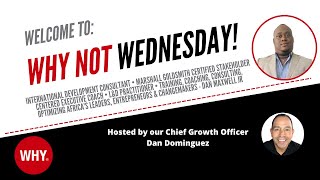
Dan Maxwell Jr. runs the Legacy Writing Salon, which helps small-business owners document their lives through interviews and transcription. His father died in 2018, which sparked the idea. He also trains young entrepreneurs in Africa through a UNDP partnership that's awarded microgrants to 300 people.
Questions this video answers
Eight clients
About four months
2018
Started 11 businesses; six failed, five remain (two sold; three still operational under him)
300 young people
Chapters
These last few years have made us question everything.
Our relationships.
Our jobs.
What constitutes an office.
And who we are.
In a.
World filled with chaos, confusion, and uncertainty. It's time for some clarity. It's time to start understanding one another.
It's time to start understanding ourselves.
We envision a world where everyone knows their why. But even more, we envision a world where everyone knows their why. O s. Their why, their how, and their what.
The operating system that drives you, that lets the world know where you stand.
What your unique gift is, and most importantly, who you are.
YOS.
Are you ready?
Hey, Good afternoon, everyone, and welcome to why not Wednesday. I am so excited to see everyone today. Thank you for being on. If you're listening and you're on social media, if you're watching on LinkedIn or on Facebook or on YouTube, don't forget to send us your comments so we can respond to them. I've got a great guest Today, Dan Maxwell Jr. Who is. We're. We're talking to him all the way from Liberia. Dan is an international development consultant. He's a Marshall Goldsmith, certified stakeholder. Certified stakeholder centered executive coach. That's a mouthful, Dan, but I. I'm so glad to have you here. We have a few Marshall Goldsmith coaches in our yos ranks. You are the founder of the Legacy writing Salon. And actually, let me bring you on because I like the way you're smiling as I'm introducing you, Dan. So you're the founder of the Legacy writing Salon, where you help successful professionals, executives, and entrepreneurs write and share their life stories in ways that leaves a transformational legacy for future generations. And you've got a great story, Dan, because over the last 20 years, you've. You've started 11 different businesses, six of which have failed, but five are still going. So you sold two of them, and they're still going. And there are three that are still operational under you. One is your international development consulting. Another one is a restaurant and catering services company, and of course, the Legacy writing Salon, which is what really attracted me to the work that you're doing. So welcome to the show, Dan.
Thanks for having me, Dan. Hey, and do you go by Dan or Daniel? I see you go by Daniel more. Right? Yeah.
You know what? You know, I'll be Daniel and you be Dan for the show purposes. Right, let's. I'll be Daniel, you be Dan, and that way we know who we're talking to. But. But, Dan, it's been really cool to read about you and. And the things that you're involved in.
You'Re in Liberia right now. So you're. It is, it is 8:30 in the evening there. So you're on UK Standard Time. So I love when I talk to guests that are in the future because you know, you can always tell us, hey, what's going to happen. Right.
But you're gonna happen a few hours from now. Right?
A few hours from now. So, so tell me a little bit about, you know, Dan Maxwell. You know, we always start with your why. Right. So your why is to make sense of the complex and challenging. And we, we did your yos a few months back. But. And your how is mastery. So how you make sense of things is by learning things at a deep level. And your what is to find a better way and share it with others. So let, let's start with that first. How does, how does the why of make sense feel to you? Are you that person that's always looking to solve problems and provide solutions?
Spot on, Spot on. Daniel. Listen, that's, I mean that's me. That's me right there. From, from as early as, you know, I can remember, like fourth grade, I was the one trying to understand why I was doing better in math and science and my classmates weren't. And we all had the same teacher, you know, and that led me into starting a tutorial service for my classmates. And at the time I didn't realize it, but I could, I somehow I could explain the material better to them than, than the teacher did and.
Right.
Many years later I'm work. I'm a learning and development specialist. I work in learning and development. I'm still teaching.
I love that because that is something that, that some people don't understand that it's a gift. Right. You have a gift for taking in a lot of information, making sense of it and often explaining it in a real simple way so that others can understand it. And this started all the way in fourth grade. Dan, you were.
And now that's the way I realized it. Yep.
And you're, and you're, you're a smart guy because you, you did you charge those students for the tutoring?
I did, I did at the time. So how can I even compare it? I was charging five Liberian dollars. Right. If I recall at the time, it might have been like maybe 7 US cents. Wow. Or something less. Yeah. I can't even remember the exact conversion. But it was, it was considerable. You know, it was, it was decent money for a nine year old, you know, when I had 30 students in my session. Yeah. So.
And how did that go over? I'd love to hear. How did that go over with your teacher? Because now the teacher's teaching and now. And Dan's running a tutoring service for profit after school with all the kids.
Yeah. I can't remember the exact expression. I know it wasn't frowned upon. I know that much. So. Because it continued for a while. So I can't remember his exact expression or anything like that now, but I certainly know it wasn't frowned upon because it went for a while.
Yeah. I mean, you were like the assistant that he didn't have to pay because the kids were paying you, right? Yeah, you know, definitely.
And we had our sessions during the recess period. We had. I think it's the same in the States. You, you know, break time and. Yeah, we'll go in a certain corner and folks will be having their lunch, and we're explaining maths and science.
I love this. Hey, Dan, you've got some fans. I. I've got. I see TJ Davidson in Texas says, howdy, Dan and Dan. And then Watson Jordan, North Carolina, says, welcome, Dan. Dan squared. Hey, they've already got a nickname for us, Bruce, Captain Kirk every week. And then our good friend Danica Treble, she says, better way. Why here? So her why is better way. Your how is mastery, which tells me you. You like to learn things at a deep level. And it sounds like that's what you did. You learned things, you understood them, and that's how you make sense of things. And then you explained it to your classmates. Right. And then your what is to find a better way. So you. You're constantly looking for better ways. Often people with the. With better way in their yos do exactly what you've done. You've started 11 different businesses. Some of them fail. You just move on to the better ones. But your current.
Focus is to grow your legacy writing salon. Tell us how that came to be.
So. So the legacy writing came. I lost my dad in 2018. And prior to his passing, there were times where, you know, family friends will say, oh, you. You're just like your dad, or you. You know, and at the time, I. Sometimes I would dismiss it. But when he passed, over the last two years or two years after his death, I began to really notice myself attracting or getting involved in similar circumstances that I remember him being involved in. You know, sometimes there were business challenges, sometimes there were personal issues. And on one occasion I was really down, and I wonder if he was around, I would go to him and ask, you know, how did you deal with this, but he wasn't. And the next thought that came to my mind was, I wish I had, you know, something like a journal or something where I could go and see, you know, how he. He did this and how he dealt with it, because I know he experienced something like this.
Right.
And I realized that, okay, this was needed because I didn't have it. And, and when I did a quick research, I realized that a lot of folks were talking about, you know, passing on values and issues. But then something, Something peculiar happened. You know, there's. There's a chapter of passage in the Bible.
Where. Proverbs. I can't remember the chapter right now. It's just skipping me where he says, a wise man leaves an inheritance for his children's children. And being a Christian, you know, I take that seriously. But then it occurred to me that inheritance doesn't have to only be, you know, physical, like real property or money. But, you know, the values and.
The belief systems and the way to deal with issues are also great inheritances that people can leave. And, and that's just what led to, you know, I had conversations with the next two, three persons I talked to, and they were all like, yes, this is something that's needed.
Yeah.
Yeah. So so far we've. We're. We're working with eight. Eight clients now. We'll be completing the first one in a couple of weeks. It takes about four months, I'm noticing, to get to completion. But yeah, we'll soon be have our first order. And yeah, it's. It's been a great thing. Experience so far.
So, so this all stemmed from. You're going through some troubles. You've got. You've got some questions that you, you're saying to yourself, man, I. I wish I could go to my dad and ask him. And you couldn't. Right? You. The questions. The time is. Has passed for that. But you figured you. That makes sense, right? You made sense of this. The solution is, what if we could get people to write their stories? I love the Bible passage, a wise man leaves an inheritance for his children's children. So you went to say, okay, people need to write this stuff down. But a lot of people don't have the time, or maybe they don't feel like they have the talent to write this stuff down. So how does the Legacy Writing Salon help people get this done?
So the way we do it is by interviewing the authors. Basically, first we get to structure. We have a deep dive to understand the general theme of your life and your work. And then we Break out and suggest based on that conversation, we agree, we co create the different themes around which the book is going to be made. So for some people we could look at things around different forks of the road. You know, maybe your life is headed in one direction and then all of something happens and it takes a different direction what happened around there? Or we move to, you know, issues around your work. How did you choose your line of work and what challenges, what decisions did you have to make? You know, so we, it's basically us interviewing you and we transcribe that interview and turn it into, into a chapter. And so it's me asking you series of questions and going deep into each of those. It's more like a coaching conversation really because it's asking those deep questions and sometimes I find that people, people forget or until that conversations I'll ask a question and the client will be like wow, I've forgotten this, you know, or I forgotten this experience. And, and people have come back to talk about the, the healing that comes from the experience. Just being able to, to go deep and bring these things up.
So yeah, yeah, well, you know Dan, that is so valuable. I, I see how valuable that that could be and I can see how people would want to know to, to do this with you. You, you've mentioned you're, you're about to publish your first one, right? Tell us about the people that are coming to you. So you've working with eight people. What's the, what's the profile of somebody that's hiring the Legacy Writing salon right now?
50 years old has had his or her share of ups and downs in life. The ups have outweighed the downs for sure. And yeah, so they're at their.
Mostly they're all small business owners.
But they're concerned about leaving something for the next generation. Making an impact.
The general idea is to write a book that makes an impact.
On the reader. So I've got four of them in the us I've got two in Nigeria, that's six. And then one out of South Africa and then one from Liberia here. Yeah.
So two and two in Nigeria, one in Liberia and what was the other one?
South Africa.
Excellent. So man, you are really reaching all parts of the world now. What's the purpose of the book? Is the book to be published to, to the general population? Is this something that goes to the family? What are the different avenues? And if, because hey man, you're talking to me. I'm that 50 year old guy that needs to, to write that legacy. So if I brought, if I sign.
On with you, yeah, it's a choice. But all of them want to publish and put it out into the world, you know, and, and the thing is, as I, as I talked like out of the, there's, there's two coaches in the US and, and you know, transformational work, very personal. And we've agreed and we've seen how the books could also serve as a tool for business building for them. You know, you want to enter a new space, you can use your book and people will read your book and connect with your story and you know, that will serve as a reason and that could open doors, you know, so they're all going to be published, but I expect at some point somebody's going to want to write a book and, and say, you know what, I'm just leaving it in the safe or along with everything else just for my children and my grandchildren.
So, so far, so far right now everybody's going public, but that, that could be, that is an option for someone if they, if they hire you to tell their story.
Right?
That's fabulous. So, so one of the things that I, that, that attracted me to you, Dan, is you're also a Marshall Goldsmith certified stakeholder centered executive coach. So you're doing some executive coaching also. Are some of these people that you're working with also clients? And they, they, as you're working with them, all of a sudden their story comes up and you say, hey, wait a minute, I've got something to help you.
That's, that's how, that's actually how I've got the most recent client. So there's, there's, I work within the coaching and consulting practice. I work a lot with high level government officials, senior level government officials, and I recently supported a particular arm of government in their strategic plan review. And as part of that process, we spent some time doing some self awareness exercises and introspection and you know, one thing led to the other and yeah, we know how we work along. One person that came out of that, that experience.
Excellent, excellent. And, and Dan, I love that that you're working and that you've grown because when we spoke, I think we met a couple of months ago, you, you didn't have as many clients, so you've got eight clients that you're working with. And that, that obviously speaks to the success that, that you're having. Let, let me ask you about something else. I'm gonna, I'm gonna switch gears if I can because I want to talk about this startup business plan competition that you're doing for the kids in Lib for young people in Liberia. And I posted about that today. So you're helping youth led startup businesses and providing them access to some needed tools and resources so they can achieve transformational impact at the local level, but all the way across the world for us in Liberia. Tell us about that program.
Yeah, so for this one, we're partnering with the UN DPs, that's the United Nations Development Program. They're actually providing the funding for that. And what we're going to be doing is we're going to be training 300 young people.
And.
Then take them through a business plan competition and they're each going to receive micro grants of $500 each to start their very micro businesses at the local level. You know, globally there's economic crisis, but you know, for a country such as ours there, things are a little really, they're really tough. So jobs aren't many. And so we have to go the entrepreneurial route. And that's one of the things that I do, aside from my consulting, you know, as part of my way of serving, I run a project called Optimizing Africa.
Okay.
That's, that's focused on supercharging. I say I want to supercharge young professionals, entrepreneurs and leaders. And within Optimizing Africa, we do a number of different things. Last April, I got together with some coaches in my own coach in Coaching Community with Rich Lippin. And we raised $17,000. And through that we were able to provide free coaching, free training support for up to 20 young entrepreneurs and leaders, including teachers. Two of them, through the support we give them, they've been able to obtain international scholarships and they're gone for international studies. One of them became, One of them launched her book and she became the national best teacher of the year. Because of the books that she published.
We're making as best of an impact as we can at the local level. And sometimes, sometimes we get envious of those who are making much bigger impact. But I think this is where we are right now and we do the best that we can here.
I love that. I love that. And so did she. What was the award like? Was it a national award for the best teacher? Tell me about that.
Yeah, so she's actually, she's in college, but she's, she teaches early childhood and yeah, it was a national award. So she's a national celebrity and she's been invited to places and she's speaking and inspiring others. You know, globally teachers are not very well paid and Here, for that matter, it's the same. Right. And even teachers are some of the least paid here in Nigeria. So it takes passion and a real desire to serve to be a teacher here. And she's been able to inspire people. Young people particularly are shying away from the profession because they don't see it being profitable. So yeah, she's now being a motivation and inspiration to others.
Congratulations on doing that. My wife is a teacher, so I've got a special place in my heart for teachers.
A soft spot for. Yeah, yes.
Because you know, you're absolutely right. They're never the highest paid, but they, they, they, they just love what they do. And for you to help her get that national recognition and to be able to, to, to work and spread the message of the importance of having good teachers. So let me, you know, you haven't been in the U. S. You know, when we, when we first spoke, I think you were in Liberia that first time we spoke. But you've been all over the world. What are some of the countries you've been in? And you haven't been in the US since 2007 but you work with four of your authors are in the US so tell me what countries have you been in?
Yeah, so I haven't been in the US since 2007, but I'm based in Liberia. But I've been obviously Ghana, Cote d', Ivoire, South Africa, Uganda, Kenya, Singapore, Cambodia. Cambodia. The Netherlands. Yeah, I think that's it so far.
Wow.
Ethiopia. Yeah.
Okay. And so how do you, how do you work with your U.S. clients? Because as, as you mentioned, you got four of your authors are in the U.S. how do, where do, how do you find the authors? And then you mentioned it's through your coaching sometimes. Right, you're doing the coaching and then it leads to the, these authorships. How else are you doing there?
So I am, one of my coaches is Rich Litvin and he's the co author of the book the Prosperous Coach.
We use the prosperous coach approach. It connects with people. Yes. I haven't been to the U.S. but hey, with technology now there's no barrier. Right, right. My company, I still have an LLC registered in the US and you know, I have a stripe account, so that's not a problem. You get paid. Yeah, you know, and I use zoom and we're moving, things are happening. So. Yeah, and I use LinkedIn a lot. I have LinkedIn to credit for a lot of my business. Even locally I do a lot of reach out through LinkedIn. I mean we connected on LinkedIn. And yeah, so I do a lot of outreach on LinkedIn. That's. That's basically it.
So Danica, Danica says Rich Litvin is amazing. So she's familiar with him. We, we got a, a shout out from Bella. Bella says hi. Dan and Dan squared excited about this. A few people are having some technical issues. Hopefully the recording is really good. But you were going to tell us some of the steps that you use from the prosperous coach to. In your process. So what are they?
So, yeah, so the first step is to connect. And, you know, it's never about just making another sale or getting another client. You know, I'm interested in making a deeper connection and understanding who you are as an individual. And only if there is a genuine opportunity for me to be of service, then I invite you to experience service. And even with the legacy writing, that's what we do. We don't move to have you as a client. What we say is, come and experience our process and let's do the first chapter for you. And only after doing that first chapter, you've seen our entire process. You've been a part of it and you've read the output. And if it makes sense for you to continue, then we talk business. So it's connect and then invite and then we serve. So after serving, if we think, if we both think that it makes sense to move forward, then we propose an offer and basically that's the process in a nutshell.
Hey, did you hear that? He said makes sense. If it makes sense, then we move forward.
I didn't even notice.
So, so, so, Dan, one of the things that, that, that I have found. So we've done this, you know, obviously, obviously with hundreds of people and hundreds of thousands of people. I've done it with hundreds of people in terms of helping them discover their why operating system. But when I meet someone with the why of makes sense, a lot of people say that. I noticed that they use makes sense a lot. They say, does that make sense? And, and, and it's so funny because after they know their why is make sense, they start noticing it in their conversations. So I don't know if you noticed that since.
And now that you said it, you know that I use that phrase a lot in my trainings. I mean, every, every training that I'm running, like I, I'm always asking that question, am I making sense? Does that make sense? You know, so. Yeah. Wow.
Well, it, and I will tell you that, you know, it makes sense that you do that because as a. Makes sense. Why you solve things quickly. So for you, it's going to come really easily. You may understand it way before everybody else does. So one of the things you learn to do is to ask, hey, does that make sense? Because you will leave people behind if you. If you're left to your own desire.
You're not slowing down.
Yeah, right. You will not slow down because you get it, and you're ready to keep going when you're, when you're a leader and your why is make sense. In an organization, you have to make sure you're letting people take the time to understand what it is that. That you just figured out, and you're ready to go. But your team is in the background saying, hold on, Dan, we're. We're not there yet.
Right. We need to catch on. Yeah.
Yeah.
So let me. Let me ask you a couple more questions because have you had the opportunity, Dan, to. To use the why or talk about yourself using your why be in. In your practice or within, with any of your clients just to say, hey, listen, when you work with Dan Maxwell, I'm a problem solver, and I'm here to help you solve the problem of not being able to tell your story or not leaving your legacy. Tell me a little bit about that.
What's the problem Dan Maxwell solved?
I wasn't using that after I did, you know, I did the why discovery. And then we had that intra call. So I go back and I'm reading the why. I'm like, all right, well, this, this is a. This is a sales script for me. You know, it's like, have you. Why. Why do you. Have you had XYZ experience? Like, you know, sometimes I will know about a particular experience in the conversation, and then I bring them. Like, my job is to make. Help you make sense of the experience that you had 20 years ago. And what did it mean then and what does it mean now 20 years later? And how can your children or your grandchildren benefit? You know, and so it's always coming as, you know, since I did that discovery. And people. People generally see the benefit right away. You know, it's like the way I experienced something then and what I thought it meant now. In hindsight, it means something different.
And.
And then this is the value that it all brings, you know, so, yeah.
Yeah, I want to recognize TJ Bennett. I think I'm gonna see you tomorrow, tj but he says I'm gonna make sense why as well and have realized I say it all the time. Very interesting.
All the time. Yeah.
You got some kudos from Bruce Captain Kirk. He says seeking alignment. Love. Love it, Dan. And so you know, that's, I think when you were talking about the seeking alignment in, in your process that you use to connect with people, to invite them, be of service and then propose an offer. And, and I think if more people did that, I, I just spoke to Mark Hunter is the, the, the sales hunter and he talks about, you know, closing a sale is not the end of, of the relationship. That is actually the start of the relationship.
It's opening the relationship.
Opening the relationship. That's exactly what he said. So you're familiar with that. And, and I really like that because in the sales world we often can get caught up in hey, let's just try to close some deals, right? And I love the approach that you're taking. Hey, let's connect first. Let's invite you to see whether this is a fit and let's see how this can serve you and then propose an offer. And it's obviously served you well in all of the businesses that you've had. So.
Dan, what, what should. If somebody wanted to tell their story and they wanted to hire the, the, the writing, your, your services. Let me make sure I get it right. The, the legacy writing salon, how would they go about doing that? What's the best way to do that?
The best way to do it is to go to LegacyWriting Co and then at the end there's a calendar form. It's just simple book a time and let's, let's give you an experience of it. Let's connect. The initial connection is a 30 minute connection. And then once we, we with that makes sense, we can move on to an hour where we go take you through the entire process and after then we, we move forward if need be. If it makes sense.
If it makes sense. I love that you finished with a. Makes sense. What do you say we end the show on that note, Dan?
Why not? Daniel? Why not?
I love it. Thank you so much, Dan. It's been a pleasure. Guys. I'm sorry about the, the, the poor connection Dan is. Look, I love that he froze with that great smile on his face. You know, we're. One of the challenges we have in his part of the world is getting great Internet service. But he did a great job. Dan, we are so glad you came on and shared the work that you're doing not just with legacy writing, but also with your sponsoring youth, youth sponsorship of small businesses and helping people realize their dreams in a part of the world that really needs your help. So if anybody out here would love to, would like to tell your story and get that written so that you can put it out to the world, don't, don't hesitate to reach out to Dan Maxwell, Jr. And I want to invite all of you guys to come back next week because next week we've got Robin Treasure with us. So it's going to be a great show. For now, it's the end of our why not Wednesday? Dan, have a great rest of your week, and I look forward to talking to you again.
Thank you so much, buddy. Thank you for having me.
More from Dr.




Women In Leadership: A Need For A Greater Systemic Change With Belinda Clemmensen






