WHY NOT Wednesday! with Dave Sanderson
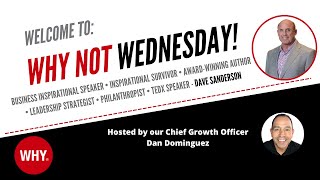
Dave Sanderson survived the Miracle on the Hudson and explains how the crash became his turning point. He talks about finding your why, building trust through your word, and learning from mentors like Tony Robbins. He flew again the week after the crash.
Questions this video answers
Hugh Hornsby — Vice President of Sales for Everflow Supplies.
The 14th anniversary.
Chapters
Our jobs.
What constitutes an office.
And.
Who we are.
In a world filled with chaos, confusion and uncertainty. It's time for some clarity. It's time to start understanding one another.
It's time to start understanding ourselves.
We envision a world where everyone knows their why. But even more, we envision a world where everyone knows their why. O s their why, their how and their what. The operating system that drives you, that lets the world know where you stand.
What your unique gift is, and most importantly, who you are.
Yos.
Are you ready?
Hello.
This is Hugh Hornsby, Vice President of Sales for Everflow Supplies, and the newest guest host, filling in for Dan Dominguez. I am thrilled today to be introducing one of the real icons and one of the real great people in our industry.
And that is Dave Sanderson. Dave's an amazing guy.
I thought I knew him. And Dave, when I started reading your bio, I was like, there's no way that he did everything that he's done, but it's amazing. Dave, I've.
I have a lot of respect for you and just, I mean, for the last day or two, I've been thinking, every time I would get mad, it was something I'd say, hey, you know, what would Dave do? So, Dave, I just. I just wanted to introduce you and just say thank you for, for joining us on. On the Y Institute and giving me an opportunity. It's my first go around.
To somebody that's so special. I just want to say thank you for that. And Dave, when I read your bio, I. There's a lot of things I can say about you, but the one that always comes up is that when you went down in the Hudson and how your mind shifted in a different direction and how instead of trying to save yourself, there was something that happened in your mind that kicked in and, and you ended up going to the back of the plane and. And can you kind of explain a little bit about that?
Well, you. Thank you and thank Dan for inviting me to be with you today. It's. It's one of those weeks of the year where hopefully everybody's getting a little RR time and start reflecting about what's really went well this last year and what they could do to contribute more into the following year. And that's. So I really am honored to be here this week with you. And yeah, we're coming up on the 14th anniversary of the miracle on the Hudson, the plane that went down the Hudson River. And you know, as you know a little bit about my. Wasn't supposed to be on that plane. I was scheduled to be on the five o' clock flight. But I think everything does happen for a reason and a purpose. You know, I think that everybody that was on that plane that day, he was supposed to be on that plane. I think everybody served a role. I think some people were there to give, some people were there to grow, some people are there to face their fears. And candidly, for me, as the moment you're talking about for me was shortly after the plane went down because up to that point, you know, we crossed over the George Washington Bridge and I heard those famous words from the captain. This is your captain. Brace for impact. At that point, I didn't think I was going to come back. I think pretty much everybody I talked to passenger wise on that plane had a ceiling that it's probably going to be the last time we, we have a chance to even check in with our loved ones. So it was, it was one of those dire, I would say, defining moments of our lives where you get to sort of check in and see where your life has come from and where you got to be, where you're at. My game plan, you know, when we were going down and once we got down was aisle up, out, I just kept saying in my head, because part of, part of, you know, I grew up doing sales and management and leadership was I always had a game plan. I grew up in sports where you always had a game plan. So, you know, you're going to sort of at least have a direction to go in the middle of something. So my game plan was aisle up, out. So when it was my turn to get to the aisle, I say, I'll up out. I'll up out. But then that's, that's the moment that triggered something that I hadn't heard for probably 30, 40, maybe close to 50 years. When my mom would talk to me when I was a child and you know, my mom passed away in 1997, but what she used to tell me when I was a child was if you do the right thing, God will take care. And whether you believe in greater, greater being or not, that's totally. I honor anybody's decision. But for me, I call that my creator, God. And at that moment in time, I had to make a decision. And the easy choice for me was just to go on out. I was there and I don't think anything would have probably changed, you know, because I was going to go out. But when I heard that, it triggered something in me that, you know, you know, the right thing for me was, you Take care of other people first. See, I grew up in a small town outside of Cincinnati, Ohio, where people knew everybody. I ran with a great group of guys that always had each other's backs. So for me it just was. I knew I was okay, I was alive, but I didn't know what was going on towards the back of the plane. So that's when I climbed over the seats towards the back of the plants, if anybody needed help. And in the back, it was moving pretty well. I mean, these things were moving pretty quickly because you got from the angle of the plane you see from the front, you don't understand. The back of the plane was already submerged underwater. So the water was already about chest to neck level deep in the back it was very, very deep. And it was 36 degree water.
So people are moving very quickly. So I just got behind the last person and I started making my way out. Like everybody, you gotta remember the way the plane landed. You saw the, how the plane landed, Atlanta backside first. So the impact came from the back. So all the bins have popped open, luggage is floating in the water and you hear about chest level, deep in the water. So it was, it was not easy getting out. But then I looked up and I saw the light on the right, which was a ten fold. I later found out I'm like, I'm out of here. My time to go. And when I started getting out, I looked out and I saw something that it was an amazing sight, that there was no room on the wing for me because it's already filled up. There was no room on a little lifeboat because it's already filled up. But people are already being rescued. And I tell people I think that's the true heroes from the day. There are a lot of heroes. But I believe the true heroes were the first responders who were there within a couple minutes to help other people. Because this whole day was about helping other people. I think that's part of the big message.
Well, I tell you, you know, you and I have only known each other, what, a couple months now, but it seems like it's been, you know, a lot longer than that. And as I've spent time with you, I think you're just an amazing person on how you, how you not only.
Have gone down in the Hudson and, and responded after that, but how you care for other people. So that kind of comes to us about with the why. And I think you learned about the why. Was that through maybe Larry, Larry Levine and his group?
Well, you know, it's interesting, you know, I think, I think when I, when Larry and, and Dan's group came together, I think that's what crystallized it. But I knew, I knew for a long time my big why was to give back and contribute. Because one of the things I learned, as you know about me, I was in security for Tony Robbins for over 10 years. He mentored me. I got to travel with him. I got to learn the insights from what he teaches. I got the insights. And part of that is the six human needs. And one of the, one of the six human needs is the need to contribute. And I think that was when I made a major shift because you know me, I haven't been in sales for 35 plus years. Most salespeople are driven towards achievement, towards significance. So when you get, get the number, be the top guy. And listen, I was that guy. I mean, I liked winning, I liked making money. But there was a time when in my life I started realizing, you know, that life's more than about me winning all the time. It's got to be about giving back to other people who got me to where I'm at. And that started with Bill and my mentor and then Tony and then now with Don Barden and other people who've mentored me. So, yeah, I, I really believe that day was about contribution. I think people check their egos at the door. I think people, you know, and that's one of the biggest lessons out of that. Also you, is this is. And I, I think people understand. He had 155 people who didn't know each other, who care about each other on a plane, who came together in less than six minutes to do something had never been done before. They check the egos at the door and say, you know, this is about a bigger thing than us. And I think that's part of what my makeup is. Can we, you know, I'd rather at this point in my life make sure somebody else gets their outcomes because eventually, as Zig Ziglar says, it'll always come back to you tenfold somewhere in your life. Always. You just don't know when it's going to come.
Well, and I, and I know that's true because I know you've worked with some of my guys, Jake Lasaris and a few others, and it's amazing how you've had an impact on them. And I really appreciate that from you. Your. How is simplify does that. Is that. Is that you?
That is me. I mean, one of the things, I get really frustrated. I still get frustrated as when things are complex, you know, and it's like, you know, my goal is always, how can I get. Get it down to simplify, Especially when I'm working with clients. Because one of the things I learned is, you know, I tell stories. I think people learn best through stories. So I try to simplify a concept down to a story so people can sort of understand and relate. And I actually wrote about this yesterday in my blog, I left it to Beaver. Because one of the things you realize when you go through a very complex situation, whether it's a sale, a business transaction of relationship, is that if you go back to your values, what you grew up with, what your core true self is, it actually is really simple, is when we try to go out of our true selves and try to go bigger than we are and try to be somebody we're not. So when everything gets really complex and people start having those challenges and whether it's their relationships or whatever. So, yeah, I, I focus on how can I simplify a process every single thing I do. And that's why, you know, you met my, my E.A. kelly, and her job is to help me simplify me.
Yeah, yeah. And she does a great job of that with you. My, my challenge is my why I kind of, you know, look at things from a different perspective. That's probably because I've got a story that goes with that. But my, my, my. How is it simplify as well? I like, you know, I like things being simple. That gets me in trouble sometimes because the people that are masteries just don't think I look at, look deep enough.
That's right.
But if I get one or two things done, I feel like, hey, I'm in the right direction. But the other thing that about you, and I think it fits you 100%, is your what, which is trust.
You know, I think that you're a person that if I ask you to do something, you do it. If you ask me to do something, I don't do it. You probably get a little. You get really provoked with that.
Does that fit you?
That's accurate. Because one of the things my dad always taught me was your word is your bond. And he, I mean, he, from the youngest age, he'd always tell me, whatever I said, you better be able to back it up. You don't back it up, you lose people's trust. And if you lose somebody's trust, all of a sudden you don't have. When you need something, they're not there for you. So one thing I've always, I mean, I've done this since I was a kid is if I said something, I'm going to back it up. And you're exactly right. If you want to get me on the other side, the frustrated side is that is when someone promised me they're going to do something and they don't do it or they do a half job on it and they don't put the, put the time and effort in to get it done what they said they're going to get done. Now if you don't, if you tell me you're not going to get it done, I got it. I won't figure out another way. But you're exactly right. You know, my dad taught me that years ago and I think my. One of the, you know the story about me and going to college, right? I mean our college, he maybe told me he had 30 days to get a job or I was out of the house. And he was a man whose word he, he meant that in 30 days.
He had to help.
I went out of the house.
Yeah. My father in law was a general in the air force and we used to sit down and my dad was an entrepreneur and they always, they, those two would sit down and talk about being seidou guys. You know, they, they, they couldn't not stand to have somebody that said something and didn't do it. So it, that was pretty, pretty neat. So we've got Mark Hunter in the house. He's. I know you and Mark. We're good friends. In fact, we've always talked about proximity. That was one of the things that you talked about a lot when we were together at Larry's event. You wanna, you wanna kind of build on that a little bit. Because I think that all goes back to your mentoring that you had with Bill.
It was. And that's one of the greatest lessons he taught me is you know, we talk about how proximity is power and I'm not, I'm not the guy came up with that. All I did is do the second part. I took action on it. I always put myself around proximity, around people who once or I could learn something from. And that's how I grew up. Because what Bill used to do with me, and Bill was my first mentor back started back in 1984 for me for 14 years, 13, 14 years before he passed away is he would take me to his cabinet, he's in the barbecue place. And all of a sudden you're at barbecue, you got a bib on, right? You can barbecue. And all of a sudden the CEO of NCMB banks there and First Union, and you have all these CEOs in there with the bibs on. He put me in proximity of people who had knowledge, wisdom, who made decisions. So it really taught me a lesson about if I could just stay in proximity, I don't have to have to be that person, but I have proximity and understand their mindset. Now I'm not going to have an education, but I'm able to take that and impact somebody else's life.
And. And is that how you ended up being on Tony, Tony's staff? Did, did you. Did you just one day decide, okay, I'm gonna go jump on his security detail?
That's not how it works with Tony. That's not how it works at all. Tony's all about trust and loyalty, right? So, you know what I did do is this is. I did pay my own way to go to be on the staff of one of his events over in Maui, Hawaii. And I was the guy putting brochures down in the middle of the night and just happened to be that a couple, couple gentlemen were talking to his former wife and I could see she was uncomfortable. All I said was, I think Mr. Robbins needs you in the back, Mrs. Robbins. That's all I said. And she said, you handle that very well. I said, she asked me if I wanted to, you know, be on security team. I said, it's better than putting brochures down, man. So, you know, I, I sat for five days here. I sat and I just, I did not move, but I was back in degree proximity. How these things come together right in the mindset. So, no, I, it was intentional to be at the event. But see, you gotta be. You got to be in the game, right? Like, like Teddy Rovers arrested, man. You got to be in the game to get, get an outcome. And most people don't even want to get in the game because they're afraid. I have fear that something's going to happen or they're going to be seen in a different way or whatever. My goal is to be in the game. Let's see how, let's see how the game's played.
Yeah, because you can't. You can't win. You can't win if you don't. We have a thing at Everflow that we talk about stepping on the mat. And I know Sean Hearn is on here today where he always talks about, hey, you got to step on the mat. If you don't step on the mat, then you're not going to play. And it's, it's it's amazing because Jackie Joy, you know, Jackie really well, ran a, a mastermind talking about fear and how, you know, how that has effect on each individual person that's out there.
Do you have any suggestions for some of those people? Because all of us go through fear. Was there something that you do differently that, that has helped you kind of break through that?
Yeah, I thank you for that question because yeah, it was a mind shift for me. It definitely was a mind shift because we all go through fear. I mean, you know, when you fear not gonna get the sale or you fear that your relationship, something's not going right. But you know, what I learned and what I practiced and started practicing consistently has helped me get over that. Even when I went back into the Hudson river last year, when I went into swim to the Hudson river currents, 3.1 miles with the elite and I had no business being there. I initially I had some thoughts about fear. But the way to combat fear is to have gratitude. Because if you have gratitude giving thanks to something bigger than yourself, you can't be fearful because you always have somebody with you. So the way I combat fear when I get into those situations where I'm questioning things like do I really need to be here is I say, say a prayer of gratitude thanks to my, my, my, my greater being, which I believe in my personal life is God, and thank him for giving me the opportunity to learn. And all of a sudden I have no fear. So that's how we jumped back into Hudson river and swam with the seals and raised money for those who were on hard times.
It's funny because my mentor always told me, Hugh, you know, faith, faith equals courage. And if, if you think that you have to go out and do all of this on your own, then, then you're going to have a really difficult time that you've got to have faith not only in something else, but faith in yourself. And if you have that, then taking that next step makes it so much easier.
So yeah, and you're, I mean, take the next step from what you just said. Thank you for prompting. That is. Well, how do you get gratitude and put yourself in the proper state, like Tony said, state management. Put yourself in the proper state of mind. Most people go, go to those deep dark recesses in their brain when things like have. Instead of going to a place where now how can I be, you know, whether it's through my body, my physiology, my, my language patterns or what I focus on, that can also change and turn you around to have gratitude, which gets you out of fear.
Yeah. It's funny because yesterday I was driving down the road in Alexandria, Virginia, not too far from where you grew up, and the guy behind me started honking the horn and yelling at me and, and using his hands creatively. Knowledge. And I, it was, it was like. And I said, you know, I think I just, I just decided to bring it down a level. It's like, I'm not going to let him, you know, ruin my day. And it actually made me calm down a little bit more.
So he's having a tough day. So, you know, he's having a tough day. Maybe he needs to have a step back.
And you never know. I mean, I'm close to a hospital. He could have been rushing to a hospital and something else was going on. And we, sometimes we react that way. And, and I think that what you talk about with attitude and gratitude, I mean, I, I preach that all the time, is that, you know, you get, you're a mirror of how you treat other people. And, you know, and I would say that if everybody out here today just goes in and opens the door for somebody, then, then you're helping to make a difference.
That's right. You take a step.
Yeah, you're, you're exactly right. And, and.
But one of the, one of the things that, that you always say, say I've heard you say, is that, that we all have that personal airplane moment. Can you explain that a little bit?
Yeah. I call it the personal plane crash moment. And Kaylee, you know, I came out right when Covid. I started. I just said this to somebody out of randomly. I said this right before COVID hit. Because what I realized is everybody's got those moments in life that something's going to happen. It doesn't need to be a literal plane crash like me, but you may have a car wreck, you may have cancer, you may, you know, you may have something going on in your life.
Right.
That even the Queen of England, when all stuff is breaking loose with, you know, everything else, she had personal plane crash moments. So no one in life goes through life without something happening. And if you don't respond and don't have to have the mental strategy and strength to respond to resiliency, to respond accordingly, it could take you down a deep path you don't want to be. And that's, that's one of the things I really didn't want people understand is, you know, you're not, you're not unique. You're not the first person to have a personal plane crash moment. In their life. Everybody's got one. It's how you respond and putting yourself in the right state of mind and going with an act of gratitude to get through those personal plane crash moments.
Well, and the way that you responded to yours was with a positive, where you said a lot of people that went down, you know, they ended up, you know, with a negative. So obviously that was something that in your mindset, you decided to do probably, you know, a lot more than everybody else would do. A lot of people would have just gotten, you know, never wanted to get on a plane again. I think you got on a plane the next week was. Is that correct?
That's correct. When I got back to Charlotte, as you know, the story, I didn't even know my company knew that I was in a plane crash because no one had contacted me or my wife. And so when I went back in, just to check in and I had sweats on, right. I looked beat up because I was pretty well beat up. And I just. He just asked my manager, my regional manager asked me to go to Michigan the next week. He said, you're going to Michigan next week.
Right.
And I had to make a decision. I could have said no, but I said yes. And it was probably a good decision for me to make because I need to get back on a plane. But it also told me that, you know, sometimes, you know, people are looking out for their own personal wins, sometimes they don't look at the bigger win and other people worth of going through. And we. You just mentioned that or, you know, you don't know somebody's backstory unless you know somebody's backstory. How can you judge them? If you start judging people and don't know that, then all of a sudden you may be going down the wrong path. So, yeah, I got on the plane the next week and Kaylee, it was a pretty dicey flight. I think I sure may have shared with you. I mean, I was flying from Charlotte up to Michigan and it was, it was a puddle jumper and I was on Delta. And hey, listen, I have nothing. I love Delta, but I was a rock star on US Airways. No one knew me on Delta, so I was in the back of the plane. But fortunately, someone, the flight attendants saw me on an interview, told the captain, and he came back and he and I had a little one on one as we were flying. He sort of gave me some different perspectives, which is, which is what I needed, right. I knew that was safe, but he was sort of giving me that check in. So, yeah, you never know. How things are going to work out. But I had to help you. I mean, if you don't get right back on it, you probably will never get back on. Still a few people from that day still haven't got back on a plane.
Well, and God works in so many mysterious ways. It's just amazing.
Any advice for people that are looking at using the why, you know, any advice for them as far as the ones that really are just trying to figure it out? Do you have any suggestions?
Yeah, I think it's a great tool. I mean, I saw the tool. I love the tool because, you know, because it goes back to my, you know, my, you know, how my what or how I forget which one. Simplify.
Right.
It simplifies and lets you understand pretty quickly how you think. Right. And, and I think, and one of the things I like using it for, especially in business, is if I can understand this why one of my clients or potential clients and understand what's driving them. Now I know the conversations I'm going to have with them because if you're going to have a conversation with me in business, you better really talk about, you know, how this enterprise can help me contribute more, how it's going to simplify my life.
Right.
And at 2:00 clock in the morning, you can call me with your problem. You hit those three points with me, we probably got a sale. So I was using the other way. I understand how somebody else's why is.
Yeah. And that's what we use it for both with our team and we're starting to use it with our clients as well just to have a better understanding. You know, we could talk forever and you know how much I think of you and looking forward to having another conversation with you. But you know, what we usually in this thing with Dave is, you know, what is. Do you have a why not moment that, that you can.
Share with it with, with everybody?
A why not moment?
Well, that's a good question. I'm giving one more piece of clarity on what, what a why not moment. How, what your perspective. A why not moment is.
Well, and I knew this would be a hard question for you because you've done a lot of why not comments within your life, so there's probably not one that sticks out. But it's usually something whether you, you know, it's when you decided to marry your wife or whatever it may be. It's different for everybody.
Yeah, I mean that's, you know, that's probably the one that's the most, that's probably the most defining moment I had, you know, it was interesting. I'm glad you said that because, you know, you know, she and I are so sympathetic, you know, we're so different. You know, I mean, she has, she's, she drives on certainty, I drive on variety and contribution.
Right.
So. But that's what makes us click. But I'll leave you with this is when I was telling my mother in law over Christmas, my father in law passed away last year and I shared with us, you know, one of the things that your husband told me on our wedding night, it stuck with me. And it will be something that'd be a piece of advice I share with my daughters. And their son in law says, you own it now. And what he was telling me was, you know, I've, I've taken her this far. This is your responsibility now to take care of things, to be a man, make the decisions, step up. And I think that's one of the greatest pieces of advice I've ever received is, you know, the torch passes. You know, I think that's we're all doing. That's what I'm trying to do right now with what Bill's done with me. And I committed to teach what I'm teaching to a million people, as you know. And I'm honored to be able to teach and coach some of your folks because they're going to help me be able to teach this to a million people. So the torch passes on and I think it's incumbent on us to mentor somebody, to coach somebody to teach them what we do so it doesn't die with us.
I love that. I absolutely love that night. I can't tell you how much I respect you and really, you know, the friendship that we've built and just everything that you give, it's amazing. So thank you for that friendship for me, but thank you for that friendship for the Y community and everybody else. And Dave, just thanks for giving back. We really appreciate it. And thanks for joining us today. Hopefully we can have you back at, you know, another time.
Thank you very much. I'm honored to be here. But everybody have a great new year. Safe new Year. Thank you.
All right, thanks. Thank you, Dave.
More from Dr.




Women In Leadership: A Need For A Greater Systemic Change With Belinda Clemmensen






