WHY NOT Wednesday! with Deseri Garcia
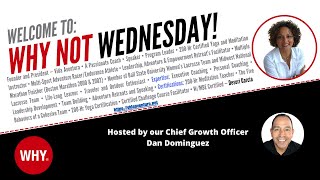
Deseri Garcia left nearly 20 years in corporate America to start Vida Aventura, a company running retreats for women. She operates on a simple system: contribute, make sense of complexity, simplify. She left when staying hurt more than leaving.
Chapters
These last few years have made us question everything.
Our relationships.
Our jobs.
What constitutes an office.
And who we are.
In a.
World filled with chaos, confusion and uncertainty. It's time for some clarity. It's time to start understanding one another.
It's time to start understanding ourselves.
We envision a world where everyone knows their why. But even more, we envision a world where everyone knows their why. O s, their why, their how and their what.
The operating system that drives you, that lets the world know where you stand.
What your unique gift is, and most importantly, who you are.
Yos.
Are you ready?
Hey, I love that. Are you ready at the end of that? So I cannot wait to introduce you to today's guest on why not Wednesday, Des Rager Garcia. She is a passionate coach, a facilitator and a speaker with nearly 20 years experience in corporate America. She implements creative, experiential and personalized programs that challenge, motivate and transform her clients. Her tireless pursuit of possibility gets results tangible, solid proof of purchase outcomes. So whether it's through a half day workshop, a one on one session or an extended training designed to your business specific goals, Desiree will lead you and your team on an adventure of a lifetime. Uncovering individual potential, your truth. And isn't that what the journey is all about? I am so excited to introduce you all to Desiree Garcia. Welcome to the show, Desiree.
Thanks so much, Dan.
Hey, you've got a great background song. I want to make sure to play it for everybody. Let's see here. And, and let's see if I can figure this out. Here we go.
So I asked you about your background song.
Yeah.
Some people will know this is my fly song. They'll know what that means.
Well, I, I hope there are a lot of your people listening. Great song. Hey, why don't we start with that question.
What a great song. Why that song, Desiree? We had a couple to choose from, but that was the one you chose.
Well, so it's called Conviction of the heart and for me that that song was actually, it was a song that was given to me in a transformational leadership work that I was doing and it, it fit. Even though I didn't quite know yet what my journey was going to be in terms of coaching and training and development. It, it fit because there I just had this conviction of the heart to make an impact.
Yeah. And doesn't that fit right with your why of contribute? You wanted to make an impact. The conviction of the heart. So as we, we do this every week, Desiree, I like to start with, with the. The first question I like to ask our. Our guests is, hey, let's go over your why the operating system? So your why is to contribute, right? Make an impact, contribute to the success of others, contribute to a greater cause. Your how is to make sense of the complex and challenging. That means you're a problem solver. You like to help people get unstuck. And your what is simplify. You deliver things that are simple and easy to implement. How did that fit you when we went. It's been a while since we did it, but how did that feel to you when we went through.
Felt like home. It. It made complete sense to me, given the work that I. I like to say I get to do it. Oh, I love that because I. I love what I. What I get to do. And to be able to come alongside people and be a contribution to them, their greater cause.
Yes. You know what? I love you. I love that you said that. Because I tell people all the time that the reason I have energy. People say, dan, every time I talk to you, you look like you got unlimited energy. And I bet it's the same with you, Desiree. I get to live my why Every single day, you and I share, contribute, and make sense. I'm contribute. Challenge makes sense. You're contribute makes sense. Simplify. But every day I get to do this in my work. And every day, you make a difference in the people, in the lives of others. Every day you help people get unstuck and make sense of what's going on in their lives. And then every day you deliver simple solutions.
Right? So, yeah, I mean it. I feel incredibly blessed to get to live out my yos. Like, how freaking cool is that?
Yeah, it is. It is. And it's an understanding. And we have a video we play when we. When we're doing trainings about Michael Jr. And a music teacher. And he sings, and then he sings from his why. And it's so different. Yeah, the way he sings is different, and the way the audience reacts is different. People react to you differently when you're living your why. Look at all our old friends are here. Des, I got. I got to say hello to Jennifer. I got to say hello to David. David, we got to get together again soon. And then Watson, Jordan. I told you he'd be on, so he did. He's here. Simone is one of our new coaches from north of the border. So welcome, Simone. And I love that Jennifer showed up. So we got a lot of stuff going on today, but, you know, this. This is about you, I want to make sure we talk about your, your why and how has your why of contribute played out in your life? You know, you, you, you've got a, an amazing, amazing background in, in corporate America, but also you got a sports background and a marathoning background. How have you all. How did. When did you. When did contribute making a difference become important to you?
Wow, that's a great question. It. I would say that I've. I was probably a contributor at birth, but I, you know, obviously did not have the language to put there. And even, even Dan, the journey, my journey through corporate America before I started coaching and leadership development. Yeah. I was in contribute. Right. I was contributing to the mission, vision, our greater cause in that organization.
Right.
For me, the shift came when I realized that although that was a beautiful vision, it wasn't mine.
Right.
And so where contribute really came to life was when I was able to. To figure out what. My how. What was the best way for me to contribute, what resonated for my. In my heart.
Yeah.
And it. And it was having a greater impact on people rather than, you know, I was in transportation and logistics. And I, I will jokingly say it's not that I didn't care any longer about giving people sleep at night, confidence that their freight was getting from one part of the world to another, but I really don't give a flip. That's not my, that's not how I contribute. And I say that in jest because that's an important part of like, our economy. But it's. For me, it's. There's nothing better on the planet than seeing someone light up and see their purpose and make steps towards what matters to them.
Right.
Out of their own.
And get out.
Of their own way. Right.
Yeah.
Gosh, I love that. You know. You know, Des, you've got, as we talked about a couple of things in your background I want to make sure and talk about. So you were a lacrosse player? Yeah, in college on a women's team. So one of the things that I know about athletes, you know, when I was in corporate and I was hiring people, I always loved hiring athletes and I always loved hiring former military because two, two things that, that I knew I was going to get is people that knew how to set a goal and achieve it and, and they were going to, they were going to follow the plan. If you, if we coached them right, if you, if you're the right coach, they were going to get things done. What was, what's your biggest lesson you think you bring from that Lacrosse experience working on a, on a team, a high performing team like that that you still use today.
Oh my gosh, I have hundreds of lessons. What's interesting, Dan, is.
I was a speed skater growing up.
I call myself a leg sport person.
I happened to be running on campus at Ball State and someone on the lacrosse team was like, this chick's running all the time. We need to ask her if she wants to play lacrosse. And I'm like, well, what, I'm from Indiana. It wasn't a big sport back then. It is now, right? Definitely east Coast. And you know, one of the biggest lesson was I, you know, here I was a freshman in college and I learned how to play lacrosse. And so the lesson is stretching yourself and learning, being willing to put yourself out there and have, you know, courage and to really suck at a sport which I wasn't accustomed to and figure out how to play and be, you know, I ended up being on the Midwest national team and.
Just formed some, you know, talk about hiring athletes. Formed some of the most meaningful friendships and relationships. And in I, to me, I think any type of sport really, even if you're, if, if you're, maybe it's music or art, when you stretch yourself beyond what you thought you could do, there's incredible power in that. And it's like, if I can do that here, then I can do it in my business, I can do it in this relationship, I can do it in this thing that's not going so well. And so it taught me tenacity and courage and that I can fall down and get back up.
Well, one of the things you mentioned during that story, you had the courage to suck. And so many people are afraid of doing things because they're not good at it. I mean, for all you know, you were a good runner, but you don't know how that was going to translate to lacrosse. And you knew, knew you were going to start probably at the bottom of the depth chart, right? You weren't the star player that got recruited to play lacrosse at Ball State. You brought, you got brought in because somebody saw you and say, hey, let's get her on the team. That transformation has to be something that you can still probably share with your clients as they embrace the suck as we talk about. Right? Because you know, we're, we're. Nobody's born an expert at anything.
That's exactly right. And you know, Dan, so my. How it's. How do I solve complex and challenging problems, right? So many times the, the individuals and, or the teams that I'M working with. It's. There are con. Complex hows. Like, they're. Tactically. I can't coach them on anything that they. They're. You know, you got CEOs and engineers and PhD. I cannot tell you tactically how to be successful in your role, but it's the how where people get tripped up. And.
So being able to identify, hey, if. If things were going great with all the relationships that you have and the work that you're doing, you wouldn't need to have courage to try to make changes. Right. And so, you know, that. That journey just, you know, is a really great example of how.
You know, being able to fall down and get back up. Great story to share. And everybody has a journey of like, hey, I'm gonna try to. I'm gonna do something I've never done before. And everyone has many examples of that. And so then you just leverage those experiences to help people to do things they haven't done before, to get to places they haven'.
Well, you're taking me. I love this, because Desiree is just like the perfect guest. She's just taking me to my next question. So let's talk about your biggest why not? Moment. Tell us about a time you said why not? And there's probably a lot of moments in your life someone has accomplished as you think about a big one, though, one thing. When you said, hey, you know what? Why not? Why not do this? Yeah. And you're so glad you said that.
Yeah. Well.
DG and I were talking about this today at lunch.
Dg, I'm jealous you're going to lunch with Desiree. And here I am in Albuquerque.
You know, my. My biggest one, and, you know, I've been blessed to have many, was deciding to make the transition from corporate America and starting my business.
Yeah.
And.
You know, I. I feel like it was something I had to do when I realized that the pain of staying was greater than the. Than the pain of leaving.
Right.
It was time to go. And it was a big. I was like, why not do this at the. Let's say at the end of the year, If I'm sleeping on a friend's couch and eating ramen noodles, then I'll go back to corporate America.
Right.
So why not take the chance on, you know, living my purpose?
Love that. And what's. What's the biggest win, you know, so. So now you did it. Now you can look back because we can't always connect the dots as to Steve Jobs in his. In his famous speech. You can't connect the dots looking forward, you always connect them. Looking back, what's the best outcome you've seen from that?
Well, I, I wouldn't be here with you today. That's a pretty significant outcome. I mean, had, had I not said, why not? I, I could have had a somewhat fulfilling career doing what I was doing.
And, and you know, you're, you've quoted some greats, Mother Teresa, like, if you can make the impact in one person's life, then your life has meaning. And I have been blessed to make an impact in at least one person's life in, in a way that really resonates with my heart and soul.
Absolutely. Oh, that is so beautiful. Thank you so much for sharing that. Got a couple of comments here. David Gregory said I should be jealous and I am, David, so I'm going to get you back on the show here soon. Jennifer said she's jealous and Watson caught on, on the pain equilibrium. You really, you touched on something that's so important. When the pain of staying is more then the pain that's going to be caught, the discomfort that's going to be caused by leaving, that's the time when you make that move. But you have to have a degree of courage.
You do.
Yeah.
And you got to be committed. Well, I think of what like Dan Sullivan says about the, you got to be committed to take the steps, have the courage to build the, to build the competency that gives you the confidence.
Yeah.
You know, we like to just say, oh, I have that competence. But it's like you got to back into the, into the equation.
Well, and you just said it. You got to build the competence. Just like you built the competence to become a Midwest national team member from someone who walked onto the team or was offered a scholarship. I don't know how that worked out, but you were, you weren't part of their plan. You came into that plan and you embraced it. Built and, and built that competence so you could be competent at what you were doing.
Yeah. Yeah. So again, right there has to, we have to have a willingness to step outside our comfort zones, to fall down and say that's, that's okay.
Well, tell me about Vida Aventura. I love the name of your company.
Thanks. I jokingly say, Dan, you know, I will tell people it means adventurous life, but I'm a Cuban from Fort Wayne, so I don't speak much.
Not, you know, Fort Wayne Cuban. I love it. It sounds like a sandwich we gotta have. We gotta build the, for the Fort Wayne Cuban. We gotta find a deli in Fort Wayne.
Yeah, there may be so again so you know, connecting to my, my why.
I, I went when, when I was going through the phase of gosh, the pain of staying seems greater than pain of leaving. I, I, I whiteboarded like what are all the things that I love to do? And I, and I left nothing off the board. It was like I love to eat sushi, ridiculous things. And I, I started to move things around and I saw themes and what, what popped off the whiteboard was.
Making a difference in others lives. And at the time I was also a multi sport adventure racer.
Yes.
And so I was working with the team. I understood, really understood team dynamics. It's like we either win as a team or we lose as a team or we either really get hurt as a team or we stay safe as a team. So really learned a new level of team dynamics through adventure racing and had also been doing some work on a ropes course. And so originally when I started Vita Aventura I was doing coaching and team building and it naturally led into doing. I had several clients that said can you come in and do leadership development for our organization? I'm like, let's partner. I think we can make that happen. And it was a natural extension of the work that I was doing. Just like leading retreats with Amy. It's like it's a natural extension of both of our lives.
So now you're taking my job, Des, and I'm going to be mad because I'm supposed to ask you about that. So Des is such a good guess. She knows what's coming next. That's exactly the next question I was to ask you because you do these amazing retreats with Amy Woodall who's been, who I had the opportunity to meet. And I know so many of the people that were at your biggest, your big retreat last year that I know, David Gregory and I thought about, you know, we're going to just crash that party one of these days. It sounds like too much fun. Tell us about these retreats. What do you, what do you, what's, what's the goal of the retreat? What do you get if you come on these V. Daventura retreats with you and Amy?
Yeah. You know, it's interesting, Dan, because I think so. So we, they're high vibe tribe retreats. Yes. And it's we, we build the retreat around yoga and meditation and, and right now the retreats are for women. If I were to simply define what the retreats are.
As we, you know, let's say marketed out there because it's different for every person. What they walk away with is profound and it's individual. And I would say we create an environment where it's medicine for your. Your body, mind and your soul. And it's so impactful for us to intentionally and deliberately take time for ourselves, especially as women.
Right.
And say, I'm gonna. I'm gonna give this to myself and yeah, I've got some things that I want to work out in my life and we create that space for that to be able to happen.
I love that you brought that up because I have no problem. As a matter of fact, for, for those of you that are trying to get a hold of me in the next couple of days, I'm going to be out of the office because I'm playing golf for the next three days at our. At our club's member guest and I have no problem doing that, whereas my wife has a hard time letting go of all the things she has to do. And so you're right. As women, I think you. You have to almost learn to make that a priority. And it's not. It's not in all male. All. All females. I think there are some men who have trouble prioritizing themselves and I'm sure there are women who have no problem taking time for themselves. But you have. It's almost a learned behavior. I don't think we naturally do that. I think women naturally are nurturers and givers and put themselves last. And then you have the added curse of. By the way, and I'm not going to even call it a curse because myself, you, David, Jennifer, we got a whole contributors retreat going on here and I. And I like the name of your retreats. The. The Vibe. Tell me the name again. The Vibe Tribe.
High Vibe Tribe.
The High Vibe Tribe retreats. One of the things I love to say is when. When people discover their why and they start talking to the people and they know the why of the people around them, you find there's. That you're surrounded by people with your why. Nikki's a contribute. Right. So you find that your vibe attracts your tribe is what one of our coaches said. I wish I could give her credit if I could remember the name, but she said, you know, your. Your why. You're going to find as people look at their dashboards, as they're working with their clients, that they have a high percentage of their own why in their client base. Because you tend to attract people that believe what you believe that want to make a difference in the lives of others.
Very True.
And so you vibe very well with them. Does that make sense?
It totally makes sense. And, Dan, you asked me about, like, starting my business.
Yeah.
When I was in corporate America. America, prior to starting my business, as I looked around, like, my. I'd say three or four of my closest friends.
Yeah.
Were living their. Why. And they were. They had their own businesses.
Yeah.
And, you know, when I. I started the business 17 years ago, that wasn't as common, you know, Right. As it is now. Entrepreneurship was. Was still kind of a newer. I won't say newer. A totally new concept, but it was like, you know, wow, you're gonna do your own thing. Yeah, kind of. Kind of thing. So. But that's a really great point. The people I, who were in my tribe were. Were doing that. And so I think there's.
It's incredibly insightful to be able to. To look around and say, who are the people that you surround yourself with? Because that's a pretty good indication of the flow and what's going to be happening in your life.
So I know you're a Fort Wayne Cuban, Desiree, so you might not understand what I'm going to say, but my grandfather used to say, dima con queenandes, yo tedo quieneres. Tell me who you are with and I'll tell you who you are. Yeah. And the people that surround you kind of define you. And it's. You know, Jim Rohn talks about it. Right. He says you are the average of the five people you spend the most time with. And so you want to spend time with great people. And you and I were talking in the pre show about the importance of surrounding yourself with good people and also taking that in and being choosy. You know, you have your. You mentioned this quote, people for seasons or for a time, and people for life. And those people for life are so valuable. And the older we get, the less of those people we have. Right.
Yeah. Yeah, very true.
Tell me. You know, I just. It just came to me because I. I made the joke about if being a Fort Wayne Cuban, was that a challenge growing up for you, you didn't look like the rest of the kids on the playground, probably. Tell us about that and how that. How that's built you.
Yeah. You know, it's interesting, Dan, because I. I do a exercise when I'm leading teams through five behaviors of a cohesive team, and it's called personal histories. So the work is based on Patrick Lencioni's.
Oh, yeah.
Work from the five functions of a team and the exercise is personal histories. It's like, you know, where. Where'd you grow up? How many siblings do you have? What was a unique challenge of your childhood? And one of the things that was a unique challenge of my childhood was when I was probably four. Four and four, you know, ages birth to four, we lived in a very diverse neighborhood for. For Fort Wayne.
Right.
You know, we had Mexican family. There was us black family. There was another Scandinavian family. Well, I didn't know that we were in a diverse neighborhood. These were just our neighbors. These were our friends. And so we moved, and we. I think my. I think my parents. I think we moved to get into a different school system.
Right.
Well, all of a sudden, we're the only brown kids running around in the neighborhood. And I remember some of the kids were told not to play with us.
Yeah.
And. And I think that. That it.
Couple things happen. One.
I learned to blend in, and I later had to work on that because I was, like, playing small, and I want to do big things in my life. But I also learned, you know, some of the challenge of. Of being very different and that.
You know, how. How do I start to form relationships with people who, for whatever reason.
Might have judgments against me? So I consider all of that a huge gift. I mean, just that it. It taught me a lot.
Yeah, well, you know, I think going through it helps you understand those that are going through it also. Right. So I'm blessed to live in New Mexico where there are more brown people than white people. And it's so interesting because I've lived in Kentucky and I've lived in Virginia, and I've lived in places where you're not the majority. It's so different here, but you learn to understand how other people might feel when they're the minority. I've always been the one that kind of looks in the room and says, oh, that person, I bet, is not feeling comfortable. Let's reach out to them. And I'm sure you probably do the same thing as a fellow contributor, Right?
Yeah, of course. Yeah. Yeah. I think you. If. If you are. If you are a person in your difference. Right. We're all so different. We're really actually so more alike than we are different. But if. If. If you happen to be a person who looks different for whatever reason, I think that you do have a different level of connection and empathy for others that share that.
Yeah, there's a. There's a famous Abraham Lincoln quote that says, you know, I don't think he said, I don't like that man. I Should get to know him better.
Yeah, I love that. I love that I have a few friends that we are. We're very opposite, and they challenge me. Like, I'm like, ah. But I love it because I want to keep that.
Diversity of thought, and.
It keeps. Keeps me growing and learning, too.
Absolutely. And. And I think, you know, I don't know about you, what your experience has been. There are people that come in my life that I like them immediately. David Gregory was one of them, and I still like him. Right.
Yeah.
But then there are other people that.
Jennifer Chapman.
Of course I love Jennifer Chapman. I love Nikki. Right. We have so many friends in common. But here's the thing. Amy Woodall, right? There's some people, you meet them and you like them, and you're like, wow, we vibe right away. And then there's some people in your life, and you're like, oh, I don't know. But the more you know them, the more you like them. And I love meeting those people because I remember, I go back and be. And I'm like, oh, gosh, he seems so pompous, or he seems so arrogant, or he seems so different from me. I didn't want to have anything to do with him. And now we're old friends, and I think it's giving people that opportunity.
Yeah, absolutely. It's giving them the opportunity. And, boy, they're likely giving you the opportunity as well. I love seeing when.
A group of people that don't know each other well come together, and I'll use our retreats as an example. You know, often it's. They don't know anyone. It's like one person who's come from wherever, and I mean, within a few short days, you would think that these women had known each other forever.
Right.
And. And. And no doubt, you know, first glance, maybe first conversation, it's like, I don't know about this person.
Right.
But, boy, if we just give others the opportunity, there's, you know, there can be something there in terms of a connection.
Yeah. Well, this has been a great connection. I. I cannot tell you I. That I've met anyone that Nikki has introduced me to through. Through her organization or just through personal friendships that I don't like. I can tell you, this has been one of my favorite interviews. I'm so glad to have spe time with you, Des. If somebody wants to reach out to you, what's the best way to get a hold of you?
Gosh, my website, vita aventura.net.net.
Hey, look at that.
Yeah, there it is Sunil?
Is Johnny on the spot? Vidamentura.net that's the best way to get a hold of Des. This has been a great interview. What do you say we end on that note?
Perfect. Why not?
Why not, indeed. Thank you so much for being on. We have a great guest for you guys next week. Matthew Brackett is going to be on why Not Wednesday. Des, we're so excited that you were here. I'm going to have you back. I know we're going to stay in touch, but sure. We are looking forward to next week and looking forward to connecting more with your network guys. Have a great week, rest of the week. And we'll see you next week on why Not Wednesday.
More from Dr.




Women In Leadership: A Need For A Greater Systemic Change With Belinda Clemmensen






