WHY Not Wednesday with Dino Watt - The Relationship Expert!
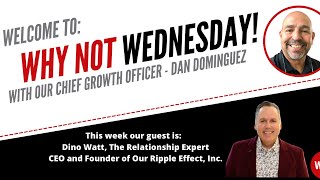
Dino Watt, a relationship expert and CEO of Dinow.com, breaks down his WHY Operating System: contribute, simplify, trust. He explains how YOS certification streamlined his coaching with private practice owners like orthodontists and dentists, and discusses designing company culture intentionally rather than by default.
Chapters
Hello, Dino, and welcome. Welcome to why Not Wednesday. I'm so excited to talk to you today. Let me introduce you to everybody who's listening. So Dino Watt is, his YOS is contribute, simplify, trust. And if this is your first time listening, we're going to get more into that as we go. But he's the relationship Expert. He's the CEO and founder of Dinow.com. he's one of the most exciting business trainers and the author of the number one best selling books the Practice Rx and Hire and Fire Like a Boss. We definitely want to hear more about that. He's been featured on ABC, NBC, CBS, Fox News, and TEDx. He's a high performance practice advisor. He's frequently referred to as the Tony Robbins of private practices. And his goal is to help business leaders and teams create more passion in their life, be more productive in the office, and create more profit in all areas of their life. So do we have that? Did I get all that right, Dino?
Yeah, it sounds like I want to meet this guy. Sounds like a good guy.
Well, I am so excited to meet this guy because, you know, we just connected recently. Dino, you, you, you came to us from, from one of our friends that told you about WHY Institute. You learned about it, we had a great conversation and you said, hey, this is something I want to do. So how's that been going? You, you're, you're, you're now a YOS certified professional. Yeah, it's been the biggest breakthrough or thing that's changed since you learned about how to help people discover their why, their how and their what.
Well, what's interesting is for me, I'm not somebody who's like, I don't collect a lot of certifications on how to coach. I've been coaching now for over a decade and helping businesses, you know, thrive in what they do, build great cultures. And I was just never somebody who felt like I needed to gain more certification to teach what I know or to justify maybe what I know. And so what was cool about when I found the yos stuff? I've been teaching about your why for quite a while, obviously Simon Sinek's book and find your why. And everybody understands that. But I have my own process for how to help people figure out their why. And I really connected with the conversation that Gary had about, I guess when he was first starting out. And they would do these live and they would go into everybody's stories and it would take forever to go through and all that. That was totally me. I have the process I would take people through and I'd get them down, and I would have people up and on my stages, and we'd be 20, 30 minutes in and finally get down to it. That. To have a process that made it very streamlined to get to the why, but then to add to the OS part of it, right? The how and the what, right? Those actually really appealed to me. And so it's just made my life a lot faster. It's funny because I, you know, I'm buying invitations a lot because I'd rather just do that. I'd rather just. I'd rather get to the source than have to go through the whole process and all that stuff and just know what it is so I can talk to them in that manner. So it's been really cool that way. I really enjoyed it.
You know, one of the things that. And so you're the second generation of WHY Institute coaches. The first generation of coaches had the. We used to do the Y manually, Dino. We used to walk people through the why like you talked about, and then they discover their why. And then we used to do the thing where we manually walked them through the yos. Now we've automated all of that for you guys. And I love what you said. It's. You get to the bottom of it, and now you have the answers. I think one of the things that I heard a lot from coaches was like, I like hearing the stories. I like getting to know my clients at a deeper level and. And what I. What I always tell. So this is a little bit of coaching for those coaches that are listening. Maybe what you do now is you can go back and you still get the stories and make the connections that. That you have. But now you know what the answer is. It's kind of like getting the answers, and now you can still go back and connect deeply. Have you done that with some of your clients?
Yeah. So that's what's been really cool, is been able to, like you said, going straight to the source, knowing what the yos is on there, and then talking through that. But for me, it also was. I still am going to do the process with the groups. Right. I have whole practices that I work with everywhere from eight to 38 people.
Right.
And so the. One of the reasons I wanted certification was to be able to say, okay, I can do it really quick with the doctors to show them, hey, let me show you how cool this is and how fast you can figure that out. But now let's do this with your whole team. I'm not going to pay to have your whole team do it. And maybe some of the doctors will, but I can do this now as a whole presentation and take the whole team through it. And now you've got a whole audience who's getting understanding their why and things like that. But it just clarifies conversation. And I'm all about understanding how to communicate better with people. That's. That's been my focus. My goal in life is to communicate better. And so if this helps me do it, great, I'll streamline it straight down to it.
And of course, as a guy whose how is simplify, anything you can do to streamline. Right. So you're. You're a guy who likes to contribute to the success of others, make a difference, make a positive impact. How you do that is by simplifying things. You simplify things and make it easier to do, and ultimately you build trust. How did that resonate with you? We went through that process together. But tell me about how that resonated with you.
Well, at first I was like, oh, I think this is wrong. Because if you would have told me the nine whys ahead of time and I had to just to pick, I would have put simplify as my why.
Yeah.
And so the fact that I didn't have that ahead of time, I just went straight through the questionnaire. I took it to my wife, actually, and I said, hey, so this is what it came up with.
Hold still. And I said, they came up with to contribute. And she's like, really? I would have thought more simplify. And I was like, yeah, me too. And then I started reading through it, and I started reading through all the characteristics and stuff, and I was like, you know what that really is? And as I'm reading it to her, she goes, yeah, like all the times you give away free stuff all the time just to help people out where you're doing. I literally did this today, Dan. I had somebody call me who hasn't been a client in over six years.
Yes.
And he called, he emailed me yesterday and hey, I'm having a challenge with my spouse. Can you. You know, I'm happy to pay you for it. No, no, no, you don't need to pay me for it. Let's get on a call. And I. I do it like, I love to contribute to people. I want them to feel better. Had a couple at my dance class. I love to dance, so dance is my kind of outlet. And I had this couple that was there, seen this the husband before, seen the wife, and I just saw the wife one day and I said, oh, where's your husband? And she's like, oh, we actually split up. My, my mind immediately goes to, how can I help you? Like, I can help you fix your marriage. So it was spot on. It just sometimes I think there's a. There's a survey, I think it was by New York Times or was it Harvard, about self awareness. And it says that like 90% of people think they're self aware of who they are, but in reality, only 13% of people are actually self aware. And I think that's the, that's the thing, right. Is that I thought I was. It took something like this to help me understand it.
Well, you just confirmed something. One of our mottos is one of the things we talk about is knowing your why is the first step in self awareness.
Yeah.
Because you want to be self aware. You want to know why it is that you do everything that you do. And I'm a fellow contributor, Dino, so I know exactly how you feel being. Being in. Being the chief growth officer at the Y Institute and being responsible for bringing in the new clients. I can want to. Sometimes, as you probably know, there are people who are not our ideal clients. Right.
And we.
How can I help you get on? What can I do to help you? And. And it's not always conducive to business, so you have to kind of grow a little bit of a tough skin and kind of go against your nature of wanting to help everyone and understanding where you can make a big difference. So, by the way, since I brought it up, who you. Let me, let me get a quote here. So.
You help business owners create their company culture by design, not default.
Right.
Increase their sales intentionally and take back control in all areas of their personal and professional life. So that being said, who is your ideal client?
So it's actually expanding quite a bit. I have really niched down my world in the orthodontic space. It's probably one of the things that also made me kind of kinship to Gary is that he's in the. In the dental space. I really weird long story that we don't get into. Fell into this space that I am not a dentist or an orthodontist, nor have I ever owned a practice. But about over a little over a decade ago, I fell into the space of these are people who are entrepreneurs by default because they went to school, they got all this great education, and no one taught them a thing about running a business. And then they went out and either bought into or. Or built up their own practice. And now they're trying to figure out how to deal with people and build cultures and be a good entrepreneur. And I already knew how to do that because I'd been building businesses since I was, gosh, 22 years old.
So I just kind of fell into the space. So my ideal client is right now is that person who wants or sees themselves having to be an entrepreneur, might not necessarily chosen to be an entrepreneur, but really wants to be successful in both their business and their relationships outside of business.
That makes sense. So if somebody is looking to work with you, you've got your. You're the CEO and founder of Dinow.com what's the best way to get a hold of you? How should people.
Well, it depends on. It depends on if you like TikTok or Instagram or Facebook. No, but I'm on all those. The best way is just dinoinowatt.com it allows you to kind of connect with me and see what we're all about. As I said, it's been really interesting in this one niche that I've been able to be in, but now being able to use that niche and knowing that the processes systems work. The principles are the principles are the principles. They work in orthodontic spaces. They work in. I've been dealing with a lot of real estate people, so it doesn't matter. The principles are the principles.
You know, it's great that you brought that up because you work in a lot of different spaces. One of the things I loved about your profile when I started doing, doing my homework on Dino Watt. You talk about the fact that studies show that your intelligence increases by 31% when you're a. When you're in a positive and fun environment. So, so the promise that I gave to people listening today was, hey, you ready to get 31 smarter? Tell me where that research comes from and how you help people work in a positive and fun environment.
Yeah, that's actually. I'm sure many people on here know Chris Voss, the author of Never Split the Difference. He and I are in a mastermind together. And Chris quotes that quite a bit because he wants people to understand that if you're going to negotiate anything, you want it to be a positive spin as opposed to dredge or negative because you automatically just drop in your intelligence. I've. I love to have fun. I love. I, I speak a lot on stages.
I am somebody who, when I was a kid, I never ever saw myself working in a cubic cubicle. I had to be out there in front of I'm a third child. I mean, let's just say it. I want to. I want attention like I like. And I'm still. I'm still looking for mom and dad's attention, right? And so I love to just have a good time. I think when I go out and I see too many speakers, especially in different industries, it's PowerPoint based. It's the same can thing over and over again. I want my audience to remember me. And funny is money and memorable. And so if I can help people laugh and I can help people have a little aha about themselves because they see themselves in me, if they also see that I'm not taking myself too seriously, but what I'm talking about is serious, then the. Then it just makes everybody that much happier.
So, that being said, so how does that correlate with creating company culture by design? How do you help people create company culture by design?
Well, what I found is there's only three ways that people do create cultures. It's either through disdain, which is it's everybody else's fault, it's the industry's fault, it's the economy's fault. It's the I can't find the right people to work with. I have too much competition, I'm not in the right area. All that is blame, blame, blame, blame, blame. I call that disdain.
Okay?
And so there are companies that have created. Let me back up. Every company has a culture, right? You just. Whether you're designing it or not, that's the challenge, right? If you like it or not, that's the challenge. So disdain is the first way that people typically build a culture. Default is where most people build their culture. They're doing fine, they're making some money. Can't complain. That's a key phrase that I hear. I can't complain. How can I ask for more? You know, like that type of thing? But they're the people who also know something inside of them wants more. They know they can be more deliberate about what they're doing. So a design culture is somebody who has a very specific vision, knows where they're going, and that's why people want to follow them. They have very specific expectations.
Right.
And they know how to support people. So if you look at Disney or Steve Jobs or Oprah Winfrey, those are people, right? Now, we've got a lot going on with Elon Musk and Tesla. Like, he knows where he's going. And so those are cultures by design, as opposed to default or disdain.
So how. How as you're as you're creating cultures. You may not have done this yet, but you're now that you can go into a practice and figure out the why operating system of the leader. How has that helped? Have you, have you used it yet? Or how do you see it helping if you've done it, if you haven't done it?
So I haven't been able to do it yet because I've been using this with all of my current clients. But that's what I'm super excited for for this year is I will now only onboard companies once they've done their Y assessment. I will, I will either pay for it myself or I will have them pay for the assessment so that I can know how to have a conversation with them.
Right.
And it's, it's crucial to me because this is, this was the unlocking of the. I think people want to know about themselves. Like people love assessments. You know, are you. Which friends character are you? Right? Maybe for our age, which three's company character are you? But you know, we want to know more about ourselves and if we can show them off the bat, I'm going to give you something of such value that you're going to use forever now. Even if I could show you how I could put this better on your website, I'll give you an example. I did this with my group. I am notorious in my industry for mocking people on their websites. When it has the about Us part, you know, the tab on about Us and almost every orthodontist and every dentist, maybe Gary can, you know, confirm this. You go to the about Us page and what is it? It's a list of when they went to school, what schools they went to, and them and their family in some field somewhere really pretty. And I'm like, that tells me not about you. If you want me to say about us. Boy, what a great thing to do on that page. And then the first thing, like my biggest why in life is to contribute to people, right? I do that by simplifying complex processes and I'm going to build a relationship of trust with you. Now I know about you and then you can go on to the other stuff. But I just think it's just, it's a foundational thing that has to happen.
So two things you said that really strike me. So Erica Groschler, who's she? She's. She's listening right now. She talks about crunchy conversation. She. I love that phrase. Let's have a crunchy conversation. Something you can really dig into. And I think knowing the yos of the people you're talking to just helps you get to that faster, right?
Yeah.
And we, we were talking, and for me, the, the aha moments are what's fun. As the chief growth officer, I get to talk to a lot of people that have never heard of what we do. And then when they come out of that conversation, they're like, oh, my gosh, that is totally me. And I get it. I do the same thing, Dino. I don't talk to anyone without sending them the yos ahead of time. So I know how to talk to them, and then I have that advantage. So we can have that really rich, good conversation that is going to feel good to them because I'm kind of talking their language, which is, you know, as Jerry likes to say, it's a little bit of an unfair advantage, but it really is just professional. If you have the ability to talk to someone in their language or your language, let's talk in their language because that's what they're looking for, right?
That's right. Yep. 100. I totally agree with that. And it's, you know, it helps them create familiarity, too. Like, obviously there's. I'm so many people on this call already know this.
Right.
But when you're talking about building rapport, mirroring people, mirroring the way that they speak, their tonality, their, their, their volume, their, Their. Their pitch, their pace, all that stuff is so key. Well, if you could also add in the things that are important to them, the understanding of speaking to their language, if you will. When it comes to their. Why, it just is a bonus.
Yeah, absolutely. Well, let's talk a little bit about your podcast. You have a podcast, the Propreneur Podcast. It's a show dedicated to building the entrepreneurial skills in private practice owners. So this is again, your ideal client, Right. So there you get to hear from industry experts, orthodontists and dentists. And you can hear topics like sales, marketing, leadership, and systems. So who should be on that podcast? Why should we listen to the Propreneur podcast?
Well, the Propaneur podcast is focused for any private practice owner. And what I do is I bring on either an expert or a professional. And how I distinguish the two is the expert is usually somebody who has a product or a service that helps the professional increase. Increase volume of money coming in, increase the amount of Right. Hires. They're having it just helping them increase. On the professional side, these are the people who, like, as they say in our industry, get their. Have their fingers wet right where they're actually inside the mouth, they're dealing with this. And so what we've been blessed enough to do is yes, I have a lot of orthodontist or dentist on, but we've also had people from other industries come on to talk about what they do and how they built their business. And just the information there alone of how to look at their business a little differently has been really great. It's a conversation I tell them all the time. I try to be like Oprah, where I'm just having a conversation with somebody. I just want to get to know them and, and, and what they do. And then at the end, I asked everybody the exact same six questions, but other than that, it's just a conversation.
I love that. And you, you mentioned something that, that earlier that Gary commented on. So we always want to recognize when Gary listens to the show, he said the, the platinum rule. Right. The golden rule is talk to people the way they like. They like that. You golden rules treat people like you want to be treated. The platinum rule is talk to people the way they want to be talked to. So you talked about that. So I wanted to give, give Gary a shout out real quick since he, he chimed in. But I love what you're, what you're saying in terms of those conversations and just having those conversations happen.
Naturally. Right. And, and they just happen naturally and they flow a little bit better when we know what's important to the person that we're talking to.
Yeah. So my, my whole industry, my whole business started in the relationship space with couples. I, I'm not a marriage counselor or therapist, but I had certain systems that my wife and I put into practice for our business that we worked with higher end entrepreneurs. And that's how I started with everything. And I've said this since then. This was over. She's 16, 17 years ago. All communication either succeeds or fails based upon the setup of the communication. So I'll give you an example. I'm sure you've all had this situation before where you're working on something, you're in your office, your home office, you're focused on something, and your spouse or your partner or your kid walks in and tells you something that seemingly is important. But you're focused on this thing and you kind of do it like, okay, sure, yeah, yeah, I got it. Okay, cool. And then they leave and 24 hours later they're like, remember we talked about this thing and you said you do that thing. You're like, I have no idea what you're talking about. Or, you know, you mess it up, you did it halfway. Well, it's because the setup of the communication was bad. So in everything, how we set up the communication will determine whether it succeeds or fails. The YOS system, to me was an immediate like, oh, this is the setup of the communication.
Sorry, you're breaking up a little bit.
I don't know if you're still on there.
Again.
I can keep talking if you need me to, but you're breaking up quite a bit. I can't hear if you're saying anything or not.
All right, so I'll keep telling you. And a YOS story, huh? Let me tell you one. Well, I have. I run a small group of entrepreneurs which is a network I call the Pro Prenor Network, just like my podcast. And on that podcast, I mean, on that network, I had everybody do this right before Christmas, right before our Christmas break. And I had everybody take it. You can hear me. Great. Awesome.
That they.
They can take the. The YOS questionnaire. And it was really interesting because you have a lot of very high performers, high achievers who are looking at things going like, oh, wow, that. That kind of is me. And at first, again, they did like I did, where they're going, oh, I thought, like, I would have probably guessed I'm this. And then instead they see it and they read through it and they realize, oh, that really is me. I'll tell you, for me, I'm just going to keep talking while we're waiting for everybody to come back for me, the in depth look at the wise of, like, who you are and then what's the positive? And I don't want to say negative, but what to be careful about. How do you work with this inside of your business or with your kids? That was huge for me because I could just see myself on there. I say yes to way too many things. Right. But the part that's really cool is I see the why is the main crux, but the other two balance you and help you really understand how to implement those things. And for these doctors, it was really an eye opener for them, too. Let's see, I had a question here from Bella. What was my biggest why not moment? Gosh, that's interesting. Yeah, right? It's a total contributor thing, Isabella, saying yes to too much stuff I contribute to. I feel like it's kind of a little. Not that I almost said this out of my mouth, that sounds almost arrogant. But I really feel like I can help so many people. I really feel like I have answers. I tell this Story often of when I'm on stage about my parents divorce and the day that I stood on a sidewalk and I watched my father pack up his things and drive away. And I remember I was 8 years old, and I remember standing there going, I can totally help you in your marriage. Like, I can solve the problems here, but I'm eight, so no one's listening to me, Right? But I could totally see that as my contribution. I had the answers back then, or if I didn't have the answers, I'm going to figure out the answers, right? For me, my biggest why not moment, when I just thought, heck, yes. Well, when in 2013, my wife and I decided, we've always had a core value in my. In our. In our family, that we. We value experience over things. I believe core values are so misunderstood in our world, not just in our personal life, but in our business life. But we've had a core value since we were first married. We value experience over things. And we had always had this idea of going on a road trip around the country for a year with our kids, putting our kids in an RV and going out and doing it well. I had just recently gone through 2008 and 9 and 10, and it was really bad for us. Like, I lost a ton of money. We almost lost our house, all this stuff, but we were just coming out of it, and my wife said, well, let's go do that road trip again, or what we thought about. And so we said, you know what? Why not? It's our only chance to be able to do it. So we sold pretty much everything. We rented out our house, and we. There's so many, like, God or kismet moments that allow this to happen. But we got our kids out of schools, we got our RV, we got our truck, and we went out for 13 months on the road around the country and just traveled with our kids and just talk about contribute, right? My goal was to contribute to their life, that they got to see stuff I never got to see growing up. That's probably my biggest why not moment. I'm just like, why not? Let's just do this. What's my biggest why not moment? Professionally, where you quit your job. Oh, so professionally, I've pretty much been an entrepreneur my whole life.
I've never quit a job that I hated or went for it. Writing a book was a big deal. Writing a book was a big deal for me because I have dyslexia and I was never good in school. I'm a terrible speller. I make a joke now of like, man, my English teachers in high school, if they knew that I had written five books, that would just be incredibly. It's out of their realm of thinking because I was just not a great student. So that was a big deal of me going, you know what? I'm going to figure out a way to do this. And then I just kind of got the bug. And after the first one, wrote the second and the third and the fourth. So those were really, really big why nots for me.
Building this house that I'm in right now. You guys can only see this part of. This is my office here. My wife and I, after our kids left, we. My business I can kind of do from anywhere. And so. Excuse me. So I. We decided to, once the kids left and got out of the house and we're empty nesters to do it again, but just with the two of us. So we sold this time, everything, even our house, and traveled. And that was a really big kind of why not moment again of like, let's just do this and build the business as we were out there and make sure the business was sustainable. And we did. So, yeah, it looks like Dan's trying to come back.
Well, that is a great why not moment. I'll just jump in for a little bit. Yes, it is.
Hi, Bella.
Hi. I kind of have a sore throat, but I'll just jump in for a second. That was a great why not moment. And so if anyone wants to get a hold of you, they should go to dino.com.
Yep. Dino dinohatt.com or just email me@dinoinowatt.com Perfect.
And thank you for being here today. I'm sorry about the technical difficulties.
Trying to get back on.
But thank you. And that was a great why not Wednesday?
Well, everybody, thank you for having me. Have a great day, everybody.
More from Dr.




Women In Leadership: A Need For A Greater Systemic Change With Belinda Clemmensen






