WHY Not Wednesday with Dr. Gary Sanchez
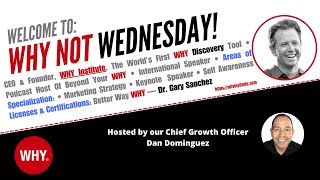
Dr. Gary Sanchez spent 32 years as a dentist before selling his practice to launch the WHY Institute in 2016. He developed YOS, an 8-minute questionnaire that helps people discover their purpose, and has trained 250 coaches to reach 250,000 people. His goal: help one billion people find and live their why.
Chapters
These last few years have made us question everything.
Our relationships.
Our jobs.
What constitutes an office.
And who we are.
In a.
World filled with chaos, confusion, and uncertainty. It's time for some clarity.
Clarity.
It's time to start understanding one another.
It's time to start understanding ourselves.
We envision a world where everyone knows their why. But even more, we envision a world where everyone knows their why. O s, their why, their how, and their what.
The operating system that drives you, that lets the world know where you stand.
What your unique gift is, and most importantly, who you are.
Yos.
Are you ready?
Hey. More importantly, are you ready? Gary Sanchez. I can't believe I've been doing this for two years, and I'm barely getting the CEO and founder of why Institute.
On why Not Wednesday. But let me introduce you, Gary. I want to make sure everybody knows, you know, this is a man who.
Needs no introduction, folks.
Welcome to why Not Wednesday, But I am going to introduce him because Gary Sanchez is the CEO and founder of Y Institute. He's the creator of the first. The world's first why and YOS discovery tool. He's a podcast host of beyond your why podcast. He's an international speaker. He's an amazing individual. Let me tell you a little bit about him in in where this all began. In 2009, Simon Sinek delivered a TEDx talk in front of only 53 people. That talk was called the Y Talk, and it's had over 61 million views, and it's one of the most top five most viewed TED talks of all time. One of the people that watched that TED talk was a dentist in New Mexico. And when he heard it, he tried to figure out his own why. Why was he a dentist? Why was he struggling to find success? Why was life not what he imagined it to be? When he graduated from USC Dental School, unfortunately, nobody had a system or created a tool to help him find his why. So he hired Simon Sinek to help him. And after months of struggling, he finally discovered his own why. Not only did finding his why help him as a dentist, but it set him on a path to help others find theirs. Dr. Gary Sanchez was that dentist. Now, Gary's not only a dentist, he's an entrepreneur, an inventor, a speaker, an author, and the creator and founder of the WHY Institute. He created a tool that, in just eight minutes, can help you discover not only your why, but your how and your what and create your own personal message for you. This tool has been used by hundreds of thousands of people worldwide. Please help me welcome Dr. Gary Sanchez. Gary, welcome to the show.
Thank you, Dan. Man, this is cool. I'm excited to be here. This is going to be fun. You know, when you read that off like that, what crossed my mind.
Because I wrote the bio, so that's. And I had help writing it. But as I was hearing it, what crossed my mind is the odds that I would ever be here in this spot talking about this with the Y Institute, with all the stuff that you and I have done together and we've done as a company. The odds of any of that happening were so low. I mean, that wasn't even in the thought process, say, eight years ago.
It definitely wasn't in the process 25 years ago when I met you, Gary.
Yeah.
You know, we were playing golf at a golf tournament, and you were a guest of one of my guests, so we needed four players, and you were that amazing. You know, for those that don't know, Gary's an amazing golfer. So he comes and plays, and I see this, and. And just like. Like, now he's, you know, 140 pounds soaking wet and hits the ball a mile. And I was so excited to have such a good golfer on our team. But then you were also a dentist, and I was looking for a dentist because my family had just come back to Albuquerque, and. And I. I can tell you that.
That'S the last thought I would have.
Had that, you know, here we'd be, 25 years later. You wouldn't be a dentist.
You.
I wouldn't be a sales manager or.
Sales director at Baxter. We'd be working to help people discover their why and would have helped so many people. So far, over 250,000 people, Gary. That's an impressive number in a short amount of time.
And now that you've got the yos that.
That really has been the game changer for your business and for the Y.
Institute, because I see.
I work with all the coaches, and.
That has made such a difference.
It has really helped you scale. Tell us about your journey, Gary. Let's. Let's start from the beginning, because there's some really cool stuff in there. You. You watch Simon Sidnick's TED Talk.
And, you know, I always.
When I tell this story, I always.
Say, unlike, unlike the rest of us.
Gary picked up the phone and called Simon. And you said, hey, Simon, can you.
Help me discover my why?
Tell me. Tell us about that process, that phone, that first phone call, and what happened.
Yeah. So I graduated from USC Dental School in 1988. Advice that I was given by the gurus of that time was build a great product and people will come. So I spent 20 years doing that, right? Reaching the highest levels. You know, you were in the dental practice. It was a very high tech practice. We had all the latest technology, a really well trained team, beautiful facility. I had been to, to, to so many, worked with so many mentors and become a premier dentist. But I still blended in with everybody else who said, I'm a dentist too. So just like your viewers, Dan, many of them are experts at what they do, but it's so hard to differentiate yourself from others who say they do the same thing, even if you're doing it better. And that's when I heard about this concept of why. I had a great what but didn't know my why. And so I watched that TED talk and then I rewatched it and rewatched it and rewatched it probably 30 times. I read the book multiple times. And I said, that's what I'm missing. I have a great what, but I don't know my why. And so that's when I called Simon. I said, simon, I need you to help me discover my why. So he and I spent about eight months together going back through my life looking for clues. You didn't really have a process at that time. And so I recorded all those conversations and we got kind of close, but I kept working with it and working with it and finally figured out that my why is to find a better way and share it. And so in our practice, we stopped talking about what we do. Crowns, bridges, fillings, complete gum care, all that stuff. And we started talking about what we believe and why we do what we do. You know, we believe that life is better when you have great teeth. In fact, you can't have a great life with bad teeth. And everything we did was around what we believe is and our why instead of what we offer. And that's when our practice took off. I practiced with my brother for about 32 years. And so once that happened, I started getting calls from other dentists that would say, hey, can you help me do the same thing? I was in all these different study groups, and so I started helping a lot of dentists. I had to go back and figure out a process for what I had been through. And so I figured out a better way to do what Simon was trying to do. So Instead of taking six or eight or 10 months, I could help someone discover their why in about an hour. And then I started doing this for anybody that would let me. I became obsessed with That I did it for thousands of people for free. And I started to notice patterns and trends and similarities and figured out there's only nine different whys. And then I helped other dentists do what I had done. And then I started helping chiropractors and lawyers and financial groups. And the businesses kept getting bigger and bigger. But during that, as I got more and more data helping people, I started to see the patterns and figured out, like I said, that there's only nine different whys. And with that data, I was able to develop the algorithm, write the software to help people discover just their why. And in 2016, we launched the why Institute that helped people find their why. And then with more and more data, as you know, Dan, we've now got the YOS discovery, which finds your why, your how, your what, and creates your message for you in about eight minutes. And that's been the game changer, because for anybody that's listening, if you've ever tried to figure out your own why, so hard to do. So hard. And you don't know if you're there. You don't know if it's right. You don't know if it's real. So what do you do with something if you're not sure about it? Not much. But with the Y O S discovery, now, it's crystal clear. It's better clear, simple, easy to use, fast, and you get an answer. And then you can start off with a clear mind, clear direction. Clear. You're just clear on. On the direction that you need to go. So that was the quick version of it. But a lot of stuff happened along the way.
Well, a lot of stuff did happen along the way, Gary. And one of the things that, that, you know, I remember just learning it, you know, so. So part of my story involves. Involves you. Why am I here? You know, we were just talking about it. I would have never thought I would be here. I. I was so happy doing medical devices. And I was talking to someone yesterday, Gary, someone who we both know, and, and they said, you know, when Gary tells a story about him not sitting in that office and not happy, you know, when you're a DDS and you're. And you join your dad's practice, you've got an established clientele. Everybody in Albuquerque loves Gary. How could you not have had success? And when you look at your why of better way, there's got to be a better way to do it. Doing it the way your dad had done it or the way everybody else in Albuquerque was doing it, you weren't going to be happy with that. There had to be a better way. And once you found that better way, true to your why you had to share it. And then once you started sharing it with lots of people, you didn't just. You started sharing it with fellow dentists. Right. Because that was an easy audience. They all were like, hey, how is it that you grew your practice so much? And, And I, I love telling this story because the first time I went to see Gary, so we play golf in a tournament. Gary says he's a dentist. I said, hey, we're looking for, for a dentist. We just moved back in town. I go to visit Gary, and this.
Was, you know, again, 25 years ago. I get to watch Cirque du Soleil.
On VR headphones, VR headphone or headsets.
Weren'T even around yet. But while I'm getting my teeth worked on, it was way better than any dental experience I'd ever had. And I'm like, I could come get fillings every week. I get to watch an amazing show and enjoy the experience, listen to, listen to the show, watch it. Next thing I know, my exam was done. So, you know, so let's ask that question. Gary, what made you. What, what do you. Why.
What do you.
Why do you think you had to search for a better way when I mean, it. It was, it isn't a bad deal, right? You're, you're, I think you, you didn't work Fridays. You're working four days a week.
Your.
Your practice was doing well, but you knew there was a better way.
Yeah. You know, Dan. Well, back in, when I first started on the path of trying to figure out my why I was practicing with my brother, we, we were not getting a lot of new patients. People came to expect. Like you said, you come a couple times and you're like, hey, this is the way it's supposed to be done. This is the way they do it. And they weren't telling other people. And we, and it was very frustrating for me. We were getting very few new people. And so our practice kept getting more and more refined, but smaller and smaller and smaller as people would pass away or move on. We weren't getting that influx of new ones. And it was scary and it was frustrating because I'd never worked so hard at something that. And not gotten the results that I thought. But then once we started getting all the results, once we started focusing on our why and our messaging and our marketing and our branding all became focused on why we do what we do instead of what we do. That's when things took off. And so yes, the practice was doing very well. I was only working three days a week, four day weekends, every other week, doing, doing very well.
There had to be something better for me. You know, after you do that for X number of years now you're looking for the, the next thing. But what actually happened, and I know you were going to ask me about this, so I might as well tell it, tell everybody is I, I went to this event in Santa Fe called Zozobra and it's kind of like a Burning man type thing, but not with all the drugs and stuff. And there's like 20000 people there. And I was at a buddy's birthday party. And so of course I wake up the next day, have a little bit of a headache, take a couple Advil, go back to bed. Not a big deal, didn't think so. But one of the Advil didn't dissolve and it lodged into my GI tract and burnt a hole right where there was an artery. And I started bleeding internally and I didn't know it and so I went home and thought just not feeling that good. I actually went and worked out and then went home and just still wasn't feeling very good. And then I went to the, to the restroom and I start. Blood started coming out of everywhere. I started throwing up blood and it was not a good sight. And so I ended up going to the ER and it was a busy weekend, so I ended up having to wait for about 11 hours in the waiting area. And so by the time they finally admitted me, my blood pressure was 60 over 30, I had lost half of my blood. I wasn't in a private room. So I got up to go to the restroom because blood in your GI tract acts like a laxative, so you have to use the restroom all the time. So I get up to go to the restroom, lock the door behind me, because like I said, I was in a private room. And then I pass out and I hit my head on the sink and knock myself out. And luckily I woke up. I don't know how much long, how long I'd been there, but there was blood everywhere. I woke up, pushed the door open and then passed out. Next thing I know, I wake up, I'm in a bed, they've cut all my clothes off, I have the two paddles on me, there's people running and screaming everywhere and they had to revive me. And so then they rushed me up to surgery to try to get to that bleed. They couldn't get to it. So they decided, just wait. They did a CAT scan, and to see if I'd stop bleeding, pumped all this dye into me. But when they did that, they blew out the blood vessel in my arm, and I started to get blood clots in my arm. And so I had these blood clots growing towards my lungs, and I had a GI bleed that they couldn't get to. So the doctor walks in and says, look, we got to treat these blood clots, because if the blood clots gets to your lungs, blood clots get to your lungs, you're going to die. But if we try to treat the blood clots, we can't get to the bleed, so you're going to die. And I said, well, that doesn't sound very good. And luckily, my phone rings about that moment, and a buddy of ours, Dan and myself, who's a heart doctor there at the hospital, calls me and said, hey, Gary, I was looking through the list of names, and I see you're here. And I don't like what they're going to do, and so I'm going to take over. So, long story short, I was in the er, the ICU for nine days. Finally had to go to bed one evening with an IV of heparin to stop the blood clots, hoping I didn't bleed. I didn't, and I made it through it. I go back to my practice, and I have a meeting. One of my patients, who's in his mid-80s, sits down with me and he says, hey, Gary, I want to talk to you about something. So I know what you're doing with this why thing. You know, we've had some great conversations about it. He said, you got a second chance on life. He says, when you get to be my age and you look back on your life, are you going to be glad that you stayed a dentist? Are you going to wish you'd taken the why to the world?
And I said, I'm going to wish that I'd taken the why to the world. And he said, well, I think you know what you need to do then. And so that's when I sold my practice, and that's when my life really pivoted to fully focusing on bringing the why to the world because it has such an impact for so many people. It's the place to start when you're trying to figure out who you are. It helped me in so many different ways, not just personally, but ability to connect, ability to communicate, ability to build my business, ability to know what my messaging was, the clarity that you get when you know it is off the charts and so many people don't even know that it's there. You know, as Mark Twain Sundays, Dan, the two most important days in your life are the day you're born out.
Why?
So it's one of the two most important days in your life. And most people go through their entire life not even knowing what their why is.
So we can help them with that. And that's the really how you and I reconnected in this way and that's how we got on this path. And now we're four years down the down that path and we've seen some amazing things, have some great stories and you know, I just want to thank you for being part of this because it's really taken shape and grown in so many different ways and you've been a big part of that and it's.
Been such a great story, Gary. And I love, I love that you shared that story because you're right, you know, in the name of the show. And it's so funny you said that because that 80 year old patient that, that said, you know what you need to do. What if you look on the show description for why not Wednesday? One of the things I talk about is at the end of our life, we don't regret the things we did. You could have. No, you wouldn't regret it that you were a dentist. You will regret the things you didn't do. Do that. You discovered something that was so important. You helped so many people discover their wine. You were doing that part time, right? On the weekends, Fridays and, and Saturdays and Sundays. And then running your practice the rest of the time versus really just pushing into that. And so, so let's fast forward. So this is right all around the same time, October 2019.
I leave my job at Baxter and I want to find something new to do. I want to find something that I love. And so I call it the toothache that changed my life again.
You know, a lot of people make.
Fun of us because a lot of.
Our stories revolve around golf, but it.
Was a, a Ryder cup weekend, Players cup weekend, and it was a Saturday. And, and I remember seeing you in the locker room and, and I said, hey, or in the, in the card room. And I said, gary, I've got a toothache. Can, can you get me in on Monday? And like a good friend, you said, yeah, call the office, we'll get you in. And I remember coming into your office and I had left my, my corporate job. People thought I was Retired, because I was hanging out at the club a lot. And he said, what are you going to do? And I said, I don't know, Gary. Whatever I do next, I'm going to love. And then the next question is a question that changed my life because you said, dan, do you know your why? And next thing I know, Gary's sending me an invite, I'm doing the why on my phone. I discover that my why is to contribute to the success of others, make a difference, make a positive impact. And I.
And.
And you did it so expertly. And now looking at it, because I've now done it over 1400 times myself, but I remember how important those questions were then. So you're. You're wise to contribute. You love to help people. You love to make a difference.
And as you were saying, I'm like.
Yeah, that's me, right? That's exactly what I love to do. And I talk about my Rotary and all the, all the foundations I'm a part of and all the volunteering that I do. It was so clarifying for me. And then, of course, you know, we. We continued the mission, the vision, and, and you helped me discover my how and my what. And that was the old way, right? Manually. I. I remember buying the course and going through it, and. And then you helping me discover that my how is to challenge the status quo and my what is to make sense of things. And then you put all that together and all of a sudden, like, whoa. And I remember saying to Gary, hey, Gary, you know, and, And Gary's very smart.
For those of you who.
Who didn't know, he knows how to.
Talk to a contribute.
So instead of saying, hey, Dan, you know, how'd you like to. To come. Come work for my institute and help us grow?
He said, dan, I need your help.
Because that's what you say to a Contribute.
Contribute.
Right? I think we could use someone with your skills.
You've sold at a really high level. We could use you to help grow Y institute.
And so I think it was December 2019.
We had. We had lunch across the street from.
Your dental practice at the Chinese place.
And shook hands and said, hey, let me help you. And then I. You invited me to a coaches meeting that you had at the Canyon Club. So it was about 20, 30 coaches in, and. And we went through the first YOS certification training. That was really cool because I got to meet some of the old school guys. Everybody was doing it the old way. And when I think about that and what you've been able to build so back then, that finding somebody's why, how and what would take us an hour, hour and a half. And if they were clarified, mastery, it could take three hours.
Right.
Because we would go through the questions. And now you've simplified that to eight minutes with a questionnaire. That's spot on. 99.999 of the time. What's. What was the biggest catalyst for that, Gary, to go from? I mean, that's a lot of work that went into, from 2019, having 30 coaches. You've got now over 250 coaches all over the world. And you've done this with over 250,000 people. And it's automated. People can discover their yos. But you've got something really cool that's new is now we talk about activation. So tell us about the process. Let's talk about first. How did you go from W to yos and, and, and then the automation?
Well, for everybody that's listening, if you have a process, if you have something that you think only you can do, that's your expertise. That's your area of. I'm the only one that can do this. That's the way I felt. I felt like I've done 10,000 hours of these and unless it's me, it's not going to be right. And then Jerry Lujan, who a lot of, you know, and who's another YOS certified coach, challenged me one day. He's like, well, how can you scale this? How can you, you know, if you're the only one that can do it? And he could do it too, at that time. If we're the only ones that can do this, and it takes us an hour per person, how many people are we going to see in our entire life? How big of an impact are we really going to make? And that's where I didn't think it was possible, because in order to get to somebody's why, we had to access their limbic brain. And the limbic brain is the part of the brain that doesn't have the capacity for language. So you're trying to get language out of a part of the brain that doesn't have the capacity for language. So the only way that we could do that was through stories. So I would have to listen to story after story after story and look for the pattern, and then that pattern would tell us what the why was. And so I'm thinking, how can I use software to get to a story, to listen to a story? So I want you to think about something. Let's say you are a musician. And you get so emotionally involved with your song that you're writing, you're writing a new song. You spend months writing this song and replaying it and replaying it in your head and creating it. And now you've got this masterpiece of a song. Well, once you write that song down, you write the the music for that song. Now other people can play it. There's other ways to get to that song, to play that song. So I was the one that spent all the time and money and energy finding out these nine whys, figuring out how to do that. But once we know there's nine whys, there's other ways to get to it. So I figured out another way to get to the nine whys. Not having to listen to stories. And it's even more accurate than the stories are. So that's how the Y discovery was developed. And then again, the same thing kind of got challenged to figure out how to do the how and the what with it. And so when you start to mind map things, get it out of your head and, and put it onto paper, then you get start to see patterns and see ways that things can can be done. Because again, I didn't think it was possible until I was challenged to do it. And then once I started that process.
Getting it wrong, getting it wrong, getting it wrong, getting it wrong. Now getting it right. That's how it was built. And then we started testing it. But one of the things that we learned, this is what Dan was referring to, what's coming up next is that the hardest part used to be why discovery? How the heck do I get to my why? I don't know how to get to it. I don't know what, how I'm going to figure it out. But now, but then we made that a done for you. Well, now how do I get to my how and my what? Well, we made that a done for you. So now the why, how and what discovery part of it is done for you. But that's only the first step is knowing it, right? The second part is activating it, using it in your life, taking it and making it a part of your life's decisions instead of just something that you know about. A really neat concept. How do you incorporate it into your life? And that's what why activation is now all about. So you can have it discovered, but have you had it activated? You can know what it is, but are you using it? And so that's the activation aspect of knowing your why, how and what and then using it in Your life. And so that's the next phase of bringing the yos to the world. And that's what you were referring to, right, Dan?
Yeah, and that's so good, Gary, because so much of it, you know, there. There's a lot of assessments out there that people use, but the why is so unique in that what you're talking about is something as a coach I've experienced. Every one of our coaches has experience that activation when somebody realizes, whoa, that's me, now I know how to use it.
And our coaches are trained in how to help people create their message, how to help people communicate better with other people, how to talk why to y. That's that activation piece of it that really is critical and that our coaches do such a great job of. And I think it's the genius part behind, because, yeah, you have discovering your.
Why, discovering your how and your what.
That. And it was so hard in the beginning. I remember doing those sessions, and it takes a long time, and you're listening to the stories and. And now that we've made that part easy now, how do you. What do you do with it? That's the part that. That is really cool, Gary. You have to have more than a few why not moments. As a better way guy, there's got to be more than a few why not moments in your life. A time when you said why not to something, and you're so glad you did. Tell us, tell us. Tell us about a big why not moment for you.
A really big why not moment for me was back when I was about 12 years old. I. Before, you know, from up until 12, I was pretty darn sure I was going to be an NBA basketball player. I mean, I was. That was my thing. And my parents were all around basketball. We went to all the college games. And. And it was funny because this other friend of mine, Steve Fadell, and I, we were the two best basketball players. And in my own mind, I. I remembered that when I was playing it, like, in second grade, there was so many people watching us play. That was what I saw in my mind. And. And I. This friend Steve happened to send me a picture of us in second grade with. Playing out on the playground with tons of people watching us. And so it actually was what was going on back in those days. But basketball was my thing. The problem was I didn't grow. I actually was so small that my parents took me to the doctors to get growth hormone shots to try to get me to grow because I really wanted to be a great basketball player. And I didn't grow much until later on in high school, but at the age of 12, I was very short, and I knew basketball probably wasn't going to be it. So my dad was really into handball, and he built this amazing handball club here. Handball and racquetball was just starting, so my dad talked to me about switching from basketball to racquetball because heights didn't matter. And that was a big why not moment for me. Why not switch from basketball to racquetball? Why not try something different? Why not go with your strengths, where you're quick and you're fast, but you're not tall? And so I switched to racquetball when I was about 12 years old, and that was a great decision for me because I was never going to be an NBA basketball player. I was never going to be a college player, probably. But since I switched over to racquetball, I became the best racquetball player in my area, and then I became the best racquetball player in the state, and then in the. In the region, and then I ended up winning the world championships in racquetball, which taught me so many lessons along the way. I learned so much on how to compete, how to win, how to lose, how to train, how to learn from others. I learned my formula for success on finding someone else who's doing what you want to do and copy them until you can do it as good as they can and then find a way.
To do it better.
There's so many things I learned on that journey. You know, what I became along the way that I never would have become as a basketball player, so that why not try something different? Why not go with your strengths? Why not go with what you're really good at instead of trying to be something you'll never be? Really taught me a lot of lessons, and that gave me confidence in so many other areas, taught me so many lessons learned that I still apply to today. So that was a big why not moment for me, Dan.
That's. That's a great why not moment. And I've heard that story before, and it. I think, you know, there's. There's so many lessons there, Gary, because you. You've used those. You became world class at something, and now you try to be world class at the other things that you do. And you. You've got a mission. You know, the. The mission of y institute is to help a billion people discover, articulate, and live their yos. And we've modified that over the years because we added the yos. But that's a big mission. And, you know, we talk about that number of 250,000 people. That's still a long ways from a billion.
What.
What drives that mission?
Why not really does. Because why not live a life of passion? Why not live a life of clarity? Why not live a life.
In alignment with who you really are? Instead of trying to be somebody you're not? Why try to change? Why not just be yourself? Why not just be the best version of you? You know, that used to irritate me when people would say, I'm going to change my brain. I'm change this, change this, change all these change things. How often does somebody ever change anything in their life? What does it take to actually change something? And how often do we see it happen? And why. Why change? Why not be the best version of Dan instead of trying to be a Dan that you're not, why not just be the best version of Dan that you can be? But you first have to know who you are in order to be that best version. So you've seen the power of this. I've seen the power of this. And it's a obsession for me to bring it to the rest of the world. And it's going to happen. It's going to happen. There's no doubt about it. It's. I've made a lot of mistakes along what. What does a dentist know about doing, bringing something like this to the world? Absolutely nothing.
Yeah.
How many mistakes have I made along the way? Lots. How many will I continue to make? Lots. But it'll happen because it's firmly implanted in where we're going, and it's gonna happen. And it's a. And it's an obsession. So anyone that's listening, if you want to be part of this journey, if you want to be part of this mission, if you want to help bring it to a billion people, come join us. You're going to have a great time along the way.
You know, it's so great to hear you say that, Gary, because that something that really resonates with me is the why is not about changing who you are.
It's about finding out who you are.
And then living into that person.
And so.
So that brings me to. And then we're talking about why not. I love, you know, you're. You're such a great promoter of the show title.
I love that you're.
Can you tell that Gary Sanchez is a.
Is a inexperienced guest on podcasts? Right.
He knows what to talk about, but, you know, that.
That whole why not? Attitude is so important, because why not.
Be the best person you are?
Why not live into your gifts and then bring that to the world? And I have no doubt, Gary, that we're going to be sitting here in 10, 15, 20 years, and a billion people will know their why and how and what, and we'll have a better world. Because when I do these workshops with teams, when I. When I see a team understand each other better, and they understand, whoa. That's why Gary's always saying, hey, I bet there's a better way to do that. Or I.
Now I know why Dan's always saying.
Well, how's that going to help anybody? Why is it. What is that going to do for society?
You know, that's what drives Dan, and that's what drives Gary. And when you understand that, you work better together. So, you know, and it. And it's led to. To. To lately, Gary, you know, I want to do this because I've done it with so many people, over 1400 people, that I've helped discover their why, their how and what. And then now I've. I've been asked to do it for teams, and it's been. It's. That's where I really am, in my sweet spot when I'm helping people discover and activate. That's the. I love that word. Activate their yos, man. That's what I love. And so. So I made. You and I have talked. I made a decision recently. Hey, Gary, I want to go do what we're teaching people to do. And you've been so supportive and helpful. So, you know, being on this journey with you, and when I look at the books behind me, play bigger the road less stupid, you know, relentless. I've read so many great books due to your influence and meeting some of these authors that, through Y Institute that, you know, I finally said, you know, Dan, it's time for you to stop talking about it and start doing it. And so I, you know, for. For those of you that are listening, we're going to have some fun with this because I. I'm starting that journey that all of you, all 250 coaches, most of whom I know personally, because I help bring them on. You know, I've been telling you, hey, this is how you do it. Well, now you can say, okay, Dan, show us how you do it. And I'm going to get a chance to do that over the.
Over the next few years and develop my brand.
It's gonna. It's gonna revolve around, why not Gary, because that's so important to me. I start, you know, you figure a guy with challenge and his how would.
Work with a company called the Y Institute and would develop a show called why not, right?
It's got why.
Why me?
Why me?
Why.
Let's talk about why not. But it. But they're so, so related.
And, and Gary, I want to say thank you to you.
This is.
It started with that conversation in your dentist chair and you said, dan, do you know your why?
What the heck's he talking about? And. And here we are, four years later,250,000 people.
I've discovered their why, 250 coaches around the world and so much more to come. I. I just want to say thank you. Thank you for inspiring me.
Thank you for bringing me on this.
Journey with you, for allowing me to learn so much and meet so many amazing people through you.
Let me add to that, Dan, and for. To be more clear, Dan is going to be starting his own.
Why not leadership. And he's going to be doing Team yos, which he's phenomenal at. And he's going. And he's got a curriculum that he's developing to help leaders lead differently. And he's going to be phenomenal at. Phenomenal at it. You know, his why is contribute is how is challenge and is what is makes sense. So the idea that we've been able to keep you this long has been amazing because you don't want to be put in a box and you don't want to be limited and you want to be able to spread your wings as big as you can go. And so you've been a huge part of bringing on coaches and helping them see and helping contribute to their success. But it's time for you to fly and we want to support you. We do support you, and I support you and. And it's exciting. And it's exciting for you to be able to just do it your way. And you have now complete control to do that. You know, Baxter, you couldn't at Y Institute, you couldn't. Dan would come to us with ideas every week and we'd have to sift through this massive list of ideas to the ones that, okay, let's try this one. But he had unlimited number of ideas, so you're now going to have the ability to get outside your own box, create exactly what you want the way you want so you can have the biggest impact helping people think about leadership differently and bring solutions that just make sense. It's going to be phenomenal. Dan I'm excited. So this is your last why not Wednesday, right?
This is the last why not Wednesday. We're going to repackage, we're going to call it the why not Leadership show. And we're going to talk to leaders that lead from a why not perspective that say why not let why not. And I love the way you said it. Thank you. You just gave me another tagline. There's Gary always finding a better way of sharing it. I like the idea of helping leaders lead differently because you know, you, if you, if you do what everybody, what everybody else does, you're gonna get, and you've said this forever, you're gonna get what everybody else gets. But if you do it differently, if you come at it from a different perspective, you're going to get different results. You might even get better results. And you know, I love that you talked about that, Gary, because I do remember just coming to you with lots of ideas and I'm going to miss that better way filter because what's really great about having a better way guy you work with, you throw all those ideas at them and they go, not good, not good, not good. Ooh, that's good. That could be better. Let me take that and make it better. And so, you know, don't, don't think I'm going away. And the other thing I'll tell everybody who's listening, why nation and why society especially. I'm not going anywhere. I'm still going to be involved in the community. Gary and I are working a way for me to stay involved with the coaching community because I love our coaching community. The two best times of my life are when we have the coaches together in Albuquerque every year for ycon and we get a chance to see each other and connect in irl, as Watson Jordan likes to say in real life. So, so Gary, as we wrap up, we've gone a little bit over on time, but it's special. This is a special show and so I really appreciate you staying on late. But what, what would you say to someone who is, you know, on the cusp, you know, they're about to make a why not decision? You had a big why not moment when you told us a story about that 80 year old guy that, that kind of just pushed you and said, hey, you know what you need to do? If somebody out there is having a why not decision that they're making, how would you encourage them to make the right decision? What would you say to someone who has a big decision to make right now?
Yeah, remember the 85 year old guy that asked me that question. When you get to 85 and look back on your life, are you going to continue on the same path or and wish that you'd done something else? Are you going to be glad that you stayed on the same path? And that was so unexpected but so powerful because all of us are going to get to that elderly age, hopefully and we're going to have to look back on our life and determine whether we spent our time the right way. And are you going to have regrets? Hopefully we won't. I would have had I just stayed as a dentist even though I could have wrote it out. I had it set up really well. I could have wrote it out but this is what I really should be doing. And Dan, I think you're making that same decision because that's what you really should be doing. And anybody that's listening think about when you get to 85 and you turn around and you look back on your life and you see the path you chose. You can be proud of it. You're going to regret it.
That's how you make that decision.
Gary, that is a great answer. And I'm gonna, I'm gonna ask you, what do you say we end the show on that note?
Why not?
Thank you so much, Gary, for being on our final episode of why Not Wednesday. It has been such a pleasure sharing the stories of our coaches with y nation and y society and getting to know everyone. It's been so cool to work alongside you as you've built this incredible enterprise, Gary, and you've built an incredible team and I can't wait to see where we go next. And I say we because we're going, we're going on this stream together. Why we'll always be a part of everything that I do. It's been a big part of everything that I've done over the past four years and I can't wait to share more and more with our audience. So stay tuned. I will post when we're going live next with why not Leadership. Thank you again, Gary, and have a great rest of your day. We'll see you all on why Not Leadership soon.
Awesome. Dan.
More from Dr.




Women In Leadership: A Need For A Greater Systemic Change With Belinda Clemmensen






