WHY NOT Wednesday! with Dr. Rosie Ward
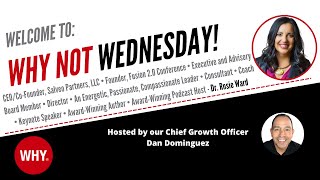
Dr. Rosie Ward discusses rehumanizing workplaces through her books, Salvio Partners, and the Y discovery framework. She shares her core values of challenging the status quo and contributing, and her personal motto: never let anyone dull your sparkle. Ward offers a Courageous Leadership program May 22-23.
Questions this video answers
How to Build a Thriving Culture at Work (2014); Rehumanizing the Workplace (2020).
May 22–23 (year implied by transcript context).
Show Up As A Leader (available on Apple Podcasts).
About three full years.
Chapters
There's a certain kind of coach who believes what we believe.
Who leads people to greatness, who gets people unstuck, who unlocks all of your passion. A coach who helps people discover what drives them to tap into their superpowers.
Then knowing your why is the first step to untap potential.
To focus.
To breakthroughs.
A coach who's looking for a better way.
Are you that coach?
Hey everyone, and welcome to why Not Wednesday. I am so excited to bring our guest today, Rosie Ward. Let me tell you a little bit about Rosie Ward. She is a fierce advocate for humanity who is sought after humanized workplaces that free fuel and inspire people to bring their best selves to work and home each day. She's known for challenging and inspiring people learn more about that challenging and inspiring people to think differently about what it takes to become the best version of themselves and for organizations to foster their growth and development. She's got an incredible gift for taking complex ideas about culture, behavior change and what it means to be human and synthesizing them in a way that makes them relevant, understandable, and meaningful for people. She's the founder of Salvio Partners, a consulting and professional development firm that works with organizations and teams of all sizes across industries to help them build more human thriving workplace cultures. She is the co author of the award winning book Rehumanizing the workplace published in 2020, and how to Build a Thriving Culture at work published in 2014. So without further ado, and by the way, this is our first time using walk up music. Let's welcome Rosie Ward. Hey, Rosie.
Hey. I'm just back here jamming.
Hello. I could see you in the green room, in the virtual green room, just dancing. This is a great song. Tell us why you chose this song. Let's, let's turn off the music and let's listen to Rose.
So let's see. There's a lot of reasons I chose song one. I have a lot of songs I love, but I love Pink because she's authentic. She's a badass. And she's like, look, one voice can make a difference. I love to dance. And this song, if you have not seen the video, like, I don't know how you dance on roller skates, but it's just super fun. So there we go. Why not?
It was, you know, when you chose that song, I had to go on YouTube and find it because I'm just not as hip as Rosie Ward. I hadn't heard the song before. I have to go listen. Listen to it before we, we play It. And the video was really cool because at. In the opening scene, for those of you that have seen it, Pink is in her roller skates and she sits down on a. On a. On a park bench or at a subway bench next to a construction worker and says to him, hey, you want to dance? And he answers, why not? Why not? So what a great song. What a great way to start our interview on why Not Wednesday with Rosie Ward. So I know we've got a few people and we always want to make sure we say hello to them. Let's see, Bruce, Captain Kirk, we had a lot of people rsvp. So when we do this show, a lot of people show up live. And so if they comment, we're going to invite them to and put their comments up and say hello to them, Rosie. So be prepared for that. But I'm so excited to talk to you because you now, believe it or not, you know, here we are at Y Institute. We're like in our third full year as Y Institute, and you were one of our early coaches. So I'm excited to have you on. You've been on Gary's podcast, but yet I hadn't had you on why Not Wednesday. So we were talking the other day, I said, hey, Rosie, we had to get you on the schedule, so thanks for being on.
Hey, my pleasure. And I have not been on Gary's podcast yet, by the way.
Oh, well, then that's the next thing I want to do.
Tell him to get on it. I'm just kidding.
He is going to. You are going to be on in the next week or two. Love this. And Jeff Pottinger and you, you know. So, Rosie, this is what I love about every time I interact with you. Rosie's yos is challenge the status is to challenge the status quo, find better ways, and contribute to the success of others. So, Rosie, in this long history you've been with us before, we had the yos discovery where we could help people find their why, how, and what. But we knew right away, the minute you met Gary, that your why was to challenge the status quo. And that wasn't a surprise to you?
No, no, not at all. Well, what's funny is in my bio, gosh, years ago, 10 years ago, it used to always say, known for challenging the status quo. Some of my early, like, taglines were like, transformation through better thinking, getting people out of their comfort zone. So I was like, yep, not surprised. Here we go.
And you. And I'm going to give you an opportunity, Rosie, because Gary always tells this Story, but we've only heard his side of it. How you guys met. Right. So for those of you don't know, Gary's our founder and CEO.
And.
And you know, Rosie, he always tells a story of how he was running late and he's got some lame excuse. I want to hear your side of it. He showed up, what, 10, 20 minutes late? But you had somebody that you trusted recommended him, so you waited, and then he got on. Take it from there.
Yeah, well, first. So he was recommended from someone that I love and respect, Howie Milstein. I think you've had him on. And he's like, you need to meet this guy. And this will split. Speak to my why of challenge that I was like, okay, I don't know what this Y Institute is. I was going to meet with this guy. We had a zoom setting. It was during COVID It was 2020. So I go look at the website, and my first thing was like, who the hell is this guy ripping off Simon Sinek? Because I saw the why, how, what? But there was no attribution to him. And so I was like, howie, what do you. What did you get me into? Right? And. But I'm like, hey, I trust him. So, fine, I'll meet with Gary. Yeah. And then he was. He was like 10 minutes late, and he hops on, and then he's in his car and he's apologizing because there's another Rosie, apparently, and he thought he was meeting her, and he went to her office, and she's like, we don't have a meeting today. So he was all, like, discombobulated. And then as he was talking, he realized I didn't know what the heck the why discovery was. I had never taken it. I had no idea why I was meeting with him other than I trusted Howie. So he had me take it right then and there. He told me about his background with Simon Sinek, and I was like, yep, this just fit. And so that was just kind of. The rest is history.
Yeah. And so. And you know what. What's really cool. And Gary's very good at this. You know, he kind of. He knew your how and what to. Just from talking to you. And so your. Your how of better way. Finding better ways to do things and sharing them with others. You know, one of the things I know about you, Rosie, just from knowing you over the past few years, is you're so generous within everything that you do. You're always about helping others. And so the better way in sharing with others and then also contributing to the success of others, but leading with that fear. And let's look at it from a different persp. Let's think outside of the box. And so as I was looking through. Through your. Your bio and your. Your core values, I love that. Making a difference and growth. Where do those come from?
So, well, one, there's a really cool exercise from the dare to lead curriculum where you sit down and you don't just identify what your core values are, but you translate them into behaviors that tell you when you're in alignment and tell you when you're out of alignment. And I. And that was really a game changer for me. And I thought it went really well with the yos and realized that everything make a difference came like that, which is my what of contribute. Because everything. Like, I feel like if I got hit by a bus tomorrow, do people feel like they were better because of something that I did? Is there some kind of legacy, Whether it's my friends or whatnot? And that's always been, like, who I am. And so at first, actually, like, God, contribute my why. But I get it. That. That. That's my what. Like, that's what I try to do, right? Really in the service of challenging outdated processes, outdated thinking. Like, it's challenging the stuff that gets in our way that keeps us from being able to contribute. And so the make a difference made a lot of sense. Growth, actually, that word changed, like, three times for me, but the behaviors didn't. And when I finally landed on growth, growth to me is very similar to challenge and better way. So it's interesting that my core values where I did that exercise completely separate from the YOs, but they really line up, and I'm like, yeah, this is the essence of who I am. And when my humanity gets the best of me, because it does for all of us, I use those to get me back in alignment and go, this is who I want to be in the world. This is where I feel like synergy. This is where I feel alignment. And so I have been tools to get me back in alignment, but they become my north star. They become my lighthouse. They become my compass.
Really, it's where it's you. It's your north star. I love that you said that. Des Ryan. Hey, by the way, I wanted to congratulate Des Ryan. He. He has just joined Y institute, and he's our first coach in Ireland. So we're excited to have Ryan. And so he's staying up late to watch you today, but he says, really cool to see a y of challenge in action. You're, you're in for a treat. Des Ryan. So your books, tell me about your books. I mean, how to build a thriving culture at work. What, what does that entail? And then here's the other part. How to build. Because Rosie, with the why of challenge, better way and contribute. How do you, how, how have you overcome? Because I'm you and I share challenge and contribute. I know that the challenges I have putting frameworks together. So how have you overcome your scatteredness? I would say to put together a way for Bill for people to build a thriving culture at work.
That's a great question. So one the, the first book, how to build a thriving culture at Work, honestly came from, did a lot of speaking at conferences and you, you do you do a breakout session or you would do a keynote and then people are like, I want more. So I started doing one day intensives and two day intensives and people were hungry for like, because it was different and it was, hey, you're challenging the status quo in the wellness industry and the HR industry and like, it makes sense. And so I just thought, well, going back to contribute, okay, besides doing these workshops, how else could I add value? So I thought, well, what if I kind of give people people like the blueprint of what I try to do with my clients? And that was really the, the premise behind the first book was giving this blue. We use a blueprint of building a house. And I think where that came from is as I was. So here's the challenge of being a why of challenge. When you are trying to create a space for people to think differently. When you're trying to like, break past outdated thinking and outdated paradigms, right. It's uncomfortable for people. And so you have to find a way to connect it to something that resonates for them that makes sense. And I tried. This is like the better way. Tried stuff that worked, didn't work, didn't land. And as I was working with clients and our sales team at the time I was working at a consulting firm, I started go, okay, you know, like a house. Like, like even if you've never built a house mop, most people understand that metaphor of, you know what you're trying to put the roof on and decorate your house and you don't even have a solid foundation. And so that's where it kind of, it started to, it started to go from there of like, okay, trying out ways metaphors to get people to sync it up. And then from there, that's where the blueprints came in. So I would say the structure, I can back into structure, but it'll take me a while. Through trial and error, I will say that's where I appreciate, makes sense. That's where I appreciate right way where I could go, okay, I have this idea in my head. Help me, help me put it in a way that makes sense. But in the absence of that, it's trial and error and it just takes.
More time and you need, you know, one of the things I found out, Rosie, I don't know about you, but Sunil, my, my ea is a right way. I need right way people around me that will put stuff in order because I sometimes will just put. Leave stuff everywhere. And he kind of just gathers it all up and says, oh, like that, that, that nice questionnaire you got. That was also Neil giving you the questions that we're going to go over and just kind of bringing you up to speed. I mean, like you said when you started doing your podcast, when you told me how long it would take, how much time you had to put into it, I can't.
Painful. It was painful.
I can't imagine that.
Seven hours per episode. And it was, it was not sustainable. I was like, this is, there's gotta be a better way.
And there was. Which. Hey, let's give a shout out to our friends at People Forward Network who you partnered with. And they have really. How many. You went from seven hours a week to. To do your podcast to how many.
Hours a week I show up and have the conversation. And the seven hours was after the conversation, by the way. That was like, that was so really, if I think about outside of me actually having the prep call and the conversation with the guests, it takes me about 10 minutes per episode where it was like six or seven hours. So, yeah. And they do an amazing job. So. Yes.
So shout out if you don't know them. People Forward Network love, love, love the work that they're doing. By the way, George Rogers I met yesterday, he's an Indianapolis guy, which is where our friends at People Forward Network are located. So he, he and I had a great conversation yesterday and Jerry Fletcher is one of our longtime coaches. Is Rosie telling it once again? And you guys met at the conference last year.
Right?
So tell us about. Well, so, okay, now your mission is to rehumanize the workplace. And that was your second book.
Yep.
And that's what your fears fiercely and fiercely passionate about. Tell us about that one.
Yeah, so rehumanizing the workplace kind of builds off of our first book. So our first book is really about here's this blueprint using the metaphor of building a structurally sound and aesthetically pleasing house. Like, what does it take to actually create a thriving culture? And that. So that's like foundation. But I look at, you know, it's one thing to have a solid structure, but it's another thing for that house to be a home where people feel cared for and that they belong and they can stretch themselves and they can grow. And that's human. It's most moves from a building to human. And so rehumanizing the workplace is really like there's so much that transpired between our first book and our second book that, you know, our world and how chaotic it is and it's really looking at the messiness of being human and that can we honor that and can we create spaces to help people show up more authentically human, to honor the uniqueness of people? And really what. What does that take? And so it's interesting because we talk about five rehumanizing principles. And the first is build a lighthouse. And build the lighthouse is from an organizational and an individual level, being really clear about your purpose and anchoring yourself and your values. So from that standpoint, I will just say the yos discovery has been such a natural, like this is what we do and has become an easier succinct way to help bring that principle honestly to life. But it's really also this premise that every single one of us has an opportunity to create a positive impact around us and show up as a leader. It's not about a title or a role and that we actually share learnings that we had that culture isn't a top down thing. Culture is an everybody thing. And you can actually transform workplace culture one team at a time. So true to challenge, it's like let's challenge your thinking about how culture change actually happens. And here's some things you can do right now to actually put some of these things into practice.
I love that. And so that leads you right into my next question. You're such a good guest, Rosie. How does knowing your yos and the wireless of your clients and help you build more courageous leaders and rehumanize workplaces? That's. That's a big part of what you do. How does knowing that about yourself and them? Because I think that's the part that our coaches probably say, okay, now that I know, but how do you use both of them?
Yeah. So I will say for me personally and then us as a business, because the business is an extension of me as well, is it. It really does that. That lighthouse metaphor, it really creates a filter to be clear about what do we say yes to and what do we say no to and what is going to. What is going to be in service of our purpose to rehumanize the workplace, what is going to bring us fulfillment, what is going to be something that we're really proud of? And what is stuff that's just like, yep, nope, not so much. And so it's been reaffirming to me why, like, oh, I shouldn't. Should I have said no to that? Like, yep, I should have said no to that because that was 100% not a fit. And so it's just been helpful to really guide us and have clarity as a business, but then also me as. As a person. Like, okay, get it. Yep. And then I will say, knowing other people's. Whether it's my consulting, consulting clients or coaching clients or even our team, it's okay. I know where I'm gonna bump up against somebody or I also know. I love that you all talk about the platinum rule, because I know how to talk to somebody. So when someone has the why of makes sense. I have several of those around me. I'm like, I need your brain. I know you know how to take complex stuff and synthesize it down. That would be super helpful here. Or I know how to speak to that or right way. Like, hey, this is a predictable process. Or simplify. Like, wouldn't it be great if this was simpler? We could cut out steps. And so it helps me know how to speak their language so we can align and leverage each other's gifts and talents. And so it's just been really, really, really helpful to just know how to. It's like, instead of one person speaking, you know, English, another person speaking Chinese or Spanish or whatever, it's yours. You can now kind of speak the same language. And it's. It helps you cut through the fog better.
The checks in the mail. Rosie, that is. That is. Can you tell? Rosie's been doing this for a while, but, yeah, that's exactly. You know, you're almost reading from my script when I'm talking to someone for the first time about what it is that we do and what it is that the yos brings to the table. For a coach that's looking for a way to shortcut that, get to know each other. Process. Right. And understanding. How do we. How do I talk to this person in a way that connects with them? So you did a fantastic job there. You know, one of the things I want to talk about. And I can't wait for this. I'm signing up as soon as we hang up. I'm okay. I'm not going to say as soon as we hang up because guess what? My follow through is, is like zero. But I'm going to do it today or tomorrow. I got to get a hold of Lisa and sign up for your courageous leadership program. Tell us about that. That's coming up in May. I mean that'll be here before we know. Can you believe it's already March 15th? We one month away from tax day? And we're almost done with the first quarter. But tell us about May 21st and 22nd.
I think 22nd and 23rd.
Okay, so that's your courageous leadership program. What are we going to, what are we going to see if we sign up for that?
Yeah. So courageous leadership program is one of my favorite programs that we provide. So it, it's virtual, but it doesn't feel virtual. And it's for people to have tools to help them become the leader that they were meant to be and wish they had. So going back to this idea that leadership is not a title or a role. So we do have people who have formal leadership responsibilities that come and send teams, but we also have individuals that come and it's really about an opportunity to look at ourselves. And I will tell you, basically what I've done is I have put together a synthesis of a lot of the core tools and exercises that I've been using for more than 15 years with teams, with organizations, with individuals because they work. And it's about helping us get back to how we can show up as our best. It's really from the inside out. And so day one is really focused on self. We have a lot of self awareness tools and building common language. We've got a kick ass playlist because I'm all about music and we've got a lot of community building. And then day two, we actually start to translate from self to. To others and look at how do we. Are we maximizing our positive impact. And so as part of that we actually do have people take the yos discovery. So we say if you've already taken it, you get one that you can gift to somebody else, which is really cool so that you're not double double dipping. We also walk people through a really cool process. One of the coaching certifications I have is immunity to change coaching from Bob Keegan and Lisa Leahy from Harvard. And so we walk people through this mapping process where you identify where you want to get better at something, but then kind of the underlying yuck of why you get in your own way. We look at. We bring in some tools from the Dare to Lead curriculum. And so it's just. It's. It's again, it's like a. It's a thoughtful hodgepodge of my favorite exercises to really equip people, and it kind of becomes your playbook. And I will say that I was talking to Nikki about this, actually yesterday, that selfishly, like, these are tools that I use when I get in my own way, when I get off course. These are tools that I use to get back in alignment of who I want to be like, over and over and over. And so it's just cool to be able to. It's one thing to write about them in a book. It's one thing to talk about them. It's nothing to. To bring them to people. And it's just. I feel so honored that everybody that's gone through the program is like, this is amazing. Oh, my gosh. Other people need to do it. I'm like, yay. Like, that. That makes me. That part of my contribute. That makes me happy. And how can I, like, you know, making a difference. Yeah, yeah, yeah.
Well, so I. Before we run out of time, I want to get to this question. Where does the sparkle come from? And you end every Rosie in your pocket and every podcast with what phrase?
Never ever let anyone dull your sparkles. You see? Sparkle.
Don't ever let anyone dull your sparkle. And I, I. That. That resonates with me because, you know, I think we all. We are all born, you know, Never let anybody hide your. Don't hide your light under a bushel. We all sang that song is kids, right? Like, you let. I'm gonna. This little light of mine. I'm gonna let it shine. You're gonna let it sparkle, right? Sparkle and shine. So where. Where does it. Where did. Where did sparkle come in for you?
Well, I've all. First of all, I've always loved Sparkle. Like, it's. It's just been. And I think, honestly, over the last few years, you know, you. You go through ups and downs in your life and when, you know, through my own growth journey and just started to realize how many places I was.
I was dulling my own sparkle. It was, you know, it was the trying to fit in. Like, this is where, like, the challenge feels like, oh, I shouldn't be a challenge, and trying to conform and try and certain things, and I'm just like, this is stupid. Like, you know what my. And so I remember my son was 3, so he's 12 now. And we were in some store, and there was some glittery, I don't know, wallet or something, and I was like, you know what my favorite color is? Sparkle. And I'm like, yeah. And actually, that fit because people would say, what's your favorite color? And I would be like, well, it's red or it's black. I'm like, no, it's not. It's sparkle, and the color is sparkle. I just started owning it, and I was like. And then it was like, yeah, that's like, that's me. And so the whole premise for me behind it is not just that I love sparkly things, but it's that, you know, it's really about how often are we all running around wearing masks, trying to hide our inadequacies, trying to pretend to be something we're not, trying to. Because we have this script that's a bunch of crap that says we're less than or we'll be rejected, and we all do it. And so. And so it's like, you know, can we just stop and can we start to, like, you know, as uncomfortable as it can be, can we get comfortable in our own skin and just say, this is who I am. Like, I like this thing. I don't like that thing. And so my. So the broader of never letting one dull your sparkle is. Can we just, like, be clear about who we are, have people around us who get us back to who we are and stop listening to the noise of the crap of the people on the cheap seats and. And. And let, like, let our authentic selves show up. And it's easier said than done, which is why we go through all the exercises we do in the Courageous Leadership program, as well as all the other work that we do with people in organizations. Because it's one thing to say it, it's another thing to do it. It's. It's hard, but it's so rewarding. And I just. I don't know, for me, when I just started owning it, I'm like, so you can't see, but that little sign back there is mermaid, and it says, never let anyone dull your sparkle and stuff. It's just like, this is me, and I'm not going to. And if you don't like sparkle, then screw you. I'm not for you. Like, I don't care.
That's right. And that's right. And you know what? I find that to be so True. When, when I'm me, I'm just, this is who I am. And you want to work with me. Great. You don't want to work with me. You said something earlier, and I think it's so important, especially in bd, where in the world that I work in, trying to bring new, you know, grow our, our business and, and bring in new partners. But if it's not a heck yes, it's a no, right?
And I can tell when it's, we're not for everybody. And I think when we start accepting and realize it's not like we shouldn't be for everybody. And, and when we find the people that we are for, like, we're going to make each other better. And I just think getting clear, like, I used to have this narrative of, oh, my gosh, everyone needs to like me. No, they don't like the right. I need to connect with the right people and nurture those relationships. And it's fine. Like, I like some music, I don't like some music. I resonate with some, you know, coaches. I don't. Whatever. It's like getting clear about who we are, that's one of the things I love. It's like when we get clear about who we are, it's. It grounds us in the middle of the chaos of our world and helps us know what to say yes to, what to say no to. You know, it helps us find that groundedness and so.
Absolutely. And, and you know what? I. I love Kurt Von on it. Just put on a genius comment. I want to share it with you. Sparkle requires rough edges to reflect the light.
I love that we all have rough edges. Seriously, if we pretend we don't, we're lying. Like, no, we all do. So I love it.
We all need a little bit of smoothing, right? But. But we need those rough edges to reflect the light. And Danya in London says. Dan Dominguez, mba. Great conversation. Hey, it's easy. You know, like, Rosie and I could probably do a two hour podcast if we wanted to, because we're going to have so much stuff that we want to talk about. But I do want to get to the key question of the why not Wednesday. I always ask every guest, tell me about a time you said why not to something. And we all have lots of these moments. Tell me about a significant time when you said why not and just went for something and it's made a positive impact for you.
I have so many. Like, I feel like probably with the YF Challenge, I am an early adopter for things that just make sense. I'm why not? All over the place. But you know, the one that I will say this is where I like kind of got my own way. And I'm so glad that I, I said why not? Is it was actually one of my consulting clients had said to me, hey, you'd be so proud of me because I was coaching her too. This was back in 2019, 2018. She was like, hey, Brene Brown opened up applications to become a certified Dare to lead facilitator. I applied for. I had no idea she'd done that. I went and looked. I'm like, holy crap. Like, the application process was insane. And I was like. And I thought, you know what? I probably have zero chance in hell, but why not? And so I went through the oh my God. It was labor intensive process and I got accepted, which was really cool. And in 2019. And I don't know that she's going to do any more trainings. Maybe she will, maybe she won't. But I was in a cohort where we got to spend three days and get certified by her. And what she told us was 10,000 people applied was like, holy crap. And there was like 600 of us that got accepted. And not only do you feel honored, but you feel like I have a tremendous amount of responsibility to like for the fidelity of this work. Holy moly. And so, and it's been a game changer. I mean because to add that into things we do. And people love her, some people hate her, but some people love her most. A lot of people love her. And we get. A lot of people are like, oh my gosh, I saw you on her website and can you bring this into our organization? Or I get to, I infuse actually the, the, the values exercise from Dare to lead with the yos. And that combination is powerful. So that was one of those that I, I had this thought of, oh, so much work. Oh, I'm never going to get accepted. And I was. And yeah, I am eternally grateful that I said why not to that one.
I am. Well, we're glad that you said why not because I can see that, I can see that in all the work that you do, it shows in everything that you do. I truly believe that lives your wireless. You, you live. You're right in front. Hey, I'm going to challenge you. I'm going to do things different. I'm going to make you look at things differently than you've ever seen them before. And you're going to get some perspectives that are New and different. You are always looking for better ways. And what I love about you, your generosity, is when you find a better way, you share it with others. And ultimately, you're there to contribute to the success of your clients, your peers, the people around you. So you truly live your Yoshi.
And the last question, tell me about a time when you really lived into your challenge. Better way. So a time that you challenged the status quo in order to find a better way that contributed to the success of your client or the cause or whatever you were involved in. Because I love asking that question, because that's really where it crystallizes.
Ha.
That's me.
Yeah. Well, thank you for your kind words. And I do feel like having this. Like, I live into it and I use it as a compass. And I, I think there are so many examples. But I will just say that with our.
With our consulting clients, you know, they'll be talking, hey, we want to do this? Or, hey, what's the plan for this year? What are we going to do? And I always take the time. Well, tell me more. Well, what's your thinking behind this? Does this make sense? Because I'm looking for, do I understand where they're coming from? But also, is that really the right thing? Because a lot of times we jump on what we think it's the right thing, but is it really? And so I really try to help them get clarity of what it is they actually want and need and then go, hey, you know what? I hear that. I think this is a better way. Hey, you know what? I think we need to put this on hold, or I think that we need to do this instead. And so I feel a lot of our consulting practice has grown because of taking that approach, because we just spend that time to make sure we're really clear. Is this the right approach? Is there a better way? And how is this going to make a difference?
Okay. I was like, thank you.
No, thank you. No, you did not. That has happened to me. That's the. One of the, One of the disadvantages of doing live. I have lost Internet connection before, but we didn't lose it with you. Rosie, how has learning your wireless affected you in your personal life?
You know, I think in my personal life. Well, one, I want to be clear that knowing your wireless, we can misuse it, right? We can like, we can, we can like. So it's knowing when is it appropriate to challenge or when does someone like, you know what? Right now, they don't need a better way. They just need me to be contribute and just be there with them or whatnot. And so I think, though, that, that knowing that I know that I'm married to a make sense person, which. Oh, thank God. So I can be like, hey, can I use your make sense brain? I'm noodling on something. Can you, you know, help me with that? And I just, it's been, I think it's just been helpful for me if I, I try really hard to be the same person in all areas of my life. Like, what you see is what you get. And so I just think it me know, okay, I know that I'm trying to find a better way. I. Right. Or is it appropriate to challenge right here? Or really, you know, when you go back to the what it's how can I make a difference here? If I'm going to a restaurant, how can I have an impact on the server or whatever? Like, I just am. I don't know. It's just a filter that I. That I almost unconsciously use now, but it's just really like, again, am I going to be proud of how I showed up in this interaction? If I got hit by a bus tomorrow, would I be proud of how I handled that situation? And that's just so that. That's how I use it.
Love that. So that's a great answer. I want to make sure we let everybody know. You can listen to Dr. Rosie Ward on Apple podcast. Show up as a leader with Dr. Rosie Ward. Rosie, what do you say we end the show on that note?
Why not?
More from Dr.




Women In Leadership: A Need For A Greater Systemic Change With Belinda Clemmensen






